Author

DU Beat

Browsing

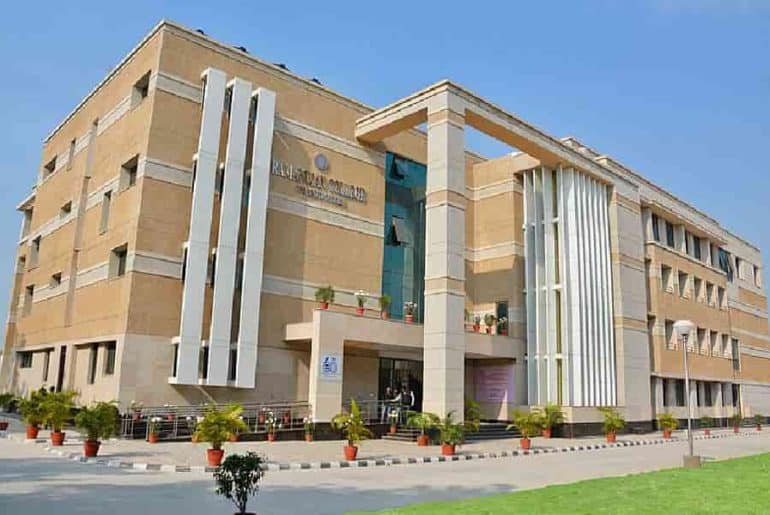
The principal of Ramanujan College, Delhi University, has been suspended following harassment allegations by a faculty member. A probe committee has submitted its report to the Vice-Chancellor, and the case will now be reviewed by the Internal Complaints Committee.

The principal of Ramanujan College, Delhi University, has been suspended after a faculty member accused him of harassment and misconduct. The complaint was filed on March 13, and the suspension was enforced on September 18 following the submission of a probe panel’s report.

University officials confirmed that a three-member committee was constituted to review the allegations. The panel’s findings have been placed before Vice-Chancellor Yogesh Singh and will now be examined further by the Internal Complaints Committee (ICC). The university has not issued an official statement on the matter so far.

The principal, meanwhile, has rejected the charges. In a letter addressed to the Prime Minister’s Office on September 13, he termed the allegations as “false, fabricated, politically motivated, and baseless.” He alleged the complaint was “a coordinated effort by the faculty member and her colleagues” to “discredit and remove” him, claiming it was filed soon after her promotion was withheld due to “incomplete documentation”.

He further stated that he has faced “immense mental, emotional, and professional distress” and sought protection against what he described as “malicious and politically driven harassment”. According to him, he was subjected to pressure to clear the promotion and was warned of being framed in a harassment case if he refused.

The principal also questioned the process, arguing that the complaint was not initially forwarded to the ICC as required under the UGC norms and the Sexual Harassment of Women at Workplace (Prevention, Prohibition and Redressal) Act. He alleged he was being compelled to resign under the threat of suspension.

“I have never indulged in any inappropriate conduct, sexual or otherwise, with any colleague or individual,” he wrote, appealing for the “dismissal of the unsubstantiated and manipulated charges.”

The ICC will now review the panel’s findings before the university announces its final decision.

Read Also: DUSU Elections Record 39.36 per cent Turnout, Up from 2024 Amidst Clashes and Controversies

Featured Image Source: The Telegraph 

Richa Choudhary

[email protected]

DUSU elections saw 39.36 per cent turnout, up from last year but below 2023 levels. Voting was peaceful yet marred by littering, clashes, traffic, and EVM tampering allegations amid tight security and 21 candidates contesting.

The voter turnout for this year’s Delhi University Student Union (DUSU) election stood at 39.36 per cent, a decent rise from last year’s turnout, which stood at 35.2 per cent, but it still does not meet the rate of 42 per cent, which was recorded in 2023. This was amidst a 3-year halt in the conduction of elections due to the COVID-19 outbreak. Polling was conducted at 52 centres with 195 booths, where 711 Electronic Voting Machines (EVMs) were deployed.

Chief Election Officer Raj Kishore Sharma said polling proceeded smoothly across most colleges.

Out of the 1.53 lakh registered voters, 60,272 students cast their votes. At Kirori Mal College, the turnout was 32 per cent.  Principal Dinesh Khattar said,

The college has successfully conducted polling, and the campus is clean… no defacement or waste lying around.

At Ramjas College, the turnout was slightly higher but still lower than the average at 37.52%. Principal Ajay Arora stated that,

Voting has been successfully held at seven booths.

Miranda House saw an active participation of over 2500 votes in the first phase. Polling in the college was conducted in two phases: from 8:30 am to 1:00 pm for day scholars and from 3:00 pm to 7:30 pm. Delhi Police deployed over 600 personnel, including 160 with body-worn cameras, while drones and CCTV surveillance covered sensitive areas.

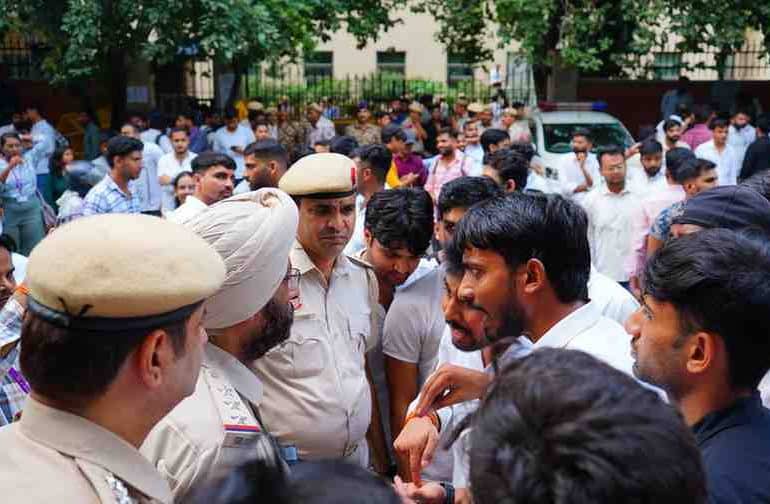
The election was conducted not without its hurdles; the area surrounding the campuses saw littering due to cards of candidates being distributed. Despite tight police control, clashes still occurred between rivals, and supporters of each faction gathered in huge numbers, resulting in road blockages and significant traffic congestion. 

The elections also witnessed controversies due to allegations of malpractice by the National Students’ Union of India (NSUI)’s presidential candidate, Joslyn Nandita Choudhary, alleging that she observed blue ink on the EVMs near the name of Akhil Bhartiya Vidyarthi Parishad (ABVP)’s presidential candidate, Aryan Maan.

Delhi ABVP State Secretary Sarthak Sharma responded by stating,

Just as the Congress blames EVMs after every electoral loss, NSUI is following the same pattern. Their desperation is evident from their fear of defeat and declining popularity among students.

This year, 21 candidates were contesting for the four main student body posts – President, Vice President, Secretary, and Joint Secretary. Of these, nine contestants were competing for the president’s seat, while the remaining were contesting for the other three positions.

Read Also: What Does the Student Body Want? 

Image Credits-: Sameer for DU Beat 

Divyanshi Dusad 

[email protected]

The Delhi High Court prohibited victory processions after the DUSU election results, citing security and order concerns.

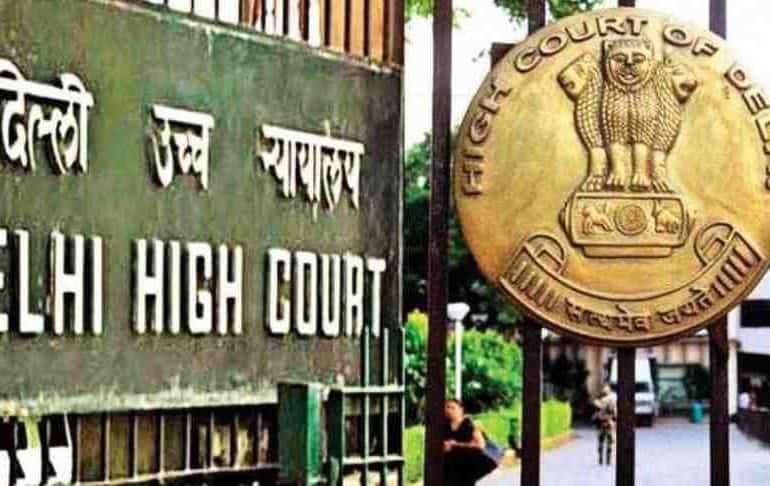
On Wednesday, 17th September, the Delhi High Court ruled that no victory processions shall be carried out in the capital by candidates or their supporters post the result declaration of Delhi University Students’ Unions (DUSU) elections on Friday, 19th September. This has come from the bench comprising Chief Justice DK Upadhyaya and Justice Tushar Rao Gedela, in response to Advocate Prashant Manchanda’s plea, concerning widespread violations of Lyngdoh Committee norms and other poll codes. The latter had submitted photographs showing alleged violations being carried out by candidates. As per Law Beat and The Indian Express, it involved large-scale campaigning using money and muscle power,  traffic breaches and damage to public property. According to The Hindustan Times, the High Court has also warned:

We’re not interfering with elections, but if the elections do not happen in a satisfactory, peaceful and orderly manner, if your reports are not positive, counting may take place, but we will stop functioning of the office bearers of the election.

The Court took notice of the fact that once the counting concludes, victory processions taken out by the winning candidates and their supporters become difficult for the police and university authorities to manage. Following this, the Court has not only prohibited these victory processions in and around the university campuses and hostels, but has also directed the Delhi Police, the university administration and the local civil administration to take all necessary measures to ensure that no untoward incidents occur during the polling process or at any time before or after it. It further instructed that no violations of regulatory norms be allowed.

According to The Hindustan Times, around 2.8 lakh students cast their votes today. More than 600 police personnel were deployed to ensure a smooth voting process, including 160 equipped with body cameras. The Supreme Court-appointed Lyngdoh Committee, which delineates mandatory rules to ensure free, fair and orderly DUSU elections, has capped the election expenditure of each candidate at Rs 5,000, and has allowed only handmade posters, that too at specified locations and in limited numbers. However, violations in the form of large convoys of luxury cars, excessive use of graffiti and banners and traffic disruptions necessitating road detours are visible. The HC ruling prohibiting celebratory marches is aimed at maintaining peace and order during elections.

Read Also: From Lecture Halls to Delhi High Court: DU’s Bribery Scandal Ends in Justice


Image Caption: Delhi HC prohibits victory processions after DUSU election results


Image Source: The Hindustan Times


Nasheta Zaidi


zaidinasheta @gmail.com


Delhi University opens UG on-the-spot mop-up round 2025, allowing admissions without CUET scores.

Delhi University (DU) has announced the commencement of an on-the-spot mop-up round for undergraduate (UG) admissions for the academic session 2025-26. Unlike previous rounds conducted under the Common Seat Allocation System (CSAS-UG) based on CUET scores, this round will admit students on the basis of their Class XII board examination marks. The decision aims to fill thousands of seats that remain vacant even after multiple rounds of CUET-based counselling.

According to the university, the registration window for the mop-up round opens at 5:00 PM on September 17 and will close at 11:59 PM on September 19, 2025. The process is open to both students who had previously registered on the CSAS-UG portal but could not secure admission, and fresh applicants who had not registered earlier. Candidates already admitted to any DU programme, however, are not eligible for this round.

For new applicants, a one-time non-refundable fee of Rs 1,000 will be charged in addition to registration fees. Students already registered on the CSAS-UG portal can apply through the “On-the-Spot Mop-Up” tab on their dashboard. DU has clarified that this round will be conducted in physical mode, requiring candidates to report in person for admission formalities once shortlisted.

The admission process will begin on September 23, 2025. Shortlisting will be carried out on the basis of Class XII marks and the availability of seats in different programmes and colleges. DU and its constituent colleges will publish the details of vacant seats on the admission portal, after which shortlisted candidates will receive invitation letters by email. These letters will specify the date, time, and venue where applicants must report physically. Representatives will not be allowed to appear on behalf of candidates.

Once allotted a seat, candidates will be required to make the admission fee payment immediately through the online portal. DU has cautioned that non-payment within the stipulated time will result in cancellation of the allotment, and the seat will be offered to another eligible candidate. Furthermore, no upgradation or withdrawal options will be available during this round.

Applicants must bring both original and self-attested copies of required documents, including Class XII mark sheets, Class X certificates for date of birth verification, a valid government ID, and reservation certificates if applicable. They must also carry a printout of their CSAS-UG application form and invitation letter. DU has advised aspirants to ensure accuracy of information while applying, as discrepancies may lead to cancellation of admission.

This mop-up round reflects DU’s effort to ensure that no UG seat remains vacant, while also providing a final opportunity to students who were unable to secure admission through CUET. The move has also prompted discussions among academics about whether the CUET-based system fully addresses the challenges of admissions in a diverse university like Delhi University.

Read Also- Delhi University Finalises Over 68,000 Undergraduate Admissions for 2025–26

Image source – Indian Express

Madhav Choudhary 

[email protected]

NIRF Rankings 2025 were delayed six weeks as EY verified the data—the first time a third-party has vetted data since the rankings began in 2015.

The NIRF rankings 2025 released by the Union Education ministry on September 4th were vetted by a private consultancy agency – marking the first time a third party agency has been used for verification, reported the New Indian Express. This is the first instance since the inception of the rankings by the Ministry of Education (formerly the Ministry of Human Resource Development) in 2015. The task was handed to EY—a private global consulting firm that provides consultancy, auditing and other services to governments and businesses. The firm has taken up various other projects for the government in the past.

Sources told New Indian Express that the decision to rope in EY for double verification of data was taken in the backdrop of an inexplicable surge in rankings by some institutions and the shocking slump registered by a few others. “It was heartening to note that the firm (EY) endorsed the rankings made by us and did not find even a single error,” stated an official with the National Institutional Ranking Framework (NIRF) team to New Indian Express. The rankings were delayed by six weeks this year due to the additional verification process.. “Post-Covid, we were releasing the rankings by July and August. It was done in June since 2015 when we commenced the ranking process. Our original plan was to release it by mid-July this year. But due to the third-party verification, we were able to release them only by the first week of September,” said an official to New Indian Express.

The increased verification process can be read as an attempt to professionalize and cross-verify the authenticity of the rankings. It is important to note that the data used by NIRF is self-submitted by the institutions through the NIRF portal. The first rankings were released in 2016, with over 3000 institutions participating. In 2017, two categories of ‘Overall’ and ‘College’ were added to the existing categories of Universities, Engineering, Management and Pharmacy. At present, fourteen different categories are ranked by the agency.

In the ‘Overall’ rankings, University of Delhi secured the 15th rank. Amongst college rankings, twenty-nine colleges affiliated with University of Delhi made it to the top hundred colleges of the NIRF ranking. DU colleges secured the top five ranks – with Hindu College at Rank 1, Miranda House at 2, Hansraj at 3, Kirori Mal at 4 and St. Stephens at 5. Other colleges included Atma Ram Sanatan Dharma College at rank7, Sri Venkateshwara at 11, Deshbandhu College at 13, Lady Shri Ram at 17 and SRCC at 18.

The parameters considered for the rankings are as follows as outlined on the NIRF official website.

1) Teaching Learning and Resources

2) Research and Professional Practice

3) Graduation Outcome

4) Outreach and Inclusivity

5)Perception

Further methodologies of ranking have been detailed for specialized colleges, open universities, etc.

Anjali Paruvu

[email protected]

Image Credits: https://highereducationplus.com/nirf-rankings-2025-what-is-new-and-changes-this-year/

Read Also: Precarity, Infrastructural Collapses, and the Façade of Prestige: What the NIRF Rankings Hide

From Lecture Halls to Delhi High Court: DU’s Bribery Scandal Ends in Justice


The Delhi HC has prohibited victory processions after the DUSU election results, citing security and order concerns.

On Wednesday, 17th September, the Delhi High Court ruled that no victory processions shall be carried out in the capital by candidates or their supporters post the result declaration of Delhi University Students’ Unions (DUSU) elections on Friday, 19th September. This has come from the bench comprising Chief Justice DK Upadhyaya and Justice Tushar Rao Gedela, in response to Advocate Prashant Manchanda’s plea, concerning widespread violations of Lyngdoh Committee norms and other poll codes. The latter had submitted photographs showing alleged violations being carried out by candidates. As per Law Beat and The Indian Express, it involved large-scale campaigning using money and muscle power,  traffic breaches and damage to public property. According to The Hindustan Times, the High Court has also warned:

We’re not interfering with elections, but if the elections do not happen in a satisfactory, peaceful and orderly manner, if your reports are not positive, counting may take place, but we will stop functioning of the office bearers of the election.

The Court took notice of the fact that once the counting concludes, victory processions taken out by the winning candidates and their supporters become difficult for the police and university authorities to manage. Following this, the Court has not only prohibited these victory processions in and around the university campuses and hostels, but has also directed the Delhi Police, the university administration and the local civil administration to take all necessary measures to ensure that no untoward incidents occur during the polling process or at any time before or after it. It further instructed that no violations of regulatory norms be allowed.

According to The Hindustan Times, around 2.8 lakh students cast their votes today. More than 600 police personnel were deployed to ensure a smooth voting process, including 160 equipped with body cameras. The Supreme Court-appointed Lyngdoh Committee, which delineates mandatory rules to ensure free, fair and orderly DUSU elections, has capped the election expenditure of each candidate at Rs 5,000, and has allowed only handmade posters, that too at specified locations and in limited numbers. However, violations in the form of large convoys of luxury cars, excessive use of graffiti and banners and traffic disruptions necessitating road detours are visible. The HC ruling prohibiting celebratory marches is aimed at maintaining peace and order during elections.

Read Also: From Lecture Halls to Delhi High Court: DU’s Bribery Scandal Ends in Justice

Image Caption: Delhi HC prohibits victory processions after DUSU election results


Image Source: The Hindustan Times


Nasheta Zaidi


zaidinasheta @gmail.com


The Delhi High Court in a ruling upheld the termination of a faculty member accused of seeking bribes at Delhi University. Amid concerns for students’ welfare and academic fairness, the decision by Delhi High Court brings relief to many.

In an order passed on September 12, Justice Jasmeet Singh rejected the plea filed by Thelma J. Talloo, a former Reader in the Commerce Department at Jesus and Mary College (JMC), who had challenged a 2012 arbitral award delivered by the Appeals Committee of the DU regarding her termination.

The proceedings date back to 2008 when allegations surfaced that Dr. Talloo solicited cash, a cellphone, diamond earrings, and a saree from students for manipulating their academic records and attendance. The accused denied the charges, blaming personal vendetta and even questioned the authenticity of audio evidence presented by the students. She added that the students used to mock her during classes and when she reprimanded them, they accused her of bribery in exchange for academic favours to defame her. Additionally, she alleged that the college’s inquiry was biased and she was denied a fair defence and proper legal representation.


In response, the college and university formed an inquiry committee, followed by an appeals committee. Both committees, after conducting disciplinary proceedings, found her guilty of misconduct. However, while upholding the charges, the appeals committee reduced the penalty from dismissal to termination so she could still receive her retirement benefits.

Dr. Talloo challenged this decision through a petition in the Delhi High Court, contending procedural unfairness and disputing the incriminating evidence. However, Justice Jasmeet Singh dismissed her plea, affirming that the demand for illegal gratification struck at the very core of academic ethics and integrity, 

In view of the matter, the proceedings were fair, the findings are supported by evidence and the penalty has already been tempered by leniency. Hence, under Section 34 of the Act, no ground for setting aside or further modification of the award is made out by the petitioner.”

The court’s decision sends a stern message emphasizing zero tolerance towards corruption in educational institutions. It is now incumbent upon educators, administrators, and society to ensure that merit and honesty define the path for future generations.


Read Also: The Beats of DU-Special Buses 

Image Source – India Legal


Arshia Sharma

[email protected] 

Congress leader Sachin Pilot campaigns at Delhi University on behalf of NSUI ahead of DUSU 2025 polls, backing Joslyn Nandita Choudhary and team as students debate for change against the ABVP dominance.


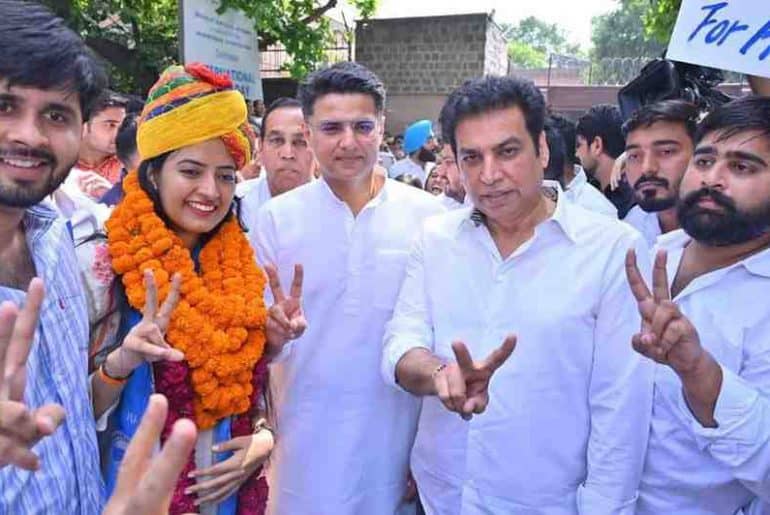
Congress General Secretary Sachin Pilot on Monday visited Delhi University’s North Campus, meeting students and expressing confidence that the National Students’ Union of India, or NSUI will sweep the upcoming Delhi University Students’ Union (DUSU) elections.

During his visit, Pilot, joined by the NSUI National President Varun Choudhary, and Delhi Congress Chief Devender Yadav, interacted with students at Miranda House, Campus Law Centre, and Hindu College. Outside Hindu College, tensions briefly flared when supporters of the NSUI and the Akhil Bharatiya Vidyarthi Parishad (ABVP) came face-to-face, shouting slogans before security personnel intervened to restore order.

Pilot said, 

Delhi University is one of the most important universities of our country. All four NSUI candidates will surely win with the support and trust of students,” 

He asserted that students were eager for change, citing the growing discontent with both the Union and State Governments. “The students believe in our ideology and vision, which will be reflected in the results,” he added.

The visit was part of a larger outreach programme by NSUI to highlight student-centric issues such as campus facilities, hostels, and academic reforms. According to an official statement, the campaign is aimed at mobilising support across colleges and presenting a credible alternative to the ABVP, which has traditionally dominated student politics at DU.

This year’s NSUI panel features Joslyn Nandita Choudhary, a 23-year-old postgraduate student of Buddhist Studies, as the Presidential candidate. Choudhary is the first woman in 17 years to contest for the top post. The panel also includes Rahul Jhansla for vice president, Kabir for secretary, and Lav Kush Badhana for joint secretary. Party leaders described the line-up as a “blend of fresh faces and representative voices.”

The DUSU polls for the 2025–26 academic session are scheduled for September 18, with counting to be held the next day. The elections are seen as a key barometer of student sentiment and often carry symbolic weight in national politics.

In last year’s elections, the NSUI staged a notable comeback after a seven-year gap, winning the President and Joint Secretary posts. The ABVP, affiliated with the Rashtriya Swayamsevak Sangh, managed to secure the vice president’s position and retained the secretary’s post. The contest this year is expected to be closely fought, with both outfits banking on strong mobilisation drives across the campus.

As the campaign heats up, Delhi University once again finds itself at the centre of high-energy student politics, with national parties keenly watching the outcome.

Read Also – Campus Promises: ABVP, NSUI, and SFI–AISA Manifestos 2025


Featured Image Source – Free Press Journal


Richa Choudhary

[email protected]


DU Beat in conversation with Sohan Yadav, contesting for the post of Vice President for Delhi University Students Union (DUSU) 2025, from the Students’ Federation of India (SFI), as a part of the AISA-SFI panel. This interview was originally taken in Hindi and has been translated into English.

S: What, according to you, is the biggest challenge that university students face, and how would you work on improving it?

S: There are three to four very common but major issues. Lack of Hostels and privacy are huge issues. Quality food is not available in most colleges, and colleges where quality food is available offer it at such a high price point that it is not affordable for many. At SFI, we believe that just like we succeeded in curbing the issue of fee hikes at Jawaharlal Nehru University (JNU), as a part of DUSU, we will do the same at Delhi University. We will provide metro passes to students, just as we have done at Hyderabad University. Additionally, we want there to be quality and affordable food at all colleges. Another huge issue is the degrading state of academics in the university. Our demands also include making the SEC and VAC papers completely additional and optional to allow students to focus on their main areas of interest.

S: . What are some key points within your election manifesto?

S: Right. So our first point is the democratisation of the Internal Complaints Committee (ICC) in all colleges, which is not the case in many colleges. The second point is the issue of hostels. Our third pointer is the issue of fee hikes. Our fifth pointer is about ensuring the functioning of a quality and affordable canteen in every college, and our sixth is the demand for concessional metro passes for students. Lastly, our seventh point is to increase student safety in and around campus spaces – we observe students being murdered and committing suicides around us, and we would like to take steps to curb this.  Another demand that is closely tied to this is the creation of quality medical facilities within colleges. In many colleges, while a medical room exists, psychiatrists, nurses, doctors and other professionals are not present in those rooms. Especially in today’s times, where so many students are suffering from mental health issues, it is necessary to ensure the presence of mental health professionals within the medical room of each college.

S: With increasing financial pressure on students, what steps would you advocate for better affordability?

S: See, there is only one solution to this. Firstly, the fee hikes that we face have already separated the oppressed classes and alienated them. When I used to study at Zakir Hussain College, every year, I used to fill the fees for at least six students by sourcing and collecting funds through my organisation. I myself have worked part-time jobs to fill the fees for two semesters after the fee hikes. So I fully understand the ripple effect of issues created after the fee hikes. So our main demand is putting a complete stop to fee hikes while simultaneously creating new policies and systems of support to help students from oppressed backgrounds who may not be able to pay their fees due to multiple reasons.

S: With increasing financial pressure on students, what steps would you advocate for better affordability?

S: Basic needs and amenities need to be targeted first. For instance, if a student is able to get affordable hostels and accommodation, costs will be reduced there; if they get concessional metro passes, travel costs will also be reduced; if they can get affordable food within their canteens, costs will also be reduced for food. So our continuous attempt after coming into DUSU will be the creation of a university where students get affordable travel, affordable food, affordable accommodation and affordable education to decrease financial burdens on students. It is our dream to create such a university space, just as we have done in JNU over the years.

S: What specific, achievable changes can you realistically deliver within your one-year term if elected, and how will you show that progress to students?

S: Right, so firstly, one of our immediate steps is to curb a very common issue, which is the lack of clean and functioning water coolers in colleges. This issue has not been settled until now, since coolers in many colleges stop working after every two months. We will also work towards maintaining quality and affordable food in every college canteen. Lastly, South Campus students have been facing this issue for a long time. The administration does not sit in the South Campus building, and as a result, they have to come to North Campus for many administrative issues. We will ensure that an administrative body also sits in the South Campus building, and lastly, we strongly believe that “keval chunaavi vaasi na chalein” (only vote-based actions should not prevail), so the special U buses should run even after the elections, and I will ensure that that happens.

Read Also: Interview with Anjali | AISA Candidate | DUSU Elections 2025

Image Credits: DU Beat

Interview by Sakshi Singh
[email protected]


DU Beat in conversation with Anjali, contesting for the post of President for Delhi University Students Union (DUSU) 2025, from the All India Students’ Association (AISA), as a part of the AISA-SFI panel. This interview was originally taken in Hindi and has been translated into English.

S: What, according to you, is the biggest challenge that university students face, and how would you work on improving it?

A: The biggest challenge is that there is a lack of trust between the students’ union and the student body as a collective. Students tend to think that student politics is limited to what they see around them, where being a part of the union is merely a launching pad for some and where hooliganism and muscle power dominate the scene. Access to quality facilities is also a huge issue—students spend more time studying VAC/SEC courses like Swach Bharat and Yoga, as opposed to their course of interest; the entire semester is taken up by multiple assessments under the IA/CA model, and with almost 45 marks being solely in the hands of the faculty, the democratic nature of the classroom is slowly eroding. Therefore, there is hooliganism on one hand and the eroding nature of education on the other, while the students suffer in the middle. 

S: What are some key points within your election manifesto?

A: Every student comes here with the aspiration of building a future for themselves, irrespective of their socio-economic background. Our first and foremost demand is access to quality education. Students come to Delhi University with the aim of studying their disciplines of choice, like History, English, Political Science, Economics etc in depth, but under NEP, in the name of “value addition” and “skill enhancement”, they are being made to study courses like The Art of Being Happy, Fit India, Yoga, etc., which are all subjects that they could have easily studied on YouTube, without coming into a “premier institution” like Delhi University. Moreover, issues like the surveillance of teachers within academic spaces and discrimination in the classroom further raise a huge question on the accessibility, affordability and quality of education in the university.

In the same Delhi University that was historically known for its diverse social fabric and witnessed students coming from a variety of backgrounds, the UGC (University Grants Commission) has been replaced by HEFA (Higher Education Financing Agency), which has led to a 20-25 per cent fee hike every semester. These hikes seem to say, “Gareeb ghar ki aulad ho? Tumhare maa-baap rickshaw chalate hai, auto chalate hai? To bhool jaao ki Delhi Vishwavidyalaya mei tumhare liye koi jagah hai.” (You belong to a poor family? Do your parents drive an auto-rickshaw? Then forget that there is any space for you in Delhi University). So, fee hikes are another issue that we are and will continue to fight against.

This is the same University where Dhani Ram, a professor from Ramjas College, harasses a first-year student, enjoys impunity, and further threatens her by saying, “Tumhare sattar number kaat lunga.” (I will cut your 70 marks). I am a graduate from Indraprastha College for Women, and 2.5 years ago, in our college’s fest, 230 written complaints were filed with the Internal Complaints Committee (ICC), despite which no action has been taken after the formation of a proctorial committee to date. We demand that all ICCs across colleges be functioning and democratic, with gender sensitisation workshops being made compulsory for the teaching faculty, non-teaching faculty, and the students.

Q. With increasing financial pressure on students, what steps would you advocate for better affordability?

Anjali: We strongly believe that the meaning of studying at Delhi University also means the ability to afford Delhi as a city, wherein the university itself is as big as a Lok Sabha constituency, consisting of North, South and Off-Campus colleges. Students from every corner of the country come to this university, but less than five per cent of students are able to get a hostel. The larger concerns about affordability and accessibility can only be addressed through the construction of more hostels.

In 2016 and 2017, the All India Students Association (AISA) launched a campaign titled “A Room of One’s Own”, showing higher authorities tracts of empty land which should have been, and can be, used for constructing hostels. In 2019, when a 39-storey building was constructed in front of the Vishwavidyala Metro Station, we protested and said, “McD, Pizza Hut ke bina zindagi chal jaayegi, Yaha hostel ka nirmaan kariye!” (We can live without McDonald’s and Pizza Hut. Make hostels here.)

A concessional metro pass is another demand. Travelling in a city like Delhi means that you have to spend around 100-120 rupees daily, and in this environment, just weeks ago, DMRC launched a notice increasing the token price in a range of Rs 1 to 4, depending on the distance. We are continuously fighting for concessional passes. We are from the student association that fought in 2017 to get concessional bus passes for students. Our model is that of resistance and continued struggle.

S: DU has a diverse student population across campuses, regions, and backgrounds. How will you ensure that voices from all corners of the university are included and represented?

A: If you look at the 2025 AISA-SFI panel and also the nature of politics that AISA represents, we have always fought for diversity and inclusion on the campus.

Even in this panel, Abhinandana hails from the northeast, Sohan worked as a security guard to pay his university fees, and Abhishek, whose parents came to Delhi in 2002, happened to fill out a form for the CRPF by chance and got a job through which he was able to get access to education. I hail from Gaya, Bihar, and in my village, most women have not studied beyond 12th. Even for my family, it is extremely difficult for them to understand why I am doing a master’s degree instead of focusing on marriage prospects. I feel that this resistance, the continued struggle for the education of all students of this university, is representative of its diversity. 

Additionally, we are from the student association that stood against communal hatred when a Northeast shop was attacked in Vijayanagara. We are from the student association that, along with 200 other students, marched into the Principal’s cabin at SBSC, after he slapped a Dalit student, demanding an end to caste-based discrimination, demanding his resignation and demanding the implementation of the SC/ST act. From Dhani Ram to the IPCW protests, AISA has been there, bearing witness to incidents of police brutality and administrative proceedings. I think our collective resistance is living proof of the fact that elections will come and go, but it is forces like us who will continue to struggle and work.

S: What specific, achievable changes can you realistically deliver within your one-year term if elected, and how will you show that progress to students?

A: Definitely, as I said before, the very burning question right now is quality, affordability and inclusivity. We will work towards the reduction of IA weightage, the restoration of quality education, democratisation and proper functioning of ICCs, the conduction of regular elections and gender sensitisation workshops for the ICCs across every college, and the provision of concessional metro passes for each and every student of the university. We will also fight for the creation of more affordable hostels and resist the arbitrary rise in rents of PGs and flats, demanding the implementation of the Rent Control Act.

Read More: Interview with Abhinandana Pratyashi | SFI Candidate | DUSU Elections 2025

Interview by Sakshi Singh

[email protected]

Image Credits: DU Beat