Author

DU Beat

Browsing

Golden Threads of Time: IIT Delhi’s Rendezvous ‘25 officially starts on 27th September 2025. This year’s fest reached the country with nationwide elimination and tons of competitions and activities on day 0 itself. 

The buzz was real at the Indian Institute of Technology Delhi on September 27th as they officially kicked off Rendezvous’25 (RDV’25), their huge annual cultural fest. With the theme ‘Golden Threads of Time’, this year’s edition is a landmark celebration, commemorating the golden jubilee of IIT Delhi’s iconic fest. Day Zero started a bit slow, but it totally caught fire later on. From serious competitions to wild fun, the whole campus was alive by evening.

The whole thing began with the grand opening ceremony, ‘Udgam’ (which means ‘The Beginning’), held in the Seminar Hall. It was a beautiful tribute to how Rendezvous started, and the stage was graced by some true legends of IIT Delhi. The event was honored by the Chief Guest, Prof. R.C. Malhotra, the retired professor known as the Founding Father of Rendezvous, alongside other incredible figures like Prof. S.C. Datta Roy, Prof. S.S. Jamuar, Prof. Prem Vrat, and a distinguished alumnus, Mr. Raghu Hari Dalmia. 

After the ceremony, the schedule filled up fast, and the entire lecture hall was vibing in the competitive spirit. The day saw plenty of brainpower in action with the formal sessions of the Model United Nations (MUN) and Debutant (Asian Parliamentary Debate) starting up. Business students tackled real-world problems in the Startup Expo Case Comps and the Mystery Business Challenge, while tech enthusiasts jumped into the intense coding battles of the Eightfold Hackathon and Aries Hackathon. If you liked trivia, there was a Crimes and Controversies Quiz and a Universal Challenge Quiz to test your knowledge. Creative and performance arts were everywhere too, with poets and speakers showing off their skills in Sam Blues (Poetry competition), Kavi Sammelan (Poet’s Meet) and JAM (Just-A-Minute), and dance groups putting on their best moves for the Western Group Dance Prelims.

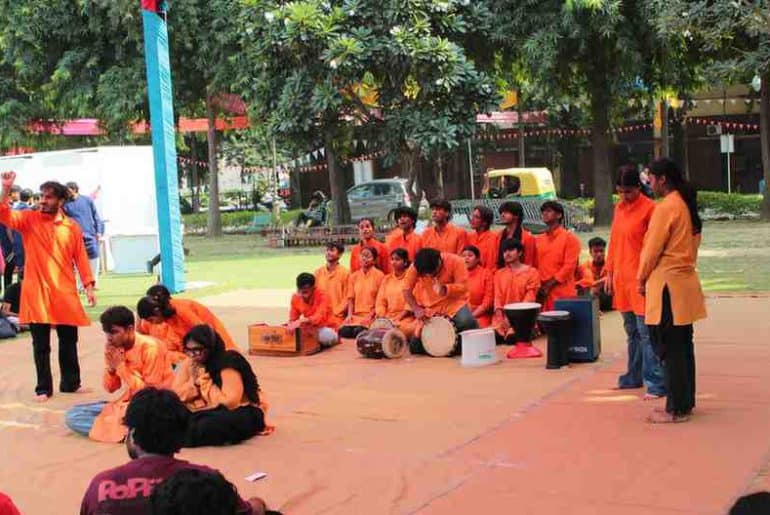
Beyond the official schedule, the campus grounds transformed into a massive carnival. The air was thick with the smells from the food stalls and pop-ups. Major brands set up interactive stalls, often featuring fun games, giving away the best freebies—branded merchandise, discount coupons. The Biotech Lawn was booming with energy all day long, hosting the stage for Mimansa (The street play competition) along with games like Laser Tag, Virtual Reality, and Adventure Games. The day’s energy peaked with two huge evening events: the colorful, traditional Dandiya Night at the SAC Lawns, and an energetic Silent Disco at the Red Square. 

Importantly, Rendezvous’25 isn’t just an IIT Delhi event anymore. They’ve launched Nationwide Eliminations so students from all over can qualify for the finals without even coming to Delhi first! With rounds held in Jaipur, Bangalore, and Pune, RDV’25 is truly sharing its golden celebration across the country. With such a strong, meaningful start, the stage is perfectly set for an epic few days.

Read More: Festember 2025: India’s Grand Cultural Celebration

Picture Caption: Stage set at Mimansa: The street play competition at IITD Rendezvous ‘25

Picture Credit: Aastha Bishnoi for DU Beat

Juhi Bansal
[email protected]

With the support of Dr.Sanjay Verma, Officer on Special Duty, Delhi School of Journalism, the department finally established a social media team that strives to keep the student population connected and informed. 


The Delhi School of Journalism (DSJ) has put together its very own social media team with the intention of keeping the whole of the university digitally interconnected. This allows information of events, activities, or even just tidbits of everyday student life at the University of Delhi to be shared to a large online crowd. 


The team is already in motion, working hard to put out content on multiple social media platforms including Instagram, YouTube and X. DSJ’s social media team will be focusing on branding the image of the department and informing the students of the University of Delhi about the emerging prominence of DSJ. Multiple forms of content, from reel-style videos and catchy captions, to different types of long-form content are expected to be put out across DSJ’s platforms. 


DSJ itself is a department that strives to create prominent names in the fields of media and journalism. This is why the platform aims to better hone the professional skills of the students in order to give them the best possible chance of excelling in their careers once they step into what is called “the real world.” 


According to Dr. Sanjay Verma, OSD at the Delhi School of Journalism, “through this platform, students should learn and refine their skills so that when they enter into the actual field, in different media organisations, they should be equipped with what is happening in the world and how to utilise their skills.” 


The establishment of the social media team is hence not only aimed at digitally stitching the outside world to the university. It is also designed to serve as a platform for students to refine their journalistic and creative abilities, because at the end of the day, that is the central objective of the Delhi School of Journalism.


Image Credits: Delhi School of Journalism 


Image Caption: The Delhi School of Journalism put together its social media team, striving for academic excellence and practical knowledge.


Souparnika Rajkumar 

[email protected] 

Room number 19, the computer lab of IPCW, has termites-infested tables with computers that can’t operate python, despite multiple complaints. IPCW second hostel list which was said to be released on 25th August, got delayed to 15th September and with a 10k concession on the fees. 


Students at Indraprastha College for Women (IPCW) are facing mounting frustration over administrative lapses, from broken, termite-infested computer lab tables and outdated desktops to indefinite delays in hostel allotments. Together, these issues have disrupted both the academic experience and the living arrangements of many students, raising concerns about campus management and student welfare.


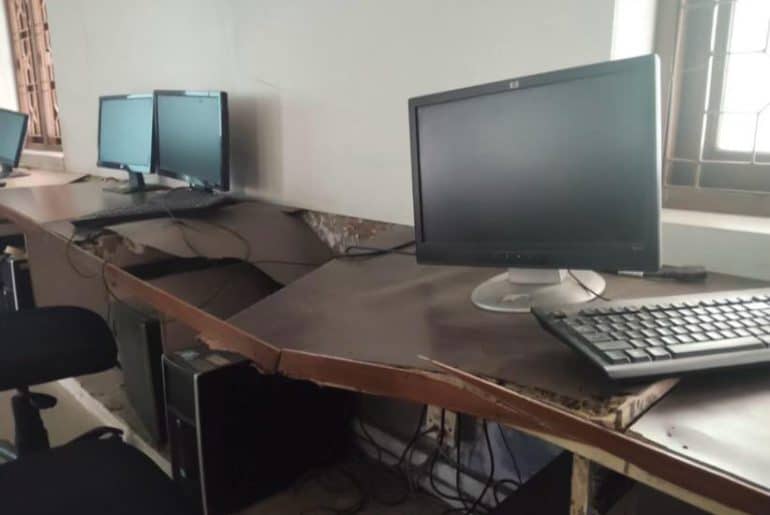
Upon entering room number 19, students were shocked to find broken tables and non-functional computers. They reported that the tables were infested with termites, with the lower halves eaten away, leaving only the veneer-covered tops intact. The computers still sit on these damaged tables. Students allege that this is not a recent issue but one that has existed for quite some time. 

“I’ve known about it since the first semester exam, which was around January this year.” One student remarked. 

Additionally, students enrolled in SEC classes for Programming Using Python revealed that Python cannot even be downloaded on some computers. Since Python only works on Windows 8 and above, many systems are incompatible. On the computers where Python can be installed, administrative locks make the process tedious. Another student said:

“Desktops are not updated, like i mean you cant even run Python on them which is in our syllabus [Programming using Python]”

Many students stated that they have reached out to the administration multiple times. Recently, students lodged complaints again, after which technicians were reportedly brought in to repair the systems. It remains to be seen whether the issue will now be resolved.

Regarding hostel admissions, the second-round list, which was supposed to be released on 25th August, had faced an indefinite delay. After a long wait, the provisional list was released only on 15th September.

The reasons for the delay remain unclear, as no official circular has been issued. Students reported receiving conflicting explanations from the administration. Those who received a hostel room have been given a ₹10,000 fee concession. However, many had already shifted to PG accommodations and paid security deposits due to the delay. One student, who wished to remain anonymous, said:

“They are giving us a 10k concession on the fees, which is 90k+ per semester but I have already paid my pg rent for both the security and advance, so the concession is of no use to me.”

The delay in the hostel list caused major difficulties for students, particularly those coming from outside Delhi, in arranging accommodation and settling in on time for classes.

Both incidents highlight a larger problem of administrative inefficiency at IPCW, with students repeatedly reporting delays in response and resolution. Whether it’s fixing computer labs crucial for coursework or releasing hostel lists on time, students argue that such oversights affect their academics, finances, and overall campus experience.


Caption: The state of infrastructure in one of the top colleges in DU. 

Credit: Anonymous


Miranda House held DUSU and MHSU manifesto readings, marked by strong anti-ABVP protests as student groups outlined agendas on hostels, fees, transparency, and campus safety.

On Monday, 15th September, Miranda House hosted the manifesto reading for the Delhi University Students’ Union (DUSU) and Miranda House Students’ Union (MHSU) elections. Held in the college’s main auditorium, the event saw representatives of ABVP, NSUI, SFI-AISA, AISF, DISHA and independent candidates present their agendas to the student body. Each panel was given ten minutes to speak to the audience.

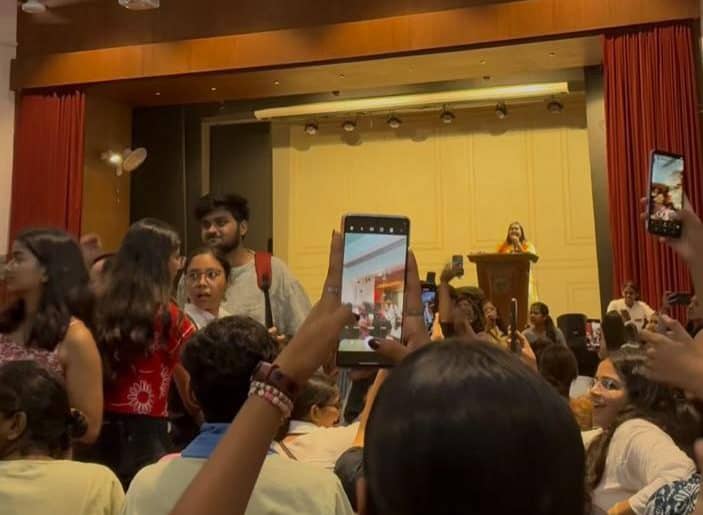
Despite a set schedule, the proceedings were repeatedly disrupted and delayed. Heavy anti-ABVP sloganeering erupted prior to ABVP’s Mitravinda Karanwal’s speech, the outgoing DUSU General Secretary (2024-25). Organisers and members of the Student Union were seen engaging in tense exchanges with those raising slogans, asking them multiple times to maintain decorum. In a particularly dramatic moment, a student stood up on her chair and raised her footwear in the air during Karanwal’s speech, sparking intense reactions. The trend of anti-ABVP sentiments during election season has repeated in Miranda House for a few years now, with the tense atmosphere on Monday being no exception. 

The auditorium remained packed to full capacity throughout the four-hour programme, with students waiting outside the door to gain entry.

In her address, Karanwal highlighted the successes of ABVP-led DUSU in mobilizing student voices. She laid focus on increasing hostel facilities, increasing financial support for fourth-years and campus accessibility. Rahul Jhansla, the Vice-Presidential candidate of NSUI, also raised issues of increasing hostel capacities and fee affordability. He brought focus to NSUI’s condemnation and on-ground inquiry into the fee hike in Shaheed Bhagat Singh College.

Anjali, the Presidential candidate from AISA and Abhinandana Pratyashi, the Secretary Candidate from SFI, spoke on behalf of the SFI-AISA panel. They spoke on the ‘atmosphere of hooliganism and violence’ created by ABVP and NSUI. They laid out their goals of securing concessional metro passes, scrapping SEC/VAC courses and revival of Internal Complaints Committees among others.

Yogesh Meena, Presidential candidate on behalf of DISHA, underscored the need for an independent student organization in DUSU politics. Ameeliya Varghese, Joint Secretary candidate of AISF-AIDSO and Divyanshu Singh Yadav, an independent candidate for the Presidential post also spoke at the proceedings. 

MHSU candidates including both independent students and those affiliated with larger political outfits brought up issues such as improving infrastructure, Wi-Fi accessibility, transparency within the college. MHSU elections are fought for the positions of President, Vice President, Secretary and Central Councillors.


Image credit: Anjali Paruvu 

caption : Mitravinda Karenwal addresses Miranda House amidst anti-ABVP sloganeering

Anjali Paruvu

[email protected] 

Following coordinated student and faculty efforts, the revised timetable previously issued by the college was rolled back. While students and faculty are relieved, larger administrative issues loom.

After a back-and-forth between the college administration, the faculty and student body of Aryabhatta College over a controversial college schedule, a new timetable has been issued, accommodating student issues and suggestions of the academic staff. 

The new timetable notably got rid of unnecessary gaps between classes, and for most courses, the grueling 8am to 5pm schedule has been removed or implemented in a more accommodating manner. This comes as a tremendous relief for students, faculty and college staff alike.


Despite promising developments, things are not settled yet. The contentious schedule which caused discontent in the first place, while never ending up being implemented, was followed by two separate revisions. The latest (and third in the month of September) was implemented to remedy certain long gaps in schedules. However, many students are still reporting problems, namely discrepancies between timetables of students and professors. 


Still, students’ burden has been greatly alleviated. While commuters’ problems persist, the working hours for most of the week are balanced, and classroom allotments have been clarified. 


This session has been rough for Aryabhatta College. Students and faculty have been dealing with a lot: from the unfinished state of the new building, the classroom and timetable issues, to recent disturbances on campus occurring during DUSU campaigning. All these instances have brought to light longstanding issues of administrative oversight, and failure to ensure campus safety and smooth functioning of the college.


Even this recent relief demonstrates these administrative problems. When the new schedule was announced, to ensure their discontent was properly communicated, students coordinated to submit a declaration signed by a large chunk of the student body to the administrative officers. The academic staff also spent a lot of time deliberating and brainstorming solutions for the scheduling problem. 


A student told DU Beat, “I’m satisfied with my timetable now. It’s good this issue has been finally sorted because this semester has been very exhausting for us. Our classes are already disturbed and everyday outsiders come and create ruckus. We’re all having a very hard time with this.”


With the timetables seemingly sorted and DUSU schedule coming to a close, the administration might be free of its most immediate issues but it remains to be seen how– and whether– longstanding issues are dealt with.


Mangalya 

[email protected]


Image Credits: Anonymous


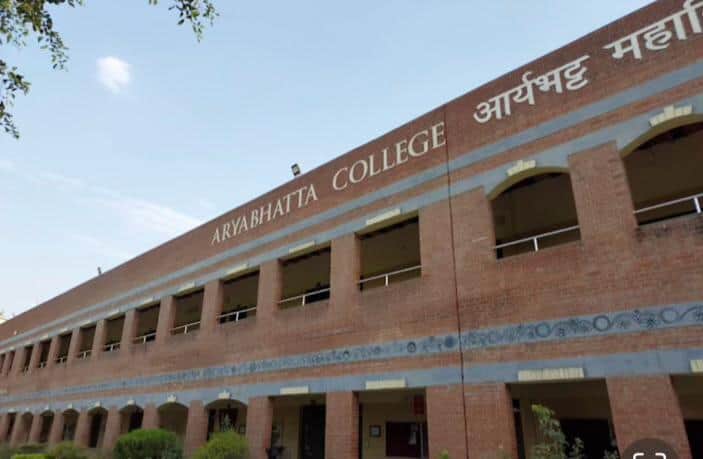
Image Caption: Aryabhatta students secure a small victory in tussles over college schedules, as administrative problems persist.

A male student from Ramanujan College is suspended for allegedly body-shaming two female students. Two first-year B.Comm students have their admissions cancelled as mutual violence escalates, and another fresher remains suspended for a year for his attack on a senior philosophy student.

Campus fights and verbal assaults are not unheard of, and unfortunately, it is not too often that colleges significantly reprimand these actions. However, Ramanujan College, on September 17th, issued a suspension order on a male student for allegedly body-shaming two female students, making derogatory remarks about their physical appearance. The issued suspension order stated that the student had performed these actions on September 16th. Being suspended for 88 days, he is prohibited from entering the college campus, let alone attending classes or participating in any college activities. 

The student’s behaviour was stated as a “serious violation” of the code of conduct of Ramanujan College, and he will remain unable to step inside college premises until December 10th. While some argue that the 88 day suspension was too harsh, others believe that it was necessary for the institution to take a firm stand in order to inculcate the virtues of discipline, empathy and basic civic sense in the student body. 

In addition to a case of verbal abuse and the issuing of a suspension order at Ramnujan College, a fight had broken out between two first-year B.Comm students. Both students involved are said to be injured. One of them was in possession of an iron rod. The college condemned the act and stated that possession of weapons of any sort is a serious threat to student safety. The admissions of both these students stand cancelled. Further, with another student from the Philosophy department being severely injured at the hands of a first-year student on September 12th, it can be expected that the college takes stricter measures to prevent any form of violence or assault on campus. The attacker has been given a year-long suspension and a fine of 10,000 rupees. 

The college administration has warned that any attempt to violate the suspension will result in stricter penalties, including expulsion. It is hoped that new reforms and stricter enforcement of rules will place student safety as a matter of great priority, making the campus a safe space to learn and thrive.

Read Also: Students of Jamia Milia Islamia University Detained during 17th Batla House Anniversary March

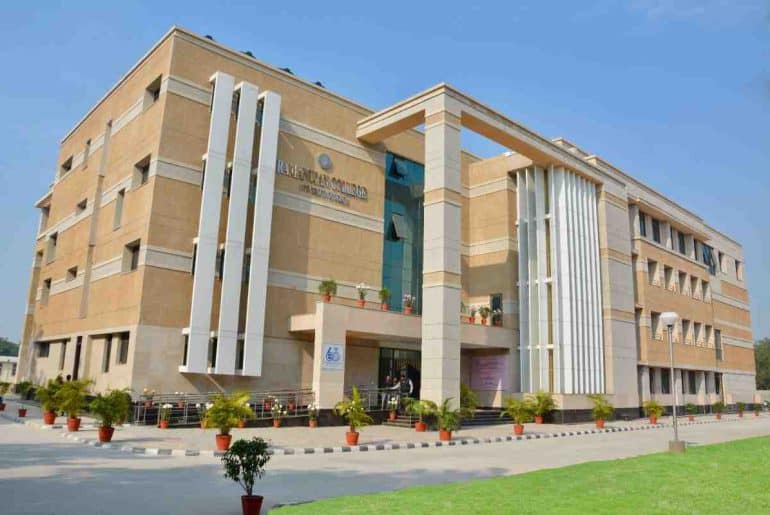
Featured Image Credits: Ramanujan College Website

Souparnika Rajkumar

[email protected]

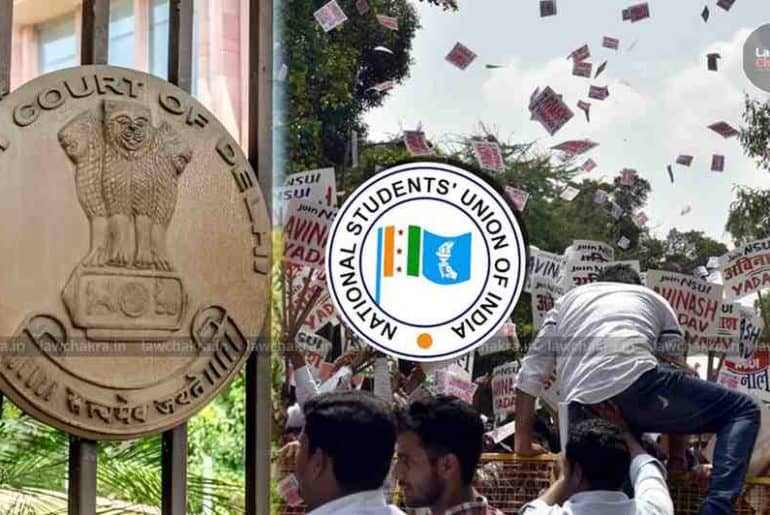
Delhi HC directs DU to preserve DUSU EVMs after NSUI alleges tampering favoring ABVP. NSUI also faces internal factional rifts, weakening its performance and sparking discontent over leadership and candidate selection.

The Delhi High Court on Monday, in a petition that was moved by Ronak Khatri, who was elected president of the Delhi University Students Union in last year’s election, and Joslyn Nandita Chaudhary, who was the presidential candidate for the National Student’s Union of India in DUSU polls this year, alleging tampering of EVMs, directed the chief election officer to preserve electronic voting machines (EVMs) and related paper trails pertaining to the Delhi University Students Union (DUSU) elections this year. The High Court also sought a response from the university.

Congress’s student wing is seeking a rescinding of the election process and a declaration that it was hampered by EVM tampering, “which was found to be marked in a manner favouring a particular candidate”. Akhil Bharatiya Vidyarthi Parishad (ABVP) candidate Aryan Maan secured the top post in the student elections held last week.

According to NSUI leaders, the EVMs had been deliberately tampered with, with blue ink markings against the name of ABVP presidential candidate Maan, “to influence voters”. It has also been submitted that the irregularities were “specifically witnessed and reported” at Hansraj College, Kirori Mal College, and the Faculty of Law, University of Delhi, and similar complaints “also emanated from several other colleges and departments across the university campus, as reported by various students”.

Despite reporting of such incidents to returning officers, teachers on election duty and other authorities, there was no effective response, according to the petitioners. Justice Mini Pushkarna directed the hearing next for December 16 after it issued notice to DU and directed the chief election officer to preserve the EVMs along with the paper trail.

The petitioners have also alleged that the election officers, university officials, and several teachers deputed on election duty were in support of ABVP based on their conduct.

The student wing is also facing friction from factions within its union. It has aggravated amidst the announcement of the results of the Delhi University Students’ Union (DUSU) polls, in which the party performed underwhelmingly and secured only one of four posts, that of vice-president, a weaker performance than last year, where they secured the posts of president and joint secretary. 

The party is divided between the supporters of NSUI national chief Varun Choudhary and, on the other, the loyalists of the All India Congress Committee’s NSUI in-charge, Kanhaiya Kumar. Those belonging to Varun’s faction accuse Kanhaiya of sabotage, alleging that his hunt for a successor to Varun a fortnight before the polls made him look weak. They also allege that Kanhaiya did not bother to campaign even for a single day before the September 18 DUSU elections.

Varun also finds himself in contention because of his decision to select candidates with roots in Rajasthan, his home state, for the posts of president and vice-president, which caused wide discontentment amongst the party and especially amongst the Haryana Lobby, who staged a protest against him in front of Congress general secretary Sachin Pilot.

Read- NSUI Garners Sachin Pilot’s Support Ahead of DUSU Polls

Image Credits– Law Chakra on X

Divyanshi Dusad

[email protected]


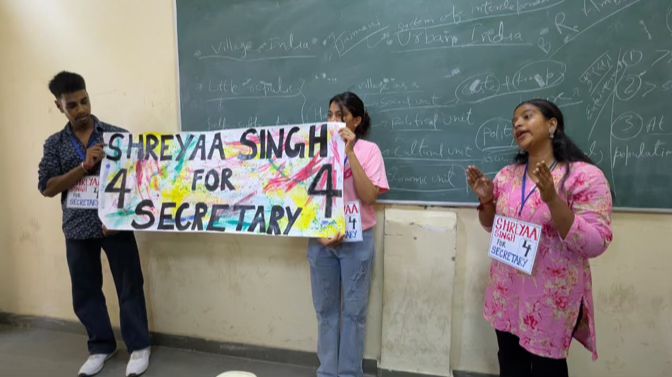
Shreya Singh, a 3rd-year student from Deshbandhu College who won the post of Secretary as an independent candidate, promises to protect students through a WhatsApp community group intended to provide a safety net. The response is mixed. 


Shreya Singh, an independent candidate from Deshbandhu College, has launched a WhatsApp community group called Raksha. A message shared with students by her describes this initiative as an effort to ensure safety and help them focus on “their growth and dreams”. The group includes 229 students for immediate reporting, either to a nearby police station or to a safe location. 


This offers a somewhat evasive promise of protection amid rising student crimes. In a campaign video, Singh acknowledged the safety risks faced by students, many of whom commute through unsafe streets. The group is new and has yet to receive a report. For many students, the initiative appears promising. Still, some remain wary: “I am unsure how this will be an exclusive space for safety. How will the admin vet people entering the group?” one said.


At the end of the day, the makers will have to weigh in the factor of protected identity to actualize the suraksha/protection through raksha. 


Image caption: A social experiment of community-bound protection. 

Credit: Anonymous 


Kinjal Sharma

[email protected]

On September 11, after former diplomat Deepak Vohra delivered a speech in Lady Shri Ram College, inculcating in his address a string of poorly-disguised misogynistic and communal jokes and jingoistic jargon, widespread furor spread both in and outside of the four walls of the college. 


As of September 15, four days after the session took place, significant developments have taken place, the first of them being a meeting of the student body that was scheduled with the Principal with assistance from the Students’ Council.


Scheduled to be in the middle of the day in a room that many students stressed was not large enough to accommodate the participants, many felt that the meeting was a futile discussion, with members of the management faulting students for popularising the issue and letting it leave the college premises. The Principal, Prof. Kanika Ahuja went out of her way to reassure students that while their anger is justified, there is little that could be done, given that the speaker had been screened beforehand to the best of their ability, and none were able to detect any fault lines. A student who attended the meeting stated that “it did not feel like a constructive discussion to me. The department responsible claimed that there were mixed reviews that emerged following the speaker session, but hate speech is not something that should be up for debate. A continuous blame game ensued between the administration and the attendees, and we were faulted for not alerting the organisers about Vohra’s many controversies on a timely basis.”

The Department of B.A. Programme released an official statement addressing the issue on the same day, stating that the organisers do not echo the statements and sentiments of the speaker and will “implement vetting mechanisms with stakeholder feedback, establish clearer guidelines for external speakers and institute additional oversight measures to ensure that all future programmes align with institutional standards and values.” The continuation to the statement, however, which requested students to “not circulate deceptive and misleading content”, invited the ire of many who believed that the department failed to address the crux of the issue, with one student claiming that she was disappointed by the clarification.


“There was no apology issued for the lapse in background check by the department union, and no accountability for platforming such vitriol, and furthermore, preventing students from leaving the auditorium in an effort to not disrespect the speaker are occurrences that did not receive even a passing mention in the statement,” a third-year student stated.

Dissent, however, has managed to find its voice both within and outside of the college campus, with a statement of condemnation authored by members of the college alumni making the rounds. With 540 signatures from former students residing both in and outside of India, and featuring names of great esteem like renowned academic and Political Scientist Nivedita Menon, it has been sent to the college administration in a bid to invite further action. 


Amidst questions being raised that address the lack of background checks and a failure to resolve similar issues on a timely basis, a student highlighted what she perceived to be a lack of accountability from the administration, stating that “the college has previously, in the last academic session, expressed hesitation in inviting academics for speaker sessions, citing the college’s ‘apolitical’ stance, but was willing to disregard this ethos for a man who has been pandering to the incumbent right-wing government for years now. A speaker session that turned into a hunting ground for minorities should not have received the thunderous applause that it had, regardless of whether or not students did not anticipate his discriminatory comments.”


In the evening, an apology by Mr Vohra himself was shared with students of the college by the Students’ Union. Dated September 15 and addressed to the Principal, it left students dissatisfied with the retired diplomat’s response, given its short length and failure to take accountability for the problematic nature and virulent aspects of the speech. One student privy to the speaker’s apology highlighted how his designation read longer than his statement, making many doubt the sincerity with which it was authored and the callousness with which it was worded, making students look like their dissatisfaction was for all but naught.


In the early hours of September 16, the official Instagram page of the Students’ Union of Lady Shri Ram released a statement of condemnation that was drafted while maintaining clear dialogue with students who suggested tweaks along the way. The statement was at the receiving end of campus-wide commendation given that it highlighted key issues with the speech, did not minimise the problems communicated by the student body, acknowledged shortcomings in terms of background checks, and, as the last few lines of the statement read, remained committed “to exercising due diligence in shaping platforms of dialogue within our college community, ensuring that they reflect the ethos of constructive debate, academic seriousness, and diverse perspectives.”


A second meeting of the student body with the Principal was scheduled to take place on September 17. It was marked by lower attendance, and the belief that no further developments are to occur in the matter.


“It seems to me that this case is not going anywhere,” a second-year student stated, adding, “There was little opposition against Vohra when it should have mattered the most, while he was in the auditorium. After his speech, there is little clarity in the student body on what exactly they wanted to get out of the protest, be it accountability from the administration, an apology from the organizers or something else entirely. The issue has died down, and people are not discussing it anymore. The college seems to have collectively moved on, but whatever remains of the college’s unanimity in standing for what is right has gone with it.”

Image Caption: Dissent finds ways to thrive on the LSR campus
Image Credits: Anonymous


Anonymous

In conversation with a Nepali student, we explore how the youth are navigating political turmoil from afar, its effects, and what the future holds for a generation looking beyond their borders.

In an age of instant global connection, news from back home is never far away. For international students, political developments in their native country continue to shape their perspective, even from thousands of miles away. We spoke with Siddhant Pant, a Nepali student pursuing International Relations at Noida International University to understand their unique viewpoint on how the ongoing political and social movements in Nepal affect the life of the students. 

Correspondent: When protests or political movements happen in Nepal, do you usually follow them closely from India?

Siddhant: Yes, I follow them closely because half my family lives there, making it essential to stay updated.


C: Have you or your friends ever taken part in any protests or student movements back in Nepal? Do you feel protests are a good way for young people to express their views, or should there be other ways?

S: Being raised in India in a Nepali family, I used to visit Nepal frequently to meet my grandmother during the summers, but I don’t recall participating in any political protests.


C: How do political strikes, protests, or shutdowns in Nepal affect students’ daily lives, like school, exams, or travel?

S: Political strikes usually result in stalling. No buses, no public transport, or sometimes otherworldly traffic. God forbid if there is a protest on exam day. You’ll probably never arrive on time.


C: Did the condition in Nepal play any role in your decision to come to India for higher studies?

S: The current situation didn’t affect me or my studies. My father is a Nepali immigrant who arrived here in the late 1990s and settled in the area. My schooling happened in Jaipur and Udaipur, and I’m currently in Noida, studying International Relations.


C: Do political decisions in Nepal (like elections or protests) affect your education or career plans in any way?

S: This is not the case for me, but for my counterparts in Nepal, it does. Many Nepalese aspire to study in foreign lands. These were countries like India for decades, but due to rising tension and political decisions, the youth are actively looking at China as an alternative.


C: Do you feel young people in Nepal get enough support and opportunities, or do you think going abroad is a better option?

S: Nepal provides limited opportunities. Many villages are being abandoned, and youth increasingly seek opportunities abroad, much like India did years ago and still does now.


C: Would you encourage more Nepali students to come study in India? Why or why not?

S: I believe that India, if it continues to adopt free market values even more, could be an excellent place to study, especially for Nepalese youth. India is almost similar to Nepal, but still so different. India can offer what I call “the true human experience”—meeting new people who live close but still speak entirely different languages, the local culinary heritage of different regions etc. This isn’t quite possible in countries like China, Japan, or Korea, the top destination for Nepalese students.


C: Is there anything else you’d like to point out or share?

S: Many believed that Nepal’s turmoil was the result of a coup orchestrated by foreign powers. But the students have shown that when the government chains liberty, arms rise against tyranny. 

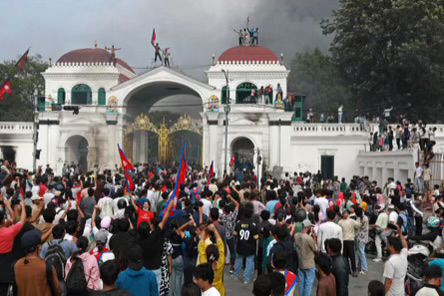
Picture Caption: GenZs started a protest in Nepal hoping for better conditions for them but what about the ones living afar?


Picture Credits: CNN

Juhi Bansal

[email protected]