Author

DU Beat

Browsing

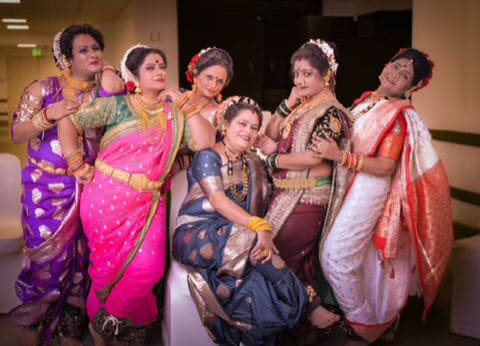
Curated by T.M. Krishna, the Kiran Nadar Museum of Art (KNMA) Music Festival, being held in Sunder Nursery from 9–12 October, brings together artists from the length and breadth of India. The theme, ‘Voices of Diversity’, carries KNMA’s spirit of making art more inclusive, accessible and a reflection of lived realities. The festival opened with ‘Lavani Ke Rang’, a dance-music-theatre production performed by traditional Bari artists directed by Bhushan Korgaonkar. 

In this interview, we speak with the Director of ‘Lavani Ke Rang’ to understand the inspiration behind the production and the legacy of Lavani.

DU Beat: What is Lavani Ke Rang and what inspired you to create this production? 

Bhushan Korgaonkar: Lavani Ke Rang is a theatre production. Now it can be categorised under dance also, music also or theatre. That’s the beauty of Lavani because it includes everything. Lavani Ke Rang is a production that is based on my book titled Sangeet Bari. I wrote this book in 2014 and it chronicles the real lives of traditional Lavani artists who come from matriarchal traditions. It also mentions various types of Lavani songs and the different ways in which Lavani used to be performed and what are the changes in the art form over the period of time. It’s all there in the book, and based on that, we have actually created more than two productions, and Lavani Ke Rang is one of the most successful productions, I would say. It’s a 90-minute production and the speciality of this, and all our productions, is that we work with these very artists. That’s the real charm because what has happened is that Lavani, as an art form, has gained some kind of popularity but not the artists—not the Khandaani artists who have lived these lives and who are living these lives. So, through our productions, we try and make them meet the audiences, the other non-traditional Lavani audiences. That’s what the production is all about. Also, when we started this production, when we started all our work, it was in the original language, that is, Marathi. But we realised that a lot of people who don’t understand Marathi are also very curious, and they used to come and attend our shows irrespective of the language barrier. In fact, because of their suggestion, we have also created these multilingual versions. So, Lavani Ke Rang narration is in Hindi. Although the Hindi has a Marathi flavour, but it’s in Hindi so that people who understand Hindi can also understand that. I also conduct lecture demonstration sessions, which are primarily in English. So, the narrative part of all our productions is either in  Hindi or English, and the Lavani songs are in Marathi. 

DU Beat: You have an award-winning book credited to your name, Sangeet Bari. So, what exactly is the Sangeet Bari style of Lavani and how does Lavani Ke Rang show that style?

Bhushan Korgaonkar: Sangeet Bari’s style of Lavani is the intimate experience of Lavani. It has a rich tradition of several years, several centuries and it is still continuing where artists from matriarchal communities dance to entertain men. That has been the traditional format. Now, there are two ways to look at it—that it’s extremely patriarchal and why should they do this? This is one way to look at it. Now the other way is to look at it from a holistic point of view where we can see the art, and then see if we can bring that art because the art is amazing. Their captivating performances are brilliant, but it’s just the linear equation that women dancing to entertain men is problematic. So, why not bring them to a platform where they can entertain everyone irrespective of their gender and preferences? So, that has been our effort. And also to add to this point, we have also introduced a transwoman—a transgender artist who also dresses up like a woman and they perform with us in this book.

DU Beat: Your book also talks about the lives of Lavani performers, their experiences and their narratives. So, how exactly does Lavani Ke Rang reflect that in its dance performances? 

Bhushan Korgaonkar: We narrate their stories, and these are all real-life stories. We talk about their systems. So, your earlier question was, What is Sangeet Bari? So, Sangeet Bari is basically a centre. These are like performance centres situated in Maharashtra, which host different groups of dancers to come and perform. Rather, these are residential places. So, the artists, around 100–150, stay in that premise throughout. These are government-regulated centres. Each group, which is known as Sangeet Party, hosts around 10 girls and 5 men who play the musical instruments—there are two of them who are like helpers and three musical accompanists. So, this is the system. Every evening, there are public stage show performances and there are also private performances. So, a single man or a group of men can go and request for a private performance. Because it’s a closed-door performance, it is looked down upon in the society. But, because of this very reason, there has also evolved a different type of Lavani, which is the Baithakichi Lavani, which is similar to Thumri—where performers sit and sing, and do adakaari and perform. Along with this style, there are other types of Lavani songs also. All these different types are demonstrated in our show Lavani ke Rang.

DU Beat: Just to get it right, is the term you mentioned “Sangeet Party”?

Bhushan Korgaonkar: Yes, “Sangeet Party”. “Party” as in the English word—like a political party. So, “Sangeet Party”.

DU Beat: There is this common perception that people have nowadays that Lavani is just flashy, fast and sensational, dance numbers on TV and in movies; And there has been a lot of criticism around the same as well. So, how does Lavani Ke Rang challenge that? And how does it show that Lavani is so much more than that? 

Bhushan Korgaonkar: Yeah, exactly. Glad you asked that question. Lavani, as I said, is gaining popularity. But the image that Lavani has or the kind of Lavani that we get to see is only this fast-paced and highly, I would say, acrobatic style of performance. Now, is it Lavani? The answer is yes. That is also Lavani. But is that the only thing Lavani is all about? The answer is no. There are so many other nuances and so many other styles. So, through our show, we show all—not all—but many of these different styles, which are very slow-paced, which use a mix of rhythm—it starts slow and then picks up, and then again, it slows down. So, we show all these different types and styles. We also show a type where a woman artist takes the character of a man, and she behaves like a man and performs. Different topics are also covered in Lavani Ke Rang. We try and show these topical, subject-based Lavanis

DU Beat: What is your vision for Lavani Ke Rang? Where do you see it going in the future?

Bhushan Korgaonkar: We have already done a couple of foreign tours, and also nationally, we have performed at many festivals. But these, as I always say, are like very token recognitions. ‘Okay, we have a festival, you come and perform’—which is great for the form, for the artists, for everyone, and for the audiences also. But there has to be sustainability. Like, how these artists who have this talent and who have familiar traditions can sustain only on these shows, and don’t have to dance at those centres where everything is reduced—in the sense—where they don’t get enough respect that they deserve as artists. So, we are also trying to find an answer to this question. But, I think the more we do these types of shows… and we have also created various modules. In fact, I am at Studio Safdar right now, and I have an AV lecture on Lavani scheduled in an hour’s time—just because I was in Delhi, had a free day and Studio Safdar was kind enough to host me here. I have done and I’ll be doing this—these types of things…As much as possible, we’ll reach out to more and more people. Through that, through word of mouth, through recommendations, we get and take leads, and then, you know, things happen. 

DU Beat: What message would you like to give the younger generation about why Lavani and other folk styles are important, and why they should be preserved today? 

Bhushan Korgaonkar: I think if they come and watch these forms, not just Lavani Ke Rang, but also any other form, they will realise…and I can share our experience with the young generation—Gen Zs and everyone—that those who come, for whatever reason, they get hooked to it. They get glued to their seats and leave their phones for at least one or two hours, and they realise the importance and significance of this form. Because the form, although it’s ancient, talks about your sexuality and your desire in a very strong and a very, I would say, desirable way—in the sense, it comes in a very organic way. And also, I will just deviate a bit, but what happens with Lavani performances when they are performed by people who don’t have any Lavani background is that they get confused, and they do too many sexy movements. I mean, they try and exaggerate the sexiness, which kind of kills the performance because it makes it look very same. So, you can enjoy one at a time, but then if you keep on watching that, you’ll get bored. So, through Lavani Ke Rang or through all our shows, we try and showcase the range. The young generation, especially when they come, realises that this ancient art form has so much of freeness or the freedom of expression, and there are so many topics which the Lavani songs cover. The way our dancers interact with the audience, they (audience) realise the importance of live theatre and our folk tradition, where the audience is not a mere spectator, but a part and parcel of the entire performance, and they have to participate. A lot of them come and meet us and share their experience that ‘thanks to you, we were away from our phones for two hours’. I think that’s the biggest compliment we can get today. 


Read Also: DU Beat in Conversation with Wild Wild Women (WWW)


Image Credits: KNMA Music Festival


Nasheta Zaidi
[email protected]

Delhi University, known for its vibrant fests and celebration of music, art, culture, and connections, has issued safety guidelines for campus events to ensure the safe and smooth conduct of college festivals during the festival season.

Delhi University, on Wednesday.  issued a new advisory for “safe, smooth and orderly conduct of events and gatherings”. As part of the new framework, two liaison officers must be appointed by the University—one for the North Campus and one for the South Campus. Every college conducting an event is required to assign its own liaison officer for proper management and crowd control. The officer must be available at all times and share essential details of the event with the local police prior to its commencement.

Additionally , every event is required to have a first aid kit, a static ambulance, and fire safety measures in place within the college, hostel, or designated venue. Events should have separate entry and exit gates for VIPs and general attendees, with contingency routes planned.

CCTVs are mandated at gates, along with trained security guards and bouncers in sufficient numbers to ensure the safety of all participants. The advisory reiterates that the sole responsibility for the conduct and management of events rests with the respective college or institution.


“Delhi Police, as part of its mandate, is tasked with maintaining overall law and order and not providing security cover to private events.”

In addition, the advisory mandates social media transparency. It requires the colleges to provide detailed online notices specifying event timings, passes, traffic arrangements, and other logistics to avoid confusion.

This notice has been released following the security breaches and gate-crashing incidents at events that happened in  Miranda House in 2022, as well as the harassment of students after walls were scaled at Indraprastha College for Women.

Delhi University officials have clarified that these measures are not intended to dampen the student experience but to create a secure, safe, and inclusive environment.

Read Also: DU VC calls Arundhati Roy’s remarks ‘hate speech’ at Law Faculty event

Featured Image source: Hindustan Times

Ananya Agarwal

[email protected]

Delhi University students and teachers condemn VC Yogesh Singh’s remarks equating Pinjra Tod with “Urban Naxalism,” after an official email shared his speech, sparking outrage over academic freedom and bias.

Several students and teachers of Delhi University (DU) on Saturday raised strong objections after the university’s computer centre, ‘Cyber Soochak’, circulated an email containing a video link to Vice-Chancellor Yogesh Singh’s recent speech, in which he allegedly likened the student-led Pinjra Tod movement to “Urban Naxalism.”

The video, titled “Naxal Mukt Bharat: Why Campuses Are the Targets?” features Prof. Singh’s address at an event held on 28 September, organised by a think tank affiliated with the Bharatiya Janata Party (BJP). The event was attended by Union Home Minister, Amit Shah.

In his speech, Prof. Singh referred to the Pinjra Tod movement—which campaigned against discriminatory hostel curfews and restrictions for women students—as a form of “Urban Naxalism.”

“They [Pinjra Tod activists] said this is a fight for freedom against parents, against the university. I was shocked. Then they say they want to take out night marches to establish their azaadi, fight against society… This is also a form of Urban Naxalism. It needs to be eradicated just as much,” he said. 

The Vice-Chancellor went on to link the movement’s founders, Devangana Kalita and Natasha Narwal—both of whom were arrested in 2020 under the Unlawful Activities (Prevention) Act (UAPA)—to the ideology he described as “Urban Naxalism.”

The circulation of the video through the university’s official email system drew immediate backlash from student groups and faculty members who questioned the purpose and appropriateness of sharing such content via official channels.

Anjali, a DU student and member of the Left-affiliated All India Students’ Association (AISA), said, “Students have been receiving emails from the university to watch the speech. It is indicative of the larger saffronisation of the university.” She added that her organisation planned to protest against the remarks.

Several teachers also condemned the Vice-Chancellor’s statements, calling them “disturbing” and “politically motivated.” Abha Dev Habib, Associate Professor at Miranda House, said,

“The V-C’s speech reflects the loss of DU’s autonomy. Some of my students were part of Pinjra Tod, a celebrated movement that challenged gender discrimination in hostels. It is even more concerning that he made these comments as the Vice-Chancellor, representing the university.”

Maya John, Assistant Professor at Jesus and Mary College and member of DU’s Academic Council, said, “It is alarming to see the dismissive attitude of the V-C towards genuine concerns raised by women hostellers. Such remarks undermine the spirit of debate and reform that universities are meant to nurture.”

Rajesh Kumar Jha, a faculty member at Rajdhani College and member of the Aam Aadmi Party’s teachers’ wing, also criticised the remarks, stating, “The university should remain a free space for debate and the exchange of diverse ideas. Freedom of expression must be safeguarded.”

As of Saturday evening, Delhi University had not issued any official response to requests for comments regarding the email or the Vice-Chancellor’s statements.

Read Also – Manufactured Choices in DUSU Elections and What Needs to Be Done Beyond the Ballot

Featured Image source – The Hindu

Richa Choudhary

[email protected]

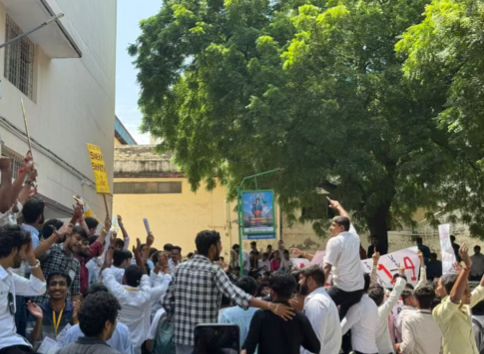
DU students led out a demonstration on Monday in response to the recent assertion made by the Vice Chancellor in his YouTube video. 

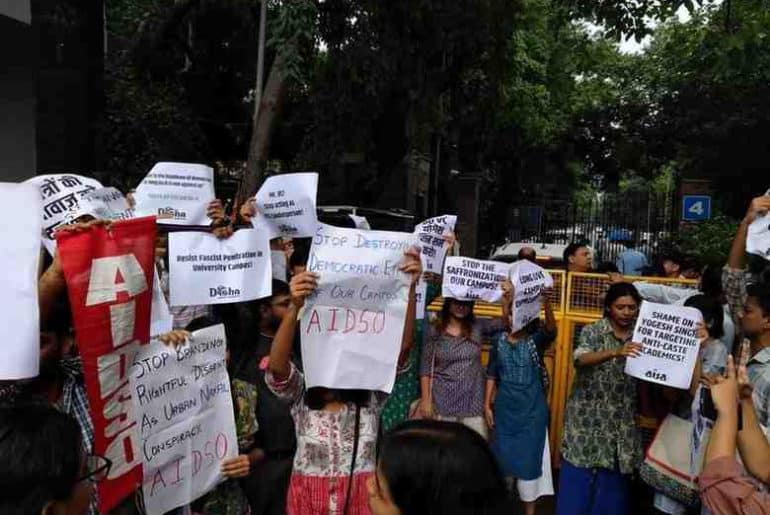
Delhi University witnessed a massive protest staged on Monday, 6th October 2025, by the students in response to the statement issued by the Vice Chancellor, Yogesh Singh. The issued remarks included labelling the student movements and activists such as Pinjra Tod and Professor Hany Babu as `Urban Naxal’. This assertion was seen to criminalise and defame the struggle for rights and freedom by the students.

The movement began from Gate No.4 along Chhatra Marg. Slogans and voices were raised in equal amounts, aiming to be heard and to claim campus democracy. The demonstration stayed united despite police deployment and the attempts of the campus guard to break up the group.

The remarks were criticised for being `anti-student’ and `anti-democratic’ by the Secretary of AISA DU, Anjali. She further added that the declaration of the student movements to be anti-national exposes the Vice Chancellor’s ideology to divide the nation and act against our interests. She also thought his remarks to be `contrary to the spirit of academic freedom’.

The students remained unified in the face of the attempts at intimidation made by the authorities and the force used by the guards. It was ensured that the protest took place as planned.

The words of the vice chancellor were seen as his venture to treat the University as his kingdom in the eyes of the students, which led this great wave of rebellion to take place by them.

The video consisting of the statement is from Yogesh Singh’s address at the event `Bharat Manthan 2025: Naxal Mukt Bharat — Ending Red Terror Under Modi’s Leadership’, released on 28th September.

Read Also: Kerala Students at DU Allege Police Brutality and Humiliation After Clash near Red Fort

Featured Image source: Instagram

Ananya Agarwal

[email protected]

Delhi University Vice Chancellor Yogesh Singh, at a Law Faculty event on hate speech, cited author Arundhati Roy’s past remarks on the Indian state as an example of divisive rhetoric, urging intellectuals to avoid such statements.

At an event on “Hate Speech and Electoral Politics in India” held at Delhi University’s Faculty of Law on 7th October, Vice Chancellor Yogesh Singh cited author Arundhati Roy’s past remarks about the Indian state as an example of hate speech. The event, organised to explore how language shapes public opinion and political narratives, became notable for Singh’s strong comments on what he viewed as harmful rhetoric from public intellectuals.

Quoting from one of Roy’s older speeches, Singh referred to her statement describing India as a “perpetually upper-caste Hindu state” that has been “at war with its own people” since Independence. In her speech, Roy had listed conflicts in Kashmir, Manipur, Nagaland, Punjab, Goa, Telangana, and other regions as evidence of this claim.

Singh remarked these statements as a pure definition of hate speech. Adding that such comments “pollute children and citizens’ minds because these statements are made from a very selective perspective.”

He further stated that public figures and intellectuals should avoid such statements since they influence young people and shape the discourse in ways that can harm national unity.

Singh said that hate speech often emerges from the public’s own biases and attitudes. “Politicians think that if they make hate speech, they will get more votes. Is it their fault or ours?” he asked the audience, noting that electoral incentives play a major role in normalising such rhetoric.

“We all should keep in mind that politicians are the smartest people in the country. They know the pulse of the people. If they realise they will not get votes by making hate speech, they will stop making such speeches.”

Read More: 32 Students Move Delhi HC Against DU’s LL.M. Practice Prohibition

Image Credits: News18

Juhi Bansal

[email protected]

“We want to talk about everything a woman goes through. We are here to make a community and make women feel heard.”  An all-women hip-hop collective from Mumbai, Wild Wild Women (WWW), are set to perform at the Kiran Nadar Museum of Art Music Fest on 9th October 2025. In a conversation with DU Beat, they talked about breaking stereotypes in a male-dominated industry. In the quest to create music that is rooted in lived experiences, community, and empowerment, WWW emerges as a voice of hope, aspirations, and revolution for women in Indian hip-hop.


The Kiran Nadar Museum of Art will inaugurate its Music Festival on October 9, 2025, a four-day celebration of India’s musical diversity, featuring ten exceptional artists from across the country. As part of this vibrant lineup, Wild Wild Women will take the stage on the opening day, and we had the opportunity to speak with the collective about their journey, music, and message before their live performance.

Question: ‘Wild Wild Women’ is definitely a name to remember. Can you tell us the story behind it, who came up with it and what inspired it?

Pratika: The name kind of resonates with us as people who love being wild and free. It didn’t come from anything specific; Krantinari and HashtagPreeti just kind of conjured it out of thin air, and it stuck. It always reminds me of the Wild Wild West in a way. And yeah, we’re from the west coast of India, so there’s that little connection too. But ‘Wild Wild Women’ just felt apt for us, not just a single ‘wild’, but ‘wild wild’ to really emphasise how free-spirited and bold we are!

Question: Hip hop has traditionally been a male-dominated field. What has the experience of breaking into the industry as an all-women collective been like? Have you encountered stereotyping, and if so, how have you navigated it?

MC Mahila: Hip-hop has always been a male-dominated industry, and it’s been that way for a long time. But this power we have as Wild Wild Women—when we come together—it just turns all those barriers into dust. We’ve seen people throw hate at us just because we started as an all-female crew. They were scared we’d flip the game… and we did flip the game. We pushed through all those outdated norms that said women can’t work together for long, that it won’t last. We’ve even had people comment on our bodies, saying we don’t fit in, that we’re ‘too big’ or whatever. But by ignoring all that negativity, we rose above it; we made more music, we stayed together, and we flipped the game. That’s exactly what our track ‘Game Flip’ is about; it’s our statement that we’re here, and we’re changing the game.

Question: Where do you see the hip hop scene in India heading? Artistically, what do you feel Wild Wild Women brings to the current scene?

#HashtagPreeti: The hip-hop scene is heading towards a really important milestone. A few years ago, or even before that, hip-hop was seen as something very male-dominated. If you thought of a rapper, you’d automatically picture a man. It was hard for people to imagine women in that space. Back then, a lot of male rappers only talked about parties, alcohol, girls, bling, and that whole luxurious lifestyle. But that’s not the full picture. Hip-hop actually comes from the grassroots—it’s about street culture, about real life. In India, hip-hop has brought attention to street artists and communities and to all the elements: skateboarding, beatboxing, graffiti, rap, and knowledge. Hip-hop is no longer just a sub-genre. It’s at the forefront now. It’s what people are listening to.

That’s where WWW comes in. We bring something that’s never been on the table before, something that was needed. We’re here to change the narrative that women can’t be rappers. But honestly, you can only really understand what WWW brings when you experience it in person. We’re not just five rappers on a stage. What we do makes people think about society, about gender, and about how they see women. I can’t put it into just a few words. You have to hear the lyrics. You have to watch the show.


Question: Wild Wild Women is often highlighted as an all-women collective with a focus on empowering women of all ages. Do you ever feel pressure to create art specifically with this purpose in mind? Does it ever feel limiting to your artistic expression?

HashtagPreeti: As Wild Wild Women, we’ve kept everything open for ourselves creatively. It’s not just about WWW; we each also work on and release our individual projects. But as a collective, we do stick to certain topics, because that’s our purpose. If no one else is going to talk about these issues, then we will. And it never feels like pressure. All our artistic expression finds its way into both our personal lives and our music.

Honestly, it takes a village to do what we do, especially in a country like India, where very few women and girls have a platform like this. We know how lucky we are to have this opportunity, and we don’t take it for granted. Also, we’re not limiting ourselves to just women empowerment as a theme. We’re experimenting and exploring a lot more; we want to talk about everything a woman goes through. We’re here to build a community, to make women feel seen and heard.

Question: What has been Wild Wild Women’s main inspiration in creating music? Are there any specific artists or voices that have been our go-tos?

JQueen: I’d say our biggest inspiration is Wild Wild Women itself. Even though we’re five female rappers, along with two breakdancers, a mural artist, and a skateboarder, all our goals are aligned; we know where we want to go, and we’re pushing to get there.

We’re not just rappers; we’re messengers of the people. Each of us is an individual artist with our own identity, but we always come together under one roof. We understand each other, we lift each other up, and we make sure everyone’s goals are supported. In the beginning, it wasn’t easy. Not everyone wanted to help us. But now, we’ve created our own space, and we’re killing it. And we always knew we would.

Right now, it’s India… But soon, it’s going to be international. Wild Wild Women is coming your way—so get ready to handle the heat!


Read Also: JNU Establishes Animal Welfare Society

Image Credits: Wild Wild Women

Anjali Paruvu and Anjali Kumari Jha

[email protected]

[email protected]

Delhi University introduces BA Education elective Adolescent Education in India (DSE 10), addressing adolescence, relationships, sexuality, and mental health with interactive learning, projects, and films.

Delhi University has launched a new elective paper, Adolescent Education in India (DSE 10), as part of its BA Education programme. The course has been designed to engage students with the complexities of adolescence, making conversations around growing up more relatable while addressing the physical, emotional, and social challenges that young people face.

The university noted that the course seeks to provide an inclusive space where difficult but essential subjects can be openly discussed. Moving beyond theoretical frameworks, it focuses on practical engagement, encouraging students to reflect critically on issues that define adolescence in India today.

One of the central components of the paper is the theme of “Growing Up and Relationships.” This module delves into the everyday experiences of adolescents, examining the challenges of forming relationships, navigating peer pressure, and confronting identity crises. It also touches upon the influence of family, school, and community in shaping the adolescent journey.

The course further opens space for dialogue on sexuality and mental health, issues that are often overlooked in conventional curricula. By addressing topics such as substance abuse, gender discrimination, mental well-being, and societal stigma, the course aims to foster empathy, awareness, and sensitivity among students. Such conversations, according to faculty, are essential in equipping future educators with the skills to engage with adolescents more meaningfully.

In addition to classroom discussions, the elective emphasizes practical learning methods. Film screenings act as catalysts for discussions on marginalization, vulnerability, and resilience. Some of the films selected for the course include Salaam Bombay by Mira Nair, which portrays the lives of street children; Smile Pinky by Megan Mylan, an Oscar-winning documentary that captures the transformative journey of a girl born with a cleft lip; The Blue Umbrella by Vishal Bhardwaj, which highlights innocence, jealousy, and belonging; and Children of Heaven by Majid Majidi, a moving depiction of sibling love and hardship. Other films such as Bhavna Talwar’s Dharm and Rahat Kazmi’s Am I Next? further enrich the discourse, introducing students to diverse perspectives on childhood, faith, gender, and justice.

Through its blend of theory, practice, and cultural representation, Adolescent Education in India (DSE 10) positions itself as more than just an elective. It is a step toward acknowledging adolescence as a critical stage in personal and social development, deserving of academic attention and empathetic exploration.


Read Also- India-Japan Talent Bridge Program organised at Delhi University

Featured image credits- Time of India 

Madhav Choudhary 

[email protected]

Campus politics often mirrors national politics in ways that feel uncomfortably familiar. The fractures inside DU echo larger democratic patterns, while the Left continues to wrestle with questions of unity, relevance, and survival in DU’s current landscape.

Every year in DUSU elections, the positions are clean-swept by ABVP and NSUI, the student wings backed by the RSS (and by extension BJP) and Congress, respectively. Each year during the elections, questions are raised about what drives the electoral politics of DU, and the answer often isn’t ideas but an intermix of caste and class, alongside a blind display of money and muscle, not just in campaigning but even in how candidates secure their tickets. From the number of SUVs to banners and posters printed, everything is taken into account. This reflects how politics and democracy in our country often seem to operate based on social and caste equations; here, ideas and ideologies frequently take a back seat.

This time we saw an overwhelming majority of ABVP wins in DUSU; the only seat won by NSUI was the Vice President’s. After Ronak Khatri’s viral Instagram reels and popularity, NSUI might have expected a better chance, so where did it go so wrong? The answer, which connects us to the bigger picture as well, may lie in the sudden exit of Umanshi Lamba from NSUI. After Khatri, she was perhaps their most popular member, but when the party refused to give her a ticket, she contested as an independent candidate. While details on why she was denied remain unclear, it can be speculated that the party’s decisions were shaped less by ideas, logic, or strategy and more by personal relationships. A parallel can be drawn with the 2024 Haryana elections, where Kumari Selja, Sirsa MP and senior Congress leader, had expressed willingness to enter state politics and sought a ticket for a family member from Uklana, her native village. Despite local enthusiasm and Selja’s overall popularity, the ticket was denied, leading to the BJP’s win in her own constituency. This pseudo-democratic model of elections, where choices are manufactured and popular candidates among voters are sidelined, often results in the kind of politics we see in DUSU today.

When ABVP sweeps votes in this way, questions are also raised about the significance of progressive politics and organisations in DU. AISA, even with a larger cadre than other leftist groups, often fails to deploy candidates with experience and real popularity on campus. First-years are frequently fielded—students who have only just joined the university are expected to gather support, build campaigns, and become the party’s public face. The AISA-SFI alliance in DUSU was finalised only in the last week before the election, leaving their campaigns entirely separate. This reinforced the perception that the Left is not a united front. AISA and SFI often distinguish themselves because of their different parent parties, and though their student members protest similar issues, the alliance falters on these divisions. The breaking of the AISA-SFI alliance in JNU and HCU has likewise allowed ABVP to bag seats in universities where progressive organisations had enjoyed majority support for decades.

That said, it would be false to say the Left’s electoral losses are solely due to weak campaigning. More than a decade of right-wing rule at the centre has fractured university structures, making it increasingly difficult for progressive organisations to sustain themselves. Right-wing ideologies are being taught and subtly embedded into daily life, to the point of becoming the default. To bridge this gap, the Left needs to focus on building strong organisations and mobilising students through education, creating space for nuanced and alternative ideologies, and calling out pseudo-democratic elections, rather than participating in a corrupt electoral system without first demanding change.

Image Caption: NSUI vs ABVP: more muscle, less manifesto. 

Image Source: SVC Student

By Gaurika Bahl

[email protected]

There has always been an ideological conflict in the Indian political environment, which has inevitably trickled down to student politics. Understanding national sentiment and its future is thus impossible without first understanding how the youth perceives it. 

The Delhi University student election season has come and gone yet again, with another set of representatives coming into office. This year, we saw an ABVP majority within the four central panel posts, namely Aryan Maan from ABVP as DUSU president, Rahul Jhansla from NSUI as vice president, and Kunal Choudhary and Deepika Jha, both from ABVP, as secretary and joint secretary respectively. While all candidates who contested for these posts expressed concern over student welfare, different approaches were taken to this endeavour by candidates affiliated with the different parties. 

ABVP reportedly consulted over 5000 students to construct its campaign manifesto, which included largely infrastructural reforms, along with pan-DU college integration, a section on gender sensitisation, (where “Pink Booths” for female police officers would be set up around girls’ colleges) subsidised health insurance for students, while also mentioning students with disabilities, metro concessions and concerns regarding ECA admissions. Since the ABVP is the student wing of the RSS and a consequent affiliate of the present ruling government, it was noticed that many of the points brought up in their manifesto actually represent a student-centric translation of the issues talked about by the present government, such as the sanitation of stray dogs, for which it faced controversy earlier in the year due to a perceived extreme stance. 


On the other hand, even though the campaign manifesto released by NSUI voiced many of these same concerns, some said that the issues raised were indicative of Rahul Gandhi’s idea of opening a “Mohabbat Ki Dukan”. While addressing infrastructural, accessibility, and inclusivity issues similar to the ABVP, the party also promised the abolition of the Higher Education Financing Agency (HEFA) and its consequent fee hikes, in addition to demanding the rolling back of the National Education Policy (NEP), 2020, on the grounds that it commercialises education. The party also released a distinct “NSUI’s Women Manifesto” under which 12 days of menstrual leave per semester would be granted, in addition to pledging a zero-tolerance policy on harassment, medical and counselling sessions, a functional Internal Complaints Committee (ICC) in every college and bhaagidari or equal representation at all levels.


While some have said that the issues targeted by ABVP and NSUI and the solutions provided by them are “practical” in nature, students have been known to widely identify with the left-aligned organisations as well.


While these organisations, also contesting in the DUSU elections, were not able to secure any of the four central positions, they had their own distinct approach of expressing student issues and campaigning. SFI and AISA had dominated Delhi University student politics for years before losing popularity in recent years, and moved on to contest DUSU polls as the SFI-AISA alliance, largely representing the left-aligned groups. Much of the alliance’s popularity remains with students who recognise the money-muscle power approach of the other mainstream parties. This year, they raised demands for affordable education and hostel facilities for all students according to UGC norms, assistance with CUET admissions, and the removal of the, what they called, “bogus” SEC and VAC courses. They have also advocated for the strict execution of the Rent Control Act, especially in university and student areas, as well as for the provision of menstrual leaves through protests and highlighting the everyday struggles of queer individuals in the university space and celebrating their resistance through a campus pride parade organised recently. They have also been known to ask for the inclusion of girls’ colleges that are not affiliated with DUSU, such as Lady Sri Ram College, Daulat Ram College, and Gargi College, in the union. 


In addition to SFI-AISA, the manifesto released by the Disha Students’ Organisation, who put forward Yogesh Meena as their presidential candidate, where they called themselves an “independent revolutionary alternative”, put across some similar points, which were aimed at fighting the “fascist agenda” and committed to “reject[ing] the politics of hooliganism and opportunism”.


While every party is ultimately advocating for issues voiced by the students, it is interesting to note how the approach towards this goal differs among them, and is ultimately both a reflection and rehearsal of national sentiments from the point of view of the youth. Not only are the DUSU elections indicative of the ideological battles fought at the national level, but are also a testing ground for party strategies, messaging, and campaign strategies utilised at a larger level.


Image Caption: DUSU candidates’ manifestos indicative of a larger ideology 

Image Source: Daily Pioneer

Manya Marwah 

[email protected]


Every year DUSU elections are greeted by much pomp and circumstance. From the beginning of the new academic year to the day of results, it is impossible to escape the crowds, the white paper slips, and the sounds of the world’s largest student body electing its representatives. However, in India’s major state universities, this exercise in democracy is nowhere to be seen.


In 2006, Lucknow University – one of the oldest state universities of Uttar Pradesh – suspended student elections citing incidents of violence, and the recommendations of the Lyngdoh Committee, which was created to ensure transparent and systematic student elections. Since then, no elections to the students’ union have taken place, despite demands and demonstrations by students. 


This is not a unique case as students of colleges and universities, both at the state and central level, report fresh cases of suspensions and delays of student union elections coming in every day.


Earlier this year in West Bengal’s Jadavpur and Presidency University campuses, student groups staged protests demanding elections to the students’ union, which have not been conducted since 2017. Similar problems of student representation persist in Tamil Nadu politics. 


Without official status as representatives, student groups still stage protests and raise student demands but the effectiveness of such efforts remains questionable. Without elected representatives, it becomes easier for Universities to dismiss even the valid and justifiable grievances and concerns of students as acts of provocation or aggression. Any dialogue between students and the administration becomes challenging. The lack of accountability has left students feeling disempowered.


In many cases, the elected student union has been replaced by an appointed or indirectly elected council, in a process  alleged to be full of biases and corrupt practices.


Not just University authorities, but state governments have not been very supportive of students’ unions. In 2023, Ashok Gehlot-led Congress government of Rajasthan was criticised for not holding student union elections in that academic session, due to concerns of ‘money and muscle power’, in a move which was protested by student groups including the Congress student wing NSUI. 


The Gujarat government has also been criticised for the ‘Gujarat Common Universities Act’, which allegedly seeks to end student politics on campus by concentrating the powers of administration of universities in the hands of the state government.


In the face of the diminishing state of student politics in India, the emphasis on DUSU elections is very significant, yet the prevalent freebie culture, funneling of resources by respective political parties and lack of productive political discourse on campus paints a distressing picture for the future of student politics.


For better or for worse, the union elections at Delhi University are more about visibility; the competition between the four major student organisations and by extension, their parent organisations. From the colourful banners, to the sloganeering, to the displays of financial and political power and influence in the form of pizza parties and Lamborghinis parked outside colleges, student elections have been reduced to a spectacle. Students today often vote along ideological lines, but in the noise of student elections, campaign manifestos and promises are buried beneath mountains of ballot slips. Voting becomes less about what candidates represent and more about simply remembering who they are.


Universities often tend to express worries over student protests being taken over by ‘outside elements’ and have cited that as a reason to dismiss student unions, but the issues of policies which are purely decorative and leaders nowhere to be seen post-elections already inundate the most prominent unions. Others are still fighting for their share of democracy.


Image Credits: Divyanshi for DU Beat


Mangalya Singh

[email protected]