
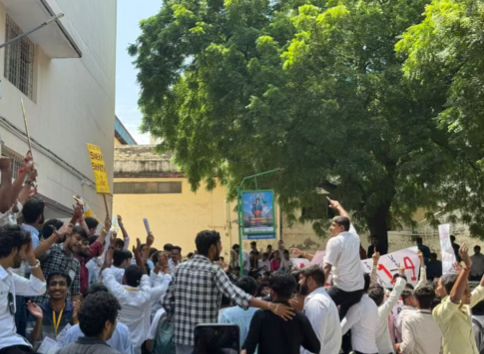
Campus politics often mirrors national politics in ways that feel uncomfortably familiar. The fractures inside DU echo larger democratic patterns, while the Left continues to wrestle with questions of unity, relevance, and survival in DU’s current landscape.
Every year in DUSU elections, the positions are clean-swept by ABVP and NSUI, the student wings backed by the RSS (and by extension BJP) and Congress, respectively. Each year during the elections, questions are raised about what drives the electoral politics of DU, and the answer often isn’t ideas but an intermix of caste and class, alongside a blind display of money and muscle, not just in campaigning but even in how candidates secure their tickets. From the number of SUVs to banners and posters printed, everything is taken into account. This reflects how politics and democracy in our country often seem to operate based on social and caste equations; here, ideas and ideologies frequently take a back seat.
This time we saw an overwhelming majority of ABVP wins in DUSU; the only seat won by NSUI was the Vice President’s. After Ronak Khatri’s viral Instagram reels and popularity, NSUI might have expected a better chance, so where did it go so wrong? The answer, which connects us to the bigger picture as well, may lie in the sudden exit of Umanshi Lamba from NSUI. After Khatri, she was perhaps their most popular member, but when the party refused to give her a ticket, she contested as an independent candidate. While details on why she was denied remain unclear, it can be speculated that the party’s decisions were shaped less by ideas, logic, or strategy and more by personal relationships. A parallel can be drawn with the 2024 Haryana elections, where Kumari Selja, Sirsa MP and senior Congress leader, had expressed willingness to enter state politics and sought a ticket for a family member from Uklana, her native village. Despite local enthusiasm and Selja’s overall popularity, the ticket was denied, leading to the BJP’s win in her own constituency. This pseudo-democratic model of elections, where choices are manufactured and popular candidates among voters are sidelined, often results in the kind of politics we see in DUSU today.
When ABVP sweeps votes in this way, questions are also raised about the significance of progressive politics and organisations in DU. AISA, even with a larger cadre than other leftist groups, often fails to deploy candidates with experience and real popularity on campus. First-years are frequently fielded—students who have only just joined the university are expected to gather support, build campaigns, and become the party’s public face. The AISA-SFI alliance in DUSU was finalised only in the last week before the election, leaving their campaigns entirely separate. This reinforced the perception that the Left is not a united front. AISA and SFI often distinguish themselves because of their different parent parties, and though their student members protest similar issues, the alliance falters on these divisions. The breaking of the AISA-SFI alliance in JNU and HCU has likewise allowed ABVP to bag seats in universities where progressive organisations had enjoyed majority support for decades.
That said, it would be false to say the Left’s electoral losses are solely due to weak campaigning. More than a decade of right-wing rule at the centre has fractured university structures, making it increasingly difficult for progressive organisations to sustain themselves. Right-wing ideologies are being taught and subtly embedded into daily life, to the point of becoming the default. To bridge this gap, the Left needs to focus on building strong organisations and mobilising students through education, creating space for nuanced and alternative ideologies, and calling out pseudo-democratic elections, rather than participating in a corrupt electoral system without first demanding change.
Image Caption: NSUI vs ABVP: more muscle, less manifesto.
Image Source: SVC Student
By Gaurika Bahl

Comments are closed.