
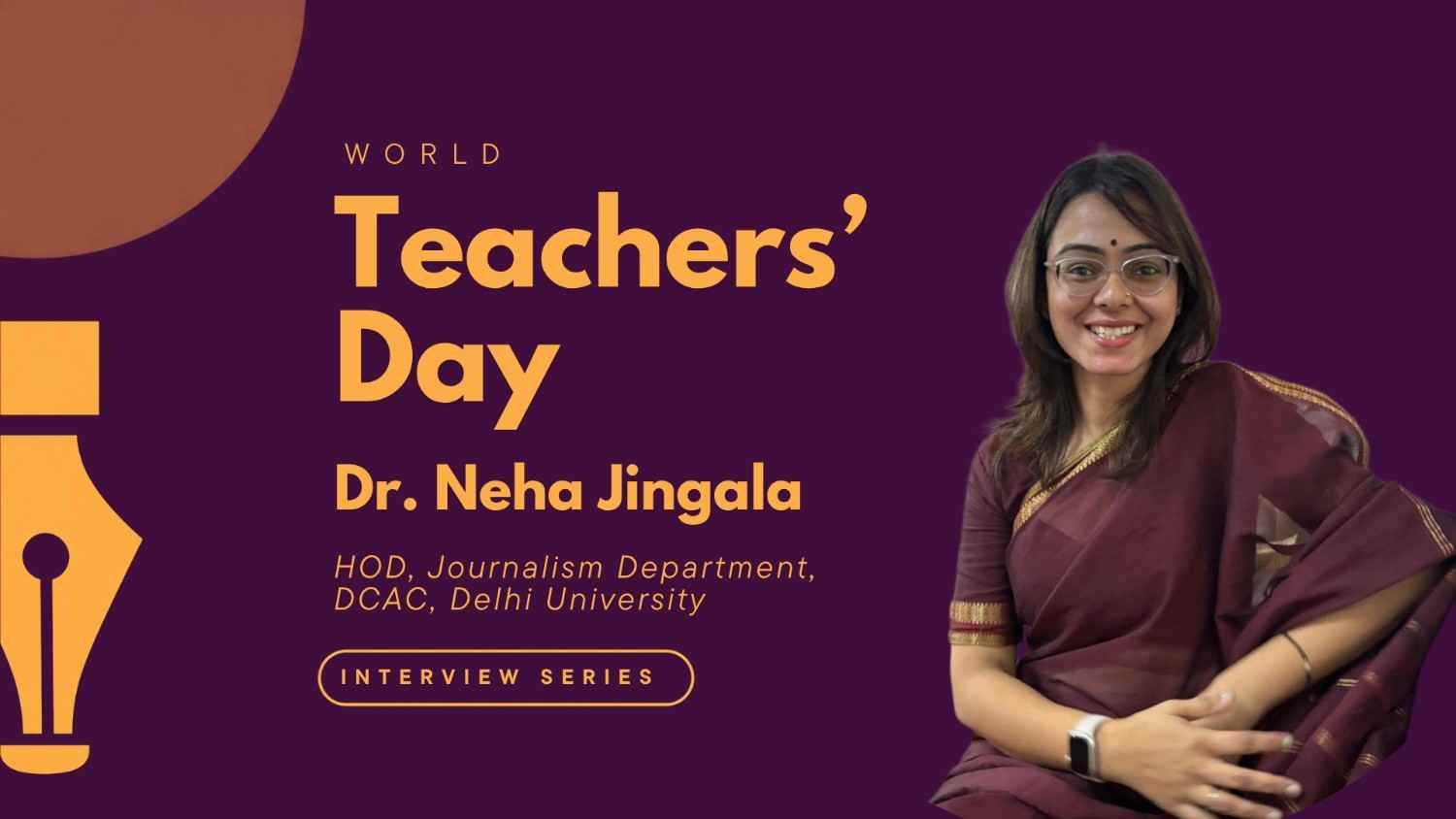
On this World Teachers’ Day, DU Beat sits down with Dr Neha Jingala, a faculty member in the Department of Journalism at the Delhi College of Arts and Commerce, University of Delhi. From navigating the corridors of DU as a student to returning to them as a teacher, she reflects on the classrooms that shaped her, the lessons she carried forward, and what it means to watch a new generation of students find their own place in the university she once called her own.
Rahul: Just to start us off here, could you take us back to the day you first walked through the gates of your college as a student? What were you feeling, and what were you hoping for?
Dr Neha: I can still recall the very first day I walked through the gates of DCAC, completely fresh out of school. I remember feeling as though my heart would fall out of my chest, while also being excited about the possibility of a new beginning. There was a sense of apprehension because everything was unfamiliar, but at the same time, there were aspirations in my eyes and a great deal of curiosity about what lay ahead.
As a journalism student, I was keen to understand everything around me. The city, the world, people, and, most importantly, how stories are found and told. I hoped college would give me the confidence, knowledge, and exposure to turn that curiosity into something meaningful and substantial.
Rahul: Do you remember the first person you met in college? And was there a person, a teacher, a friend, or even a moment that made you feel that you belonged there?
Dr Neha: I distinctly remember attending my first class at 8:30 am with Mr Sunny Thomas, a seasoned journalist who taught us Writing for the Media. His lectures went beyond the basic principles of writing. He spoke about what made a successful journalist. The curiosity, discipline, observation, sensitivity, and, above all, a sense of responsibility towards the profession and the people we report on.
Those early classes made journalism feel real to me. They helped me understand that journalism was not simply about writing well, but about being curious, asking the right questions, and understanding the world around you. In many ways, those classes gave me an early sense that I had chosen the right path.
Rahul: How was teaching on your first day?
Dr Neha: My first day of teaching felt surprisingly similar to my first day as a student. I was both apprehensive and excited. There was the natural nervousness that comes with entering a classroom from the other side for the first time.
However, as soon as I began interacting with the students, those worries gradually faded. Their curiosity, energy, and willingness to participate made me feel comfortable. Very soon, the nervousness gave way to a sense of connection and confidence. It also made me realise that, although the role had changed, the classroom could still be a space where I was learning and discovering things with my students.
Rahul: What part of DU feels the same as when you were here, even after all these years?
Dr Neha: The students are still just as wonderful. They are enthusiastic, ambitious, and inquisitive. They want to make the most of the opportunities available to them, ask questions, and explore as much as they can during their time at the university.
The excitement of college life, the friendships that are built, the conversations and chit-chat in the corridors, and the desire to do something meaningful at DU all still feel very familiar to me. In many ways, it is this youthful energy that keeps the spirit of the university unchanged, even as the institution itself continues to evolve.
Rahul: Is there any course that you learnt during your time here that you now get to teach? How has that journey been?
Dr Neha: Yes, I studied Print Journalism as a student, and today I get the opportunity to teach it as well. It has been an interesting journey because I now find myself teaching something I once learnt as a student myself.
The fundamental principles we were taught. The accuracy, clarity, verification, structure, and the importance of good reporting remain the foundation of print journalism. However, the field itself has changed tremendously over the years. Technology and digital media, particularly social media, have transformed the way news is gathered, produced, distributed, and consumed.
So, while the principles remain largely the same, teaching print journalism today is very different from what it was when I was a student. In that sense, it has been fascinating to come back to the same subject from the other side of the classroom.
Rahul: What was that one moment in your teaching career, like an epiphany, that made you realise that “yes, this is why I became a professor”?
Dr Neha: I don’t think there has been just one such moment. For me, it has been a series of small moments over the years. Every time I see a student grow, find their confidence, overcome their inhibitions, and go on to do something meaningful, I feel that I am in the right place, doing the right job.
There is a particular sense of satisfaction in watching a student grow not just academically, but also into a more confident, responsible, and thoughtful individual. Seeing that transformation makes all the effort worthwhile. Those moments, rather than one particular incident, are what continue to motivate me as a teacher.
Rahul: Has a student ever taught you something about the subject or maybe about life?
Dr Neha: Teaching is a two-way street. Yes, I enter the classroom as the teacher, but I learn from my students all the time. They bring fresh ideas, different points of view, new trends, and entirely different ways of looking at the world. Sometimes, those perspectives make me pause and rethink my own understanding or opinion.
This is particularly true of journalism because the media landscape is constantly changing. Students often have a very different understanding of how young audiences consume information, how platforms are evolving, and how new forms of storytelling are emerging.
In that sense, every classroom becomes an exchange. I may enter with something to teach, but I often leave having learnt something myself.
Rahul: There’s a common notion among professors that the batches each year are declining in quality, especially post-CUET. Do you feel the same? How do you think we, as students, can challenge that perception?
Dr Neha: I don’t think the quality of students is diminishing. Students today exhibit a high level of confidence and awareness; they bring new perspectives and experiences into the classroom. The best way for students to challenge such a perception is through their work. Stay curious, participate actively, ask questions, be proactive, and make the most of the opportunities available to you. Be willing to learn beyond the syllabus and engage seriously with the world around you.
Rahul: In all these years of having been a student of Delhi University and currently teaching here, what’s that one thing that you wish would never have changed, and one thing you’re glad has changed?
Dr Neha: One thing I hope never changes is the sense of community and the enthusiasm that students bring to university life. The friendships, conversations, debates, disagreements, and the sheer energy of being a student are what make DU special. I hope that spirit continues regardless of how much the university changes with time.
One thing I am glad has changed is the amount of exposure available to students today. Students now have access to many more opportunities, platforms, internships, experiences, and avenues of learning beyond the classroom. They can explore different interests and gain practical experience much earlier, and I think that makes a significant difference to their overall education.
Rahul: If you could sit beside your past student self for five minutes, what would you tell them?
Dr Neha: I would tell my younger self not to stress over everything and to have more confidence in myself. I spent a lot of time worrying about whether I was good enough, whether I was making the right choices, and whether things would work out the way I wanted them to.
I would tell myself to enjoy the journey a little more, take risks, learn from failures, and not be afraid of uncertainty. Not everything has to make sense immediately. There will be moments when you feel lost or unsure, but with time, many things do fall into place. I would simply tell myself to trust the process a little more.
Rahul: This World Teachers’ Day, is there anyone you’d like to thank, maybe a teacher of your own or someone who’s taught you something about life?
Dr Neha: It is difficult to mention just one teacher because I have been fortunate to come across many wonderful teachers during my school years and higher education. Each of them, in their own way, encouraged me, guided me, and helped shape the person I eventually became. They taught me not only through their subjects, but also through their faith in their students, their advice, and the goals they encouraged us to achieve for ourselves. I will always be grateful to them for that.
So, on this World Teachers’ Day, I would like to thank all the teachers who have been part of my journey and have contributed, in one way or another, to shaping the person I am today.
Dr Neha Jingala
Head of the Department, Department of Journalism
Delhi College of Arts and Commerce, University of Delhi
Interview conducted by
Rahul Kumar
[email protected]
Image Credits: Design Team, DU Beat
Read Also: DU Quietly Drops Credit Requirement for 2025-26 Batch, Teachers Ask Why


Comments are closed.