
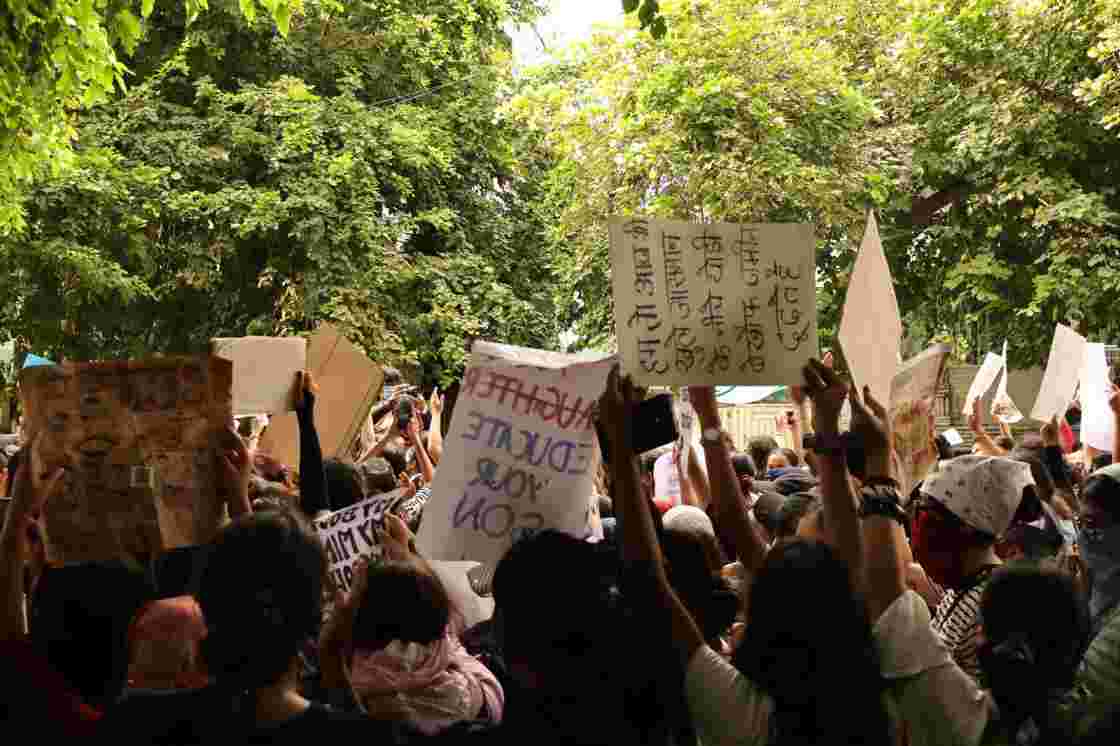
A solidarity march demanding safer public spaces for women and gender minorities was held across South Delhi on September 25, with students from Delhi University colleges taking to the streets following the gang-rape of a 17-year-old girl in Astha Kunj Park.
The march remained largely decentralised and student-led with no formal affiliation to any political party. Members of the Collective were, however, also seen participating in the protest. Coordination and communication were primarily carried out through multiple WhatsApp groups.
Students from various Delhi University colleges, along with those from institutions like AIIMS and IIT Delhi, joined the demonstration. The march began near Gargi College and proceeded towards Kamala Nehru College, with protesters raising concerns over women’s safety, inadequate infrastructure and restrictions on women’s access to public spaces. Reports from the protest noted demands for better lighting, security infrastructure and accountability around areas frequently used by students.
Hindustan Times spoke to a student and revealed how they were publicly recorded in a metro, raising questions around privacy and safety. The demonstration unfolded in multiple stages. Students first marched on the road before moving to DDA’s Arun Jaitley Park for a public meeting, where participants discussed the demands being raised by the protest. The gathering later resumed as a night march at around 7 pm, with students returning to the streets as an act of reclaiming public spaces after dark.
The protesters opposed measures that restrict women’s movement in the name of safety. A major point of contention was the reported move to restrict access to parks after sunset, which protesters argued places the responsibility for preventing sexual violence on women rather than addressing perpetrators, policing and inadequate public infrastructure. Moneycontrol reported that protesters also criticised restrictions on women’s access to parks and called for stronger institutional accountability.
The march also expanded the conversation beyond rape to everyday forms of gender-based harassment. Protesters raised concerns about stalking, inappropriate recording of women in public spaces and the lack of adequate lighting and security around college-adjacent areas.
At the public meeting, participants released the “Hum Auratein Azaad Hai Declaration”, a ten-point charter outlining their demands. The declaration calls for street lighting in roads, parks and public spaces, particularly around universities, slums and industrial areas; improved public transportation, including more DTC and shuttle buses and metro passes for women; and functional public toilets and menstrual-health facilities for women and gender minorities.
Speaking to DU Beat, another student emphasised the need to build collective solidarity beyond Delhi University, arguing that the movement should extend to central universities like IITs and AIIMs across the country. “For collective solidarity, this cannot remain limited to Delhi University. Students from central universities across the country should be brought into the movement so that the demand for women’s safety and the right to public spaces becomes a nationwide struggle.”
Beyond immediate security measures, the declaration places women’s safety within wider questions of economic and social freedom. It calls for more hostels and scholarships for women students, greater opportunities for women in STEM and professional fields, equal pay, and investment in public infrastructure such as anganwadis, creches, maternity homes, community kitchens and laundries.
The charter also addresses the treatment of women care workers, calling for recognition and dignity for workers in anganwadis, sanitation, hospitals and domestic work. It further raises concerns over the treatment of sexual violence as a matter of community “izzat” and demands greater accountability for public officials accused of sexual harassment.
Similar marches are scheduled to happen across Delhi University colleges. The protest thus connected the immediate demand for safer streets with a broader demand for women’s freedom to occupy public spaces without restrictions.
Read also: IPCW Announces Student Elections Following Earlier Refusal
Image Credits: Satakshi for DU Beat
Tarunima Tayal



Comments are closed.