Tag

students

Browsing

The UGC-approved guidelines make internships compulsory for students pursuing undergraduate courses. The guidelines come after the UGC’s previous attempt at bolstering student participation in internships and other similar activities. Read to find out more.


On Tuesday, 10th May 2022, the University Grants Commission (UGC) approved the guidelines for making research internships compulsory for students pursuing undergraduate courses. These guidelines come in accordance with the National Education Policy (NEP) 2020 which also aimed at making such internships compulsory for all graduation courses. The guidelines mention two purposes of these internships– “to enhance employability of an individual student” and “to develop research aptitude of an individual student”.


The integration of Research, Innovation and Technology Development is the foundation of Atma-Nirbhar Bharat (Self-reliant India). An institutionalisation of Research Internship at Undergraduate Levels is expected to play a pivotal role in catalysing inter-disciplinary/multi-disciplinary/transdisciplinary and translational research culture embedded in NEP 2020,” read the guidelines from UGC.


Internship Length


While this step makes internships compulsory for all students, the length of the internship would depend upon the duration of the course a student might be pursuing. Students pursuing a four-year degree course with research would have to do 10 weeks of internship along with one year of actual research work. The students pursuing a four-year undergraduate course without research will also have to do at least 8-10 weeks of internship. Even in the case of students wishing to exit their FYUP programme after the second or the fourth semester, the completion of one internship of 8-10 weeks is compulsory.


ugc internships

Source: news.careers360.com


Credit System

The completion of the internship would award the student with 10 credits upon a completion of 450 hours. This means that 1 credit implies a minimum of 45 hours of engagement in internship work and activities. Students in FYUP would have to complete an internship amounting to a minimum of 20 credits.

In addition, the UGC has also proposed to respective higher education institutions (HIEs) to offer Research Ability Enhancement Courses (REAC) worth 10 credits.

Few Research Ability Enhancement Courses (RAEC) in research and analytical tools and techniques, worth 10 credits, to be offered during the 7th semester as pre-requisite courses for 4-year degree (Research) students, …. Research work in the form of dissertation/project work preferably in interdisciplinary/multi-disciplinary/trans-disciplinary areas worth 30 credits,” read the draft.


Research Supervisors

Under research projects, students will be attached to research supervisors, preferably belonging to other HEIs, for a specified duration at the research facility of the supervisors to conduct a time-bound internship project. Students would be given hands-on training in research equipment, methodologies, techniques, etc., and would learn other aspects of research training, allowing them to gain experience.


Research internship experience can be gained by working with faculty/ scientists in education institutes, research institutions, industrial research labs, nationally reputed organisations and individual persons distinguished in specific fields,” the guidelines read. 


Application

Students would be allowed to apply for internships on their own or through faculty mentors by registering on an online portal. After registration and application, students will be selected based on the selection criteria specified under different internships. Further communication would take place with the potential intern through the portal itself or via email, with the host organisation asking for confirmation or acceptance. After that, the students can join the internship upon getting permission from the parent organisation.


Monitoring and Evaluation

Student will undergo internship in the supervisor’s lab/ working space at the host organisation. During the period of internship, the parent HEI through the mentor will arrange to keep track of the activities and performance of students as interns at the host organisation, based on periodic reports submitted by students,” the draft reads.


After completing the internship, the students will also have to submit an internship report, copies of which will be submitted to their parent organisation and the host organisation. 


Upon completion of the internship, the student would be given a certificate by the organisation.


Read also: “Ensure Reserved Category Seats Are Not Left Vacant, DU VC is Urged”

Feature image: Financial Express


Manasvi Kadian

[email protected]

DU students organised a protest at Arts Faculty, North Campus to attract Delhi University authorities’ attention towards their demand for online examinations for all semesters of DU.


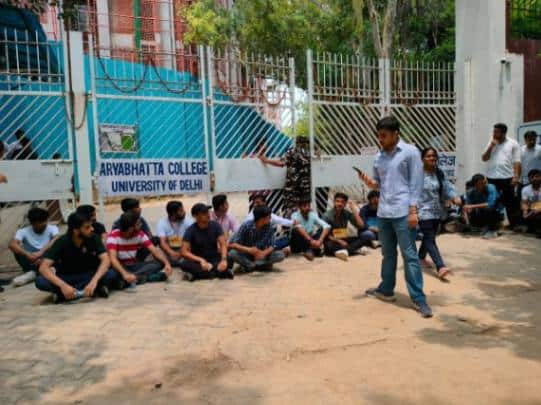
Following an earlier protest which was organised on 7th March 2022, students of Delhi University held another protest on 11th March 2022, demanding online examinations (or OBE) for all students, including those belonging to semesters other than the first semester. This protest was held at Arts Faculty, North Campus, Delhi University and students showed up in massive numbers to support this demand for OBE for the ongoing semesters.


These offline protests were accompanied by online protests which involved sharing of posters on stories and using the hashtag ‘#Hybridmodeshouldbeachoice’ and ‘#OnlineExamForAllSemestersOfDU’. This also led to the signing and filling of an online petition form which was then to be submitted to the Vice-Chancellor of Delhi University on 11th March itself.


After the massive re-opening protests in the beginning of February, these protests highlighting the problems of re-opening and offline classes have brought forward the irony and duality of being a Delhi University student. 


The student protesters believe that OBE mode of examination is the only form in which examination should be taken in such a scenario wherein almost 70-80% of the syllabus has been covered during online classes. 

For 2 years we have been giving online exams and online assignments and now suddenly the colleges have opened and (offline) internals have started… It will take time to adapt ourselves to the university environment; and we haven’t gotten that much time. Majority of our syllabus has been completed online. Only the latter 30% is being taught in offline (mode) and then you are expecting that we give offline exams so obviously that is a problem for us,” says Anubhav, a 3rd year UG student from Ramjas.


Many students have also raised concern over the fact that while all the colleges have opened, hostels have not. This means that in addition to all the other problems and issues that the students are facing, they also have to find a place to stay at a very short notice. This comes with an extreme rise in PG prices and rents, something that cannot be ignored when talking about students coming from different economic backgrounds.

I saw yesterday that the mother of a student was crying that please get my daughter a hostel, a room. They haven’t thought about where the students are going to stay. All they have said is that come and give offline exams,” continues Anubhav.


Many of the post-graduate students have also highlighted the problem of having to leave the jobs that they had taken up or the examinations they were preparing for.

We have already started pursuing our different (professional) lines and we have started the studies for the same. Now you are expecting that we switch over, so obviously it isn’t that easy. It isn’t easy to do so in a Master’s (degree),” said a student from Hansraj College.


Following these protests from Friday, a group of student protestors was called in front of the examination decision-making authority, that is, the Dean of Examinations, to discuss the issue and address the students’ demands. This was done without the presence of the Vice-Chancellor due to his absence during that time.

First of all, they said that majority of the students want to give offline exams. On that, we showed them the 7000 forms (petition forms) that had been filled after which they said that they would mediate upon this and get back to us,” said Divyanshu Singh Yadav, who has been very vocal and visible at the protests and has been constantly urging students to support the cause through the medium of videos on an Instagram page dedicated to this cause, ‘du_online_mode_2022’.

At present, no clear decision has been taken in response to these students’ protests yet.


Read also ‘CYSS Vivekananda College Demands ‘No Classes’ on Saturdays’ 

Feature Image Credits: YouTube (@Gaurav Doraha)


Manasvi Kadian

[email protected] 

Brace yourselves for a mocktickle upon the grief that has swallowed our dreams and continues to haunt us- reopening of colleges. Read ahead to know what mocktickle actually means. 


As reopening feels like a distant dream, the only thing left for us to do is feel hopeless. But for how long? This was supposed to be a phase, a time period that was supposed to end but has become an ever going dream, nightmare perhaps.

Apart from being sad and angry on a regular basis, this time and age of learning demands tons of things to be learnt but are we in any position to learn when our dreams have been made into torn papers that can never be in their original shape. Thus to lighten your hearts we present a mocktickle (yes I came up with that word, getting it registered soon, say hi to the Tharoor in me!) – an article to tickle you while mocking the situation we live in.

  • Visualise, Imagine, Dream

The perfect way to kill time until reopening is to stalk all your seniors and gaze at their fest photos. Try imagining yourself in their place and derive pleasure from this dreamy scrolling of Instagram. If you are a part of any society or aspire to be one, provoke the stalker inside you and search the entire history of your society. Watch every youtube playlist, every performance, every Facebook post that ever existed about them. (This actually gets you brownie points during auditions just don’t overspeak)

  • Learn, Learn and Do it!

Learn those skills that your parents have been shouting for at the top of their voices for two years now. Just in case if reopening actually ever happens how will you survive it? The hopelessness won’t cook your meals nor will the excitement clean your clothes. (There are actually tons of tricks that can come in handy if you are an outstation student so listen to what your parents say closely)

  • Have a Tissue for this Point!

Let’s accept how lucky are those who have already got the chance to stay in Delhi. To push yourself further towards being a Nihilist watch those photos clicked in front of red walls. Cry over those group photos of societies who are practising while leaving outstation students and understand the depth of sadness.

  • Be Social

It’s about time that you finally take out some time to get to know your classmates. The best way to do this is to scroll over the DPs in WhatsApp groups to actually know your classmates. (If you can make an effort to socialise, even a small birthday wish or a ‘good luck’ before exams can bring smiles.)

  • Thoda Dukh Thoda Productive

In spite of all the hardships we are going through owing to Covid, we can’t deny that this is one of the most crucial times of our life. Owing to the availability of time and resources one can easily manage 2-3 commitments together. If you can gather the courage to actually work in these gloomy times we salute you! And if you are the brave one who chose to prioritise their mental health over running in a rat race, then we bow to you for that is equally productive.


Read Also: An Ode to My Exhaustion: Letting Go & Letting Loose

Featured Image Credits: Grindfiti


Kashish Shivani

[email protected] 

As a semblance of normalcy begins to return to functioning around us, Delhi University performance-based societies choose to go offline with their workings – a decision that risks alienating outstation students who are still hesitant to return to campus. Read on to find more. 

Delhi University sees a diverse crowd in all terms. The play of privilege has come to the forefront in the era of the digital divide. We witnessed students committing suicide, leaving education, and going to all ends to just afford a phone or laptop for studies. In this phase, where do the cultural societies of Delhi University stand?

In the online scenario, all the performing societies were forced to operate in the online space, as a result of which we saw many online productions, audio plays, and virtual open mics. But the transition phase in DU societies has begun even before the colleges are officially reopened. A few months back a lot of performing societies started functioning offline, some with or without permission from the college authorities.

These mainly comprise drama societies, music and dance societies which need offline spaces to carry on with their operations smoothly. But since DU is not a university of Delhi students only, the question that ‘Do DU societies belong only to Delhi people?’ seems pretty valid in a scenario where outstation students are being repeatedly sidelined by the indiscriminate move to go offline with functioning.

Just a few days back Mood Indigo, the fest of IIT Bombay, organized the prelims for its street theatre competition, where some of the prominent societies performed with their productions like Ibitida, Hindu College, Hansraj Dram Soc, Kahkasha JMC, Lakshya, Kamla Nehru College, Anubhuti, Sri Venkateswara College, and many others. DU Beat talked to Simran from Hansraj Dram Soc to understand their take on conducting offline practices and workshops in collaboration with other societies.

We first years came into the society to perform and sadly it was not happening. Offline practices were essential for us to learn how DCTC worked as we will soon become seniors and the onus of training others will be on us.”

An outstation member of Kshitij, the street play society of Gargi College which organised an offline workshop in collaboration with Hansraj Dram Soc, on grounds of anonymity, shared their views with DU Beat,

If we talk about outstation students, someone who has never seen their college, for them, online meets are everything, that screen becomes more than just a screen. Offline meets are not fair to them, and they cannot be expected to travel long distances to attend, it is just not fair. They are missing out on experiences and lessons because of the circumstances. In the end, it comes down to whose perspective you choose to see – that of the helpless first year or the third year who will choose the offline mode due to the sheer rigour and space it allows one to work in.” 

The culture of performing societies is surely a source of pride for the University of Delhi but another thing that the nukkad nataks propagate is the call for equality. In such a situation, when being in Delhi means being able to experience the societies, aren’t these societies becoming elite spaces? Various outstation students, who can afford to be in the city for internships or societies have moved here already, so who is actually being left behind? For these answers, we talked to Jai Mahajan from Shunya, Ramjas who shared his society experience.

Being in an online space has affected theatre but we are trying our best to level the playfield. Shunya is trying to come up with a fusion of both online and offline work. Surely people in the offline mode are learning and adapting quickly, but it’s up to seniors how they balance the collaboration.” – Jai, a member of Shunya, Ramjas

In the month of November, Shunya conducted its first series of month-long offline workshops. Students across departments and years from the college attended the workshops, which were conducted by incumbent and erstwhile members of the society on a wide range of topics relating to theatre. But the attendees also included a large number of outstation students who flew down to the city specifically to attend these workshops. Although safety precautions were adequately taken for the same, the decision to conduct these workshops in the offline mode, which many society members too could not attend, still remains under question.

As the auditions of performing societies were conducted in the online mode in the time of the digital divide, it already pushed out students from backward sections of societies. Several talented students could not audition due to unstable internet, and some had to travel elsewhere just for the sake of giving their auditions. And after that exclusion, the dispersion of outstation and Delhi students brings forth the question of representation. Performances talking about the evils of caste and class while propagating on those same foundations are making a farce of the art form.

We can’t lose out on practice just because the colleges are online now. To get on the stage and win awards and experience that feeling of dancing in front of people cheering for you hoping that you win. To learn things online is really difficult, offline practice is of the utmost necessity if you want to bring the best out of your crew. There is no formal permission as such but socs have never totally depended on college to practice even when it was offline.” – A member of a dance society

DU performing societies have been known for their rigorous working, but the entire working process changed owing to the prevailing conditions. Talking about how his society operates, Tushar, a member of The Dramatics Society of Dyal Singh Evening College, Junoon said,

Most of the members of our society are from Delhi, offline meets are recorded, and activities are discussed in the online meets. The same activities are done in the online mode with some tweaks to make them feasible.”

Meanwhile, Jai from Shunya, Ramjas shared how audio plays helped them bridge the gap to some extent.

Some of our members are from Kashmir and places where there is low connectivity; for them, we practiced and explored auditory drama on phone calls.”

Shruti, the President of Lakshya, KNC, shared her society experience of working in the online mode. For better functioning, they divided the team into two where outstation members worked on the stage production, working with characters, while the Delhi students worked on street play.

At least some of the students would learn and know something; this year we are focusing more on learning and teaching.”

There are also various societies that chose not to function in the offline space. Siddhi from LSR Dramsoc shared her take on the issue,

Even though the offline experience was beautiful, we chose not to practice in offline mode since we have people from other cities as well in our society. We need to adapt to the times, and to pass on the culture, we talk about our past experiences and activities, so our juniors know about the working. DCTC as a group needs to think and engage in dialogue to come to a better and more feasible conclusion.”

While sharing her experience of being an outstation student, a member of a drama society said in a conversation with DU Beat,

It doesn’t feel like a team anymore; the production doesn’t feel ours. If offline working brings back the culture of theatre it also breaks the team apart in two. It’s a sort of slow coercion over outstation students to leave since we don’t play any active part. We feel like outsiders instead of outstation students, where we realize being in Delhi is a privilege that we can’t afford.” 

Despite the brouhaha surrounding the debate around offline and online functioning, there are societies that have accepted the online mode and have gone ahead with annua productions; for example, the Shakespeare Society of St. Stephens College performed their annual production for the year Chateau Manor House on Zoom a few weeks back. The reluctance of many societies to adapt to the same mode is, on one hand preserving the physical essence of these performance societies. At the same time, it risks non-functioning and becomes largely emblematic of the larger hegemony present in these societies to refuse to adapt to changing times and tweak and challenge procedural functionings that have been set in stone for years now.

Image Credits: Sabha, the dramatics society of St. Stephens College 

Read Also: The Rise of OTT: Destruction of The Theatre Culture?
Remembering Safdar Hashmi: Inquilab and Theatre

Kashish Shivani ([email protected]

Anwesh Banerjee ([email protected]

With the rosy season of auditions going on, this is an introduction for freshers to the dark side of DU Societies.  

As the audition season approaches, one could have seen the college areas buzzing with auditions. On the online campus, it’s a bit different; the society’s social media pages, which have been abandoned for long, now become the main agenda of society meetings. All of a sudden, reels are being posted, and you see clips of happy members of societies playing along, some on screens while some on the ground, and a Ritviz song playing in the background. The usual words that will be used in these videos are “family”, “creative community” and every adjective you can imagine for a bunch of happy undergrads. But are societies really this happy, or is it just the poster happiness to lure in freshers?

(Obviously, not all societies fall into this category, the main aim is to introduce freshers to the toxic side of DU societies.) A lot of societies are run by seniors who exercise control over all the functioning. At some colleges, administration or the teacher or convenor intervene, but at some, they don’t pay any heed. Some societies have also faced such extreme obstruction of administration that even their performances have been canceled, whereas the bullying by many societies goes unchecked due to no surveillance. (Societies should ideally lie between this tussle of control, where admin maintains minimum control but a required check, but hey, we are in DU!)

A hierarchy is maintained among all the members to maintain ‘discipline’. But this setup often leads to toxicity as seniors in positions of responsibility take undue advantage of their power. The societies that should act as communities housing creative talent become a powerhouse of trashy politics and toxicity, where bullying and ragging houses.

Recently, such a situation came to light during the auditions of Finance Investment Cell of Hansraj College, about which a first-year student said,

During our Finance Investment Cell interviews, the core team members made us dance against our will, I felt uncomfortable but since I wanted to get into the soc, I had to go with the flow. Later on, they were boasting about the fact that they made us do squats, dance, and sing in the interviews during our induction meeting.” 

First Years who are already ridden with anxiety get pushed underneath the wish of being in the cool circles of college and fail to report such behaviors, and the cycle of toxicity continues. Another student from a dance society shared their experience in a conversation with DU Beat.

This certain level of hierarchy restricts our freedom as an artist and as a person. The role of unions should be to represent the members of the society and to guide us, but it feels like someone has given them authority and they just want to show it off.”

Even in the online mode, several students have suffered terrible things at the hands of societies. With the second batch moving into the online campus, we need to configure our thinking accordingly. If the cultural front of the university keeps on reeking privilege and toxicity, the development of the individual would be a far-gone concept here. It’s high time proper redressal forums (talking about Cultural Secretaries) work in every college to respond to all grievances and dismantle these toxic hierarchies.

[email protected]

Kashish Shivani

Following the recent events, we tried to locate what language our nation speaks—of hate or of Mir?

“I knew that language is the most private and yet most public things.” – Arundhati Roy, In What Language Does Rain Fall Over Tormented Cities?

What language do we speak altogether, collectively as a nation? 780, or the ones actually recognised? Of love or of hate? Do we even speak together, ever?

I learned in my history class about imagined communities. Are we just one true imagination that exists with all its hypocrisies with just one name that binds us together? The peculiar curiosity about your identity starts somewhere around our age only, I think India never got out of that phase, she is still trudging the path of curiosity to know all about it.

Being trilingual, I get how difficult it can be to brainstorm with three words meaning something somewhat similar but never the exact same. How does India manage with so many? We read about diversity since first grade. In the language, I read it, “Anekta mei ekta.” At times, I think her diversity could never get out of this essay. It tried and tried, but it was such a high pedestal that returning was never an option, but we found out her invisibility on the streets at times, for we all read or maybe heard it – India: A Land of Diversities.

But whose language does India actually speak? Of Ghalib or of those who went rallying against Fab India when it named its Diwali Collection Jashn-e-Riwaaz, which loosely translates into a celebration of tradition.

The social media went mad with hails of ‘NO Abrahaminsation of Hindu Festivals’. And amidst this, a Markazi Khayal came to me that what word could we substitute for Khyal in Kabhi Kabhi mere dil mei Khayal aata hai? Or maybe what would we substitute when the people actually discover that the words Hindi, Hindu and Hindostan are from Persian Arabic? Did I miss a class of Language partition when the words of Urdu casually entered the conversations and even a bit of Shudh Hindi found its place with slang from the local dialect?

The Partition happened when, during the British era, the Hindustani language broke up into Hindi and Urdu, and since then, the graph has been up and down with the ‘language’ that we decide to speak publicly, sometimes of hate and sometimes of mir.

According to a research paper about the decline of Urdu sounds,

First, the decline of Urdu sounds began in the 1990s, which marks the rise of the Hindutva politics and the beginning of the mushrooming of cable television networks.”

So, this is the language I have been referring to the language that the current hegemony chooses to speak.

A good thing about Grammarly is that you can set the tone of language that you want to deliver your content in, and it rectifies the words accordingly. What would the tone be when people don’t let Munawwar Faruqui perform in Goa for 500 people would set themselves on fire. The organisers received threats from several Hindutva groups, and shows in Raipur, Surat, Ahmedabad, Vadodara and Mumbai had to be cancelled. Munawwar was also arrested for a joke he did not tell, and the apex court that granted him release said the tone of the FIR was vague and no apparent reason for his arrest.

Clearly, the cancel culture in our country goes a different way, where the dominant group shuns the language that it does not want to hear, be it just the name of the collection, an advertisement that talks of love bonds, or anything that might prick the forces of Hindutva. Who will be the next Kaifi saheb, perhaps Ghalib or the true sense of diversity that we talked about on pages?

Although Hindi’s victory has been a resounding one, it does not seem to have entirely allayed its keepers’ anxieties. Perhaps that’s because their enemies are dead poets who have a habit of refusing to really die.” – Arundhati Roy, In What Language Does Rain Fall Over Tormented Cities? 

There is a linguistic relativity hypothesis that says our language shapes our thought, and Arundhati writes in her essay that a country’s public language is its own public imagination. So, the next time you say ‘ye Ishq nahīñ āsāñ itnā hī samajh liije ik aag kā dariyā hai aur Duub ke jaanā hai’ know that in the current context it literally applies to the word Ishq for someday people might take offence for its existence because of its source.

All this is to say that we in India live and work (and write) in a complicated land, in which nothing is or ever will be settled. Especially not the question of language. Languages.” – Arundhati Roy, In What Language Does Rain Fall Over Tormented Cities? 

Kashish Shivani

[email protected] 

The Students’ Federation of India (SFI) released a statement about the need for financial support for students facing problems during the COVID-19 pandemic and released a set of demands regarding the same.

In a statement dated for 17th April 2020, SFI released a press comment regarding the triangular problems being faced by students during the Coronavirus lockdown and urged the government to provide financial support for the same.

The SFI condemned the BJP-led government’s abrupt announcement of the lockdown without any prior notification for the students to prepare for the situation. They commented that though necessary, the statement for a lockdown came upon every citizen “like a bomb”, and though the lockdown is set for 3rd May, it is likely to extend further.

“The wage labourers and unorganised sector workers who live from hand to mouth are the ones who are facing the worst repercussions of the lockdown. But the brunt of the lockdown is felt by all sections of the population, and by all industries. While a huge portion of the Indian population is facing dire livelihood issues, with the unemployment rate touching a 1/4th of the population, it is futile to expect families to support their children in schools, colleges and universities. many families can’t afford it. If this is left unchecked, it could lead to a great increase in drop-out rates.

Many students are stranded in universities and college in various cities across the country in hostels. They are stranded not only because we were all told to remain where we were and not travel, but also because the lockdown announcement gave no time for students (or anyone) to make preparatory decisions. The government had demanded the students to remain as they are, thereby we demand the government to provide financial assistance to these students. Moreover, students are from disparate economic backgrounds and given the present economic condition, to expect their families to financially support these students is irresponsible”, as stated by SFI’s Delhi State Committee.

SFI has, as a result, released a set of demands for the government to help the students being affected by this pandemic. These include:

  • Provision of a minimum amount of sum to students’ bank accounts
  • Disbursing Fellowships/Scholarships and Grants for Bachelors to PhD
  • Waiving college fee of two months
  • No hostel fee to be charged during the lockdown
  • Government to pay the rent for students staying on rent
  • Necessary steps to be taken to ensure that students’ basic needs are met.

Feature Image Credits: The Sentinel

Shreya Juyal

[email protected]

We, the people of India, may have grown up with school debates that argue in favour of India being a “soft State”. However, the delusional bubble can only carry so far as the world around you, as you know it, is crumbling and, to paraphrase Rick Blaine’s line from Casablanca – our delusions of peace don’t amount to a hill of beans in this crazy world.

India, as a society, is violent and not mild about it. From the practice of female foeticide, dowry murders, and caste violence to the silencing of journalists (fifth-worst as per Reuters, circa 2015), danger posed to women (Reuters, The
Guardian, CNN reported India as the most dangerous country for women in 2018), and our educational model with its suicide stories of frustrated and frightened youth – we have internalised this violence as a part of the Indian
routine alongside “chai-paani”. Then, over a week ago, a CCTV footage surfaced from Jamia Millia Islamia, which would be enough to shake the ideological core of the people of a society not so blindly in love with violence and mob justice, as the Singham, Simmba, and whatever Rohit Shetty’s making next-applauding masses are.

The footage from the University’s library showed policemen entering with lathis, charging at students who appeared to have been inside in their booths. The violence in the video is triggering as the youth holds its hands above its head to avoid injuries. The footage comes in, post the denial of the Home Minister and the Delhi Police regarding thelatter ever having entered the library on 15th December 2019. Media outlets like Republic TV, Times Now,etc. claimed to have found the “unedited” version of the footage, showing the students entering the library with stones, suggesting that the actions of the CRPF were provoked.

Alt News later fact-checked the authenticity of the footage and revealed that what had been propagated as a stone in the hands of a student was a wallet. The damage, however, to the collective conscience and moral psyche of India was done and dusted with, at that point. When Instagram pages like Indian Military Updates post captions that state “Condemn The Violent Actions of CRPF Bcoz (Because) They Were Not Violent Enough”, we need to analyse our problematic romance with violence.

Anurag Thakur and the like of his breed of politicians can get away with cries that lead to violent action, in the faces of the Jamia and Shaheen Bagh shooters, not because the judiciary or the State are being undemocratic, but because they are seemingly catering to the bloodlust of the masses. Family WhatsApp groups and dinner-table conversations should be one’s doorway to the horrifying glorification of the acts of the police. Lived experiences of the people, their dissent, a need to question – these become secondary in middle- class Indian households, to the need to dictate and control the narrative, even if it defies any semblance of fact.

Middle-aged people alike have justified the violence in the footage, believing that the acceptable realm of universities and for students is text-book education, employment, and not the acceptably dirty business that is politics. They fail to see the first two as inseparably linked with the course of political developments, blinding themselves conveniently to the ideals of the very Independence struggle that allows this nationalistic fervour but was carried on the martyred backs of young college students.
Like or dislike for student politics aside, what the attitude towards the Jamia violence shows is not just social tendency to dismiss our youth as misguided when they do anything but obey, but it is also reflective of a deeply problematic ideological acceptance and internalisation of Althusser’s repressive state apparatus. What this country needs to ask itself is not whether the students had stones or any other fictional weapon, but whether the Police has a
right to unleash that kind of barbaric violence. Or worse, when they think the State’s people condone the violence that contains and kills dissent.

Anushree Joshi
[email protected]

On December 16, 2019, Akshit Dahiya, President of the Delhi University’s Student Union (DUSU) was captured on a video escorting a student outside which later resulted in violence, the student along with All India Student Association(AISA) claims that the student was beaten up. However, Akshit Dahiya denies all claims.

At 9 pm, Kawalpreet Kaur, National President of the All India Student Association (AISA), posted a video allegedly claiming that a student was beaten up by the DUSU President for protesting peacefully at the Social Sciences Department in presence of the Delhi Police. The video even featured female students trying to save the beaten student from the President as well as the police.

Kawalpreet Kaur wrote, “Remove Akshit Dahiya From #DUSU President! Not our President! This is yesterday video of Delhi University. MA. Philosophy student can be seen beaten up clearly by ABVP led DUSU President Akshit Dahiya and Ankita Biswas, Sonal (these girls pulling his hair) Indejeet Dagar and Bharat Sharma. All of them members of ABVP can be clearly seen in the video. What was the fault of this common student? That he took part in his university protest against #CitizenshipAct. That he stood up with the constitutional values of this country.”

Attached below is the video discussed in the context:

On December 16, students from the Social Science Department organised a protest in terms of examination boycott to show solidarity to the students of Jamia Millia Islamia who had faced a brutal police attack from the police a day before.

The protest was put on halt after the students were allegedly lathi-charged by ABVP (Akhil Bharatiya Vidyarthi Parishad) goons called by the Delhi Police. However, the ABVP denied all of the claims stating that the students along with Leftist parties were trying to persuade and prevent other students from giving their examinations, and the students called the ABVP for help.

The above-mentioned video was shot on the same day and it was said by the victim as well as the AISA that the DUSU President used his power to beat up the students for peacefully protesting. The video features, Merin C. Rapheal, M.A. Philosophy, 1st year from the Department of Philosophy, being the victim of violence.

He said “I was physically assaulted and mentally harassed near the statue of Swami Vivekananda on the Arts Faculty campus as I was returning from the protest. I am extremely disappointed as I got to know later that you were present in the mob that attacked me. As my President in the student body, I expect in earnest and urge you in good faith to restore the decorum of an academic space and re-build the lost trust among the student community at large.”

In contrast, Akshit Dahiya, DUSU President, in conversation with DU Beat, presented his side and a different story, denying all violence claims.

He said, “How this video is being circulated is the false narrative. I was actually supporting the students, I even told them that I will stay with them on the ground as long as they are protesting even when some of the students were not from DU. In the video, I’m actually escorting this student outside who was provoking students to turn the peaceful protest violent. I’m one of the only DUSU president who has gone on ground zero to help them express their right to dissent.”


Feature Image Credits: ABVP

Chhavi Bahmba

[email protected]


As the old saying goes, ‘A pen is mightier than a sword’, in today’s time, writing and expressing oneself clearly is an important skill one must have a good grasp of. Thus, here are some tricks and techniques for better writing skills.

Keeping these small but significant pointers in mind will help one present their writing in a clear and concise manner, with effective communication taking place.

  1. KISS

(Keep it Short and Simple)

This golden rule works wonders when it comes to writing. Short sentences grab the reader’s attention. They don’t bore them and allow the message to be understood easily. It also gives an illusion of a short write-up thereby not making the readers bored to death while they read a piece.

  1. 5W1H

What, Where, Who, When, Why and How

Keep these questions in mind and your writing will become one with the maximum information without beating around the bush. Answer and address all the questions precisely to have a piece that conveys all information without unnecessary details.

  1. Use of Simple Vocabulary

While writing a piece it is important to understand that your work is understood by all. Hence, use plain and simple language while you construct your sentences. Not only will it make the piece easy to read, but also provide a good speed to the readers while they go through your work.

  1. Less is More

Convey more meaning in less words. Make the right use of synonyms, antonyms and idioms. Choosing words and phrases wisely will not add value to your writing but also make it an interesting read.

  1. Read Out Loud

Reading out a piece before submission is always a helpful and a handy trick. It helps one see if the sentences are framed correctly and make sense.

  1. Ask for Reviews!

Make someone whom you trust- a senior, a friend or a mentor go through your piece. An honest review from peers and people who surround you serves as a great feedback channel for improving upon ones’ work and writing skills.

  1. Read!

Read. Read. Read.

Be it newspapers, magazines or even fiction books. Reading from a variety of genres exposes a person to various techniques of writing and helps in picking up and identifying which techniques are helpful when it comes to incorporating them in one’s writing skills.

  1. Write!

All of these above-mentioned practices become futile if one does not put them into action. Writing skills are like a muscle; the more you practice, the stronger your grip gets in it! So, explore various kinds of writings. Be it a long form essay, journalling or even story-writing.

The more you write, the better you become with the skill.

These are some of the techniques which when taken into practice ardently, will surely make your work emerge as one which everyone appreciates for its readability, flow and presentation of thoughts.

So what are you waiting for? Write your heart out! Get up, get going!


Feature Image Credits: Scopio

Amrashree Mishra

[email protected]