Tag

social media

Browsing

The abrogation of Articles 370 and 35A has invited a series of memes on social media which are downright insensitive and distasteful. Here’s analysing how much humor is too much, or is it really humour?

Ever since the Articles 370 and 35A have been abrogated, this piece of news has become a hot subject of discussions and debates in canteens, dinner tables, and possibly every social media platform. 

The decision taken on 5th August, which strips Jammu and Kashmir of the special status granted to it decades back, and bifurcates the state into two Union Territories has invited mixed response from the people around the country, as some call the decision a historic step towards unification of the country and an attempt to resolve the long ongoing Kashmir issue, while others find it unconstitutional and a violation of rights of Kashmiris. 

As different opinions and responses found their way to social media, so did the memes. Meme culture in the last couple of years has taken social media by the storm, and it is here to stay. 

For every recent happening in the country and beyond, there are memes to lighten up the mood and give a humorous angle to the situation. Thus, it was only obvious to expect memes flooding our timelines after the abrogation of Articles 370 and 35A, and they did.

While a lot of memes were decent enough to be shrugged away after a laugh, there were double the ones that were really problematic and made us question- how much is too much?
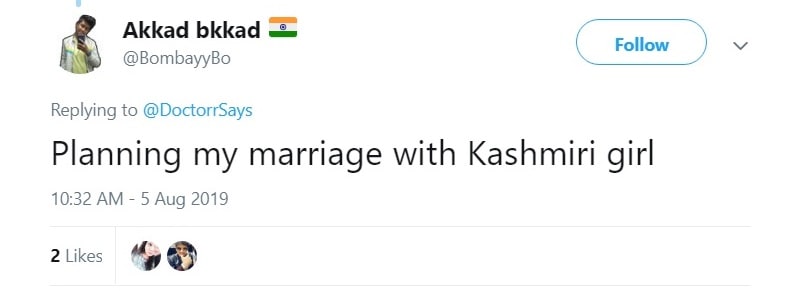
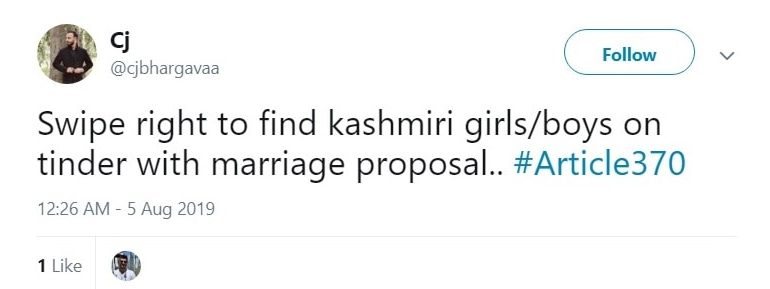
Image Source: Twitter

From people going to buy land in Kashmir to showing their desire to marry “beautiful” and “white” Kashmiri girls, the memes turned insensitive to the people of Kashmir whom the decision impacted in the first place. 

“The memes on Kashmiri girls and land are not helping or creating humour out of this situation. It is only alienating the people of that area furthermore. It is creating a very stifling environment,” said a student from Jammu and Kashmir. 

These meme-makers and sharers turned Kashmir into a mere plot of land which they can now buy and girls from Kashmir as a mere commodity they think they supposedly have rights over. The complete lack of empathy from their end reflected their deeply embedded patriarchy and opportunism.

While it’s completely okay to take sides in a decision and celebrate where one feels necessary, it’s not okay to derive sick and problematic humor at the cost of respect and dignity of the people who are still coming to terms with the change in their lives, and are very much the part of your own nation.

Memes on Kashmir
Image Caption: Deccan Chronicle


Section 144 was imposed on Jammu and Kashmir on the night of 5th August to prevent any threat to security. While Ladakh and some parts of Jammu and Kashmir have started gaining their connectivity to the world back, several districts of Kashmir are still without internet connection. The meme-makers were/are making these distasteful jokes on people who didn’t have access to read and comment upon them. 

It’s extremely saddening to imagine a situation where our people from Kashmir will find these insensitive memes, welcoming them as they log in after days. 

“When the sentiments are so charged and atmosphere is apparently full of fear and distrust. Is it really helping the situation if you make the people of that land unwanted instead of being welcomed?” said one student. 

“The environment feels very occupationist. The way memes are being made on women and land. Trivializing the matter like that makes it seem like everyone cares not about the people But the land and girls,” added another. 

Humour is meant to convert a serious situation into something light to make people see something funny and positive in every situation. But, under this veil of “it’s just a joke”, can we conveniently forget the context sitting on our privileged positions? 

Is it okay to defend every insensitive remark as a joke without paying any heed to how the subjects of your memes will possibly feel amidst the tense situation?

It’s important for these people making careless remarks to register that the place and people they are joking about, thoughtlessly have been living a life of acute distress for over seven decades now. Sounds of bullets and witnessing dead bodies are normal of the lives of these people. Generations after generations, all they pray each day is for one more peaceful day to survive. While you and I live our lives joyously because of our privilege of being born into a state where constant terror attacks don’t haunt our lives, the Kashmiris are under a constant threat. 
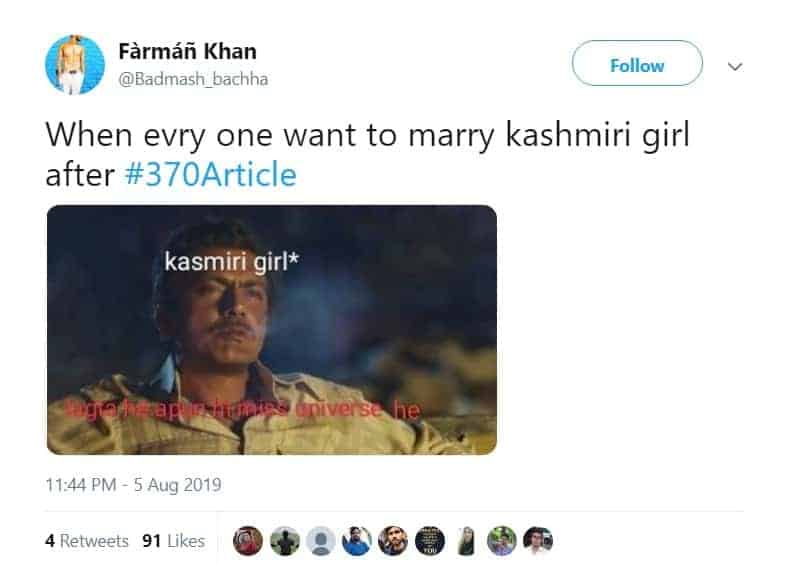
twitter 3

It’s okay to celebrate the decision. It’s okay to put forward your opposition. Any debate is healthy to democracy. But what’s certainly not okay is to make our fellow countrymen feel like a commodity and their homeland, property or plot of land. 

It becomes imperative for us as people who “actually” love the heaven that Kashmir is and the people who reside in the valley, to be thoughtful and sensitive of their emotions and make them feel the sense of belonging to the country and fellow citizens. 

In our haste to earn a few likes and comments, let’s not forget that humanity trumps everything. 

Feature Image Credits: Twitter

Shreya Agrawal
[email protected]


Discussing the absolute belief with which we, at times, think we are right, providing no space for any sort of discussion. 

As college students, who are always being bombarded with new ideas and often one-sided news on social media and other platforms, we are, at times, too quick to form certain opinions, which we then start treating as absolute truths of the universe. More often than not, we also get influenced by the talks and views of our professors and friends. Some people, on the other hand, enter college with already fixed notions which they then are ready to defend in the face of opposition and at times even reason. 

Irrespective of how our believes and opinions are developed, for they are a result of our social and personal environment, most of us very strongly believe that we are situated in the moral and ethical corner at all times. Often, this hampers our understanding of why those who are in opposition to our views are so. Many of us who consider ourselves open-minded make statements like “everyone has a right to their own opinions”, but how often do we believe that or not belittler someone, when they hold, beliefs opposite to ours?

As students of the University for Delhi (DU), many of us consider ourselves as politically and socially conscious beings. We attend political rallies and go for protests and some students even join political organizations like the Akhil Bharatiya Vidyarthi Parishad (ABVP) or the National Students’ Union of India (NSUI). However, most of us live in complete denial of even wanting to understand the other side of the argument, leading to a lack of empathy on all sides. Many times we also associate a particular policy with a party. A person who believes in right-wing politics will more often than not believe that all actions of a right-wing political organization are correct and a person who believes in left-wing politics will more often than not believe that all actions of a left-wing political organization are correct, leaving no room for doubt. Incidents of physical and social media bullying or social ostracizing of people because of their political or social believes is a global issue, from which our University corridors are infected as well. 

In conclusion, with partial or complete information, opinionated or neutral media platforms and associates, many of us rush into making concrete judgments, completely oblivious to the fact that the other side must have their reason for their views, irrespective of whether we agree or disagree with them. Dismissing the other side of an argument does not make us victorious on an imaginary debating platform. Perhaps then, at times we can agree to disagree, for discussion is not to win, but to understand and perhaps at times even empathize with those we do not agree with, in a patient and peaceful environment.  

For instance, you may be inclined to follow my line of personal thought and agree with the beliefs behind this article, or disagree with it very strongly; you have a right to do so. I cannot admit to knowing it all but so can’t any of us. 

Feature Image Credits: Aaron Mead 

Juhi Bhargava   

[email protected] 


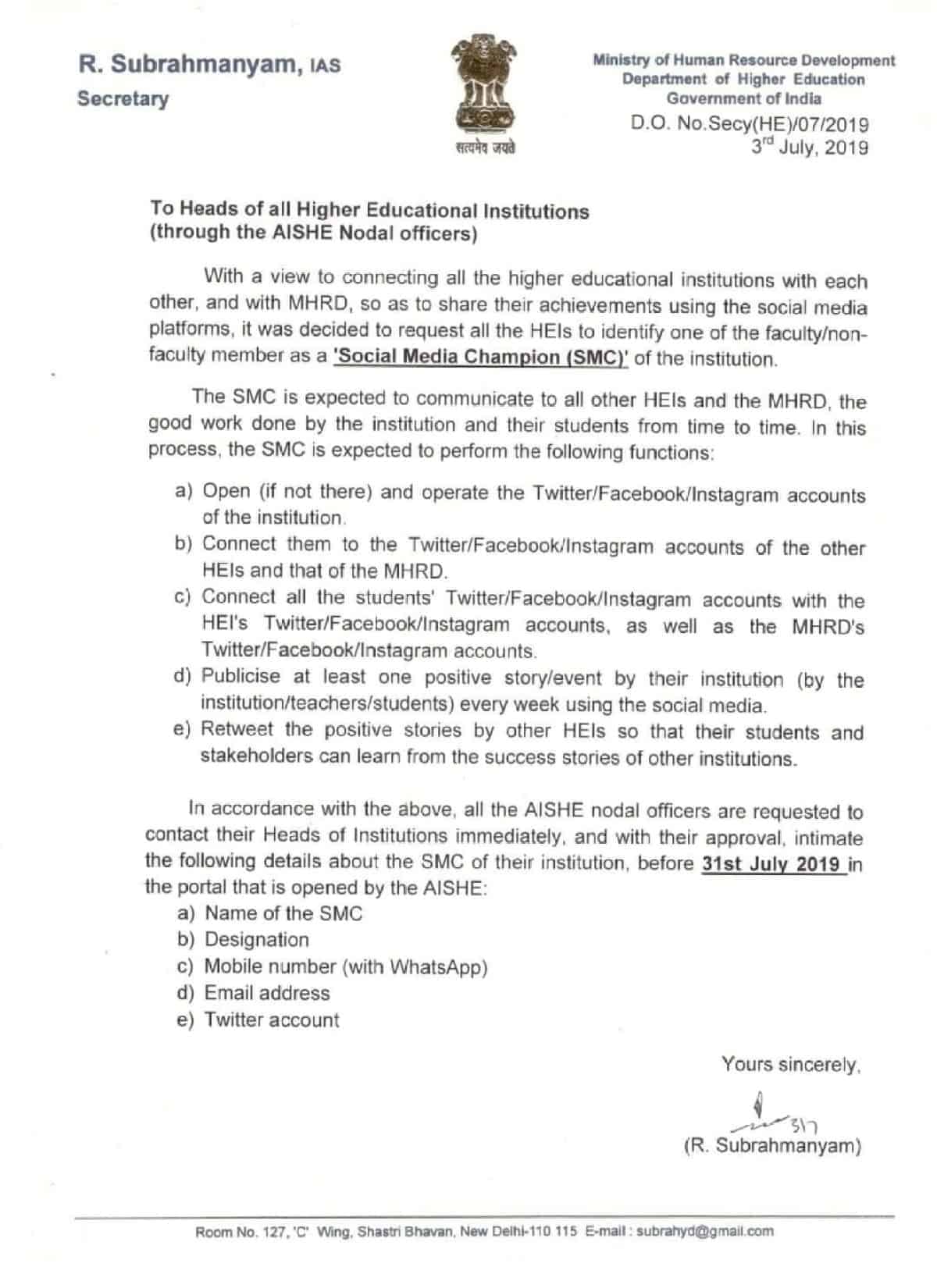
A brief look at the Ministry of Human Resource Development’s (MHRD) letter to all higher education institutes to link all student accounts to the social media accounts of the institutes, and the ministry and the reactions of college students.

A letter sent on 3rd July 2019 by the MHRD to all higher education institutes requesting them to identify and designate a faculty/non-faculty member as the “Social Media Champion” (SMC) whose duty it will be to get all the students of the college to connect their Twitter/Facebook/Instagram accounts to that of the MHRD and the educational institution by the 31st July. This move has already received a lot of backlash with the AISA saying on 9th July, that this step was aimed at curbing the freedom of expression of students. While the MHRD has replied that this step is completely voluntary for the students and they will not have any access to the student’s posts or data if a student follows them on social media, this move is still a cause for concern among the student community.

A copy of the MHRD’s letter sent to all Higher Education Institutes

On talking to several students, it was found that some students felt the very act of asking students to follow certain pages was wrong, even though the MHRD ministry claims that it will just use this as a way to promote good work done by them and the educational institutes. Srijan Vaish , a first-year student from Dyal Singh College said, “The MHRD ministry is run by the government which is run by a  political party with its own particular ideologies, in this case the Bharatiya Janta Party  and the ideology of ‘hindutva’. So if students are compelled to follow their page, as young students, we can fall prey to the ideas that the central government is trying to promote. I feel that this manipulating the youth and not giving us the right to think for ourselves.”

While most students disagreed with the idea of following the MHRD, there was some who felt that something more sinister was going on behind the scenes, and felt that this would be the first step to monitoring students, their posts and their data. Prachi Johri, a second-year student from Indraprashta College for Women said that this could open the door for the government to “invade the privacy” of students. Prachi went on to say that if the government does take this extreme measure, it would “make the minorities, Muslims, LGBTQIA+ community, tribes and people with ideologies against the BJP lives very hard to survive, as the government will probably bully or lock them up for speaking against the government. It’ll disclose a lot of things to public which a student might not want to share. This will create a sense of fear and will stop students from pursuing higher education.”

In conclusion, while the MHRD might have good intentions and want to share their good work with students, perhaps connecting social media is not the best way to do it as lots of students are against this step, and additionally, feel that “sharing good work” is not the real motive of the government behind taking such steps.

Feature Image Credit: The Quint

Prabhanu Kumar Das
[email protected]


On 15th May, 2019, a girl named Paridhi (@the_centaur on Instagram) posted a series of stories, revealing the cyber harassment one of her friends faced while applying for an internship on Internshala.

Internshala is one of India’s largest website providing students with ample opportunities for internships at different companies across the country. As of 2018, the platform has 3.5 million students registered and 80,000 companies associated with them.

On 15th May 2019, a girl named Paridhi uploaded stories talking about the kind of cyber harassment one of her friends underwent with regards to an internship offer from a company named Zvaari.com. Paridhi’s friend went on Internshala to look for an internship, and was contacted by a person from the aforementioned company, who made claims about working with graphics for Nike, Facebook, and Apple. But, to her, these did not add up to the information present on the website. The person also asked her for a deposit of INR 2,400 to provide her with a secure laptop for work purposes, claiming that the money would be refunded. After realising that this offer did not sound safe, the girl decided not to go for the internship.

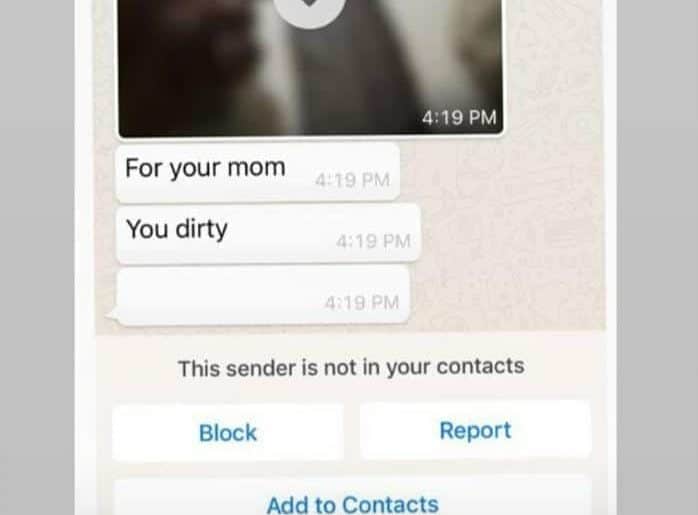
Thereafter, she received explicit and inappropriate images and messages on her WhatsApp. After multiple such complaints were reported to Internshala, they mailed applicants an advisory note to inform them that they have blocked the company from using their platform as the company “violated their policies”. Unhappy with such a response, Paridhi used her Instagram account to post her disgust for this issue and she gathered support from her followers to repost her stories so that Internshala would take some concrete action.

Part 1 of the stories shared by Paridhi. Image Source: Instagram account of Paridhi
Part 1 of the stories shared by Paridhi.
Image Source: Instagram account of Paridhi
Part 2 of the stories shared by Paridhi. Image Source: Instagram account of Paridhi
Part 2 of the stories shared by Paridhi.
Image Source: Instagram account of Paridhi

Paridhi’s stories garnered an immediate outrageous reaction and Kavya, a worker from Internshala, went ahead to message a private apology to her. She updated her on the situation and told her the actions Internshala is willing to take to further strengthen their verification procedures, in order to avoid anything like this in the future.

When DU Beat contacted Kavya, she responded by stating, “This is a very unfortunate incident and no student should have to experience this. We deeply apologise to the students for the extremely poor experience. We have a huge sense of moral responsibility towards our students and while we are handling this issue, we are also looking on ways to strengthen our internship authentication process further so as to avoid any such issue in the future.” She also went on to elaborate the verification procedure undertaken by Internshala, and added that in this particular case, the employer had registered from an official email address, had provided a functional website link, Facebook page, and his phone number was verified via a one-time password (OTP) so that he could be traced if required. Kavya went on to add that Internshala has acknowledged the student’s complaint and, as per the standard operating procedure, has blocked the employer account on the platform and sent an advisory email to all the other applicants of the same internship. She also stated that given the gravity of the situation, they are also exploring possible legal actions that can be taken against the employer and have informed the student about the same. She stated, “We are deeply pained by this incident and are committed to providing all necessary support to the affected students.”

This form of cyber bullying and harassment has increased over the years. Girls receive explicit images, texts, and even rape threats on their personal mobile numbers. For it to happen via a seemingly secure platform, popular among the youth, like Internshala speaks a lot about the lack of cyber security, as well as the sexually violent and frustrated mindsets of men who feel safe enough to harass girls under the veil of technology. Such acts of oppression against females are examples of power struggle and hypermasculinity girls all over the world are fighting against.

Social media, in such cases, has turned out to be a boon in some cases by empowering the violated ones to speak about the problems. These people, or their well wishers, have fortunately come up, sharing their stories of such unfortunate instances on their social media platforms and garnered support from people. More power to these young women who are not shying away from taking a stand, going out there and telling their stories. It is a jarring world and support does change things.

Feature Image Source: Instagram account of Paridhi (@the_centaur)

Sakshi Arora

[email protected]

College students often find themselves grappling with the Fear Of Missing Out, endearingly shortened to ‘FOMO’, as they struggle to keep their lives together. Here’s delving deep into this fear to understand it better.

College years are an amalgamation of a never-ending struggle for attendance, CGPA, friends, and social life. Managing all of these dimensions, and devoting equal attention to all of these aspects become quite impossible and we end up missing out on one thing or the other in our bid to keep them all in our control. No matter how much we try, acing the art of keeping a perfect balance between all these aspects is one Herculean task.

“I need to complete my assignments and my friends are out there partying and having fun,” or “I’ll miss out on an awesome trip with my friends if I pursue this internship in the summers,” and the more famous one, “I must keep up with the show that I hate, because I want to be relevant” etc.. If you have had similar thoughts draining you out of joy and making you constantly discontented with your life, you are suffering from a syndrome called FOMO.

FOMO is defined as anxiety than an exciting or an interesting event may currently be happening elsewhere, often aroused by posts seen on social media.

Youngsters are most vulnerable to FOMO as anxiety of living a perfect life and comparing their lifestyles with that of their peers constantly pressurize them. Darlen McLaughlin, assistant professor at the Texas A&M Health Science College says, “FOMO is especially rampant in the millennial community because they see a peer achieving something they want, and somehow in their mind, that achievement means something is being ‘taken away’ from them.” This could, perhaps, be linked to the kind of connectivity that we have – with people posing on Instagram, Facebook, etc., it becomes difficult not to compare yourself with others. And the verity of the virtual image of people is always a big question mark, that seems to get blurred in our fit of envy.

Constantly getting affected by this fear hampers productivity and ends up in acute dissatisfaction. Thus, dealing with FOMO in a smart manner is essential to retain one’s sanity.

It becomes imperative to internalize the fact that no matter what you do, you’ll always miss out on something. Constantly dwelling on what you are missing out will strip you of your satisfaction. It is also significant to prioritise, so you invest your time in activities that are yielding and actually interest you. So, tell yourself that’s okay to miss a few parties or outings as you are working towards an even more important goal.

Besides, this idea of the Gen-Y, that says that there has to be this constant state of bliss is especially problematic. Not saying that there shouldn’t be ambition, or motivation to be able to do everything, but one must realise that it is okay to have bad days, or dissociation, or not having watched the show that everyone seems to be talking about.

Bottom line is that for everyone, their mental health should be their number one priority, even if it means disappointing your friends and peers.


Image Credits: The Irish Times


Shreya Agrawal

[email protected]


With the use of cellphones at an all-time high, there is an ongoing debate about if they should be allowed in colleges and classrooms, or not. Let’s delve into the matter and understand it better.

Technology has invaded almost every aspect of our lives. Our gadgets have become our new friends without whom life is just impossible to imagine. So much so, that we become totally inseparable with them. We are exceedingly becoming dependent on them to lead our lives. Students, especially, find themselves heavily reliant on their smartphones and even carry it to their colleges.

How right is that and should this act be allowed? This is the question that needs to be discussed.

People supporting the ban of smartphones in colleges term it as a distraction deviating students from their academics. Usage of cellphones in classrooms results in the wastage of time during important class hours. It also fuels their social media addiction since a productive academic atmosphere should be devoid of social networking apps. Another important aspect which Simran from Gargi College brought forward was how smartphones weaken the students’ ability to come to a solution themselves as everything is available just at the press of a button.

But, should we consider banning them from college premises keeping the above propositions in mind? There is another side of the coin that needs to be assessed too.

Smartphones are like handheld computers which can be used as a great tool of learning in innovative ways which are beyond the scope of traditional teaching. It becomes convenient for teachers too, in cases when they need to hand out digital academic materials to their students. Apart from being great learning tools, they also become absolutely essential for students for keeping in touch with their parents and ensuring their safety while they travel to and from college.

Thus, banning the usage altogether doesn’t appear like a wise decision but its shortcomings can’t be brushed under the table too.

There instead, needs to be a strict regulation on the use of smartphones on the campus. Social media apps like Instagram, Snapchat, Facebook must be inaccessible on college WiFi and strict actions must be taken against the defaulter. Mobiles should be collected before the class and should be handed over only when there is an academic need.

Feature Image Credits: DU Beat

Shreya Agrawal

[email protected]

Social media provides an explosive and elevating platform to rant. Most of us will agree that ranting becomes a cathartic exercise over time. But could it ever become “toxic”?

Colleges are defined by the activities and opportunities that they organise for the students. As we increasingly become more involved with these activities, we become increasingly complex with our emotions. Or to put it in simpler terms, the cause-effect relationship between overwork and frustration becomes more apparent. How do you vent out a complex multitude of emotions that seems to smother you, and also sadden you? Although everyone has different coping mechanisms, many of you would agree that the most famously accepted and satisfying way to do so, is to rant.

Most of our rants are really in the moments of great crises. To use a foul alliterative play, a rant provides us with a catharsis in crisis. It really is a purge. Most of the rants that you become a listener to, or even those that you are declaring, are moments of deep emotional outbreak. “I cannot do this anymore,” or “I have had enough of this,” or “how difficult is it for me to say ‘NO’ for once?” Reflective questions like these throw us off into a heated rant. But overwork is not the only factor to push us off this emotional cliff. An elucidation of an emotional blueprint that is a rant, we become the truest versions of ourselves. We realise and connect with our reality during the course of a rant.

Sanchi Mehta, a Literature student from Hindu College, says, “My rants are therefore seminal to an understanding of my inner being because the process makes me introspect. More often than not, in narrativising the assault of emotions churning within me, the pent up anger dissipates. Laying it all bare unveils the gaps that generally an emotion like anger or tiredness – while synthesising a surmounting pile of undealt with events – obstructs, thus helping me to look at things with a more objective acceptance and self-critical gaze. It is like self-induced therapy. It keeps me from hysterically dealing with situations and dispensing the tendency for adopting over-the-top responses.”

Annoyance, frustration, or sadness held in for too long internally becomes toxic. An ideal lifestyle wherein you keep your “unpopular opinions” to yourself will ultimately become a baggage slowing you down. Thankfully for us, social media has efficiently given us an amazing pedestal to rant. However, despite the platform and improved means, the listening / hearing end of the rant has often interpreted these rants negatively.

And how does it work? You watch a movie, for example; the movie shows some character in a bad light, normalises issues like harassment, ridicules the idea of consent, or shows anything else. You feel strongly about something which you express online and there it is, your “rant”. It is not uncommon for people to call an emotional journaling or expression a rant these days. We are naturally bound to feel strongly about certain things. The expression of such strong emotions is translated into being an unnecessary “rant”. It is this classification that seems to question the act of expressing, by associating it with entitlement. Having an opinion makes you entitled to rant, period. It is with the opposing opinions that a balance is maintained in this life.

Rants guide you out of deep crises. Anoushka Sharma, a second-year student of Journalism, says, “I believe it’s very important to rant once in a while. It relieves the stress and baggage in one’s head (at least in my case). But I think it is also important to know who you are ranting to. The person should be understanding and should have the mental capacity to listen, and in that, interpret what you have to say. One simple reason for this is that the other person may not be emotionally available to understand your situation or your need to rant.” The only cautionary advice as you rant is that you must try to access the emotional faculty of your listener. Your understanding of your listener’s unavailability improves the mutual connect. “Ranting is a healthy way to vent. If done properly, it’s a good way to express yourself,” says Anoushka.

 An important idea that demands attention at this point is that of acceptance. People will say that if you rant about things, you are being too uptight or even mean with your opinions. A rant is about non-acceptance, after all. But then, an argument builds up against this. That if you do not rant about or do not express your non-acceptance, that simply is equivalent to giving in to something that you do not approve of. Certainly you cannot go around and question everything, and that is precisely where you have to practise your discretion. As important as it is to rant, the surfeit of it also loses its seriousness and / or impact. If we are to measure opinions in this narrow fashion, we block the possibilities of change; both in our personal and general spaces.

Find your balance in rants. Rants have been able to achieve so much in the face of resistance, simply because rants become the resistance, the peace and the way of life. If you rant, you have a voice and a mind; now that is not a bad combination to boast of.

Feature Image Credits: Paul Garland via Smithsonian Magazine

Kartik Chauhan

[email protected]

With use of social media being at an all-time high, our mental health is seeing an all-time low. Here’s how social media is directly hitting hard on our mental health.

Social media has undoubtedly revolutionised our way of living. Gone are the times when we would wait for days for a letter to arrive. Who would have imagined that our distant friends and relatives will be just a click away? But, social media did it! It turned our lives into a never ending loop of “Click, sleep and Repeat”.

But we the millennials, the already sandwiched generation between traditions and modernity are totally stuck in this loop and coming out of it has become a distant dream of many. What has made this gigantic world a dangerous space to be in is its effect on our mental health?

To get the answers of such questions, you need to rewind in your mind your activities on Facebook, Instagram, WhatsApp and answer the following questions for yourself.

Have you “checked in” on Facebook when you last visited Starbucks or any other high end restaurant or even watched a movie?

Have you checked again and again the number of likes and comments on the picture you uploaded on Facebook or Instagram and felt a tinge of sadness when the number of likes didn’t match up to your expectations?

Have you ever hated your life when you saw the pictures of swanky and happening lifestyle of your friends?

I hope the readers have got the point. But the ultimate question is “WHY?”
We were wondering the relation between the two, and here we see social media directly aiming and hitting hard at our self esteem which in turns leads to affect our mental health. We often come across the question that why our generation is so unhappy? The answer lies here.

With an advent and never-ending rise of social media, we have become overly dependent on others and those sitting miles away, having absolutely no care of our lives to validate our worth.
Here’s a list of few ways it does hit our mental health:

Validation and approval : This system is based on other people’s validation and approval of our lives. And this has created the biggest impact. Even the person living a happy and peaceful life will start doubting his way of living if social media disapproves it. You all must have seen your Instagram filled with videos and images of concerts. This is people’s way of asking others to judge their lives as “happening”. One can go on thinking thoughts like “Who would like a guy or a girl who spent the weekend at home?”.

Numbers, numbers and numbers : Don’t get confused. This is what our lives revolve around, numbers. From numbers of comments, number of likes to number of views. A single number below our expectations makes us judge if we are even living it right. And what’s the point of living a moment when there aren’t numbers to say “Yeah, you did it right?”. Haven’t we living life with that mentality? Think about it.

Instant glorification : This is another aspect of social media which again has two sides. With Instagram pages and YouTube channels making people superstars in few days, the greed to become popular without many efforts has also risen among youth today. But what don’t meet the eye is several others who bite the dust. Thus, when failures and trolls hit us hard, we find it almost impossible to get back our lost esteem and sanity.

Self doubt: Models with perfect bodies and faces attract everyone on Instagram. This has led to a tremendous increase in guys and girls opting for surgeries and implants to present themselves as “perfect”. Perfection seems like the myth social media created and has now people aiming towards it. Basically, social media presents people full of confidence and glamour while they hide themselves in the gloomy rooms painting their scars.

Featured Image credits: CNBC

Shreya Agrawal
[email protected]

A derivative of what the 21st century’s social media holds, let us figure out what truly is this FOMO.

As we swung in a fast forward motion to the world of social media and the smartphone, making our life buzzing (pun-intended) and also distanced in a way. It was a strange discovery after going through a workmate’s personal text to me, that while I declare myself as a millennial child, the bearing of FOMO in the lingo intrigued me, and here is how it goes.

FOMO stands for the Fear Of Missing Out. What really captivates me is its uncanny rhyme to my favourite street food ‘momo’ and the tenacity of the mind to control the urge to have some. Keeping this digression aside, let us focus on the coinage of this slang. The surge of this term grew somewhat in the phase when Instagram rocked the entire globe. Not even one celebrity post or any major event has the comments section missing out on this “FOMO”.

We all come across some of these things, “I didn’t read this tweet that was posted by xyz celebrity”, “I haven’t posted a story of this breaking news on my Instagram!”, “I can’t believe two of my workmates are dating, their pictures say otherwise”, “I wish I could’ve gone to this party”, “I wish I had a dressing sense like her, it’s amazing” and much more.

The FOMO is a feeling of being left out or having a tendency to feel insecure upon realization that one misses out on a particular event or a story or any other happening which influences their life. In the words of Annie Rana, a literature student from Maitreyi College, “FOMO for me arises definitely upon scrolling through my Instagram feed, that too when my weekends are spent in my house, as opposed to going for a night-out with my friends or missing out on something in my social circle’s calendar.”

Studies conducted by different research groups suggest a binary approach to understanding FOMO. While one research group asserts it is a general anxiety over the idea that others are having a more content and fulfilling time without you, whereas the other research groups states it to be a social anxiety which revolves around a continuous urge to be connected with the activities of one’s friends or other people.

We all can admit that we have all felt this fear of being left out once or twice (or more for some), especially if we are to believe in the delusions of conventionality. Taking the case of the youth, FOMO arises especially if we witness someone, who we are connected to socially having a great time around, probably a fancy lunch, or a weekend party, as opposed to our plans, which might be to laze around in the company of our bed and duvet, making us feel that we are ‘boring’ or have no ‘social life’.  It is also believed that the people, who experience FOMO, are in fact very active on social media, accrediting to the constant exposure to others’ lives and being up to date about it, creating an unnecessary feeling of being bothered and having bouts of self-doubt in you.

Heena Garg, a second year student of Maitreyi College comments, “I have witnessed the feeling of FOMO quite a lot. My friends who are outstation students have more access to partying or ‘chilling’ around frequently, due to the state of their accommodation like PGs or apartments, as opposed to me, who usually prefers weekends as time to spend with the family. It bothered me a little at first, but I think I have accepted this fact and in fact it makes me more joyous. It is about knowing what makes you really happy and to really stop doubting yourself as a person, because everyone has different interests when it comes to spending their time.”

Due to its widespread use, the word is now a part of the Oxford Dictionary, ever since 2013, making it as valid a term, as any other word from the language.

The feeling of FOMO also hints at a hidden desperation or a need to be validated by the others. Most online shopping sites also use this tactic to a fine advantage. Social media handles which portray the quirkiest and eclectic collections become online favourites among users quick due to their different approach and also because the FOMO factor which is targeted in the users, making one believe what they are buying is definitely the next big thing or definitely something which will make them look much more cool.

The question which we should ask ourselves is, how do we get rid of this online disease? The answer is simple. Opting for a social media detox. While others may chide it as useless, or something which comes off as very ‘first world-ish problem’, a social media break, in fact helps you to focus better and to stop consuming much of your time lingering around others’ feeds or stalking them and then feeling worse about yourself. Taking this break will help you to find time for yourself and most certainly give you time for the much needed introspection. Why a lot of people have now started opting and recommending for a social media break is because we all need it at some point ot the other. It is exhaustive and it is impressionable. It makes us want to blend in better, making us thus feel detached from our true identities’, resulting in this feeling of being as lost and clueless as ever.

Hence, FOMO, as hideous as this acronym may sound, is in fact much more a grave thought. I suggest, we all take a step back from this incessant need to be involved into other people’s lives and invest our time to better causes.


 Image Credits: giphy

Avnika Chhikara

[email protected]

A convincingly coy justification to increasing psychological strains among students is sought in their connectivity to social media. Convenient, right?


It is not unheard of: social media causes depression.Social media is an endless space that connects all of us and brings us closer to each other in certain ways. The convenience of communication has been supplemented by this selfsame medium. But the idea of defending social media on the pretext of such rewarding connectivity is not entirely correct.

Social media is not without its vices. But the point of discussion is not these vices. It is, in fact that how these negative impacts have overshadowed our idea of looking at something a lot more intricate than this technological network- mental healthA lot of people will claim that social media is the central cause of deteriorating mental health among youngsters. Unfortunately the statement cannot be entirely overruled, but the magnitude of its truth can be questioned.


The competition and toxicity on social media causes strain. The constant activity can be extremely exhausting. Which is why we feel the need for “detoxifying”. In providing the vent, social media is helpful. The additional utility of this vent is the challenge we face.To say that social media is the primary source of depression is equal to saying that Diwali is the source of all pollution in Delhi. Such broad classifications eliminate the seriousness of the actual issue. However, looking objectively at issues is not a modern-day practice. Most of it has to do with escaping the responsibility by leading on with the scapegoat; in this case social media addiction.


We need to acknowledge the factors that contribute to depression. Is it societal expectations, filial obligations, and/or personal-overwhelming-anticipations? What is causing depression? The questions we need to ask have been left unattended as the answer is sought in indifference.Dealing with depression more informedly can only become more real if we first analyse the factors contributing to this delirium. Finding the causes is really the half-way. If you feel that social media is causing unwanted uncertainty and toxicity, by all means, take a drift away from the swamp. But if that does not help, the only measure that remains is introspection. It is always more than what it looks on the surface. Looking is all that matters.


Social media is not the only source of depression. Your source is different from mine. And it is in this subjectivity that the centrality of this discussion rests. Find your causes and factors. Because labelling indifferently is not a healthy practice.


Feature Image Credits: Freepost Press


Kartik Chauhan

[email protected]