
Tag

rally

Browsing

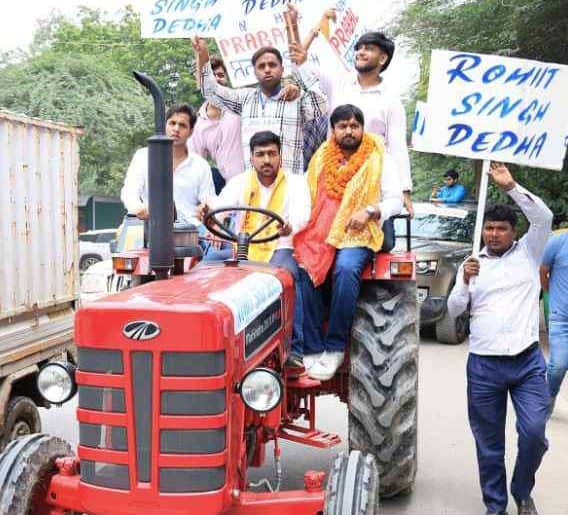
On Monday, 1st September 2025, the RSS-affiliated Akhil Bharatiya Vidyarthi Parishad (ABVP) launched its new, eco-friendly “Clean Campus, Green Campus” campaign for the Delhi University Students’ Union (DUSU) elections.

The campaign featured a bicycle rally that commenced at Vishwavidyalaya Metro station and proceeded to several North Campus colleges, including Ramjas College, Hindu College, Kirori Mal College and Daulat Ram College, before concluding at the Arts Faculty.

The campaign aligns with the efforts of the student union to keep the electioneering process “environment-friendly and campus-friendly”. According to ABVP leader Harsh Atri, the union will keep introducing thoughtful, eco-friendly campaigning practices such as bicycle rallies and clean-up drives. These endeavours complement the ABVP’s goal to keep the entire process of campaigning clean, transparent, and peaceful. The union is allegedly reaching out to students and strictly adhering to the Delhi High Court guidelines in its campaigning practices. 

The emphasis on responsible campaigning is well expected, as the 2024 DUSU elections had brought about legal trouble due to the violation of court directives and the Lyngdoh Committee’s guidelines for defacement of public property, leading to the halting of vote counting by the High Court until all defacement was undone and the restoration of public property had been completed.

On Thursday, 28th August 2025, the ABVP released a list of 11 probable candidates for the 2025 DUSU elections, which are set to take place on 18th September 2025. The final list of four candidates for the central panel will be released on Thursday, 11th September. The counting of votes will take place on 19th September 2025 under strict measures in order to avoid any form of defacement or disruption.

Featured Image Credits: @RohitDedhaABVP on X

Read Also:  ABVP and NSUI Welcome Freshers: A New Year of DU Student Politics

Souparnika
[email protected]

The recent gay pride parade held in June was a riot of colours, a celebration of diversity, and a march against anti-gay laws. It was a procession that demanded freedom of choice and expression. And there could not have been a better place for its culmination than Jantar Mantar, the epitome of freedom of expression and Delhi’s prime demonstration destination. In fact , many DU protest marches / rallies have been known to culminate here..

Jantar Mantar of Delhi, one of the five observatories built by the 18th century Rajput king Maharaja Jai Singh II, has been the site for many a protest, demonstration, procession, strike and dharna ever since the Narsimha Rao government banned rallies at the Boat Club. This choice of location seems to be very apt as it is situated on Parliament Street, which leads up to the Parliament House. The dharnas at Jantar Mantar that have been going on for three to four years are a testament to this fact. Says Sheetal, a little girl holding fort at a bandh with her mother, “We have been here since 2006. We want the government to rehabilitate the Bhuj earthquake victims. There are still a lot of people who have not been given any support and are without shelter.”

Sub-inspector of Police at the Parliament Street Police station, Bhup Singh, said “There is at least one procession here every day. Most of the time the demonstrators restrict themselves to Jantar Mantar, but sometimes, with prior permission of the Police, come onto Parliament Street, in which case we need to block the road and divert traffic”. The traffic is diverted to the parallel road, Jai Singh Marg. This diversion of traffic causes great inconvenience and chagrin to commuters. Says Subroto Das, a retired executive, “the traffic is often diverted( because of the demonstrations). When that happens the buses do not come here. I have to walk a lot to get to the nearest bus stop. This disrupts my routine and is very irritating”. Agrees an employee of a bank located on Parliament Street, “Even though we employees have found alternative routes to reach our office, this almost-daily drama serves as a hindrance to our customers who have trouble reaching the branch. This causes minor losses to our business.” However, some daily commuters have acclimatised to the frequent disruptions. Says Promila, a personal assistant to an MLA, “These protests do not bother me. If one is underway, I simply walk a little to Janpath and catch my bus.”

These protests often get out of hand, and the police have riot control vehicles on standby. “If the protesters get too rowdy, we are forced to use water cannons and tear gas to contain the mob”, adds the Police officer. This tear gas also seeps into the offices on Parliament Street and leaves the employees with their eyes stinging for a long time. Moreover, the noise is an irritant to these employees.