Tag

protest

Browsing

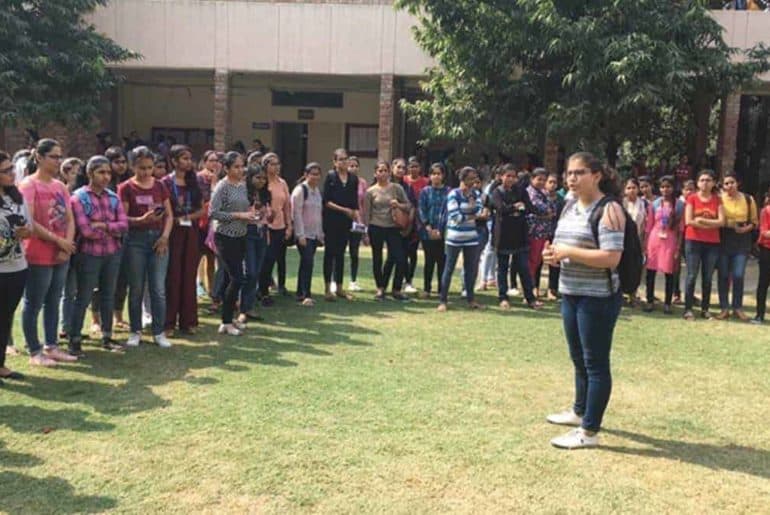
Lately across the country, in the absence of a notable opposition decisions of the establishment, students have taken it upon themselves to stand up to the authoritarian policies. Lately, the spur of student movements in the JNU, DU, University of Hyderabad and other campuses has also spiked up the enthusiasm in other Universities where student politics have been suspended for long for the revival of Student Politics and the demand of Student Union elections. On Thursday, students of Jamia Milia Islamia University staged a protest march and submitted a memorandum to the Vice-Chancellor Talat Ahmad demanding the restoration of the Student Union and demand of elections.

Eleven years back, the University had suspended the Student Union on the account of student leaders interfering with the administrative process of the University in 2006. The Union was disbanded after a scuffle broke out between the union president and the proctor over the former having a say in the allotment of hostel seats, which the university was not willing to agree to. Later in the year 2011, Hameed Ur Rahman, a student approached Delhi High Court for the matter. Najeeb Jung, who was the VC during that period told the court that the environment was not conducive for polls.

Recently the students have formed a Joint Action Committee (JAC) with members from various students bodies’ including the National Students’ Union of India (NSUI), Chhatra Yuva Sangharsh Samiti, All India Students’ Association and Jamia Students’ Forum to raise the demand for a Union. Speaking to a major national daily, students of the JAC said that they would “resort to democratic means of protest” in case the varsity does not meet the deadline of announcing a date for the polls.

However, the administration on receiving the memorandum said that the university had no objections to the formation of a students’ union but it could not give the go-ahead as the matter was sub judice. Talat Ahmad, the vice chancellor of the University who is known to be personally in favour of having a student’s union said, “When the matter is in court, I cannot take decisions that would end up in contempt of court.”

The University which has a rich past of student activism during the freedom movement remains an environment devoid of a students’ voice today.

Interestingly, Jamia has a strong union of teachers and non-teaching staff.

Image Credits: jamiajournal.com


Srivedant Kar

[email protected]

The Banaras Hindu University (BHU) has been on the boil following alleged molestation of a student on 21stSeptember, by three men and the university officials refused to take action and blamed the victim, instead.

What have been the circumstances?

The protest is on going for quiet afew days. This began midnight on 21st September, Thursday, after three men riding on a motorbike molested a student, pursuingBachelor of Fine Arts degree of the Mahila Mahavidyala of BHU.

The alleged molesters hurled abuses, passed lewd remarks, and touched the victim inappropriately only a few metres from where a security guard was present. The girl, the protesters said, cried for help but the security guard did not move to make an attempt.

The girl was traumatised when she reached her hostel. When her hostel-mates gave her assurance, she narrated the entire incident to them. Concerned over everyday eve-teasing and frequent molestation of the girls on the campus, a group of students of the hostel went to report the matter to the warden.

The girls complain that instead of listening to their grievances, the warden blamed the victim for the incident. “What were you doing outside your hostel so late?” the warden allegedly asked the victim as reported by India Today.

Infuriated by the warden’s moral policing and indifferent stand, the girls sat on a dharna outside his office at around midnight on  21st September. The women staged a bigger dharna at the Lanka Gate of the BHU campus on  22nd September, when Prime Minister Narendra Modi was in Varanasi.

22nd September was a stressful day:omen from other hostels and courses also joined the protest. The protesters demanded action from the Vice Chairman,Girish Chandra Tripathi, who wanted to meeta few of the protesting girls in his office chambers, as claimed by the women. “What happens is that the VC calls around 10 students and warns them against raising their demands. The students are suspended without giving a chance of resting their case. The matter ends there. We are concerned about our safety,” Akansha Singh, one of the girls who was protesting, told India Today.

Later, BHU issued a statement saying that the protest by the girls demanding safety on the campus was politically motivated. This comes into light although, unlike Delhi University or Jawaharlal Nehru University, BHU doesn’t have a students union. Teaching staff too don’t declare political affiliations.

After the violence on Saturday, the girls took out a silent march. But the police apparently had an issue with this as well, brutally chasing the protesters away, allegedly with batons. Yet the girls continued to lead the march, supported by many male students as well. The demands of the students were simple – they want installation of CCTV cameras, proper lighting of the campus and gender sensitisation of university staff and security personnel.

Did the administration do anything so far?

Beside making sexist and discriminatory statements (In an interview to The Indian Express, Tripathi justified the discriminatory policies against women students, particularly with regard to hostel curfews on the grounds that, “security for boys and girls can never be at par.”),U.P Chief Minister, Yogi Adityanath sought a report from the commissioner of Varanasi on the entire episode.

The government has so far removed five officials for negligence of duty and transferred them to other places.An internal inquiry, found them responsible for alleged disturbance and violence, thus removed to ensure fair enquiry. Meanwhile, 1200 students have been booked for violence.

Chief Proctor, O.P Singh, resigned from his post, and the government appoints BHU’s first woman Chief Proctor, Royana Singh.

However, this is not a rare instance in Banaras Hindu University’s history. According to a report by Huffington Post, there has been a surge in cases related to sexual crimes and harassment in recent years, ever since the current Vice-Chancellor, Girish Chandra Tripathi, took office. In 2016, there were cases of sexual assault, including gang rape of a male student and complaints of harassment made even by female faculty members. The frequency of such severe crimes points to the authorities and administration’s lack of seriousness in addressing safety issues. This is particularly the case with women, who already face a spate of curfews and curtailment of freedoms. Calling these restrictions ‘strict’ would be a understatement, for they apparently treat adult women like tender creatures of pristineness and purity, who shouldn’t go out to for their own safety. Consider some of the statements of the Vice-Chancellor, like “Consumption of non-vegetarian food makes women impure according to the Malviya values,” “Girls who study in the night are immoral,” and “Don’t think like a journalist, think like a father. Think of what ‘appropriate clothes’ would mean to a father,’’ upon being asked what constitutes “appropriate clothes” in this Youth Ki Awaaz interview, where his sexism is on open display. Through absurd rules like no phone calls post 10 p.m., no internet connection in rooms, and deadlines on venturing out, in the name of “protecting women”, they are being robbed off their freedom. Depriving a whole section of the society from thinking for themselves and allowing them the same freedoms as men is deplorable, and it is even more shameful when it happens in the constituency of the same man who tweeted, “Women empowerment is crucial to India’s growth. Days of seeing women as ‘home makers’ have gone, we have to see women as nation builders”.  Keeping aside the dismissal of homemakers for a moment, one is presumed to think that the way things are, “nation-building” will only be done till 8p.m. – the hostel curfew time.


Feature Image Credits: The Indian Express

Rishika Singh
[email protected]

Ankita Dhar Karmakar
[email protected]

On 22nd August 2017, the All India Students Association (AISA) conducted a march called “DU Demands” in North Campus, University of Delhi. Kawalpreet Kaur, the organisation’s President at the DU level, said, “There are three central purposes behind the march – the problem of accommodation, violence, and the demand for the reestablishment of university special buses and metro passes to make travel easier for students of Delhi University”.

Kaur stressed upon the fact that there is a severe lack of hostels in Delhi University and reiterated that a no-tolerance policy must be implemented in DU against violence, referring to the Ramjas incident where numerous students were hurt due to violence from the involvement of several political parties in February 2017. She also laid emphasis on the immense cost incurred by DU students who travel from a large distance to their respective colleges and how the introduction of university special buses and special metro passes could contribute to solve this problem. Through this march, AISA wanted to make these demands known to the Vice Chancellor of Delhi University.

The march began at the Arts Faculty at 1 p.m., where over 100 students had gathered from both off-campus and on-campus colleges like Deshbandhu College, Kirori Mal College, Miranda House, etc. to show their support. The students carried AISA banners that had the three demands mentioned on them. Kawalpreet Kaur addressed the gathering where she reiterated the purpose of their meeting and motivated the students to raise slogans and march with them. The students then proceeded towards Ramjas College where they went inside the campus and raised several slogans like “DUSU ka itehaas badal do“,  “Dekho kaise garaj ke aaya AISA AISA, Bhagat Singh ka naya roop hai AISA”, “Vice Chancellor khabardar“, “Hostel ke liye kon ladega: AISA”, “Hostel ka adhikar maangte, nahi kissi se bheek maangte“.

During the march, the students also raised several slogans against the Akhil Bharatiya Vidyarthi Parishad (ABVP) by chanting “Gundagardi nahi sahenge, pathar maaro nahi sahenge, inqalab zindabad, ABVP haye-haye“.

Rupal Anand, a student of Ramjas College said, “The march by AISA was a great disruption to our classes as they were shouting very loudly.” From Ramjas, the march continued towards Hindu College and ended at Kirori Mal College.


Image Credits: P.V. Purnima for DU Beat

Bhavya Banerjee
[email protected]

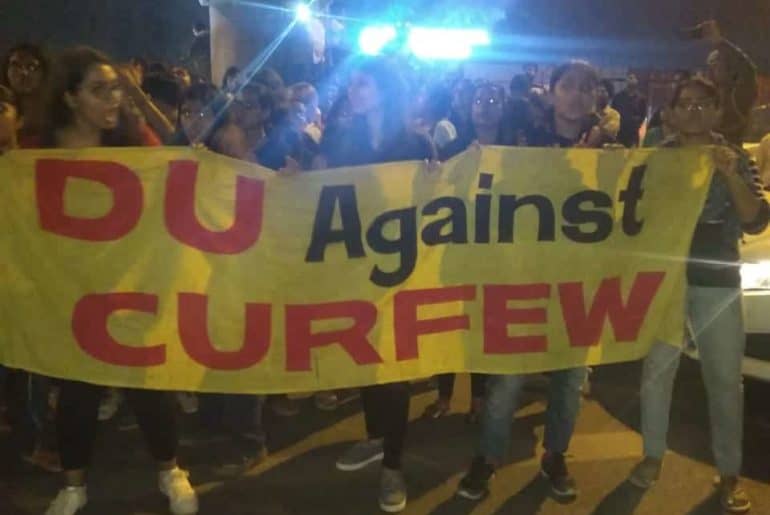
Recently, the Ambedkar-Ganguly Students House for Women shifted its curfew timings from 10 p.m. to 9 p.m. Students dissented but refrained from protesting in the fear that their hostel seat would be taken away from them.

The hostel provides accommodation to postgraduate DU students with a majority of the seats reserved for the students of Delhi School of Economics (DSE) and ST and SC categories. The unilateral change in the curfew timings was brought about by the hostel warden, K. Ratnabali, without any consultations with the elected Students Welfare Association. This could be an act of violation of the regulations of the University Grants Commission that occupies the position of the law in the collegiate space. The regulations put forward by the UGC deny safety as an excuse to restrict mobilisation among female students. There were further rules proclaiming that “Students cannot interfere while authorities make or modify rules”, thus paralysing all participation of the students in the management committees.

Pinjra Tod, a students’ collective that focuses on the right to freedom and fights sexism in university spaces, said:

Such infantilisation of university students is unacceptable! When it was pointed out that this act is a violation of UGC guidelines, the authorities focused their energies to silence protests rather than addressing legitimate concerns of students. They deployed pressure tactics such as:
– Denial of University housing and using it as a threat to silence/discourage dissenting voices from surfacing.
– Denial of democratic participation in the process of drafting of hostel rules.
– Forcing students to ratify the rules stated in the handbook which have been surreptitiously altered to deny residents any participation in the rule-making process!
– Forcing students to sign affidavits and undertakings that amount to waiving off their right to protest as a precondition to securing a hostel seat.

The victimisation of dissenting voices among students and infringement of their democratic fundamental rights have always been contentious situations across university spaces because of which harassment, oppression, abuse, and even coercion often remains unreported.

Looking further into the issue, an emergency general body meeting was held by the Warden, where she explained that the rules were being misinterpreted. One could come in till 4 a.m. after the 9 p.m. curfew, which would be regarded as a late night.

A resident of the hostel stated, “We thought that our exit timing was shifted from 10 p.m. to 9 p.m. Basically that is true that once you sign the attendance by 9 p.m., you cannot exit. But we did not have any idea about this late-night thing. So, she (warden) was like if you people had a problem or wanted clarification why didn’t you approach us. We were planning to do so but as people were not readmitted to the hostel yet, we couldn’t decide which will be the right time to approach her. As the rule book says, you cannot question authority. I really don’t know whether it was a consequence or we genuinely misinterpreted it.”

The residents are currently waiting for a written resolution to dissolve this ambiguity.


Feature Image Credits: University of Delhi

Trishala Dutta
[email protected]

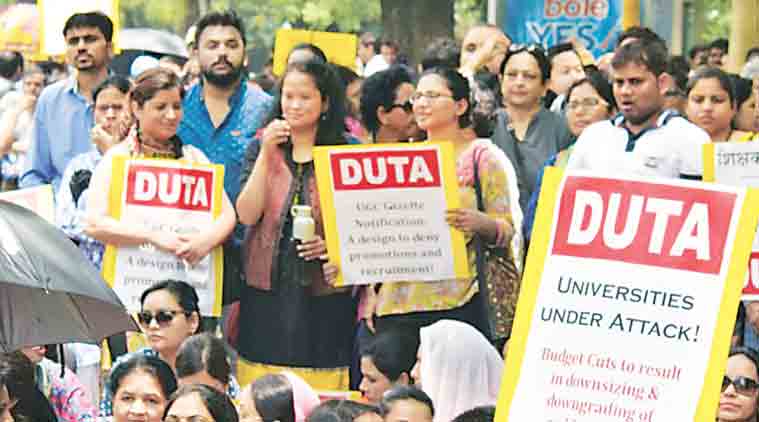
Seeing no action being taken either by the centre or by the state government against the Four year undergraduate programme  (FYUP), All India Students’ Association (AISA) carried out a protest on the streets of Delhi recently on the 10th of March. As a part of the prolonged FYUP Hatao, Future Bachao yatra – the bike caravan saw members of the student party travelling around 28 colleges of Delhi University and covering about 150 Kilometres.

According to some sources in AISA, the party wants to make it an election issue, reaching out to major political parties and inviting their stand on the issue. “We have tried our level best to make sure that FYUP is rolled back, though policy paralysis and less impetus among political parties for the issue has been a cause of deterrence. We will now take the issue to the parliament”, said Anmol, State Vice-President of AISA.

aisa

The student’s party has also been protesting against the possible re-appointment of Prof. Dinesh Singh as the Vice-Chancellor of Delhi University.

After repeated agitations and assurances, the much awaited rollback of Delhi University’s FYUP has still not become possible. With the possibility that Vice-Chancellor Prof. Dinesh Singh might serve another term as the VC, the chances of a complete rollback seem even lesser.

About 150 teachers and students who had gathered to protest against the four-year undergraduate programme (FYUP) in Delhi University were arrested at India Gate on Monday. The protest was a peaceful candlelight protest and was organised by the Joint Action Front for Democratic Education (JAFDE).

There were about 500 teachers and students in all who came together at India Gate to hold a torchlight procession. All the detained teachers and students were loaded onto buses and kept in the Parliament Street Police. On this matter, S B S Tyagi, DCP, New Delhi was quoted as saying, “They didn’t have our permission to protest at India Gate. We advised them to move to Jantar Mantar but they refused. We had to detain them.”

The students of the Faculty of Law, as well as the students who are trying to take admission in the Faculty of Law, organized a huge protest march starting from the main gate of the Arts Faculty and it culminated inside the Faculty of Law. The main reason for organising this protest march was to make the University authorities aware of the malpractices that are going on with total support from the admission committee and with full guidance and support from the Dean, Faculty of Law.

There have been several cases of mental harassment as well as vulgar abuses against the existing students who have been detained due to personal biases and also against girl students who are trying to seek admission in the Faculty of Law. Several cases of students seeking admission in the Law Faculty being booed with filthy abuses have been reported. There have been several complaints regarding this from the students to DUSU. Students seeking fresh admission to the Faculty, as well as those currently enrolled, came out and joined hands, expressing their solidarity against the Dean in what has been described by some students as a “tyrannical” rule.

Current students of the Faculty have been facing constant harassment at the hands of the Dean as they have been detained on account of shortage of attendance, the stipulated requirement of which is 66%. These students spread out overall three years of the LL.B. course found themselves in these unfortunate circumstances only 4 days before the start of their end-semester examinations. When they approached the Dean and other members of the Faculty, they were humiliated, verbally abused and made to run from pillar to post. They allege that they have been detained without warning and have fallen victim to the rivalry between the Faculty and the administration. As if the testimonies of the current students did not disincentivise an admission seeker from applying to the Faculty of Law, students have been made to wait for hours on end to be able to procure and submit their LL.B. Entrance Forms in the sweltering heat. The counter to submit the forms opens an hour late and the lunch hours are flexible to the whims and fancies of the staff. Upon making a complaint, students were abused verbally and the staff did not even heed to the presence of female students and continued to use filthy language which is not expected from a faculty of their caliber.

Students, fed up with the situation, approached the DUSU Office and through its President, Shri Arun Hooda, a complaint was made. Instead of readdressing the grievances of the students, the faculty, hand in glove with the college administration, falsely framed the student leader of misconduct. The Dean’s attitude and approach has made many a student regretful of their association with the Faculty and fresh admission seekers are thinking twice before applying for admission on account of the harassment meted out to them. The protest was carried out in the Faculty premises and the students marched near Gate No.4 and a memorandum of their grievances was submitted to the University authorities. Appeal has been made by these angered student community for stringent action against the Dean and an enquiry into the issue at hand.

After months of hard work, the SRCC students’ union finally executed the much awaited event of Narendra Modi’s visit to the college.Although the program was a huge success with around 1800 students turning up and thronging the sports complex to hear the Chief Minister of Gujarat speak on the theme: “Emerging business models in the global scenario”, some students protested in front of the college, shouting slogans against SRCC’s move to call Modi. In all, over 1000 students had assembled outside SRCC, which also included Modi’s supporters. Fortunately, the security was quite strong all around the campus with more than 150 police officers checking ID cards and allowing only SRites inside the college.

The protest took a turn for the worse when a section of students tried to break the barricade to get in and some pro-Modi students joined in to add to the confusion. It was then that the police had to use water cannons and even lathi charge. This went on for almost the entire session at the end of which students attending the event were told to stay back until the crowd subsides. There were also reports of ABVP activists misbehaving around campus.

The students were demonstrating to oppose his entry into Delhi University calling Modi “Fascist mass murderer”. They said that his invitation is wrong because it overlooks the communal riots in Gujarat in 2002 in which 1200 people were killed while he was in office. “This is pure nonsense, how is Modi’s visit to address students connected with any riot whatsoever! He is a man of action and we respect him for what he did for the development of Gujarat. I think they are creating a mountain out of a mole hill by making it a political issue”, says Bhargav, an SRite. The event, however, ended without any serious harm or injury to anyone.

Aishwarya Chaurasia
[email protected]

Image credits: Sakshi Gupta 

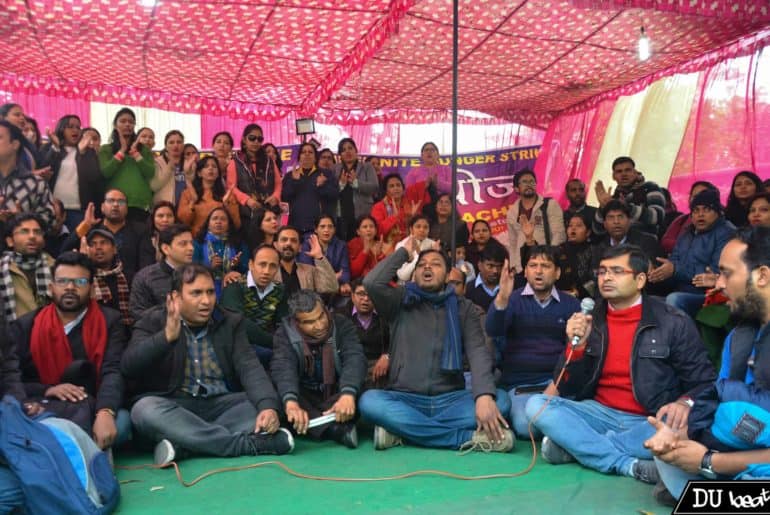
The students of the School of Open learning held a protest at the Faculty of Arts, North Campus on January 22. One of the major grievances of the students was the delay in the declaration of results. Students say that the number of people enrolled in SOL is very high and the current infrastructure isn’t enough to support it; the University is very lax in all its procedures. Moreover, since there was a delay in the release of results, many students could not fill up their forms for their post graduate degree on time.

Another grievance that the students want addressed is that there is always a disparity between correspondence students and regular students, with the former being neglected. They think kind of it as an “Education Apartheid” that most people perceive students of SOL as those who do not take studies seriously and thus are only interested in part time studying. Moreover, according to SOL students, they are very much neglected by the University, as they have only one class every week, which does not help them study in any way. The students believe that the correspondence students outnumber the regular students and so there is a need to open more colleges. There has been no new college under the aegis of Delhi University since the past thirty years.

They demand that the infrastructure to accommodate more students and organize more lectures for students should be immediately developed and 80 new colleges be set up so that regular evening classes can take place and students get access to study material. In response to the protests a senior official said an immediate meeting with the VC will be called.

There has been an outrage all over the country in the light of the 16th December incident. The gang rape of the 23-year old physiotherapy student in a moving bus has ignited a general outcry across India. Candle marches have been held all over Delhi. One such march was held at Sector-6 market in Dwarka on Saturday, 22nd December. It started in sector-6 and went up to the sector-12 market.

The people, close to 150 in number, carried candles and filled the atmosphere with slogans condemning the crime. Two groups marched on the roads. One group had ladies ranging from little girls to elder women. The other group consisted of teenagers. The energy and the anger could be felt throughout the streets.

The protestors halted the traffic for a little while, but cleared it soon. The candles and posters were later set on the footpath. A two-minute silence was observed for the well-being of the victim. The crowd also questioned the vigilance of the Delhi Police, as the bus went on a trip around Delhi for over 40 minutes. They expressed shock over how the victims were neglected by onlookers.

Archana Singh, a mother of two daughters, described “how utterly dangerous” it was for her and her daughters to step out of the house after dark.

Sahil Kukreja, a student, said “Capital punishment is the only fitting punishment for this heinous crime.”

Other punishments suggested for the crime were castration and public humiliation. People believe that any punishment that completely deters a criminal from committing such atrocity is the best punishment.

Suhani Rana says, “I can’t even imagine being in her place.”

The people pledged to fight for the right of women and to not let this matter become mere history. They also pledged to not blame the victims of this crime, referring to the stigma attached to the victims of such crimes. The incident has been very disturbing for the whole country. Schools like DPS Dwarka have stopped using private buses that are used to transport students.

Unlike the march at India Gate, however, there was not any violence in Dwarka and the Police force did not have to interfere. It was much more peaceful and people exercised their right to freedom of speech, without attracting any mishaps.

The victim is admitted in Safdarjung Hospital and has undergone two life-saving surgeries since the 16th. She is still in a critical condition due to an infection spreading across her body, the reason for which is supposed to be the iron rod. The doctors are worried about her delicate condition. She is communicating now, but with difficulty. No one but her mother has been allowed to meet her, given the fear of infection.

The only prayer India now has that the girl should come out of danger and the criminals should be punished properly, so that justice can prevail.


Shreya Mudgil
[email protected]