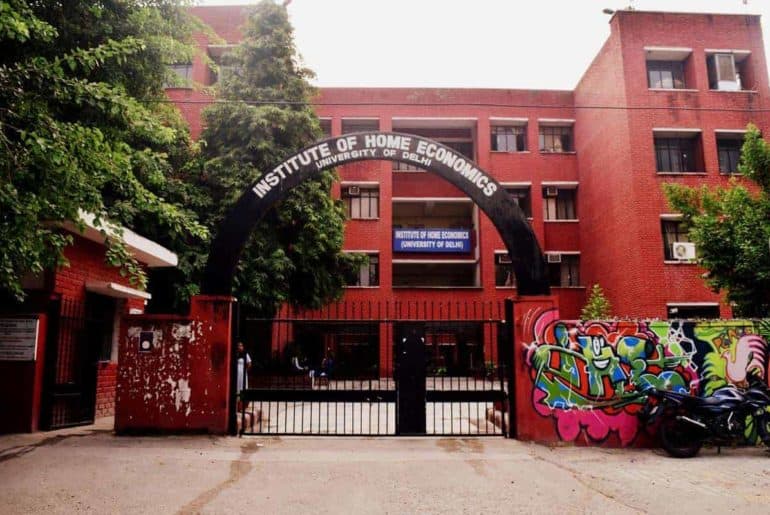
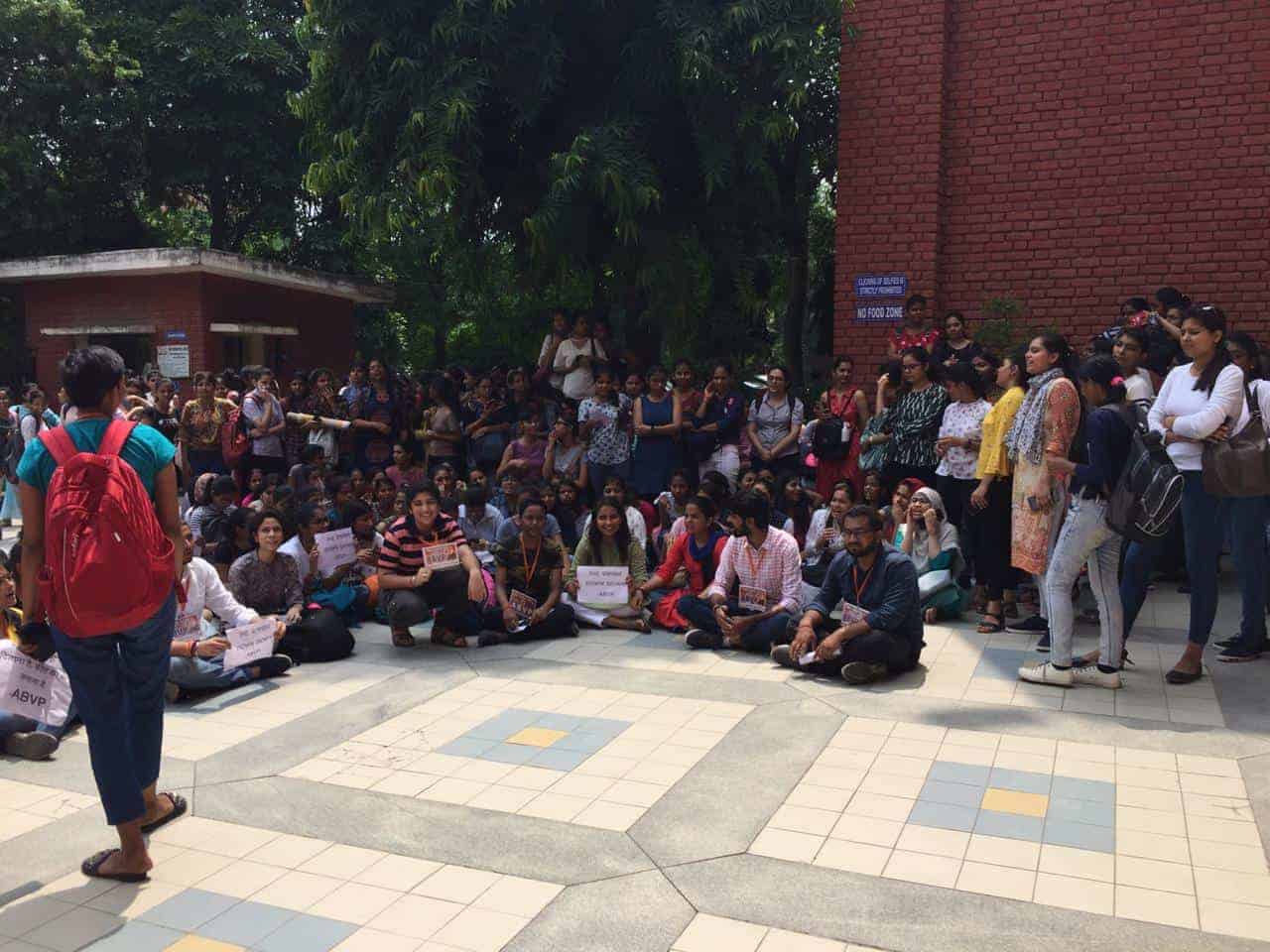
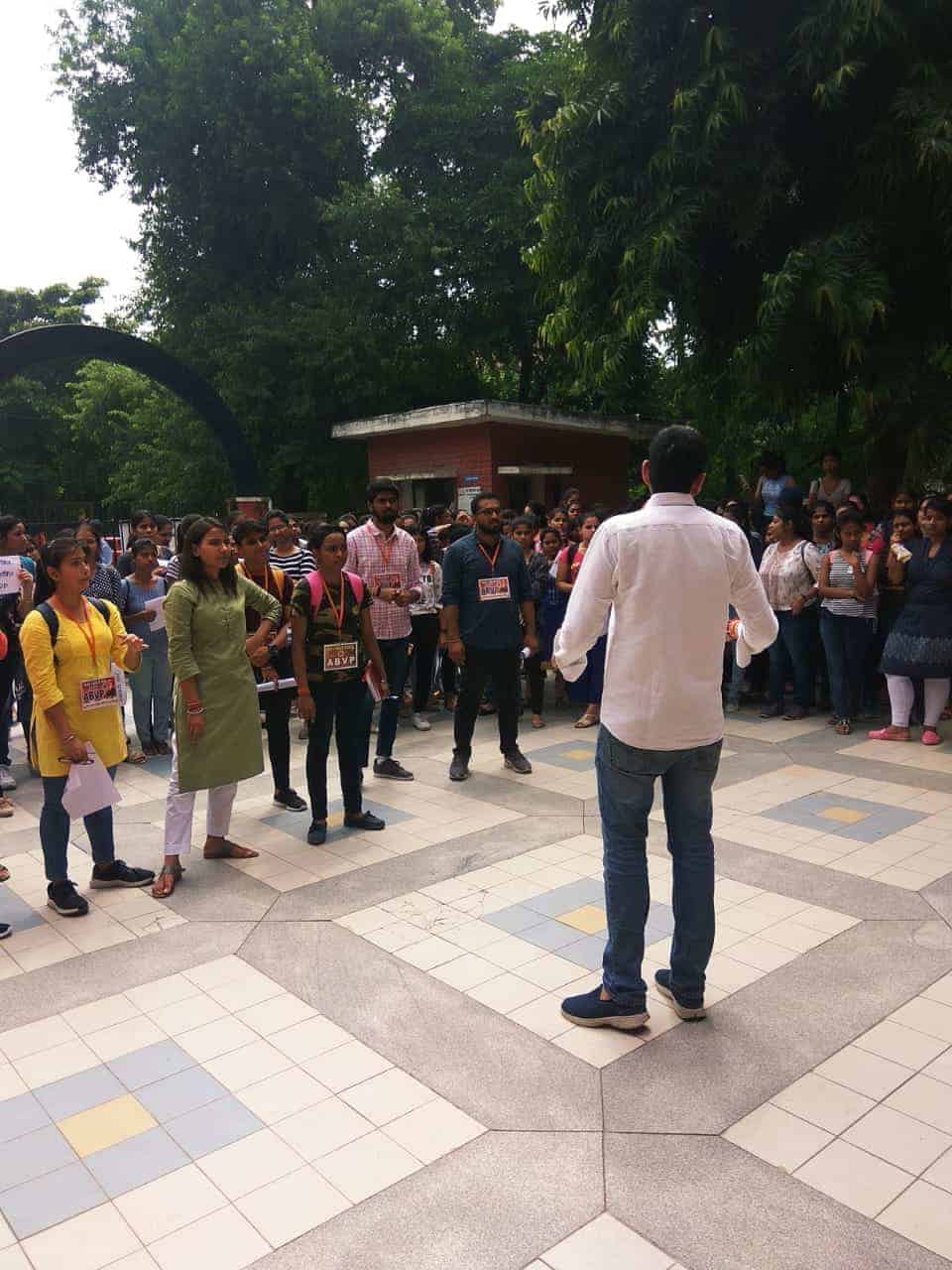
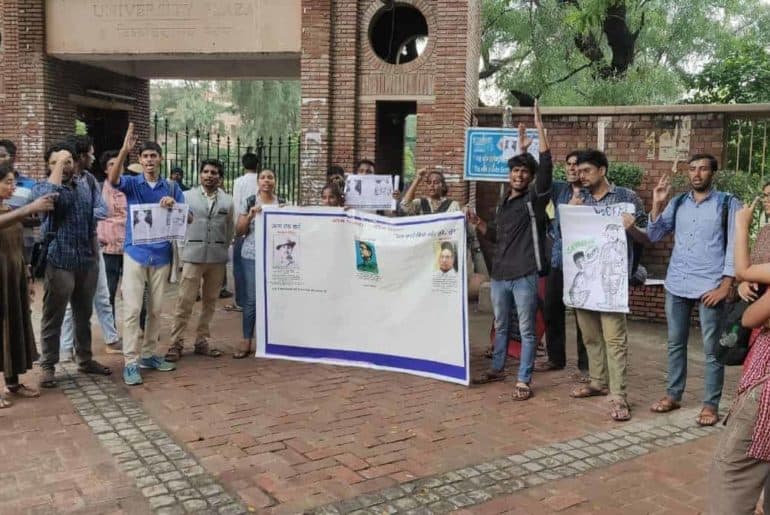
Students from the Institute of Home Economics, with the support of Akhil Bharatiya Vidyarthi Parishad (ABVP), engaged in a protest against the increase in the fees of the college.
On Monday, 1st September 2019, the students of the Institute of Home Economics led by ABVP protested against the increase in the fees of the college. ABVP placed several demands before the college administration including reduction in the fees, improvement in the quality of food in college canteen, renovation of college washrooms, and re-opening of the closed book shop inside college premises.
As per the latest fee structure, the fees for many courses have been increased by INR 8,000-10,000 from last year. Last year, the fee for courses such as B.Sc (Honours) Home Science and Microbiology was INR 19,675. It has now been increased to INR 28,890. Similarly, the fee for B.Sc (Honours) Food Technology was INR 29,895 last year which has now been increased to INR 39,995.
According to the students, the fee structure of the college always seemed inadequate to them as it has always been more expensive than other colleges affiliated to the University of Delhi (DU), but they had accepted it as the courses offered by the institute are not widespread and not a lot of colleges offer the same courses. However, this immediate increase in the fees seemed unnecessary and requires change along with other issues of the college.
According to Jyoti Chaudhary, ABVP’s State Executive Member and former Joint-Secretary of Delhi University Students’ Union (DUSU) “The fees of various colleges of Delhi University are constantly increasing, it’s a matter of concern for the common students. DUSU and ABVP had protested against the fee hike in colleges and hostels in the past as well, following which they were assured by the Delhi University Administration that their issue would be resolved but there has been no result so far. The way the fees are being increased by more than 50% in colleges, is not justified in any way. Colleges will continue to struggle against the fee hike.”
Image Credits: ABVP MediaStudents from Institute of Home Economics along with members of the ABVP protest against the fee hike. Image Credits: ABVP Media
Pratik Gupta, ABVP’s Institute of Home Economics Unit Chairperson said, “The fee of Institute of Home Economics is twice or thrice the fees of that of other colleges affiliated to the University of Delhi. Moreover, the college administration has imposed a financial burden on the students in several other ways adding to the common problems of these students. Fees inequality is unfortunate, considering that the condition of the washrooms and canteen of the college is not worth the additional fees.”
According to sources, hundreds of students participated in this protest against the authorities, but no one from the college administration tried to listen and understand the problems of the students. ABVP will soon conduct a protest on a large scale against the college administration in this context.
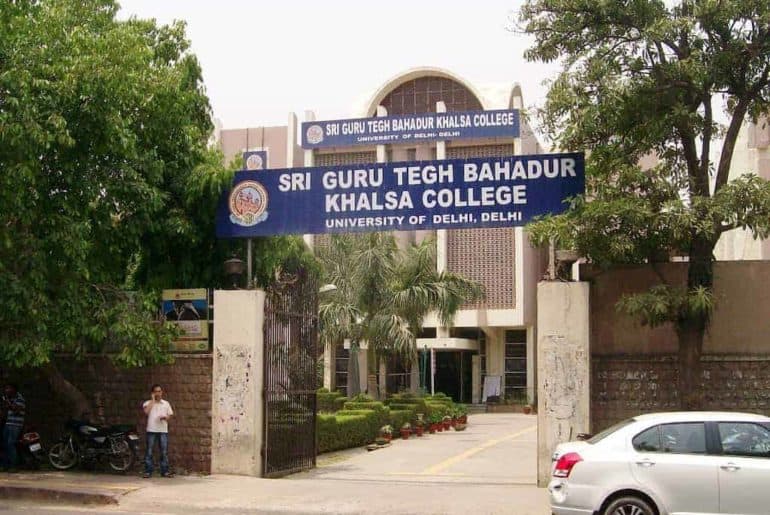
Students of Sri Guru Tegh Bahadur (SGTB) Khalsa College protest against an abrupt increase in fees by the authorities.
SGTB Khalsa, established in 1951, is one of the oldest and most prestigious colleges for Science, Commerce, and Arts in India.
Unlike other colleges affiliated with the University of Delhi (DU), the fee structure of SGTB Khalsa is relatively expensive. According to the sources, there has been a sudden fee hike this year ranging from INR 3,000 for Arts courses to INR 9,000 for Science Courses. Science students already pay additional fees in the name of labs and it has been increased again. Students are also charged in the name of university development fund, college development fund, maintenance fund, and overall development fund. Further, they are also expected to pay some extra amount as examination fees, which isn’t required in other colleges. Students are convinced that this is nothing but different ways by authorities of extracting money from them. This hike seems unjustified when there is no upgradation in the facilities provided by the college.
The source also revealed that apart from this, the accommodation facility inside the campus is also very expensive. The college hostels have skyrocketing fee structure of INR 71,000 per semester which is almost INR 1.5 lakhs per year. On the other hand, in other colleges, hostel fees are practically negligible or genuinely affordable.
According to Rhythm Nagpal, a student from SGTB Khalsa College, “The easily affordable fee structure is one of the reasons why Delhi University is a dream for students. We worked hard in high school to get here and this unjust behavior makes our efforts seem worthless. This hike is pointless and makes us question the authorities as it’s extremely unfair on their part. What will be the difference between private and government colleges then? The increment that is done gradually over years now takes place suddenly in just a year with no improvement in the facilities provided to us, the college needs to have a reality check and gain a perspective”.
Ravnoor Kaur, another student from SGTB Khalsa College said “The fees of DU doesn’t seem a lot and makes us think that a hike of Rs 3,000 hardly makes a difference but DU has students from all over the nation who are accommodated in PGs and are paying abundant of rent, which is also increased every year at an alarming rate. The administration should think of those students and think what impact this unjust action would have on them and their families”
The controversy behind the installation of the busts of VD Savarkar, Subhas Chandra Bose, and Bhagat Singh in North Campus escalated with protests, detentions and ultimate removal of the statues.
In a press release by the Akhil Bharatiya Vidyarthi Parishad (ABVP) today, the student outfit said that the Delhi University Students’ Union (DUSU) removed the busts of VD Savarkar, Bhagat Singh and Subhas Chandra Bose, which had been installed earlier this week, from the University premises.
It also said that the University administration has given assurance to the ABVP and the DUSU that after the students’ union elections – scheduled for 12th September – the busts will be re-installed as per the necessary procedure. According to the DUSU’s own admission, the busts had initially been installed overnight of their own will, as the administration had allegedly not responded to their requests for months.
Even though the ABVP is currently in power in the Union, the party had maintained that “the busts should be installed in the University of Delhi campus only with the permission of the Delhi University Administration and other concerned authorities.”
Before the removal of the busts, however, there had been demonstrations and protests by parties opposed to the ABVP. A signature campaign was held Friday by various student organisations, such as Parivartankami Chhatra Sangathan (Pachhas), Pinjra Tod Collective, Krantikari Yuva Sangathan (KYS), Students’ Federation of India (SFI) and others. Sources told us that during the proceedings, the police took action and detained two Pachhas members: Deepak Gupta and Manish Gautam.
A statement made by Pachhas alleged that the police took the biodata of both detainees, who were also told that they would be charged under Section 188 of the Indian Penal Code. The statement then alleged that Deepak Gupta was taken into a separate room, where he was not allowed to sit and not given water. Mr Gupta also alleged that the police tried to “personally attack and humiliate me verbally.” Gupta’s father was allegedly called by the cops, however owing to “bad signal” the call could not be completed. “In a half-hour interrogation, the police tried to intimidate me just because we were peacefully protesting against Savarkar,” the statement further read.
The statement further alleged that during the interrogation, two members of the ABVP, who had been detained for some matter, came into the room. “The strict demeanour of the cops disappeared,” it said. It was also alleged that while Gupta had been made to stand for half an hour, the ABVP members were offered chairs to sit. The statement said that the protests meanwhile kept going at the Arts Faculty Gate. Following the “continued pressure, both members were released after three and a half hours.” However, Gupta says that while the police told them that they were being charged with Section 188, Gautam and he were not given any information about it as they had not received any calls regarding this yet.”
Speaking to DU Beat, Siddarth Yadav, State Secretary, ABVP Delhi, denied the veracity of this chain of proceedings. “It is a good story but none of it is true,” he said. However, he did not respond on time to our further questions regarding what the correct account of proceedings in his view was.
A statement released by ABVP said that the party “demands stringent legal action against those involved from the National Students’ Union of India (NSUI) in insulting our freedom fighters” – in response to the NSUI Delhi President Akshay Lakra blackening the bust of Savarkar around 2-2:30 a.m. on 22nd August. “Student organisations associated with left ideology, CYSS and NSUI have stooped down to a very low level and have given a major blow to the culture of debate and discussion prevalent in the university,” it read, saying that the said organisations were “insulting freedom fighters to meet their trivial political interests.”
Akshay Lakra also released a statement which said: “NSUI never wanted to create any hooliganism or nuisance in the campus but we won’t tolerate infiltration of any type of fake nationalism.” He alleged that the “ABVP tried to divert the attention of students of [their] unsuccessful DUSU 2018 tenure including Ankiv Baisoya’s fake degree… this whole statue incident was an attempt to polarise and change the discourse of DUSU elections.”
The history and importance of protests and political expression in the University of Delhi (DU) after Vivekananda College released a notice warning students against taking part in political rallies becomes more significant.
DU is known for having an active and politically engaged student body, with protests, marches, and parades for various issues being an integral part of college life. Being a part of DU means being a part of a student body comprising people from all parts of the country, all sections of the society, and ideologies across the whole spectrum. In the varsity, students actively use responsible and peaceful forms of dissent to get one’s voice heard and bring student issues to the forefront. However, this freedom is slowly coming under attack due to certain groups of people trying to enforce their ideologies and stifle others who go against them. Recently, with Vivekananda College issuing a notice warning students against taking parts in political rallies and promising a disciplinary action for those who disobey, this suppression of voice has become more apparent and real.
Aahil sheikh, a first-year student of B.A (Honors) Political Science from Kirori Mal College, when asked for his opinion on Vivekananda College’s decision, stated “The current decision of Vivekananda College to ban political activities on campus takes away the autonomy of college students which completely goes against the right to protest. I believe that the Constitution has given everyone, including college students the right to mobilize and try to get something they believe in, so I am completely against the decision taken by Vivekananda College.”
On the importance of youth activism at college, Manvendra Krishna , another first-year student from Kirori Mal College said “Since the youth is the future of the country and college is the final stepping stone for students before they enter the real world, the exposure to politics at the college level is important because it produces educated student leaders and empowers the students to question the system, and provides them a medium to voice their opinions on the policies that impact them and fight the oppressors by making them aware of their rights as well as that of others and bring about a positive difference in the world.” Krishna quoted an example of Joshua Wong, who at a tender age of 14 was the face of the umbrella revolution: a pro-democracy movement that barricaded itself in downtown Hong Kong to emphasize that there are many such Joshua Wongs in the world but they according to him don’t get enough opportunities to speak. He also added that “This snatching away of student voices is aversive to the fundamentals that bind a democracy. Thus, I believe in advocating for a system that fosters the growth of many such young and educated student leaders so that the system becomes more responsible and accountable.”
College students are of the age and maturity to know how to show dissent and protest responsibly. They should be allowed to voice their opinions on campus since that is the fastest way to reach the eyes and ears of the administration. Democracy is constantly changing and evolving and students can and play an integral role in keeping the administration and the government in check.
Following demands to rename the Delhi University Students’ Union (DUSU) Office after VD Savarkar, the DUSU has now installed a pillar with the busts of Savarkar, Subhas Chandra Bose and Bhagat Singh in the campus, creating a new row.
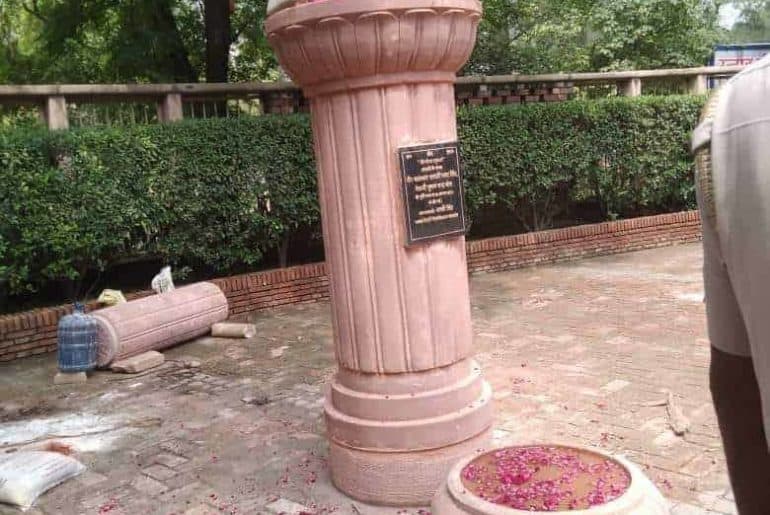
In an incident that is causing a new controversy in the University of Delhi (DU), the DUSU– led by the Akhil Bharatiya Vidyarthi Parishad (ABVP), the students’ wing of the Rashtriya Swayamsevak Sangh (RSS)– on Tuesday, installed the busts of VD Savarkar, Subhas Chandra Bose and Bhagat Singh on a pillar outside the Arts Faculty Gate No. 4 in the North Campus. This development comes a week after the student party raised a demand to christen the DUSU Office as ‘Veer Savarkar Bhawan’.
This episode has created a new row in the University circuit. The conflict has arisen because firstly, the DUSU allegedly not followed the proper procedure behind the installation of the busts, and secondly, the opponents of this move are raising a more fundamental criticism that placing Savarkar along with Subhas Bose and Bhagat Singh is unjustified.
“Anti-national step”
In what seemed like giving the ABVP a taste of RSS and BJP’s own medicine, the Indian National Congress (INC) backed National Students’ Union of India (NSUI) called the move made by the DUSU an “anti-national step” and an example of “sheer pseudo-nationalism”.
Saimon Farooqui, the National Secretary of the NSUI, said, “ABVP has always considered VD Savarkar as their hero. [In spite] of him begging for mercy in front of the English Government, the ABVP wants to promote his agenda. We should never forget that he opposed Quit India Movement and refused from unfurling Tiranga, hence demanding for Hindu Rashtra. Comparing Savarkar to Shaheed Bhagat Singh and Subhas Chandra Bose is an insult to our Martyrs and their freedom struggle. Naming the august office of representatives of the students of one [of] the best universities after an anti-national person will bring disgrace to the university. It is an example of sheer pseudo-nationalism of ABVP. I, on behalf of NSUI strongly oppose this anti-national step.”
Similarly, on the issue of naming the DUSU Office after Savarkar, Sumit Kataria, the Delhi State Vice President of the Students’ Federation of India (SFI), the party affiliated to the Communist Party of India (CPI), said, “They [DUSU] are not making any new institution and are just renaming an already existing one. All these are just political gimmicks by ABVP to cover up the fact that they have not done anything for the welfare of the student community over the past one year since the DUSU elections are around the corner. Also, this is just a part of their agenda of rewriting Indian history. Savarkar was a traitor to the Indian freedom struggle as he wrote many mercy petitions to the British and had pledged his allegiance to the British rule. Also, his views are completely against the idea of a secular democratic India. Naming DUSU office after such a person should be opposed at any cost and it will be.”
Akshay Chauhan, a student of History at Hindu College stated “I must say Bhagat Singh has died today. To be venerated with a Hindu nationalist who was in cahoots with the colonialists, Bhagat Singh died a shameful death.”
“Youth icons”
Not all were condemning the move of the DUSU. Professor Rasal Singh, a Member of the RSS-affiliated teachers’ organisation, National Democratic Teachers’ Front (NDTF), said, “All three [Savarkar, Bose, Bhagat Singh] are great youth icons. It is high time for the youth to get inspired by them and inculcate those values for which they lived and died.” Prof Singh had contested for the post of the DUSU Vice President on an ABVP panel in 2000.
However, given that many contested and criticised Savarkar’s very ideals and actions, was it justified to consider him a hero? “Yes definitely,” replied Professor Singh, “This is distorted history [written] by communist and colonial historians. That’s why we demand rewriting of history with nationalist perspective.” He asked in return, “Members of DUSU, which is [the] largest students’ union in the country and ABVP, which is [the] largest organization of students in the world feel that Savarkar is a national hero. [Then] what’s the issue? [Do] not they represent youths of this country?”
DU Beat had previously quoted Siddharth Yadav, the ABVP Delhi State Secretary, as saying, “Our University has forgotten the heroes of our freedom struggle. If studied thoroughly, he [Savarkar] is the true inspiration for youngsters.”
Question of procedure
According to a report in The Indian Express, “The pillar came up overnight and, by DUSU’s own admission, without permission from university authorities.” The report stated that a guard, supposedly on duty outside the Arts Faculty Gate No. 4, had said, “a mini-truck was brought in a green tent-like structure around 2 am [on Tuesday], which was set up outside the gate and surrounded by ABVP activists. Around 9.30 am, the structure was removed to reveal the pillar.”
Shakti Singh, the DUSU President in the aforementioned report, stated “We have written to university officials several times asking for permission to set up such a monument — last November, this March, April and again in August — but we got no response. So we decided to go ahead and do it ourselves,”
The condemnation (and approbation) towards the installation of Savarkar’s bust alongside those of Subhas Chandra Bose and Bhagat Singh was largely partisan. However, concerns regarding the adherence to the proper procedure were raised by even those who fundamentally supported the idea of installing the busts. Despite hailing the move itself, Professor Singh said, “However, I feel laid-down procedure should have been followed for this installation.”
Mr. Yadav, regarding the question of procedure, said, “ABVP is of the clear view that the busts should be installed in Delhi University campus only with the permission of the Delhi University Administration and other concerned authorities.” Despite reiterating the claim of the DUSU that their demands had been “completely ignored” by the administration, he added that “ABVP has clarified to the [DUSU] that the busts should be kept in the DUSU office till the permission is granted and the busts should be installed only after the due permission of the administration.”
The land on which the bust has been installed falls under the jurisdiction of the North Delhi Municipal Corporation (NDMC), as reported by the Indian Express.
Protest against the bust
The Indian Express had quoted Akshay Lakra, the NSUI Delhi Unit President, as saying, “If the statues are not removed within 24 hours, we will launch a strong protest.”
Then, early morning on Thursday, NSUI activists were seen approaching the Arts Faculty Gate where the pillar was installed. TheTimes of India reported that the incident took place between 2-2:30 AM. Mr Lakra, who was leading the members of the student party, first garlanded the busts of Bhagat Singh and Subhas Chandra Bose and then tore off the garland from Savarkar’s. He then went on to place a garland of shoes around Savarkar’s bust but was stopped by the security personnel present there. With the garland of shoes off the bust, Mr Lakra then defaced it with what looked like black ink. The bust was, however, found clean in the morning today.
Akshay Lakra, NSUI Delhi President, was seen defacing the Savarkar bust around 2 AM. Image and Video Credits – Amarjeet Kumar Singh, AISA
It should be noted that these recent developments have come up when the DUSU elections are just around the corner. The University announced on 20th August that while the last date for filing nominations is 4th September, the polling will take place on the 12th of September.
Feature Image Credits – Kawalpreet Kaur – Delhi President, All India Students’ Association – via Facebook
In response to the abrogation of Article 35A and Article 370, the nation saw countrywide protests being organised by various organisations.
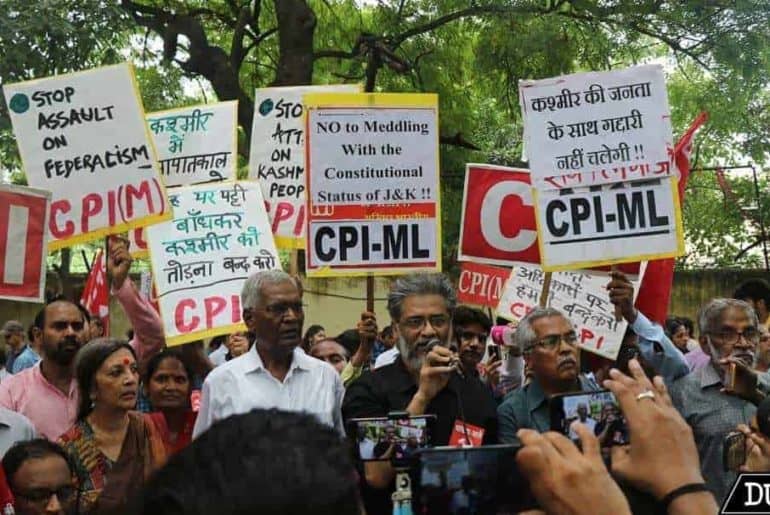
Student leaders, political figures, and dissenting students took to the streets of Mandi House to make their way to Jantar Mantar to protest the abrogation of Article 35A and Article 370 which granted special status to the state of Jammu and Kashmir. The protest was supported by organisations including Communist Party of India, Communist Party of India (Marxist), Communist Party of India (Marxist-Leninist), and All India Forward Bloc (AIFB).
The move has left people confused and shocked. People have been vocal about their dissent through social media. The varied reactions, some celebratory and some condemning it have made Delhi the hotbed of protests and celebration rallies this week.
“There’s a new way of misogyny in the air after the abrogation. There are memes and posts about men wanting to marry a Kashmiri woman. Does this mean they intend to kill all our boys? There has been excitement over the prospect of buying land. So, it was never about the people, was it? Only the land,” said a Kashmiri woman.”I’ve been here for 10 years. I went to university here, I got my first job here. I’ve never come out for a protest ever before but the latest news forced me out of my house. I need to be seen, I need to be heard.” added another Kashmiri woman on the conditions of anonymity.Amidst placards, posters, and media personnel running around to take interviews, a few protestors drew graffiti and wrote slogans on the road as leaders from the Communist Party of India (Marxist-Lenininst) spoke about the issue.
Shortly, a counter protest by unknown people began outside the barricades. They unfurled the national flag and waved it high while shouting slogans demanding ‘azaadi’ (freedom) from ‘anti-nationals’. Their display of hyper nationalism found itself in slogans praising the nation as the police and CRPF forces formed a tight, protective circle around them. The counter protesters also chanted aggressive slogans like “desh ke gaddaro ko, goli maaron saalon ko” (shoot all the traitors of the nation).
As the valley spends its third day without any communication channels, reports and rumours of protests, stone pelting, and death in the rehion leave the Kashmiri students in Delhi distressed.Students are yet to hear from their families back home. Reports of curfew and increased military presence has only added to their fears and worries.
The abrogation has left Ladakh as a Union Territory without its own legislature. Students from Ladakh spoke against the decision. Mohammad Ali, a student from Jawaharlal Nehru University said,“The MP proudly smiles and boasts his hapoiness on TV, he say the people of Ladakh are happy, but let me tell you that they aren’t. There have been protests because we don’t welcome this move. Bifurcating the state only puts us in a more vulnerable position. Ladakh’s ecology is in danger due to climate change and rising tourism. The abrogation of Article 370 and Article 35A will only damage the ecology further as outsiders will try to set up their companies. Tell me, how do you take such a major decision without asking the people? Is this what Indian democracy stands for?”
Many students chose to cover their faces at the protest or chose to not show up at all. Fear of being recognised and reported grips the Kashmiri diaspora in Delhi. “As a Kashmiri woman, my fears have only increased this year. First it was Pulwama, and now this.” The suddenness of the abrogation has left students torn between the legalities and the emotions it provokes. “It’s unconstitutional and undemocratic, that’s all I can say,” said a university student. “They’ll have to lift the curfew someday, and when they will, there will be bloodshed. I am terrified of that happening.”
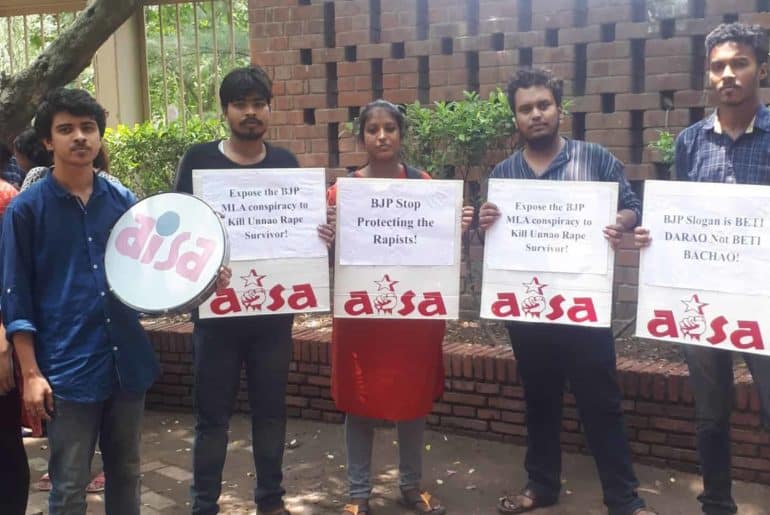
Various University of Delhi (DU) Student Organisations gathered to protest against the planned attack on the Unnao rape victim. Read on to know more.
Student organisations of DU held a joint protest in front of the Faculty of Arts, North Campus, on 1st August 2019, to show their dismay over the lack of protection provided to the Unnao rape victim, and the delayed actions taken by the Supreme Court and the Government with respect to this incident. They also condemned the BJP Government, especially Yogi Adityanath, the Chief Minister of Uttar Pradesh, for being complicit with the accused.
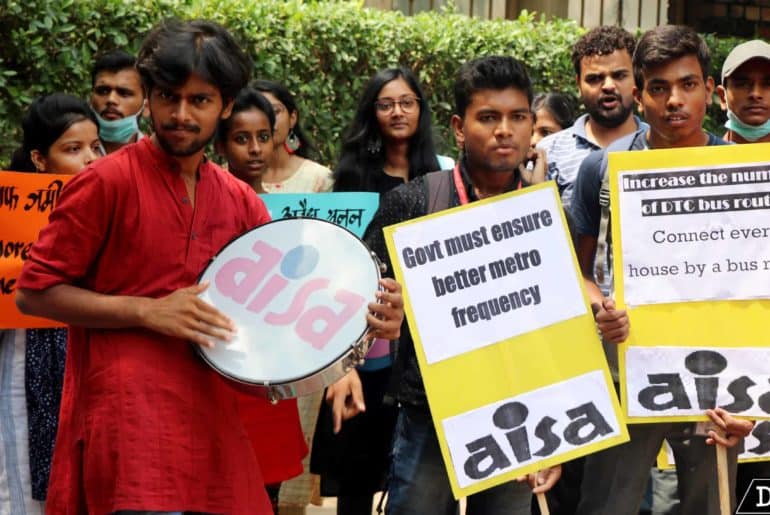
All India Students’ Association (AISA), All India Students’ Federation (AISF), Krantikari Yuva Sangathan (KYS), Pinjra Tod, Students’ Federation of India (SFI), etc., were some of the student parties that had joined the protest.
Shreya Singh, a member of the All India Democratic Students’ Organisation (AIDSO) said, “This protest is not only for the Unnao rape victim, but for the lack of safety provided by the Government to girls and women in the country. This protest is against patriarchy. It is for true equality and real freedom for women.”
In the shadow of the Unnao Rape Case, Siddhant Raj, a member of the Progressive Democratic Students’ Federation (PDSF) questioned the Government, the police, and the Supreme Court’s capabilities to protect the girls and women in the country. Many present also condemned the BJP Government’s hypocrisy with respect to the status of women in the country. Harish Gautam, a member of KYS said, “The BJP MLAs go around chanting slogans of ‘Beti Bachao, Beti Padhao’ and promote themselves by clicking selfies in front of campaigns like this, but when it actually comes to it, they do nothing to protect the girls in the country. Right from the beginning, the Unnao rape survivor was being threatened but the BJP Government failed to provide her with any security.” Shreya Banerjee, a member of AISA agreed to this and said, “Beti Bachao, Beti Padhao has been murdered.”
On 28th July 2019, the Unnao rape survivor and her lawyer were critically injured and the rape victim’s relatives killed in a car accident in Rae Bareli, allegedly planned by the BJP MLA Kuldeep Singh Sengar, the main accused in the rape.
The National Student’s Union of India (NSUI) held a protest march against the amendments made to the Right to Information Act (RTI) by the Government. Read on to know more.
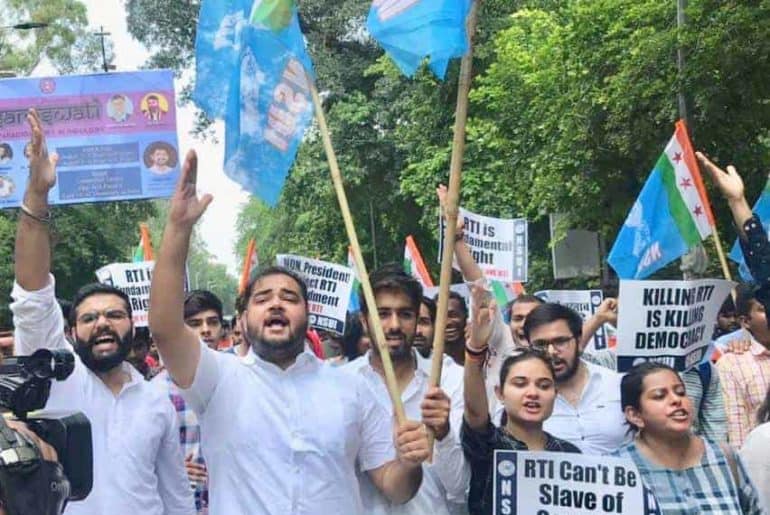
On 1st August 2019, the NSUI held a protest march in front of the Faculty of Arts, North Campus, showing its strong displeasure towards the move taken by the Government to make amends to the RTI Act. The members of the students’ political party marched from the Faculty of Arts to Kirori Mal College, all the while chanting slogans like “RTI Bachao, Desh Bacho“.
Neeraj Kundan, National President, NSUI said, “Today the RTI is one of the most important laws in the country, it directly affects the people. In 2017, when the BJP Government saw that the RTI could expose high government officials like Smriti Irani, and even Prime Minister Narendra Modi, they started trying to curb its power. The Government is now trying to reduce its autonomy and cage it. NSUI is going to hold protests all over the country until our rights are given back to us.”
Students and associations like The North East Students’ Society, Delhi University (NESSDU) turned up in large numbers to support the NSUI’s protest against the RTI amendments. They marched with bold banners and enthusiastic slogans. The presence of the Delhi Armed Police and Central Reserve Police Force (CRPF) showed how protests in the DU are feared to turn violent, but this was an extremely peaceful protest.
Surbhi Dwivedi, National General Secretary of NSUI and the RTI Team Convener emphasised on the importance of the RTI for the student community. She said, “The RTI is the most effective tool in student politics. It helps students to find discrepancies in the University. A strong RTI is our right.” Robin Chaudhary, National Secretary of NSUI, said that they were determined to fight for democracy and that if the Government did not heed to their demands, they would go on a hunger strike.
The RTI Act, 2015 is an Act of the Parliament of India “to provide for setting out the practical regime of right to information for citizens”. It has made the workings of the Government more transparent, helped to reduce corruption and has facilitated in the workings of this democracy. The RTI Commissioners used have fixed five-year tenure and their salaries were equal to certain posts in the Election Commission and the bureaucracy. The recent amendments made to the act by the BJP Government have changed this. According to the new amendments, the central government now has direct control over the Chief Information Commissioner and Information Commissioners’ term of office and salaries. The changes made to the RTI are being seen by many as the Government trying to control it, and as a result of this many voices in objection to the RTI amendments are being raised all over the country.
The University of Delhi (DU) recently saw a row emerge over the proposed syllabus changes in some undergraduate courses. To understand this better, we spoke to some of the key players involved.
The story developed rapidly in the last couple of weeks in what has now become an ideological battle as various organisations clashed over proposed changes in a variety of the University’s undergraduate programmes – English, History, Political Science, Sociology. Both sides levied a number of accusations on the other – in essence, ranging from trying to manipulate academic spaces to spreading propaganda against certain ideologies. However, some claim that the issue is not a Left vs Right matter at all.
A few characters seem important to this story: Professor Rasal Singh, the Academic Council (AC) member who opposed these proposals; the Akhil Bharatiya Vidyarthi Parishad (ABVP), the student wing of the Rashtriya Swayamsevak Sangh (RSS), which protested against these changes; a host of Left organisations like the Students’ Federation of India (SFI), All India Students’ Association (AISA), Collective, and others, who staged counter-protests against the ABVP’s demonstration; Professor Saikat Ghosh, another AC member who defended the recommendations of the departments. Our conversation with Professor Sanam Khanna, who was involved in the syllabus drafting exercise, is also of great interest.
But first, here’s the background. After objections from within the AC and the protests by the ABVP over the alleged negative portrayal of the RSS and its affiliates, and what was called “inclusion of false facts relating to Hinduism and nationalist organisations,” organisations like the SFI, AISA, Collective and others staged a ‘joint protest’ in return. As reported by The Indian Express, the University’s English department has decided to drop the “objectionable” portions as it did not want to “hurt anyone’s sentiments”. With “minor modifications,” changes in the Political Science and Sociology courses were reportedly passed, while the Head of Department of History said that the department may “consider changes”.
{One}
In a long text sent to us by Professor Rasal Singh, he detailed the reasons for his opposition to the proposed syllabus changes. Some of the more widely reported reasons were his objections over the alleged depiction of the RSS and its affiliates as “looters” and “murderers” in the story Maniben Alias Bibijaan – a background to the infamous 2002 Gujarat riots – and also the usage of Hindu deities, such as Vishnu, Shiv, Kartikeya and Ganesh, in readings about queerness, based on what he called secondary sources “written by Leftists on the basis of foundational texts of Indian culture like the Bhagavata Purana, Skanda Purana, and Shiva Purana.”
While his right-wing leanings might be apparent above, he also cited some concerns – which were not as widely reported – that perhaps blur the typical ‘rightist’ and ‘leftist’ lines, as we generally understand them. Among these were the alleged removal of the histories of Amir Khusrau, Sher Shah Suri and Dr B.R. Ambedkar, along with those of the Rajputs; the absence of social movements like Bacha Khan’s Khudai Khidmatgar movement; the removal of topics on environmental discussions and nature worship in Sociology courses. In addition, he also alleged that the English Department had made close to “100 per cent” changes in the syllabus, instead of 30 per cent, as supposedly mandated under the rules of the Choice Based Credit System (CBCS) curriculum. Yet, he also stated that the syllabus showed “tremendous predominance of leftist ideology and a ceaseless opposition towards nationalist ideology, Indian culture and the RSS”.
For more details on why the revised syllabus faced objections, read this author’s previous piece here.
We asked Mr Singh what was a bigger reason for his objection – the content of the proposed chapters or the English department allegedly not following the ‘30 per cent’ CBCS rule. While he said that the latter was also an issue, the content of the chapters remained more problematic. Objecting to what he called the “monopoly” of one ideology (read leftism) in the syllabus revision exercise, he said that a more inclusive process, accounting for teachers with “diverse ideologies and specialisations,” would have been less controversial.
At this point, we wondered whether Mr Singh had some reservations about the ideology of the left itself. He denied. He said that he did not have any issues with the priorities and politics of the left, but with their “exclusive” presence in the process. “Inclusion of other ideologies in the process would have made for better discourse,” he said. Mr Singh’s reservations over the inclusivity of the process also extended to the sources of information supposedly used. Claiming that most news sources used for the Gujarat and Muzaffarnagar riots case studies – The Wire, Scroll, Al Jazeera, to name a few – were ideologically-driven and not mainstream either, he said that other sources, such as Aaj Tak, ABP News, NDTV and The Indian Express, should also have been used.
An SFI press release had mentioned other instances of what they called attempts by the RSS and its “frontal organisations” to “tamper with the education curriculums”. There had also been allegations – such as the one by Professor Nandita Narain, former President of Delhi University Teachers’ Association (DUTA) – that the ABVP protest turned hostile wherein the protesters allegedly demanded that the Heads of Department of English and History departments of the University and AC member Professor Saikat Ghosh be “handed over” to them. Mr Singh – an ABVP leader during his student days – denounced violence and misbehaviour against teachers perpetrated by any organisation. However, he claimed with “full responsibility” that these allegations were false. Christening the ABVP “the most culture-conscious party” out of all student organisations, he said that while the protesters did enter the Vice-Chancellor’s office, they did not enter the Council Hall. “I’m disappointed that some AC members called the students ‘goonda’; students are also important stakeholders [in determining the syllabus],” he said.
{Two}
“This is the most ridiculous allegation that can be heard,” says Siddharth Yadav, the Delhi State Secretary of ABVP, when we ask him about the veracity of the alleged hostile nature of his party’s protest. “We have fundamentally opposed the changes, both technically and ideologically. Why would we demand the teachers be handed over? I don’t even know who comes up with these things. Technically we oppose the process which was adopted for these changes. We have been demanding student representation in the academic council for a long time. A handful of teachers made the entire course without any discussion with the stakeholders. This was our second protest in a row to prevent the mishappening,” he adds.
In their press release, the ABVP had said that they don’t want the “anti-Hindu mindset of the left” to dominate the curricula. However, professor Rasal Singh of the AC had raised other objections also. Was the ABVP against those issues as well or only against RSS’ alleged negative portrayal? We posed this question to Mr Yadav, to which his response was: “Ideologically we are opposing a lot of changes. All Dalit writers have been removed from ‘Hindi Upanyas’ curriculum, Ambedkar’s name has been removed from Dalit thinkers, Godhra riots have been wrongfully presented, a lot of ancient history has been deleted and only the colonial period is focused upon, Maoism and Naxalism is shown as a social movement, Hindu gods and goddesses have been wrongfully commented upon by relying on secondary sources and the list goes on.”
Saying that “all we wanted” was a “review of the syllabus”, Mr Yadav said that there was “a lot more than what is being told. I hope it comes out soon.”
{Three}
The Vice-President of SFI Delhi State, Sumit Kataria, says, “Whenever the BJP has been in power, they’ve always attacked our education system”.
There is a general belief that the academia is largely populated by left-liberals. From some of the most prominent historians of our country, who tend to belong to Marxist schools of thought, to litterateurs critical of the right-wing, there probably is a presence of a more left-oriented academia. After all, the ABVP and Professor Rasal Singh expressed clear displeasure over the alleged leftist character of the revised syllabi. This situation is perhaps not even unique to India either; conservatives in the United States have been claiming for quite some time now that their voices in the university spaces are shrinking. We asked Mr Kataria if he felt that there was a general dominance of the left in academia and if that could make the right-wing voices feel that they are not heard properly. “To say that there is a general dominance of the left ideology is a very ahistorical statement. When has the left ever dominated the academia? It [academia] has always been dominated by the elite and the upper caste sections in India. The left is not in power, so how can we dominate?” he responds. “It is the right-wing organisations’ propaganda and nothing else.”
Now that the revised syllabus has been taken back, essentially ending things the way the ABVP wanted, do parties like the SFI consider it a loss? Mr Kataria says, “It doesn’t mean that ABVP has won. It is our education system that has been defeated and not SFI or any other organisation…These are just attempts at destroying our democratic education system.”
{Four}
Professor Saikat Ghosh. AC member. Professor of English. Allegedly wanted by the ABVP to be “handed over”. Speaking to Mr Ghosh brings a few twists, and confusions, in the story.
He tells us that the information about the alleged “handing over” demand of the ABVP was given to him by the security personnel at the Viceregal Lodge, where the office of the Vice-Chancellor is located. “We were told by the security guards to disperse from the University premises at the earliest as the threat of violence is real.” He further added, “We were escorted out of a back entrance of the Viceregal Lodge in a clandestine way. We were also told that the lights surrounding the Garden outside the Viceregal Lodge were switched off by the ABVP to ensure that CCTV becomes ineffective in the case of an actual physical attack.”
“Unfortunate and indicative of vindictive rejection of the English Dept’s academic autonomy,” was how Mr Ghosh described the resultant withdrawal of the proposed syllabus by the English department. Claiming that the department’s “academic arguments are not being heeded,” Mr Ghosh alleged that the University Undergraduate Curriculum Revision Committee – tasked with overseeing the revision process – had “taken the role of a bully on behalf of the ABVP and NDTF (National Democratic Teachers’ Front)” – both linked to the RSS.
While Mr Singh had called for consultations with more teachers to ensure inclusivity in the process – he said only around 15 teachers of the English department drafted most of the new syllabus – Mr Ghosh contradicted him. “Prof. Rasal Singh is conveniently hiding the fact that 120+ teachers from across 50 DU colleges participated in the English syllabus revision,” he claimed. He further said that an “open call” was given in the English teachers’ General Body Meeting (GBM) in 2017 for voluntary participation in the syllabus revision, of which the “right-wing” teachers chose not to be a part. “Students, alumni and peers in the international academia recorded overwhelming praise,” he said about the revised syllabus, which was supposedly open for “public review and feedback for a month”.
“The NDTF and ABVP seemed to be sleeping through the entire exercise. The RSS is politicising it and not engaging with the academic merits of the syllabus,” he alleged. When we asked Mr Singh whether this was true, he replied that he said “whatever is fact.”
Mr Ghosh profoundly disagrees about the whole issue being an ideological one. He has been associated with the SFI in the past, but strictly maintains that his support for the syllabus has been on academic grounds and that he has not “asserted any party agenda.” He also said that many of the teachers involved in the exercise did not belong to any political background.
“The issue is not a battle between the Right and the Left. It is being given an ideological colour by those who don’t want the English department to give its students a world-class syllabus that allows them to engage with contemporary social and aesthetic concerns. The people opposed to the English syllabus are being unfair to thousands of students who dream of pursuing an English Honours degree from DU colleges,” he said.
Was the process really ideological in nature? Were only members of a certain ideology considered for the syllabus revision exercised, as alleged by some? Or was there an attempt made by the departments to accommodate as many teachers in the drafting exercise as possible, as was claimed by some others?
Professor Sanam Khanna, a teacher of English at Kamala Nehru College, also participated in the syllabus revision exercise. She said that the whole syllabus drafting exercise, which began two years ago, went something like this: “The English department called a General Body Meeting of all teachers from across the University. From the GBM, subcommittees were formed to look after clusters of papers. The drafting process starts from there based on what the teachers feel the students need, the shortcomings of the current syllabi, and feedback from their departments.”
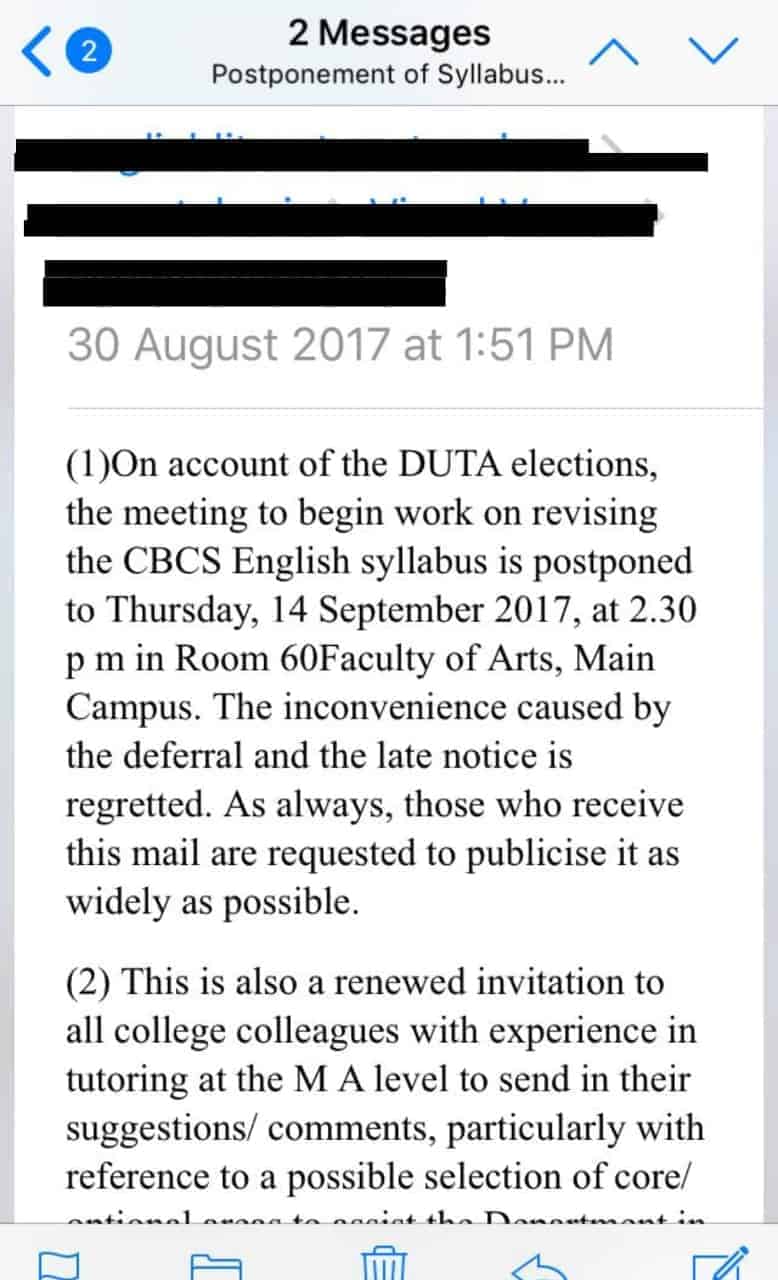
DU Beat got access to some of the emails, dated 2017, which were sent as intimation regarding the syllabus drafting exercise.
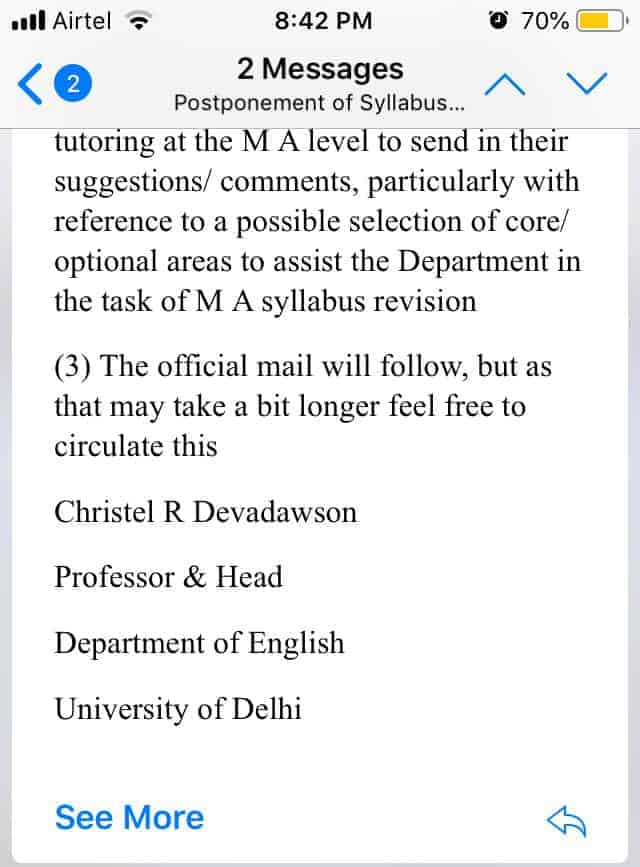
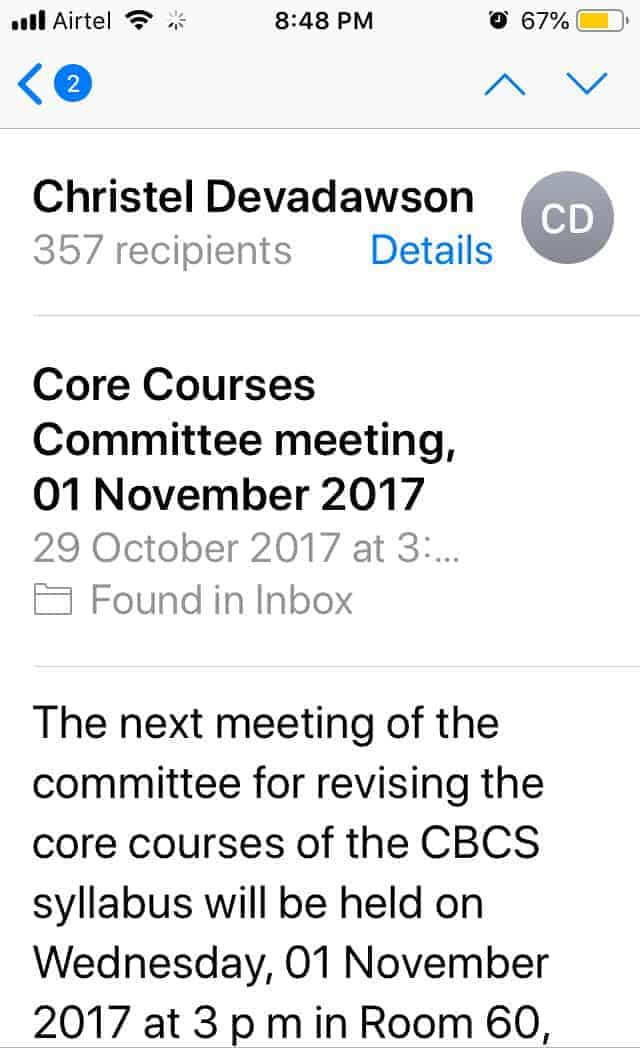
E-mail 1E-mail 2The emails accessed by DU Beat show that invitations to be a part of the syllabus revision process were sent to a large number of professors and colleges.
The first and second images of the email dating 30 August 2017 show that the revision exercise was already underway at least as early as September 2017. Here, a clear request has been made for publicising the email as widely as possible and suggestions and recommendations have been invited. The email was sent by Professor Christel R. Devadawson, the then English HoD. The second email – also by Professor Devadawson – dated 29 October 2017, was sent to 357 recipients. The email seems to be about the committee on revising the syllabi for the core courses – an indication that multiple people were involved in the drafting exercise. “Mails such as these were sent to all principals and colleges as well as English teachers’ groups and email lists, inviting suggestions and participation,” Ms Khanna said. “So how can anyone say the process was ‘limited’? Whoever was interested came, attended and worked for over two years,” she added.
Ms Khanna also denied any ideological motivation behind the syllabi. “This is a huge collective effort. It decolonised the study of literature. For the first time in DU, so many Indian authors have been introduced in the syllabus. More than 100 Indian authors across different time periods and genres [were included]. What is leftist here? It is deeply painful to hear such unacademic responses,” she said.
We tried contacting Professor Sunil Kumar, the HoD of the History Department, via email but he did not respond to our queries by the time of publishing this article.
{Five}
What may have started as a purely academic exercise has now taken the form of an ideological and political tussle. The organisations holding protest after protest all come from one or the other ideological leaning; and the demonstrations seem to have taken an ugly shape. While all the politics is fair and well, we do wonder if the agitating parties have gone through the newly proposed texts. For all their claims of holding dialectics and discussion in high regard, did the right engage enough with the left and vice-versa? We may never know.
However, as things stand, another protest was held on 23rd July. Two days earlier, the revised syllabus was put before the Executive Council of the University for final approval; it was sent back for revision. Mr Singh welcomed this decision of referring back what he called the “propagandist” and “non-inclusive” syllabus to the respective departments. He said that the syllabi of these departments should be “comprehensively reviewed by including more teachers and stakeholders in the exercise.” He however expressed disappointment as “the teachers are hardly given any reasonable time to comprehensively and critically analyse all contents of these departments. The cosmetic and superficial approach on such an important academic matter will not serve the purpose.”
An oversight committee is now tasked with finalising the syllabi by 31 July. The syllabi of these departments was supposed to take effect from the current session onwards. While the revised syllabi of many other courses has been approved, as available on the University website, that of these departments hangs in the balance. Ms Khanna hints at this when she says, “We are worried about our students who are without a syllabus when every day is precious in this short semester system.”
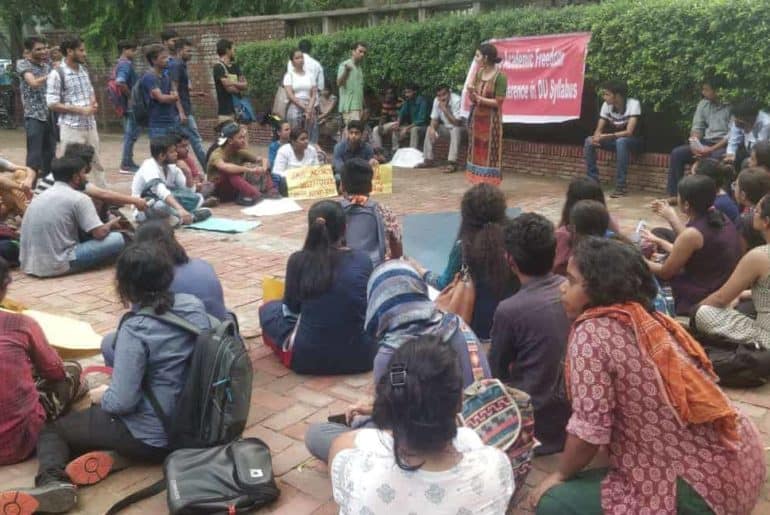
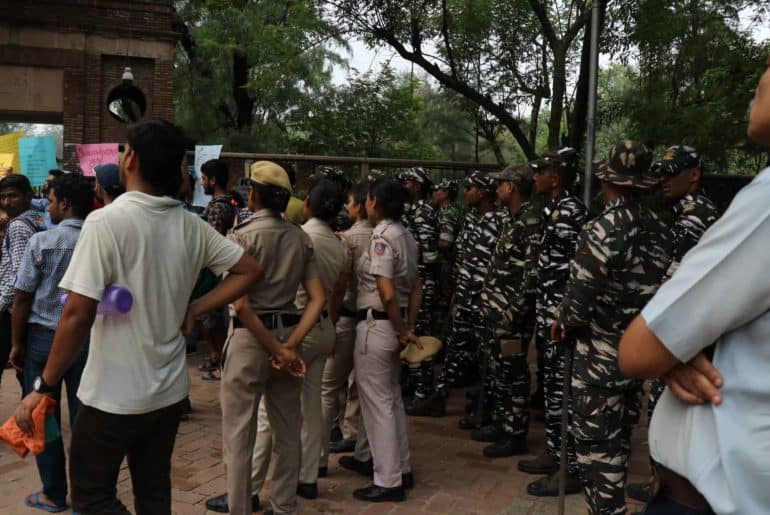
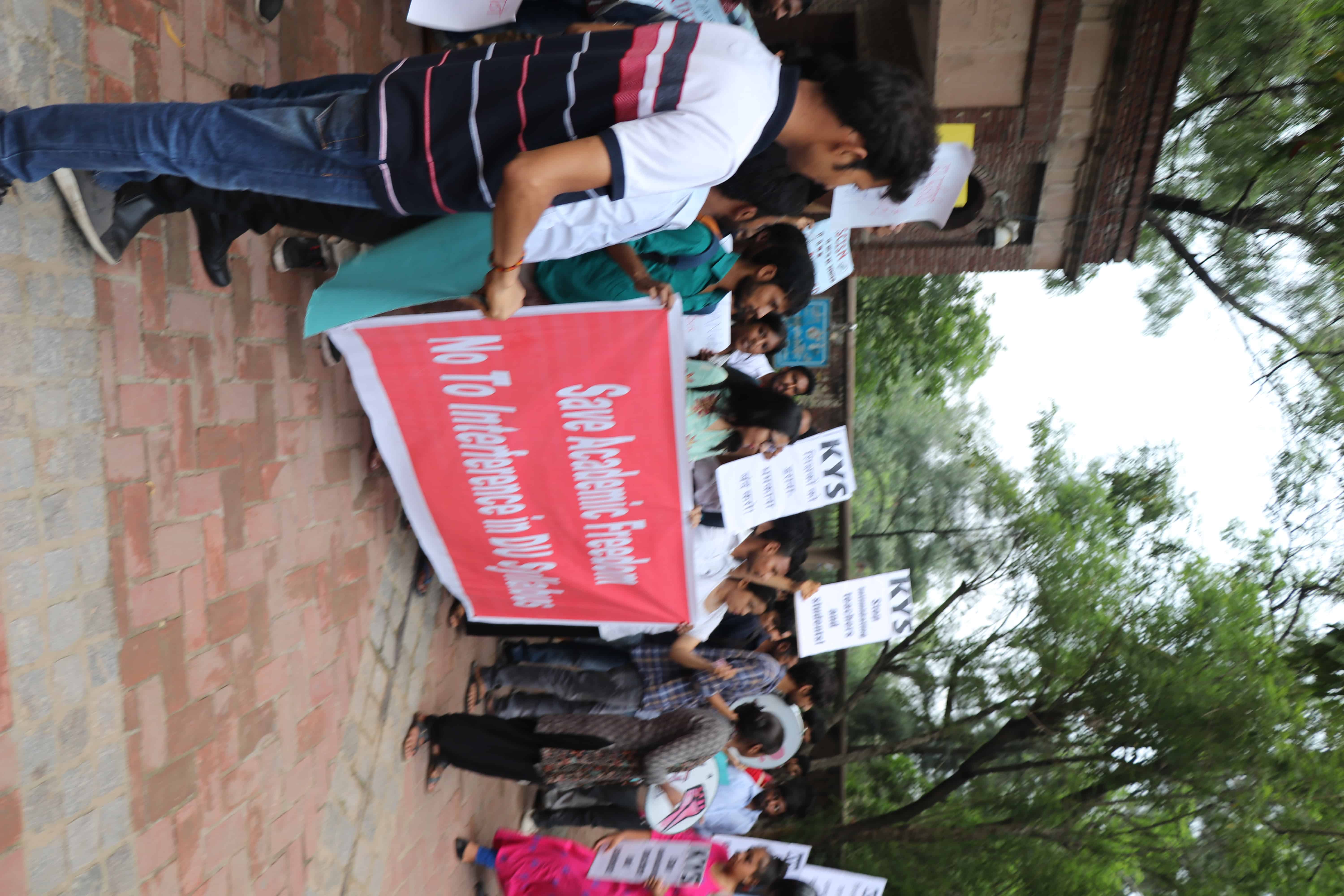
March in defence of academic freedom and Akhil Bharatiya Vidyarthi Parishad’s (ABVP) interference in the syllabus making of various departments of the University of Delhi, namely English, History, Sociology and Political Science took place at the Faculty of Arts on 23rd July amid tensions between the ABVP, departments involved and other student bodies. The protest took a political turn when the members of ABVP and Delhi University Students Union (DUSU) held a counter-protest expressing dissent over the protest.
Students from the English Department and student unions like Students Federation of India (SFI), All India Students Association (AISA), Krantikari Yuva Sangathan (KYS), Pinjra Tod, along with the Delhi University Teacher’s Association (DUTA) held a march in the north campus of DU against ABVP’s opposition to DU’s syllabus-making process. An exercise that was meant to be academic in nature took a distinctly political turn at the meeting of the standing committee on academic matters, where the syllabus was presented on11th July. Rasal Singh, an elected representative of the National Democratic Teachers’ Front (NDTF) which is supposedly aligned with the ideology of the Rashtriya Swayamsewak Sangh (RSS), took issue with parts of the English syllabus that he wanted to be removed and some of the history syllabus that he wanted to be added.
The protest came in the wake of the episode of ABVP barging into the compound of the Vice Regal Lodge, and was rumoured to be asking for three professors, including the Heads of English and History department, to be handed over to them. Since then, ABVP has been protesting against those departments.
Kawalpreet Kaur, Delhi State President of AISA said, “It is well known that the syllabus of Delhi University has an unmatching standard. This owes to the professors who worked hard to maintain the DU’s academic quality. Clearly, ABVP’s intervention calls for systematic destruction of the course content of Delhi University. It is high time that we should all join hands and resist all such moves.”
Changes in the syllabus proposed by the English department of the University were opposed in a meeting of the Standing Committee to review the Undergraduate syllabus on 11th July. Among the proposals was the inclusion of study materials related to the role of the Rashtriya Swayamsevak Sangh (RSS) in the 2002 Gujarat riots, and use of Hindu deities in the reading of Queer Literature. DU, having one of the most prestigious and world-class education in humanities and social sciences intends to provoke a critical faculty among the students. However, the references to Hindu deities and Gujarat riots have irked the right-wing forces.
Mahima Chaudhary, a student of Hindu college told DU Beat, “In an academic institution, no party has any right to dictate what should be taught and what not. It is truly fascist and undemocratic.”
Protesters at the Faculty of Arts.
ABVP and Delhi University Students Union (DUSU) have sought support from the academic world for representation of the students with regards to the inclusion of three R’s in the syllabus i.e. representation, review of the syllabus and rational debate. ABVP emphasised on the need for democratisation of academia. However, the intimidation and threatening nature of dissent ABVP used turned out to be anything but democratic.
Addressing the students, Sachin Narayanan, who teaches English at Dyal Singh College, said, “The controversy over the short story ‘Maniben alias Bibijan’ exposes the sinister designs of RSS-BJP government-backed groups and individuals in academia. Factually, neither this story nor the text containing this story was part of the Syllabus Committee’s proposed Undergraduate Programme English language syllabus at any stage. Bunch of lies are being spread to misguide people which must be exposed.”
Given the fact that the revised syllabus was uploaded on the website of the respective departments in the month of May, and feedback from the public was invited before it was presented before the University’s statutory bodies on 11th July, none of the objections was raised, giving the whole syllabus-making process a political turn. The protest took a political turn when ABVP and DUSU held a counter-protest outside the office of HoDs of 5 Departments of English, Sociology, Political Science, History, and Hindi. Headed by the President, Shakti Singh, members were seen shouting slogans like, “Tum naxalvaad se desh todoge, hum rashtravaad se jodenge” and criticised communist and left-wing forces in the campus. The campus had a heavy presence of police in view of the political turn the events had taken.
ABVP Protesters at Faculty of Arts
Shakti Singh told DU Beat, “The way in which Hindu deities are being depicted in the syllabus is very unfortunate. We have written to the Chancellor of DU for the students’ representation in the syllabus making process, and we demand the administration to bring in a new syllabus considering the demands of the students.”
“The entire left-wing professors and the administration of Delhi University must be held responsible for this.” he further added.
The fact of the linkages between Hindu deities and LGBTQ being regarded as “unfortunate” is itself contradictory for a progressive institution like DU. The academic fervour of the University stands threatened and vulnerable by the political turn the events have taken. The subjects of humanities and social sciences are undoubtedly political in nature; however, they also amalgamate the confluence of various thought of schools and discourses. Turning a blind eye and creating a political situation on a dominant opinion threatens the academic stimulation of the various courses being taught in the University. The consequences of the ideological warfare have to be borne by the students and the politicisation of an academic affair raises eyebrows over the academic autonomy of the University
Feature Image Credits: Sriya Rane and Noihrit Gogoi for DU Beat