Tag

protest

Browsing

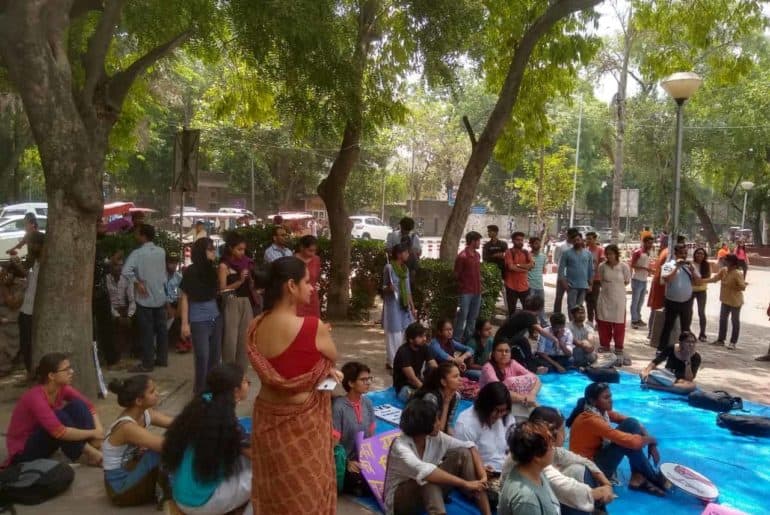
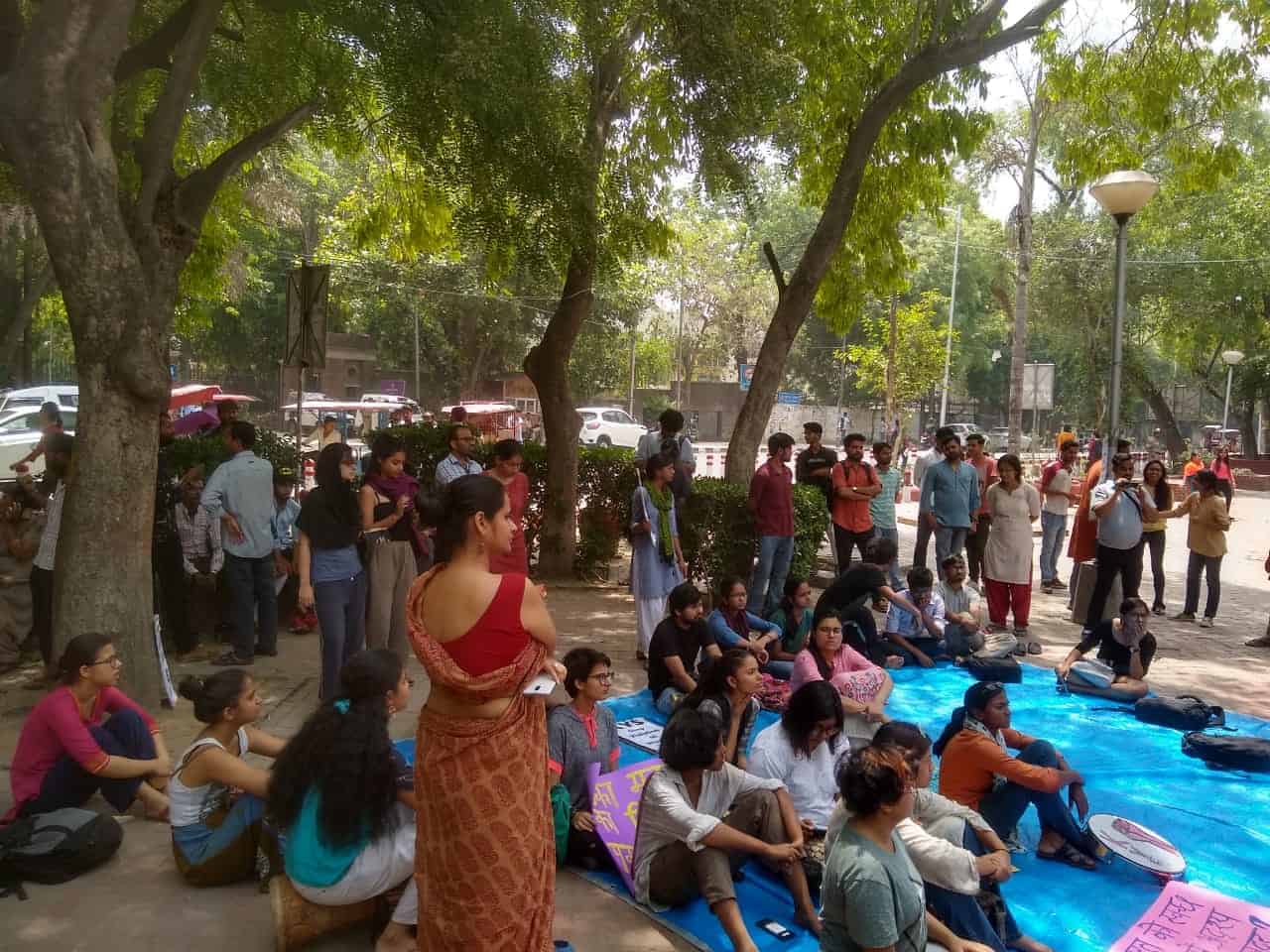
Solidarity and resistance found itself in the heart of the national capital on 7th of February. Students from all over the country gathered to voice their dissent against the prevailing system.

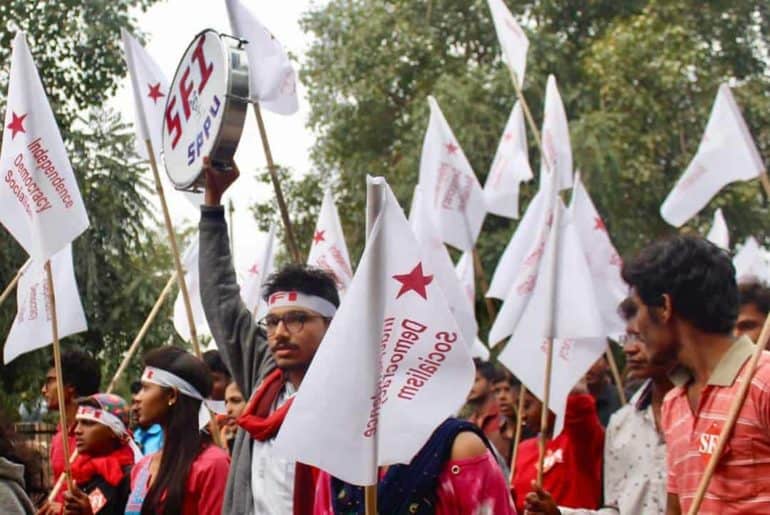
On 7th February, thousands of students, migrants and political activists marched from Lal Quila to Parliament Street to protest current labour laws, unemployment and issues within the education system as a part of the Young India Adhikar March. The march started at the Red Fort around 10 AM, with daflis, posters, banners and songs of resistance, the contingent reached Parliament Street in the afternoon.

The march saw students and migrants from Assam to Punjab and various remote areas of the country.
Though the march had a less turn out than previous student protests, the sound of resistance echoed loud and clear. With small groups in every corner, chanting slogans for azadi, it was clear, the student organisations divided by their ideologies stood united in their act of resistance.

Hope screamed louder than fear in the air, Jairsong Tisso from AISA, President of the Karbi Angalog and Dimmahassau Hills district region says “We hope that the government will accept our demands, we will not give in. We spent a night at the Ramlila Maidan and we would be leaving tomorrow or day after. We want our voices to be heard. We would be presenting a memorandum to Rajnath Singh, the Home minister. (sic)”

Sadaf from CYSS, the student wing of AAP says, “We had thousands of students march today and 70+ student organisations came together and took a stand against the central government. There have been so many scams, the paper leak scam and the lack of jobs and the seats that have remained vacant in the jobs…(sic) Our demand is that the vacant seats must be filled and unemployment does not mean that we go out and sell pakoras, we demand that our education budget be increased, the budget isn’t enough to sustain educational institutions and that’s where privatisation comes in. Privatisation hits the lower and middle class the most. Another demand we had from this march is that the lower and underprivileged classes are completely neglected. Look at the mob lynching, they suppress all the news. We want our voices to be heard by the center. We want it to be known that Modi sarkar will not triumph once again in this general election”.

Speaking to Reetkamal Kaur from Y4S, she talks about the state of the youth in her homeland, Punjab as the Y4S chants slogans of azadi in the background.
“I am from Jalandhar, I am an MPhil scholar and I don’t have a job. It’s sad but I am here to fight for the younger generation, so that they don’t have to struggle the way I do. We are here to fight together. We want our voices to be heard.”

“This march was inspired by the Kisan Mukti march which took place in Nasik and Mumbai and then spread to other parts of the country…It was pretty easy for the BJP to win the Madhya Pradesh elections, they needed to incite another communal agenda..(sic) it was pretty easy to propagate that kind of communal agenda..(sic) but when farmers march, no political party has the right or the audacity to ignore it and that is the inspiration behind this march as well ki (sic) we know that the 2019 elections is around the corner and we know that every single political party will march towards Ayodhya. At that time, we as students feel is our responsibility to bring them back, hold them by their collars and ask, ‘where is (sic) the 2 crore jobs that you promised?’ ‘what kind of alternative (sic) are you offering to the youth by telling them to sell pakoras on the street?’ We are here to stand against bhagwakaran (saffronisation), we are here to stand with the teachers who are abused daily by the system. We are here to stand with the yuva (youth), kisan ( farmers) and the masses of the country whose issues aren’t treated like real issues.”
Hope finds its way into Abhigyan’s resistance, “We certainly hope that the government does something. This march was supported all over the country by prominent figures like Arundhati Roy and Kunal Kamra. One march alone cannot change the shape of our politics, it’s not about one day and a few thousand people marching…it is about continuously challenging the fascist agenda that currently surrounds the country and threatens the very civilization of the country. (sic)”

The common resistance to the Modi government was echoed with protests by the Dilli Nirman Mazdoor Sangathan and All India SSB Volunteer Association. Their songs of resistance echo the same demand, to be heard, to be recognised, to get justice, to find azadi.

Image Credits: Jaishree Kumar for DU beat

Jaishree Kumar
[email protected]

The recent strikes by the University ad hoc teachers still go unheard as the University approves contract hiring of teachers for vacancies.

The 17 th January march by Delhi University Teachers’ Association(DUTA) at Ram Lila grounds sems to turn unfruitful as the University approves the contractual hiring of teachers after introducing ordinance XII E, enabling the hiring of contract-based lecturers who will be employed for vacancies spanning one year. This was passed with a provision to have 10 percent of the permanent positions as contractual appointments.

DUTA conducted a long march on the 17th January 2019 from Ramleela Maidan to Parliament Street in lieu of the several demands placed by them, including the proper absorption of the ad hoc and temporary teachers through a one-time regulation into the university, the resolution of the reservation issue through an ordinance and the restoration of the 200 point roster which the Supreme Court set in July 2018 which treats university/college as a unit. This became necessary after the recruitment policy in the University observed a halt on account of a letter drafted by the University Grants Commission, dated 5th March 2018 which asked the colleges to implement reservations by considering the subject as a unit, resulting in a significant reduction in the jobs for the reserved castes.

The DUTA strikes have been an ongoing struggle as protests began on 2nd January 2019, when the professors across Delhi University agitated against the unavailability of permanent positions, pensions, and maternity leaves for the ad hoc teachers. Such demonstrations and protests have been witnessed in the past too, but to no avail. The strike had more than five thousand people, including the teachers and students as active participants. The march was initiated from Zakir Hussain College at 11 AM and continued to Ramleela Maidan and Parliament Street. The protestors were detained by the police and lathi charge was issued on them, leading to many teachers and students suffered injuries.

The introduction of the contractual appointment as a response to the Ministry of Human Resources Development in these teaching positions will not lead to any substantial benefi, as it will create a feeling of insecurity among the ad hoc teachers who are already agitating against their lack of employment privileges.

In response to the past happenings, Professor Rajib Ray, President of DUTA, in his interview to The Tribune commented, “We hold the Vice-Chancellor squarely responsible for the complete administrative paralysis and subversion of the statutory bodies in the University and demand that he should act or go.”

The present situation still does not have any tangible outcomes, despite the active protests. The University has not issued any recent statement on the same issue, providing a bleak future to the entire agitation.

Feature Image Credits: Aakarsh Gupta for DU Beat.

Avnika Chhikara

[email protected]

Exploring the history of the events that triggered the ongoing unrest within DU’s academia.

In October 2017, the University Grants Commission (UGC) had introduced rules, making reservation applicable at the department level instead of university level. The UGC rules had followed an Allahabad High Court order of April 2017, which was upheld by the Supreme Court. The High Court had struck down a UGC circular on institution-wise quota to fill vacant Scheduled Caste (SC) and Scheduled Tribe (ST) posts, pointing out that there were departments without any SC/ST teachers. The new UGC rules had led to widespread protests across universities with professors, and critics saying that such a move will deprive many reserved candidates of their jobs.

In March 2018, UGC issued a fresh order with new clauses that asked for a roster system, sparking an instant backlash in the university system. Delhi University Teachers’ Association (DUTA) said that, till now, the UGC had specifically prohibited the practice of making department-wise cadres, as that would lead to the denial of reservation in small departments. In June 2018, DUTA organized ‘satyagraha’ amid reports of autonomisation of the University of Delhi (DU), by calling off the evaluation for this semester’s examination papers. Members cited this move as ‘anti-education, and anti-people policy pronouncements of the Union Ministry of Human Resource Development.’ In particular, the teachers were strongly opposed to the 30%-70% funding formula, the tripartite Memorandum of Understanding (MoU) requiring steady increase in students’ fees, graded autonomy, and the scheme of autonomous colleges. The DU administration later via a press release pleaded teachers to start the evaluation soon. In response to the ongoing protest about reservation roster, the Ministry of Human Resource Development (MHRD) drafted a bill that stipulates for the maintainence of the vacancy roasters university wise at all centrally funded higher education institutions to implement reservation of faculty members in November 2018.

In December 2018, agitation with respect to the government’s failure to implement the Seventh Pay Commission in totality for universities translated into more protests. The notification for implementation of revised allowances, and pensions, consequent to the Seventh pay Commission, and disbursal of the required funds for its implementation are still pending, according to the memebers of the DUTA.

In January 2019, a two day shutdown was triggered by the Vice Chancellor’s (VC) refusal to table the report of the Recommendation Committee constituted to review the UGC gazette notification related to teachers’ service conditions. Dr. Rakesh, a member of DUTA spoke to DU Beat. He said, “VC has launched new terms to count the served time period, which harms us. He hasn’t enforced the UGC guidelines, which relieves the ad hocs.” Thousands of teaching, and nonteaching permanent posts remain vacant, while teachers and karamcharis have been working on ad hoc posts for many years. Ad hoc teachers lack job security, and employment benefits. They demand regularisation, and absorption of temporary, and ad hoc teachers. They also accused the government of sweeping the reservation roster issue under the rug, owing to their silence on the matter. Dr. A.M. Khan, a member of DUTA, expressed dissatisfaction with the Ministry, VC and the Government, saying, “There were very high hopes with regard to the new government, but unfortunately the opposite happened. Thus, everyone is on the streets today”.

Feature Image Credits: Aakarsh Gupta for DU Beat.

Nikita Bhatia

[email protected]

The Delhi University Teachers’ Association (DUTA) held an Executive Meeting on Saturday, 12th January 2019.

The resolution for the same is a comprehensive account of the crisis being confronted by the teachers of the University in lieu of the Central Government’s withdrawal of government funding from public-funded universities. This was termed as a “highly misguided policy” and “commercialisation of higher education”. This has led to a delay in the announcement of revised allowances and pensions of teachers. The exploitative conditions in terms of long working hours and lack of job security and employment benefits for ad hoc teachers have also contributed to the rage and unrest among teachers.

In addition, DUTA has also directed rage and disappointment against the Vice Chancellor (VC) of the University of Delhi, and condemned him for his inaction and lethargy in carrying out timely appointment procedures for teachers. They expressed strong criticism towards the VC for capitulating to the Government’s agenda by not even allowing the tabling of the report of the sub-committee set up to facilitate the adoption of the UGC Regulations 2018. Owing to the same, several young ad hoc teachers had declared a hunger strike in effect from 4th January 2019, which has now continued for nine days in the blistering cold.

In the resolution dated 12th January 2018, the DUTA has declared solidarity with the teachers on hunger strike, and has demanded that the Government bring in a one-time Regulation for the absorption of temporary and ad hoc teachers. They have proposed a one day strike and dharna at Gate No.1, DU to highlight their demands for the re-convening of the adjourned meeting of the Academic Council. They have also announced an immediate action programme of One Day Strike along with a Long March to MHRD on 17th January 2019.

Emphasising that these consequences emanating from a reduction in Government funding will soon affect the students as well, and has called for support by all sections of the university community, including and especially students.

Feature Image Credits: The Indian Express

Nikita Bhatia

[email protected]


An account of a widespread protest against the parliamentary Trans Bill 2018 which would have a negative impact on the transgender community if passed.

Amidst posters and hoardings criticising the controversial Trans Bill, a corner of Jantar Mantar was filled with a crowd, a crowd questioning parliamentary amendments and personal stereotypes. They were the trans-people from all over the country, proud of their identity and raging at the proposal of the Transgender Persons (Protection of Rights) Bill. And not only members of the transgender community, college students, activist, laypersons also joined the procession. Some of the provisions of this Bill which are cited as “biased” and “unfair” are that members of the transgender community would be subjected to a screening committee to have their gender assessed and it also reduces the punishment of convicts in sexual crimes against them, among other things. South India Transgender Federation had a major presence in the protest but activists from other states like Manipur, Maharashtra, and Haryana were also present.

Jatin, an alumnus of the University of Delhi says, “As a theatre actor, I have often worked on productions that revolve around queer issues, but after some point, you realise that theatre is just talking. By coming here, I am trying to show the little support that I can from my own side. It’s important to be physically present for the protests about which you preach via your art form.” Jatin’s point gets clearer in the face of a need for students to get educated and know more about the issues that ostracised groups face in their city, in their country. “The problem lies in the education. It’s like we are brought up to mock transgender people or just look at them as if they’re criminals even if they are just earning their living”, another college student remarked.

Trinamool Congress leader Derek O’ Brien also attended the protest and used it as an opportunity to show his support for the cause, while also pushing for the political agenda of his party. Image Credits: Shaurya Thapa
Trinamool Congress leader Derek O’ Brien also attended the protest and used it as an opportunity to show his support for the cause, while also pushing for the political agenda of his party.
Image Credits: Shaurya Thapa

Trinamool Congress leader Derek O’ Brien highlighted how the Mamta Bannerjee government in Bengal is working towards the betterment of trans persons and guaranteed that this controversial Bill would definitely not be passed at Rajya Sabha (receiving several cheers). His monologue ended with “Do hazaar unees, BJP finish!” (BJP’s rule over in 2019!).

Politics aside, this protest represented a struggle for personal rights. Radhika Naik from Tamil Nadu questioned how the government can impose a Bill on determining trans identity without consulting transgender people. “The police beats us if we beg and sometimes for just wandering. Tell me isn’t this harassment? And if someone really harms us, how can we even go to the police? We live in troubled times. The government gives us a ration card and voter ID card but that’s just equality for the namesake. You give us cards but what about our basic rights, what about our roti (food), kapda (clothing), and makaan (shelter),?” Radhika said on an emotional note. “More than the government’s perspective, it’s the people’s perspective that matters and this will ultimately influence the government,” Selvi Naik, Radhika’s friend added.

sdr
The protesters claim that the Bill has been made without any community consultation, lacks accountability measures, and doesn’t have provisions for reservation. Image Credits: Shaurya Singh Thapa

Radha Chatterjee from West Bengal complained about how the government can’t as much as make separate seats or washrooms for the third gender, leave alone other facilities. Still, on an optimistic note, Radha added how the revolution will live on and these protests will turn nationwide. “They’ll call us chutiyas, but if you think of us as chutiyas then let us be chutiyas! We will still fight. You see even though we have faced atrocities, we are still surviving. My guru survives as a trans, I have survived as a trans since a teen, and we all will live on no matter what,” this statement probably captures the optimism that everyone felt in this protest.

On a pavement, photographs from the ongoing protest were exhibited and sold by a middle-aged photographer who has been covering sit-ins, campaigns, and dharnas in Delhi for quite some time (even if he himself didn’t seem to show that much of interest in the movement). "I have been covering protests around Jantar Mantar for the past 15 years. I participated in the 2012 protests about the Nirbhaya rape case, but all other protests feel like a routine and a business opportunity," he added honestly as people bought their pictures. Image Credits: Shaurya Singh Thapa
On a pavement, photographs from the ongoing protest were exhibited and sold by a middle-aged photographer who has been covering sit-ins, campaigns, and dharnas in Delhi for quite some time (even if he himself didn’t seem to show that much of interest in the movement). “I have been covering protests around Jantar Mantar for the past 15 years. I participated in the 2012 protests about the Nirbhaya rape case, but all other protests feel like a routine and business opportunity,” he added honestly as people bought their pictures.
Image Credits: Shaurya Singh Thapa

After shouting slogans and singing rebel songs, the mood turned light as several drum players arrived at the scene. And for a brief moment, many joined from the crowd dancing merrily on the beats of the drums, melting the anger into a celebration of collective struggle and hope for a better future.

Feature Image Credits: Shaurya Singh Thapa for DU Beat.

Shaurya Singh Thapa
[email protected]

In lieu of the absence of classes and study material for the approaching exams, students of SOL are distressed.

The School of Open Learning (SOL) faces a crisis as students remain in angst due to the absence of notes and proper scheduled classes. The classes for the session of 2018-19 are set to commence soon enough. The Executive Director of SOL, H.C. Pokhriyal, said in a recent interview to The Indian Express, “We have been able to complete our admissions only by 20th October, which is why classes have not started yet, but they will start soon”.

The SOL website has already added the portal for acceptance of examination forms, without a proper commencement of the academic session. Colleges under Delhi University will commence their examinations from 28th November 2018. Mr. Pokhriyal further explains that the admission process usually begins by June and extends till August. However, this year, the process began in August itself, as a result of which there was a delay. Students should be able to pick up the material from 12th November and classes would begin soon. Usually, the classes commence in September. The admission process for SOL is similar to that of other colleges associated with the varsity. The examinations are also conducted by Delhi University. The course structure is also alike, for the school as well as other constituent colleges.

The annual examinations occur in April. However, the strange thing is the fact that students still do not have their study materials. The study material is given immediately after the admission, as explained by the Staff Council Secretary of SOL, J.Khuntia. At present, more than four and a half lakh students are enrolled at the UG and PG level.  Almost all of the processes are handled by the online Students Information and Management System. Several students do not have proper access to the e-resources and do not have a sense of clarity about the study patterns. The official website is showcasing study materials for the second semester and beyond, thereby creating more confusion. Authorities should give directions to the students in lieu of the approaching exams.

Feature Image Credits: The School of Open Learning

Avnika Chhikara

[email protected]

After releasing a charter of demands regarding the hostel regulations and receiving a dissatisfying response from the administration, LSR united with Pinjra Tod on 5th November to demonstrate a protest against curfews, gendered treatment, absence of OBC reservations, and more.

At 5 PM on 3rd November 2018, the students of Lady Shri Ram (LSR) College, along with supporters from Pinjra Tod, collected outside the main-gate of LSR to engage in a protest. The protest’s objective was to get the administration to come out of the college gates and to engage with them on the demands listed in the charter released by Pinjra Tod and LSR.

Some of the demands from the charter stem from a practice of sexist and hypocritical foundations, students stated. The University Grants’ Commission’s regulations prohibit discriminatory rules citing safety considerations for women. For example, the curfew was 10 PM before 3rd November 2018, and it was mandatory for the first-year residents to acquire the signature of either of the two wardens in a ‘day-slip’, if they wished to move out of college at any time of the day before 7:30 PM. Staying out at night was permissible for only four nights a month, and even then the tedious procedure ensured the restrictions on the women’s mobility.

The accounts of the residents present a picture of gendered discrimination and judgements, which also includes practices ignoring the PWD residents’ convenience in mobilisation in the hostel premises. On the condition of anonymity, a resident shared that once when another LSR hostel resident was moving out after 7:30 PM, she was asked the following by the authority at the hostel- “Kiska bistar garam karne jaa rahi ho?” Several other residents revealed the hypocrisy in citing safety in maintaining curfews for adult women, while at the same time ‘gating out’, i.e. suspending the residents for breaking alleged rules, at any given time. A student was once forced to spend the night at the railway station when her train reached late enough for her to miss the 10 PM deadline.

When demonstrations were announced, the administration accepted a few demands from the charter, to be exercised from the beginning of the second semester, i.e. 1st January 2019, which are as follows:

  1. The curfew timings were pushed to 10:30 PM.
  2. The concept of ‘only four nights out’ was amended to the attendance rule of 60% per month.
  3. The system of issuing day slips stands abolished, and identity cards will be issued.
  4. Instead of the rule of making mandatory two local guardians (married), there will be the provision of an emergency contact number.
  5. Leaves will be issued without the signatures of any local guardian or parents.
  6. Appropriate changes will be made in the Hostel Handbook.


The Charter of Demands

There has been no abolition of the curfew, or adherence to the reservation guidelines for the OBC community, and many other significant demands remain unaddressed. Pinjra Tod gathered in lieu of the said events, and the students shouted slogans like ‘Kuchh salaakhein tooti hain, poora pinjra baaki hai!’ (‘Some grates have broken, the entire cage remains!’), ‘Pitrisatta ka khol de pol, pinjra tod, pinjra tod!’ (‘Demolish the patriarchy, break the cage, break the cage!’), etc. to remind the college administration of the hypocrisy used to justify the regulations in hostel.

Over 50 women joined the demonstration, and the momentum increased such that an ultimatum was declared by the protesters, according to which the principal was asked to engage with them outside the college gates by 6:30 PM. The principal, Dr. Suman Sharma, did not respond to the cries and demands of the demonstrators. The vice-principal and a few members of the college administration stepped out of the gates, and attempted to deter the protest through a dialogue, but the demonstrators shouted ‘shame’ and refused the reported tokenistic gestures.

The Hostel’s Union was not present at the demonstration, nor was any statement of solidarity released from its end. Allegedly, some members of the union approached the administration in confidence and stated that they had been feeling ‘pressurised and attacked’ by the methods of the protest. After 8 PM on the 5th, the union released a statement defending its non-participation and non-solidarity for the protest, and also addressed other concerns in it.

At 6:16 PM, the LSR Students’ Union representatives, Katyani and Drishti, announced that they were going to engage with the administration to make them aware of the demonstrators’ decision to break open the college gates, if they failed to address them. No fruition occurred of the expected nature for the students as the administration proposed permitting only the current students of LSR to assemble in the college auditorium for a discussion on the demands. The demonstrators refused, and at 6:48 PM the demonstration took to the road. The one-way was blocked by the demonstration and the traffic assimilated for approximately thirty minutes before being diverted by the police officials. Women alleged groping and perverse remarks directed at them by the men gathered outside LSR.

Almost a quarter past seven, the demonstrators marched towards the intersection at the traffic signal, when their demands remained unheard by the administration. Around 8:30 PM, the students were let into the premises and the principal agreed to address them. Due to the apprehension of being intimidated by the administration, many demonstrators sat outside the gate and continued raising the slogans against the regulations.

The official account of Pinjra Tod remains that the principal left within a quick while of her appearance before the student community. They stated: “LSR principal barely came out for two minutes and left the protest site. All of campus is militarised with police men & plain clothed police women, they beat up women mercilessly. They say they will implement OBC reservation once there are more seats!” Members of the SU are reported to have been pelted at with stones, and scratched as they extended their explicit support to the cause. At 10:30 PM, the demonstrators broke through the hostel gates and continue to chant revolutionary slogans, singing songs to claim their liberty by defying the curfew for the day.


The Demonstration on 5th November

At 10:30 am on 6th November, about 30 faculty members entered the hostel and the hostel-residents’ account revealed that they were not allowed to move outside and assembling in the dining hall was made compulsory. The students gathered outside the hostel again.

Day-scholars and residents later assembled in the hostel gardens, where the faculty members addressed the students. In the dialogue, the hostel union’s President, Aarushi, stated that they would issue a solidarity statement if those students, who wish for the curfew to continue and had previously approached them personally, did not explicitly voice their perspective at the time.

A student who had been accused of intimidating the union, stated that the demands were being suggested as reductive when there was much more than the curfew.

Professors stated that they would listen to the demands point by point, and respond accordingly. When the issue of WiFi was brought up, the faculty members agreed with the demand and stated that they had already complained regarding it, and the inadequacy of the WiFi was not solely for the hostel residents. They were working upon it. The students demanded a deadline for the course of action.

The protests have paused for now and the new plan of action is as follows:

  1. A new, more detailed charter of demands will be formed by 7th November as the administration has accepted certain demands already and they have termed the main demands ‘vague’.
  2. The deadline for sending a written response back to the demonstrators is Sunday for the administration.
  3. The principal has to address the students on Monday in the auditorium. If she fails to, or if the students remain dissatisfied, then the protests will resume from Monday onwards.
  4. Attendance was not adhered to yesterday, and the same will happen on Monday.

The hostel warden has suggested that she will forward the letter to the principal herself, and Katyani from the Students’ Union stated that the students’ body of LSR will be present to back up the demands.


Image Credits: Anushree Joshi for DU Beat

Anushree Joshi

[email protected]

After 8 months of waiting, the concerned authorities have left the decision hanging, over a professor accused of misconduct.

On Wednesday, 24 October, various students of the University of Delhi’s Bharti College protested in the college campus against the alleged ignorance of the Governing Body (GB) for not following the recommendations of the Internal Complaints Committee (ICC) in a sexual harassment case against a teacher. The protest comes after 8 months after the case came to light through a student’s complaint against the accused professor. However, the failure to take any action has been met with backlash from the students in the varsity.

In February, a student had written to the university authorities against a teacher, who she said was sending her lewd messages and trying to have “vulgar conversations” with her. She had also submitted a purported video of her confronting and slapping the teacher, with him apologising, following which the college sent him on leave pending enquiry. It is to be noted that the college authorities decided to suspend the professor in June, but they did not receive approval from the varsity authorities.

The ICC, which submitted its report on August 28, has suggested compulsory retirement for the accused. “We submitted our recommendations on August 28 to the university. Students are angry because, in June, the GB had suspended the teacher, but the university did not send its approval. He’s not coming to college, but he’s getting his full salary. So there is some resentment among students because of this, and because the ICC recommendations have not been followed,” told ICC presiding officer Rakhi Jain, to The Indian Express.

The college principal, however, said that the procedure was being followed. Officiating principal Mukti Sanyal said the college and GB were following procedure.

“There are long-drawn processes which have to be followed. The ICC has submitted its report and the GB has done whatever it needs to do at the stage at which it is but there are other stages to be completed. It has to finally be ratified by the university and get the V-C’s approval. We’re steadily and surely working in the direction so that the right thing is done,” she told the same daily.

GB Chairman Ajay Gaur said the “matter was under process”.

DU Registrar Tarun Kumar Das and Vice-Chancellor Yogesh Tyagi did not respond to calls and texts by The Indian Express.


(With inputs from The Indian Express.)

Feature Image Credits: The Indian Express.


Kartik Chauhan

[email protected]

After 4 days of hunger strike, protesting day and night, being denied entry in their own campus, and heated discussions with the administration, the students of Delhi School of Journalism called off the protest on 21st September 2018.

On 17th September 2018, violence broke out in the campus of Delhi School of Journalism after the talks with the officials of the University regarding the poor infrastructure facilities reached no conclusion.

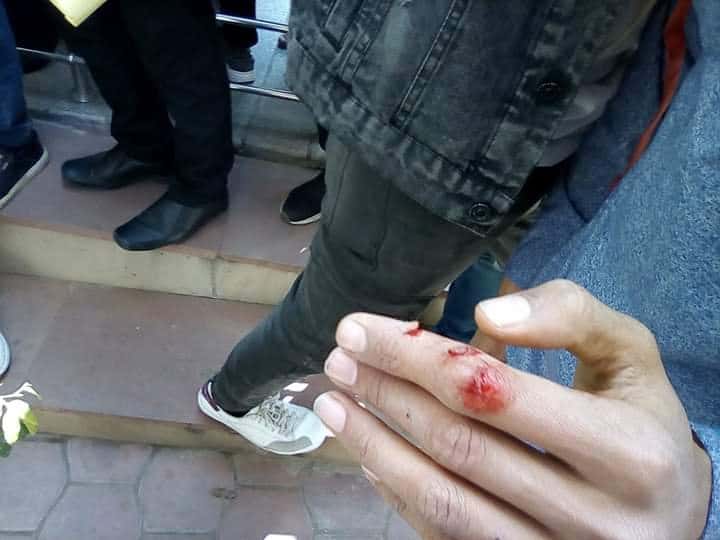
The protest took a different turn when a second-year student, Ambuj Bhardwaj was arrested by the Delhi Police. He was dragged by his neck openly in the college premises and was brutally thrashed by them. On speaking to DU Beat, Ambuj said, “We were protesting peacefully near the gate of our college. When we tried to protest near the gate of the Vice Chancellor’s office, the security guards manhandled us, one of my friends was also slapped by the guards. The moment I tried to defend him, the police caught hold of me and thrashed me. I was taken into custody for six hours.” The police was called by the administration to curb the protest. However, the students complained of being manhandled by the police.

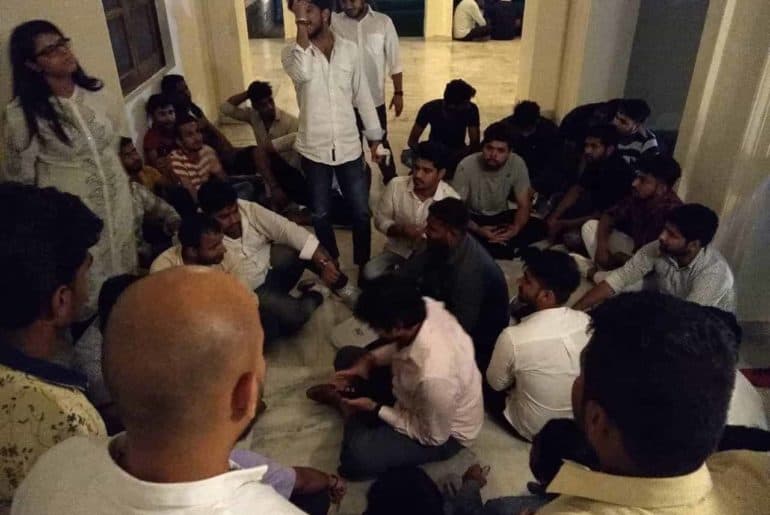
When the discussion with the administration of the college and officials of the University didn’t prove feasible, six second-students, namely Ambuj Bhardwaj, Mohammad Ali, Prashant Yadav, Roshan Kumar, Vipul Sharma and, Suman Shekhar went on an indefinite hunger strike. They were supported by both the students of the first and second year. The administration responded by issuing a warning to take disciplinary action against the students who were protesting in the campus. This was ineffective as the students continued their agitation. Continuous health checkups of the students on hunger strike were done by the WUS Health Centre. Vipul Sharma, one of the six students on hunger strike said, “We tried many different methods of protest in the last few months, but the administration did not bother. We could not reach a proper solution to the problem. At the same time, the students were facing huge academic loss. Therefore, we had to take such a radical step. The hunger strike was a pure Gandhian step.”

Hunger strike by DSJ students
The hunger strike by DSJ students

The students of first and second year also went to different colleges and departments and appealed to them to support and extend their solidarity with them in the cause. Support for the protesting DSJ students came from various students, organisations, political parties, leaders, and teacher associations. On 20th September 2018, Delhi University Teachers’ Association members including the President, Rajib Ray and Treasurer, Najma Rehmani visited the students and appealed to them to end their hunger strike. They spoke about the initial problems associated with implementation of the course and how DUTA was against privatisation of higher educational institution as it would lead to a violation of our democratic and socialist values encompassed in the Indian constitution. While addressing the dissenting students, Rajib Ray talked about the streak of fire the students have evoked in the education industry, which has transcended from the walls of Lutyens Delhi to the entire nation. He underscored how he and his friends used to perform hunger strikes back in their days and how we remind them of the zeal and energy the youth should possess. They extended support and also promised to be present in the rally being organised by the DSJ students on 25th September 2018 against the privatisation of education and high fees. Rajya Sabha MP, Manoj Jha also met the students and understood their grievances. Members of DUTA in their individual capacities extended their solidarity to the students. Abhishek Dutta, Congress leader, Professor Abha Dev Habib, Professor Ratan Lal, Professor Suraj Yadav, students from the Law Faculty, Sunny Chillar and Akshay Lakara and other members from NSUI, newly elected DUSU Vice President Shakti Singh, Kawalpreet Kaur and members of AISA , CYSS, ABVP, SFI, Disha Student Organisation also stood with the agitating students. The members of Academic Council and Executive Council of the University also appealed to the students to end their hunger strike. They also assured that the issue will be raised in their next meeting with full force and no one will be spared. One of the members of the Academic Council promised to make DSJ the best institute for studying journalism.

Support by members of DUTA and NSUI to the protesting students

On 21st September 2018, conditions worsened as Roshan Kumar, one of the students on hunger strike was advised urgent medical help. Ms. Neeta Sehgal, Proctor of the University of Delhi visited the students to resolve the matter. After a series of discussions, the administration and the students settled the matter. Deadlines along with proper details were provided to the students failing which the students demanded the resignation of the administrative authorities- Dr. Manasvini Yogi, Officer on Special Duty and Professor J.P. Dubey, Honorary Director of Delhi School of Journalism.  The students called off the hunger strike at 8:00 p.m. in the campus in the presence of the college authorities and fellow students.

On speaking to DU Beat, Mohd Alishan Jaffri, a second-year student of DSJ said, “This is a moment to cheer, not for complete celebration. In all these eight months of protests, the students have fought remarkably with grace. DSJ is an isolated place in North Campus, where half of the colleges in North Campus don’t know about our existence. It’s an island of misery in a fortune called North Campus. We need the world to follow this example and ensure that academic discourses are conducted properly in every public institution. We hope that Delhi School of Journalism becomes the next Columbia School of Journalism. Through DU Beat, I would also like to invite all students, teachers, organisations to be a part of the rally being organized on 25th September.”

Students stood united

The students are organising a DSJ Chhatra Sangharsh Rally on Tuesday, 25th September 2018 at 1:00 p.m. in Arts Faculty.  Many organisations and students are expected to be present in the mass rally against privatisation of education.


Feature Images Credits: DSJ students

Anoushka Sharma
[email protected]


Kathua, the case of misplaced outrage.

On the morning of 18th January, Mian Altaf, an influential Gujjar leader in the Jammu and Kashmir Assembly, waved an Urdu newspaper that had printed a photograph of Asifa Bano with a news item of the eight year old’s gory gang-rape.  No one paid much attention to the story.

It was only recently that the groundswell of outrage against the rape grew and protests erupted on social media. The fact that it has taken so long for Asifa to get national attention highlights how difficult the fight for justice still remains for rape victims when the accused enjoy political power or patronage.

The girl from the Gujjar-Bakarwal community in Rasana was abducted in January, held captive in a local temple, drugged, raped repeatedly by at least three men, and then strangled. Her body was found in the forests on January 17th, a week after she went missing.

The charge sheet of the case names eight accusers and puts 60-year-old Sanji Ram, custodian of the temple, as the mastermind behind this rape. It goes on to say that Ram had hatched the plan to terrorise and dislodge the Muslim nomads from the Hindu-majority area where the girl lived. Asifa’s house is now locked. Nobody seems to know where the family that belongs to the nomadic Muslim tribe has gone. Seems like Sanji Ram’s purpose has been served.

Soon after the first arrests were made, hundreds of people, under the aegis of Hindu Ekta Manch, rallied in defense of the accused, thereby revealing the volatile religious fault lines. Those defending the accused include Lal Singh and Prakash Chandar Ganga, both of whom are Bharatiya Janata Party (BJP) ministers in the Mehbooba Mufti government. Along with them, The Jammu Bar Association on Wednesday protested against the crime branch probe as they thought it was ‘targeting the Dogra community’ in the state. To ensure neutrality in view of the Hindu-Muslim polarisation, the state government has appointed two Sikh special public prosecutors for this case.

It is ironic that slogans like ‘Bharat Mata ki Jai’ are being used in such rallies, even as Gujjars and Bakarwals have in the last 29 years of political turmoil in the Valley remained loyal to New Delhi, only to be refused cremation in their own land. The locals of Rasana did not even allow the Asifa’s family to bury her bruised body. It had to be buried in a neighbouring village where her relatives live.

In these contexts, like every rape, this case is heavily political. Sanji Ram decided (allegedly) to kill Asifa in order to instill fear in her community, who he feared would over number Hindus in the area.  The Hindu Ekta Manch and Bar Council came out in protests because the accused were Hindus.  This case has gathered celebrity attention, but those ‘placards’ are apolitical in nature. They ignore the politics of region and religion. They reduce the identity of Asifa to a young girl, instead of a Bakarwal Muslim girl who belongs to a marginalised nomadic tribe and is hence more vulnerable, especially when she is in a Hindu majoritarian area of Jammu and Kashmir. Yes, a rape is a rape, it is a grave problem, but to solve any problem, we have to acknowledge its various facets. By ignoring the communal angle of this tragedy we are being dishonest.

We must politicise it because, guess what, it is political.

In a U-turn, the Jammu Bar Association has announced its decision to organise a candle light march for the eight-year-old girl. Dear Bar Council, we don’t want your mild candle light marches, we want the rage full fire to burn in your chest against something as heinous as rape. You questioned the work of your own colleagues and pitted the national flag against the dead girl’s shroud. Your hypocrisy and fundamentalism will not be absolved with a symbolic protest. We don’t need your obligatory march, we need your apology.

Unnao, the story of a feisty survivor and her complicit neighbours.

In June 2017, a 17-year-old girl from Unnao alleged that she was gang-raped for more than a week by Kuldeep Singh Sengar, a BJP Member of Legislative Assembly (MLA), and his accomplices. However, when they tried to file the First Person Report (FIR), the case registered by the Unnao police did not name the MLA.

The survivor’s family eventually approached the chief judicial magistrate to finally get an FIR lodged against the MLA. Even then the Unnao police took no action in the case. On April 3rd, the survivor’s father was thrashed by Sengar’s brother and his men. The police did file an FIR but didn’t name the MLA’s brother despite video evidence. Instead on the same day, the police arrested the survivor’s father himself and booked him under the Arms Act. A few days later he died in police custody. The post-mortem report listed multiple injuries on his body.

It was only after the survivor tried to immolate herself outside Adityanath’s residence on 8th April that the administration and the media took notice of the case. “I was raped. I have been running pillar to post for the last one year but no one is listening to me. I want to see all of them arrested, otherwise, I will kill myself,” The Indian Express quoted the survivor.

On 12th April, the Uttar Pradesh government registered a case against the MLA for kidnapping, rape, and under the Protection of Children from Sexual Offences Act (POCSO). On 14th April the arrest was made.

All this while the survivor and her family are living in a government guest house as they fear for their safety. It has been almost a year since the survivor and her family are fighting for justice. They didn’t give up. We cannot even imagine the amount of pressure she must be subjected to, we cannot even imagine her trauma after the death of her father, and we cannot even fathom the strength of her bravery. She didn’t give up and we, as fellow humans, should be grateful for her courage, for it shows us how to fight against all odds.

She shared the location with her rapist, everyone in the area knew what had happened, everyone saw how her father was assaulted, but no one said anything. People like Sengar seek their impunity from our compliance. He was a bahubali leader who won four times. Who elected him four times? Us, the people. According to reports, Senger earned his social standing by giving away freebies in his constituency. Next time when someone like him offers us gifts or favours, will we accept them with wide smiles and marigold garlands? Will we ask him tough questions when he comes to our threshold with folded hands?

Despite the bad history of Senger, the Modi government accepted him in his party. Yogi Aadityanath’s administration who claims to curb the Jungle Raj didn’t give to hoots about the victim until she caught media attention. Next time when we vote I hope we remember what people like Senger do. Next time when we see someone struggling against the powerful, I hope we extend our solidarity. I hope we become more brave, more political, and most of all, I hope we stay angry, very angry.


Feature Image Credits: NDTV and ANI