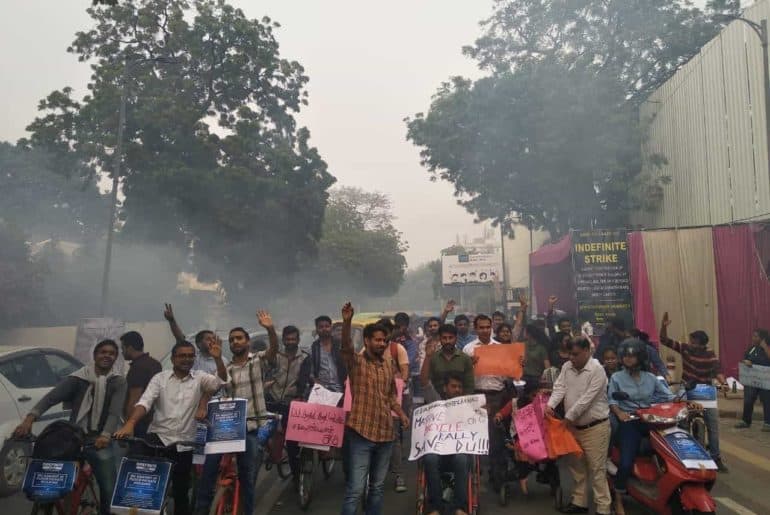
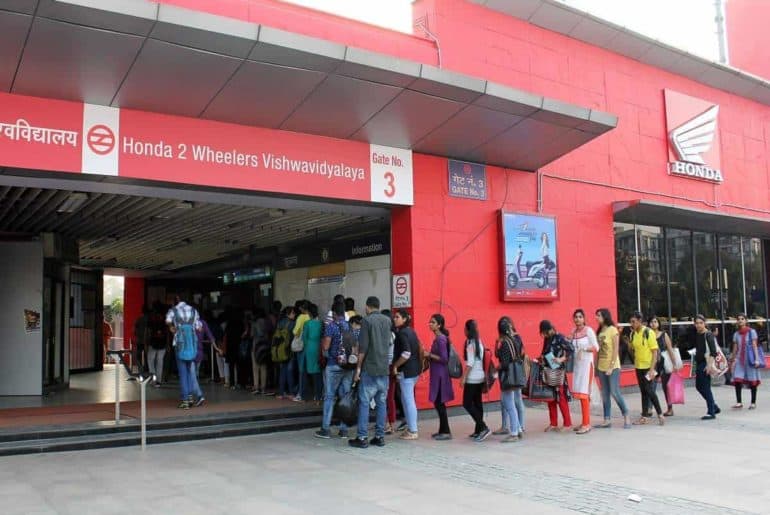
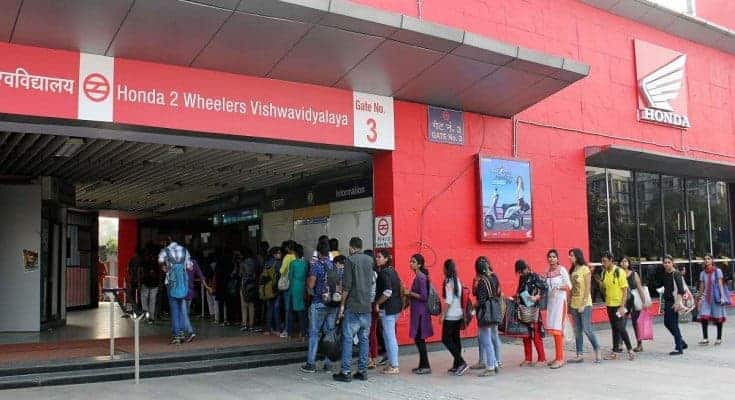
On the 10th day of the strike, students cycled from Vishwavidyalaya station to the Lieutenant Governor’s house to seek his intervention on the matter regarding the construction of the 39 storey building in the North Campus.
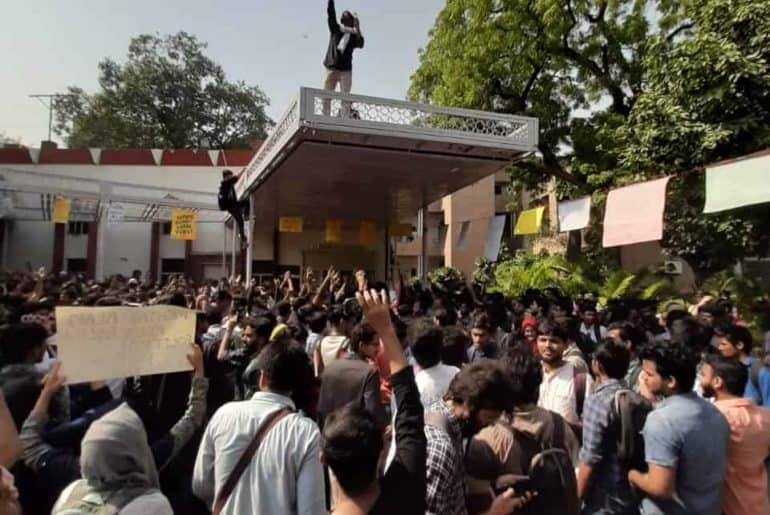
The indefinite strike against the construction of the 39-storey building in the Campus by the students has been going on since 4th November 2019. Raja Chaudhary, Coordinator of the ‘DU Against 39 Storey Private Building Committee’ has been sitting on a hunger strike since the 10th November 2019, supported by other students, Gautam Barnwal and Kanika and a faculty of the university, Dr.Rasal Singh.
On the tenth day of the strike, a cycle rally was conducted from the place of protest near Vishvidyalaya metro station to the Lieutenant Governor’s house to seek his intervention in this matter.
Initially the Governor was reluctant to meet the student coordinator Mr. Chaudhary. However, after some deliberation, the governor conducted a meeting and appointed three officers, headed by Special Secretary Mr. Chanchal Yadav to inquire into the basis of permission given for the construction of the 39 storey private building by the Municipal Corporation of Delhi authorities and directed to submit the inquiry report within the next three days.
A letter by the students, addressed to the Lieutenant Governor, talks about the legality of the construction and the adverse effects of the constructed building. It asked the Lieutenant Governor to quash the project.
Mr. Chaudhary, in conversation with DU Beat, said, “This was the fifth day of my hunger strike. Yesterday, when we went to the LG’s house, we initially had to protest to be heard. However, now we have received assurance from the LG. We demand from the university as well that it take back the public land. Authorities from the DU are committed to building a hostel if we get the land back… Our strike will continue until we get an assurance from the Defence Ministry.”
The next meeting will be conducted after issue of the aforementioned report.
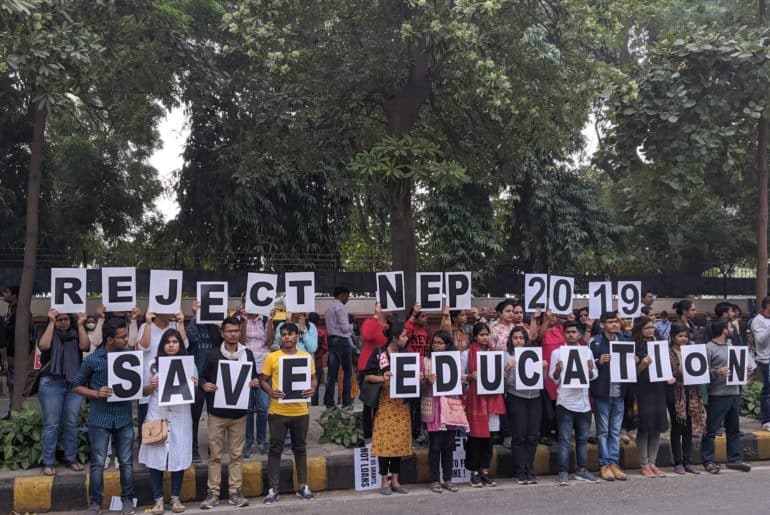
On 14th November, Students’ Union and Teachers’ Association from all central Universities in Delhi marched from Barakhamba Road to Jantar Mantar, and stood in solidarity with students from Jawaharlal Nehru University (JNU) to protest against the New Education Policy (NEP).
14th November observed a central march at Jantar Mantar against the NEP. Student Political groups from Delhi like All India Students’ Association (AISA), CYSS, Krantikari Yuva Sangathan (KYS), National Students’ Union of India (NSUI), Jawaharlal Nehru University Students’ Union (JNUSU), and Students’ Federation of India (SFI) came together to protest against the NEP, and the fee hike in JNU. The protest was led by Federation of Central University Teachers Associations (FEDCUTA) which incorporates the Delhi University Teachers’ Association (DUTA), Jawaharlal Nehru University Teachers’ Association (JNUTA) and Jamia Millia Islamia’s Teacher Association (JMITA )under it. Students showed up at the protest in large numbers with banners, masks to combat the Delhi pollution, and immense grit and determination.
NEP has paved way for Privatisation of education. It has also resulted in the constant fee hikes observed by the Universities. Under NEP, a new mechanism of Higher Education Funding Authority (HEFA) will be established to not give grants but to lend loans. DUTA also fought for permanent absorption of the Ad-hocs to have stability in colleges.
Damini Kain, Presidential Candidate from AISA, said “Public Education is a fundamental right for all. But what the new education policy is doing is, its just making education exclusive. It is deliberately excluding people that come from marginalised communities, lower caste backgrounds and other minorities. NEP is breaking the core fabric of education. It will change the entire dynamic of lending and granting into loans. And the burden of repayment of those loans will lie on the common student.”
The March witnessed many keynote speakers to apprise the students about the consequences of this policy.
Doraisamy Raja, General Secretary, Communist party of India appreciated the students and teachers of JNU to protest against the tremendous hike. He shed light on the importance of education and the threat to its integrity. He also criticised the one language ideology of the current Government.
The common demand that each JNU student and teacher had was to meet with their Vice chancellor and roll back of the fee hike. More than 40% of the students studying at JNU are below poverty line and cannot afford the new fee structure.
Aishe Ghosh, President, JNUSU, said, “All these charges that weren’t existing before like utility charges of electricity, water, food, WIFI will be paid by students even after giving a hostel fees. We’ve come here with a motive to spread this protest to every college and university ad education is for all. All we would like is for our Vice Chancellor to have a discussion with us rather than appearing on Republic TV.”
After all speaker sessions, the March began, led by Federation of Central University Teachers Associations (FEDCUTA), followed by various student organisations. The Teacher-Student-Karamchari unity was an important focus of theMarch.
Slogans like “NEP down down”, “Privatisation se azadi”, “Modi govt Haye-Haye” were chanted. Posters with “Godi Media” talking about the fake media portrayal of press were also displayed, and the banners of Teacher associations of various colleges were also seen.
Among all of these issues, the students from School of Open Learning also came to bring to light the struggles they had face being trapped in the sudden imposition of Choice Based Credit System.
A SOL student, who wished to remain anonymous, told DU Beat, “We’re fighting against the autonomy of education, yet, correspondence where most of the students from lower background study is often ignored. We have exams in December, yet we haven’t been given any books or material. And the material given is so substandard it cannot be used. And the worse, even DUTA has completely ignored us.”
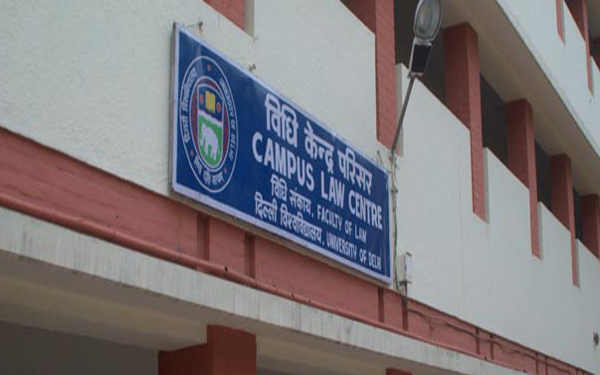
Students of the Campus Law Centre (CLC) protested against the unjust students’ elections to elect the Internal Complaints Committee (ICC) for sexual harassment.
According to the students of the institute, the tier-1 selection wasn’t conducted according to the rules. The tier -1 selection consisted of appointing of Class Representatives for the ICC, which was done without providing full knowledge to the students who weren’t properly informed about the procedure. The students nominated their CRs for normal activities of the department just like in any other institute of the University of Delhi(DU), but to their utter surprise, there was more to the activities of CRs something which the concerned people i.e. the students themselves weren’t made aware of.
Shivank Trivedi, the Vice President of CLC’s Students’ Union said, “In September, the University had asked the departments to select the CRs for the ICC. These CRs are different from the CRs elected for coordinating the day-to-day matters. But our centre did not notify this. When Law Centre-1 uploaded the matter on the website and issued a notification, we got to know about it. We tried to raise the issue with the authorities.”
According to sources, students are not in favour of the nominees appointed for the formation of this gender panel as they were elected in an unjust manner.
“On November 6, the class representatives received an email and were asked to assemble in the teachers’ common room on November 7. The email didn’t specify any purpose. They called the general CRs and conducted the elections in a deceitful manner without any prior notice, ” said Trivedi.
The students have registered their complaints against this manifestation of unlawful practices with the Dean of Students’ Welfare, and the Proctor’s office.
On Monday, the students will engage in a protest against the same demanding fair conduction of the election according to the legal procedure.
Image Caption: The protest arranges by the students against the unjust election procedure. Image Credits: Students of Campus Law Centre
Students strongly believe that the formation of the ICC is a highly sensitive matter as the panel acts as the moderator between the students and the authorities. They feel cheated on not being given full disclosure about the purpose of the selection of the representatives.
“In CLC, the first process has only been flouted, resulting in many students not even knowing about the ICC. We are just being given assurance but nothing concrete has taken place and the election is scheduled for November 13, we only have a day to time to ensure that everything is done as per the law”, said Trivedi.
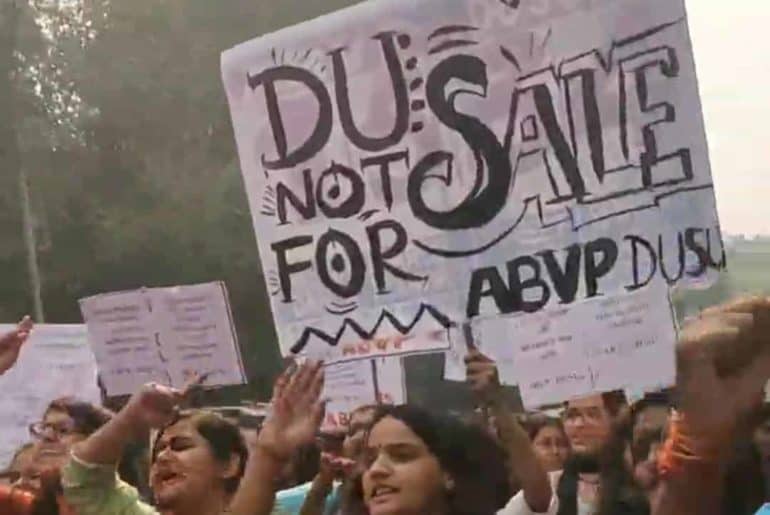
On 11th November 2019, Akhil Bharatiya Vidyarthi Parishad (ABVP) organised a protest from the Arts Faculty in the University of Delhi (DU) North Campus, to the Vishwavidyalaya metro station against the construction of a private 39-storey building in the University Campus.
The protest was joined by members of ABVP and led by Siddharth Yadav, State Secretary, ABVP, and Shivangi Kharwal, Delhi University Students’ Union (DUSU) Joint Secretary. The protest was led with slogans like, “students’ power, Nations’ power,” and “DMRC hosh mein aao,”.
Siddharth Yadav, State Secretary, ABVP, said to DU Beat, “We were the first ones to raise this issue as an organisation. We attracted attention towards it way back. The land was transferred in 2008 to this private builder by Delhi Metro Rail Corporation (DMRC) by corrupt practices that involved the then government as well. A private residential land on a public complex will not be accepted by the student union. This is one issue where people must unite. This is beyond ideological differences. We are hopeful in the coming days, people would unite.”
“A building on chhatramarg would be destructive- it would not be chhatramarg anymore. It would be 600 more families, 2500 more cars on campus. This is not what DU looks like. North Campus is prestigious. Most of the buildings are heritage buildings. If we change it today it is going to be a disgrace to all student leaders, to all students across. We are going to attract media houses. After this, DUSU is going to meet the defense ministry, the DMRC, the LG, and the NDFC. So, we are planning for delegations, we are planning to take this issue big,” he added.
“This is our second protest. This time, DUSU has called all organisations to come forward and join our protest and fight. This issue is an issue concerning all students in the University. Our demand is that this land should be used for the construction of hostels and sport complexes. This land is not for private builders of mafias. ABVP has written a letter to all student organisations and talked to DUTA and DUCU as well,” said Shivangi Kharwal, DUSU Joint Secretary to DU Beat.
Raja Chaudhary, one of the students who had been leading a protest against the construction of the building since 4th November on the footpath beside the metro station, said, “aap dekh rahe honge yaha pe ABVP ka protest chal raha hai. Mai bas yahi kehna chahunga ki yaha pe tokenism wala protest nahi chalega. (You would be seeing the ABVP protest that is going on right here. All I would like to say is that tokenism would not work here,)”. He has also guest authored an article regarding the construction of the private building on DU Beat.
This construction has also been opposed by students from colleges like Miranda House, Aryabhatta College, Kirori Mal College, and the Delhi University Teachers’ Association (DUTA). DU has also written letters to the President and the PMO regarding the construction of the building.
Thursday witnessed litthis and chokhas at the North Campus as students from the University of Delhi (DU) held a protest near the Vishwavidalaya metro station to show their displeasure against the construction of a 39-storied building near the Campus.
A wave of voices raised in unison on 7th November to protest against the construction of a building near campus. Vishwavidalaya metro station, being the nearest spectator to the protest, witnessed students from DU put forth their concerns and issues.
An uncanny side of the protest was the campaign of “solidarity through food” at the North Campus, serving litti chokha as a way to amplify support against the construction. Jagannath Jaggu, one of the organisers of the event, pursuing M.A. in Buddhist Studies said that they were trying to unite people living in the University area. He further added that the E-rickshaw Drivers’ Association has extended their support to the campaign.
The roots of the protest were traced out to be an issue against the construction of a 39- storied building near campus, on the grounds that it could compromise the privacy of women’s hostel in the area. The Delhi University Teachers’ Association (DUTA) and the University administration joined hands in opposing the construction. The Hindu reported that the construction by a private builder is reportedly being undertaken on a land that originally belonged to the Ministry of Defence. It was transferred to the Delhi Metro Rail Corporation Limited (DMRC), and finally to the builder. It is told that the DMRC had acquired 3.05 hectares of land from the Defence Ministry in 2001, of which the metro station was built on 1 hectare of land. The rest was given to a company, which is planning to build residential flats.
Rasal Singh, member of the Campus Development Committee said, “The University was united over the issue.” He said that the building would “bulldoze the teaching-learning culture of the University.” He further added, “Government authorities must take serious cognizance… and immediately stop the construction of this illegal building.”
One of the participants in the protest, who wished to remain anonymous, said, “I am here for a different cause too. The Air Quality Index of North Campus has hit a severe low. Constructional activities have to stop, otherwise, the air shall remain choked.”
Read our Print Editor’s take on entitled social media activism and its removed and elitist enforcement on ground.
A few weeks ago, the Global Climate Change Strike struck its momentum on the streets of Delhi, and organisations like Fridays for Future started marching to mobilise the population against the silence of Government authorities and policy-makers on environmental degradation plaguing our planet. Social media flooded with posters and invitations to partake in the various marches – at Lodhi Gardens, Faculty of Arts, Jantar Mantar, and any place in Delhi which could make the authorities in power take notice, and twist a little in their comfortable seats (on airplanes for some of them).
What appeared to be an excellent initiative and the righteous action in theory, however, raised unsettling questions when seen with a critical lens on ground. A security guard walked up to us during the march at Jantar Mantar, and he asked one of the protesters with sincerity, “Yeh morcha kisliye kar rahe ho aap logg? (What are you guys marching for?)” The person whom he addressed had been sloganeering a few moments ago, but fumbled to express the basic agenda of the protest. This is not to highlight that she herself was ignorant – which, in our millennial thirst for “wokeness”, may verily be an absurd possibility – but to showcase that she did not know the right words in the tongue of the guard (Hindi) to explain the enormity of the issue.
The slogans, cries, and popular references employed in these strikes are, if not monopolised by the English language, subservient to a mainstream understanding which is accessible to a rare few. The “rare few” does not refer to the number – these marches had plenty of people supporting what is a pressing cause – but the strata of the diverse Indian society this form of a movement caters to is, consciously or unconsciously, significantly English-speaking, upper/ middle class. In today’s time, social media has become the norm of propaganda and publicity, but there is an inevitable class and culture divide which makes it impossible for many to become aware, let alone partake, in the cause of the environmental movement.
There are many like the security guard in our country who do not have access to the Instagram stories of the English-speaking, highly privileged influencers, or even concerned educated youth, but that lack of access does not essentially translate to a lack of concern. The movement in India appears to take this language and culture divide for granted. When aspiring for the quintessential western values and standards of awareness, we often laugh at the typical Indian behaviour by equating it with callousness. Knowing at least a minimal level of the English language has become a prerequisite for being included within the ambit of environmental activism in India. The mainstream media and television channels’ non-existent contribution to a movement that is becoming the most threatening matter of survival to our generation, is questionable. While Indian politicians make statements in absolute disregard of science, facts, and anything logically acceptable to an informed brain, it is an unfortunate reality that informs the realms of knowledge for most Indians.
Mainstream media broadcasts the Prime Minister stating, “Climate has not changed. Our habits have changed,” or education ministers claiming that cows exhale oxygen. Media is no longer a vehicle for bringing in expert panels that dissect the threat of global warming and climate change. While Greta Thunberg is an inspiring figure for the movement, a Western icon cannot define the entirety of our understanding of the movement’s complex practicality in India. This becomes a tool for exclusionary caste politics of the movement, since Adivasis and other marginalised tribal communities have been on the streets, fighting for the cause before it became popular on social media. The movement for environmental conservation is not an individualistic fight, and it cannot be a successful one if we delude ourselves in believing so. As youth, these strikes and marches showcase the strength of collectivism and have the power to bring significant policy changes. However, all movements are rooted in the context of their times, or else they lose any real power of change. It is imperative for us, to keep our jargon aside, keep the banners down, and explain our cause to those who will then join their force with ours.
Colleges for Climate Action organised a climate action march at Arts Faculty, North Campus, University of Delhi (DU) on 1st November to stand in solidarity against climate change.
The march began from Gate Four of the Arts Faculty, and was concluded at Gate three of Vishwavidyalaya Metro Station. Students from various colleges gathered at the Arts Faculty gate with masks on their faces, posters in their hands, and intent in their hearts.
Slogans like “What do we want? Climate Justice. When do want it? Right Now.”; “Climate Change se Azadi”; “As there is no Earth B!” were chanted while matching forward. All the posters and structures held by students were made out of reusable materials.
The main motive of Colleges for Climate Change, as told by the organisers was to “provide a convenient campus solution to college students to get involved in the fight against crisis.”
“Even though many people may not turn up on one day, march at institutions worldwide help to raise our voice against this as a community as a whole,” they added.
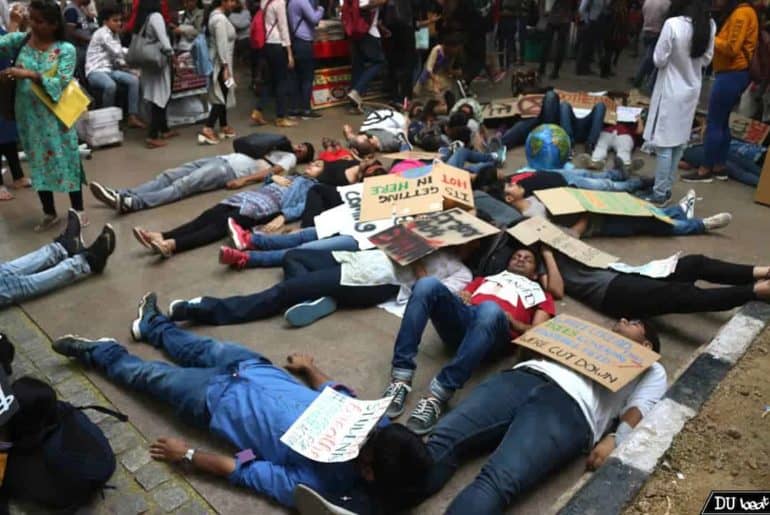
The march concluded at the Vishvavidyalaya metro station where the students orchestrated a fake die, on the sounds of raging sirens to symbolise the urgency of a required climate emergency, as otherwise, this will be the clear end.
Sharda, student of Environment Sciences said, “People think they don’t know what to do for climate crisis, they don’t know how to contribute, but there is so much they can do, join strikes, use the public transport, make dire lifestyle changes and even quit meat.”
After the fake die, students sat in at the Vishwavidyalaya metro station to share their stories of how they’ve contributed to climate action, they sang songs to promote solidarity through harmony and recounted various ways to contribute to climate action.
The women specially from colleges, were seen leading the strike. Just like the global strike pattern, this March definitely had a women’s and young adult narrative. The protest was said to be apolitical, but asking for a political discourse. A Climate Crisis Act lies in the hands of those in power. Their negligence, by not declaring climate emergency and much more is what had let many to protest earlier. But, this protest was said to be apolitical.
Pragya, a Hindu College student said, “We’re saying this is apolitical as we don’t pertain to any political ideology or are not affiliated to any political party, as climate crisis is an issue for the entire world and not just any political party.”
The march also emphasised on scrap the straw movement, with mentioning the petition which each college could fill out to ban use of all single use straws and plastic.
Varsity seeks President’s intervention to stop the construction of a 39-storey high rise private building in North Campus.
The Delhi University (DU) has urged the President of India, the Vice President, and the Delhi Lieutenant Governor to intervene in the matter pertaining to the construction of a 39-storey private building in North Campus. The Vice President of the country is the officiating Chancellor of the University, and the Lieutenant Governor of Delhi is the Chief Rector of the varsity.
Various sections have condemned the construction of the building, saying it is being constructed illegally on public land. They have also said the building will overlook six girls’ hostels in the varsity and will invade their privacy. Protests in this regard have regularly been ongoing since the move was given clearance by the North Delhi Municipal Corporation (NDMC) earlier last month.
The Delhi University Teachers’ Association (DUTA) has also opposed the construction of the building in North Campus saying it “would significantly alter the social and cultural landscape of Delhi University” and also compromise the “safety of women students”.
The building is coming up adjacent to Vishwavidyalaya Metro Station in the North Campus of the University.
On Saturday, the varsity’s vice-chancellor Yogesh Tyagi announced at the Executive Council meeting that the varsity will be developed into an “integrated closed campus” within a year, sources said, adding the Council sought the support of North MCD and Delhi Police for this. The University’s South Campus, on the other hand, is a closed campus. The varsity has also formed a 20-member task force to look into the matter and address issues like illegal parking, traffic, incidents of snatching in the campus.
DU had also written to the Prime Minister’s Office, the Home Ministry as well as the Ministry of Defense on this matter. DUTA, the teachers’ body also said that there is already a severe paucity of spaces for students on campus, for their accommodation, recreation and for other academic activities and the use of this space for a residential complex is questionable in its intent. DU also insists that the construction of this building will come in the way of the Master Plan of Delhi, 2021, that has been envisaged for the city’s infrastructure. Moreover, according to the documents accessed by Mail Today, 228 trees have been felled for the construction of this building.
Usually called as a politically ‘shy’ University, this Tuesday, Jamia Millia Islamia erupted with thousands of students outside the Vice Chancellor’s office which was subsequently followed by a muscle fight between the protesters and some goons, which are alleged to be hired by the administration itself.
The event raises significant questions that ought to formulate certain conjectures, but through a detailed assessment and statements from both the parties, we have tried to trace down most possible answers to these questions.
The first question that arises in our cerebral manifestations is what was the protest all about?
Apparently, yesterday on 22 October, a number of student organisations arranged a Solidarity March from the Central Canteen to VC’s Office as an extension of the 10-day long ongoing protest against the University administration which has issued a show cause notice in the name of five students of the University.
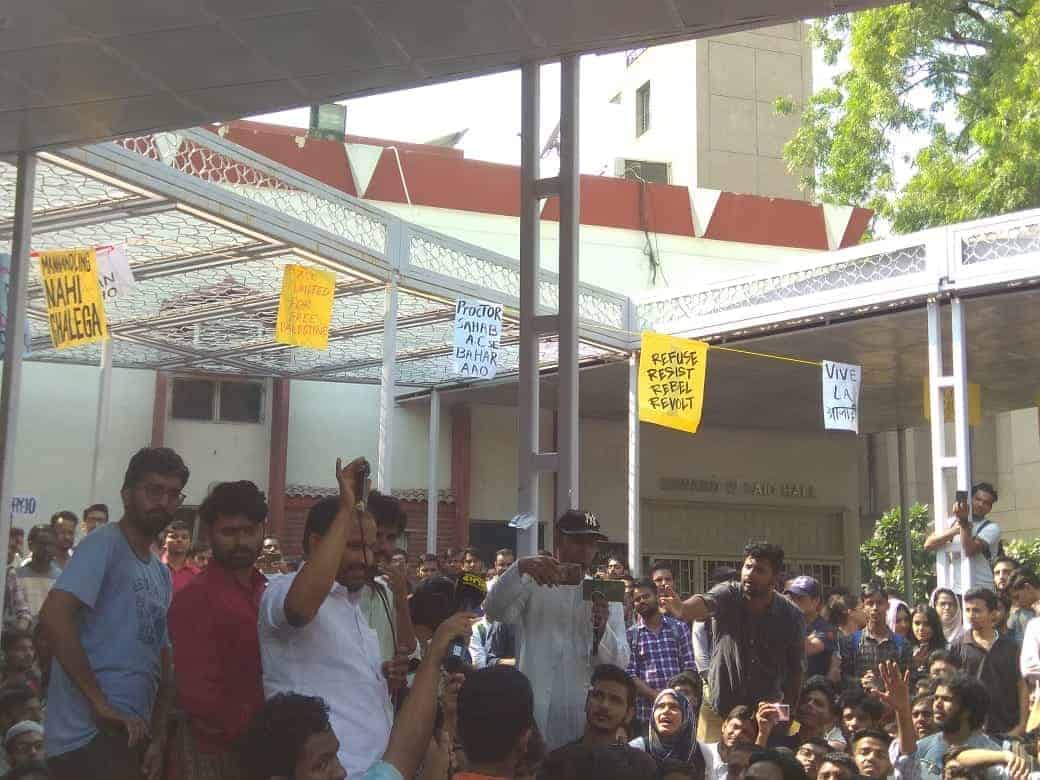
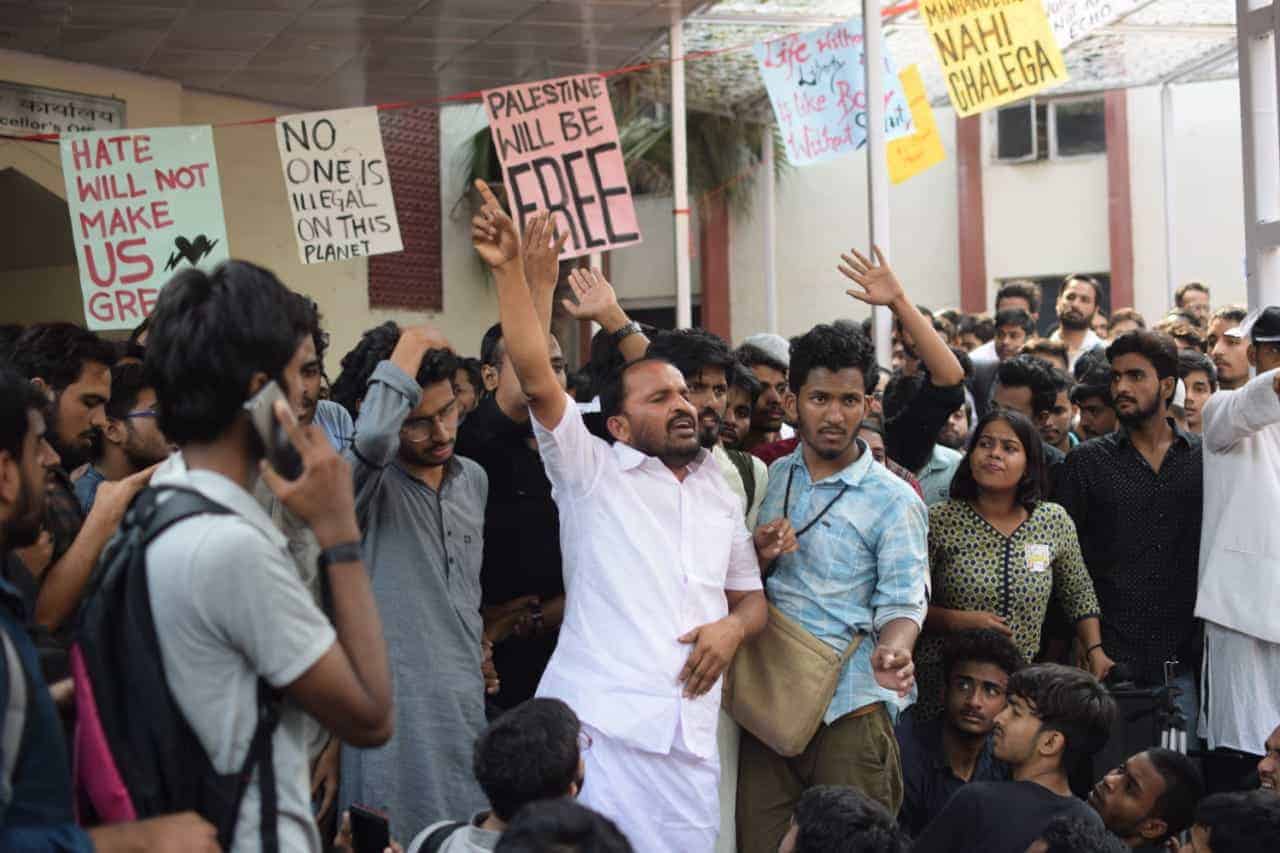
Protests in support of Palestine, outside the Edward W Said Hall, named after famous Palestinian- American Scholar Edward W Said. Credits: The Jamia Review
What was it with regard to the show cause notice?
The five students who have received the show cause notice were among the 12 students who were a part of a symbolic protest probing the intrusion of an Israeli delegation that was supposed to be the country partner of ‘Global Health Zenith Confluence’19’, organized by the Faculty of Architecture and Ekistics, JMI, on October 5, 2019.
According to the administration, the students were rewarded with this show cause for hampering the University’s image and vandalising in an otherwise peaceful campus with an unnecessary protest.
One of the members of the All India Students Association says as we quote,
“It is our fundamental right to express our voices and it is utter nonsense to say that we engaged in some kind of vandalism, rather it was us who were manhandled by the guards.”
What was the progression of the protest?
For past one week the All India Students Association and the Dayar-e-Shauq Student Charter, another student organisation assembled near the central canteen demonstrating their contempt regarding the administration, and demanding for a revocation of the show cause notice against the students and a total boycott of Israel.
What happened at the Solidarity March?
On the ninth day of the protest, the students planned for a peaceful protest seeking a reply from the administration regarding the show cause notice and a face-to-face talk with the vice chancellor, reportedly almost a thousand students joined the March chanting slogans of ‘Inquilab‘ and ‘Azadi‘. After a day-long protest, in the second set of the day, some 10-15 students appeared at the venue, asking the protesters to vacate the place within next 30 minutes, failing which severe repercussions may befall upon them (as reported by one of the protesters).
Subsequently, the protesters refused to withdraw the protest following which they were attacked with flower pots and which were later dragged around, creating a huge scuffle, injuring many students; one of them being Shah Alam of B.A. (Hons.) Political Science is reported to be in extremely critical condition. The varsity campus was then flooded with a Delhi Police delegation which attracted lots of eyeballs.
The students then went on to protest for the entire night and were joined by more students from all over the University in the later part of the tenth day of protest. Songs and slogans complemented the fulmination, with flags of Palestine and India being raised outside the office to signify the protest. They were also extended support by the Hon’ble MP of the Thissur Constituency, Mr. T N Prathapan, who expressed his grievances against the authority and ensured his support to the students protesting. Protest also witnessed support from the JNU General Secretary, Satish Chandra Yadav, who backed the students with his words.
Congress MP Mr T N Prathapan extending support to the protesters at Jamia Millia Islamia. Credits: The Jamia Review
What next?
The students have now raised their demands to be fulfilled by the administration, following which they are ready to withdraw the protest and return to the classes which elsewise witnessed a boycott of classes in the University today.
The demands by the protesters include three major points which include, a withdrawal of the show cause notice against the five students, an assurance of the safety of the protesters which ensures no action to be taken against the students, and a serious action against the ‘goons’ that prompted the attack on the protesters.
What happens further is yet to be discovered but this incident has surely engaged number of students who have expressed their solidarity and support in concerning times.
University students, teachers and admin steps out in silent protest against non-appointment of the Hindi HoD.
On 18th October, Friday, the administration, teachers and students of Delhi University stepped out wearing black bands in a silent protest against the delay in the appointment of the Head for the Hindi Department. The post for the same has been vacant since the 19th of September when the former head’s tenure ended.
The absence of the HoD has led to multiple complications not only regarding issues with the researchers but also causing a delay in the announcement of dates for M.Phil and PhD admissions, despite the issue of notification.
This position has been vacant for almost a month now since two proficient members of the department- Professor Sheoraj Singh Bechain and Professor K.N. Tripathi, have demanded claim for the said post, both refusing to back off. The question of seniority arose within this given situation.
The teachers and students demanded the appointment of Professor Bechain as the new HoD. Professor Bechain is the senior-most member of the Hindi faculty. He is one of the few Dalit professors in the University of Delhi. He has written multiple books on anti-caste and Dalit literature including Samajik Nyay Aur Dalit Sahitya and Mera Bachpan Mere Kandhon Par, and has also been awarded by the Hindi Academy of both Madhya Pradesh and Delhi governments.
It must be noted that no Dalit professor has been appointed as an HoD in the past 70 years in the Delhi University. This has given rise to numerous questions alleging the University of exercising discriminatory practices against the Dalit community. As a result, the teachers and students stepped out in a silent protest march from the Arts Faculty to the Vice Chancellor’s Office demanding appointment of Professor Bechain as HoD in “the interest of social justice”.