We demand freedom of speech but do not realise that the information we get through the mouthpieces of mainstream media reach us through a process that is not exactly free. The stories we hear, read or see are often biased. They are presented to us through the prism of the media house’s own lens created from a mixture of political, geographical, ideological and pecuniary elements that the house could be influenced by.
A journalism student who lands in any of such media houses might end up becoming another automaton programmed to work in the assembly line of the house and forced to follow a coloured thought-process. Imagine the future of journalism in such a scenario. This makes the need for a fair, free voice for everyone exceedingly important, and this is why we created SUNO.
SUNO is a unique app that lets the user tell stories to a fast expanding readership comprising new age, educated men and women from around in the world. It won’t be an exaggeration to state that SUNO could be like the Oracle of Delphi in the hands of a journalist who has a nose for news. Its advanced features empower the user to present the story in an interactive and attractive way too.
An intern will learn the ropes of journalism better with an app that lets them at least report on whatever they think is worth reporting. At SUNO, an intern learns the two most important aspects about journalism – fairness and impartiality.
So why wait? Join the SUNO Internship Programme here.
The Department of Journalism at Lady Shri Ram College for Women kicked off its Annual Academic Meet, Juxtapose 2015 on October 7. The theme for this year’s meet was ‘Deconstructing Identities, Reconstructing Perceptions’ and shined through in the topics of the various events.
Team from LSR at Media Quiz
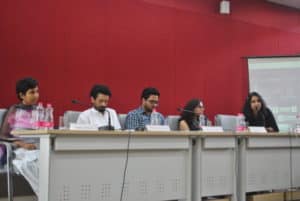
Panel Discussion Day 1
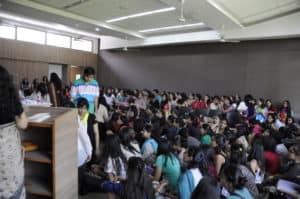
Hall of Panel Discussion
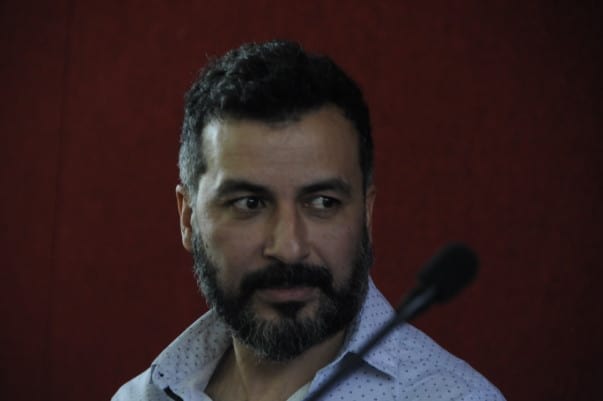
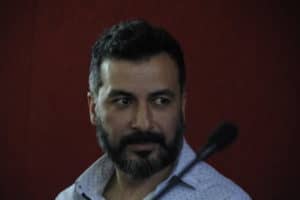
Aamir Bashir, in Panel Discussion
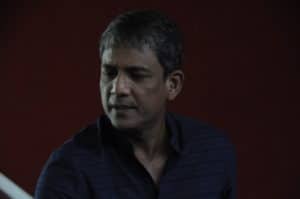
Adil Hussain, in Panel Discussion
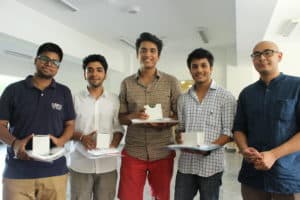
Winners of Ad Mad
Pre Juxtapose, 7 October- All India Media Meet
The issue of freedom of expression in the light of recent killing of journalists was subjected to heated discussion at The All India Media Meet of Department of Journalism, Lady Shri Ram College on 7th October 2015. The discussion shed light upon the subjective issue of freedom of press. The major issues of whether killing of journalists is an ultimate resolution to the “offensive” content produced by media was put to discussion. The major issues addressed during the course of discussion were the need of media and government to be independent bodies, inadequate self-regulatory mechanism prevalent in media, how killing of journalists is a direct consequence confrontational journalism.
The conference finally sought to address the two major issues of implementing an ideal law exclusively for the safety of journalists and the question of the actual identification of journalists considering how the concept of citizen journalists has led to ambiguity in the definition of journalists. Other issues of media blackout,the thin line of difference between hate speech and criticism and the leading consequences of defamation of judiciary by the press were address.
The debate whether an independent body other than the Press Council of India is required for safeguarding the interests of journalists was the final question addressed towards the end of the discussion. The discussion concluded with the following recommendations by the delegates of the committee –
Creation of a committee that gives licenses to freelancers and not citizen journalists and ensures that these licenses are not misused.
Ensuring that the committee formed shall ensure legal safety of journalists.
Ministry of Information and Broadcasting should put forward these recommendations to the Parliament.
Periodic meetings like AIMM must happen frequently to address these issues.
Day 1, 8 October- Turncoat Debate, Panel Discussion and AdMad
The topic for the Annual Turncoat Debate – Vox Pop at Juxtapose 2015 was whether film certification works in favour of the state or the public. Ideas like state propaganda, state mandate, to name a few, surfaced. Speakers spoke of how the Indian government compresses its citizens into a monolithic identity while at many a times completely disregarding the plurality of the country and on the other hand, how the state’s “parental attitude” was essential and justified.
‘Kissa Kursi Ka’ was a movie cited as an example by many speakers. However, as felt by the judge, Ms. Ishita Tiwary, what happened to the movie after it was banned wasn’t talked about by the speakers. This was an integral part as it shows the lengths the state can go to, to prevent anything that goes against its interests. After drawing comic reactions to a reference by speaker Chandrashekhar to Ragini MMS and how it had a “mentally scarring” effect on children, he went on to win the debate. The second and third positions were bagged by Naman Malhotra and Kushal Mishra.
The panel discussion, the second event of the day, was on the topic, “Media’s content: A state of compromise or progression?” The panelists included eminent personalities from the field of media – Abhinandan Sekhri, Shoma Chaudhary, Ritu Kapur and Supriya Sharma. Anshul Tewari, Founder and Editor-in-Chief of YouthKiAwaaz.com, was the moderator.
“Digital media has really shot up in the last 7-8 years. Though it has received a fair share of criticism but it has emerged as a powerful tool for people to speak up,” said Anshul Tewari. “Yes, digital media is limited there is no denying but I think over the next few years it will go deeper,” said Ritu Kapur, co-founder- The Quint. They further went on discussing the impact of digital media to which Abhinandan Sekhri’s stance was very unambiguous. According to him it’s a screen and it doesn’t really matter whether it is NDTV or News Laundry or Scoop Whoop. Also, he said that he believes that the number of views is not a yardstick to judge whether something has impacted people or not, rather, it’s the time they are spending in reading it which speaks.
On comparing the online media with print, Supriya Sharma, recipient of the Chameli Devi Award, given for excellence in Journalism, pointed out that online media is an interactive media with young readership and a sense of feedback. For her it is really very exciting to be able to influence the young minds of the country.
Towards the end the panelists discussed free speech and reasonable restrictions to which Abhinandan responded by saying that he is an absolutist and does not believe that any restriction is reasonable. His opinion was seconded by Ms. Shoma but with two caveats, which were – factuality and incitement to violence. The session concluded with a question and answer session with the audience where in issues like gate keeping, hate speeches and corporate ownership were discussed.
The AdMad competition was judged by Professor Shikha Jhingan and Professor Vibhushan Subba, from the Department of Journalism at LSR. One team that stood out was the one given a “mind reader” to sell. Their mind reader was a pair of flashily lit glasses. Team 4, consisting of Khushwinder and Dhruv, from who advertised an online grocery store bagged the first position, followed by Team 8, Manan, Akhil, Ishan and Vikas from Netaji Subhash Institute of Technology. The second runner up was Team 10, consisting of Manan Batra and Tushar Singh from Sri Venkateswara College.
Day 2, 9 October: Paper presentation, Panel Discussion, Media quiz
“Media presents to the audience what the audience wishes to see.” A paper presentation competition, Samantha vs. Savitri, organized by the Department of Journalism at LSR, kicked off the final day of their Annual Academic Meet – Juxtapose 2015. This platform acted as a podium where speakers presented their papers, on the question of representation of gender identities in 21st Century Sitcoms. The five participants present here had been shortlisted on the basis of their abstracts submitted much in advance. The event was judged by Ms. Abhija Ghosh, a student of Cinema Studies at the School of Arts and Aesthetics, Jawaharlal Nehru University.
The presentations highlighted how women in particular are stereotyped as being submissive, prudent, and emotional with lack of strength. While the debate concentrated move over the roles of women, reference to other genders were also brought in by speakers. They mentioned how genders apart from the males and females are hardly mentioned as they are considered “unnatural”.
One of the participants, Sukanya, from Daulat Ram College, said, “Ironically, the small screen acts a harbinger of change”. But what change are we talking about if the whole concept of sitcoms dwell on reinforcing stereotypes in just a “funny or new” manner. Indian television serials show mainstream drama projecting the relationship between a mother-in-law and a daughter-in-law as being manipulative and competitive to gain the sympathies of the son/husband.” Another participant, Azra Qaisar, who also happened to be the winner of this event, quoted Naomi Wolf, “Women are allowed to have a body or brain but not both”. A student of LSR itself, her paper focused on the women characters in the famous American sitcom The Big Bang Theory.
The title of the panel discussion of Day 2 was Alternative vs. Mainstream Cinema, will the spectrums ever converge? The panelists on board were Mr. Pankaj Butalia, an award winning documentary filmmaker known for his films like Moksha and Textures of Losses; Mr. Aamir Bashir, a renown Indian actor and filmmaker, known for his work in films like Harud and A Wednesday; Mr. Adil Hussain, an Indian stage, film and television actor most known for his work in Life of Pi and English Vinglish; and Ms. Shohini Ghosh, is the Zakir Hussain Professor of media at the AJK Mass Communication Research Center, an essayist on popular culture and a documentary filmmaker. The discussion was moderated by Ms. Abhija Ghosh, who is a student of Cinema Studies at the School of Arts and Aesthetics at Jawaharlal Nehru University. The discussion began with the moderator asking each panelist to define what mainstream and alternative films are to them.
One particular analogy given by Shohini Ghosh, was that of “the king’s highway and the detours” referring to the mainstream and alternative films, respectively, was used extensively througout the debate. Ms. Ghosh looked more towards the intersection of the two ways, and the ways in which each has its own importance. She quoted the example of Christopher Nolan, as to how he converged the king’s highway and the detour to completely redefine film form. She said, she prefers the term ‘independent cinema’ over alternative cinema. Documentaries, she believes, create the ground for content based movies in the mainstream cinema and have an invisible network of screening and reaching the audience.
Mr. Aamir Bashir wondered where the “dung on the detours” would go with the “swachh abhiyaan” happening. He said that the problem was of appropriation of alternative into the mainstream and how the mainstream tries to proach the alternative. He questioned the distribution system and market economy and how these forces were not willing to back alternative content. He also clearly mentioned, how he wasn’t very optimistic for the future of alternative films in India.
Mr. Butalia was concerned with documentaries and the lack of importance given to them in conversations about films in general, saying that it was “almost as if they do not belong to the category of films“. In the words of Mr.Batalia, we look at the “content” and “form” to distinguish between alternative and mainstream cinema. As the content gets more and more acceptable, it gets appropriated into mainstream media. The demands of commerce do not constrain the alternative film whereas a formula is literally laid out to govern the mainstream cinema; while the alternative cinema experiments more with the form. According to him, creativity is the defining factor in alternative media.
Adil Hussain said that all people who act, make or criticise movies are only human. Human nature and tendencies lead to mainstream media to be more widely accepted than the alternative, simply because it is more familiar and more acceptable to the masses. According to him, the greatest flaw in the medium of film is the need for money to begin making it. While comparing films to theatre, he mentioned how theatre needs no such investment. He defined alternative or more artistic films as those which put the characters and content under an electron microscope, giving them a completely new perspective rising from extreme curiosity and respect towards the arts.
The final event of Juxtapose 2015, was the media quiz. This year’s quiz was conducted by QuizCraft Global Knowledge Solutions. The Quiz Master was Mr. Adittya Nath Mubayi, Director of QuizCraft Global.
The quiz began with a preliminary round of 25 questions. A total of 65 teams participated out of which 6 made it to the final. Each team consisted of two members. To break the ice, Mr. Mubayi interacted with each of the final teams and asked them which journalist they would become, if given a chance, for 60 seconds.
The teams that made it to the final quiz had some really interesting names like Inter Galactic Hanuman Sena, Merry Pranksters and Bazingaa to cite a few. In the first round, each question was backed up by 2 hints. Each team had to recognize a person. First the audio was shown then the first hint would be a fact and the second would be the photo. Answering without using hints meant 60 points while it came down to 40 and 20 with the use of the first and the second hint respectively. The second round had direct oral questions. The third round was named Look here, Look hear which included audios and visuals. It covered questions right from the iconic interview with Princess Diana to who the voice of the Delhi Metro is. The fourth round again had direct questions. The last round was the buzzer round. This was a +40 and -20 round and had eight questions. The interesting part about the quiz was that each round began with a question from the audience and ended with the same and also when no team could answer, it was passed on to the audience. For every correct answer from the audience Amazon Kindle e-vouchers were given as gifts.
Team Chapter 11 which had Sreshth Shah of Amity University and Raletim of IGNOU won the quiz with a total of 440 points, they were given a cash prize of Rs. 5,000 and gifts from Support Foundation, Muskaan the NGO and Print Octopus. “The quiz was quite tough and interesting and we are lucky to win it,” said Sreshth Shah after his victory. They were followed by Merry Pranksters which had Gokul and Arunav, students of Atma Ram Sanatan Dharm College and Aryabhatt College. There was tie between LSR’s Bazinga and Gulabbo for the third position and with a tie breaking round, Team Gulabbo grabbed the third position. The runner ups were awarded with cash prizes and gifts from the sponsors.
Compiled by: Sakshi Jain Megha Kalia, Maitreyee Misra, Tanvi Jalan and Saloni Singla
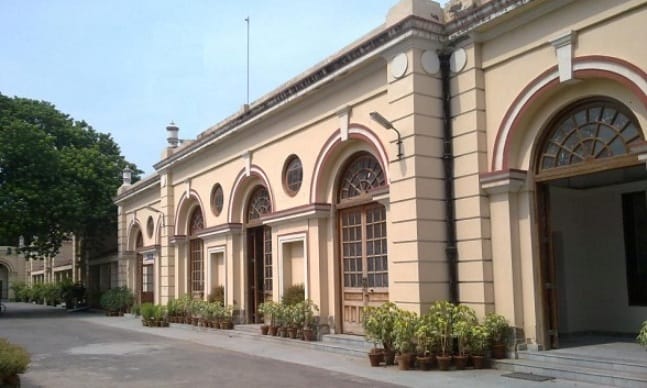
Indraprasth College for Women’s (IPCW) journalism course has gone through a host of changes since the introduction of the Four Year Undergraduate Programme (FYUP). Initially known as Bachelor in Mass Media and Mass Communications, it was renamed to BJMC and its entrance exam was scrapped in favour of admissions through cut-off percentages. Last year, after the scrapping of FYUP, Bachelor in Multi Media and Mass Communication (BMMMC) was reintroduced but admissions continued through cut-offs.
In a press conference on Thursday, the college announced the return of the entrance exam system for the course, which has now been renamed to BA(H.) Multi Media and Mass Communication in order to fall in line with the University Grants Commission directives on course nomenclature.
There will be two exams for admission to the course. The first entrance exam will be an objective (MCQ) test and is scheduled for 21st June. The second entrance exam will be held on 25th June. It will be a subjective test on English comprehension and creative & analytical skills.
The college will issue a list of accepted candidates on 29th June followed by payment of fees from 1st July to 3rd July.
To register, candidates can collect and deposit forms at IPCW starting 1st June. Last date to apply is 10th June. The chargeable fees for the form and the test is Rs.950 for general category and Rs.475 for other categories. Aspirants can also request postal delivery of the application form.
A student from the Class of 2015 (last batch to have taken the entrance test) suggests that entrance exams ensure that only candidates who are ready for the highly specialised course make it through the admission procedure. “It’s a welcome change,” she said, on condition of anonymity. The graduating batch reportedly also faced problems while filling application forms for PG courses due to the change of name of the course from Mass Media and Mass Communication to Multi Media and Mass Communication.
In the press conference, IPCW also announced the proposal of a new journalism course to the University of Delhi. The course will include Fashion Communication, Disaster Management & Communication and Public Service Broadcasting among other subjects.
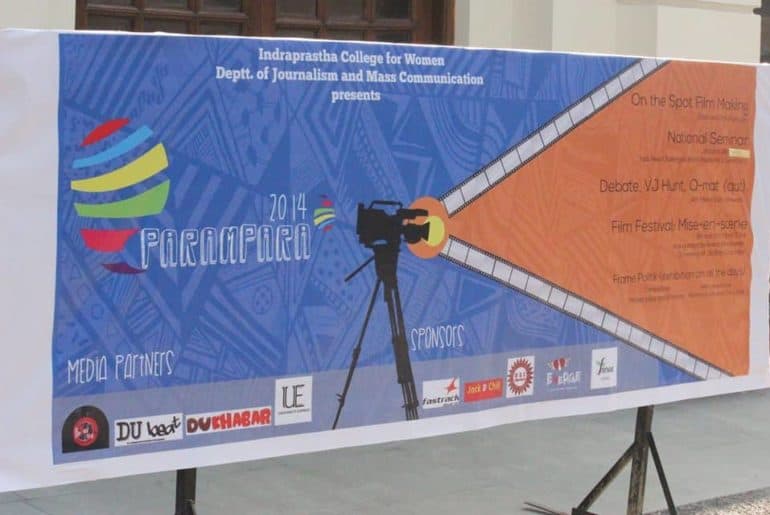
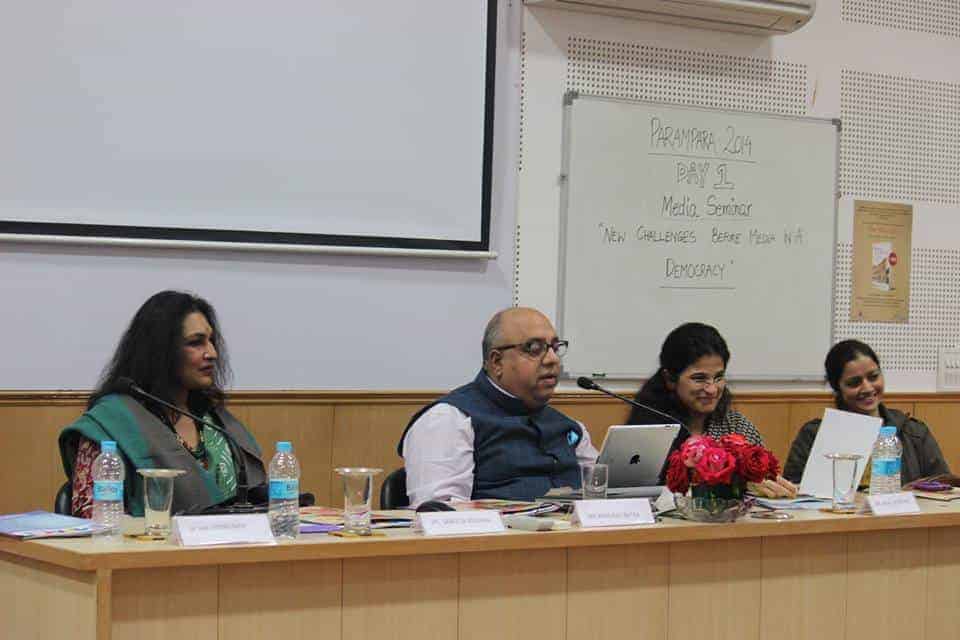
The annual fest of the Mass Media and Mass Communication department of Indraprastha College for Women – ‘Parampara’ was held on 3rd March and went on till the 8th. A national seminar was held on the 3rd comprising of several well known panelists from the media industry. The discussion comprised of two sessions, the topic for the first session was ‘New Challenges before Media in Democracy’. Mr. Anurag Batra, CEO Exchange for Media group was the chairperson as well as the keynote speaker. Amongst others were Sangeeta Malhan, former journalist and author of ‘The TOI Story’ and Anjali Bhardwaj, co-convener people’s RTI campaign. The topic for the second session was ‘Reporting from Conflict Zones’ and Kishalay Bhattacharjee, a former NDTV reporter of the Naxal movement was the chairperson. Preeti Mehra, associate editor of The Hindu and Ajith Pillai, former Correspondent for The Outlook were the speakers.
The second day comprised of the student session which was chaired by the head of the department and Principal Ms. Babli Moitra Saraf. The topic was ‘Attitude of Media towards Nascent Horses in Politics’. Students presented on this topic and the session was enlightening. The topic was mainly interpreted in the AAP context and how media built their image.
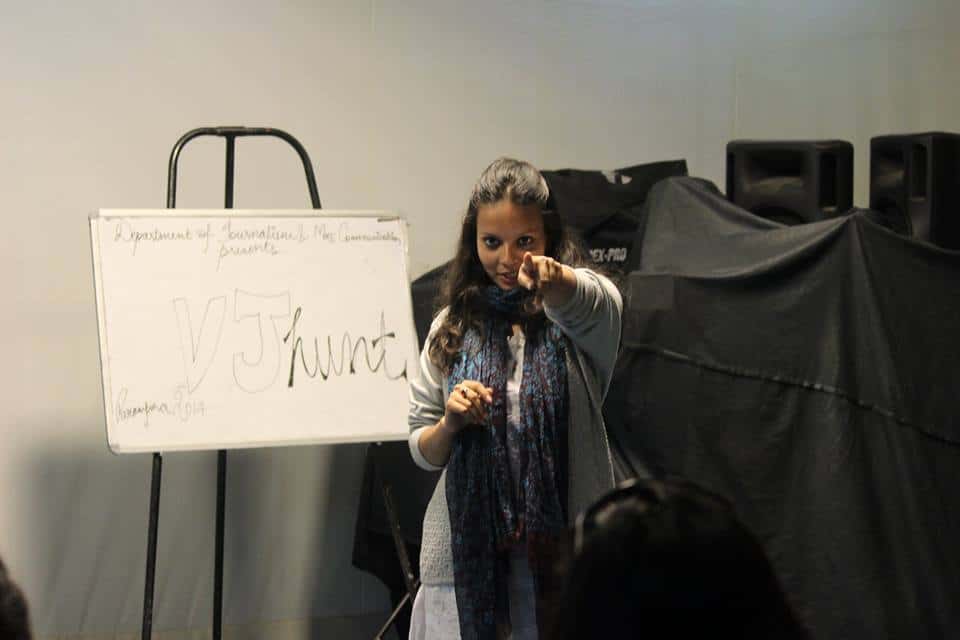
In the second half of the day, several competitions were held. VJ Hunt was judged by RJ Abhilash from Fever 104 FM. The 1st prize went to Khyati Sharma and second to Sampada Jagga. Q-Mat, the quiz competition was won my Netijayata Mehendru and Arzoo Bhel.
Apart from these, the photography competition, Frame Politik had two themes Market and Emotions. The 1st prize in the Market category went to Sahil Ali and the 2nd prize was won by Abhishek Gupta. In the Emotion category, the first prize went to Akanksha Chitkara and the second one went to Sakshi Jaiswal.
Mise-en-scene, the movie screening event was inaugurated by the celebrated documentary writer Mr. Anand Patwardhan and his film ‘Jai Bhim Comrade’ was screened on 5th March, followed by an interactive session with him. 2 p.m. on wards, films made by students were screened. The fiction category was won by LV Prasad College and the second Position went to National Insititute of Fashion Technology (NIFT). The Non-Fiction category was won by Jamia Milia Islamia and second prize went to I.P. College. On the Spot film making was won by JIMS, Vasant Kunj.
The event ended with a talk by Mr. Nagesh Kukunoor and the screening of his film ‘Laxmi’ on 8th March. Having faced trouble with the censor board and being forced to delete many scenes and dialogues, he wanted his film seen uncut before it gets released in theatres. So he came to IPCW to get his message across to students. The movie was about a young girl Laxmi who was sold by her father and how she gets over hundred people caught by testifying against them.
Politics was not so murky and abysmal before the 1990s, or apparently it didn’t look so, but with the evolution of media, a wave of transparency has transcended on each decision-making body and also on the decision makers of this country. The 21st century has seen the advent of investigative journalism, and with it, that of blame games and revolutions.
The past decade witnessed the trend of ‘an uprising media’, which has now become the face of India. More appropriately, it is the tool in the hands of citizens, to check the wrong-doings of the so called ‘public workers’. Many scams have been unearthed, many bad policies reviewed and many politicians sent to jails for their ill work , all has been made possible due to the ever-efficient media and its wide outreach.
The polity of India is now as lucid as a diamond. Every new policy is now checked, if not by the policy-makers than by the media, the fourth pillar of democracy. Well, we all know what happened with the Augusta-Westland deal. Every strand of the deal was reviewed and put in front of the people to decide. What if media had not been there? The corrupt in this case would have run away with all the black money. Fortunately it was present, and thus the deal was put off for an internal inquiry.
This is just one example of the power of media when it comes to being a critic of Indian politics. There is another side to the story, wherein media has also helped the politics to incur a never before seen boom. Parties now reach people through the media. A 500 crore image makeover for the scion of one of the major political parties in India is not a lie. Political parties have been on both back foot due to the media revolution and at the front foot when it comes to improving their public image. The ‘Development model of Gujarat’, and ‘Chai pe Charcha’ are two such examples of the same, where through media, interested parties have tried for an image makeover. Not only makeover, media has also helped some budding parties to come at par with national ones as we saw in the AAP phenomenon.
So, it is understandably clear, how media can shape the politics and with it the future of this country. What has to be borne in mind is the limit in which it has to work. The past has shown us how media can change scenarios, what has to be ensured is such a change in the status quo is for the betterment of the people of this country. As ultimately, media is by the people, of the people and for the people.
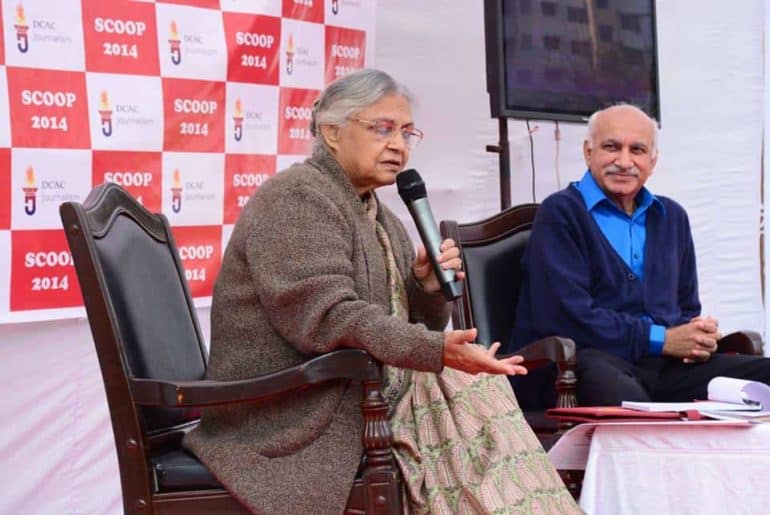
The annual fest of the Journalism Department of Delhi College of Arts & Commerce, Scoop 2014 started off with ‘Heads-Up’ with Sheila Dixit and M.J Akbar for a panel discussion on ‘Lok Sabha Elections 2014: Is the traditional political landscape changing in India?’.
After the interactive session, Scoop 2014 kicked off its numerous events which are to be held over two days at the college campus.
The events on Day 1 unfolded as follows:
General Quiz
Popular Quiz Master Aniket Mishra hosted the general quiz at Scoop where around 40 teams participated and cross college teams were allowed. The winning team consisted of students from St. Stephens and Jamia Millia Islamia. The runner up was a team from the host college itself.
Ad-Mad
The ad-mad event also saw a large number of participations across colleges and universities. A team from Delhi College of Arts & Commerce emerged victorious and took home cash prize worth Rs. 4000 and a travel voucher by Roads Less Travelled.
The events on Day 2 unfolded as follows:
Football Bidding
Football fans participated in the Football Bidding competition where 8 teams were shortlisted on the basis of a general football quiz among 24 teams. These teams were given an amount of imaginary 150 million dollars to buy their team among a plethora of international football players and sit for the auction. Abhinav Paliwal and Rishabh Singh Chauhan from Delhi Technological University won the First prize and Second prize was won by a team from DCAC. The winners won cash prizes worth Rs. 4000 and a complimentary dinner at Hilton Hotel.
Street Play
DCAC saw students from various colleges flocking the campus to participate in Street Play Competition. Sri Guru Gobind Singh College of Commerce’s act ‘Chidiya ki Kahani’ walked away with the First prize followed by P.G.D.AV’s ‘Jhukna Toh Humne Seekha Hi Nahi’ amongst the 10 acts shortlisted for the main event. The winners took home cash prize worth Rs. 10,000.
Photography Competition Results
The two day fest by Journalism Department concluded with the announcement of winners of Aks-Online Photography Competition with about 30 participants from various universities. The First prize went to Koyna Tomar from LSR and Second prize was bagged by Pratyoosh Kashyap from Kirori Mal College. The theme of the competition was Taboo/ Expressions. The judges were Omar Khan, a photojournalist for News X and a freelance photographer covering F1 racing at the Buddh international Circuit and Saumya Khandelwale, a freelance photographer.
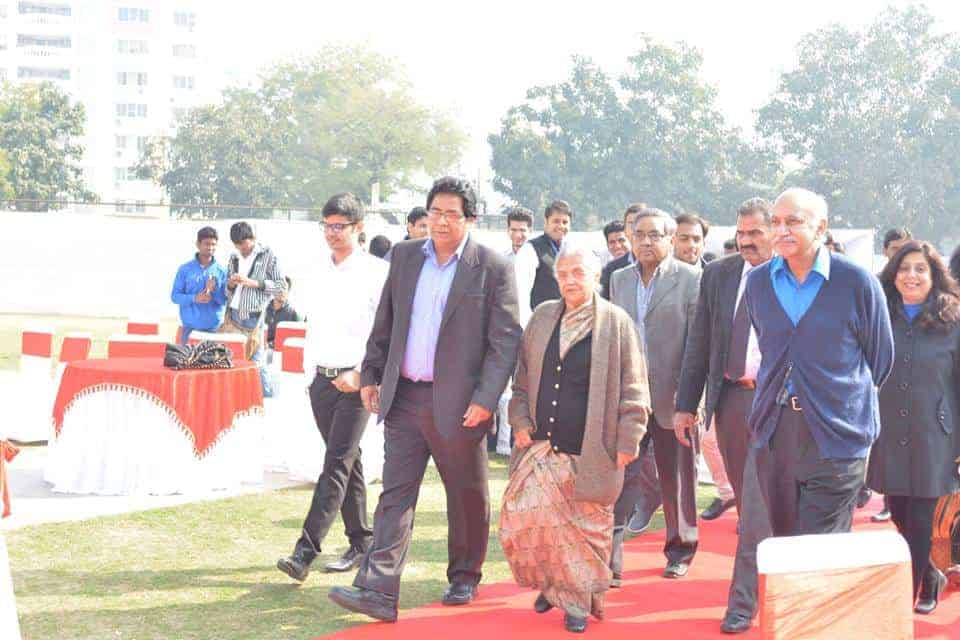
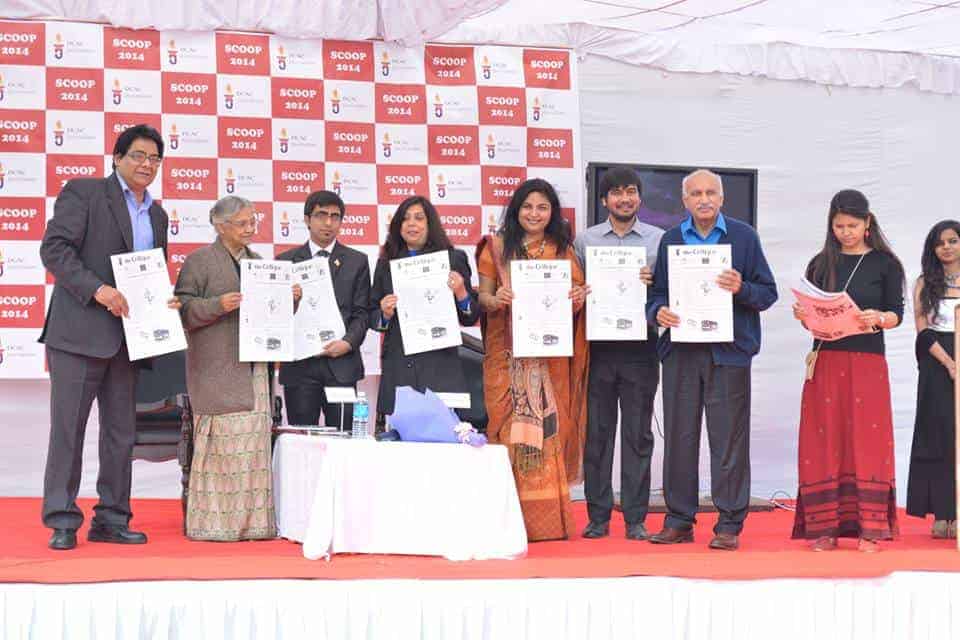
The inaugural ceremony of Scoop- 2014, the annual fest of DCAC’s Journalism Department was graced up by the presence of ex-Delhi Chief Minister Sheila Dikshit and senior journalist M.J. Akbar. The distinguished personalities were on campus to be a part of the panel discussion ‘Heads Up’ about Lok sabha elections 2014. The event that lasted for an hour saw the three time Delhi CM answer the questions asked by fellow guest as well as the audience, and simultaneously taking a dig at the Kejriwal government, and at times, even at the UPA – II.
On being questioned about the blow Congress faced on the Delhi Vidhan Sabha elections 2013, she attributed it to the eventual desire of people to usher change for sake of the change. “There was a sense of fatigue in minds of Delhites. People were misled by tall promises, which we couldn’t counter due to loss of public faith and several internal party reasons.” said, Ms. Dikshit. Replying to this, Mr. Akbar commented that democracy is not merely the right to vote, but right to change government, and if public doesn’t do it for long, it forgets how to. He also suggested to not to look in large of the crowd, but small of the eye.” A government survives till the eyes of public repose faith in them, when those eyes go blank, cold and questioning, the good days are over, even Jawaharlal Nehru didn’t survive the elections fourth time”, he added.
On being questioned about corruption charges against her government, she snubbed all the allegations on the pretext of clean chits granted to her by concerned investigating committees. Also, she stressed more on the corruption of idea, than money, which has supposedly become the new disease political system ails with, where in the public was induced by the bait of free water, pakka houses and guaranteed jobs.
Answering back on the shelved Janlokpal bill, and weak governance at centre, she said held the Central government complacent, and indecisive and guilty for not articulating what it wanted. According to her, “The need of the hour is a stable and capable government that creates a congenial atmosphere to hold debates to inject fresh ideas in system and push pending bills forward.”
Along with discussions, mostly political, the event also had several light moments. M.J. Akbar underlined importance of majority governments against coalitions comparing the iconic characters of Ramayana, where in the hero had one face, and the villain was ten faced. On being interrogated on tax payer’s money spent on advertisements , Ms. Dikshit alleged all parties including BJP to be doing the same, “…maybe you like Mr.Modi’s face more than mine” she jokingly added.
The Journalism department is also celebrating its 25th anniversary this year. The event also marked the launch of their department news paper – ‘The Critique’ by the chief guests. The discussion was a cue to the two-day fest in the college, holding numerous events like quiz, football bidding and ad mad.
As a head start to their annual fest Scoop, the Department of Journalism, Delhi College of Arts & Commerce is presents Ex Chief Minister Sheila Dikshit in conversation with M.J. Akbar, Editor-in-chief of Sunday Guardian. Talking of the upcoming elections, the discussion will be on the topic, “Lok Sabha Elections 2014: Is the political Landscape Changing in India?”.
Are you a science student but don’t want to be scientist or a teacher? Do you want to try your hand at something totally different and yet stay connected to your science roots? Science journalism may be the thing for you.
Science journalism is about reporting about science to the public. The field typically involves interactions between scientists, journalists, and the public. Science journalism, like the Science and Tech page in The Hindu, simplifies the very detailed, specific, and often jargon-laden information produced by scientists into a form that non-scientists can understand and appreciate, while still communicating the information accurately.
The National Association of Science Writers fights for the free flow of science news. The Indian Journal of Science and Technology accepts research based articles from students studying at various levels. Various other publications like Indian Journal of Scientific Research and Indian Journal of Science by Discovery prove helpful to those who look to broaden their perspectives about their respective research fields.
It’s not just about research though. Science journalism, or science media if we broaden it, is vast. From interviewing various smart heads to being a brainy radio jockey, the opportunities are endless for those who want to continue with science and yet don’t want to become Einstein. Maybe we could be looking at the next David Saltzberg, the science advisor to The Big Bang Theory. After all, it takes smart people to actually understand the depths of Sheldon’s jokes. And it takes even smarter people to actually use all the scientific knowledge in the world to sit and crack jokes on such matters.
Penny: So what do you say Sheldon, are we your X-men?
Sheldon: No, the X-men were named for the X in Charles Xavier. Since I am Sheldon Cooper, you will be, my C-men.
Yes, it’s a nerd joke. And yes, it’s definitely funny.
The Cluster Innovation Centre (CIC) at Delhi University had recently launched a new course in Media and Communication. The closing ceremony will be held tomorrow, on the 5th of February in the presence of the Registrar of Delhi University, Ms Alka Sharma.
25 students from CIC had been selected for this course. The course was a 10-class, or a 30-hour credited programme that was instructed by Brij Bakshi, the former Additional Director General at Doordarshan, joined by Gouran Dhawan Lal as senior faculty and Mike Pandey, a green Oscar winning wildlife film maker, L V Krishnan, CEO, TAM Media Research and Ashok Raina.
The aim of the course was to improve presentation and communication skills of the students while giving them knowledge about various aspects of media in an interactive manner. A wide range of topics including environment and wildlife programming, understanding TRPs, art of video editing were covered.
Sahil Mathur, a B. Tech student who participated in the programme said, “This course allowed me to understand various facets of media, from film making to editing, from technology to understanding how to present an idea to an audience. The course has made me much more aware in the field of media and communication.”