Tag

Journalism

Browsing

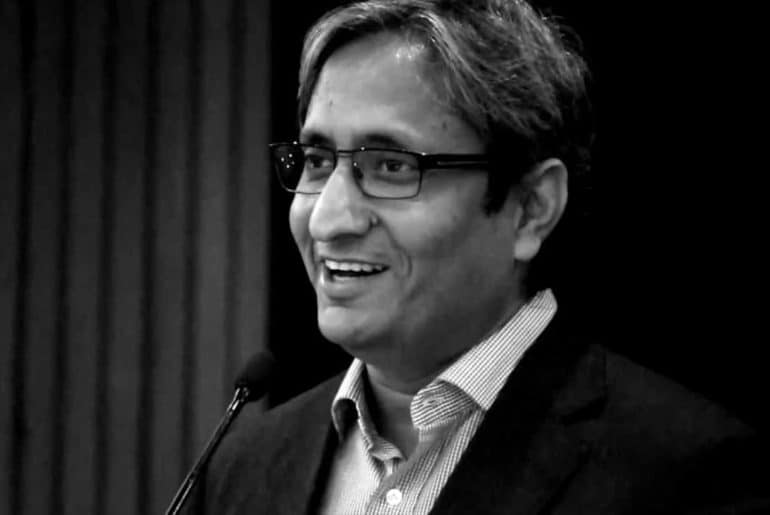
After gaining prominence with his ground breaking reporting on shows like Prime Time, Hum Log, and Ravish Ki Report, NDTV Journalist and Senior Executive Editor, Ravish Kumar was conferred with the prestigious Ramon Magsaysay Award.

Being one of the five recipients of the 2019 Magsaysay Award, the Asian equivalent of the  Nobel Prize,  Kumar has been awarded the prize  for “harnessing journalism to give voice to the voiceless” and his “unfaltering commitment to a professional, ethical journalism of the highest standards”.

Other recipients of this year’s Magsaysay include Ko Swe Win of Myanmar, Angkhana Neelapaijit from Thailand, Raymundo Pujante Cayabyab from Philippines, and Kim Jong-Ki from South Korea.

Ravish Kumar, an alumnus of the prestigious University of Delhi is a History Honours graduate from Deshbandhu College. Initially, he was interested in Public Affairs and further pursued a postgraduate diploma in Hindi Journalism from the Indian Institute of Mass Communication, but dropped out eventually.

In 1996, he became a part of the New Delhi Television Group (NDTV) and rose to the top with his dealing of the common problems on Prime Time and influential reporting of the same criticising the Government and the authority coupled with professional attitude with a fluid explanation of critical issues presenting facts and figures substantially.

Established in 1957, the Ramon Magsaysay Award is Asia’s highest honour. It celebrates the memory and leadership example of the third Philippine president after whom the award is named, and is given every year to individuals or organisations in Asia who manifest the same selfless service and transformative influence that ruled the life of the late and beloved leader.

“In electing Ravish Kumar to receive the 2019 Ramon Magsaysay Award, the board of trustees recognizes his unfaltering commitment to a professional, ethical journalism of the highest standards; his moral courage in standing up for truth, integrity, and independence; and his principled belief that it is in giving full and respectful voice to the voiceless, in speaking truth bravely yet soberly to power, that journalism fulfills its noblest aims to advance democracy,” says the citation by the Ramon Magsaysay Award Foundation.

Previously, he has also been awarded the Ramnath Goenka Excellence in Journalism Award twice in the years 2013 and 2017 respectively. He has also won the Red Ink Journalist of the Year Award in 2016.  Ravish Kumar is also a celebrated writer, who has authored books like The Free Voice India, Dekhte Rahiye , and Ishq mein Shehar Hona.

The Award will be presented in formal ceremony in Manila, Philippines on 31st August, the birth anniversary of the Philippines President whose ideals inspired the Award’s creation.

Feature Image Credits: Edugenius Blog

Faizan Salik

[email protected]

Recent proposals for changes in the syllabi of various undergraduate courses have sparked opposition from the teaching staff, and the ABVP.

Controversy over academic matters arose in the  University of Delhi (DU), with some members of the Standing Committee and the Academic Council (AC), along with the Akhil Bharatiya Vidyarthi Parishad (ABVP) taking objections to some of the proposed changes in the syllabi of various undergraduate courses.

The controversy has taken the form of opposition from Academic Council members and protests by the ABVP, which some had alleged to have turned hostile.

The Background

A report in The Hindu stated that changes in the syllabus proposed by the English department of the University were opposed in a meeting of the Standing Committee to review the Undergraduate syllabus on 11th July. Among the proposals was the inclusion of study materials related to the role of the Rashtriya Swayamsevak Sangh (RSS) in the 2002 Gujarat riots, and use of Hindu deities in the reading of Queer Literature.  

Similar was the case with the English Journalism syllabus. As reported by The New Indian Express on 15th July, objection was raised by some members of the Academic Council over the inclusion of chapters about Muzaffarnagar riots, and instances of lynchings.

On 17th July, The Indian Express reported about the syllabus changes of other courses and the objections that came along with them. These included syllabi of History, Political Science and Sociology, along with English. The report stated that the Academic Council “referred the syllabus of English and History back to the respective departments for reconsideration, thereby refusing to pass it as it is.” The report further read, “On the syllabi for Political Science and Sociology, some AC members said they too had been sent back for modification, while others claimed they were passed with ‘minor modifications’.”

Who objected and why?

Professor Rasal Singh, a member of the Academic Council, had raised objections regarding the syllabus changes. He alleged that in the story Maniben Alias Bibijaan – a background to the 2002 Gujarat riots – RSS and its affiliate organisations like Bajrang Dal were shown in a “very bad manner”, and were portrayed as “looters” and “murderers”.

He further said that in the syllabus proposed by the English department, “Gods Vishnu, Shiv, Kartikeya and Ganesh were depicted as part of the LGBT community. The sources and evidence for these were secondary sources like ‘Same Sex Love in India’ written by Leftists on the basis of foundational texts of Indian culture such as the Bhagavata Purana, Skanda Purana, and Shiva Purana.” He also alleged that “too much Literature was being incorporated in a paper like ‘Communication Skills’. Instead of core courses like ‘Indian Writing in English’, new papers such as ‘Literature and Caste’ and ‘Interrogating Queerness’ were started.”

Regarding the History department, he said that “[topics about] Rajput history, Amir Khusrau, Sher Shah Suri and Babasaheb Ambedkar were removed from the syllabus. In the ‘Democracy on Work’ course, only the history of Naxalism and the Left have been included.”

He also said that the topics related to the Vedic society, the joint family, village swaraj, and “basics of Indian cultural thought such as environmental discussions and nature worship” were removed from the Sociology syllabus. On the Political Science front, according to Mr Singh, Maoism had been included in the course on ‘Indian Social Movements’, while other social movements like the Ramakrishna Mission, Arya Samaj, Brahma Samaj, and Khudai Khidmatgar were removed.

Mr Singh also alleged that the English department had not complied with the format and instructions of the Choice-Based Credit System (CBCS) and instead of a 30 percent change in the syllabus, close to a 100 percent change had been done.

The syllabus showed “tremendous predominance of leftist ideology and a ceaseless opposition towards nationalist ideology, Indian culture and the RSS,” Mr Singh said.

The ABVP, the student-wing of the RSS, organised a protest on 15th July, against the “inclusion of false facts relating to Hinduism and nationalist organisations.” The ABVP also demanded for the “inclusion of elected office bearers of Delhi University Students’ Union in the Academic Council,” as per a press release made by the student organisation on 16th July.

While some alleged that the ABVP tried to “barge into” the Vice Chancellor’s office and demanded that the Heads of Department of English and History, and Academic Council member Saikat Ghosh be “handed over to them,” the student organisation maintained that the protest was “peaceful.”

“Following the protest of ABVP yesterday, Delhi University administration has withdrawn the proposed syllabus of Political Science, English, History and Sociology courses for revision and decided to retain 5 students as members in the Academic Council,” said Ashutosh Singh from the ABVP.

Note – Mr Ghosh could not respond to requests for comments by the time of publishing of this report. This report would be updated as and when he does.

Similar instances in the past

In October last year, the ABVP had objected to the appointment of historian Ramachandra Guha as the Shrenik Lalbhai Chair Professor of Humanities and the Director of the Gandhi Winter School at the Ahmedabad University’s School of Arts and Sciences. Pravin Desai, the ABVP Secretary for Ahmedabad city was quoted in The Indian Express as saying, “We said that we want intellectuals in our educational institutes and not anti-nationals, who can also be termed as ‘urban Naxals’. We had quoted anti-national content from his [Guha’s] books to the Registrar. We told him, the person you are calling is a ‘Communist’. If he is invited to Gujarat, there would be a JNU-kind ‘anti-national’ sentiment.”

Following this, Mr Guha announced that he would not be taking up this position due to “circumstances beyond my control.”

Counter-protests

Some student organisations have condemned the ABVP’s protests. Organisations such as the Students’ Federation of India (SFI), All India Students’ Association (AISA), Collective, and others had called for a ‘joint protest’ on 17th July at the Arts Faculty, to “save our critical thinking universities and textbooks from communal forces.”

Amarjeet Kumar Singh from AISA said, “We demand that the syllabus should be decided by the Academic Council and not by the ABVP.”

Feature Image Credits: Various.

Prateek Pankaj

[email protected]

 

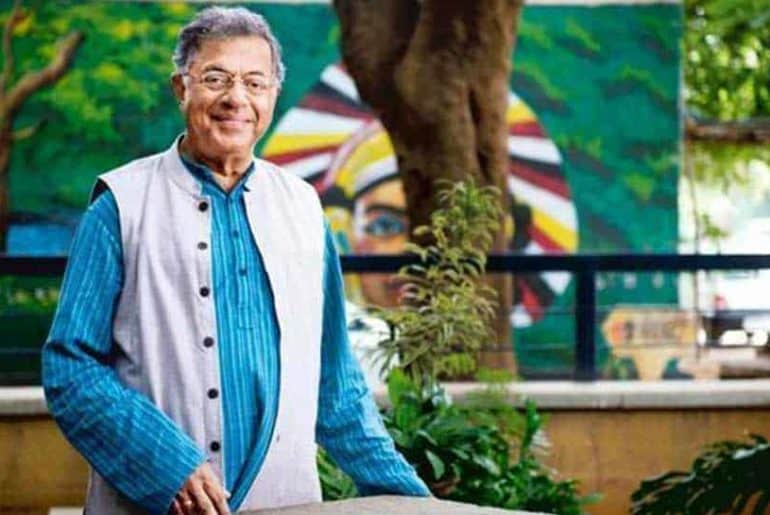
India’s acclaimed writer, director, scholar, and voice of rebellion Girish Karnad passes away at the age of 81.

Girish Karnad (1938-2019) was an actor, film director, multilingual writer, playwright, and Rhodes scholar. He passed away on 10th June at the age of 81, after suffering from degenerative pulmonary disorder for some time. His sad demise has left a void in the abstract world of art and literature. One of the most revered personalities has left behind a long lasting and unfaltering legacy.

Born in Maharashtra and brought up in Karnataka, he began writing plays in Kannada at a time when they were heavily influenced by western literature and marked the coming of modern play writing in Kannada. Yayati (1961) was his first novel based on the predecessors of the Pandavas. Tughlaq (1964) till date remains one of his most acclaimed plays. He debuted as an actor and screenwriter in Kannada movie Sanskara (1970). His directorial debut was the film Vamsha Vriksha (1971) based on a novel, which also won him a National Film Award for Best Direction. He has also showcased immense talent in several Bollywood films, most recently Ek Tha Tiger (2012) and its sequel. Rakshasa Tangadi, a Kannada play on the Battle of Talikota, remains his final work.

Karnad is the recipient of several prestigious awards including Jnanpith Award, Padma Shri, Padma Bhushan, National Film awards and many more in the South and North Indian Cinema.

His contribution to activism remains invaluable. A champion of free speech, he was a critic of hard-line Hindutva and later the Babri Masjid incident. Further, he was also a proponent of secularism and multiculturalism, women’s rights, and identified as a liberal. He did not confine himself to films and plays, but fearlessly voiced himself for any cause. At an event at Bengaluru – which Karnad attended wearing a nasal tube, due to his deteriorating health – he wore a placard around his neck which said: Me Too Urban Naxal. Karnad commented, “If speaking up means being a Naxal, then I am an urban Naxal.”

In his biography, Aadadata Ayushya, he revealed how his mother intended to terminate her pregnancy when she conceived him. But due to delayed arrival of the doctor, his mother left the clinic. He went on to dedicate this biography to the doctor. Today the world mourns the death of this multitalented individual who could weave stories with colossal depth and meaning.

Kalrav Vashishtha, a first year B.A. (Honours) English student commented, “We had ‘Broken Images’ by Karnad in school, and I loved it. A few years later, I realised we just had a portion of it in our syllabus. It shocked me to the core to read the rest of the play. A masterful manipulator of words, he turns the whole play upside down with such haunting realism. We just lost one of the best writers in the country and the void can never be filled.”

His contributions in over ninety films in both Hindi and Kannada, thirteen directorial works, several plays and translations earned him places in institutes like Film and Television Institute of India (FTII), Nehru Centre in London, and Sangeet Natak Akademi, among many others.

The master playwright was cremated in a quiet ceremony. He is survived by his wife, Saraswathy Ganapathy, and two children Radha and Raghu.

Feature Image Credits: Zee News


Shivani Dadhwal

[email protected]


The Pulitzer Prize, the highest American honour in journalism was recently announced. Here is a look at the winners.

The Pulitzer Prize, a prestigious annual award in the field of excellence in newspaper journalism, literary achievements, musical composition in the United States, was announced on Tuesday, 17th April. The annual prize administered by the Columbia University in New York City shook things up this year, by allowing new unprecedented entries like Kendrick Lamar making a foray into the twenty-one categories. Here is a list of some of the winners:

  1. Public Service: The New York Times for reporting led by Jodi Kantor, Megan Twohey and The New Yorker for by Ronan Farrow: The staff of the two newspapers was awarded the honour for their impactful coverage of the allegations of sexual assaults including those against Harvey Weinstein, and thus leading to new debates and “worldwide reckoning about sexual abuse of women” as the Pulitzer website mentions.
  2. Breaking News Reporting: Staff of the Press-Democrat, Santa Rosa California: The newspaper was lauded for its breakthrough coverage of the wildfires that spread through the city of Santa Rosa and Sonoma County by using an array of journalistic tools including social media, photography, video, etc.
  3. Investigative reporting: Staff of the Washington Post: The Washington Post was awarded the honour for their brilliant coverage exposing the sexual harassment of Republican candidate Roy Moore, and the subsequent criticism they faced for it.
  4. Explanatory Reporting: Staffs of The Arizona Republic and USA Today Network: The two newspapers were rewarded for their combined efforts to explain and report on the promise of the Mexico border wall by Donald Trump, heroin reporting and editorial writing in health care.
  5. International Reporting: Clare Baldwin, Andrew R.C. Marshall, and Manuel Mogato of Reuters: The Reuters correspondents through a dint of sheer hard work and determination that included countering the propagandist narrative that was being spewed by the Filipino government, exposing “the brutal killing campaign behind the President Rodrigo Duterte’s war on drugs”, the Pulitzer committee mentions.
  6. Feature Photography: Photography staff of Reuters: The photo-journalists of Reuters were awarded the honour for their immense contribution in exposing the violence faced by Rohingya refugees fleeing from Myamar.
  7. Music: DAMN., by Kendrick Lamar: The first non-jazz and non-classical recording to be given this honour, Lamar’s album hit critical as well as popular acclaim soon after its release on April 14, hitting number one at US Billboard 200. The Pulitzer admits contemporary rap and with it, the multi-faceted African-American life, into the sphere of ultimate critical acclaim.     


Feature Image Credits: The New York Times

Sara Sohail

[email protected]     

In an increasingly globalised world where information is accessible at our fingertips, what role does ethical and responsible journalism play in ensuring the dissemination of facts?

The advent of fake news is one that is unfortunate yet undeniable. It has its own distinct definition, one that differs from satire and practical humour. This relatively new phenomenon can be described as the spread of deliberate misinformation with the intention of misleading consumers. The act may be driven by a desire to garner political or financial gains, or may simply be a result of government propaganda and/or censorship. A defining characteristic of fake news are sensational headlines, also known as “clickbait” headlines to garner more click-based revenue in the online world.

The concept of false reporting came into the global limelight during the 2016 presidential election held in the United States of America (USA), through Donald Trump branding everything he disagreed with as “fake news”. There were numerous instances of reputable personalities and sources quoting morphed information during the election. Closer to home, in November 2017, the University of Delhi’s Kawalpreet Kaur posed in front of the Jama Masjid with a poster, stating her stance against mob lynching. The photo went viral, but the one that the Pakistan Defence Forum chose to tweet to more than 300,000 followers was an edited version, which read that Kaur hated India because of its colonial tendencies.

The problem with fake news in the contemporary world is that its distribution is not restricted to its producers; ordinary citizens with social media accounts can just as easily contribute to the mass propagation of false information. As a Wired article titled ‘It’s the (Democracy-Poisoning) Golden Age of Free Speech’ states, “In the 21st century, the capacity to spread ideas and reach an audience is no longer limited by access to expensive, centralised broadcasting infrastructure. It’s limited instead by one’s ability to garner and distribute attention.”

In this context, it is more imperative that media houses and journalists in positions of responsibility make an active effort to recheck the veracity of their information and stay true to the ethics of reporting. 2nd April 2018 was celebrated as the second annual International Fact-Checking Day, an occasion that seems almost ridiculous on the surface, but is essential in the era of fake news.

Ordinary citizens may not always recognise the dire need for fact-checking before they indulge in sharing fake news on social media. However, this is a luxury that journalists cannot afford. Our national ruling party recently ordered that journalists would lose access to government events if they are accused of fake news. The order has since been revoked, but the Information and Broadcasting Ministry has set up a committee to provide a regulatory framework for online media in the country. Despite the government’s own agenda and threats to the media, journalists owe it to their audience to be principled. Whether it is national print newspapers or student-run campus publications, the ethics remain the same. Before succumbing to over sensationalised headlines and political bullies, we must evaluate our foremost responsibility: to deliver facts.


Vineeta Rana
[email protected]

There has been a surge in the number of student-run media houses in universities recently. These outlets have an important role to play in the campus ecosystem when it comes to disseminating news and providing students with infotainment.

In the recent past, a surge in the number of media platforms has been observed in the university hemisphere. The mushrooming of student-run media houses stands as a testimony to this fact. To cater to the ever-increasing demand for information by university students, a lot of student-run media houses have been integrated into the campus ecosystem, and their work of student newspapers is to provide this public service to a university audience.

Many students go through distress about not having the official information at the right time. University offices have not been very effective when it comes to disseminating important information. Moreover, help lines issued by the administration do not cater to the students’ questions satisfactorily. More often than not, they are liable to technical glitches and fail to serve the students in the stipulated time frame. A university houses a huge number of students and it gets practically impossible to reach out to every student in person. This gave way to the proliferation of student-run media outlets in the universities.

The need got coupled with technology in the form of smart phones and easy internet access, which created a fertile field for the burgeoning of media houses in the universities. 

These media houses are fast emerging and students believe that it has a thriving market.  There is a steep competition among student-run media outlets, with each of these outlets delivering innovative content in a weekly cycle to outnumber each other’s subscribers. These media outlets are grooming entrepreneurs, writers, marketers, designers, and artists. Today, every student seeks opportunities to acquire practical knowledge by interning at myriad professional platforms. This compensates for the exposure that our university system fails to provide.

Student-run media outlets provide necessary information and promote democratic participation of the students. These media houses instill a sense of responsibility within students and inculcate leadership qualities in them. Not only do they create narratives and make the students aware of the issues around them, but also strive to be accessible to a larger audience.

Rather than just providing high-quality content, student journalists are also dedicated to connecting students, academic departments, alumni, and the world. Universities should acknowledge and encourage the student journalists with bubbling energy and should create porous gateways for the passing of information from the administration to the student-run media outlets to sustain such an ecosystem. 


Feature Image Credits: USA Today

Sandeep Samal
[email protected]

The second day of Mushaira 2018 was dedicated to independent journalism, celebrating 10 years of the establishment of the largest student-run media organisation, DU Beat.

The day began with a panel discussion on “Quality Journalism for the New Age” was hosted by panellists Vinod Jose, Executive Editor of the Caravan, and Manisha Pande, Associate Editor of Newslaundry. In a vivacious discussion on quality journalism in the age of fake news and sheer propaganda, Vinod Jose and Manisha Pande enlightened the audience on the crises faced by modern day journalists. On being asked by Moderator Srivedant Kar on the apparent crisis looming upon media today, Vinod Jose held political pressure on journalists as being responsible. On the issue of distinguishing between quality and ‘fake’ journalism, Pande claimed that even the mainstream media isn’t exclusive of the phenomenon of fake propaganda; hence social media like Facebook and Twitter aren’t at fault alone.

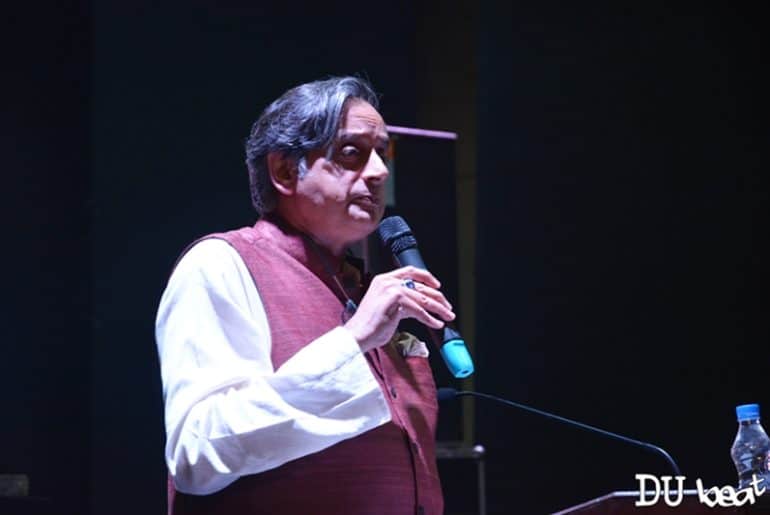
Followed by the discussion on journalism was Dr. Shashi Tharoor’s inspirational speech on “How can the youth make a change today”. Dr. Tharoor started his speech by joking that age-old rivalry between Hindu College and St. Stephen’s is not there anymore and was nostalgic about his college days. He commented that students around his time had fewer opportunities than students of today and the youth must stay aware of the country’s politics. He emphasized the need for the youth of the country to be participative in decision making because they should not abdicate to old men for choices about their lives. He talked about India being the third country in the world with 800 startups each year, the advancement in telecommunications and advent of AI. The audience was enthusiastic throughout his speech and applauded him numerous times. He encouraged the students to take interest in various social or national issues and try to make a change. He ended his speech with the poem Tehzeeb by Gopal Krishna Gandhi and left the young minds absolutely enthralled.

The speech was succeeded by a panel discussion by three social media influencers, Sejal Kumar, Shibani Bedi and Shivesh Bhatia. The three talked about their gradual success, making good content, and to reach out to the target audience. Given the day and age we all live, and being a consumer of visual art, one’s photography skills matter but Shivesh added that one must make the best of what is at their disposal whether it is a phone, computer or DSLR. They all ended the discussion with the fact that there are no instant results and brands eventually come if one is committed fully to one’s work.

The next speaker of the session was Suchita Salwan who is the CEO and Founder of Little Black Book. She also happens to be a Hindu college alumnus. Talking about entrepreneurship, she quoted “There’s a difference between an influencer and an entrepreneur”. She emphasised on the fact that people who aspire to be entrepreneurs need to focus on forming winning companies. Also, addressing the problem of availing funds, she pointed out that it is important to find the right kind of investor for the company. A brief Q&A session followed.

In a nostalgic journey through memory lane, the former DU Beat members engaged the audience in a spirited discourse of their life after DU Beat. The panel consisted of Radhika, Gurman, and Brij, all ex-DUBsters. Their discussion ranged from jovial anecdotes about how Brij’s first article was rejected by Gurman Bhatia who was the Web Editor. DU Beat had played in constructing their professional lives. When asked about the prerequisites of being a good journalist, Radhika remarked, “You don’t necessarily need to do English honours to be a journalist. You don’t need to know fancy words. You just need to know how to do clean reporting.”

Speaking on “Partition Literature”, Sukrita Paul Kumar opined on the anguish and pain associated with the creative reflections of 1947. Quoting Gulzar’s “Dil Toh Baccha Hai Ji,” she asked the audience to revive the ‘child’ in them in order to prevent the rising homogenisation of society and keep alive the spirit of dynamic creativity. For her, knowledge of history combined with personal experience captures the essence of history better than history itself.

Following up next was the team of Slip of Tongue, who is a group performing slam poetry formed by the National Youth Poetry Slam winner Diksha Bijlani. Originally composed of seven members, only four could make it at the event. Starting off “Hero Syndrome”, Diksha Bijlani lifted the spirit of everyone present in the audience. Somesh Thapliyal’s “Toxic Masculinity” was the next performance. Diksha Bijlani and Cheryl Mukherjee performed a duet on female camaraderie titled “Bra Shopping”, much to the delight of the audience. The fourth member Ishaan Chawdhary performed a love poem titled “A wedding song”. Their performances left everyone snapping their fingers, which is a slam poetry tradition. A few other sets of poems followed before the team signed off, leaving the auditorium filled with the sound of snaps and claps.

In an enchanting performance by Delhi-based singers and songwriters Vishnu Kumar and Amani Kerr, the duo initiated their rhapsody with “Sugar” from Maroon 5. As it progressed to “I Can’t Feel My Face” from The Weeknd, everyone was left tapping their feet. The high-point of their rhapsody was the performance of “Attention” by Charlie Puth. They also captivated the audience with two of their originals, “Kite” and “Where the Light is Always Green”. With this, they drew the curtains of Mushaira 2018.


Feature Image Credits: Sahil Chauhan for DU Beat.

Oorja Tapan
[email protected]

Karan Singhania
[email protected]

Vaibhavi Sharma Pathak
[email protected]

Prachi Mehra
[email protected]

The Academic Council (AC) of the University of Delhi, in its third meeting which began yesterday and culminated today morning, has discussed and deliberated on the proposals which were in the pipeline. It has announced decisions which shed light on three prospective courses which should be introduced in the varsity soon: Journalism, Transnational Studies, and, Cyber Security. These courses have received the approval of the Council in principle; with the nitty-gritties of these proposals being left to be chalked out in clarity later.

Delhi School of Journalism

The Council has decided to drop the self-financing clause which had been previously planned, and agreed to send the proposal to the UGC for approval of government funding. Earlier, the Vice Chancellor also suggested that the course would function on a no-profit no-loss basis. Meanwhile, the Council will also consider other avenues for funding; like resorting to philanthropic organisations for scholarships. In addition to the monetary factor, a three-member committee will also be set up to delve into the practical aspects of the course structure, along with the other intricacies of the proposal. The Council has decided to employ teachers on deputation from other colleges to serve as the faculty of the institute, along with those working in eminent media houses to serve as consultants. AC member Pankaj Garg said that such courses are “necessary and important as they enhance the reputation of a university.” The VC proposed Rs. 30,000 per semester for the five-year integrated course, a decision which was met with resistance. The AC members have decided that the committee will deliberate on the fee structure. It will also provide reservation for SC/ST candidates, and offer scholarships to facilitate admissions from the weaker sections of the society.

The establishment of the school has, however, been met with opposition from some members of the Academics for Action and Development (AAD) and University Teachers’ Forum (UTF).
Transnational Studies and Cyber Security

Both these courses have received the nod from the Academic Council. The course for Transnational Studies has been agreed to be developed in layers, with the aim of its establishment as a premier research centre. In the first phase, it will be a virtual platform where scholars and faculty can engage in discussions on a spectrum of research ideas. The University may then approach the UGC to put in money for research and create an exceptional and unique school on established lines. The Cyber Security course is facing debate on securing the UGC funding. A member of the Academic Council says, “You cannot run the specialised courses, like Journalism and Cyber Security, through a self-financing mode.” The Council has decided to approach UGC to obtain funding for the same.


The Delhi School of Journalism, which is scheduled to undertake applicants from this academic cycle, will not become operational from July 20th. It would take some time to untangle the web of decisions which are yet to be made. Meanwhile, the varsity will be releasing the first-cut off list for admission into various merit-based courses tonight. You can check the lists here.


Feature Image Credits: University of Delhi


Saumya Kalia

[email protected]

The University of Delhi’s standing committee on academic affairs approved proposals to start the Journalism School, another School of Transnational Affairs and a postgraduate diploma in Cyber Law and Security. The proposals will now be placed at the Academic Council for final approval.

Admissions for the Delhi School of Journalism start from this year and will proceed on the basis of cut-offs like the other courses. Thirty students will be admitted this year. The five-year integrated degree will have the option to exit after three years with an undergraduate degree in journalism. Some papers will be on data journalism, investigative journalism, foreign languages, and regional languages. The process for applying for the undergraduate course is the same as for other courses. Applicants have to fill the centralised registration form and opt for the course. Admissions will be based on cut-offs. B.A. (Hons) Journalism, a popular course at Delhi University, has already received 45,000 applications from the online form.

The chairperson of the standing committee, Savita Datta, said “Students will be taught discipline-specific and elective courses. There will be a paper on data and investigative journalism along with papers on media and psychology, media and history, editing, writing, and documentary making,” while talking about the structure and syllabus for the five-year integrated journalism programme.

Here, students will have to study two compulsory languages, which will help them report from different regions. There will be four foreign language options – Arabic, Chinese, Spanish, and French. There will be two regional languages as well – Tamil and Bengali. Students will have to learn one foreign and one regional language. The journalism students will learn to read, write, and comprehend the language.

The Journalism School may adopt an entrance-based admissions process from next year. The initial plan was to admit students based on an entrance test, which failed to be feasible this year. Six colleges in Delhi University currently offer journalism at the undergraduate level – Lady Shri Ram College for Women, Kalindi College, Kamala Nehru College, Delhi College of Arts and Commerce, Maharaja Agrasen College, and the Institute of Home Economics.


Feature Image Credits: University of Delhi

Radhika Boruah
[email protected]

 A school of Journalism and Communication is likely to start from the 2017-2018 academic session in Delhi University. The initiative has been taken by the newly appointed vice chancellor, Yogesh Tyagi.
 The faculty of the new school will regulate the workings of all the Journalism and Communication courses offered by Delhi University in various colleges.Concerning the New School of Journalism and Communication, Professor Tyagi said, “We are planning a new school for journalism and communication. But what we call it will depend on the outcome of the consultation that is to take place very soon with various stakeholders”.
The new school is likely to start with a five-year integrated masters course. The procedure for admission is expected to be entrance exam based, similar to other Masters courses. However, a final call about the admission procedure has not been given. The school, apart from the integrated masters’ programme, is likely to start undergraduate, a conventional masters’, MPhil and PhD programmes as well in the future.

Initially the school is expected to work from the Arts Faculty in the North Campus of the University, with a strength of 30 students in the first batch. The authorities are consulting various stake holders such as teachers, journalists and students for finalising the plans.

With inputs from Times of India

Tooba Towfiq
[email protected]