Tag

elections

Browsing

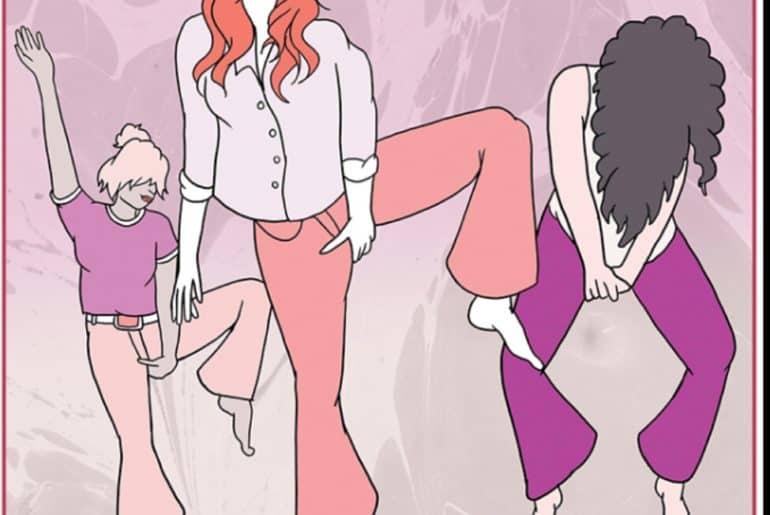
By being barraged by Trump’s chauvinistic political rhetoric we don’t realise how it desensitises us towards the problems that today’s gendered society faces. Here’s why its not okay to grab women by their anything.

Sexism and Donald Trump go hand in glove. Throughout his electioneering his blatantly crude remarks about women makes you wonder what on earth is his PR and campaign team doing. You’d think he would have learnt his lesson after the backlash he received as a result of the lewd remarks he made about women, be it a former Miss Universe or various media house journalists and reporters. In the same breath, he says he cherishes women and “has great respect for women”. And supposedly, “nobody has more”.

He has managed to dig himself yet another grave when Washington Post published a hot mic conversation where he says that if you’re a “star” you could do anything, even grab women by the p***y. Granted this may have been the only time throughout the campaign he has actually apologised for his statement, which he refuted to be “locker room banter”, it still doesn’t compensate for how him making this remark in turn trivialises sexual assault.

Given how all of Trump’s fiascos create such a social media sensation, it’s not surprising that business minded people have caught on. Recently a Mexican restaurant in Toronto shared a picture of their tacos on instagram and captioned it “What if Donald said, grab her by the taco…”. They received a significant amount of backlash from people for it highlights a different kind of problem. Which is that it normalises a culture of violence and brings us back to square one when it comes to fighting for co-equal gender rights. It belittles and naturalises us into thinking that for a woman to be part of a high-profile workforce she shall have to “endure”.

There is an online women empowerment campaign that sells $21 baseball caps that say “Grab Her by the Brain”, of which a mere 10% of the proceeds go to charity. This pseudo counter vocalisation merely taps into a certain political trend in the name of gender equality and doesn’t actually address the gravity of the issue, it converts it into something thats in vogue.

This overbearingly masculine approach that Trump adopts is sure to backfire on him. With each move he makes he further dichotomises himself and Hillary. This campaign has seen such a heightened gender war that one can only hope that its outcome will not be regressive. We are at the precipice of a major unraveling of all the positive changes that have come about in the 21st century at the hands of a misogynistic megalomaniac. What is even more disturbing is that a significant section of the US population applaud him for his actions and sentiments regarding women. Goes to show that we still have a long way to go as a global society. But that being said, we are witness to a turning point in political history where gender/culture wars are at its peak and these contentious issues are at the forefront of people’s social consciousness. A bull like Trump and flawed political rhetoric cannot go unnoticed.

Image Credits: lennyletter/Jess Rotter

Debashree Unni

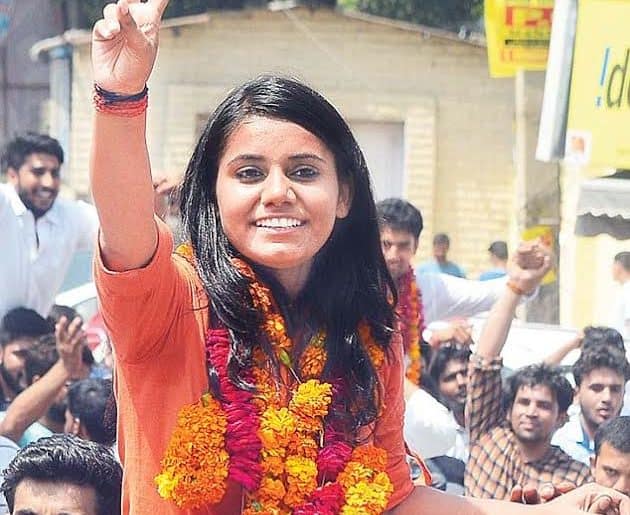
After days of anticipation and a rigorous electoral campaign, ABVP’s Vice Presidential candidate Priyanka Chhawri emerged victorious. A graduate in Mathematics from Lakshmibai College , University of Delhi, and currently pursuing her M.A in Buddhist Studies from Dept. Of Buddhist Studies, DU, from discussing her journey into politics to her plans of bringing changes in the campuse, we got chatting with her about her new found role.

Excerpts:

DUB: What motivated you to pursue your candidature in the DUSU elections? How did your journey into student level politics begin?

Priyanka Chhawri: I am a student activist from the past five years and it all started when I appeared for CATE entrance and saw a group of students protesting at the arts faculty against the DU administration. The protest was led by ABVP.I was so influenced by the student leaders that it occurred to me that I must also be there one day! So when I got admission in LBC,  I joined ABVP and became an active member! I saw a great change in me in these five years. ABVP groomed me into a more confident and responsible person and with time I attained the leadership skills that were needed to contest in DUSU elections and now, here I am, as the DUSU Vice President.

DUB:  What are your some of the key areas that you are personally looking forward to focusing upon in your tenure?

PC: Personally , I would focus more on introducing societies for blind and physically handicapped students, constructing pathways for the same, giving North Campus a new look by putting the map of the campus near metro and recognised places, creating awareness session about the women safety app launched by ABVP – ‘I FEEL SAFE’, in every college, providing health cards,making medical rooms functional in every college and providing the facility of printed mark sheets be issued to students after every semester.

DUB:  The DUSU polls saw some lavish campaigning this time again. What is your take on the guidelines by Lyngdoh Committee and National Green Tribunal about the budget restrictions and green campaigning? Do you think they are realistic targets that can be met?

PC: I think it’s not feasible to contest DUSU election in just 5ooo Rupees. How unrealistic it is, that the same amount is allowed to both contest college elections and DUSU? From the last four years , the Lyngdoh Committee hasn’t been reviewed and it’s time that we look into this matter.So, as an officer bearer, I will certainly put forward this issue. As far as paper usage is concerned, it is reduced as compared to last two years but yes it needs to end and just be limited to wall of democracy and advertising sites.

DUB: Last year saw DUSU office bearers being involved in some controversy or the other and accountability and work transparency was also an issue. How do you seek to tackle that?

PC: ABVP led DUSU is very committed to work for the student welfare and we have started working the day we joined our office. We submitted a memorandum to the DSW concerning the issues of students and currently we are working to combat the recent mass failure of the LL.B students regarding which, we have given a letter to the VC. This DUSU panel is dedicated to work for the student community and we have started our work positively !

DUB: NSUI has alleged discrepancy in the voting process and after a hunger strike, they are now planning to move to the court. What is your take on this whole matter?

PC: DU is a democratic university and it’s NSUI’s democratic right to get their doubts clear but I think by doing this they are questioning the mandate of the students. I think they should accept the decision of the students and move on and raise students issues rather than sitting and challenging the choice of students.

DUB: Having gone through the entire process of filing nominations, becoming the final candidate to actually winning, is there anything that you wish to change (procedural or otherwise) in the way DUSU elections unfold?

PC: From filing the nomination to actually contesting DUSU was a great experience. The administration has been very cautious during the scrutiny. But, an incident that seemed like a failure to me was when a candidate who filled the nomination was not present during scrutiny. It should become mandatory for all the candidates to be present during that process.

DUB: DUSU elections have been known to provide the country with some of the finest ministers we have had at the helm of authority in the past. Do you see yourself there? Do you plan to continue in politics?

PC: As of now , I will be working for the students and continue as a student activist.

DUB: Any interesting anecdote you would like to share with us that happened during the election process?

PC: Yes. Once I was delivering a speech in Shaheed Bhagat Singh College. I was in such a hurry (because it was the last day to campaign and I had to cover many colleges) that I forgot the last part and garbled some words and ran away. The students found it so funny and they said, ‘Hum samajh gaye aapki bhaavna’.

DUB: In a line, how would you define your motto for this year as a DUSU office bearer?

PC: I want this DUSU panel to be a medium of exposure for the student community. I will work on involving more students in every activity that is organised by DUSU!

Interviewed by Riya Chhibber

[email protected]

The Student Union Elections in Rajdhani College witnessed 36 nominations for the only 2 posts of Central Councillor.

This year, the students of Rajdhani College actively participated in the elections. The desire for the post went so bizarre that 36 candidates ended up filing nominations for the only 2 posts of Central Councillor that the college union has.

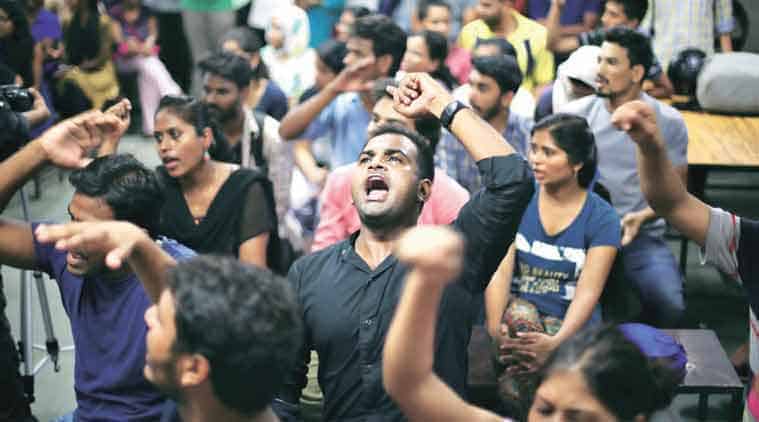
The college witnessed a huge protest on 2nd September against the Principal and election committee members as students in big numbers gathered in front of the college gate restricting any entry or exit, to raise their voices against the cancellation of about 30 nominations for the post Central Councillor. College guards doing their righteous duty held the gate and controlled the mob as far as possible. The situation soon became eccentric and the Police men showed up to established the decorum.

It was after hours that the members of the staff finally made an appearance and justified the procedure and decision of choosing a particular nominee and certainly assured that no unjustified candidate will be allowed to contest the elections. They also mentioned that they’ll be reconsidering all the applications just to make sure that all the worthy and deserving make it to the list.

Soon the classes resumed and nobody was penalised though, students actively participating in protest were given a warning.

The college staff avoiding ambiguity for students made a wise decision by being very harsh with the selection process of nominees. The criteria looked upon while selecting a particular candidate consisted attendance, academic records, behaviour of the student with teachers and students, to name a few. Last year 19 students contested for the two posts. The number shrunk down to 8 in spite of more nominations.

It was finally on 9th September that the results were announced with Avnish Malik, B.Sc. (Honours) Chemistry, Third year, and Sahil Antil, B.A. (Honours) History, First year, ended up winning the elections.

Hardik Kakar

[email protected]

Image Source: indianexpress.com

Voting is an integral part of our college experience. By casting an informed vote, we embody the ideals of a democracy. Not a single vote cast consciously, is a waste.

In a particularly stimulating class discussion a few days before the elections, one of my professors declared that some “elite” colleges tend to think that keeping their students entirely out of university politics in the process of providing quality education, is the way to go. She then went on to say how she wished she had been more politicised in her college days. Within the ambit of a wholesome college education, student politics plays an important role.
As a second year student from a not very politically active college, who hadn’t cast her vote in first year, this conversation had an impact on me. Deeming politics a dirty game and disassociating oneself from it is not going to enhance the political scene. Like many others, I want a change in the political set up of the university. I want the existing miasma of coercion and cunning influence to be substituted by an atmosphere of free thinking and freedom of choice. But really, what value do my opinions hold, if they are not put into practice?

That is where casting a vote comes in. It is the democratic system’s way of allowing us a chance to put force to our beliefs. In an age where we don’t have the freedom of not having an opinion, it is our duty to support a candidate or a party whose opinion parallels that of ours. It is true that no party has a flawless manifesto or a completely blameless panel. However, we do have the discretion of narrowing down on one party whose belief system completely or even partially matches that of ours.

If we choose to remain completely unaffected by the politics of our varsity, we should ask ourselves this- Where is all the quality education going, if not to cultivate an opinionated and free thinking individual?

I read an article which declared that it is better to not vote entirely, rather than casting a misinformed one. In some ways it does make sense. Why must you vote for one party if you’re oblivious of its ideologies and of its history, and only rather charmed by a selfie stick that a party worker has curtly handed to you? However, we’re in an institution where opinions and information are suspended in every atom of air that we take in, and gaining information of the parties from multiple perspectives isn’t very difficult. Of course we don’t live in a Manichean framework. Disparaging between right and wrong isn’t easy. It is probably the duty that we bear to ourselves to assert our individual franchise, or that which we bear to our education that should ideally foster this self-consciousness within us, that should propel us to form an informed belief system. There will always be opposition to that belief, and we should consider the grounds on which they’re based. We may also change sides often, and our opinions may sway. Taking a side will not come quickly or easily, but we should at least try to get there.

Speaking of the NOTA option, 17,712 students voted NOTA this year. The figure is higher than the votes won by any of the four winning candidates. Such a large number of students declaring that they do not trust any of the candidates relay a powerful message. The various parties have to step up their game next year, if they want to win respectably. A NOTA vote is counted as an invalid vote, but it also grants the voter to voice her/his opinion against the existing system.

Whether voting for one party or voting against all, every ballot cast embodies a message from the voter. Each vote culminates into the end result. I personally wouldn’t cast NOTA, as I feel like I’m taking an easy way out. But as I have said, allegiances do not come easy and as college students range mostly from 18 to 21 years of age, simply casting a vote is a statement of assuming the duties of democratic citizens.

Suffrage is a privilege, that as a nation, we were deprived of for centuries. The initial arenas to practise our franchise are our educational institutes. Don’t waste or undermine this fundamental right.

Photo credits: www.indialive.com

Swareena Gurung
[email protected]

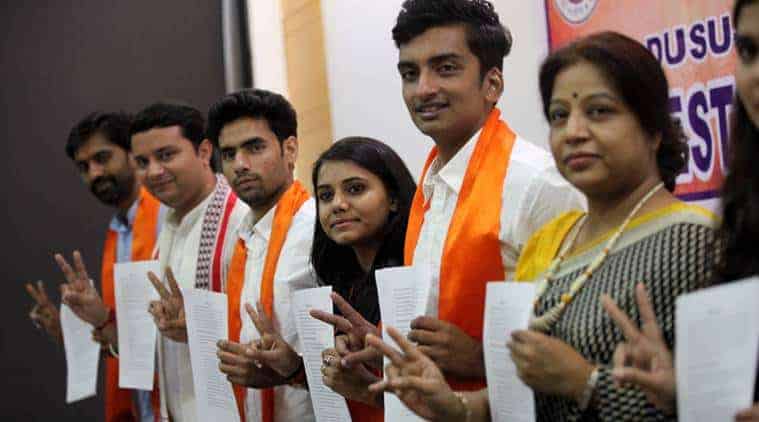
ABVP has secured three and  NSUI one out of the four seats in the Students Union elections of Delhi University. 

Amit Tanwar (ABVP) has bagged the post of the President, Priyanka Chabri (ABVP)  the post of the Vice President and Ankit Sangwan (ABVP) the post of the Secretary. Mohit Garid from NSUI secured for his party the post of the Joint Secretary.

Amit Tanwar, elected president for the session 2016-2017 has been actively involved with ABVP for the past four years. He is currently pursuing M.A. in Hindi from PGDAV college.

Priyanka Chabri was one of the three women standing up for the post of the Vice president. This year saw a significant number of women in the DUSU elections. Four out of the seven candidates for the post of the President and three out of five candidates for the post of Vice President were women.

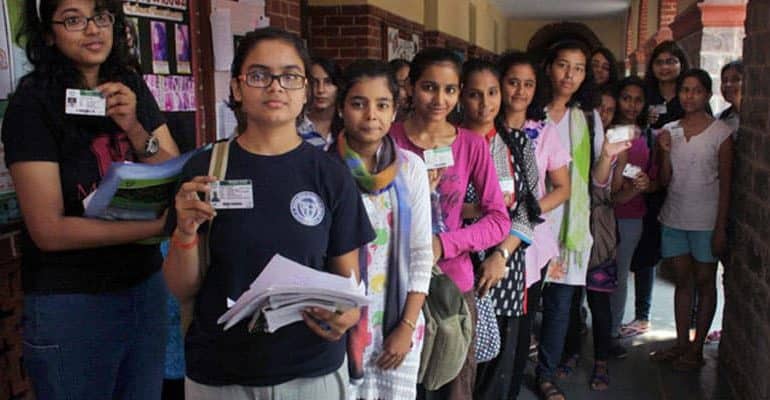
The voter turnout had been low especially among the North Campus colleges. On Friday, the morning turnout was approximately 33%, significantly lower than last year’s overall turnout of 43.3%. It was reportedly the lowest in comparison with the last five years. Voting had taken place in two phases across the university on Friday.

Featured Image Credits: Indian Express

With inputs from Indian Express

Tooba Towfiq
[email protected]

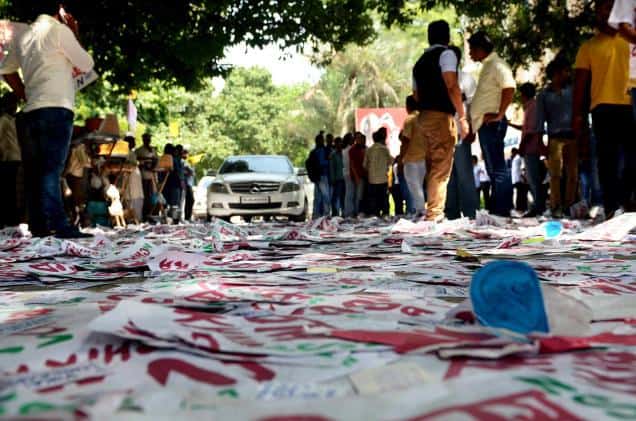
How many times have we been handed pamphlets and completely ignored them? In the age of social media, where a tweet can be more effective than a hundred such pamphlets, the Delhi University political parties need to shift their focus to digital campaigning Campaigning tactics during the Delhi University Student Union (DUSU) elections, follow a recurring pattern almost every year. Enormous numbers of pamphlets bombard DU students and infrastructure alike, posters and hoardings litter the campus, party notebooks and pens fly from every direction and walls suffer from having to bear the alphabets of candidates’ names in the most glaring font. All parties put in massive amounts of money to make their presence felt and endorse their candidates. However, while the sheer intensity of party campaigning is ridiculous, social media isn’t still being utilised effectively in the DUSU elections. One need not look far in order to gauge the impact of smart social media campaigning. As the second most followed Indian on twitter, Narendra Modi has been titled the ‘first social media Prime Minister’ of India. In the 2014 elections, BJP carried out an aggressive social media campaign, harnessing the popularity and reach of digital media. Live interaction platforms like ‘Chai pe charcha,’ catchy slogans like “Ab ki Baar Modi Sarkar’, interactive twitter handles, youtube channels and facebook pages captured the attention of the 80 million Indian internet users. Almost 30 to 40 percent of the overall seats had been affected by social media. Similarly in Delhi University, capitalising on the social media frenzy and shifting focus to more of digital campaigning can pave the way for a more receptive election. As a two way communication platform, the queries of students can also be addressed by party officials. Extensive digital interaction will make party politics more transparent and keep the voters more informed. Sourcing of manifestos online, hashtag campaigns, live sessions and chat boxes could be more effective than thrusting a handful of pamphlets at random autorickshaws containing students. By sourcing party manifestos online and gauging the response of the voters, their suggestions can be included as well. Digital spaces will not only spark the interest of the voters but will make the elections more participatory in nature. By way of interaction, voters begin to feel like they’re contributing more to the election. Candidates become more than mere names on posters. By now, many students have grown wary of offline campaign tactics. With the NOTA option this year, parties need to gain the respect of the voters even more so than previous years. By situating people dressed in mickey mouse costumes holding party banners outside Vishwavidhyalai station or carpeting campus roads with paper, they’re in no way increasing their respectability. Voters need to be updated during the campaign as well as after the elections by means of a responsible and responsive social media presence on the part of various political parties. Image Credits: thehindu.com Swareena Gurung [email protected]]]>

  • Pamphlets, pamphlets on the wall; who is the most anti-environment of all?
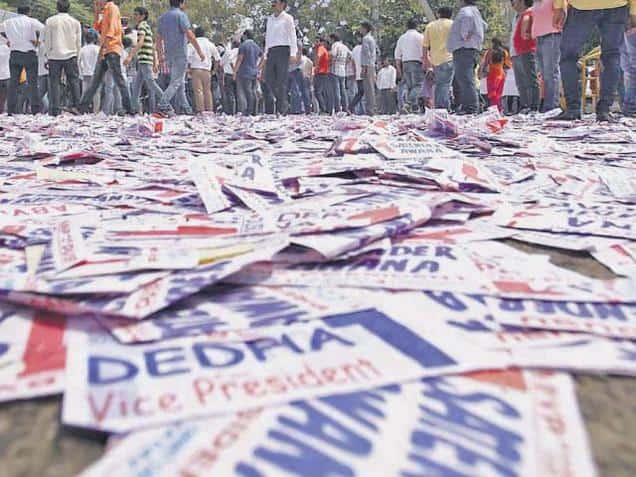
  • If you have never walked over a carpet of pamphlets in your college life, worry not! DUSU election candidates will make your dream come true. They’ll exclusively get their faces and names printed on pamphlets for you to tread upon them! But on a serious note, this is the worst way of campaigning. Each year these candidates waste huge amount of paper and money over these pamphlets. We have been reading about saving trees and ‘3 R’s’ since childhood. Do we want such candidates who are anti-environment? By wasting resources these candidates only show off their money power not, leadership abilities!
    1. You can run, you can hide, but you can’t escape – the white walkers!
    DUSU season is the only time in Delhi University where instead of your college guard and the usual rickshaw-wallas, you meet the white walkers – frantically forcing you to accept their cards and chanting the names of their candidates as soon as you step into your college or out of the metro station! The other kind of white walkers are found in groups. They’re usually going around the college shouting slogans and once they find a group of kids, they stop to tell them about their candidates, agenda and mention the flaws of the rival party contestant. They often interrupt the lectures, hence irritating professors. This is not exactly a bad way of campaigning but, please don’t make us listen to your manifesto and resentful ranting towards the current union or opposition 5 times a day. We like to be informed but, making us late for lectures and interrupting our conversations doesn’t really make us happy!
    1. From the bus pass to latest movie tickets – they’ve got you covered!
    So, this is one of the most unethical way of campaigning. Under the garb of helping students, the campaigners try to buy the student votes. Yes, there are some who genuinely help students with the form filling, anti-ragging, offer ‘if you’ve any problem come to us’ kind of thing. But that’s not the only kind of help they do. They lure the students by offering Lakme lip-colour, latest movie tickets, free amusement park trips, food vouchers – basically money! To nip this corrupt way of campaigning is to ‘refuse’ any such help. The candidates and the party are not the only ones corrupt when they offer such stuff, you also become corrupt the moment you accept it!
    1. The vicious circle of blame game and violent fights!
    Every year the rival parties indulge in this blame and negative publicity. We don’t want to listen to the failures of your opposition party neither want to be a part of your character-shaming/shredding activity. Each time the ruling student union won or lost a battle, we were at the receiving end of the consequences. Also if you failed to deliver your promises, don’t go around blaming people. The last thing we want to hear is your ‘sorry excuse’. We want solutions, we want to see the actual work. Let your actions speak for yourself – and by actions we don’t want you to beat each other or break stuff, we want leaders not goons who just have money-muscle power and zero intellect! Informing us is not wrong but, spreading hostility and hooliganism around the campus doesn’t exactly show off your leadership qualities. Nidhi Panchal [email protected]]]>

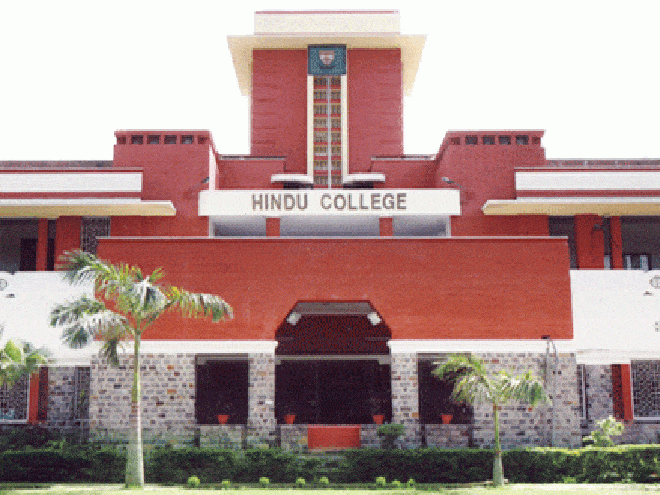
    War cries can be heard amidst scores of people seated in the Hindu College auditorium. It’s the day of the Prime Ministerial Debate, a battleground among warring factions that sets the tone for the highly anticipated college elections a couple of days later. It’s a pleasant pandemonium. Each Member of Parliament, seated, or standing high in passion to congratulate or hit back at the contestants in the cult like rhythmic chants of the crowd, is engaged in rhetoric, enabling a process that also keeps the person next seat engaged, politically. In what might seem like a cacophonic environment characterised by sloganeering lies the political dispensation of Republic of Hindu College that every student here actively engages in.

    Poetics doesn’t seem to shy away from the jam-packed auditorium for the right and the left sides support different candidates. The event, which is in its 5th year now is organised by the Symposium society of the college. It is a celebration of the parliamentary system that the college follows, a microcosm of the national level parliament.

    The college parliament is a students’ representative body that has a Prime Minister with her cabinet, the leader of opposition, Speaker and the President. Members of Parliament are the students of the college who sustain the ethos of the system by coming out in large numbers to vote on the day of elections. The cabinet has ministers with individual responsibilities of Finance, Literature, Sports, Culture, etc. The Prime Minister, on her discretion elects the cabinet ministers. Even the Civil Services finds representationas secretaries actively work under various ministries.

    With the beginning of the session, political activity in the multi-layered structure of varsity politics at DU is visible in the college, much in line with other colleges. In the run up to elections, bringing in various departments (smaller political bodies) and societies within the fold of a faction forms a major part of the political strategy. That identity politics keeps at an arms-length from the college’s political contest is evident from systematic bludgeoning of any attempts at giving the contest an identity based colour.

    The Parliament is also responsible for allocating funds to various societies that run in the college. Part of the agenda is focused on enabling impediment free environment to the societies and their functioning.

    As an institution, its functioning is steered by the Speaker (a faculty member) whose appointment is done by the President (College Principal). With seasonal sessions, on lines with the national Parliament, one dispensation of the Hindu College parliament functions for one fiscal year.

    Over the years, debates and discussions on various international issues like the Cold War, 1962 War with China, 1972 Liberation of Bangladesh and state sanctioned excesses and human rights violations have upheld the sundry nature of issues discussed. The parliament has passed various bills in relation to issues of national and international importance.

    Atal Bihari Vajpayee’s approval of the college’s system while claiming that “India has only 2 Prime Ministers. One sits in the Indian parliament and other in Hindu College”; his categorical equation, is symptomatic of not just the structural credibility of the institution but also its workability in representing the students.


    Sidharth Yadav

    [email protected]

    This year, the National Green Tribunal (NGT) had asked Delhi University to conduct paperless elections. Bolstered by NGT’s order, University authorities have decided to allow each candidate to paste only two “handwritten” posters in the campus. The chief election officer Prof. D.S Rawat said “As per the NGT order, we will allow just two ‘handwritten’ posters per candidate in one campus. Candidates will have to strictly abide by the model code of conduct set according to the Lyngdoh Committee’s recommendations”.  In a recent meeting of the central advisory committee, decisions were taken to prevent wastage of polls of paper used by candidates for campaigning. Every year, lakhs of rupees are wasted on papers used in campaigns. But the university has not yet taken any action in this regard.

    Recently, one of the candidates was found to have violated the rule in colleges across north campus. Following the trend, just after a couple of days, many other parties also showered the corridors of colleges with their flyers. No action has been taken against any of the candidates even though college level committees have been constituted under the principals to report such violations to the University authorities. Last Thursday, one candidate and his supporters were found defacing the Vishwavidyalaya Marg in front of gate no.1 of North Campus with paper posters and fliers. When asked about the same, one of the supporters said “These pamphlets are printed to be thrown on campus”.

    Even though the campaigning has started with full swing, the University authorities seem to be in deep sleep. Without any actions, even after rampant violations, it looks like the University is planning to implement paperless elections by making rules which exist only on paper.

    Image Credits: www.thehindu.com
    Srivedant Kar
    [email protected]

    “Some leaders made a mockery of the whole election process”: Akash Mehta, Students Union President, SRCC

    “For a rank doesn’t confer just power, it imposes responsibility as well”

    The SRCC Union President, Akash Mehta, currently in his third year of Economics Honours hails from a small town in Haryana and is an alumnus of DPS RK Puram. While in a conversation with DU Beat, he speaks of his experiences, the challenges and future endeavours for the college, being at the helm of things going in and out.

    How has the first semester been for you?

    We introduced the Regional Sensitization Cell and PWD canteen enclosure to ensure a level playing field for all. A session with H. Sri Sri Ravi Shankar was organised along with a Cleanliness Drive on 2nd of October in sync with the Swachh Bharat Program. A Freshers’ Party was organised with The Progressive Brothers and DJ Harsha. We plan on introducing Yoga to ensure overall development of students.

    With your nomination being finalised just a few days before the voting day, how difficult was it to reach out to all the students in such a short span of time?

    It is surely difficult to meet 2500 students in all, but life has taught me that if you have honest and clear intentions, nobody can stop you. Undoubtedly it was an arduous task, but with the support of my family and tireless efforts of my team, I could manage my campaign.

    With the constant tiff between the hostel and day scholars, how do you plan to strike a balance between the two?

    For me each student of SRCC is equal and fair in my judgement. I am the biggest testimony of this fact as in spite of not being a hosteller, I was able to gather all of their support. I shall strive to work for them all alike.

    How is your vision for the college different from that of past Presidents of SRCC?

    All the previous Presidents worked to their full capacity to make Crossroads what it is today. I have my own style of working though and as a President, alongside working for the fest I should be amongst the students more and get closer to their problems and find solutions.

    What is your strategy for handling this fest season?

    It has been going well with my team since we started our term. Our focus is to make our two major events bigger and better.

    With all the allegations and rumours, are elections becoming a dirty affair and is there any escape from it? What is your take?

    It is quite dirty in my opinion. I think some student leaders have made a mockery of the whole electoral campaign. They should understand the morals and ethics before entering this field. There’s an escape once we start realising the true essence of fair politics.

    How do you like the tag of a ‘Cool and Charming President’ that you’ve been adorned with?

    (laughs) I really don’t know a perfect response to it, but it’s really flattering. To be honest, I am pretty shy around girls, but it feels good to be conferred upon with this title!


    Tanya Agarwal

    [email protected]

    Image credits: SRCC Students’ Union