Tag

DU

Browsing

Shaheed Rajguru College of Applied Sciences for Women, University of Delhi – organized its second Sports Fest “SPARDHAA” on 18th-19th January 2018 on the college campus. Spardhaa – which signifies healthy competition, served as a significant platform for the participants to exhibit their sports talent, leadership and comradery. The Chief Guest for the Opening Ceremony was Shri Ram Niwas Goel, Speaker, Delhi Legislative Assembly and the function was also graced by Shri Manoj Kumar, Member Legislative Assembly, NCT of Delhi. The guest of Honor was Mrs Santosh Yadav, Padma Shree Awardee and the first woman in the world to scale Mount Everest twice within a gap of less than a year. The festival started with a March-past of fourteen Departmental Teams and two teams of Students Council and Sports Council respectively. The Department of Physics bagged the first Position in March-past for their well-coordinated and energetic presentation.

In the Intercollege category, there were nine events including Aerobics, Rhythmic Yoga, Yoga, Volleyball, Kho-Kho, Table Tennis, Badminton, and Tug of War. Chess and Carom were specially kept for Para- athlete category to encourage equal opportunity. A vibrant participation by around 800 athletes from 43 colleges/Institutions of University of Delhi and NCR was witnessed in “SPARDHAA” to make it a grand success. Though these events were primarily for girls but Badminton, Tug of war, and Table Tennis were open for boys also.

The Sports Fest was yet another platform to display women power. It also catered to community sports activities for the non-sports students and staff of the college in order to promote fitness, wellness, and a sense of socialization. The community sports activities included 50 M Race, 200 M Race, Discuss Throw, Shot Put, Long Jump, 4×100 M Relay Race, and Three Legged Race and some fun-based activities for staff. The community sports activities proved to be very popular among the in-house students/staff and showcased their sports potential.

Spardhaa received overwhelming support from our sponsors, Chief among them being the ONGC Ltd. and the Delhi State Aids Control Society, Govt of Delhi. Other sponsors like vki fotographie, Sega Shoes, Parle Agro, and Delhi Sports also chipped in and contributed to its success. Our media partners like Samachar Nirdesh, DU Express, DU Vibes, DU Beat, DU Khabar etc. covered the events and helped us in reaching out to all our stake holders.

Whenever college students are depicted in movies, you have to take it with a grain of salt. They are generally depicted as 25-to-30-year-olds never studying or attending class while focusing all their time on their social lives. That being said, sometimes there’s an ounce of truth to these stereotypes.

Here is a carefully crafted list of college students as movie characters that you find in every college-

The tomboyish exuberance: Anjali from Kuch Kuch Hota Hai

For an industry that had a history of being stuck with “gulaabi gaal” and “reshmi zulfein”, Anjali was a miracle. The tomboyish exuberance, the loud disposition, the nonchalance towards fashion and social mannerisms was more real than Bollywood likes to be. Millions of girls across India felt seen for the first time. For this, Kuch Kuch Hota Hai will be a landmark and blessing to Bollywood, always.

The self-loving socialite: Poo from Kabhi Khushi Kabhi Gham

She loved herself. Right from her killer entry dancing on “It’s Raining Men” to her looking for fat-free stuff on the dining table, Poo’s world revolved around herself. She refused to be bossed around by men and did the bossing all by herself. She also taught every woman that there’s nothing wrong with finding yourself sexy. You’ll definitely come across a Poo in college whose fashion sense might be over the top, but is never afraid to speak her mind.

The reckless and westernised archetype: Laxman aka Lucky from Main Hoon Naa

Lucky represents the most radical divergence from the typical Bollywood hero figure. From the moment he first appears on screen, Lucky typifies everything that Bollywood culture seems to fear. He wears Westernized clothing (leather jackets and ripped shirts), drives a motorcycle, plays the guitar, and is a serious lady’s man. Lucky also sports long, unruly hair, a sign of recklessness and wild behaviour. Throughout the movie, we see him smoking, failing classes, and denying any romantic feelings for girls in order to maintain his image. In each college, you would encounter such a prototype who would appear reckless from afar, but on close scrutiny, you’d discover the “softer” image of their character.

The Youth Leader: Michael Mukherjee from Yuva

In every college, we see the erudite college youth leader who wants to bring about a change in the social order and wants to use student power to change the festering fortunes of Indian politics. He doesn’t think it’s wrong to hustle people around as long as the ends are achieved. He is passionate about his ideas to the extent that he’d be willing to turn down a US scholarship, like Ajay Devgn’s character did in Yuva.

The good student whose passion lies elsewhere: Farhan from 3 Idiots

Farhan has a passion for photography in the movie and his passion is to become a wildlife photographer. But he joined an engineering college to satisfy his parents. Throughout your college life, you’d come across many of his kind who have been compelled to choose a course of life they are not passionate about, but still go ahead due to certain compulsions.

The ditzy party girl: Haley Dunphy from Modern Family

Sarah Hyland’s ditzy yet lovable Haley has had a rough collegiate road. She first got kicked out of college for freshman drinking, thereafter got enrolled in community college and then started her own fashion photography blog. If you pay closer heed, you’d see that every college has someone with this party-girl persona.

The Bro:  Steve Stifler in American Pie

Much like the offensive but good-natured Stifler, bros are obnoxious, loud-mouthed males who live for partying. Every college has at least one. They usually just stand around holding a red plastic cup waiting for something exciting to happen so they can scream something that demonstrates how much they really enjoy partying. Usually, well concealed under spiked hair with frosted tips, there’s a heart of real gold.

The Nice, Stable Nerd: Max Fischer in Rushmore

Just as every movie features a bro, the flip-side of the coin is the uncool nerd character who is still somehow likable despite being presented as a loser. Unthreatening, intelligent, and helpful, he would be obsessed with joining and starting college clubs like beekeeping, stamp and coin collecting, French, Model United Nations and so. Like Max, the likeable nerd also often has trouble in love.

The talented multi-tasker: Elle Woods from Legally Blonde

Elle Woods had a lot going for her. She was president of her sorority, was charming and most importantly, was a natural blonde. She was also crafty enough to make it into Harvard  Energetic, sweet, and persistent, she is the prototype of the multi-tasker in every college.


Feature Image Credits: PNGTree

Vaibhavi Sharma Pathak

[email protected]

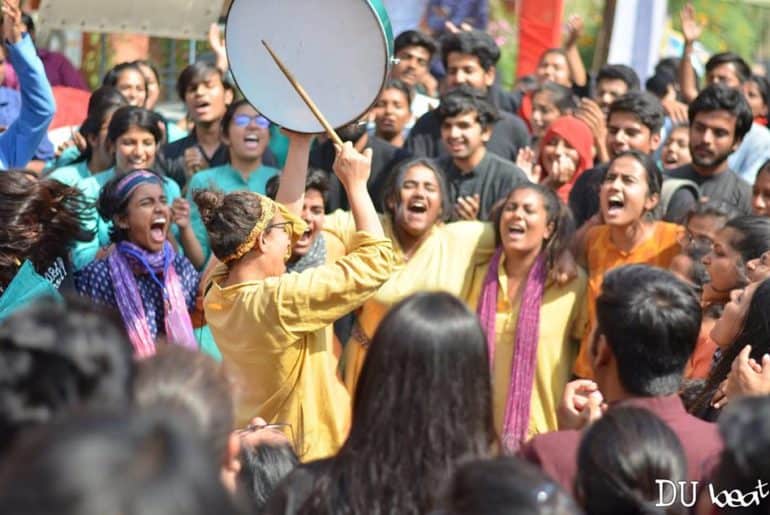
In a landmark step to pressurise the government into rolling back the metro fare hike which came into effect in May and October of 2017, the All India Students’ Association (AISA) held a strike in the Vishwavidyalaya Metro Station from 1pm on the 18th of January.

The protest “Occupy Vishwavidyalaya” witnessed a number of students, led by the AISA, block Gate 3 of the metro station in a bid to ‘occupy’ the same until the government accepted their demands of immediate rollback of the metro fare hike and giving metro consessional passes to all DU students.

Senior members of AISA Neeraj Kumar, Sucheta Dey, and Sunny Kumar along with ardent supporters raised slogans like “fare hike dhokha hai” (fare hike is betrayal), “metro pass dena hoga” (the government will have to give metro concessional passes), and “paee paee occupy (occupy every inch)”.

In the context where an estimated 2.8 million passengers travel daily on the capital’s metro, the DMRC had recorded a fall in ridership when it had hiked the metro fare twice in 2017. This move had been exceptionally hard-hitting for the students of DU, many of whom have to travel long distances to come to college.

At the face of several policemen being stationed at the metro station to control any law and order situation that might crop up, AISA President (DU) Kawalpreet Kaur, in her impassioned speech, invoked the crowd to block Gate 3 and pledged not to move until either the DMRC or the government heeds their demands. Terming the fare hike as “unacceptable”, Kawalpreet said, “This metro is named Vishwavidyalaya and yet the students themselves aren’t able to use the metro. So what is the point of calling this metro station ‘Vishwavidyalaya’? The fare hike has compelled the students to either use other means of transportation or even skip college on days at an end. This inability to access the university campus also amounts to denial of education.”

It is noteworthy that even last October, AISA had held a demonstration in the Vishwavidyalaya Metro Station to pressurise the government on this issue. However, AISA National President Sucheta Dey today claimed that till date, there has been no communication from the DMRC in response to the same. On being asked by the DU Beat correspondent regarding their course of action if the police forcefully tries to evacuate the gathering, AISA State Secretary Neeraj Kumar said, “We have raised our voice in a peaceful manner. Any unprecedented step by the police would go against the law. In a passionate reference to the legacy of student protesters, Kawalpreet discerned that it was because of the protests by the students of DU a few years back that student passes for DTC busses were made available.

While Delhi Metro has lost 3 lakh commuters after the fare hike in October, there is an apprehension that by 2019, the metro fare will double itself. At the backdrop of the DMRC’s reticence on the issue, the question that various student quarters of DU are asking is, if Kolkata can have metro concessional passes for students, why can’t Delhi? While the aam janta shouts, “mehengi metro nahi chalegi” (costly metro will not be allowed), is the government listening?


Feature Image Credits: P.V. Purnima for DU Beat.

Vaibhavi Sharma Pathak 

[email protected]

The announcement of delayed results has indefinitely spread waves of shock among students across the university. DU Beat has reached out to DU officials to confirm the veracity of all claims.

In a startling revelation, the officials of University of Delhi (DU) have confirmed that results for the semester-end examinations conducted over the months of November-December 2017 will be postponed by at least a month, thereby delaying the process indefinitely. It has been classified as a means of retaliation against Delhi Government’s inordinate delay in the release of funds to pay salaries to DU’s teaching staff. Last month, the Delhi University Teachers’ Association President and Secretary had written to Manish Sisodia, the Deputy Chief Minister of Delhi to appeal to release funds for the 28 DU colleges that are either partially or fully funded by it. This contentious issue stems from the delay by DU in the formation of a governing body for these 28 colleges.

The Dean of University Examinations confirmed the news, as released by sources. In a press statement released by him, he explained the gravitas of the situation and contended that the issue has extended for far too long to be controlled by them anymore. Teachers have unanimously decided to not check any university papers unless they receive an official update by the Delhi Government regarding the release of funds. Rashmi Gurzhou, a teacher at one of DU’s colleges, said “Our positions have been undermined and our personal lives are jeopardised due to the lack of salaries to cover daily expenses”. Despite their seemingly obvious disconnect with the formation of a Governing Body, most teachers have to bear the brunt of the University’s nonchalant behavior.

However, political pundits have accused the university officials of concealing the actual, inconspicuous reasons behind this delay by putting DUTA’s strike into the limelight, and henceforth not taking any action to curb it. One popular theory is that teachers are thoroughly disappointed with the quality of answer scripts. A few teachers, who had begun with the process of correction before DUTA called for a strike to protest, were apparently shocked by the level of degradation of answer quality even among those students who hail from reputable colleges. As an instinctive response, they disbanded from the process and shrunk from this responsibility, letting go of the opportunity to earn a few extra bucks. Some conspiracy theorists have gone a step further to theoritise the possibility of a fire in the vicinity of checking hall, which burnt the answer scripts.
Niharika Dabral, a student at DU was ecstatic when this news was announced, and said, “I’m a hundred percent sure that the DU authorities are trying to cover a goof-up. Either way, I’m happy.” Many others, unfortunately, do not share the same perspective. After writing several times to the VC’s office, a few student groups are preparing to approach the Delhi High Court now.

**Disclaimer: Bazinga is our weekly column of almost believable fake news. It is a humorous, light hearted column that should only be appreciated and not accepted.


Feature Image Credits: EduPristine

Vijeata Balani
[email protected]

The professors of the 12 DU colleges have been caught in the crossfire between the university and the government.  Professors claim that they do not have money to pay off their regular bills. These professors had to greet the New Year with empty pockets. 

An ongoing row between the University of Delhi and Delhi Government has resulted in the freezing of funds for 12 DU colleges. This has not been a ‘happy’ new year for some teachers of the DU. Around 12 colleges including Sukhdev College of Business Studies, Shaheed Rajguru College, Maharaja Agrasen College, and Deen Dayal Upadhyaya College, which get 100% funding from the Delhi government have no resources left to pay their staff, after the government stopped the funds in July over a tussle on the names for governing body with the university administration.

S.K. Garg, the Principal of Deen Dayal Upadhyaya College, which is fully funded by the Delhi Government, told India Today, “We are neither in a position to pay salary to our staff nor do we have funds for paying electricity, water, and telephone bills. Financially, everything is held up, as we have not paid our outsourced security staff and sanitation staff,” He also informed that college had to divert funds to ensure the basic functioning of the college.

The President of DUTA, Mr. Rajib Ray, told DU Beat that he has written to the Vice Chancellor and the Delhi Government regarding the tussle. “It is very unfortunate that the professors are suffering due to the non-payment of the salaries,” told Ray to DU Beat.

The Principals are particularly concerned about the salaries of the non-teaching staff because their everyday needs may be affected due to this delay.  Aware of the crisis, a senior official of Delhi Government’s education department, told Mail Today on condition of anonymity, “Delhi government will release the salary as soon as the names of panel members of governing body are submitted to us by the university,”


 Feature Image Credits: India Today

Sandeep Samal

[email protected]


The students were involved in the supply chain of over a kilogram of Charas and LSD blot papers to Jaipur and around NCR.

In a major development before the New Year celebrations, the Delhi Zonal Unit of Narcotics Control Bureau (NCB) arrested four students from across the top Delhi Colleges on Saturday. Among the arrested were Sam Mallick from Jawaharlal Nehru University, Gaurav Kumar and Tenzin Phunchog from Hindu College of University of Delhi and Anirudh Mathur from Amity University. The arrest was made after the the Narcotics Bureau received information on 28 December about the drug use and peddling around these campuses.

“For the last few months, NCB Delhi Zonal unit had been receiving inputs about drug peddling and intense abuse of drugs around institutional areas like Delhi University, Jawaharlal University and Amity University,” Times of India quoted S K Jha, Deputy Director General, NCB as saying.

Acoording to sources of the department, the authorities were given intelligence reports about a parcel of banned substances dispatched to Jaipur via DTDC, following which they reached the Vijay Nagar DTDC office and confiscated the consignment containing 1.14 kg Charas and 3 strips of LSD (Lysergic acid diethylamide). The source was traced and the students were subsequently arrested. However, the major actor behind the drug racket functioning from Himachal Pradesh, Neelchand, is still at large.

The authorities confirmed that the students will be prosecuted under the Narcotic Drugs and Psychotropic Substances Act, 1985.


Feature Image Credits: ANI

Nikhil Kumar
[email protected]

The University of Delhi conducts semester exams twice a year that puts the student in an exhaustive procedure of gathering information, scribbling notes, and remembering it in an unthinking fashion. This habit of mindless rote learning is being subconsciously promoted by the question paper framework and pattern set by the committee. The long questions demanding long answers underpins the act of students of not delving into the meaty parts of a concept and getting engaged in the gross lengthening of an answer.

Moreover, the repetitive nature of particular questions every year makes the question paper very predictable and further adds to the scenario. Such medieval predictable pattern of question paper encourages the student to employ the very controversial  ‘Guidebooks’ reference to sail through the semester which has always been deemed as an unhealthy practice.

With an increasing demand for skillful students in job sectors, DU’s question paper pattern fails to meet the required standards and this calls for a sharp revision in the methodology of testing in the current scenario. DU examination committee should evaluate the loopholes and try covering it in the subsequent terms.

Instead of few long questions, the question paper must comprise of relatively more short questions covering a greater span of the syllabus. Short question ensures that students are thoroughly going through the given readings as a short question demands a to-the-point answer. An ideal question paper should have more realistic questions where a student can connect the theory into practical applications and realities. This would develop intellect in students’ mind. Largely, a question paper should have more of conceptual questions than the long questions. This would inculcate a habit of active and associative learning among students at all levels.

Its high time that the authorities of the University of Delhi should come together and take the onus to bring about a revolution and overthrow this age-old method of taking an examination and instill a more scientific way of testing knowledge and skills.


Feature Image Credits: Matchboard.co 

Sandeep Samal

[email protected]   


The University of Delhi is planning to introduce an app-based attendance system in order to bring transparency. A pilot test run was being conducted in a few colleges, however, it received backlash from the teacher’s.

Recently news broke regarding the digitisation of attendance at the University of Delhi that is to be done via an application based system that will help students track their attendance in real time. The colleges where the beta testing was underway are Deen Dayal Upadhyaya College, Lakshmibai College, Shivaji College and Aryabhatta College. However, this system received criticism from many teachers of the colleges.

In a press release on Friday, the Delhi University Teacher’s Association (DUTA) called this a “mindless experiment” stressing on the fact that the university failed to take into account the cost and feasibility. This discussion regarding the rejection of the app-based attendance system took place in a DUTA Executive meeting held on 22 December 2017.

In the meeting, the relevance of the prevailing attendance system was discussed, highlighting its positive aspects and calling it a satisfactory arrangement. “There is no special/additional advantage to students if attendance is uploaded on an hourly/daily basis. It, however, certainly increases time and effort of teachers towards it. Over-focus on attendance cannot help towards raising quality. Rather, it will lead to mechanisation and over-regulation. The DUTA also fears that this hourly based monitoring will be used for surveillance and will become a handle to victimize teachers.” the press release stated. Miranda House teacher Abha Dev Habib told Indian Express, “In a few colleges where the app was implemented, teachers still kept paper records because of fear of data loss.”

DUTA also blamed the central authorities of Delhi University for undermining the role of Statutory Bodies and emphasized that the university lacks focus when it comes to the real issues that confront the university today. DUTA deems the university spends “efforts and resources on a change which has no real bearing on the quality of education”. In the press release, DUTA claimed to engage with students and take joint action against the implementation of such a system.


Feature Image Credits: Indian Express

Bhavya Banerjee

[email protected]

With the end of the semester, it’s that time of the year where we look back and think of all the things we could do.

The dreadful month with the semester exams are over. The endless preparation, extensive consumption of coffee and painstaking nights looking at the books while scratching the head are now all over. But end of the exams also marks the end of another six months of college, and we naturally end up evaluating the semester thinking about how things were and how they could have been.

Looking back at when the semester began, all of us remember the plans we had made and the things we had promised to do. We had made a plethora of points under the “not-to-do” list and the ones we wanted to do. There were six valuable months of the college life which we planned to spend by learning new skills and increase our knowledge. The list might have varied from joining internships, taking classes to being a part of the college societies. The main highlight of the list might have been the point to study seriously from the beginning of the semester. Now that the semester has ended, many of them seem a fantasy.

Time flies and this is probably the time when this fact hits us hard. We have all heard that college life is probably the best time of our lives. But this also happens to be the time when we shape ourselves for the future. The tug-of-war between making our resume and making memories seems to be never-ending. The semester that began with the most ambitious of targets ended up being filled up of nights that were spent drinking, the classes that were bunked, the most pointless of conversations that took place in the canteen and so much more. The thing is- this is what gave us joy.

But there’s always room for hope and improvement. So once again, with the coming of the new semester there will come a much planned and thoughtful list. This list will be much better than the previous one. This is will also have the points listed in a strategic manner such that the loopholes of the previous semester are covered. Some of us might also give ourselves the liberty of setting a bit more than what is possible. And all of us know the line, “If I set a big list, I’ll complete at least half of it.”

The process of preparing this list seems no less than a ritual and will probably be followed this semester as well. So let us all prepare our lists filling them up with the best and the most filtered points. But yes, let’s see how many boxes we tick this semester!


Feature Image Credits: IStock

Karan Singhania
[email protected]

The college administration cited the surplus staff strength as the reason following the calculation of the required ‘workload’.

University of Delhi’s Motilal Nehru Morning college released a press release on its official website on Tuesday stating the termination of three ad hoc teachers. Among the discharged was a teacher from the Computer Science department whose name could not be learnt in addition to Arunakar Pandey and Shashi Kumar from the Hindi Department. The teachers believe that the college used faulty calculation methods, as 41 teachers at the staff council meeting went on to complain the “wrong calculation”.

Workload is the number of a teacher’s teaching hours at the college. The workload at the University has been a cause of tussle between the Teacher’s Union and the University Grants Commission (UGC) ever since the Regulations introduced in 2010 which specified that the workload to be not less than 40 hours a week for 30 weeks in an Academic Year. Later it was further increased after the 2016 UGC gazette notification, leading to widespread protests last year. The Ministry of Human Resource Development had later intervened and asked UGC to re-examine the guidelines, leading to the University’s resolution on workload.

The sacked teachers opined that the college administration had infringed these guidelines in their case. “Blatantly violating the rules, the college sent me a termination letter late in the evening. Following protests against this calculation, the college principal said the standing committee is reviewing it,” The Indian Express quoted Shashi Kumar as saying.

The college administration could not be reached for any further response on the subject inspite of our repeated efforts. The student community was particularly disturbed with these developments. A student from the Hindi Department when approached by our correspondent said, “Mr. Kumar had been serving at the college from eight years. It is most unfortunate.”


With valuable inputs from The Indian Express. 

Feature Image Credits: College Dunia 

Nikhil Kumar
[email protected]