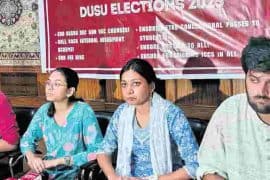
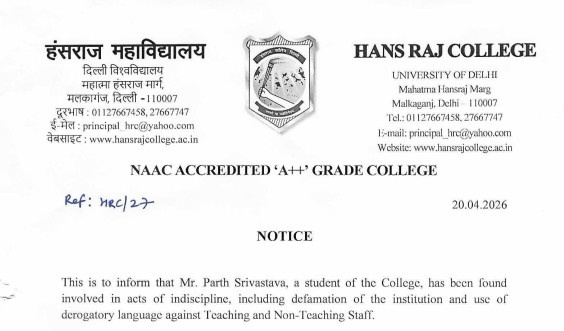
On 30th April, Hansraj College issued a notice terminating the suspensions of 29 out of 30 students; however, Parth Srivastava’s suspension remains in effect. He has approached the High Court of Delhi under Article 226 and has argued that the suspension violates Parth’s fundamental rights under Articles 14, 19(1)(a), and 21 of the Constitution.
Hansraj College terminated the suspension of 29 out of 30 students who were suspended due to alleged defamation, violence, indiscipline and misconduct, which had occurred after the college fest, Confluence 2026. However, one student, Parth Srivastava, the former president of the student union of Hansraj College, is still suspended, and the matter has reached the High Court of Delhi.
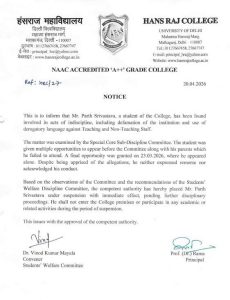
The reason for the revocation of the suspended students was because of “…observations made by the Special Core Sub-Discipline Committee and the subsequent recommendations of the Student Welfare and Discipline Committee…”
However, Parth Srivastava is still suspended and has filed a petition to the Delhi High Court challenging his suspension on multiple grounds, including “defaming the college through social media platforms” and using “derogatory language.”
On 29th April, Justice Jasmeet Singh issued a notice which allowed Parth Srivastava to enter the campus to fill his examination form as the last date was on 30th April. The notice also stated that the petitioner will not cause any disruption in the college. But he wasn’t allowed to attend his farewell.
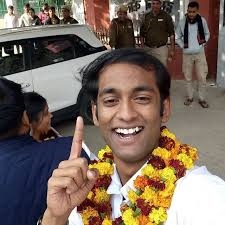
He told DU Beat,
“The person who gave all of his four years to the college and its students was specifically not allowed to attend his own farewell through explicit instructions mentioned in the notice/poster. It was truly very disheartening and shattering for me.”
Filed under Article 226 of the Constitution, pleas that his suspension, which was declared on 20th April, be squashed. In a report by Newslaundry, “[t]he petition argues that the suspension violates Parth’s fundamental rights under Articles 14, 19(1)(a), and 21 of the Constitution–the rights to equality, free speech, and life and dignity.” It has also challenged the legitimacy of the Special Core Sub-Discipline Committee, which suspended him.
The petition also seeks to restore all the academic benefits throughout the suspension period and ensure the petitioner is permitted to attend all classes, participate in academic activities, and continue his education without interruption. This had all begun on February 9th, when a controversy arose because the principal of Hansraj College had used the campus for her son’s wedding, which caused a protest that raised questions about the use of public resources for private use.
Later, around February 12 and 16, another controversy sparked by allegations of NIRF data manipulation. Multiple RTIs were filed by Parth, who later received a disciplinary notice with no charges specified. Later, he filed a complaint with the Central Vigilance Commission on 31st March and then, on 20th April, received his suspension letter.
“After the irregularities highlighted by my RTI application and a CVC complaint were forwarded to the CVO, DU on 16th April, my suspension notice was issued just four days later. Further, suspension notices issued to others during the same period have been revoked, while action against me continues, raising concerns about selective targeting,”
Parth Srivastava mentioned in an interview with DU Beat.
On April 1st, the college had uploaded the Standard Operating Procedure (SOP), which prohibited the students from speaking to the media without prior permission, posting defamatory content on social media, and recording meetings or administrative discussions.
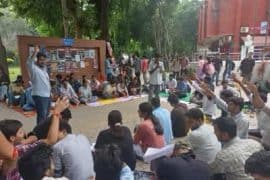
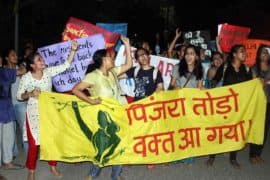
On the day of the college fest, many decisions by the college administration, like restrictions on external artists and forcibly concluding the fest early on day one, caused a 20-hour sit-in protest. Many misogynistic remarks were allegedly made to the female protesters by the principal. The college administration gave in, however, on Day 2 of the fest, but the poor crowd management led to physical violence, harassment, and uncontrolled chaos, which led to police intervention.
Parth admitted to posting videos that criticised the college over fee hikes and administration issues.
Parth’s lawyer, Shaurya Vikram, argued that the suspension order is illegal and driven by malice. According to him, the order was issued without any charges, evidence, or clarification of the committee’s authority, making it invalid. He also pointed out that Delhi University stated in 2023 that it cannot regulate staff social media activity, questioning why the same principle shouldn’t apply to students.
In an exclusive interview with the editorial team of DU Beat, he mentioned that:
“ I was targeted because I’m the only one who’s willing to raise a voice. I received emails from the Special Disciplinary Committee formed by the administration of Hansraj without any proof, show-cause notice or relevant information. People allegedly brought knives and guns to the fest, and their faces were all over the internet, yet no action was taken against them. When a civil crime like alleged “defamation” carries so much weight compared to serious crimes like that, it raises concerns about the priorities of our institutions and the environment they are creating. I have been part of the same administration during my tenure, and I know exactly what goes on there, so I am not one to back down from a fight. We trust the Hon’ble Delhi High Court and the student community that we will get justice. ”
Principal Rama Sharma defended the suspension, saying it was needed to maintain order. She criticised students for making false claims and defaming the college on social media. However, she added that most students come to Hansraj College to study, and their academics shouldn’t be disrupted, as it is a “very prestigious college.”
The next hearing for the court case is on 8th May, 2026.
Read also: Hansraj College suspends over 30 students due to alleged indiscipline, violence, and defamation
Image Source: Hansraj College Website
Reva Rawat



Trending