
The signing ceremony was held at the Miranda House campus in Delhi. It was attended by DMU Vice-Chancellor Prof. W. Chandbabu Singh, Miranda House Principal Prof. Bijayalaxmi Nanda, Dean of Humanities S. Lanchenba Meetei, DMU Registrar Dr. R.K. Joteen Singh, Dr. Geetanjali Elangbam of the Department of Botany, along with faculty members, officials from both institutions, and representatives of the Manipur government.
Under the partnership, the two institutions will collaborate on joint academic programmes, faculty exchanges, student mobility, resource sharing, specialised workshops, and interdisciplinary research. The collaboration aims to build a stronger academic network between Manipur and the national capital, encouraging knowledge exchange and research partnerships.
Established in 2018 under the Rashtriya Uchchatar Shiksha Abhiyan (RUSA), Dhanamanjuri University is a state university named after Maharani Dhanamanjuri for her contributions to higher education. The university was founded to promote multidisciplinary learning, research, and academic excellence while expanding access to quality higher education in Manipur.
The MoU is expected to deepen academic engagement between the two institutions by fostering interdisciplinary research, collaborative initiatives, and the exchange of expertise. With Miranda House’s strong academic reputation, the partnership is expected to open new avenues for collaborative learning and research.
The partnership also reflects the growing emphasis on inter-university collaborations in Indian higher education, enabling institutions to share expertise, strengthen research capabilities, and provide students and faculty with wider academic and professional opportunities.
Apart from being the biggest tournament in the world of football, the FIFA World Cup is also a celebration of heritage and cultures from across the world. From the quiet respect of Japanese fans practising atarimae to the roaring Viking row of Norway, the sartorial statements of the DRC, and Cape Verde’s astonishing underdog run to the knockout rounds, discover how the beautiful game united diverse nations. The tournament featured countless memorable moments, only a few of which are captured in this article.
The FIFA World Cup comes back to us every four years and brings with it a passion and love for the game like no other. Every four years, the world gathers to witness the magic of football. It accepts everyone—the seasonal fans, the die-hard football lovers, the loyalists, the fans who support every other team, and even the ones who do not really understand the rules of the game find themselves drawn towards any screen broadcasting the matches. This is what sets the FIFA World Cup apart from many other major sporting tournaments. It’s not just a battle of who reigns supreme on the field or has mastery over controlling the ball; it undeniably brings the world together. After all, football knows no borders.
But beyond goals, the FIFA World Cup 2026 offered us so much to look at and ponder over. It truly has been one of a kind. From it being the only football World Cup with 48 countries competing to an American classic Super Bowl-style halftime show being introduced for the final match, the audience has been kept on their toes the entire tournament!
This World Cup has been home to many “firsts”. Starting with the hosts themselves. For the first time in the history of the FIFA World Cup, three countries—the USA, Canada, and Mexico—had the opportunity to host the tournament in collaboration with each other. The list doesn’t end there. The number of countries competing in the tournament was also the highest that it has ever recorded. This year, a grand total of 48 teams were competing for the golden trophy. For some tiny nations, it was their first appearance at this international jamboree of football; for others, a return after a very long absence. Countries like Curaçao, Cape Verde and Bosnia and Herzegovina got their names recorded in the list of countries playing the World Cup for the first time.
With fans from all across the globe filling stadiums, what grabbed more attention than the bright and colourful national flags being waved around every corner was, undeniably, the rich cultural heritage and idiosyncrasies celebrating the beautiful game.
Every country harbours in itself a distinguished way to celebrate victory or show support. The USA is often associated with loud and expressive celebration. But Japanese fans who travelled around the world to support their national team playing in the tournament performed something that earned huge respect from others. They showed their support and love in a quiet, dignified way. It would be wrong to assume, however, that Japanese fans aren’t vocal enough or fierce in their support. Terrifying face paint, showing up dressed as fearsome samurai, and even cheering their team with gusto are testimony enough. But at the end of every match, regardless of the result, we have seen them stay behind to clean up after themselves, producing plastic bin bags seemingly from nowhere and leaving the stadium as they found it. This habit reflects their deeply rooted philosophy of atarimae (things that are naturally expected) and meiwaku (avoiding causing trouble to others). The Japanese, in this way, paid their respects to the venue, the host and fellow attendees. This is not their first time practising it; the Japanese have been doing this ever since their debut in the FIFA World Cup in 1998.
In the list of the countries that returned to the World Cup after long years of not qualifying, the Norway national team remained undefeated when it came to capturing the hearts of its audience. Be it the 6’5″ striker of the team quickly becoming the most beloved star of the netizens or their beautifully blended cultural heritage while celebrating, the team has undoubtedly got us wrapped around their fingers. Their Viking row celebration was arguably the hit of the tournament. Devised by fans in a pub back in Oslo based on the legends of Norse seafarers, the celebration showcased a wonderful tapestry of Norwegian heritage, folklore and passion for the game. Executed with equal gusto and passion by both fans and players, the call of the Norse horn, blown to announce it was about to begin, sent a ripple of excitement around the ground. Beyond this, fans won American hearts by embracing the local culture just as their own. Social media couldn’t get enough of star striker Erling Haaland buying cowboy boots and hats in Texas and his return to Oslo with a taxidermied raccoon under his arm.
Erling Haaland returned to Norway with a taxidermied raccoon.
If we are talking about capturing the centre stage at the 2026 FIFA World Cup for cultural and historical benchmarks, it would be extremely unfair to not talk of the Democratic Republic of Congo.The country last appeared in the tournament in 1974, when it was known as Zaire; after that, it had a long hiatus.Ruled by the then President Mobutu Sese Seko, who was famous for his leopard-skin caps, the team got the look upon their touchdown in Houston, styling it out in custom-tailored black suits featuring bold leopard-print panels and lapels and throwing down a sartorial marker. But such a peak fashion statement is not where it stops. They had fans scurrying into history books with the sight of superfan Michel Kuka Mboladinga’s standing statue still on a plinth for every minute of their matches.
Michel Kuka Mboladinga has been a regular at DR Congo’s matches for more than a decade.
Despite having quite an underwhelming tournament, Scotland had its fans winning over Americans with their antics of celebration culture. It was the first time the Tartan Army’s team had made the World Cup finals for 28 years, and they were determined not to let go without enjoying themselves. Boston witnessed the Scottish fans take over the city within days of arriving—drinking bars dry, putting traffic cones on statues’ heads, leading locals on a merry dance through the parks and public places of Boston, invariably accompanied by bagpipes. Beyond their little antics of putting cones on top of statues lies a lesser-known Scottish ‘tradition’. This tradition is known to have started in the 1980s in Glasgow as a late-night, drunken prank with the equestrian statue of the Duke of Wellington outside Glasgow’s Gallery of Modern Art getting “crowned”. This soon turned out to be seen as an unofficial symbol of Scottish culture.
Scotland fans with the Tartan Army
For 96 years, the FIFA World Cup had never witnessed the ground getting converted into a temporary stage for singers during half-time. A half-time show specifically. The World Cup final has religiously followed the same routine at half-time ever since it was established: punditry, tactical analysis, and players regrouping in the tunnel. But this year, the New Jersey stadium shook fans across the world with an intense lineup starting with Madonna. The other headliners of the show were Shakira, BTS, and Justin Bieber, with Burna Boy, Venezuelan conductor Gustavo Dudamel, the PS22 Chorus, and Coldplay.
Shakira performs at halftime during the FIFA World Cup Final on July 19 in East Rutherford, New Jersey.
FIFA president Gianni Infantino spoke on the show,
“As the world unites for the most significant football match in history on Sunday, 19 July 2026, at the New York New Jersey Stadium, this groundbreaking spectacle, curated by Chris Martin of Coldplay, will celebrate football, music and our shared values, ensuring a legacy that transcends the final whistle.”
However, all this glamour didn’t go without heavy criticism. Sports medicine experts and football officials have warned that prolonged breaks can disrupt players’ physical rhythm, and IFAB has previously stated that extending halftime could negatively impact player welfare and safety because of the longer period of inactivity, potentially increasing the risk of injuries when play resumes. More critics argue that this move has drawn comparisons to the Americanisation of football, while broadcasters like the BBC and ITV were initially reluctant to air the show, preferring their usual halftime analysis before agreeing to broadcast it. Now, will this become a newly added tradition to the FIFA World Cup final? The question remains.
Lastly, the piece would remain incomplete without a note on the tiny island nation and the most captivating underdogs—Cape Verde. They have not just played the matches with diligence and a top-notch game plan but have created a history that will be remembered for years to come. They defied multiple odds to become the smallest country to earn a spot in the World Cup knockout round. With a team cobbled together with journeymen who plied their trade in the lower leagues of Europe, this band of misfit brothers held the mighty Spain to a draw in the group stage. The Cape Verdean belief that hard work and dedication will one day be rewarded was perfectly captured in the story of the side’s 40-year-old goalkeeper, Josimar José Évora Dias, better known as Vozinha.We witnessed him make 18 saves across four matches that the team played, making it difficult for international superstars like Vinícius Júnior and Lionel Messi to get past the last line of defence. Upon the team’s return to Cape Verde as nothing less than heroes, Vozinha was honoured with a newly discovered sea slug named after him.
Cape Verde goalkeeper Vozinha soaking up applause at the 2026 World Cup.
And just like that, the tournament has come to an end with Spain lifting the golden trophy, but more than that, for 39 days the matches have lifted the mood of its fans by bringing tremendous joy, passion, and love for the game. The tournament doesn’t only showcase goals or incredible saves but rather works as a platform blending together cultures, traditions, and celebrations from all over the world.
Two Delhi University students remain hospitalised after the July 20 Jantar Mantar protest, as eyewitness accounts and medical findings draw attention to the injuries sustained.
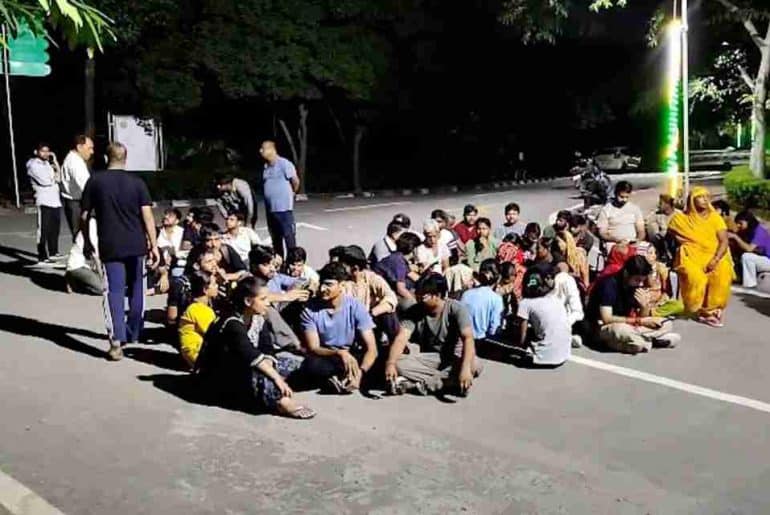
Days after Delhi Police baton-charged thousands of demonstrators marching towards Parliament as part of the Cockroach Janta Party’s “Chalo Sansad” march, at least two Delhi University students remain hospitalised with serious injuries, raising questions about the extent of force used to disperse the July 20 protest. While Delhi Police have consistently denied using pellet guns, multiple eyewitnesses and medical reports have disputed that claim.
Sahil Lochab, a Delhi University School of Open Learning student preparing for the SSC Combined Graduate Level examination, may lose vision in his right eye after what his family alleges was a pellet gun injury sustained during the march. Lochab underwent surgeries at Lady Hardinge Medical College and Safdarjung Hospital before being shifted to the AIIMS Trauma Centre, where doctors reportedly removed a pellet lodged in his eye that had caused a corneal perforation, along with others from his lung and the tissue surrounding his heart. His family was initially told there was only a one per cent chance of his sight returning. Doctors have since said his prognosis remains “guarded”, meaning the likelihood of vision recovery remains uncertain.
Twenty-one-year-old Sakshi, also a Delhi University student, was caught in a crowd crush near Jantar Mantar after police allegedly pushed demonstrators into an already congested area following the use of tear gas, according to protesters. She was carried unconscious to a police vehicle after demonstrators alleged officers at the scene were reluctant to transport her to hospital. Admitted to the intensive care unit (ICU) at Ram Manohar Lohia (RML) Hospital and placed on ventilator support, she was extubated on July 23 after hospital authorities said her condition had shown “steady improvement”. They added that she was conscious, breathing independently, and that MRI scans of her brain and spine were normal.
Protesters on July 20 have described police charging at people who were simply filling water from a cooler, triggering a stampede. One eyewitness who was present when Sakshi was found unconscious, said her face had turned blue and that she was bleeding near one ear. Bystanders, guided by others in the crowd, attempted cardiopulmonary resuscitation (CPR) and, when that appeared unsuccessful, administered mouth-to-mouth resuscitation. The witness also alleged that protesters restrained a police officer whom they believed was responsible for her injuries, and described difficulties in locating an ambulance before she was eventually taken to hospital in a police vehicle.
Delhi Police have said around 60 protesters and 118 police personnel were injured in the clashes. They also reported that more than 20 police vehicles were damaged and that 70 protesters were detained. Officers, including Head Constable Balram, Inspector Nand Kishore Singh, ACP Vivek Bhagat, and Head Constable Babu Lal, alleged they were separated from their units and assaulted by crowds.
Delhi Police have repeatedly and categorically denied using pellet guns during the protest, stating the force neither possesses nor uses them and warning against circulating “false and misleading” information. However, medico-legal case (MLC) reports for at least three injured protesters, including Lochab, 25-year-old Sheikh Irshad Mansoori, and a 28-year-old Outlook journalist, reportedly describe “suspected gunshot injury” or “pellet injury marks”, and hospital sources have said the pellets recovered were metallic rather than plastic or rubber. Pellet guns and shock batons form part of the Rapid Action Force’s (RAF) riot-control equipment. However, no official evidence has conclusively established whether pellet guns were fired during the protest.
Leader of the Opposition Rahul Gandhi, speaking to reporters in Parliament, accused the government of suppressing students’ voices and said the police action against them was “completely wrong,” renewing the Opposition’s demand for Prime Minister Narendra Modi to apologise and for Education Minister Dharmendra Pradhan to resign.
DU to launch scholarship for student athletes in honour of former Union minister and 1974 DUSU President, Arun Jaitley.
Delhi University is set to inaugurate a new sports scholarship in memory of former Union Minister Arun Jaitley on August 13, marking the anniversary of his election as DUSU president in 1974.
Titled the “Late Shri Arun Jaitley Scholarship”, the scheme has been proposed by the university’s Scholarship Cell to support undergraduate students excelling in various sports at the national and international levels. If approved, it will run for 20 years, with the endowment generating funds for annual awards.
The proposal, carrying an annual outlay of Rs. 50,000 plus accrued interest from a Rs 10 lakh endowment, will be taken up for approval at the university’s academic meeting scheduled for July 24.
The award ceremony is recommended to be held on August 13 every year. The total amount granted is to be divided amongst the recipient students. Three scholarships will be awarded every year with at least one of the recipients being a woman. This is a provision put in place to promote gender inclusivity in competitive sports.
Selection will be made by a committee comprising the Director of South Campus (Chairperson), a nominee of the Vice-Chancellor, the Director of the Delhi University Sports Council, a representative of Jaitley’s family, and finance and administrative officials.
University officials said the initiative aims to recognise sporting excellence while honouring Jaitley’s legacy and long-standing association with the university.
The final decision is expected to be taken on Friday’s meeting, which will also take up the July 10 notification on restructuring under the Undergraduate Curriculum Framework 2022, under which students in Semesters VII and VIII will study only three courses each semester. The restructuring has drawn criticism from sections of the DU faculty.
DU has announced a revised postgraduate admission schedule, updating the timeline for the upgrade round and spot round 1 under CSAS-PG.
With the admission process for the academic session 2026-27 underway, a revised schedule announcing dates for the upgrade round and spot round 1 under the Common Seat Allocation System for Postgraduate Admissions (CSAS-PG) has been released by DU.
Candidates allotted seats through the Delhi University PG upgradation round are required to complete the admission process by paying the prescribed fee on or before July 24, 2026. Colleges and departments will verify and approve online applications until the same date. Students who receive upgraded allocations must complete all admission formalities within the stipulated deadline to retain their allotted seats.
The university has also introduced spot round 1 to fill seats that remain vacant after the completion of the regular allocation rounds, ensuring that available postgraduate seats across departments and colleges are utilised efficiently. The round provides an opportunity for eligible applicants who were not allotted seats in the earlier rounds to secure admission to their preferred postgraduate programmes. It also enables the university to fill seats left vacant due to withdrawals, non-payment of fees, or candidates opting for admission elsewhere after previous allocation rounds.
According to the revised schedule, the list of vacant seats for spot round 1 will be published on July 25, 2026. Candidates who wish to participate must opt in for the spot round between July 25 and July 26, 2026 by 4:59 pm. To opt in, applicants are required to log in to the CSAS-PG portal using their CUET (PG) application number and password during the specified window. Only candidates who opt in during this window will be considered for seat allocation.
The university will announce the Spot Round 1 allocations on July 29, 2026. Candidates allotted seats must accept their allocation by July 31, 2026 by 4:59 pm. Colleges and departments will verify and approve online applications from July 29 to August 1, 2026 by 4:59 pm, while the final deadline for online fee payment is August 2, 2026 till 4:59 pm.
Candidates are encouraged to follow the revised schedule thoroughly and keep track of important dates to avoid any inconveniences and ensure a smooth admission process.
DU’s Political Science department marks 75 years with a Diamond Jubilee event featuring VC Yogesh Singh, alumni felicitations, a new academic journal launch, and reflections on the department’s legacy.
The Department of Political Science at the University of Delhi celebrated 75 years of its existence with a Diamond Jubilee programme held at Vande Mataram Hall, Faculty of Arts.
Present at the event were current and former faculty, alumni, scholars, and university officials for a day that combined academic discussion with reminiscence and cultural performance.
The program commenced with the ceremonial lighting of the lamp and a rendition of Delhi University’s Kulgeet. Head of the Department and Convenor Prof. Rekha Saxena opened the session by tracing the department’s evolution from a small postgraduate cohort in 1952 to what she called the country’s largest centre for the discipline today, now reaching over one lakh learners annually. She called the department her “intellectual home,” reflecting on her own path from student to its Head, and pointed to its enduring culture of critical inquiry and openness to varied perspectives.
Guest of Honour Prof. Rakesh Sinha, a former Rajya Sabha MP, spoke on the decolonisation of knowledge systems and the importance of nurturing thinkers equipped to shape India’s future, and welcomed the launch of the department’s new academic journal during the inaugural session.
Vice Chancellor Prof. Yogesh Singh, attending as Chief Guest, congratulated the department for its 75-year run, noting that it has produced over 1,200 PhD scholars and has contributed to strengthening confidence in India’s democratic trajectory. Co-convener Bipin K. Tiwary delivered the vote of thanks.
A second academic session, chaired by Prof. M.P. Singh, featured remarks from Dean of Colleges Prof. Balaram Pani, Prof. Rajni Abbi, and Prof. Sushma Yadav, along with a keynote by Prof. Charles Hankla of Georgia State University, who spoke of his long-standing ties with the department. Former faculty members and alumni, including Prof. Neera Chandhoke, were felicitated during the programme, which closed with a cultural segment chaired by Sh. Anup Lather.
Delhi University’s Academic Council meeting on July 24 will consider a proposal to convert the School of Open Learning into a Centre for Distance and Online Education, in line with UGC’s 2022 distance education regulations.
Delhi University’s School of Open Learning may soon operate under a new name and a restructured administrative setup. The Academic Council meeting scheduled for July 24 will take up a proposal to convert SOL into a Centre for Distance and Online Education, abbreviated as CDOE.
The restructuring is meant to bring DU’s distance education setup in line with UGC’s Open and Distance Learning and Online Programmes Regulations of 2022, which made it mandatory for all universities, except open universities, to establish a CDOE to run distance and online programmes. SOL was first established in 1962 and is one of the largest distance education institutions in India.
SOL’s governing body had recommended the proposal at a July 15 meeting, and it will now go to the Academic Council for a decision. DU has said the restructuring is necessary given the growing demand for digital education and the need to bring administrative arrangements in line with current UGC standards. Once CDOE is formed, the conduct of online and distance courses, quality monitoring, and administrative arrangements will be handled in a more structured way, according to the university.
The July 24 meeting will also take up several other proposals, including the introduction of the Arun Jaitley Scholarship for three undergraduate sports students, a fourth-year research and entrepreneurship track under UGCF-2022, and the launch of a four-year integrated BA-BEd programme at Lady Shri Ram College from the 2026-27 academic session.
For the over five lakh students currently enrolled at SOL, the university has not indicated any change in courses, fees, or degree recognition as a result of the renaming.
Delhi entered the global top 100 at 99th in the QS Best Student Cities 2027 rankings released on July 22, while being named the world’s most affordable student city. Mumbai climbed seven places to 91st, the highest any Indian city has ranked.
Delhi has been named the world’s most affordable city for students in the QS Best Student Cities 2027 rankings, released on July 22, while Mumbai moved up seven places to 91st globally, leading India’s only four cities in the index.
The rankings cover 150 cities across six indicators: university quality, employer activity, affordability, desirability, student mix, and student view. Delhi entered the global top 100 for the first time, rising from 104th to 99th. It received the highest affordability score of any city in the world, with average annual international tuition fees around US$2,700. The city also ranked 29th globally for employer activity.
Mumbai’s rise from 98th to 91st was the biggest gain among Indian cities this year. It scored 78.3 for employer activity and 84.4 for affordability, finishing with an overall score of 61.8.
Bengaluru fell six places to 114th, the only Indian city to drop this year. QS pointed to its comparatively high international tuition fees, averaging US$5,400 annually, as a contributing factor. Chennai gained five positions to rank 123rd.
Globally, Seoul retained the top spot with a perfect score of 100, followed by Tokyo and London. Melbourne ranked fourth, with Munich and Sydney sharing fifth.
For students at Delhi University, the affordability ranking has a direct read. Delhi’s tuition cost advantage over cities like Bengaluru is substantial on paper. Still, the city’s student view score of 14.6 out of 100, the lowest among the four Indian cities, points to a gap between what the data shows and what students actually report about their experience.
The wave of AI-generated anthropomorphic fruit taking over social media seems to be subliminally pushing a distinct political agenda.
Summer is the time of the year when the weather gets warmer, drinks get cooler, skin gets darker, and hair gets lighter. Friends, fun, and my favourite part – fruit! The richness, ripeness, and freshness of summer fruits are like nothing else. Nothing could make me look at nature’s candy with disdain. Nothing, except turning it into an anthropomorphic abomination and inserting it into repetitive, erotic, soulless storylines.
Generative AI is becoming less of an option and more of a shadow – one that always lingers and hovers around, refusing to leave, latching onto you and suffocating you like a python squeezing the breath out of its prey. Every day, it seems like media algorithms try their best to push some kind of AI-generated, sloppy, brain-numbing absurdity. One such disgrace to the face of the planet and the name of fruit is the AI-generated videos following the lives of humanoid fruit. And this isn’t a localised phenomenon. Media algorithms all over the world are pushing this kind of content.
Why is the algorithm pushing content for which the word “trashy” seems too flattering? Why is it that this content is heavily fetishistic and erotic in nature? And why is such content being force-fed to us? The answers to these questions are intense and multifaceted.
From the usernames of the accounts (@aifood487 and @dumbal30_.ai, to name a couple) posting such content across multiple platforms including Facebook, Instagram, and TikTok to the storylines they follow, the uncreativity and unoriginality is unmatched. However, there is meaning that goes beyond the mere uncreativity of generative AI. Now, to be fair, fruit has often been used throughout literature as symbolism for sexuality and intimacy. However, in those contexts, themes of tenderness, passion, and self-discovery are emphasised rather than control, humiliation, and degradation.
Assault, violence against women, and male domination emphasise female powerlessness through humanoid fruit
According to a 2022 study by the Zien Journal of Social Sciencesand Humanities, repetition in media serves distinct political purposes. Essentially, repetition convinces an audience that a particular idea is the truth or that a certain ideology is correct. There is a misconception that AI is ultimately neutral. According to computer scientist, Nisheeth Vishnoi, on speaking with the Yale School of Management, “Despite being governed by precise mathematical rules, algorithms can be very brittle, and human biases can creep in, and they’re not really as objective as people think.”
Thus, it is safe to conclude that these repeated themes we see in AI-slop media push a certain political agenda; one that is predominantly right-leaning. The algorithmic combinatorics involved in the generation and re-generation of the same story in different fonts, or in this case, fruit, can be accounted to algorithmic biases of users as well as tech oligarchs who ultimately control what is being propagated and pushed on the platforms they own. Hence, it is fathomable that their platforms push content that aligns with and furthers what tech capitalists find not just profitable, but also politically advantageous.
Stereotypical gender roles and the idea that reproductive autonomy lies completely with men are frequently seen in this kind of content. The pushing of an agenda that emphasises female submission and lack of reproductive autonomy gives a subliminal message: you can’t escape your reproductive responsibility. Beyond disturbing. This makes perfect sense when you also notice that there is a “rape-esque” aspect to generative AI being forced onto users with the whole narrative of “AI is coming whether you like it or not” and “just accept AI.”
Reproductive autonomy lies fully with the male characters, with women facing the consequences of infidelity
But that is not where the unsettling nature of AI slop ends. Often, these videos use bright colours and incredibly cartoonish characters, making it seem like they are targeted at children. This means that the political agenda in question is being forced onto young, malleable minds. Female humiliation and degradation as concepts are being fed to innocent children who are yet to develop a complete worldview. In addition, it is important to notice the incredibly eroticised nature of the videos.
Fruit is personified, and somehow, hypersexualised. Borderline pornographic content is being pushed to children in a colourful, cartoonish costume. I wondered why billionaire techies who have all the power in the world to control the media and hence prevent such sexually explicit content from reaching children do not do anything about it. Then I remembered the relationship billionaires have with children.
Deliberate eroticisation of cartoonish figures that gives a nod to pedophilia
Why is AI slop so soulless? More importantly, how are we accepting it? The simple answer is that brains are getting smoother. In other words, we are being so repeatedly subjected to media that is a full-on disgrace to the realm of art and literature that we no longer comprehend the complexity of soul and depth. The bar is deep in the fiery pits of hell when it comes to modern-day standards for art, music, and literature. Critics, including Dwight Macdonald and Neil Postman, repeatedly explain the “dumbing down” of media and culture.
Macdonald’s essay, A Theory of Mass Culture, beautifully elucidates this. He writes about the dichotomy of culture – how culture is divided into “high culture” or the “traditional” kind that is chronicled in textbooks, and “mass culture”, which is a mass-produced, impersonal commodity that, unlike high culture, requires no intellectual capabilities to consume and relish. This easy-to-produce, easy-to-consume media systematically reduces intellectual capacity and withers away the conscious ability to critique, turning consumers into mindless bots who are willing to enthusiastically accept anything and everything that is thrown at them.
Being fed media that actively disapparates neurons leaves the masses in a dazed state. A dazed, digitally intoxicated, intellectually desensitised population is easier to control. This intoxication also allows you to learn to love your oppressor, an idea that is explored in the dystopian novel Brave New World, by Aldous Huxley. The consumption of such slop trains you to simply accept whatever is pushed to you – ideology, policy, or agenda – without question or critique. The masses become hypnotised into a state of anti-intellectual euphoria that allows the oligarchy to function as they please.
Women’s bodies have always been objectified and used as a commodity. Sexually explicit AI fruit videos further this. Hundreds of thousands of viewers engage with this content while another network of individuals (and/or bots) is focused on pushing out more of this mass-produced commodity. Several Reddit forums and other online spaces exist where people teach each other how to create these mass-produced atrocities. In essence, people are learning to capitalise off of the fetishisation of fruit and the humiliation of women, as if the densely patriarchal society we live in hasn’t already sold women for parts for centuries.
Something as stupid, seemingly harmless, and supposedly as insignificant as sexually active fruit that one may deem as “not that deep” is indeed just that deep. It is crucial not to fall victim to any form of mind-numbing cognitive dissolution that may be pushed by the media; retain critical thinking, and hence be able to challenge monopolies. Question and ponder what you see, no matter how “brain-dead” the content itself may come off as. A population that can think for themselves and is not afraid to exercise their intellect will not fall victim to blissful oppression and brainwashing.
Delhi University 2026 admissions process faced document verification concerns; the university plans an AI verification tool to detect fake certificates and altered records.
After detecting multiple cases of AI-generated and digitally manipulated documents during the ongoing admissions process, the University of Delhi (UoD) is planning to develop an artificial intelligence (AI)-based verification tool for the next admission cycle. The proposed system aims to strengthen document verification and detect forged certificates more efficiently.
In its advisory, the university asked applicants to avoid uploading AI-generated, digitally altered or heavily edited documents while applying for undergraduate and postgraduate programmes. It said the admission branch had come across manipulated certificates, mark sheets and identity proofs during the verification process, prompting the warning.
Speaking to PTI on Monday, Dean of Admissions Prof. Haneet Gandhi said colleges have reported multiple cases of manipulated documents during the ongoing undergraduate admissions process. She noted that the university has come across digital certificates with QR codes that, upon verification, were found to be fake or AI-generated. In some instances, scanning the QR codes displayed the details of a different person, indicating that the digital records did not match the applicants’ information.
Gandhi told PTI that such cases have been reported across different categories of applications, including those submitted under the Extra-Curricular Activities (ECA) quota, category certificates and other admission documents across colleges. She added that while university and college teams have been identifying manipulated records, verifying documents for over 90,000 applicants is a challenging process.
We will certainly look at developing an AI tool for next year’s admissions so that such cases can be filtered out completely,” she said.
DU has instructed candidates to upload only scanned copies of their original documents. It also cautioned that anyone found submitting fraudulent or AI-altered records at any stage of the admission process could have their candidature or admission cancelled without prior notice, face legal action, and would not be eligible for a refund of the admission fee. The university has further urged applicants to review the documents they have uploaded and ensure they comply with the admission guidelines.