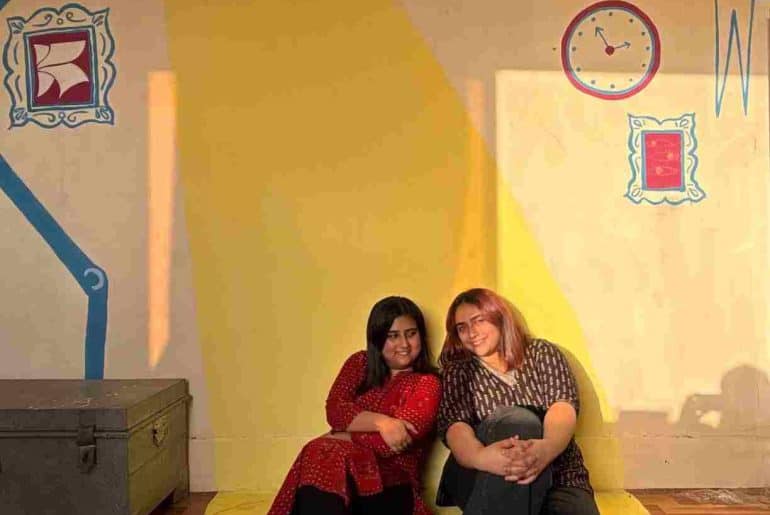
DU Beat speaks to Sneha and Navya Misran, the sisters behind Kitaab Club, about reading, community, and their vision of creating a Delhi University beyond its campus.
Rishika: Sneha, what was it like to be a student at Delhi University in 2014, when you founded Kitaab Club? Was there a specific moment that made you feel, ‘We need to build something’? And Navya, you came to DU five years later, in 2019. Did you experience DU differently from how Sneha has described it, and how did that shape the way you approached Kitaab Club?
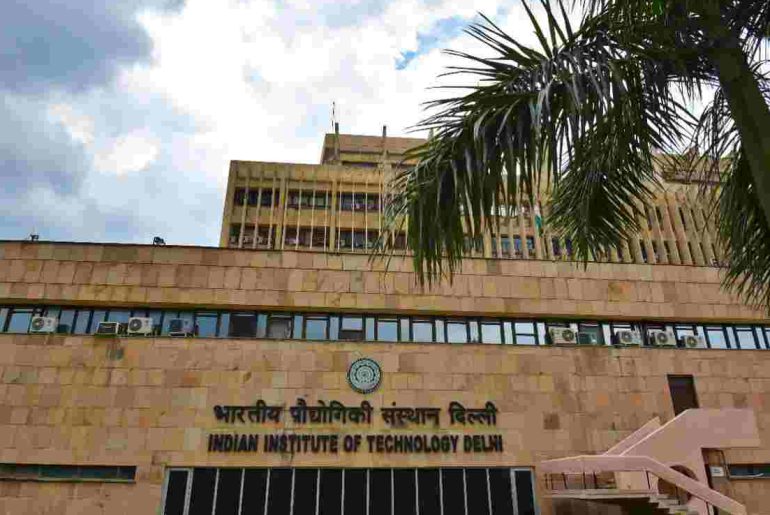
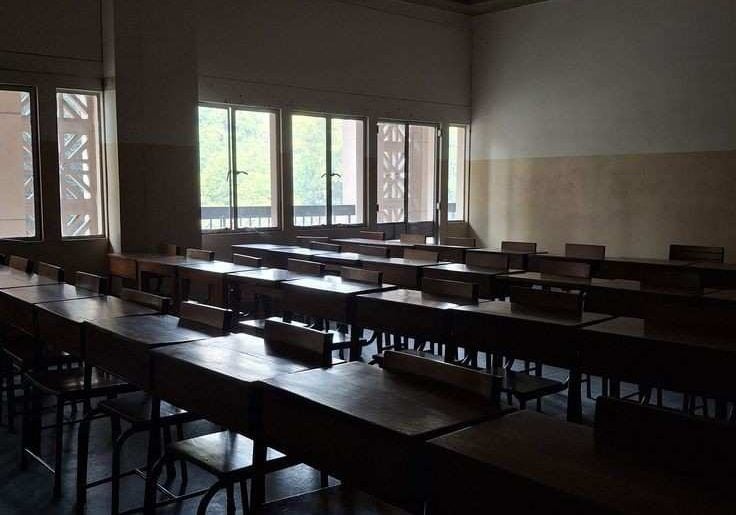
Sneha: I started college in 2012, and Kitaab began in 2014. This was the first time I was given the time and space to go through my day, align it with other work, and think about more than just ‘What is going to come out of it?’ It was exploratory. It was, ‘Okay, how can you, as a person, grow and evolve?’ I also felt a sense of agency when I was in college. We had access to classrooms and spaces where I could invite people to meetings. Kitaab literally started in the college canteen. We would have meetings in Economics classrooms because they had AC, and be like, ‘Okay, let’s talk about reading, books and culture,’ or organise an MUN in the auditorium. A lot of agency was given to students. This is what really stood out for me because I would have conversations with people in similar age groups, and they were not getting this kind of freedom at all. Their days were packed and pre-planned by the college timetable. For us, it was like, okay, you have to come for two hours. After that, you are free. Initially, it was very unstable, but I guess, after a point, that is what Kitaab grew out of. You know, if you’re building something, go for it, do it.
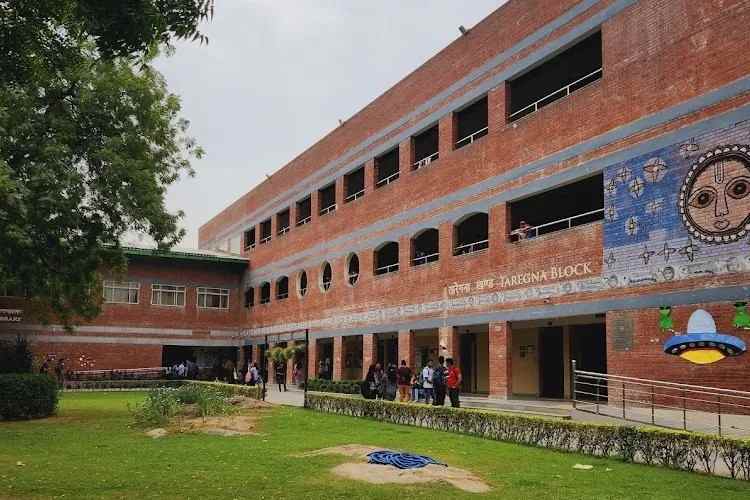
Navya: When I got into DU in 2019, honestly, it was everything I had ever dreamed of. I really wanted to get into Hindu College. I would romanticise it so much. I just wanted to be there so badly. And when I finally got in, I was living every single day of it, not just in terms of the classes, but also the kind of people I ended up meeting there. I found myself surrounded by people who were so passionate and sensitive and cared about these topics. They would argue about politics and sociology and banter with the professors. I got to meet people who were like-minded, into music and literature, and had a life outside academics. I found Delhi University to be a third space. Every single place, even outside the classroom, turned out to be one.
However, I joined in 2019 and, unfortunately, was in the pandemic batch. College lasted for a very short duration. I still remember we went home for the mid-semester break and came back after two years. So, a lot of my college life was spent pining to go back. But what changed from Sneha’s experience to mine was a sense of apprehension in the classrooms in general. It just got stricter over time. The societies were unable to function with the same level of creative freedom. So, a lot had changed from what I used to hear my seniors talk about their college days. But I feel that I carry DU with me everywhere I go.
Rishika: What do you think led to the emergence of apprehension in Delhi University?
Navya: There is anti-intellectualism in the current political atmosphere. We were feeling this. There were online classes, and everybody was afraid that someone might record something and post it online. But I also feel that everybody at college knew what was happening. If the spaces in college were taken away from us, we would have social media. We would still talk about these things. I do believe that what the university produces, by virtue of being a liberal arts institution, is people who engage in discourse. You cannot stop them. You cannot take that away from them. I do feel a lot has changed, but I think it is ours to claim whenever we want to, whenever we can.
Rishika: I think books are such a powerful way to do it. Pivoting to Kitaab Club and Kitaab Impact – I read what you wrote about the ‘tyranny of metrics’ and how CSR boards expect ROI even from philanthropic initiatives. Since shifts in reading culture are difficult to quantify, how do you approach methodology – from choosing texts and structuring interventions to tracking whether children are reading more, reading differently, or simply engaging with books?
Sneha: I’ve been very vocal about how difficult it is to measure certain outcomes. I can easily measure whether a child’s reading comprehension or reading level has improved. But how do I showcase that when a child walks into the library or classroom and feels excited or smiles when opening a book? Some children used to be shy around books or uncomfortable taking them home, but now that’s no longer the case. Things like this are difficult to showcase quantitatively. My argument was more about the corporatisation of NGOs in recent years because of CSR laws. The NGO sector is formalising, and there is increasing pressure to show its impact quantitatively. Only then can you be eligible for funding. You have to justify that with this much funding, this many children showed improvement. Oftentimes, that misses the larger picture.
There are certain sectors where it may be easier to quantify impact. But with reading, critical thought and the larger purpose of a library – building discourse, agency and community spaces where reading is accessible – these things are difficult to reduce to numbers. It is important to have a metric to measure impact. Otherwise, how do you know whether your programme is working?
We try to keep a blend of quantitative and qualitative markers. We primarily use tools from library science. We have a simple reading analysis test that we conduct on the first day. Our trained volunteers use a reading tool to assess children on a scale of 1 to 4, based on whether they read and sound out letters, words, sentences, and paragraphs. Similarly, there is a comprehension test. After reading a paragraph, we ask the student to explain in simple words what it says. There are different markers for comprehension: can the child identify a name, explain the central idea, or have they understood it at all? Then there are markers such as words per minute.
These are measured on day one and again six months later in a baseline and endline assessment. You can then review the impact through mathematical modelling and draw conclusions. We get a general idea of how the student is being impacted. That helps us refine the programme. Still, this captures only a small part of the picture. I wish somebody could visit and see the programme happening because of the energy the kids bring – the love for the library that develops, the awareness generated in the community, and how, when we walk through the village, everyone asks us, ‘What is this? Why is this happening? And how can we contribute?’
We are still exploring how we can capture them. That’s where people like Navya come in.
Rishika: Absolutely. Do you think this goes beyond Kitaab Club? What, according to you, is the biggest gap in India’s social sector today – measuring impact and evaluating programmes, or the way social programmes are structured and designed?
Sneha: When we talk about measuring social markers, it becomes a debate between science and humanities. There isn’t something missing or a particular gap; this is how the field works. Some things can be measured quantitatively. I’m very hopeful because there are amazing organisations working in this space, and every couple of years, there are better ways to measure. Earlier, I didn’t know how to explain the depth of our library usage. But later, when I visited the TCLP library in Delhi, I saw that they had put an RFID at the gate. Every time someone takes a book out, they know that it has left the premises. So, whichever child takes it, whether they read it or not, they can calculate which books circulate more. They call this a marker for the ‘depth of the library’.
This is something the field is constantly exploring. We will keep developing better ways to measure these things and ensure that the impact reaches where it is needed. Again, quantitative markers are necessary to understand whether a programme is working to rationally allocate funding. If the markers aren’t improving, funding should be redirected to where it can have a greater impact.
Rishika: You’ve described the vinyl sessions as a way to go completely analogue, and The Bluest Eye paired with Ella Fitzgerald and Roberta Flack is a great example of that curation. In a moment when so much is mediated by screens and algorithms, what does choosing vinyl over a Spotify playlist add to the experience of a book? Is it, in itself, a small political act – a refusal of the attention economy of our screens?
Navya: Definitely. In a world where Big Tech is constantly drawing you into algorithms and taking the fun out of exploration, it is a small political act to reject that – to go to a community where you are sitting with people, listening to an analogue piece of art, reading a book and talking about it with fellow humans.
Personally, I’ve always had this desire to own a room full of records. Mostly because I was always really deep into music and wanted to listen to more of it. I learnt more from people than I could ever have learnt from algorithms. At a place like Delhi University, you meet people listening to completely different genres. Your algorithms will only show you what you already like and consume. They’re also going to show you a lot of slop. But in real life, you meet people who will walk up to you and say, ‘Hey, whatever you’re listening to, try this.’ I met a lot of people who challenged my tastes and opinions. That’s something you don’t find with algorithmic listening. You don’t find people who challenge you, or discover that there are certain albums you have to put in effort to appreciate and like.
In an analogue format, if you buy a vinyl, you get that one record with six songs. You have to listen to the same thing over and over again. You get to analyse it, live that experience, and touch the music. That’s what I absolutely love. Then there are things you find on vinyl that you don’t find on Spotify or other streaming platforms. Artists put extra demos, interviews, and little imperfections on their vinyls. You also find records that people have owned and listened to so many times that parts of them are scratched. You listen to them on the device, and it feels like a book that has been read; like reading an annotated book or one with dog-eared pages. There is a beauty in analogue that I think algorithmic discovery can never match.
We wanted to combine the two and create an experience where people exposed to good literature could discover great music, and vice versa. For the punk and poetry event, we wanted to bring together people who appreciate the same ideas – questioning, criticism, and deviance – and get them talking, sharing, and asking questions. For some who came for the poetry, it may have been their first time listening to heavy guitars, allowing them to discover something completely new.
A lot of it is just us trying to create Delhi University outside Delhi University – that third space we had, where people from different walks of life and experiences could come together, engage in discourse, listen to music and talk about theatre.
Rishika: As the creative director of Kitaab Club, you’re building its visual identity for two very different audiences: an urban, Instagram-driven crowd and children in underserved communities who may not engage with the branding in the same way. How do you design for both without one identity diluting the other? Or are the two audiences not as separate as they seem?
Navya: There’s a universality to people appreciating colour and wanting to experience something deeper. I do feel that there’s a difference in how we approach creating a space in a metropolitan city versus a library for Kitaab, mostly because of the age demographic. Here, we mostly work with students from liberal arts colleges who are already interested in books and want to discuss literature and engage with art and theatre. But when we go to villages, we want to understand the space, the geography, and the children who live there, and give them access to the world of literature.
One of my biggest takeaways from the internship programmes was that the moment you give them access, they engage themselves and show interest. It’s basic human curiosity. When we speak to these children, we realise they already engage with literature in their own ways. A child may sit with their grandmother and listen to stories or sing folk songs. Stories and literature are not foreign concepts we are taking to them; they already exist independently. When we go to Uttarakhand, there’s this song about the geography and beauty of the place – the greenery, mountains, hills and flowing rivers. It’s a universal experience.
What we like to do is bring the world into a single room where a child can come every day and feel the books and colours, and engage with them. That’s why Kitaab has always wanted to bring fiction and storybooks to these places. The idea is to transform a room into a space where they can experience beauty and stories and talk to each other. When that happens, their language improves, and they interact better with their textbooks. We’re simply bringing access to something that is already there. Within the design process, we also try to understand the colours and symbols the children are familiar with. We don’t want to create an alien experience for them. Access alone is not the solution; we also want to interact with them and help them engage with the space. We involve the children in the design process. They see us painting and interact with it themselves.
At the end of the day, we want them to walk into the library and feel, ‘Yeh humne banayi hai, yeh humari library hai, aur hum yahan pe kabhi bhi aa sakte hain aur humari kitaabein padh sakte hain.’ (We created this; it is our library, we can come here anytime and read our books.)
Rishika: It makes them feel like they have a role to play in that story. That’s amazing. For my next question, is there a tension between wanting reading to feel like defiance and a political act versus wanting it to feel like joy and silliness, or are the two more interrelated than one might imagine?
Sneha: Honestly, I don’t feel that it’s a contrast or collision in any way. These things aren’t contradictory; they’re both things you get from reading. For example, I find joy in developing ideas that give agency through reading. Let’s say I’m reading Nivedita Menon – the joy comes from the defiance. So, the two often converge.
Secondly, I think the point of joy is to get to rebellion. Being able to have your own perspective, your own thoughts, and your own agency over your ideology – reaching that would, in most cases, begin with joy and a love for reading. In most of our programmes, plays are associated with reading, along with fun activities and games. We have people dancing and singing with books and doing things. But the motive, at the end of the day, is to develop robust thinking and reading and to explore the world through ideas and symbols. So, I don’t think there’s a contrast or collision. But, of course, that’s just my personal opinion.
Navya: I don’t think I would separate the defiance from joy either. For people, both defiance and deviance lead to joy. Especially as women, we’ve experienced this firsthand. Reading a feminist text for the first time is just this canon event that happens to you. You’re going through something, and immediately, one argument after another, your entire life plays out in front of you. I think that is a rite of passage, actually being able to achieve joy. Reading and engaging with someone else’s thoughts can lead to that. I wouldn’t separate the two.
Rishika: Absolutely. I agree that defiance can lead to joy, especially in a society that isn’t very inclusive of all identities. For my last question, there’s been a lot of online scrutiny around the term ‘performative reading’. Do you think this critique is fair, or does it flatten something more complicated? Can reading be performative and still be valuable to the reader?
Sneha: I really don’t think performative reading is a problem. Please, go out there and perform reading by all means. I love that there are people who see reading as a fashion statement and want to be seen with a book. I love that people think, ‘If I’m seen with a certain book, I might attract the right partner.’ Maybe the whole point is to be seen with it or show it off, but if you’re performing the role of carrying a book with you, I’m sure you’ll probably end up reading a page or two as well, right?
One reason book clubs have suddenly started rising is how much people have been posting about them on social media. I’ve often seen people show up at book clubs who maybe haven’t read the book but have posted about attending with a lot of fanfare. And that’s amazing because five more people, or 50 more people, are going to find out about this whole thing. I don’t think it’s fair to call it ‘performative’ in a derogatory way. Of course, you’re trying to show that you’re a philosophical person, or maybe signalling that you read deep literature. What’s wrong with that? I think it’s lovely. I don’t feel that it’s a problem at all. Instead of talking about it, we should all jump into it. I would perform reading as well. There shouldn’t be any pressure. After all, there’s no right way of reading.
Navya: I absolutely agree. I feel like I will not judge a human for merely being a human. All of us are performing something or the other; it’s just that when it comes to literature, we’ve given it this term. I understand the frustration that comes from reading a body of literature and then meeting people who don’t dive as deeply as you would. But it’s literature; it’s for everybody to engage with as they want. It’s completely normal for somebody to feel like some Kafkaesque character and want to walk around with a Kafka book in their hands. Maybe they’ll meet somebody else who feels the same way. There’s also a certain element of authenticity within the performance. Even people who perform reading choose their titles very deliberately. They want to perform a certain identity, a certain protagonist. It’s human nature.
As Sneha said, please, by all means, perform reading. Make it cool again.
Sneha: Yes, and the most beautiful love stories we’ve read about have started with finding somebody at a library or picking up the same book.
Navya: Let somebody live the story is what I want to say. I don’t think we’re to judge anyone’s choices. Even when people come to Kitaab for the first time, many haven’t read and have difficulty reading and processing books. The first thing we tell them is to start keeping a book with them at all times. If somebody is doing that and even reading a couple of pages in the process, that’s still better than keeping yourself completely distant from books.
I do believe there’s a need to dive deeper, and the frustration is real. People will tell you that titles lose their credibility when they become mainstream. But this is just a very natural rite of passage. I don’t think it’s a pressing issue.
Sneha: Exactly, woh toh hoga hi (that is meant to happen). Books will trend, and this will come and go. It’s for us to jump into the whole river with everyone and enjoy.
Rishika Jain
[email protected]
Image Credits: Kitaab Club
Read Also: On Record with Anish Gawande

 Prime Minister Narendra Modi is scheduled to visit Shri Ram College of Commerce on 5th September, for the college’s centenary celebrations and a direct interaction with the students.