Author

DU Beat

Browsing

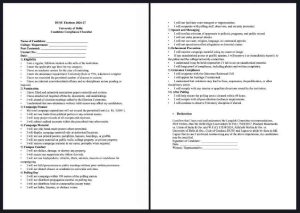
Ahead of the 2026–27 academic session, DU has set up two joint control rooms, ordered bilingual anti-ragging banners, and directed colleges to strictly implement anti-ragging measures before classes begin on July 28.

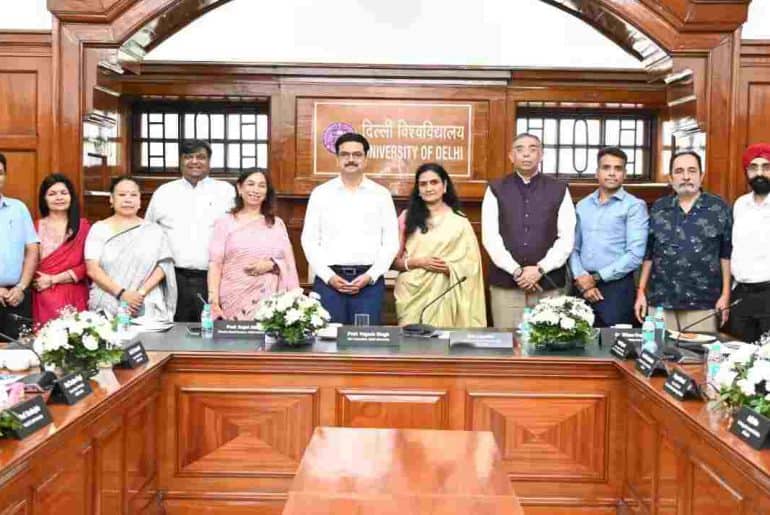
The University of Delhi held an online meeting on July 20 with college principals, heads of departments, hostel authorities, DUSU office-bearers, and Delhi Police to finalise anti-ragging arrangements before the arrival of the new batch, in accordance with the academic calendar notified by the university. As part of the measures, DU will establish two joint control rooms – one each on the North and South Campuses – from July 28 to August 7, providing students and college authorities with a direct channel to report incidents of ragging.

The university has also directed colleges, departments, and hostels to install bilingual (English and Hindi) anti-ragging banners at strategic locations, prominently display rules prohibiting ragging, and restrict the entry of outsiders into their premises. Delhi Police will deploy women personnel in plain clothes both within university campuses and outside individual colleges. The university has also stated that women’s colleges will receive additional police assistance.

In line with the Supreme Court’s directions on ragging and UGC regulations, all incoming students and their parents or guardians must submit an anti-ragging undertaking through the UGC’s official anti-ragging portal at the time of admission. Colleges have further been instructed to strictly enforce Ordinances XV-B and XV-C of the University of Delhi, along with the provisions of the Sexual Harassment of Women at Workplace (Prevention, Prohibition and Redressal) Act, 2013.

These measures form part of the UGC Regulations on Curbing the Menace of Ragging in Higher Educational Institutions, 2009, which are mandatory for all higher educational institutions and were framed following Supreme Court directions on preventing ragging.

A comparison with previous years shows that the university’s anti-ragging framework has remained largely unchanged. In 2022, DU operated joint control rooms from November 2 to 11, along with NCC/NSS vigilance squads and police deployment outside colleges. In 2024, it issued an 11-point anti-ragging notification, set up control rooms from August 1 to 10, detailed disciplinary penalties, and observed Anti-Ragging Day on August 12. In 2025, the university retained the same structure, with control rooms functioning from August 1 to 8 and the addition of the Himmat app and campus security helpline numbers.

For 2026, the principal change is the timeline. The control rooms will operate from July 28 to August 7, with the existing anti-ragging framework brought forward to coincide with the earlier commencement of the academic session rather than introducing significant new structural measures.


Name: Arshia Sharma

Email- [email protected] 

Image credits: DuBeat

Read Also: NCWEB applications open for B.A. (Prog) and B.Com; last date to register: July 24

From first-round seat allocation to college verifications and spot rounds, here’s a comprehensive guide to Delhi University’s CSAS.

Every year, lakhs of students from across India set their sights on Delhi University, one of the country’s most reputed and competitive educational institutions. With admissions now conducted entirely through the Common Seat Allocation System (CSAS) based on CUET-UG scores, understanding the admission calendar has become just as important as securing a good score.

The University of Delhi has officially released the CSAS (UG) 2026 schedule, outlining every major milestone – from seat allocation and document verification to fee payment and spot rounds. Now that the first-round seat allocation has been completed, here is a comprehensive breakdown of the next steps in the admission process.

1. First-Round Seat Allocation – July 16 (5:00 pm)

The first CSAS allocation list was released on July 16, marking the beginning of the formal admission process. Each candidate is allotted the highest possible programme-college combination based on their CUET scores, category, reservation, percentile, and the preference order submitted during CSAS registration.

Receiving a lower preference in the first round does not mark the end of the admission process. Candidates who accept their allotted seat can still opt for an upgrade and be considered for higher preferences in the subsequent rounds.

2. Acceptance of the Allocated Seat – July 16 to July 18

After receiving an allocation, candidates are required to accept their allotted seat within the prescribed deadline to continue with the admission process. Failure to do so can result in the automatic forfeiture of the seat, making the candidate ineligible to retain that allocation in subsequent rounds.

Seat acceptance, however, does not conclude the admission process. It simply initiates the document verification stage. Even candidates wishing to upgrade their seat must first accept their current allocation.

3. Online Document Verification and Approval by Colleges – July 16 to July 20 (11:59 pm)

Once a candidate accepts the allotted seat, the respective college examines the uploaded documents, verifies eligibility criteria, and confirms admission credentials.

Colleges retain the authority to raise queries or reject applications if discrepancies are found in the submitted documents or if the candidate fails to meet subject-specific eligibility requirements. The first round of online document verification and approval is completed during this period.

4. Online Payment of Admission Fees – July 21 (Till 11:59 pm)

Following successful document verification, candidates are required to pay the admission fee by July 21. Admission is considered officially confirmed only after the fee payment is completed.

Failure to pay the fee within the deadline results in cancellation of the allotted seat, irrespective of the verification status.

Furthermore, only after paying the admission fee do candidates become eligible to exercise the Freeze or Upgrade option for subsequent allocation rounds.

5. Second-Round Seat Allocation – July 25 (12 Noon)

Candidates who opted for an upgrade after confirming their admission become eligible for the second round of seat allocation. This round follows the same procedure as the first and includes the following stages:

  • Seat Acceptance: July 25 to July 26 (till 11:59 pm)
  • Online Document Verification and Approval by Colleges: July 25 to July 27 (till 11:59 pm)
  • Online Fee Payment: July 28 (till 11:59 pm)

These steps formally secure admission for candidates allotted seats in the second round and conclude the regular rounds of admission.

6. Mid-Entry Window

Candidates who failed to register during the original CSAS application window are not entirely excluded from the admission process. After the completion of the second allocation round, Delhi University released a Mid-Entry facility.

Applicants registering through this route become eligible only for seats that remain vacant after the regular rounds and are considered strictly based on merit and seat availability

7. Spot Admission Rounds

If vacancies remain after the regular allocation rounds, Delhi University conducts Spot Admission Rounds. Unlike the earlier rounds, candidates participating in Spot Admissions generally compete only for the seats displayed as vacant at that stage.

Spot rounds usually represent the final opportunity to secure admission for the academic session. Once these rounds conclude, the admission process for the academic year formally comes to an end.

With the release of Delhi University’s academic calendar, the new academic session is scheduled to commence on July 28, while additional allocation rounds and spot admissions may continue simultaneously. Students admitted in later rounds are expected to join classes as per the University’s guidelines without losing their admission rights.

The CSAS admission process, conducted based on CUET-UG scores, has been designed to ensure greater transparency, fairness, and flexibility in undergraduate admissions. Through upgrades, mid-entry, and spot admission rounds, candidates receive multiple opportunities to secure admission to one of India’s most prestigious universities. 

For applicants, success during the admission season depends not only on a strong CUET score but also on staying informed, meeting deadlines, and taking timely action at every stage of the process.


Rajarshi Ghosh

[email protected]

Image Source:  www.svpc.edu.in

Read Also: After 31 Years, DU Opens a New College. How does it matter?

Delhi hasn’t opened a new arts, science, or commerce college since 1995 – an RTI reveals why this year’s DU admission crunch is worse than ever, and whether Veer Savarkar College could finally change that.

As DU’s admission season unfolds, the Common Seat Allocation System (CSAS) rush, seat allocation portals, and the cutoff stress for one of the most sought-after undergraduate systems in the country all tell a familiar story. But an RTI reply has revealed a less familiar one: Delhi University has not opened a new conventional arts, science, or commerce college in 31 years. 

The last time it did was in 1995, with the founding of Bhaskaracharya College of Applied Sciences (BCAS) in Dwarka. Every institution added to DU since then has been a specialised professional college: nursing schools, a dental institute, a physiotherapy college, not a general undergraduate college of the kind that defines DU’s core identity.

This year, 2,73,751 candidates registered for DU’s undergraduate admissions. Of these, 2,18,284 completed Phase 1 of the process, and 2,08,043 locked in their programme and college preferences.

Against this, DU’s 69 colleges and departments offer just 71,624 seats across 73 programmes, meaning roughly 3.8 registered applicants for every seat, or close to three serious contenders per seat. 

The RTI data maps DU’s growth across three phases:

1881–1946 (8 colleges): The founding era gave DU the colleges whose names still carry weight in every admission conversation today, St Stephen’s (1881), Hindu College (1899), Ramjas (1917), Indraprastha College for Women (1924), Zakir Husain Delhi College (1925), and Shri Ram College of Commerce (1926).

1947–2000 (76 colleges): Post-independence India expanded DU at a pace it has never matched since. Hansraj College and Miranda House opened in 1948; Lady Shri Ram College for Women in 1956; Kirori Mal College in 1957; Sri Venkateswara College in 1961; Gargi College in 1967; Jesus and Mary College in 1968; Shaheed Sukhdev College of Business Studies in 1987; and Deen Dayal Upadhyaya College in 1990. This era closed with Bhaskaracharya College in 1995, DU’s last conventional undergraduate college.

2001–2019 (just 7 institutions): In the two decades after 1995, only seven institutions were added to the cohort, and every one was a professional healthcare, education, or rehabilitation college: the School of Rehabilitation Sciences (2002), Durgabai Deshmukh College of Special Education (2006), Holy Family College of Nursing (2011), Maulana Azad Institute of Dental Sciences (2013), and Florence Nightingale College of Nursing (2019) among them.

Since 2014, DU has added exactly one institution: Florence Nightingale College of Nursing in 2019. Like every addition before it, stretching back to 1995, it too was a specialised healthcare college, and not a single functional general undergraduate college was added. 

This also traces an older separate episode: in 2020, then-Delhi CM Arvind Kejriwal wrote to the Union Education Ministry asking it to amend Section 5(2) of the Delhi University Act, 1922, arguing that the Act’s requirement that all new Delhi colleges affiliate with DU had capped the university’s capacity for three decades and was shutting out lakhs of Class 12 graduates every year.

On January 3, 2025, Prime Minister Narendra Modi laid the foundation stone for Veer Savarkar College in Roshanpura, Najafgarh, alongside plans for new East (Surajmal Vihar) and West (Dwarka Sector 22) campuses. 

Built at an estimated cost of ₹140 crore with 24 classrooms and a built-up area of over 18,800 square metres,  it has been described by DU’s Vice-Chancellor Prof. Yogesh Singh as the university’s first new college in roughly three decades.  And because the college was not yet operational when the RTI data was compiled, it doesn’t appear in the RTI’s count. 

According to recent reporting, Veer Savarkar College may begin functioning this academic year, but not from its own building, since campus construction is still incomplete. 

DU is reportedly planning to run its first-year classes out of Deen Dayal Upadhyaya College’s campus instead, with DU’s administration having already agreed to the arrangement pending formal university approval. If this goes ahead, it would be the first addition to DU’s conventional undergraduate seat count since 1995. 

Arshia Sharma

[email protected]

Read Also: CM Rekha Gupta Pledges Infrastructure Push for Delhi University at Shaheed Bhagat Singh College’s Diamond Jubilee

Image Source: DU Beat

DU has formed a six-member committee to review seat availability in its one-year postgraduate programmes following ABVP’s protest over limited admissions for students completing the fourth year under FYUP.


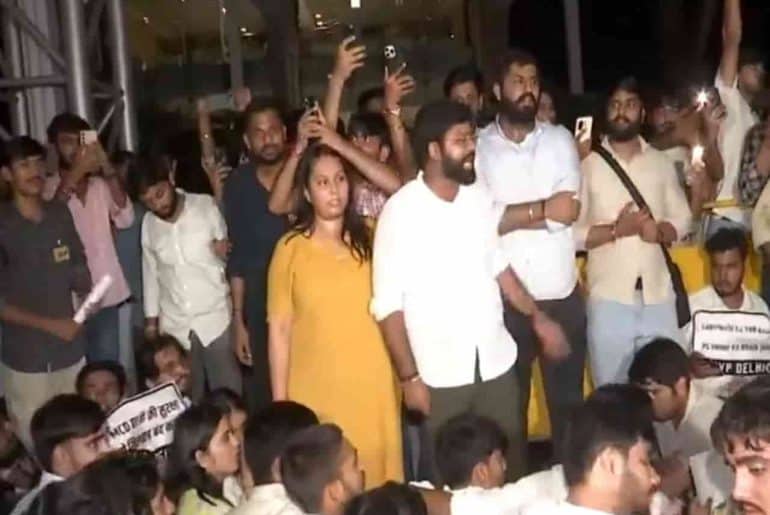
On Friday, July 17, students gathered outside the Arts Faculty, University of Delhi (DU), as the Akhil Bharatiya Vidyarthi Parishad (ABVP) protested the limited number of seats in the university’s one-year postgraduate programmes, arguing that many students completing the fourth year of the Four-Year Undergraduate Programme (FYUP) could be left without admission opportunities.

As students from colleges across the university joined the protest, ABVP submitted a memorandum to DU Registrar Prof. Vikas Gupta, urging the administration to increase the intake across all one-year postgraduate courses.

The issue has come into sharper focus this year as the first batch of students completing FYUP becomes eligible for admission to one-year master’s programmes. As thousands of students prepare to move to postgraduate studies, concerns over limited seats have intensified. ABVP argues that while the number of eligible students has increased significantly, postgraduate intake has remained largely unchanged, leaving many students uncertain about their admission prospects.

In response to the protest, the university formed a six-member committee to review the matter. The panel is expected to arrive at a decision within 10 days.

According to Millennium Post, the committee will be chaired by the Dean (Academic Affairs), with the Dean (Admissions), Dean (Social Work), Head of the Department of Chemistry, Joint Registrar (Legal), and Deputy Registrar (Recruitment and Promotion) serving as members.

Welcoming the university’s decision to form the committee, ABVP Delhi State Secretary Sarthak Sharma called it a positive step and urged the administration to resolve the issue at the earliest.

As reported by The Tribune, Sharma said, “The University of Delhi remains the first choice for lakhs of students across the country. However, the inadequate number of seats under the current admission system is doing grave injustice to students’ academic aspirations.

The university administration must immediately enhance the number of seats to ensure that no deserving student is denied access to higher education due to seat constraints”, he added.

The organisation said it hopes the committee will recommend an increase in seats. However, it added that it would intensify its protest if the university does not take a favourable decision after the committee submits its report.


Image Source: iStock

Read Also: Delhi University Announces Strict DUSU Election Rules Ahead of 2026 Polls


Mahi Mishra 

[email protected]


As DUSU elections approach, Delhi University has enforced a strict campaign code banning all printed materials and capping vehicles, with violations risking nomination cancellation.

With the Delhi University Students’ Union (DUSU) elections approaching, the university has laid out firm rules for how candidates may campaign. The guidelines were reiterated at a meeting held on Thursday at the Proctor’s Office, where University Proctor Prof. Manoj Kumar Singh briefed DUSU office-bearers and student body representatives on the code of conduct, in accordance with directions from the Delhi High Court and the

Lyngdoh Committee.

The most visible restriction concerns campaign materials. Printed materials are completely banned. Candidates may put up only handmade posters, and only on the designated Wall of Democracy. Billboards, printed or digital, and banners suspended from poles are not permitted anywhere on or around campus.

Vehicle use during campaigning has also been capped. Each candidate is allowed a maximum of five cars. Tractors, JCBs, and animals are not permitted, and cars with tinted glass or missing number plates are strictly prohibited. 

Freebies are out too. Distribution of gifts, souvenirs, canopies, umbrellas, or any promotional material bearing a candidate’s name has been banned. The university has made clear that if such material is found, the concerned candidate’s nomination will be cancelled.

Only five students will be allowed inside colleges for campaigning. In girls’ college hostels, only girls will be permitted to enter. Candidates wishing to hold public meetings on campus must inform the Proctor’s Office in advance.

The same protocols are to be communicated to all college authorities, while the 2026-27 Code of Conduct remains awaited. 

Rishika Jain

[email protected] 

Image Caption: The Wall of Democracy on the University of Delhi North Campus, the only designated space for campaign posters during DUSU elections.

Image Source: The Indian Express

Read Also: Delhi University Announces Strict DUSU Election Rules Ahead of 2026 Polls


Delhi University has announced a stricter code of conduct for the 2026 DUSU elections. It introduced tighter regulations on campaigning, expenditure, and campus defacement. 

With the announcement of the upcoming DUSU elections, the university administration has released a detailed set of guidelines that all candidates and student organisations must follow during the election period. The rules draw heavily from the recommendations of the Lyngdoh Committee, which governs student union elections across universities in India.

Among the most significant changes is a complete ban on defacing university property. Candidates have been prohibited from putting up posters, graffiti, or wall paintings on campus buildings and other public spaces. The administration has instead directed students to use only designated spaces approved by the university for election publicity. Digital campaigning and direct interaction with students have also been encouraged over large-scale physical campaigning.

The university has also reiterated strict expenditure limits for candidates. Contestants are required to maintain detailed records of campaign expenses and submit them to the election authorities within the prescribed timeline. Any candidate found violating the spending cap or concealing campaign expenses may face disqualification from the election process.

To strengthen enforcement, Delhi University has constituted monitoring committees to oversee campaign activities across university departments. Election officials and college administrations will monitor violations of the code of conduct and disruptions to academic activities. Candidates found violating the prescribed norms may face disciplinary action in addition to electoral penalties.

The administration stated that the revised rules are intended to create a level playing field for all candidates while reducing environmental damage and ensuring that normal academic functioning is not affected during the election period. Students have been urged to conduct campaigns responsibly and in accordance with university regulations.

The announcement comes amid renewed attention on student politics in Delhi University, where election campaigns have historically witnessed extensive poster campaigns, large rallies, and complaints regarding campus defacement. By reinforcing stricter compliance with the Lyngdoh Committee guidelines, the university aims to make the 2026 DUSU elections more transparent, orderly, and sustainable.

Tarunima Tayal

[email protected] 

Read Also: CIC Directs DU to Consider Maintaining OCI Admission Records 

Image Source: DU Beat


ABVP staged a protest at Delhi University against the shortage of seats in one-year PG programmes, with the demonstration led by Aryan Mann.

The Akhil Bharatiya Vidyarthi Parishad (ABVP) staged a protest at Delhi University, drawing attention to the minuscule number of seats available for students seeking a postgraduate diploma after completing their fourth year. Their chief demand was that the total number of seats should be increased, as the current setup has “betrayed” the aspirations of the students.

DUSU President Aryan Maan, in a statement to IANS, said,

The university administration had announced that all students completing the fourth year, whether from honours or programme courses, would get an opportunity to take admission to the one-year course on the basis of merit. However, there are only limited seats for students who have completed the fourth year.”

Further highlighting the disparity between students opting for the conventional two-year route and those coming in straight after their fourth year, the ABVP chief stated,

Those who are willing to do masters for 2 years, they have more 4,000-5,000 seats; however, those who have completed their fourth year are only offered 1,000 seats.”

Another ABVP protestor, explaining the specific course at the centre of the protest and the demand being pursued to increase the total number of seats, said:

“The one course that has been increased in DU, thousands of students come from third and fourth year to enroll in that said course. However, the seats for MA are very low, so ABVP demands that the number of seats for the MA course be officially increased.”

The protest comes amid growing scrutiny of the one-year PG programme’s rollout, with the university’s official seat matrix listing roughly 1,068 seats spread across 45 programmes, a fraction of the number of students who stayed on for the additional fourth year. Notably, the intake for the one-year route is calculated as a percentage of each department’s pre-existing sanctioned strength rather than the actual number of fourth-year completers, a formula finalised only months after most students had already committed to the extra year.

Image credits: ABPlive Ground Report

 Kaustubh Dwivedi

[email protected]

Read Also: DU’s One-Year PG Promise Hits a Seat Ceiling

Lady Shri Ram College has reopened its Residence Hall for first-year students after remaining closed since 2023 for structural repairs. The renovated hostel will accommodate around 150 students this academic session. 

The Lady Shri Ram College (LSR) Residence Hall has reopened for first-year students for the 2026-27 academic session after remaining closed for nearly three years due to extensive repair and renovation work.

According to a notice issued by the college, the renovated residence hall will accommodate about 150 students across all categories and social groups in 109 rooms. Most rooms will be shared, while a limited number of single rooms, both air-conditioned and non-air-conditioned, will also be available. The college has stated that single-room allotments will be decided through a lottery system, and once allotted, rooms cannot be changed.

The reopening marks the end of a prolonged closure that began in 2023 following concerns over the building’s structural safety. The hostel was vacated after a resident sustained injuries when the roof of a bathroom cubicle collapsed. Subsequent inspections by a structural engineer identified deficiencies in the building, including deteriorating infrastructure, water leakage from blocked drains and pipes, and rusting, prompting the college to shut the residence hall for major repairs.

At the time, hostel residents were asked to vacate the premises, with the college refunding the remaining hostel fee and security deposit. Students were informed that the repairs could take a considerable period owing to the extent of the structural work required.

With renovation now complete, LSR has resumed hostel admissions for incoming first-year students. The application process for the 2026-27 academic session is currently open through the college website. Students have been advised to carefully read the hostel admission notice before submitting their applications.

The reopening comes as welcome news for outstation students seeking on-campus accommodation, particularly as hostel availability remains limited across several Delhi University colleges. The move restores an important residential facility that had remained unavailable for multiple admission cycles while repair work was underway.


Read Also: CM Rekha Gupta Pledges Infrastructure Push for Delhi University at Shaheed Bhagat Singh College’s Diamond Jubilee

Image Source: Lady Shri Ram College website


Aarushi Chaubey

[email protected]
Speaking at Shaheed Bhagat Singh College’s Diamond Jubilee curtain raiser, Chief Minister Rekha Gupta laid out plans for hostels, a subsidised canteen and expanded bus connectivity for Delhi University, alongside a college proposal for a dedicated girls’ hostel.

Delhi Chief Minister Rekha Gupta spoke at the curtain raiser for Shaheed Bhagat Singh College’s Diamond Jubilee celebrations on Thursday, where she outlined infrastructure commitments for Delhi University, asserting that a nation’s progress rests on how well it invests in its youth and the quality of its education system.

According to Gupta, the state government has prioritised upgrading academic infrastructure and student housing to position Delhi as a hub for higher education. A hostel for Delhi University students on the upcoming Indira Gandhi University campus is reportedly among the measures being considered, though the proposal is yet to be finalised.

Gupta further confirmed that the university will get an Atal Canteen from August 16, offering meals at Rs 5, alongside 50 additional U-Special bus routes for the university’s students.

The Chief Minister urged students to play an active part in nation-building and encouraged colleges to partner with surrounding communities to support local children in pursuing their ambitions. She described the creativity and drive of India’s younger generation as key to realising the goals of a ‘Viksit Bharat’ and a ‘Viksit Delhi’.

Separately, the college’s administration used the occasion to press for a girls’ hostel of its own, proposing that Shaheed Bhagat Singh Evening College be shifted to an alternative site to free up its current premises for the new facility. College representatives said many of its female students commute from outside Delhi, and that the lack of on-campus housing continues to affect their safety and continuity of studies.

The event also featured a virtual walkthrough of the college’s history, along with Gupta’s unveiling of a year-long Diamond Jubilee events calendar and a QR code granting access to the institution’s digital archives. Delhi University Vice-Chancellor Yogesh Singh and college Principal Arun Kumar Attree were reportedly among those in attendance.

Image Credits: Usha Parewa, Haribhoomi.com 

Read Also: CIC Directs DU to Consider Maintaining OCI Admission Records

Vidhi Ramchandani

[email protected]

The Central Information Commission (CIC) has recommended that the University of Delhi maintain records of foreign students admitted through Overseas Citizen of India (OCI) cards, following concerns over the absence of such data despite its relevance to the university’s admission process.

Delhi University has long attracted students from across the world, offering opportunities to international applicants through its foreign admissions process. However, concerns have been raised over the university’s failure to maintain separate records of students admitted under the OCI category, affecting transparency and public access to information.

Information Commissioner Sudha Rani Relangi, in her order, observed that the non-maintenance of records relating to foreign students admitted through OCI cards, despite such information forming part of the university’s admission process, was a “matter of concern”.

The matter arose after Advocate Sanjukta Basu filed a Right to Information (RTI) application in May 2025 seeking details from Delhi University’s Central Public Information Officer (CPIO) regarding the number of foreign students who applied for admission between 2020 and 2024. The application also sought information on applicants who had applied as Indian citizens while availing the benefits of an OCI card rather than through the foreign student category.

In response, the CPIO stated that the request had been forwarded to the Dean, who was the deemed Public Information Officer under the RTI Act. However, as the required information had not yet been received from the Dean’s office, the appellant was advised to pursue the matter with the concerned authority.

Dissatisfied with the response, the appellant filed a first appeal. The First Appellate Authority directed the Dean (Foreign Students’ Registry) to provide the necessary information to the CPIO within two weeks. As the direction was not complied with, the appellant subsequently approached the CIC.

During the proceedings, it was argued that Delhi University’s admission application form provides an option for foreign applicants to seek admission under the OCI category by submitting either a foreign passport or an OCI card. The appellant contended that the existence of this option indicated that the university ought to possess the relevant data, despite the CPIO’s inability to provide it.

During the hearing, Delhi University informed the Commission that while it maintains overall statistics on foreign student admissions, it does not keep separate records of students admitted using OCI or Person of Indian Origin (PIO) cards. The university submitted that foreign applicants had generally been admitted based on their foreign passports and, consequently, no distinct database existed for OCI or PIO card holders.

Taking note of the matter, the Commission recommended that Delhi University maintain a public record of foreign students admitted through OCI cards in the interest of transparency and proactive disclosure under the RTI Act. The Commission further directed that its order be placed before the Vice-Chancellor of Delhi University for consideration and instructed the university to submit a compliance report on the recommendations within six weeks.

The recommendation is expected to strengthen transparency in Delhi University’s foreign admissions process by ensuring better record-keeping and improving public access to information, thereby promoting greater institutional accountability in line with the objectives of the RTI Act.

An Overseas Citizenship of India (OCI) card is issued to eligible foreign nationals of Indian origin, granting them lifelong visa-free travel to India and several benefits similar to those available to Non-Resident Indians (NRIs). However, an OCI card does not confer Indian citizenship, voting rights, or eligibility to hold constitutional or certain government offices. In university admissions, OCI card holders may be eligible to apply under specific admission categories, subject to the institution’s regulations.


RAJARSHI GHOSH

[email protected]

Image Source: Indian OCI – Gateway Visa 


Read Also – Delhi High Court seeks clarity on UNHCR status; Impleads Centre, MHA, MEA in Myanmar refugee’s DU admission plea.