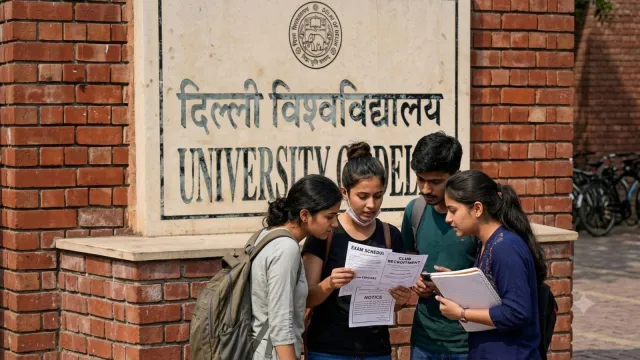
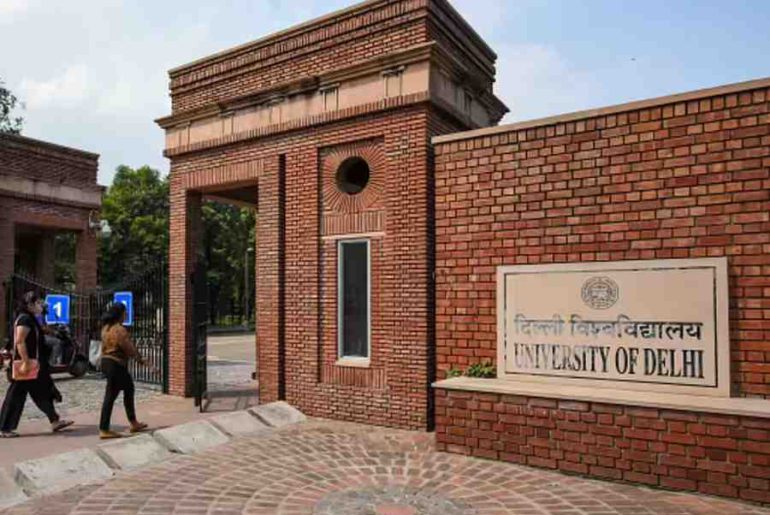
Delhi University has approved a ₹5,889 crore hostel expansion plan to accommodate 21,895 students through new hostels and redevelopment projects across multiple campuses amid housing shortages.
The University of Delhi (DU) has approved a ₹5,889 crore plan to expand its hostel infrastructure, aiming to provide accommodation for 21,895 students through new construction and the redevelopment of existing residential facilities.
The proposal was cleared at the university’s 1,284th Executive Council (EC) meeting on October 13, 2026, chaired by Vice-Chancellor Professor Yogesh Singh. The approval comes amid concerns over the limited availability of affordable and safe accommodation for students moving to Delhi for higher education.
Of the total proposed expenditure, ₹4,027 crore has been earmarked for new hostels, which will accommodate 15,758 students. The remaining ₹1,862 crore will fund the reconstruction of Jubilee Hall and the Postgraduate Men’s Hostel, providing residential facilities for another 6,137 students. The university has also confirmed that the names of these existing hostels will remain unchanged after reconstruction.
The expansion will cover several locations, including the Dhaka Complex, Surajmal Vihar and Najafgarh. New hostels for male and female students are also planned at Veer Savarkar College in Roshanpura, Najafgarh, as well as DU’s proposed West Campus in Dwarka and East Campus in Surajmal Vihar, Karkardooma.
The proposed residential complexes will include dining halls, shops, common rooms, reading rooms, and warden accommodation. With limited vacant land available across university campuses, the EC has emphasised making maximum use of the permissible Floor Area Ratio (FAR). Discussions also included high-rise hostel buildings of up to 32 floors wherever space permits.
The university said the designs account for evolving student requirements, with long-term infrastructure planning in mind. The EC has further urged colleges to prepare proposals for constructing hostels on their own premises and submit them to the relevant funding agency.
The approval comes against the backdrop of persistent concerns over student housing in Delhi. A building collapse in Satya Niketan in September, which killed seven people, including five DU students, renewed scrutiny of the shortage of safe accommodation. The Delhi High Court subsequently raised concerns about the inadequate availability of university hostels.
However, the university has not announced a definitive construction or completion timeline for the newly approved projects. Their implementation will depend on subsequent planning and funding processes. The proposal marks a significant step towards expanding DU’s residential capacity, although its impact will ultimately depend on timely execution.
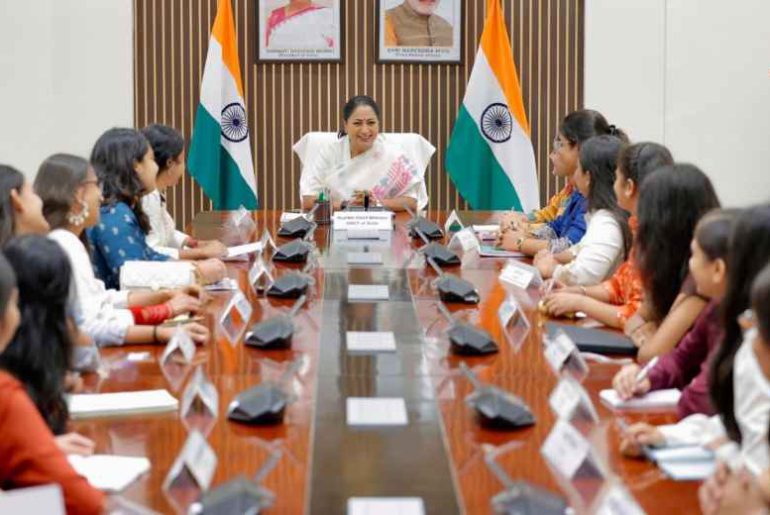
CM Rekha Gupta held a meeting with DU women representatives from various colleges to discuss topics of travel, safety, and educational facilities while promising rapid improvements.
Chief Minister Rekha Gupta interacted with DU students and female representatives from various colleges on October 12th at the Mukhyamantri Jan Seva Sadan. The session highlighted the importance of the inclusion of young people while incorporating their perspectives and ideas into administrative policymaking. The youth of Delhi represent a significantly valuable resource for the country’s socio-political development. The discussions addressed many important topics related to women’s safety, such as campus safety, public transport, and educational facilities.
At the meeting, many students shared their personal experiences and suggested definitive measures such as periodic safety audits across all educational campuses, an increase in the number of female police personnel, and adequate street lighting while simultaneously illuminating the dark spots near the campus and student housing areas. Discussions on the regular accessibility of Pink Booths were given adequate attention. In response to these constructive remarks, the Chief Minister assured the students that their concerns would be properly addressed with necessary action.
To address these safety issues, Rekha Gupta addressed the students, saying that the work for installing around 1 lakh streetlights is currently underway. These lights would be connected with the Integrated Command and Control Centre. Under an annual maintenance contract, agencies would be required to repair non-functional lights within a specified timeframe. She said steps to improve lighting near colleges would be taken in coordination with local agencies and college administrations.
To tackle security issues outside the jurisdiction of the colleges, Rekha Gupta asked the students to use the emergency helpline number, 112, to seek police assistance in an emergency. Furthermore, for internal auditing within the institutions, women representatives suggested setting up safety committees in every college comprising the principal, student representatives, and local police officers.
Transportation was also a key topic that was brought up in the discussions. Better DTC Bus connectivity and University-Provided Bus Connectivity for off-campus colleges, regular stops at designated locations, regulated e-rickshaw operations, and stronger security around paying guest accommodation.
Students and representatives from Lady Shri Ram College, Gargi College, Daulat Ram College, Jesus and Mary College, Maitreyi College, Aditi Mahavidyalaya, Bharati College, and Janki Devi Memorial College attended the meeting. For further developments, CCTV surveillance and grievance redressal at college levels were also demanded by the student representatives, the Delhi Chief Minister’s Office said in a statement.
To facilitate quick and reliable communication measures, WhatsApp groups would be created to establish a reliable coordinating system between the students and the officials that would always remain active, enabling students to share their concerns directly. This platform would also help the students feel encouraged to speak up about their issues and concerns directly to the official authority. Thus, this framework is very important to create a 2-way relation that acts as a bridge to cater to every scenario and help find a proper solution for all the safety demands from students from all campuses.
In lieu of the concurrent frameworks and protests, the CM assured that if a complaint is not addressed at the appropriate level, students can also approach senior police officers and officials of the concerned departments. Therefore, removing the unseen barriers that affect female safety. She emphasised that effective grievance redressal would be executed while ensuring students’ safety remain priorities for the government.
For a major portion of young women in this country, education is an incentive rather than an indispensable right. This is not just a paved pathway for education, but sometimes the only means to become truly self-dependent and instil confidence. Therefore, by addressing and solving such coherent safety concerns, the youth of this nation can continue to work towards their goal without any unnecessary barriers. The session served as a reminder that meaningful youth participation begins with attentive listening and continues through sustainable action in response to dialogues.
Delhi’s autumn protests, from DU women’s safety marches to the ‘Cockroach’ movement, were called scattered, unserious and futile. But the actual question is whether an ‘ideal protest’ really exists, or if the question itself is flawed.
Protest is one of the biggest elements of the Spirit of Democracy, and this concept is not alien to our land, be it the British era or the Indira era. And naturally, protests follow every government. But in the end, every protest in India eventually meets the same three questions. Why was it so scattered? What did it actually stand for? And what exactly has changed?
In September and then early October this year, protests in Delhi got all three: They were called unserious, disjointed, ideologically vague and, because no minister resigned the next morning, pointless. It is a tidy verdict.
But at the same time, it is also built on quite an assumption: there is an “Ideal Protest” somewhere out there, organised, focused and victorious, against which the real ones fall short. Almost utopian. But before looking at what happened, it is worth asking whether that benchmark exists at all.
Outcomes are harder to pin down. Three days after the march, the Supreme Court took suo motu cognisance of a series of rape and sexual assault cases across Delhi-NCR, saying they underlined a systematic failure by authorities. Nothing in the coverage links the two events, and it would be dishonest to claim one caused the other. But the timing shows the issue had reached the highest court within a week. The charter’s final text and any official response were not reported in the coverage I reviewed, so that part of the story is still open.
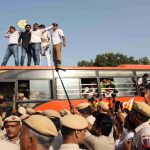
Here the “disjointed” charge has more bite, because the coalition is wide. Starting October 2, AISA led protests on the streets of Delhi. On 4 October, AISA’s national president Neha Bora was detained near Ashoka Road as marchers tried to reach Jantar Mantar without police permission. Days later, the INDIA bloc held its own protest at Rajghat. Student groups, party workers and a national opposition do not share a single script. Whether that is incoherence or simply what a coalition looks like is the question.
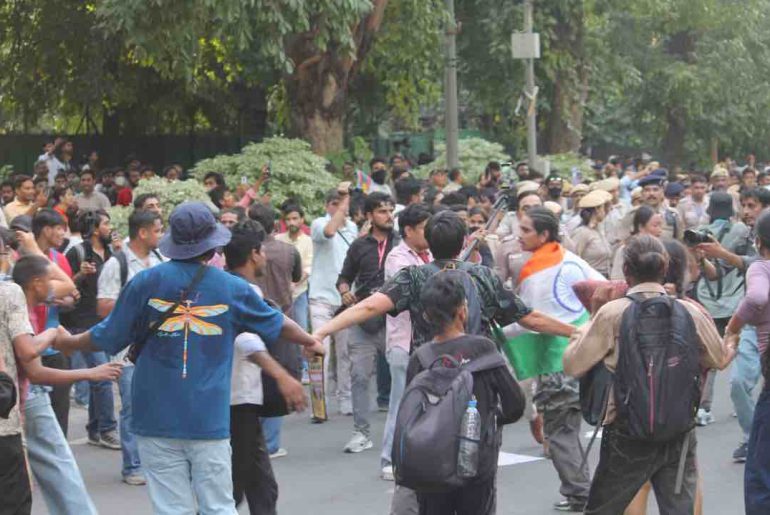
Scenes from the 4th October Protest (Credits: Mananya for DU Beat)
The state’s response is itself evidence. Ahead of the 10 October protests, Amnesty International India criticised the “lockdown-like” restrictions, including planned Metro closures, sealed borders, and thousands of additional armed personnel. Nobody deploys that much machinery against a protest they consider irrelevant.
CJP Protests at Jantar Mantar Over NEET Cancellation (Credits: Mananya for DU Beat)
But the jokes were a delivery system, not the demand. Foreign Policy reports that the movement mobilised through memes, Reels and humour, and one Delhi participant said social media made the protest feel like a conversation, not a lecture. The test of seriousness is the result, and reports that a movement that began as a call for education reform and grew into a broader protest over unemployment and accountability won its first major concession in July.
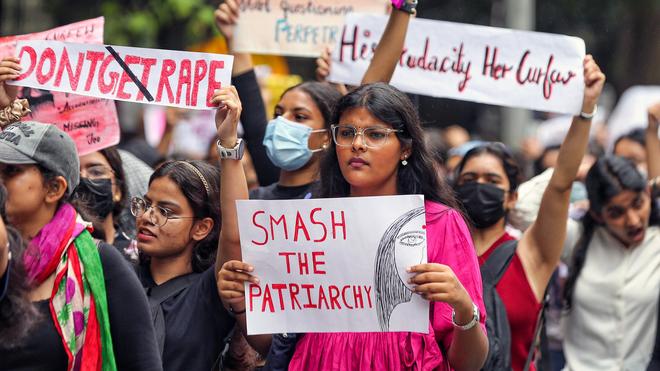
“Gen Z” is not one register, either. The DU marches ran on a different grammar: the Hum Auratein Azaad Hain banner, a rhyming chant about breaking apart the society that keeps women bound, open consultations and a charter. Students of the same age used satire in one protest and earnest verse in another, so tarring both as “unserious” lumps together two different strategies.
The 10 October protest at Jantar Mantar was blunted before it began, and the way it was blunted is the story. The CJP’s founder had called it “Season 2”. Delhi Police refused permission, saying the application arrived on 7 October against a 10-day notice requirement and pointing to alleged violations at an earlier protest. The city was then locked down with about 25,000 police and paramilitary personnel, a notice of closure of 57 metro stations, which, after the Apex Court’s intervention, was later reduced to 45 Metro stations, and several trains were cancelled.
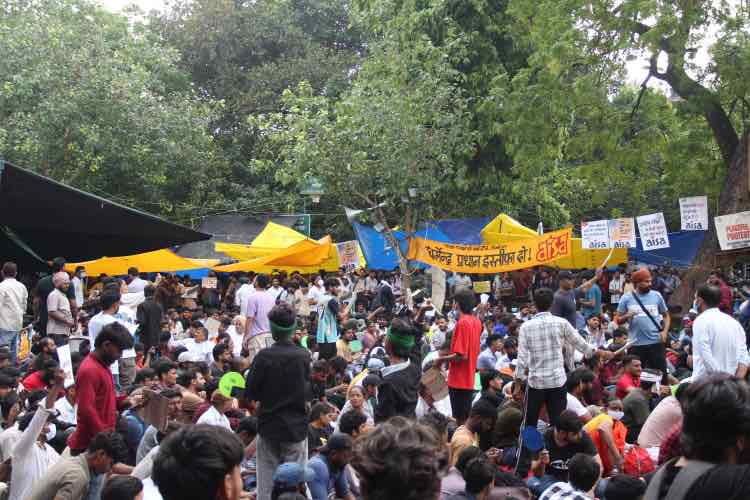
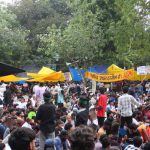
Protesting crowd at Jantar Mantar on 4th October (Credits: Aaratrika for DU Beat)
On Sunday, a court released Dipke and the two others on condition of no breach of peace for a year, and with central Delhi sealed, turnout stayed small and people who started slogans were detained. By crowd size, the BJP has a point. By every other measure it doesn’t: a party that began as a joke took a 25,000-strong deployment to contain and put four former chief ministers behind the same barricades. It also exposed the weak point of an online-first, leader-centred movement. Detain the leaders, seal the venue, and the street goes quiet. The CJP itself called the arrests an attempt to cripple its leadership.
A Domino Reaction
Read as separate events, these protests might look scattered. Read in order, they look like a chain reaction. An important point to note is that after the first CJP protests, multiple small protests also took place at the Jantar Mantar, with each one lowering the cost of the next. That is an interpretation, not a documented fact, and the sequence below is where it has to hold up.
Jantar Mantar is sealed; opposition and CJP leaders are detained
Now, an important question—What links?
First, precedent. Noted that the government has rarely yielded to sustained public pressure, with the 2021 farm-law withdrawal the notable exception. The July resignation showed young protesters that a street campaign can extract a concession, and every later protest inherits that proof.
Second, the shared grievance: exam leaks, public space, and the electoral rolls are different issues carrying the same message: that institutions are not answering this generation.
Third, the state’s response. Heavy-handed policing, which Amnesty called lockdown-like, turns each crackdown into a reason for the next protest, and it draws in the opposition parties that now stand beside the students.
The limits matter. Nothing in the coverage reviewed for this piece shows the women’s-safety marches feeding into the CEC protests, and the Supreme Court’s notice doesn’t appear to respond to the marchers. The honest picture is closer to neighbouring fires fed by the same dry grass than to one line of dominoes. That still makes spillover a useful way to measure a protest, as the next section argues.
Ways to count scores of Protests
If “did it win?” is the only question, nearly every protest fails on the day. A fairer scorecard has more columns:
Concrete outcomes: were demands met, whether a policy change or a resignation?
Agenda-setting: did the issue enter public debate and the courts, and stay there?
Infrastructure: did it leave behind charters, coalitions or networks that can act again?
Participant formation: did it politicise the people who showed up? A first-year at her first march is an outcome too.
State response: what do bans, barricades and detentions reveal about how the protest was perceived?
Time horizon: judged after a week, a year, or a decade?
Spillover: did it make the next protest easier to start, for the same people or for others?
By these measures, the DU marches score well on agenda-setting, infrastructure, and formation, and are unproven on outcomes. The CJP protests score high on state response and agenda-setting, and it is too early to say on the rest. Neither is a failure. Both are mid-sentence.
Can there be ideal protests?
Short answer: NO! Because the virtues contradict each other. A tightly led protest is easy to message but at the same time easy to decapitate. A leaderless one is resilient enough but might be hard to negotiate with. A narrow demand might be achieved or fulfilled with easier efforts, while a broad one has the potential to change a country. Disruption gets attention but can lose public sympathy, and politeness does the reverse. Humour travels furthest and is the easiest to dismiss, while solemnity is taken seriously and reaches fewer people. In order for a protest to maximize one of these, the only way is by sacrificing another.
That is why “ideal” is the wrong word. A better question is whether a protest fits its purpose. A march meant to put an issue on the agenda and start a charter did its job if the issue got on the agenda and the charter got started. A campaign meant to force a resignation has to be judged on whether the resignation happens, and sometimes it does, after two long months.
The perfect protest is a retrospective fiction, tidied up by history in writing once the mess has been long gone to be witnessed by the readers. The real ones are loud, plural and unfinished. The honest critique is not that they failed to be perfect, but a more specific question: what were they trying to do, and can we see it working?
DU orders all its colleges, departments, and hostels to conduct comprehensive safety audits and submit the safety audit reports by 12th October.
The University of Delhi has directed all colleges, departments, and hostels to conduct a comprehensive safety audit and submit a detailed report to the university by 12th October.
DU Proctor Manoj stated this during an online meeting on 9th October with college principals, deans, directors, and faculty to improve student safety across campus.
“Delhi University has colleges and campuses spread across the city. The objective is to first collect data on what can be improved, so we can give the report to the LG and CM, and accordingly action for campus and women safety can be taken,” said Mr. Singh.
The meeting highlighted multiple points that must be focused upon while conducting the safety audits. The identification of blind spots and fixing them or adding streetlights for the poorly lit areas. Strategic installation of CCTV cameras for enhancement of surveillance. Cutting down overgrown trees blocking natural light and assessing the infrastructural quality of college campuses and PG buildings.
The increase in police presence near colleges and hostels, with specific teams being strategically located in different areas for increased and better safety. The installation of more pink booths for women and strengthening the Vamika police van operations, as it’s known for its fast response capabilities.
The meeting planned to organize gender sensitization workshops in collaboration with Delhi Police, with a seven-day self-defence course for students. The prominent display of women’s safety helpline numbers across the university was also a part of the discussion.
In addition to all these arrangements, the university asked the colleges to conduct a structural assessment of the condition of the campus buildings, colleges and hostels. Officials have been asked to coordinate with the Engineering Department to identify infrastructure-related concerns.
The university ensured that the arrangements would be implemented effectively to make college spaces much more suitable for students.
As long as the slogans of resistance have echoed in the history of our nation, ‘Azaadi’ and ‘Inquilab Zindabad’ have remained at its core. Today, however, the same chants and the same spirit of protesting that had given rise to us as a Sovereign, Socialist, Secular, Democratic, Republic, become the biggest threat to the ‘rulers’ (or in better terms, government) of our land.
The year is 2026, and it is only the second week of October; the year is yet to be over, and the people are yet to be heard. Some decades earlier it was 1975, and it was the early month of March; the Emergency had been declared, and the people were already enraged. About 79 years ago it was 1947, and the month of August; the colonial rule was soon to be over, the people were soon to be heard.
There is never a democracy, at least a true one, where there isn’t dissent. What fundamentally makes a nation a democracy is the existence of a thesis, an anti-thesis, and ultimately a synthesis, in the middle of which functions a government—one that must not only heed to its voters, but also its non-voters and dissenters. It is these dissenters, that often take shape of the opposition party, an Instagram/X page, or people marching on the streets with concrete demands that make the ruling government earn respect; not by brutally detaining the people who march with their voice and placards, but by letting people resist, dissent, and protest, while addressing them democratically.
The changing face of our democracy is probably reflected at its highest coverage in the capital city. For decades, the urban residents of Delhi have quietly witnessed the atrocities breaking across Manipur and Kashmir, along with the labouring and farming class of rural India who have by now learnt to live with internet shutdowns, gunfires, brutal detentions, complete lockdowns, and a long list of restrictions that could be debated as constitutionally wrong—the Delhites remained quiet for they never once believed the same atrocities could come knocking at their doorstep. They, just like all of us, were wrong.
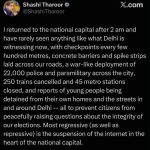
Today is 10th October, 2026, and somehow it feels like the 1920s as a lot of the youth who’ve only heard of those days in the stories, histories, and documentaries of the yesteryears would say. Some have even gone to the extent of calling this a remembrance of Indira Gandhi’s 1975 Emergency, but possibly worse. Shashi Tharoor in his wordplay of affairs writes,
“Gen Z deserves better than an undeclared Emer-GenZ.”
Image Credits: Shashi Tharoor on X
Delhi is officially, on papers, locked down—45 metro stations have been closed, X numbers of individuals from across the city have been detained, leaders of opposition parties like CJP, CPI(M), AISA, and more have been detained, incoming trains have been cancelled, and roads have been closed throughout the city with the Delhi Police doing the best job they have ever done in making sure order, safety, and ruliness is maintained. If this isn’t a declaration of Internal Emergency, one is to wonder what truly is.
Irony remains here, that the citizens who leave the comfort of their homes to walk on the streets amidst the brutal sun and police, are here protesting for answers on the integrity of elections—the same medium through which the current government remains elected by a majority, as they continue to maintain.
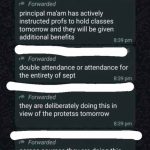
Just like the Delhi Police, even the University of Delhi has tried its best to keep its students in the classroom. While Zakir Hussain College (Evening), Satyawati College (Evening), Shaheed Rajguru College of Applied Sciences, and SBSC have let its students stay at home and attend online classes, women’s colleges of Delhi that happen to be regarded as “apolitical spaces” have once again risen to the occasion—Maitreyi College assured double attendance for all students who came to classes while Lady Shri Ram College witnessed more discussion on cancelling its Garba Event than on addressing concerns of offline classes. The issue here is more than just students wanting to attend the protest—DU doesn’t just have hostellers or students occupying nearby PGs, it has a larger number of day scholars who commute from as far as Faridabad and Ghaziabad to the city. With roads closed, main metros restricted, buses a less than feasible option, and Rapidos unable to function without a massive fare hike, the concern is about reaching college on time before the teachers shut the door on your face for an 8:45 A.M. lecture.
Screenshot of a Maitreyi College Official Group Chat (Credits: AISA Maitreyi)
Yet, despite the fear of RAF and CAPF being called in, the attendance bribery offered to students, and the detention of leaders right from their residence or the airport the morning of the protests, people are on the streets. They, however, are confused.
If there’s one thing India should have learnt from its history of protesting, it is that a disorganised movement has no outcome. On the 4th of October, the protestors walking from India Gate to Jantar Mantar, after losing its leader, Neha Bora and her fellow AISA comrades to the detaining police force began to scramble—they ran after the detaining buses shouting and in a spur of confusion ended up getting detained themselves. 10th October, one can only hope, has been different.
Scenes from the 4th October Protest (Credits: Mananya for DU Beat)
Abhijeet Dipke, founder of CJP—detained.
Neha Bora, AISA President—detained.
M.A. Baby, CPI(M) General Secretary—detained.
Ronak Khatri, Ex DUSU President—detained.
Arvind Kejriwal, Ex Delhi CM and National Convenor AAP—detained.
Lawyers and Journalists—detained.
Common People—detained.
While the leaders sit in buses at undisclosed locations, the public, that is, the ordinary people, many of whom have risked travelling from across the city if not other states, remain in a state of perplexity. From Jantar Mantar and ITO to Dilli Haat and Safdarjung Flyover, the people have taken to brainstorming new routes with the city’s auto bhaiyas and rickshawalas being the biggest supporters of the mass resistance. As disorganised as it may be, the people—both the ones sitting in detention vans since 11:30 AM and the ones running from the police and sitting down wherever the protest location next evolves—are angry. In fact, they are furious, tired, and hopeless. They demand a change, one that should be larger than simply a resignation but systematic, and shouldn’t vanish the minute one demand is met. In July it was for NEET. In October it is for Anti-CEC and SIR, and in the future, the right to protest shouldn’t be one that is met with brutality and disapproval, but one that is welcomed with peace, dialogue, resolution, and hopefully a Prime Minister’s Press Conference with media houses that are yet to be bought—a utopia, one day we hope our nation achieves.
As 10th October slowly closes and midnight approaches, one is to wonder, if at the stroke of midnight, Delhi will awaken to lesser restrictions and more freedom to dissent. If at every moment of dissent the government calls machinery of the state like the Police and Army to back it up at the cost of brutality towards its dissenting citizens, who will suffer—their non-dissenting citizens. If this is indeed the State’s ‘divide and rule’ policy: that they shall use the “inconvenience” caused by the protesting public to the non-protesting crowd, then one is to wonder about the success rates of it.
Today the protest may die down. Tomorrow it will rise again. Today might’ve been a Saturday with fewer offices and colleges open. Monday will be a weekday with more offices and colleges open.
One can only hope that the people stay, no matter the level of brutality, detention, and hiding away of leadership. One can only hope that this rage at being attacked, simply for being on the streets demanding accountability for a wrong, can be cultivated into a peaceful resistance that is met with systematic changes and not the sacrifice of only one member of the ruling party. It is through these hopes that protests like these sustain, and when a country finally awakens after years of being silent, one can expect the government to finally realise that its people will be exhausted, not by the protests, but by their lack of empathy, response, and accountability.
Students of the History Department of Delhi University stage a protest as half of 20 papers get removed from their course.
On October 9th, students from the History Department at Delhi University protested over an alleged reduction in the courses the university offers.
Hundreds of students gathered for the protest as only 23 out of the 43 papers were being offered, limiting students’ academic choices. The university has offered papers on caste, gender, tribal histories, labor, and medieval Indian history. The reduction process allegedly lacked transparency and did not involve adequate history faculty members.
The head of the history department, Prabhu Mohapatra, came forward and said that teachers with relevant expertise in their areas of specialisation were being prevented from teaching it. Jitendra Meena, a history teacher, said that this reduction in papers was a reflection of ideological intervention in higher education; adding to this, he told about a notification received from PMO where there were many books listed, such as BR Ambedkar’s “Annihilation of Caste”, not to be taught in universities.
Another professor, Maya John, pointed out the structural governance issues, stating the history department was restricted from speaking in the academic council meeting and that the expert committee lacked history domain experts.
The demands of the protest are that all 43 papers be restored, the protection of departmental academic autonomy from arbitrary course deletions, ensuring a transparent decision-making process involving domain-expert faculty, and providing additional classrooms and resources to support expanded FYUP enrolment.
A joint student statement summarised that cutting courses from 43 to 23 impacts educational quality, intellectual freedom, and depth of historical scholarship adversely; it isn’t just a curricular issue.
Several posts circulating online allege sexist and sexual remarks made by Union Members of FLP Hansraj. The club union has released a statement announcing that the named members are no longer associated with FLP.
On Thursday, 8th October 2026, posts appeared on LinkedIn and Instagram, alleging misogynistic and sexual remarks made by members of ‘Future Leaders Program (FLP)’ Hansraj College.
Screenshots circulating on social media, independently verified by DU Beat through anonymous sources at Hansraj, show the named individuals making inappropriate remarks such as“She’s asking 4 it” and “Mein toh soc chod deta first year hota toh – zero hot women”. The screenshots also show the accused using obscene language and casteist slurs against female juniors.
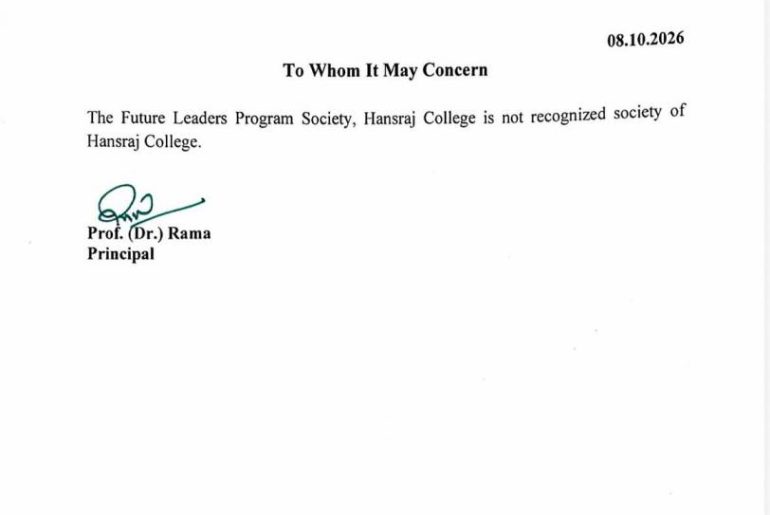
Future Leaders Program, Hansraj College, was founded about a year ago in 2025. Following the surfacing of sexual and sexist remarks by the leadership, Hansraj College declared that the Future Leaders Program is not a recognised society of Hansraj, in an official notice dated 8th October.
Following the controversy, the Future Leaders Program on 9th October released a statement announcing, “In light of the recent developments and concerns that have come to light, the President, former Presidents, and individuals holding the previously associated core positions are no longer associated with FLP in any capacity.” The club also stated that it does not stand by the conduct that has surfaced, and has attempted to address these concerns over the past weeks through structured channels within the society.
Students at Hansraj stated that this misconduct had been ongoing since November 2025, and the details were made clear recently. DU Beat was also told that the club’s previous union, responsible for choosing the new presidents, was aware of the alleged misconduct of the individuals named, their statements and was directly involved as well.
An anonymous source at Hansraj College stated that the FLP President, named in these allegations, had apologisedto those who brought the allegations forward. They pointed out that “if it wasn’t true, he wouldn’t have apologised.”
When asked about the wider environment of the club, it was revealed that the club had a skewed gender ratio,“The current council had 10 men, 4 women, and there was only 1 woman in the whole core union.”
Further, according to social media posts, backed by students at Hansraj College, those named have received Pre-Placement Offers (PPOs) from several reputed consulting companies.
Individuals involved are demanding cancellation of the accused’s Pre-Placement Offers (PPOs), out of concern for appropriate workplace behaviour and have stated suspension as the bare minimum. SFI Hansraj, a left-leaning student political organisation, has also condemned the incident and submitted a memorandum asking for strict action to be taken against those involved.
These allegations arise against a backdrop of growing student concerns over women’s safety and their ability to move through public spaces without fear. With the recent allegations coming to light, questions surrounding safety, dignity and accountability continue to remain a concern.
DU Beat reached out to the FLP Club for a direct quote, but no response was received at the time of publication.
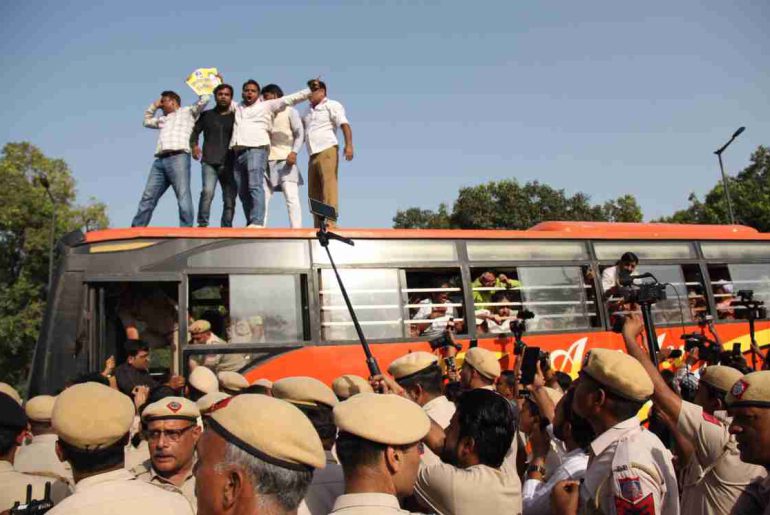
The Jantar Mantar protests planned on 10th October 2026 against the CEC, Gyanesh Kumar, and SIR witnessed the Delhi Police detaining major leaders of opposition parties along with protestors from across the capital.
On 10th October, ahead of the planned Jantar Mantar protests, the Delhi Police detained CJP Founder Abhijeet Dipke along with other leaders like Saurav Das and Ashutosh Ranka from their flight at the Delhi IGI Airport. Alongside them, CJP Spokesperson Mehr Parsicha has also been detained.
Live Law reported that a group of lawyers who were protesting against the CEC and SIR were also detained by the Delhi Police after they marched for “around 100 yards.” The location of the lawyers is currently unknown.
In addition to lawyers, the Delhi Police have also begun to detain journalists despite their declaration as well as possession of Press ID Cards. Scroll News reported that their journalist, Ayush Tiwari, was detained by the Delhi Police near ITO, which is 3.1 km away from Jantar Mantar. Tiwari said, “I literally shouted out to say that I’m a journalist. But the police said everyone is claiming to be a journalist.”
News Laundry too released a statement that their journalists, Ashwine Kumar Singh, Astha Savyasachi, and Anmol Pritam have been detained with their official phones seized by the Delhi Police. Similarly, two journalists were taken to the Chanakyapuri Police Station, where they were informed that they had not been detained, but were also not allowed to leave until the Investigating Officer arrived, writes Caravan Magazine.
Apart from political leaders, journalists, and lawyers, the Delhi Police has released a statement that “500 people arriving in various groups from different locations have been detained.” This comes after a shutdown has been imposed on the capital, with 20+ students detained en route to Delhi via the Goa Express in Madhya Pradesh. Similarly, 45 Metro Stations across the capital have been closed, with traffic blockages and restrictions across multiple key areas.
Hansraj College has introduced a new biometric system for Gate No. 4; students across years have been mandated to enroll immediately for smoother facilitation.
A new biometric system was installed at Hansraj College Gate No. 4 recently. The new system requires students to tap their ID card to the system. This opens up the metal gate and lets the students pass through it. This metal gate was set up to provide a secure and inclusive campus experience.
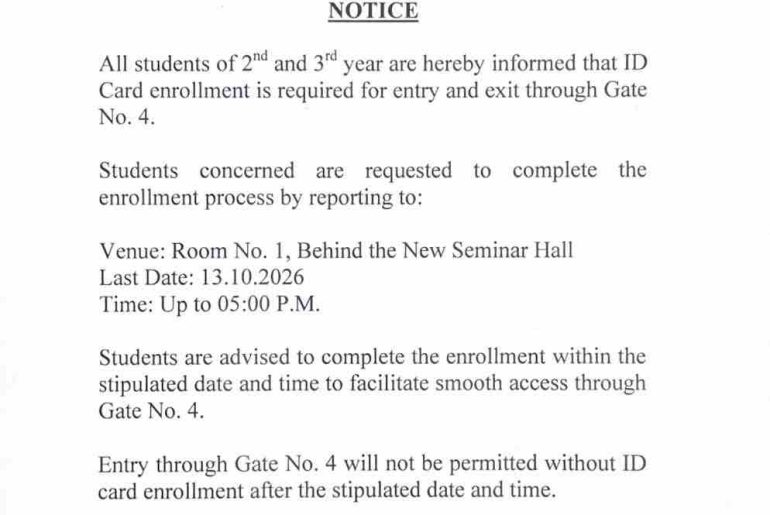
The biometric registration for the first-year students has been carried out altogether, as they received their student ID cards very recently. As for the second- and third-year students, they have to complete their enrollment process by 13th October, 5 pm.
The students have been advised by the college to complete the registration process within the due time limit for smooth access through the new college gate. Entry without their individual student ID card will not be permitted after the stipulated time.
The primary gate no. 1 has been closed down due to some renovation and redevelopment work in the Hansraj student hostel accommodations. As of now, Gate no. 4 remains the only open passage for entry to the campus, as two of the other gates on different sides have been closed for a few months now, due to some ambiguous reasons, as described by one of the students.
Many students believe the installation was essential to add an extra layer of security within the campus. In light of the chaos that occurred during Confluence 2026, the official fest of Hansraj College, which also witnessed an alleged stabbing. Moreover, the aggressive and ruthless campaigning of the DUSU elections that often obstruct the regular affairs of the college could also be one of the potential reasons.
All these statements remain speculative and hypothetical. The college administration has not provided any confirmation or advisory for the biometric installations. In spite of this, the new addition of biometrics to the main gate has been received very positively by the students. One such student anonymously quoted, “This is a great initiative, and the campus shall also become much more inclusive and safer now.”
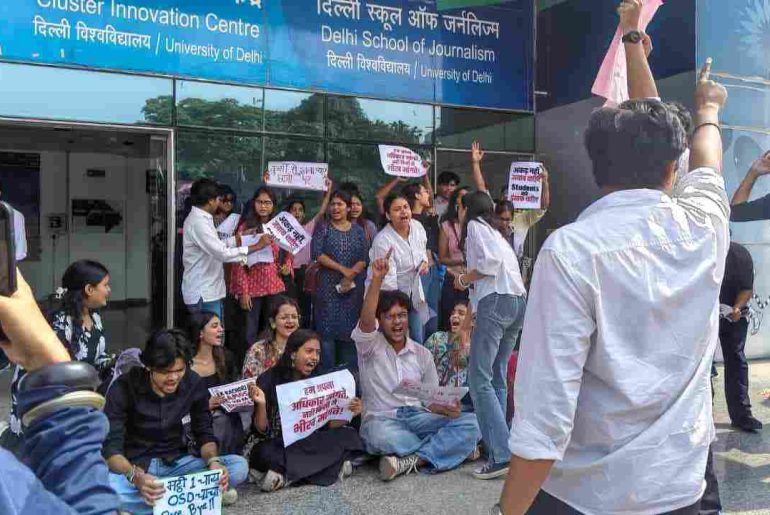
Students of the Delhi School of Journalism protested, demanding the resignation of OSD Dr. Sanjay Verma over alleged gender and caste discrimination, alongside fundamental changes in faculty recruitment, internal assessments, student funds, and infrastructure facilities.
On October 8, 2026, students of the Delhi School of Journalism (DSJ), University of Delhi, organized a walkout during a lecture part of the weekly lecture series, as soon as the Officer on Special Duty (OSD), Dr. Sanjay Verma, took the stage for his address. The students stood on their seats, raised posters and slogans for the resignation of Dr. Verma, before proceeding to walk out in front of the dignitaries and guest speakers.
The students allege persistent gender-based harassment, including the use of sexist, abusive language; gender harassment; and psychological torture specifically targeted against female students. The students have also accused the faculty and administration of engaging in caste vilification, victimisation of marginalized students, as well as breaches of academic ethics that warrant immediate punitive termination.
The professors allegedly threatened students with academic failure and arbitrary marks if they challenged authority.
The students have also raised concerns regarding arbitrary evaluation and opaqueness in the calculation of Internal Assessment marks, demanding a standardised, transparent grading measure to avoid personal vendettas and institutional corruption. Moreover, the lack of transparent re-checking and re-evaluation procedures makes students vulnerable to malicious grading. Students also allege manipulation of attendance records and are raising demands for a real-time, tamper-proof digital attendance portal to prevent arbitrary academic disqualifications.
The students have also raised complaints regarding infrastructure collapse, especially the uninhabitable state of female washrooms. According to the students, the female washrooms lack locks, have shattered doors, and are unhygienic, exposing students to privacy breaches and health hazards. Students also report a lack of basic medical or first-aid facilities, hazardous electrical wiring, broken furniture, and decayed academic spots.
According to the students, the media studio lacks any operational functionality, alongside a deficiency of basic functional laboratories such as broadcast production, digital editing, and audio engineering, creating obstacles in practical media training.
Additionally, students have to rely on contaminated or non-functional drinking water units due to negligence in servicing water coolers. The students also report heavy library fees despite limited access to research databases, literature, or physical infrastructure.
According to a student, the college lacks basic infrastructure, which negatively affects academics. Despite repeated complaints, the authorities have not taken any action, which affects students’ overall college experience. The student asked the authorities how long they would have to wait before any serious steps are taken.
However, the authorities refused to negotiate with the students, and the lectures reportedly continued to function normally despite students carrying out the protest. From the college campus, the protest moved to the Vice-Chancellor’s office as students raised demands for reform. According to many students, these instances of gender and caste discrimination have been occurring for over a year with no action by the authorities. The protest was then joined by the Vice President of Delhi University Students’ Union, Deepanshu Shokeen, who reportedly broke the college gate lock to enter the premises, and the Joint Secretary, Lakshay Raj Singh.
A team of students’ representatives was later allowed to meet the Dean of Students’ Welfare as they raised their concerns and demanded immediate reforms, including the resignation of Dr. Sanjay Verma. The students later returned to the college with the reassurance of an inquiry into the matter.