
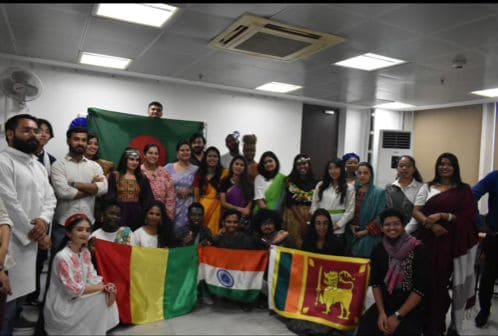
The NEP has ushered in several changes to the field of Indian education, from what and how students study to how teachers teach. On paper, the NEP has made education more flexible and overall more ‘glamorous’, incorporating global exposure and digital learning. However, the NEP looks at knowledge and education through an ‘Indian’, and arguably ‘saffron’ lens. Hence, many curriculum alterations made by the NEP are of little value to foreign students.
One of the most beautiful attributes of Delhi is that it is a melting pot of diverse cultures from around the world. It is a hub of globalisation where cultural differences meet, mix, and are adopted. This diverse population is indicative of a diverse student body, one that cannot be fully served by education policies that view learning through the eyes of unilateral exchange. Yet, the University of Delhi was the UGC’s first experimental candidate when it came to implementing the NEP.
The NEP has not only failed to accommodate the needs of the multitude of foreign nationals who have chosen India as their study-abroad destination, but it is actively forcing them to learn subjects that seldom contribute to their academic and/or professional aspirations. For instance, departments of Astrology, Rituals, and Vastu have been established in universities like Banaras Hindu University and Jawaharlal Nehru University. Superstition has been incorporated into education in the name of “value addition.” Ironically, this added value is undetectable.
Some syllabus alterations in particular courses simply make no sense; these are barely of measurable utility to Indian students, let alone helpful to foreign students. For example, journalism students would benefit more from writing or political science classes as opposed to learning about Bharat Muni’s Natyashastra. The NEP has replaced several logical, intellectual, and scientific parts of curricula with Indian feudal values. Japanese exchange student Kenta Terada questions the relevance some subjects have in his journalism course, and says, “I would rather have practical classes.” It also attempts to write the “history of India from an Indian perspective.” Some argue these are attempts to saffronise the country through education. However, that claim is ambiguous and a topic of heated discussion.
Living in a country and learning its language(s) and culture is one thing. It is both necessary and, a lot of the time, recreational. But, when it is enforced and delivers content that is devoid of practicality (which is often what the NEP’s changes have done), it becomes a tedious waste of time and money spent on education. As Mary Flaviah, a Kenyan student at the Delhi School of Journalism, said, “I just didn’t see the relevance, and to me it felt like a pure waste of time since at the end of the day I’ll go back to my country…some courses still don’t make sense to me as a foreign student. The Indian Philosophy, for instance. I am so sure I am never going to apply that anywhere, but because it’s part of the coursework, I am forced to study it.”
Many other foreign students share the same opinion, with Nigerian student Nneoma Marvellous Anyaogu saying that though she appreciates being able to gain a deeper understanding of India’s culture and traditions, as someone who is not Indian, and may not build a career in India, she “sometimes finds these subjects less connected” to her personal or professional goals.
Read Also: The Politics of Evaluation: Continuous Assessment and the Disappearance of Depth
Image Credits: Mahin for DU Beat
Souparnika Rajkumar




Comments are closed.