Tag

foreign students

Browsing

The NEP has ushered in several changes to the field of Indian education, from what and how students study to how teachers teach. On paper, the NEP has made education more flexible and overall more ‘glamorous’, incorporating global exposure and digital learning. However, the NEP looks at knowledge and education through an ‘Indian’, and arguably ‘saffron’ lens. Hence, many curriculum alterations made by the NEP are of little value to foreign students.


One of the most beautiful attributes of Delhi is that it is a melting pot of diverse cultures from around the world. It is a hub of globalisation where cultural differences meet, mix, and are adopted. This diverse population is indicative of a diverse student body, one that cannot be fully served by education policies that view learning through the eyes of unilateral exchange. Yet, the University of Delhi was the UGC’s first experimental candidate when it came to implementing the NEP.


The NEP has not only failed to accommodate the needs of the multitude of foreign nationals who have chosen India as their study-abroad destination, but it is actively forcing them to learn subjects that seldom contribute to their academic and/or professional aspirations. For instance, departments of Astrology, Rituals, and Vastu have been established in universities like Banaras Hindu University and Jawaharlal Nehru University. Superstition has been incorporated into education in the name of “value addition.” Ironically, this added value is undetectable.


Some syllabus alterations in particular courses simply make no sense; these are barely of measurable utility to Indian students, let alone helpful to foreign students. For example, journalism students would benefit more from writing or political science classes as opposed to learning about Bharat Muni’s Natyashastra. The NEP has replaced several logical, intellectual, and scientific parts of curricula with Indian feudal values. Japanese exchange student Kenta Terada questions the relevance some subjects have in his journalism course, and says, “I would rather have practical classes.” It also attempts to write the “history of India from an Indian perspective.” Some argue these are attempts to saffronise the country through education. However, that claim is ambiguous and a topic of heated discussion.


Living in a country and learning its language(s) and culture is one thing. It is both necessary and, a lot of the time, recreational. But, when it is enforced and delivers content that is devoid of practicality (which is often what the NEP’s changes have done), it becomes a tedious waste of time and money spent on education. As Mary Flaviah, a Kenyan student at the Delhi School of Journalism, said, “I just didn’t see the relevance, and to me it felt like a pure waste of time since at the end of the day I’ll go back to my country…some courses still don’t make sense to me as a foreign student. The Indian Philosophy, for instance. I am so sure I am never going to apply that anywhere, but because it’s part of the coursework, I am forced to study it.” 


Many other foreign students share the same opinion, with Nigerian student Nneoma Marvellous Anyaogu saying that though she appreciates being able to gain a deeper understanding of India’s culture and traditions, as someone who is not Indian, and may not build a career in India, she “sometimes finds these subjects less connected” to her personal or professional goals.

Read Also: The Politics of Evaluation: Continuous Assessment and the Disappearance of Depth

Image Credits: Mahin for DU Beat

Souparnika Rajkumar

[email protected]

The Delhi University Students’ Union (DUSU) has established the University’s first official Foreign Cell to address the grievances and issues of international students.

The Delhi University Students’ Union (DUSU) has set up a Foreign Students’ Cell which is set to be first student body at the Delhi University to address foreign students’ grievances and sort out their problems.

The DUSU said that the Cell has been established to address the varied issues of the international students through developing mutual comprehension, cultural exchanges as well as moral diplomatic understanding.

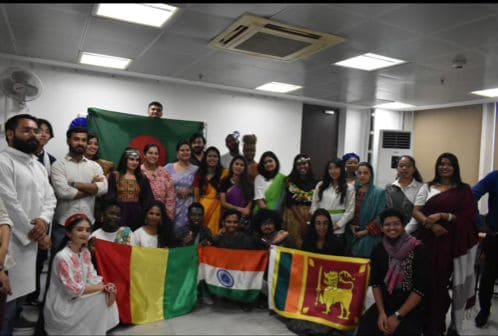
The Delhi University Students’ Union convened an inauguration ceremony of the Foreign Cell on 6th March 2020,  in which the honourable guest speakers were Dr. Vinay Sahasrabuddhe, President ICCR , MP Rajya Sabha, ShriNiwas, The National Joint Organising Secretary of ABVP, Mr. Sediqullah Sahar, Ambassador , Embassy of Afghanistan, as well as Mr. Vishnu Bahadur Gurung, Nepal.  Pradeep Tanwar, Vice President, DUSU,  welcomed all the guests and felicitated them; followed by a vote of thanks by Shivangi Kharwal, Joint Secretary, DUSU.

A total of 230 students from 19 countries registered for the Cell, students from Nepal and Afghanistan being the most in number.

Akshit Dahiya, President, DUSU said, “During my campaign, a few international students asked me why they should vote for me if I don’t do anything for them. I promised them that they will have better representation and a formal one. This foreign students’ cell will provide assistance during admissions, FRRO registration as well as in organising extra-curricular activities. The academic aspect has also been included through introducing an award for felicitating the international student with the highest grade point average. The cell is a step towards enhancement of communication between different cultures and also a great opportunity for the students to learn our culture as we learn theirs,”

 “Till they find a proper office I have asked them to use mine. This will be an independent body but DUSU will always provide the necessary support they would need at any point of time,” he added.

Nouresha, a Journalism student from Kamala Nehru College said, “As a foreign student, this is a good initiative. Because when I came to India, I didn’t even know what the processes were. Thankfully, somehow I got in touch with some of the Mauritian seniors in DU and they were very helpful. But if they weren’t here, I would have been roaming aimlessly, not knowing what to do. For a foreign student everything seems alien. So if the Foreign Cell helps them from day one, it would be awesome.”

Feature Image Source: DUSU 

Paridhi Puri

[email protected]


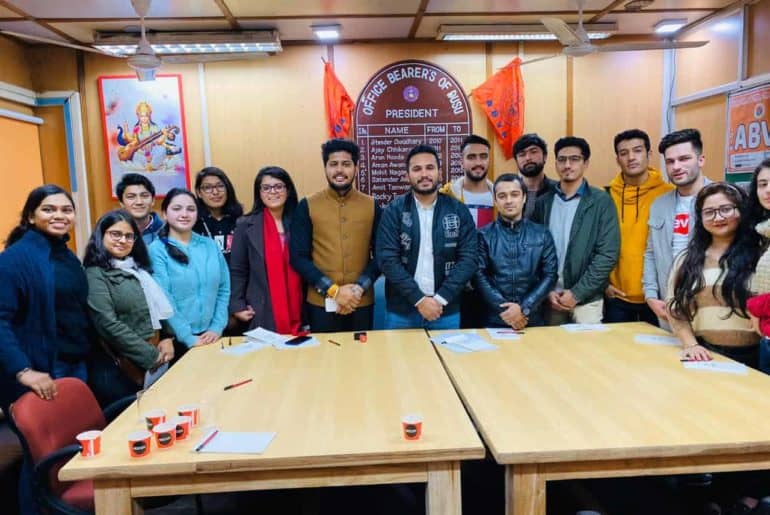
On 3rd January 2020, Akhil Bhartiya Vidhyarthi Parishad (ABVP) led Delhi University’s Student Union (DUSU) met with foreign students of University of Delhi (DU) for establishing DU’s first foreign cell to cater to the needs of  foreign students studying in DU.

Akhil Bhartiya Vidhyarthi Parishad (ABVP) led Delhi University’s Student Union (DUSU) held a meeting at DUSU office in University of Delhi (DU), North Campus on 3rd January 2020 to listen to the needs and difficulties of foreign students studying in DU.

In this discussion DUSU Vice President, Pradeep Tanwar along with DUSU Joint Secretary, Shivangi Khairwal were also present to extend full support to the students.

The motive of the meet was also to discuss the establishment of DU’s first-ever Foreign Cell. Approximately 25 students from 5 different nations put forward problems faced by them during their academic stay in Delhi. Some of the common problems discussed were fee structure, accommodation and linguistic barriers.

The foreign students in anonymity also stated, “We often feel isolated as we don’t belong to the same culture. However, events like this bring pressing issues like Regional Registry office procedure in the discussion.”

In response to their issues, a committee of 15 students from various countries will be launched to pertain to the needs of foreign students particularly and solve the current issues they are facing. A Panel to curb the most prominent communication barrier would also be established.

Selection of the working committee would be done through done Google search and advertisements and then a personal interview would be conducted to judge their merit. 

Akshit Dahiya, President, DUSU has invited all interested foreign students to fill the google form to constitute a committee and has offered a volunteering position with DUSU to rest, who are not selected.

Akshit Dahiya, in a conversation with DU Beat, said, “Much more can be expected from DUSU under the leadership of ABVP to uplift the students of DU. A new committee has also been established to promote sports in the Varsity. More than 12,00,000 lakhs have been allocated to give scholarships to students of Economically Weaker Sections (EWS), Persons with Disability (PWD) and of Extra-Circular Activities (ECA) and Sports quota.”

“This is an initiative taken to strengthen the relations between foreign students and ensure their warm stay in India as they pursue their study” Akshit Dahiya added.

Feature Image Credits:Akshit Dahiya


Chhavi Bahmba

[email protected]


The University of Delhi (DU), which sees students from all across the world enrol into various courses, has decided to extend the deadline for the admission of foreign applicants. Every year, hundreds of aspirants from countries such as Afghanistan, Mauritius, and Sri Lanka apply to DU for courses such as Economics (Hons.), B.Com (Hons.) etc. in the undergraduate programme. This year, the University saw their number rise to a record 3,300. Thus, a conscious measure taken to extend the application deadline was required, in order to ease up the document submission and screening process.

Ashutosh Bhardwaj, a senior official of the admission committee, verified the news to MAIL TODAY. He said that while the deadline for admission to undergraduate courses for non-Indian students has been shifted to 4th May, the deadline for Ph.D. applications has also been extended to 31st May 2017. Earlier, the deadline for online applications for the upcoming academic session was 20th April 2017 for the undergraduate students. The new deadlines, as Bhardwaj confirmed, give students more time to submit their documents for verification. This step does, indeed, create an opportunity for both the students and the University to participate in the admission process and to make it a smooth and hassle-free affair.


Feature Image Credits: CryBytes

Deepannita Misra
[email protected]