Tag

undergraduate

Browsing

The University of Delhi, through its policies and activities, acts as a hub of opportunities for all sectors of the society. One such endeavour to facilitate women empowerment is the Non-Collegiate Women’s Education Board (NCWEB), which allows thousands of young women who are unable to join a regular college to obtain an undergraduate and postgraduate degree in the varsity. These students can attend classes during the weekends or academic breaks, and the Board allows them to appear for the DU examinations without attending the regular scheduled classes.

The foundation of NCWEB lies in the vision of enlightening women through academic and skill training. The holistic development offered stems from a desire to enforce social change, and thus presents itself as a platform of women’s education. The Board’s initiative is a significant step in the construction of an egalitarian society. Established in 26 UG courses and one PG centre, NCWEB has cropped up as a significant academic horizon with 23,000 students growing under its umbrella.

The admission in NCWEB is merit-based, and is administered through the declaration of cut-offs in July end. The schedule this year’s admission cycle is as follows:

schedule

Image Credits: UG Bulletin 2017-18

Interested applicants residing in NCT Delhi are automatically considered for NCWEB on selection of programmes, either B.A. (Prog.) or B.Com (Prog.) or both. The Board provides library facilities and financial aid to those candidates who are deprived of these facilities. The candidates are permitted to utilise the infrastructure of educational platforms at a low cost, thus allowing them to overcome their barriers. Through the convergence of cultural and extracurricular activities, NCWEB offers a holistic education arena to the students.

Details of the Programme

  1. Students are expected to attend classes regularly as the minimum 66% attendance has been made mandatory to appear in the University Examinations, which are held annually in the month of May.
  2. The NCWEB UG students are permitted to finish their B.A./B.Com. three-year degree programme within 6 years, of taking admission, i.e. span period for UG is 6 years.
  3. The classes are held either on Saturdays or on Sundays and during the academic breaks of the University of Delhi. There are 50 teaching days in a year.
  4. At the Under-graduate centres, classes are held from 9.00 a.m. to 2.00 p.m. There are 5 periods in a day, each of 60 min duration.
  5. Teachers of the University of Delhi and affiliated Colleges are deputed as guest faculty to teach the Non-Collegiate students. The pass percentage of these students is as good as the regular students.

Admission Procedure to B.A. (Prog.)/B.Com Programmes:

  1. Total no. of Seats in B.A. (Prog.) in each of teaching centres: 284

Total no. of Seats in B.Com. in each of teaching centres: 184

Number of seats in B.A. (Prog.) subject combinations are fixed. Reservation for SC/ST/OBC/PwD/CW will apply as per University rules.

  1. The percentage for cut-off will be decided on the basis of marks obtained in the best four subjects in 10+2.
  2. The cut-off list shall be displayed at 9:30 a.m. at all centres and the NCWEB website ncweb.du.ac.in
  3. Any student who takes admission in any one NCWEB centre, will not be allowed to change the centre at any later stage during the admission process
  4. After approval of admission, the applicant has to log on to the undergraduate admission portal to make online admission fee payment. This may be done till 12:00 noon of the next day of the given admission list deadline.

Requirements at the time of admission:

  1. The applicants will have to submit their original certificates at the time of admission.
  2. The annual fee would be approximately around Rs. 3500/-.
  3. No fee will be charged from PwD students.
  4. The Non-Collegiate students are not allowed to pursue any other full-time/degree programme.
  5. It is suggested that the students may take admission in a college near their residence, if possible.
  6. Residence proof of NCT Delhi (i.e. Aadhaar card/ Passport/ voter Id card/ Driving license/ Ration card) in original will have to be submitted.

Feature Image Credits: University of Delhi

Saumya Kalia
[email protected]

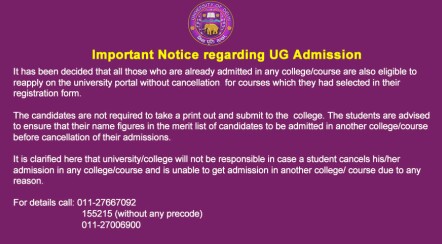
In a major relief to several aspirants, the under graduate admissions committee of Delhi University has allowed students to apply for the vacant seats in various courses across colleges under this round of admissions. Students can now apply for the same by logging into their respective accounts in the undergraduate admissions portal. The link for the same shall be made available from tomorrow i.e-26th July 2016. Tomorrow is also the also the last date for accessing the admission portal for applying for the same.

The students who have already been admitted in any college of Delhi University need not require to withdraw their admissions from their current colleges to apply to other colleges. Furthermore the candidates are not required to submit the print out of their application form at the colleges they are applying in.

The students are also advised to confirm their name in the merit list of the colleges before cancelling their admissions at their current colleges. Neither Delhi University nor the college shall be responsible if the student cancels his/her admissions in one college and fails to get admission elsewhere.


For any further clarifications regarding the issue the students can call University Helpline numbers given below.

011-27667092

155215(Without any pre code)

011-27006900


Picture from www.du.ac.in

Srivedant Kar

[email protected]

With a bundle of high hopes, millions of students enter their college classrooms every year. Some think of changing the world while others swear to change themselves and acquire the skills which boundaries of school life did not allow. Be it History or Psychology, English or Metallurgy, students show a high interest in their subjects for the first few days of college but this fire dies out the second they are faced with long reading lists and a cumbersome syllabus to cram. Our University does not provide the option of an in depth academic exposure to a subject in the undergrad level. Thus, undergraduate research still remains that big elephant whom the system has failed to tame.

Undergraduate Research provides an exposure for students to explore the academic boundaries of the subject of their choice. They are told to choose a project under a supervisor (researcher) and under his/her guidance, learn to do a research. It includes their introduction to research methodology and various research tools that are used by researchers around the world. This academic exposure not only gives them an edge over the traditional Bachelor’s degree but also a preference over others while applying for a graduate school abroad.

The projects that are chosen by or provided to the candidates are mentored and supervised by a professor with a good background in the chosen subject of research. This in turn, builds a better rapport between students and professors and often helps the students to get good recommendations from their supervisors. Having worked with the student closely, the professor also gets to know him/her better which later becomes useful in filling out the recommendation letters of those applying for admissions abroad.

The research work that a student does can be presented at various conferences, paper presentations and even poster presentations in colleges of their parent university or other universities. This helps them form meaningful connections with other research scholars, working in the same field at an early stage.

Even though a majority of the students lack an in depth knowledge of their subject at this level, it is their curiosity to learn which becomes valuable to the research. Sometimes, their exploratory minds come up with incredibly breakthrough ideas or observations which tend to become a matter of further study.

In fact, nowadays, even employers across several hiring platforms look for candidates who can brilliantly take a lead in various projects for their companies. A successful undergraduate research spanning for a couple of months in summer or an experience of an yearlong research would be like an icing on the cake for all the students in search of employment opportunities after college.

Therefore, students in India can explore the opportunity of Undergraduate Research at various Universities like IITs, IIMs and other Universities. Delhi University offers the option of Undergraduate research in form of various Innovation projects to its students.

Image Credits: www.shutterstock.com

Srivedant Kar

[email protected]

Admission process for undergraduate courses at University of Delhi closed on the 15th June 2015. Varsity invited applications for around 54000 seats for the upcoming session of 2015-16 and application forms were accepted both online and offline. Total registrations received by students of all categories via both the modes were recorded at 291817. This data excludes the applicants for BMS/BBA/BBE and B.El.Ed. Programme.

Find out our report for the details on individual categories, here.

Office of Dean of Students’ Welfare released the compiled report for the statistics on Admission today on the 19th June 2015. According to the statistics, 122020 female candidates have applied in comparison to 169731 male students. ‘Other’ category for third gender students was introduced for the first time in undergraduate admission applications and 66 students have applied under the same.

For the percentage-wise statistics, around 36000 applicants have secured 90% or above in their Class 12 Board Examinations. Central Board of Secondary Education (CBSE) has given University of Delhi the maximum number of aspirants with the number standing at 218872. Other applicants are from ISC or other state boards like UP, Bihar, Rajasthan etc.

Find out the full statistics, here:

TotalApplications 291817
Total applicants(Female) 122020
Total applicants(Male) 169731
Total applicants (Other) 66
Gen 178419
OBC 68867
SC 37085
ST 6270
Pwd1 460
Pwd2 137
Pwd3 434

Top 10 choices for Course

CourseOpted Total
B.A(Hons)English 90331
B.Com 71505
B.Com(Hons.) 68866
B.Sc(Hons)Chemistry 66987
B.Sc(Hons)Mathematics 66586
B.A(Hons)Economics 63264
B.Sc(Hons)Physics 62585
B.A(Hons) PoliticalScience 56408
B.Sc(Hons) ComputerScience 50317
B.A(Hons)History 47088


Board Wise Applicants

Category Total
CBSE 218872
ISC(AllIndia) 8311
UP 8293
Bihar 12705
Haryana 3332
Rajasthan 26693
OpenSchool 3763
Other 9846
GrandTotal 291815


Year of Passing

PassingYear Total
2015 246548
2014 35146
2013 6753
Before2013 3337
GrandTotal 291784


Status of Result

ResultStatus Total
Passed 287279
Awaited 995
Compartment 3438
GrandTotal 291712


Percentage Wise Applicants

Percentage Range Total
0-45 8106
45.01-50 10101
50.01-55 15674
55.01-60 21403
60.01-65 28082
65.01-70 32580
70.01-75 35268
75.01-80 35195
80.01-85 35597
85.01-90 33791
90.01-95 28999
95.01-100 6850
Grand Total 291646


School-Wise Applicants

School Total
Government 93692
Public 123398
Govt. Aided 16328
Other 33411


Study Medium Wise Applicants

Study Medium Total
English 163098
Hindi 48660
Other 1384

Information Source: Dean of Students’ Welfare

Feature Image Credits: The Hindu

Iresh Gupta
[email protected]

Now that the Board exams are done, have you already started day-dreaming about your dream college in India’s top university? At the same time, are you apprehensive about moving to a new city altogether? Here’s a little something for all would-be outstation students wishing to be a part of the University of Delhi in the upcoming academic year- a survival recipe exclusively for outstation students, by an outstation student.

 (Author’s note: ‘survival’ is just used for a dramatic effect; you’ll sail through college here!)

All about Delhi

First things first- Delhi is NOT the rape capital of India. It’s as safe and as unsafe as any other city in the country. There are people on the road that will help you; there are shopkeepers and auto-waalas who won’t rob you of your money, so clear your head of all these clichés about Delhi.

 The plus points? Easy access to all landmarks across the vast city via the city’s lifeline- the Delhi Metro. Delhi-ites swear by the efficiency of Delhi’s metro system. Other than this, exceptional food joints with as much variety as you wish to have on your plate along with being a shopper’s paradise, an art-lover’s heaven and an observer’s utopia., just when you start thinking you’ve got to know it all, the city throws something majestic at you to ponder upon!

Essentials for an outstation kid

Find good accommodation

Finding good accommodation is one of the most essential aspects you need to focus on once you get into the college of your choice. Many colleges across DU don’t have adequate hostel seats and hence alternative accommodations such as flats and PG (Paying Guest) accommodations are popular. Confused about what to choose? Here’s something to make your life a little easier-

Hostel– While many colleges have inadequate hostel seats, it’s still considered the first choice for most outstation students. The safety of the accommodation and lesser rent in comparison to flats and PGs are the main benefits hostels have to offer.

With this, hostels do come with certain guidelines and regulations to comply with. These maybe in the form of curfew deadlines and leave regulations. Food is also an issue in certain cases since all of us spoiled, in-love-with-home-made-food kids might find it a little difficult to adjust to the hostel mess’ food. It is a myth though that hostels are all about regulations. The mid-night parties, studying and staying together, sharing food (the list goes on till where your wishes can take you) will bring you a lifetime of friendships and irreplaceable memories.

PG Accommodation– One of the fastest growing businesses in Delhi (it’s not IT!) is of the Paying Guest Accommodations. You will have hundreds of PGs to choose from as per your own preferences. PGs in Delhi come with both rigid and flexible curfew deadlines. The food issue one might face in hostels is a rarity in cases of PGs given that you have the option of demanding the food of your own choice.

However, higher rent, difficulty in adjustment with fellow PG-mates (yes, that’s a term!), curfew deadline issues and safety concerns at times are a few negatives tagging along.

Flats –  As rosy as the thought of owning your own flat may sound, it’s a mammoth task. Unless you’re willing to bargain with the subzi-waalas and relying on the wishes of a maid to turn up and get you some food, flats is not a good idea.

But, you surely cannot ignore the benefits of having a house party or calling your friends over whenever you wish to. Your parents will certainly have a lesser control over your activities since there’s no deadline issue and they’re often cheaper than PG accommodations.

The only advice is to think thoroughly before choosing your accommodation and consider all pros, cons and worst case scenarios for all options. Ultimately, your comfort (and survival!) overrules all other factors.

Wish you could be home…

Homesickness is something every outstation kid feels at some point of time. We understand how close you are to home but always think of the time you were earnestly waiting to get out of your home and explore. Well, the independence a new city gives you is your perfect chance to live your dreams. While doing all your work yourself might seem to be a burden initially, it’ll eventually become something you’ll be thankful for and proud of.

There are ways to get over the feeling of homesickness, of course! Take an early morning walk, go on a shopping spree, explore historical places in and around the city with your new found friends- the more you try to get your mind off the thought of home, the more at-home you’ll feel!

Adjustment issues often crop up when you come across unfamiliar people. The key is to see this unfamiliarity as a part and parcel of growing up and becoming your own person. It’s also important to understand that every kid in your hostel/PG is in the same boat as you are, and is facing similar issues.

The best part about Delhi is the fact that you will never run out of ‘things to do’. With its historical and cultural importance, the city in itself has a lot to offer. You might feel a little lost initially but embrace the change with open arms. Within no time, you’d be a part of this cross-cultural hub making a mark of your own. (Too much philosophy? Well, you’re getting the first hand experience of an outstation kid!)

Feature Image Credits: thedisneyden.com

Arushi Pathak
[email protected]

As I slogged my way through the tedium of class XI and XII, my ambition to study in one of Delhi University’s prestigious colleges was a constant source of motivation. All I wished was to hop right out of school and into college. College, to me, symbolised liberation. The burning desire and hope for brighter prospects helped me tide by many difficult moments of low self-esteem, fatigue and pessimism.

It’s a simple concept, really.The idea of studying in college has been glamorised to an ad nauseum degree in our movies, songs and literature. Collegiate life has always been painted in rosy hues, making it look like all fun and play. So vehement has been such enforcement that even before one enters college, one forms multiple mental images about it. And more often than not, these images can be extremely deceptive, false and misleading.

So yes, I was a little disappointed when I walked into college on my first day and no one rolled out a red carpet in my welcome; or that the canteen was not full of good looking boys. The teachers weren’t cool and trendy (no Sushmita Sens in my college,unfortunately) and the girls weren’t dressed like they had walked out of a fashion magazine. In retrospect, I realised that college after all, is not the optimum amalgamation of Riverdale High (Archie’s Comics), St.Teresa’s (Student Of The Year) and East High (High School Musical). College is a pretty raw and serious deal.

One year in college and I have come to know college life for what it really is. Here are my musings:

1. When elders tell you to study in school so that you can enjoy college, they’re just baiting you. Maintaining good scores in college is important and that means you must maintain your academic rigour.
2. Professors aren’t necessarily cooler than teachers. Even though professors are more lax than teachers, some professors can be daunting and nagging, perpetually handing out assignments and tests.
3. Even though you don’t have to wear a uniform, you have to be quite mindful of what you wear and when you wear it. People like to judge.Never let yourself be voluntarily victimised.
4. Friends made in the first semester may not remain friends in the second semester. Group dynamics are subject to frequent changes. This happens because in the first semester, you’re too new to gauge people’s true personality.
5. The festival season is great, but not as sensational or stunning as you’d hoped.
6. No matter how many amazing eateries might be in around your college’s campus, sooner or later, you’re going to tire of all of them.
7. Once you’re in the University, your college name hardly matters. The importance of the name of your college is one of those things that outsiders make a big deal out of. But for a student or teacher in University, you’re just like any other university student.
8. College societies require time, commitment and dedication. And they’re important because they shape your college life. Thus, be heedful about the society you join.
9. College is not the destination; it’s a pit stop along the journey. Don’t let it be your end all. Keep improvising on yourself, use your experiences to develop your personality and don’t settle easily.
10. Don’t let college life strip you off your ideals. Be true to yourself and your values. These are the things that will set you apart from the rest of the world later on.

Feature image credits: learnmoreeveryday.wordpress.com

Kriti Sharma
[email protected]

Bachelor Of Management Studies, the only undergraduate management course offered by Delhi University, has been seeing quite a few changes in its admissions criteria. As per recent reports, the entrance exam, which was slated for cancellation, is back on.

With the course being only 1 year old, the admission criteria changed last year, when a group discussion round was removed from the criteria. Another change that was sought to be implemented this year was the abolition of the entrance exam, and having 12th grade percentage based cut offs for admissions. The proposal, however, faced vehement opposition, with the Principals of the 6 colleges offering this course along with the student body refuting the idea.

As per recent press release from the office of the Dean of Students Welfare, the entrance exam is back on, with an equal weightage being given to the test score and the board percentage. Whether the decision is final or is due for further deliberations is not certain yet. If the new proposal is finally implemented then the personal interview round for the final selection of students will be done away with.

Kritika Relan, a second year student from BMS is uncertain of the outcome. ‘The criteria has been shifting from one to the other. The whole point of a Personal Interview was to judge students holistically. Only having an entrance seems inadequate.’