Tag

nep

Browsing

NEP 2020 is envisioned towards creating an inclusive education to all by bridging the abiding spaces in the society. Yet, it seems to just be a façade of progression. The policy is ought to introduce the much needed practicality into the mainstream education but what is the correct way to go about it? Is it going to be an actual consideration of voices of all the stakeholders or will it be a theoretical approach to a ‘practical solution’?


The National Education Policy (NEP) 2020 has a vision towards transforming the Indian education system into a global knowledge superpower. It lays down the veracious purpose of the education system, to develop virtuous human beings having rational and critical ability, empathy and solicitude, creativity and the power to go beyond but what is the cost to implement this? Will this be uniform for each child living under the same sky or a question of ‘subjectivity’ would arise?

NEP address to the practical knowledge and skills like carpentry etc but see now the things is that our government schools do not even have quality teachers how can you equip them all in such a small time frame, so first government should be focusing on ground development rather than looking on to the entire nations prosperity.

-Malvika Choudhary, Delhi School of Journalism

The irony of this policy is such that it is a step towards changing the theoretical approach into practicality but the policy itself sounds too theoretical than pragmatic. While observing the NEP 2021, inclusivity is a major factor of the entire policy. Yet, there are provisions that might look like encompassing all the sections of the society. However, in the actuality of this realm, it is only pushing the way towards widening the gaps of disparity. It is as if a kid falls down, gets hurt on the knee and starts wailing; rather than using a bandage to heal the wound, they are being given licorice in pursuit of ceasing the tears. The question is not about if these provisions are good or bad but about the “tomorrow” that the nation is trying to build.

The problem in NEP is that it scarcely mentions of affirmative action in the form of reservation for the socially oppressed anywhere in the document moreover it also talks about financial autonomy for the government which will lead to rise in fees and so more exclusion of the students.

-Aman, Ramjas College, member of Students’ Federation of India (SFI)

The NEP emphasizes on the sitch of inclusivity and universal education. However, granting the status of autonomy is only going to widen the gaps. Autonomous colleges and universities can introduce independent rules and regulations and curtail the transparent admission processes which guarantee the seats to the marginalised sections. Further, they can enjoy the liberty of introducing expensive self-financed courses. This step does not speak inclusion, instead, is screaming omission.

The National Education Policy (NEP), 2020 is a policy aimed at commercialization, privatization, centralisation and saffronisation of the education system in the country. In the garb of granting ‘autonomy’ to educational institutions, the NEP gives unbridled power to the institutions to implement fee hikes as per their will. It turns education from a responsibility of the state and a social service, into a profit making enterprise. This will further lead to education being inaccessible and a debt trap for the coming generations and the present.

-Prabudh Singh, graduate from Zakir Hussain Evening College, member of SFI

Adding to this, the policy emphasizes on the need to set up a ‘Gender-Inclusion fund’. On the surface it seems to be bringing an end to the unjust practices against the girls and transgender but as a matter of fact what is in it for them? Will it bring solace to the wronged genders or will it welcome even more adversities than it is already present?

This fund will be set- up to provide equitable quality education to the transgender students and girls, especially belonging to the socio-economically disadvantaged groups. However, this step would require the transgender students to come out and identify themselves in the public eye. We are living in a progressive country but not progressive enough to even provide security to this section through penal laws. From a classroom to the roadside tea stall, slurs are normalized against trans people then how are we supposed to believe that a fund is going to solve these deep-rooted problems? Are we supposed to turn a blind eye towards the underlying issues and focus on the surface?

A trans student dressed up as a boy for every single day until he finished his final school examination and secured a seat in a foreign land. It was then that he recognized himself as she/her. It took her nearly twelve to fourteen years to come out in the public eye since she has the sense of security of leaving the country so how are we supposed to accept the fact that by introducing a fund, by providing bicycles, provisions of sanitation and quality education, the long-lived stigma will come to an end? Is this enough to turn the thorns into roses when the country finds it normal to laugh them out?

Certain aspects of the NEP might have long term detrimental effects, after lapsing the short-lived happiness. It is a good decision but not a thoughtful one. The gender inclusivity fund is a good start per say, but at some point these students will be exposed to the vulnerability that our society hides. A system has to be incorporated that would not throw these students under the bus and would provide them from basic needs to quality education.

-Sanya Gupta, a student of Kamala Nehru College

Furthermore, the policy talks about introducing similar inclusion funds for other marginalised sections. These funds are in the talks for their holistic wellbeing in addition to equitable and quality education. These steps look good on paper but are they a promise to a long-term happiness or just a fantasy of seventh heaven? Not to mention, how are we supposed to address the issue of ‘roti, kapda aur makaan’ on the pile of discriminatory laughter and societal stigma. On top of all these, the perplexing situation arises about the source of the funds, given that we live in a country with quite a number of marginalised groups. Even if they are introduced, how is the question of transparency in terms of usage of the funds is going to be answered? These funds seem to be a wolf in a sheep’s skin. From exposing to a greater vulnerability to a possibility of widening the societal gap, this policy needs to be rethought from the perspective of the wronged ones.

The NEP-2020 is set to be implemented completely by 2030. Given that India has the second largest population in the entire world, not only is it a strenuous task but also mapping the various tangibles for over 250 million students, next ten years seem to be quite a less number.

NEP 2020 is very promising in theory, but its implementation is way difficult, especially in a country like India which ranks second in population. Surely, there’s a long way ahead for the Indian education system to grow and develop under the NEP, 2020. There is a need to shift from mugging up facts and figures to encourage creativity and practical experiences.

-A Professor of University of Delhi in conversation with DU Beat

Besides a problematic implementation, it needs to account for all the tangibles that come along with it. The most quintessential stakeholders of this policy, the students, believe that the demerits of the policy might overpower the actual vision which in turn could lead to a massive failure if not addressed. Nevertheless, this policy might be the much needed change to one the largest education systems of the world but which lines are we ready to blur in order to achieve the top rank?

Featured Image Credits: itstimetomeditate.org 

Ankita Baidya

[email protected]

The Akhil Bharatiya Vidyarthi Parishad (ABVP) issued a press release Monday. The release outlines its plans for the country’s 75th anniversary of independence, as well as its own 75th anniversary in 2022-23. Education sector related issues and the formation of committees to aid in the implementation of the NEP were also discussed.

In a press release dated 9th August 2021, student organisation Akhil Bharatiya Vidyarthi Parishad (ABVP) announced its plan to hoist the National Flag at 1,28,335 locations across the country on 15th August 2021- India’s Independence Day. They have also planned to work on internships, Tiranga marches, social media campaigns, short films on forgotten warriors, and so on.

Sidharth Yadav, the National Media Convenor of ABVP, said “We plan to engage the entire young community with the celebration. In Delhi, we are hoisting at 647 bastis. A big number of students from DU have volunteered and the experience they are getting while visiting these bastis is already heart-warming. I am sure that we will be successful in taking the celebration to the last man in the line and also develop a perspective amongst University students.”
Bharat Sharma, ABVP’s Delhi Media Convenor, added “until now, flag hoisting has largely been a government ritual. We intend on taking it to the masses.”

Furthermore, the organisation has decided to form a committee in each state. This committee would make recommendations to the governments, administrations, and universities for ensuring timely implementation of the National Education Policy.

The organisation is also celebrating its 75th anniversary in 2022-23. In light of the celebration, the ABVP has decided to take on large-scale campaigns. A one-day National Executive Council meeting was held on August 1, 2021, in Bhopal via a virtual and physical medium. In this meeting, the organisation passed two resolutions and an appeal.

The first resolution referred to the problems in the education sector during the Covid-19 period. They have also demanded a solution from the Central and State Governments. The second resolution discussed the country’s current situation and called for action. The council has decided to expand the ‘Parishad Ki Paathshala’ activity nationwide. They have also decided to establish the ‘Ritumati’ campaign for women’s health and empowerment as an amplitude across the country.

Read also: ABVP Meets G. Krishnan Reddy; Talks on Increase of NSDs & Tribal Upliftment

Feature Image Credits: Akhil Bharatiya Vidyarthi Parishad

Sandhini Goyal
[email protected]

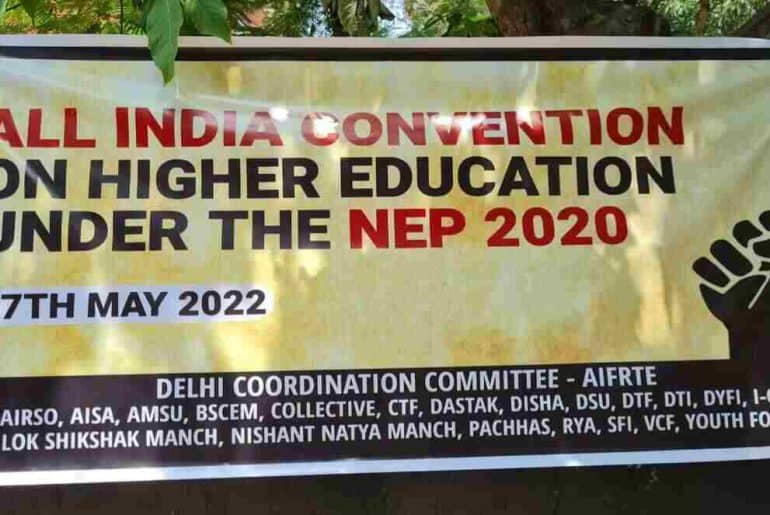
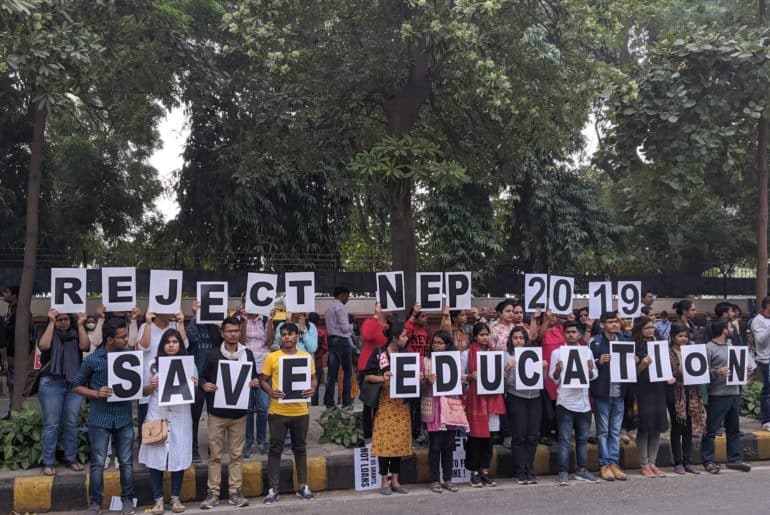
On 14th November, Students’ Union and Teachers’ Association from all central Universities in Delhi marched from Barakhamba Road to Jantar Mantar, and stood in solidarity with students from Jawaharlal Nehru University (JNU) to protest against the New Education Policy (NEP).

14th November observed a central march at Jantar Mantar against the NEP. Student Political groups from Delhi like All India Students’ Association (AISA), CYSS, Krantikari Yuva Sangathan (KYS), National Students’ Union of India (NSUI), Jawaharlal Nehru University Students’ Union (JNUSU), and Students’ Federation of India (SFI) came together to protest against the NEP, and the fee hike in JNU. The protest was led by Federation of Central University Teachers Associations (FEDCUTA) which incorporates the Delhi University Teachers’ Association (DUTA), Jawaharlal Nehru University Teachers’ Association (JNUTA) and Jamia Millia Islamia’s Teacher Association (JMITA )under it. Students showed up at the protest in large numbers with banners, masks to combat the Delhi pollution, and immense grit and determination.

NEP has paved way for Privatisation of education. It has also resulted in the constant fee hikes observed by the Universities. Under NEP, a new mechanism of Higher Education Funding Authority (HEFA) will be established to not give grants but to lend loans. DUTA also fought for permanent absorption of the Ad-hocs to have stability in colleges.

Damini Kain, Presidential Candidate from AISA, said “Public Education is a fundamental right for all. But what the new education policy is doing is, its just making education exclusive. It is deliberately excluding people that come from marginalised communities, lower caste backgrounds and other minorities. NEP is breaking the core fabric of education. It will change the entire dynamic of lending and granting into loans. And the burden of repayment of those loans will lie on the common student.”

The March witnessed many keynote speakers to apprise the students about the consequences of this policy.

Doraisamy Raja, General Secretary, Communist party of India appreciated the students and teachers of JNU to protest against the tremendous hike. He shed light on the importance of education and the threat to its integrity. He also criticised the one language ideology of the current Government.

The common demand that each JNU student and teacher had was to meet with their Vice chancellor and roll back of the fee hike. More than 40% of the students studying at JNU are below poverty line and cannot afford the new fee structure.

Aishe Ghosh, President, JNUSU, said, “All these charges that weren’t existing before like utility charges of electricity, water, food, WIFI will be paid by students even after giving a hostel fees. We’ve come here with a motive to spread this protest to every college and university ad education is for all. All we would like is for our Vice Chancellor to have a discussion with us rather than appearing on Republic TV.”

After all speaker sessions, the March began, led by Federation of Central University Teachers Associations (FEDCUTA), followed by various student organisations. The Teacher-Student-Karamchari unity was an important focus of theMarch.

Slogans like “NEP down down”, “Privatisation se azadi”, “Modi govt Haye-Haye” were chanted. Posters with “Godi Media” talking about the fake media portrayal of press were also displayed, and the banners of Teacher associations of various colleges were also seen.

Among all of these issues, the students from School of Open Learning also came to bring to light the struggles they had face being trapped in the sudden imposition of Choice Based Credit System.

A SOL student, who wished to remain anonymous, told DU Beat, “We’re fighting against the autonomy of education, yet, correspondence where most of the students from lower background study is often ignored. We have exams in December, yet we haven’t been given any books or material. And the material given is so substandard it cannot be used. And the worse, even DUTA has completely ignored us.”

Feature Image Credit : Noihrit Gogoi for DU beat

Chhavi Bahmba

[email protected]

The progressive National Education Policy (NEP) was in headlines recently when an old controversy reappeared in its document.

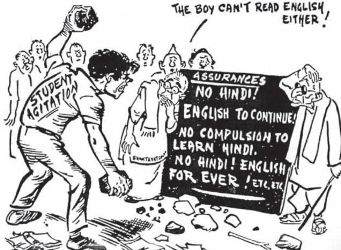
‘Balkanisation’ is a geo-political term used to explain the fragmentation of a large sovereign territory into smaller units due to social, political or cultural differences. The optimal examples of countries that surrendered themselves to this phenomenon are Yugoslavia and USSR. There are other failed attempts of segregation where states could not attain sovereignty because of compromise or suppression. Among others, the Indian state of Tamil Nadu is an astute example. The unflattering and relentless opposition of Tamilians towards the Hindi language has an 80-year-old history. It has led to violent protests, polarization and demand for a separate nation at different epochs of 20th century.

The current draft of the NEP is progressive in many ways. Orchestrated by noted scientist K. Kasturirangan, it promises to revitalize the ailing education system of India. Among other reforms, it changes the focus group for imparting education from 6-14 to 3-18 years. It also brings accreditation system in schools and envisions that by 2035, the gross enrolment ratio in schools will increase to 50% compared to the current 25%. But these amendments did not grab the eyeballs as much as a paragraph in the policy to implement the Three Language Formula did.

The Formula first appeared in the NEP in 1968. The clause suggests that along with Hindi and English, any Modern Indian Language be taught to students in Hindi-speaking states and the regional language be taught in non-Hindi speaking state. The formula resurrected the long-running resistance against Hindi imposition in South Indian states, especially Tamil Nadu. Tamilians, in order to conserve their identity and culture, have been protesting against compulsory Hindi education since 1937. Leaders like Periyar, who formed the Dravidar Kazhagam, initiated this anti-Hindi agitation when the then Indian National Congress government made teaching of Hindi compulsory in schools of Madras Presidency. The anti-Hindi sentiment has given genesis to the idea of Dravida Nadu, a hypothetical sovereign country comprising the non-Hindi speaking states of Southern India. E.V Ramasamy (Periyar) and C.N Annadurai, who were the initial proponents of Dravida Nadu, made an attempt to Balkanise India as they feared the hegemony of Hindi would repress their native languages.

But the fear is not inappropriate either. One of the most controversial subjects in the Constitutional Assembly debate was the selection of India’s official language. Noted historian Ramachandra Guha writes that when R.Dhulekar, a member of the house from United Provinces stood up to move an amendment, he started speaking in Hindustani. When the chairman reminded him that many people do not know the language, he replied, “People who do not know Hindustani have no right to stay in India.” The amount of chauvinism reflected in his majoritarian perspective makes it evident why our dear ones in the South are sceptical about compulsory Hindi education.

Following backlash from political parties in Tamil Nadu and Kerala, the government officially amended a portion of the NEP. In the new draft, students will have the choice of changing any language they want to. The war of language has been very sensitive and controversial in India. It has fabricated the politics of Tamil Nadu in such a drastic way that the implicit advocate of Hindi imposition, the Congress party has never come back to power after 1967 following the anti-Hindi agitation of that year.

The ship of Unity in diversity sails only when there’s unity without uniformity and diversity without fragmentation. Imposing uniformity by enclosing a country like India will bring consequences that we don’t need or deserve.


Feature Image credits: NCERT

Priyanshu

[email protected]