Tag

JNU

Browsing

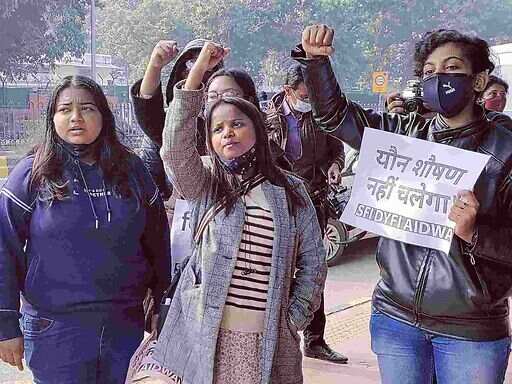
JNU’s Students along with SFI-AIDWA-DYFI staged a protest against the police inaction and demanded swift action for identifying and arresting the suspect who sexually harassed a student on campus on Monday night.


On 21 January 2022, the Students’ Federation of India (SFI) along with other student unions and associations, including All India Democratic Women’s Association (AIDWA) and Democratic Youth Federation of India (DYFI,) protested in front of Delhi Police Headquarters against the police inaction in regards to an attempt to rape at Jawaharlal Nehru University (JNU).  On Monday night, 17 January 2022, an attempt to rape was made on a JNU’s student. The student was taking an evening stroll near the VC house when a motorcyclist tried to drag the student into the forest and attempted to rape her. SFI condemns the casual approach of the police in this incident. They strongly feel that this incident is a shameful reflection of patriarchy that persists in society. Such incidents have been on the rise during the lockdown when vigilance has lowered. They find it disgraceful that students who identify with minority genders have to go through such traumas in University space. Asha Sharma, State Secretary of AIDWA, also condemns Delhi police for their lack of accountability towards the victim and towards the due process of law.

AIDWA Delhi was shocked by this unfortunate incident as it is a residential space where students return from libraries late at night. Moreover, since it has been considered a safer space for women, the female students often come out to walk even later than the time at which this incident has occurred. Satarupa Chakraborty from AIDWA points out that it is very irresponsible of the Internal Complaints Committee (ICC) who did nothing upon hearing about the incident. It is quite shameful that a young woman had to undergo such a heinous crime within the premises of a prestigious university.  She further adds the importance of escalating the efforts that are being made in bringing back the Gender Sensitization Committee Against Sexual Harassment (GSCASH) in JNU. In conversation with DU Beat, Twinkle Siwach, former GSCASH student representative, directed attention towards the ICC. According to her, ever since the ICC, the puppet body of the JNU administration (as opposed to the idea of GSCASH which was constituted with elected members from different constituencies) has been installed, they have witnessed that cases of harassment, stalking in particular, have significantly increased in number. She stated that woman students do not feel confident in approaching ICC, particularly because, in some cases, complaints have been leaked, or the blame has been put on the complainants. In the absence of GSCASH, students still find it a safer option to seek help from the former GSCASH student representatives instead of approaching any member from ICC. She points out that in some of the extreme cases; students prefer to contact the police directly.

This incident has once again highlighted the lackadaisical attitude of the JNU administration and ICC, which continues to control the freedom of women students inside the campus and does not outreach or come out in the support of the complainants or women students in general.

-Twinkle Siwach, former Gender Sensitization Committee Against Sexual Harassment (GSCASH) student representative

Elora Chakraborty, an EC member of the SFI JNU unit, in conversation with DU Beat strongly believes that the JNU administration should immediately pressurize the Delhi Police to carry out the investigation and arrest the culprit. The administration should leave no stone unturned to help the Police with all necessary information and data. Alongside the Administration, including the JNU VC, must immediately take not only cognizance of the crime but also apologize to the student community in general for the inability to provide security. Further, she stated that the scandalous appointment of Cyclops Security and Allied Services Pvt. Ltd. must be undone at the earliest. She marked out that ever since the security agency has been brought to campus, the campus is seeing more and more instances of security lapses in recent times like in this case of an attempt to rape a fellow female student along with the regular cases of sexual harassment in the campus space or on 5 January 2020, when the Jawaharlal Nehru University Students’ Union (JNUSU) President Aishe Ghosh was attacked by right-wing goons in a premeditated manner and also of harassment of students by the security agency. When the security agency is ill-equipped to provide the campus with the security they must immediately be replaced.

It is needless to say the JNUSU demands resignation of the JNU VC Mamidala Jagdish Kumar for degrading the institution and if the question is about what JNU students are doing, they already are protesting for justice to the survivor and for the revival of GSCASH in the campus alongside the JNUSU.

-Elora Chakraborty, former JNUSU councilor for School of Social Sciences, EC member, SFI JNU

Concluding her statement, Elora asserted that the student community in JNU will not rest until justice is provided to the survivor and the culprit is arrested. The voice for the reinstatement of GSCASH is getting stronger day by day and students are coming out on the streets of JNU and Delhi to demand justice for the survivor. On 20 January 2022, the student community walked alongside the JNUSU reclaiming the night with the campus in a March from Sabarmati hostel to the VC house. On 21 January 2022 the JNU student community and the JNUSU marched to the Vasant Kunj Police Station demanding speedy justice to the bone-chilling crime on the campus.  AIDWA-SFI-DYFI had a common call of protest at the Delhi Police headquarter to make campus spaces safer. The protest will go on in the demand for justice for the survivor and reinstatement for GSCASH.

Read Also: Multiple Accusations of Sexual Misconduct Against A Doctoral Student from JNU

Featured Image Credits: Chirag Jha for DU Beat

Ankita Baidya

[email protected]

Casteism has been lurking in our systems as a product of historical grievances. From condemning the actions to being the perpetrator, is this deep rooted caste bias finding new ways to make itself comfortable?


Yet in another turn of events, a student from scheduled caste, hailing from the Jawaharlal Nehru University (JNU), had to face the atrocities of casteism. The victim, Sagar Kumar, was subjected to physical brutality over refusal to copy the assignment of the alleged attacker, Shubham Kumar. In a conversation with Dalit Desk, Sagar explained what he faced.

On 28 November, at night 11, I was studying in my room while Shubham came in and asked me to do his assignment to which I refused and told him the teacher can fail me for this. Several times he insisted but I refused. Thereafter he hurled Casteist slurs at me and started abusing me and beat me. Adding, I am mentally traumatized after this incident; strict action must be taken against him.

-Sagar Kumar told Dalit Desk.

According to the report by Birsa Ambedkar Phule Students Association (BAPSA), JNU, Shubham Kumar has been abusing Sagar Kumar for the past one year. This has put the latter through a great deal of purgatory and physical trauma. This incident is a reminder of the prevailing status quo arising out of casteism. BAPSA found Sagar Kumar with a high blood pressure. He was shivering in fear for his life while his voice was cracking. A complaint of the aforementioned incident has been lodged at National Commission for Scheduled Caste, Vasant Kunj Police Station, Equal Opportunity Cell (JNU) and Chief Proctor of JNU. The creamiest brains putting it out at the most premier institutions of the country makes me wonder, if we are too invested in literacy that educating the consciousness has taken a back seat.

The shameless shout out for impunity by Shubham Kumar only exposes the fault lines of the self-proclaimed island that JNU is.

-BAPSA, JNU

The irony of the entire situation is the fact that we condemn the very actions that we see being perpetuated around us by our own people. From using the casteist slurs to mocking the minority in the name of comedy, we are witnessing a degree that is pulling us towards the breaking point. Institutional casteism is on the rise and this incident comes as no shock. A recent study suggests the lofty prevalence of casteism in higher educational institutions but the constancy of this sitch is quite overwhelming. What irks me is the smell of normalcy around it. Unless the blood oozes out of the situation, the discriminatory and defamatory acts are subjected to negligence. How can these deprecatory and belittling instances thrusted aside while condemning them?

The very existence of the grievances cell for the marginalised section in the educational establishments proves the existence of these preferential and unjust acts. Creation of these cells to seek redressal has pulled curtains over the actuality of the situation. This has made it easier to achieve those estranged dreams in the crippling shadows of the same. Meddling with casteism does question the political agenda and its pernicious relationship with it. A peculiar pattern can be observed in the same regard, even at the places of education. Meenakshi Yadav, the representative of Student Federation of India (SFI) from Lady Shri Ram College spoke to DU Beat. She questions the standing of this circle which instigates casteism while fulfilling their political dream.

Brahmans portray themselves that they are in-charge, they are in power. They feel a sense of superiority due to the presence of the current governing body.

-Meenakshi Yadav, SFI representative, LSR

It is a simple monopoly of strength to establish dominance of a caste by the ones in power. Showing the monochromatic nature of elitism, it pulls the reins of casteism. It aligns the political inclinations and caste-based notions, producing a class of inherent elitism. This is an establishment which teaches equality and the next minute pulls the card of ‘winner-winner, political dinner’.

Koi gujjar hai toh batado, humko dosti karni hai par sirf apne cast walo se.
-A first year student as quoted by Meenakshi Yadav, SFI representative, LSR

Delhi University has long been known as a place where tensions arising from casteism have been lit. Not long ago, it had displayed a reservation of their thoughts when the writings of two dalit writers, Bama and Sukhartharini, have been removed and replaced by the work of an upper caste writer, Ramabai. This altercation of syllabus poses a sheer threat to the sovereignty of the institute and questions the autonomy of the academic space. How can we account for the pillars of democracy with a prejudiced and biased eye? Is this discriminatory influence above the education imparted by the most premier institutions?

A student from Delhi University told DU Beat on anonymity, “It is quite usual for me to go about
my day and hear people using a language that might not be welcomed by any marginalised group. Even if we retaliate, all that comes out is a small laugh and the words are expected to be forgiven the next minute. It is quite normal to see the usage of such a language, be it in college or my neighbourhood. It is the same story spinning everywhere.”

Our civilizational past shows us the derogatory history of this section of the society. The pain inflicted on people like Sagar Kumar is told in pursuit of the lost self-respect and in anticipation to put an end to such infamous incidents. It is veracious to say that we are experiencing an infamous facade of cruel reality. The blatant act of turning a blind eye to the prolific iniquity by the prestigious establishments makes me question the due justice. Will a fair play swing by the wronged eyes or will it continue to serve exoneration to the offenders?

Featured Image Credits: ‘Skyscape’ by Rajyashri Goody via India Today

Ankita Baidya

[email protected]

Delhi High Court places an interim order against the new JNU Hostel manual and asks JNU administration to keep registration fees, reservations, and priorities according to the old manual.

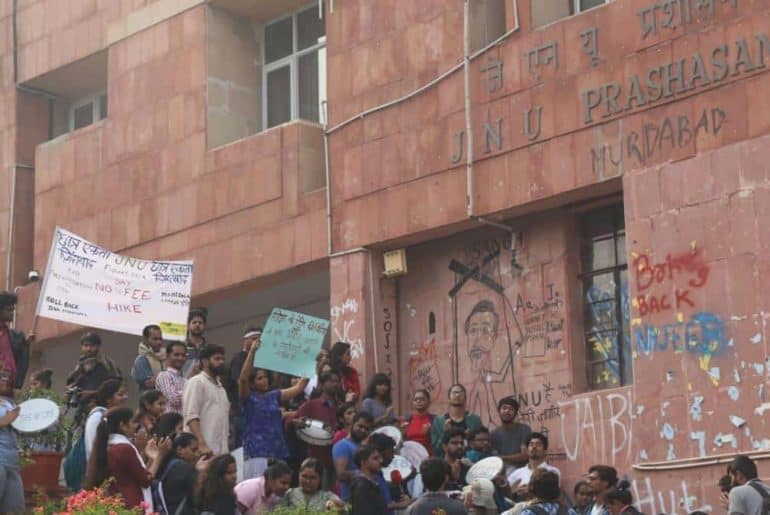
On 28thOctober 2019, The Jawaharlal Nehru University (JNU) Administration unveiled a new hostel manual with extremely steep hostel fee hikes. The rationale given by the JNU administration was that the hostel fees had not been revised for 19 years. However, these overall fee hikes would have led to JNU becoming one of the most expensive central universities in the country. The Jawaharlal Nehru University Students’ Union (JNUSU) held massive and continuous protests against the decision by the administration, stating that according to the University’s own annual reports, 40% of the students who come from lower income backgrounds would not be able to afford the revised fees and would have to pursue education elsewhere, if at all.


Earlier this week, the Delhi High Court has granted a major relief to the students of JNU upon hearing a petition filed by AIshe Ghosh, JNUSU President and other office bearers against the new hostel Manual. According to a legal update dated 24th January, 2020, from JNUSU. The High Court has directed the JNU Administration to:

Firstly, allow for registration at old rates, as per the previous hostel manual; for students yet to register. Secondly, extend the last date of registration for a week without late fine. Thirdly, apply reservations and priorities/benefits according to the old hostel manual. And lastly, to hold dialogue with the students in order to resolve the issue.

Justice Rajiv Shakdher, who was hearing the case, points out that “Government can’t get out of education. Government has to fund public education. The burden of paying the salaries of contractual workers is not on the students. Someone has to find the funds.”

The next hearing of the case will be held on 28thFebruary , 2020.


Feature Image Credits: The Print


Prabhanu Kumar Das

[email protected]


As India celebrates its 71st Republic Day, let’s take a look at our dissenting Republic.

According to the Oxford dictionary, a Republic is defined as a State in which supreme power is held by the people and their elected representatives, and which has an elected or nominated President rather than a Monarch.

India, the largest democracy in the world, became a republic on 26th January 1950. In over seven decades, 103 amendments have been enacted as of December 2019. India celebrates Republic Day with much grandeur where our military might is put on display for the world. The celebration witnesses world leaders as Chief Guests for the day. This year, Jair Bolsonaro, President of Brazil, has accepted to be the Chief Guest for the celebrations.

All the citizens of this nation have been granted the Freedom of Speech and Expression; however, many have questioned the Government when it comes to the Freedom of Dissent. A student from the University of Delhi (DU), on conditions of anonymity, said, “In 2014, our PM said that the country’s democratic principles will not sustain if we don’t guarantee freedom of speech and expression. When we go out to protest, we are detained, even when it is a peaceful protest. I ask ‘why’? Is the Right selective? Do we have the Right depending on the Government’s wishes?”

I believe that dissent is not anti-national. Our country has been built on expression at crucial times in history. Gautam Buddha and Mahavira had expressed their displeasure over the rigid Vedic system and the associated rituals during the sixth century. The Sepoy Mutiny of 1857 was the first form of dissent by the Indians against the British rule. This even continued after Independence.

J. P. Narayanan’s call for a revolution in the social, economic, and political sphere in 1975 led to the imposition of Emergency and the whole Country turning against the then Government led by Indira Gandhi. A country cannot be free if its people feel threatened in any way, or if there is a fear of expressing oneself.

It is important that the youth, as responsible young citizens of India choose to fight for what is right. It is our prerogative to make sure that there exists a culture of democratic discussion and peaceful dissent, where there exists no violence, where the youth protests for the cause, and not for name and fame.  It is disheartening that during the times when the entire nation was protesting, some student leaders found their way to be a part of larger political organisations to favour their interests. Thus, at that time, the cause is left behind, and the political career is given more light. I saw a few people who came out to ‘protest’ at Jantar Mantar on 19th December 2019, while they saw the protesters raise slogans against the Government, one of them remarked, “acha timepass ho raha hai” (this is a good way to pass time).

The Constitution also provides for an independent Judicial system and the integrity of the higher Judiciary. So, doesn’t the judiciary hold any conscientiousness towards the alarming situation of India? I strongly feel that the Legislature, the Executive, the Judiciary, and an independent Press are the real pillars of India. Even if one of them doesn’t question the damaging image of India, then they are not justifying their existence to the citizens of the country and to the rest of the world. In these times when grave violations of human rights are being alleged every day, it is imperative of the judiciary to fulfil its constitutional duty, maintain its democratic significance, and uphold its institutional prestige.

India’s population of over 1.37 billion people gives us an indication of how many ideas and opinions can flourish in a democratic set-up. Constructive criticism and meaningful dialogue area hallmark of a democratic society and depends on its informed and active citizens who will speak out and distinguish themselves from rabble-rousing.

Anoushka Sharma

[email protected]

Universities, the breeding ground of education and ideals, echo today with chants of Azadi, and Faiz’s Hum Dekhenge. They think we’ll let go and surrender. However, they don’t know that our resistance is stronger than their hatred.

 
As another year goes by, the ‘one who must not be named’ reigns back to power and, yet again, the country erupts in massive dissent in one of the ways propagated by the moderate protests. While more universities get labelled as ‘anti-national’ by the followers of the ‘party that must not be named’, I am reminded of Satyajit Ray’s Hirak Rajar Deshe (1980); as the protagonist says, “Era joto beshi pore, toto beshi jaane, toto kom mane.” (The more they learn, the more they know, the less they obey).
Nandini Sukhija, a student of Mumbai University, said, “Our political leaders gain power by mobilization of groups, which are usually composed of brainwashed partisans. The intellectuals know better than of all for their cheap and divisive tactics, by which they threaten the Government’s power. It’s not hard to connect the dots and realise why fascist governments will always clamp down the educated and shut down channels of information.”
The well-read are rational critics whereas the ideologists are the irrational ones. Targeting universities, the educated, scholars, and writers, is an age-old gameplay to curb the anti- establishment voices, to curb nothing but dissent and voice.

Forcing the well- read to obey the regressive actions coerced on the vulnerable sections of the society is a task of great objection. The very reason why their voices are silenced is that the establishment is aware that they are wrong, they know that they’d fail if the truth prevailed, if the educated people’s voice reverberated.

The youth is the ‘future’ of India, long ahead after the remains of the politicians have vanished into thin air, their remnants left as a by-product of hate, fear and, fascism, the youth will still exist.

History is evidential of the exemplary contribution and corrupt silence that students are bestowed upon by fascist governments. When the ones to oppose, the ones to criticise cease to exist, their propagation, their ideology, their reign thrives. Democracy without opposition is no democracy at all. Arresting the well-read and labelling them as urban Naxalites is a reminder of the very failure of democracy.
Central universities ordering students to not protest, charging them of disciplinary action to prevent dissent or questioning the Government, Is everyone an accomplice here?

“Educational institutions are the hotspots of awareness. Silencing educational institutions to gain peace is like burning the Amazon and then expecting the earth to be ecologically sound. The consequences will only intensify. “Finger on your lips is not something appealing to the youth,
neither is it going to stay for too long,” Priyanshi Banerjee, a student of Lady Shri Ram College rightfully explains.
If we go down the pages of history, Nazi Germany right before World War II reminds us of eerily similar circumstances. Sonderaktion Krakau, a German terror operation against academics at Jagiellonian University performed in order to eradicate the Polish intellectual elites.

Along with this, Frankfurt University was the first university targeted by Nazis for their liberal, exuberant academic record, scholarships, international faculty, and uphold of democratic values and ideals.
The times we live in are scary, they attack unarmed students, name-call academicians, murder journalists, hush down voices, curb protests. Where is dissent? Where did the safety valve of democracy go?
All revolutions, all rebellions, nationalist movements, demand for rights, protests, agitations, all starts from the students; the very foundation of a stable country. The recent attacks on students at various universities are nothing but an act of cowardice in the world’s largest democracy; the very country which once upheld the ideals of secularism, democracy, justice, liberty, and equality.

Feature Image Credits: DU Beat

Anandi Sen 

[email protected]

ABVP-led DUSU slams the Left for 5 January JNU violence and anti-CAA protests with hoardings all over North Campus. ABVP and NSUI exchange words regarding no official meetings, securing permission and wasting union budget. 

University’s North Campus has been covered with hoardings put by the Akhil Bharatiya Vidhyarthi Parishad (ABVP)  led Delhi University Students’ Union (DUSU) blaming the Left for the January 5 violence inflicted at Jawaharlal Nehru University (JNU). They have also blamed the Left for protesting against the Citizenship (Amendment) Act. 

 Akshit Dahiya, President, Delhi University Students’ Union (DUSU) has accepted that the provocative hoardings have been installed by the ABVP. “They (the Left) are speaking about breaking India and slogans and banners seeking freedom for Kashmir have sprung up at their protests. There are attempts to project students’ protest in a negative way,” said Dahiya. 

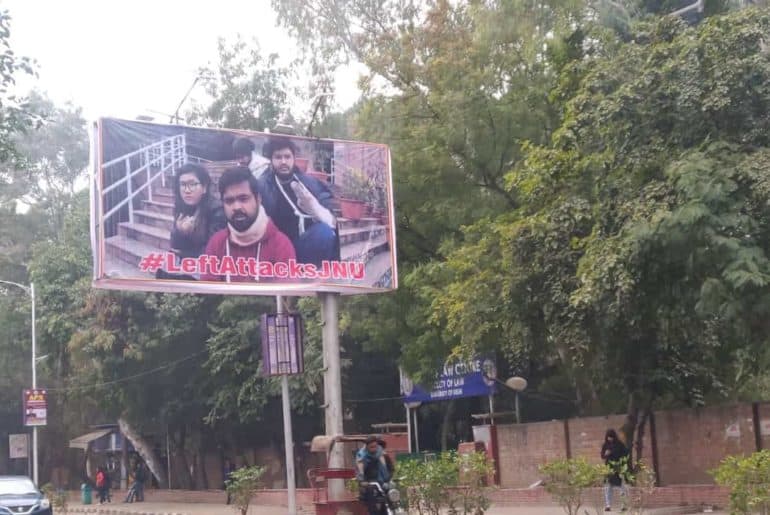
The DUSU sits on an unbalanced note as three of the members are affiliated to ABVP while the post of Secretary comes from a rather different ideology; led by the Congress-led- National Students’ Union of India (NSUI). Dahiya added that three hoardings have been put up near Law Faculty after attaining the required permission from authorities. The hoardings have messages such as “CAA ke naam par desh jalana bandh karo” (stop burning the country in the name of CAA) and “Left attacks JNU,” carrying pictures of ABVP members injured in the Jawaharlal Nehru University (JNU) January 5 violence and those injured due to anti-CAA protests all over the country. One of the hoardings also shows mob pelting stones.

However, the National Students’ Union of India slammed the rather cheap move by ABVP. Ashish Lamba, Secretary of the DUSU questioned the ABVP’s decision to put up such posters as there was no official DUSU meeting regarding the same. Dahiya countered the claim by stating that DUSU Executive Council which comprised 15 members, including the four DUSU office-bearers who came to the conclusion with the consensus of 10 members.  

The Delhi President of NSUI, Akshay Lakra, criticised the wastage caused by ABVP-led DUSU of the Union’s budget. Accusing the ABVP in indulging in dirty left-right politics in free university spaces, Lakra continues, “Despite being exposed many times by media and JNU students, ABVP still hasn’t accepted its defeat in its own propaganda. The NSUI strongly condemns any sort of hate campaign run by political parties on university campuses. It’s high time that we restore peace and harmony on campuses,” he said. To counter this claim, Akshit Dahiya, DUSU President, denied using the budget for putting up the hoarding rather the Executive Council contributes 200 INR per member. 

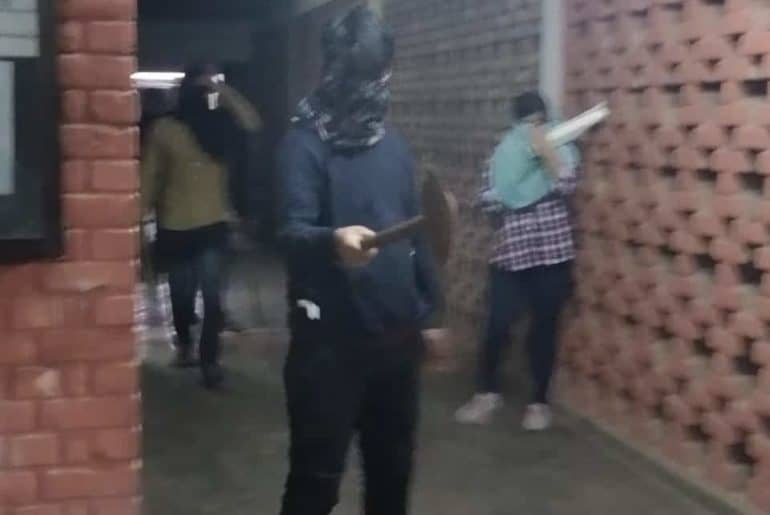
January 5, 2020, went down quite unfortunate on JNU as masked men and women barged into the campus with weapons, vandalising and injuring people as the Delhi Police observed in silence. Media debated and conspired to blame the Left for inflicting violence on the left, thus perpetuating the idea of ‘Left Terror’. However, within a few days, Pinky Chaudhary of Hindu Raksha Dal took to video to claim responsibility for the merciless attack on unarmed students. In the video, Chaudhary says, “For several years, JNU has been a bastion of communists and we will not tolerate it. Hindu Raksha Dal, Bhupendra Tomar, Pinky Chaudhury take the responsibility of what has happened in JNU…all of them were our volunteers. Those who cannot do such work for Mother India don’t have the right to live in this country.” The violence instigated on students was deadly as over 30 injured students and professors were admitted to AIIMS Trauma Centre on the night of 6th January. 

Featured Image Credits: Jaishree Kumar

Anandi Sen
[email protected] 


Students participated in a peaceful protest held at Jesus and Mary College on 8th January 2020,  where they also faced problems by the Student Body due to restriction of dissent by the Administration.

Jesus and Mary College (JMC) saw students gather on the 8th of January 2020, outside the campus in Chanakyapuri, New Delhi at 10:30 a.m. to show solidarity against the brazen misuse of political power and violation of basic Fundamental Rights by the Government. The state-sponsored violence meted out to the students of various educational institutions across the country was strongly condemned, in a silent protest held in front of the campus.

1578488824620_3_IMG_20200108_111548

Students condemning State-sponsored Violence

Despite the absence of the Students’ Council from the place of protests, a message was circulated by them before the protest, condemning violence and voicing their support for freedom of speech in a peaceful way. The students, however, were sceptical at the apolitical stance of the student council, which had earlier refused to comment and release a statement of solidarity condemning the violence citing different views of students. Some students also cited the pressure from the administration when it came to the college societies and departments to release solidarity statements.
Later, the Students’ Council urged the students to come inside the college campus and protest after seeking permission from the Principal.
Some students chose to continue the protest outside the college campus.

The silent protest was held in a peaceful manner, a welcome change that encouraged and fostered dissent in the erstwhile apolitical campus of JMC. Students held banners criticizing the government and the forces of law and order. A healthy dialogue about democracy was fostered, in a protest that saw attendance by students from other colleges too. No disruptions by the police occurred. A group of students joined the protests at The Faculty of Arts, North Campus immediately following this at 12:00 p.m. Students affirmed their support for dissent against authoritarian forces, condemned the growing excesses of fascism within the country and stood up for student-worker unity.

Feature Image Credits: Paridhi Puri for DU Beat

Paridhi Puri 

[email protected]


In an unforeseen turn of events, Bhupendra Tomar, leader of ‘Hindu Raksha Dal’, a right-wing organisation claimed responsibility for the attacks on the teachers and students of Jawaharlal Nehru University (JNU) in Delhi on the 5th January 2019.

 Bhupendra Tomar, leader of Hindu Raksha Dal, a right-leaning organisation claimed responsibility for the attacks on the teachers and students of Jawaharlal Nehru University (JNU) in Delhi on the 5th January 2019 through admission in a video.

The video surfaced on the internet after being posted by a Twitter user where Tomar, popularly known as Pinki Bhaiya blamed the university for being a hotbed of “Anti-National” and “Anti-Hindu” activities.

Bhupendra Tomar, said in the video, “We take full responsibility for the attack in JNU and would like to say that they were our workers. The way these people have been behaving over the years, especially the people in JNU, it is against our religion. We can never tolerate such anti-national activities,”.

According to the ANI report on the issue, Government sources have informed that the claims made by Pinky Chaudhary (Popular name for Bhupendra Tomar) are under investigation. The sources also informed that the Delhi Police is using CCTV footage and facial recognition to identify the masked men and women.

He also added, “These people live in our country, eat here, study here and indulge in anti-national activities. Hindu Raksha Dal will never tolerate this and again attack whoever tries such ideals.”

He with much pride also confirmed the party’s ideology to engage in further violence in the name of nationalism.

Affirming to that, Pinky Chaudhary said, “If in future others indulge in similar anti-national activities, we will again carry out a similar action in those universities. We take responsibility to carry out these actions.”

The gruesome display of violence that the students and teachers of JNU endured where more than thirty people were injured along with tremendous property damage by the people, who were seen carrying around sticks and rods has succumbed to this video.

JNU Students’ Union (JNUSU) president Aishe Ghosh was also injured in the incident and was rushed to AIIMS along with the other injured people. All of them were discharged on Monday.

This incident raises major questions about the safety of the students on campus. However, both JNU Students’ Union (JNUSU) and Akhil Bharatiya Vidyarthi Parishad (ABVP) have blamed each other for the violence.

Feature Image Credits: ANI

Khush Vardhan Dembla

[email protected]

Students’ Union President Aishe Ghosh sustains severe head injuries. Students and teachers have been attacked and hostels vandalised. Roads to JNU shut, and streetlights turned off. Read on to find out more.

Students of Jawaharlal Nehru University were attacked by masked men wielding lathis and other weapons. The news broke in the evening when visuals of the JNUSU President Aishe Ghosh went viral. In the video, Ghosh is heard saying “I have been brutally attacked by goons who were masked…I am not even in a condition to talk, I was brutally beaten up”. Gosh sustained head injuries and was soon rushed to the AIIMS Trauma Center. 

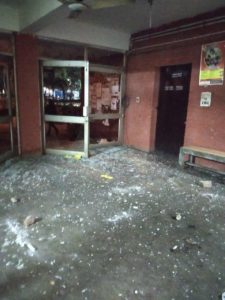
Students allege that the masked goons entered Sabarmati, Mahi Mandvi, and Periyar hostels were they attacked students with lathis and vandalized property.
In a video allegedly from the Periyar hostel, women can be heard screaming ‘These people are not from JNU, they have acid with them…they are attacking people.”

IMG-20200105-WA0115
Aishe Gosh, the JNUSU president was rushed to AIIMS after sustaining severe head injuries.
IMG-20200105-WA0080
Sabarmati Hostel of JNu vandalised

Teachers were allegedly attacked too. Pictures show that Suchitra Sen, a professor at Centre for the Study of Regional Development, JNU was attacked too while she tried to shield students from attackers. 

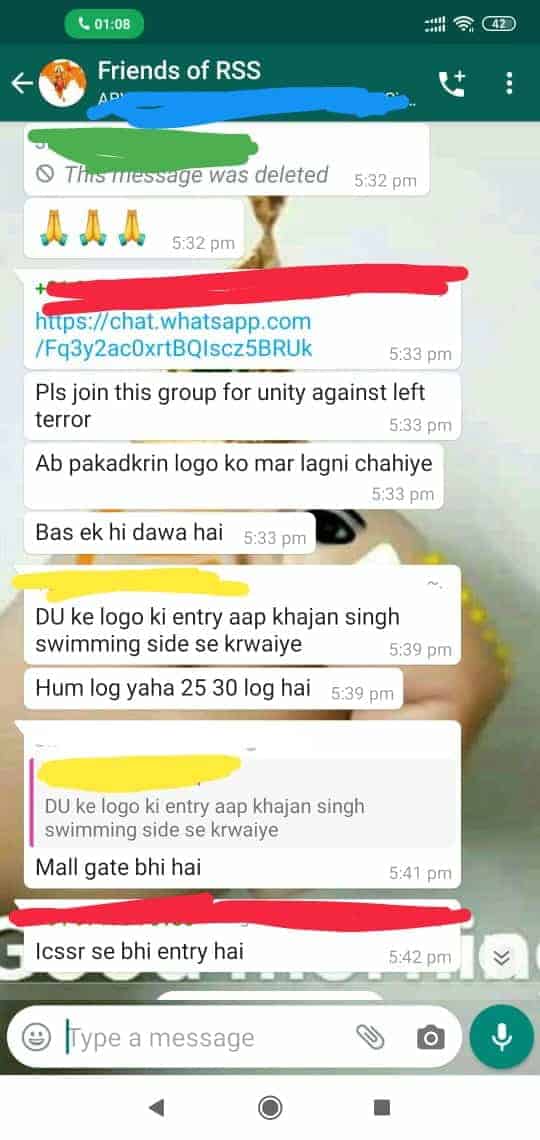
Screenshots of a WhatsApp group called ‘Friends of RSS’ went viral which showed members discussing the plans to attack the university and the possible ways to enter the campus.

IMG-20200105-WA0102__01
the WhatsApp group where the attack was allegedly planned.

In another video allegedly taken from JNU, chants of ‘Vande Mataram’, and ‘Bharat Mata Ki Jai’ are heard. 

The JNUSU has alleged that the attack was orchestrated by the Akhil Bharatiya Vidhyarthi Parishad (ABVP) which is backed by the Rashtriya Swamyasevak Sangh (RSS) and the Bharatiya Janata Party (BJP). The ABVP has denied its role in the attack and has claimed that students of youth groups affiliated to the Left attacked the ABVP members near the admin block. The ABVP claims that 25 of its members were attacked and 11 of them are apparently missing.

The routes leading to JNU have been shut off by the police, As per sources, students aren’t being allowed to enter or exit the campus unless they’re gravely injured and the streetlights have been turned off. Masked goons with lathis are still freely roaming inside the campus.

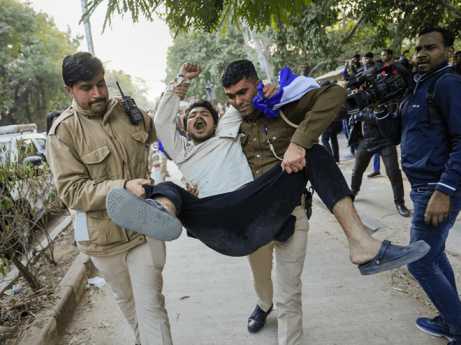
Several protesters have gathered at ITO in front of the Delhi Police Headquarters to protest against the incident.

Students were allegedly attacked yesterday too over the indefinite strike over the fee hike, The Students’ Union had called for a registration boycott. Satish Chandra Yadav, the General Secretary of JNUSU was attacked along with many students. Students alleged that the perpetrators of the violence were the Jawaharlal Nehru Teachers’ Federation (JNUTF), and the ABVP.


Note: This is a developing story and will be updated as more information comes in. 

Image Credits: Various

Jaishree Kumar 

[email protected]


The JNU administration decided to conduct the end-semester examination, in a peculiar alternative method amidst protests by the students. The student body has boycotted this alternative system adopted for conducting the examinations.


In a recent circular issued by the JNU administration, the end semester examinations are to be conducted by an alternative mode through WhatsApp and e-mail for MPhil/PhD and MA Programme citing that this step has become imperative in view of the persistent student strike, call for boycotting the examination and physical prevention of holding of such examination by the agitating students by closing down the school/centre buildings.


In a letter sent to all Centre chairpersons, School of International Studies (SIS) Dean Aswini K Mohapatra said the decision was taken “in view of the extraordinary situation” on campus, after a meeting of the Deans of Schools and Chairpersons of Special Centres with the Vice-Chancellor and other officials. It could not be confirmed if the step was being taken in all Schools.


Musaib Ul Haq, the hostel president of JNU told DU Beat that the students have rejected collectively this mode of examination. Calling it an insult to the university, its academics and its ethos, the JNU Students Union said, “Our fight was not regarding the examinations but regarding the complete rollback of fee hike and the illegal hostel manual. If the fee hike with increased room rent and service+ utility charges is implemented, a lot of students won’t be able to survive in the university. The online mode of examination initiated by the VC is an insult to the university, its academics and its ethos. This university has upheld the mantra of ‘Study and Struggle’. We shall not accept sub-standard modes of examination.”


The last day for submitting their answer scripts was 24th December 2019. However, students have rejected to accept this mode of examination and said that the circular on online examinations also violates the statutes and ordinances of the university. It also violates the press release issued by the MHRD which asked the Service and Utility Charges to be rolled back and a buffer period provided for exams. A JNU student commented, “The circular regarding the alternative way of examinations and threat of not being able to register for the next semester don’t have any legal standing. The Teachers Association met with the MHRD and they will release a statement soon.”


The Centre for Political Science faculty has unanimously rejected the online/alternative mode of examination and won’t send any question paper for the M.A., M.Phil. or PhD programmes. Students are requesting their respective chairperson and faculties to support them and reject the bizarre mode of examination.


Apart from academic loss, this mode examination does not ensure any malpractice and therefore raises questions on its validity. Conducting the examination through WhatsApp and e-Mail has not been received well by the students and teachers and further decision on this is expected soon.


Feature Image Credits: DU Beat archives.


Sriya Rane

[email protected]