Tag

JNU

Browsing

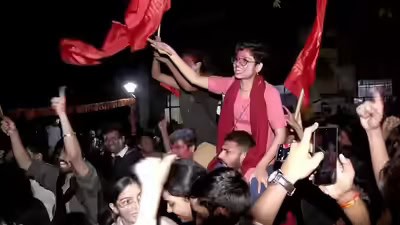
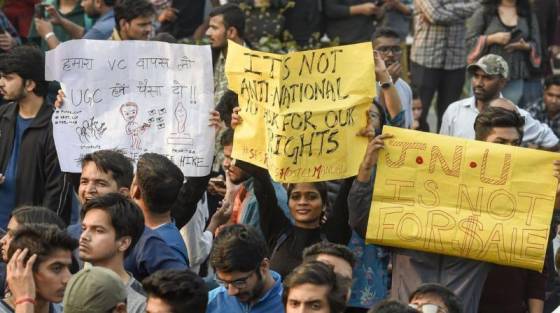
On the night of November 6th, election results were released, cementing Left’s dominance in JNU student politics as the alliance Left Unity swept the central panel. Unlike last time, AVBP was unable to get a hold of a seat in the central panel and especially in the councillor seat of School of International Studies (SIS) or School of Social Sciences (SSS) which it has previously won. 

On November 4th, elections for the new Jawaharlal Nehru University’s student union (JNUSU) was held. Many student unions formed panels to fight in the elections, namely the RSS backed Akhil Bharatiya Vidyarthi Parishad (AVBP), Indian National Congress Student Wing National Students’ Union of India (NSUI) and an alliance of All India Students’ Association (AISA), Students Federation of India (SFI) and the Democratic Students Federation (DSF) named Left Unity. Many smaller organisations and independent candidates also stood in the elections.

The counting began on the night of the 4th November and finished on 6th November night. A total of 5,802 votes were casted of the 9,043, 64% voter turnout. The alliance Left Unity swept all the central posts. For the president position, Aditi Mishra got 1,977 votes, around 33% of the votes, beating the AVBP backed candidate, Vikas Patel by 449 votes. The vice president Kizhakoot Gopika Babu won a staggering 3,101 votes, more than half of the total votes. For the general secretary Sunil Yadav secured 2,005 votes and Danish Ali secured 2,083 votes for the joint-general secretary. 

AVBP which had won seats in the last election, was unable to make a comeback in the central panel neither in many of the councillor seats especially SIS or SSS which they had previously won. Asking a JNU student as to why this was the case, they opined that it was due to an increase of violence. They recalled that the SSS general body meeting (GBM) had turned ugly when people started fighting, using abusive and casteist slurs against each other. It turned violent when elected councillor candidates and the JNUSU President were attacked. Another factor that they said was when a FIR was lodged against the students who went to report the above mentioned incident. Due to these incidents the alliance Left Unity was able to consolidate its hold.

The votes being divided in the last election due to two different left alliances was, for many, a major reason as to why ABVP was able to consolidate a seat in the central panel. This time however left organisations were able to come together and form a single alliance. Critics have, however, pointed out that the alliance has sidelined many smaller organisations and accused them for slacking on student issues. 

The results have cemented the Left Unity’s dominance in the university’s student politics and has marked a change in its strategy to organise, marking a significant shift from the previous election.


Read More: DU Cancels a Seminar from DSE’s Longest-Running Colloquiums, Convenor Resigns

Image Credits: Times of India

Reva Rawat
[email protected]

JNU, known for its extensive initiatives on creating environmental capacity building and livelihood practice, has approved another milestone, setting up a statutory body for creating animal welfare seeking to integrate compassion and sustainability.

JNU established an animal welfare society, a known initiative also adopted by Ashoka University, which possesses an Institutional Animal Ethics Committee (IAEC) that supports an animal welfare club known as Team Pawsitive.

The initiative has been rolled out under the leadership of Vice Chancellor Santishree Dhulipudi Pandit, in line with directives from the Ministry of Education and the University Grants Commission (UGC), and in keeping with the vision of the National Education Policy (NEP) 2020.

This initiative includes an animal feeding zone, awareness campaigns, and teams to research animal law, ecology, and sustainability. This move is also getting attention  in the wake of the recent order by the Supreme Court to not send the stray dogs to shelter homes. This will definitely help the varsity animals to get an ally in this precarious situation. 

This initiative was accompanied by several dog bites reported earlier this year. Since the campus is surrounded by extreme forest canopy, it is likely that the animals from nearby Sanjay Van hop and reside here. The campus is spread out over 1,000 acres, accommodating several animals; while some students feed them, others feel scared. 

Currently, the society will be chaired by associate dean of students, Professor Piyush Pratap Singh, and includes faculty members, staff members and external advisers such as animal-rights activists Gauri Mauekhi and PAWS Foundation’s Vipu Jain. 

According to Vice Chancellor Pandit, the initiative is designed not only to encourage sustainability but also to embed animal welfare into the university’s academic and social environment, 

This move creates a model for other universities by bringing together education, biodiversity conservation, and sustainable living.

Kinjal Sharma

[email protected]

Featured Image Credits: The Indian Express

JNU has grabbed headlines again, and this time for its food policing agenda. The Maha-Mandvi Hostel of JNU is witnessing a cultural crisis of food-divisive policy.  

The Maha-Mandvi hostel of JNU witnessed a recent clash on the food-policing agenda of ABVP.  The hostel has introduced a new segregation arrangement for people with non-vegetarian and vegetarian needs. Students refer to this move as “divisive” and “disturbing” to the academic space of JNU. When asked about this incident, a student of JNU, on the account of anonymity, said,

JNU has a tradition of hosting special dinners on occasion. This is not the first time this has happened; in the past, there was a very violent altercation over the same issue at the Kaveri Hostel. As the Saawan month is going on, ABVP uses religious festivals as an excuse to indulge in politically motivated tactics.”

Saawan is a sacred month for Hindus to abstain from any indulgence in alcohol and non-vegetarian food. However, since there was no deliberate pressure to adhere to these standards, this is regarded as a harmless move; those who wished to do so could do so without any consequences. “JNUSU protested vehemently against this initiative but later quietly withdrew from it when they were reprimanded by the administration,” said an eyewitness.

Following the disturbing incident of food-based segregation at Mahi-Mandavi Hostel, JNUSU immediately intervened and raised the matter with the concerned authorities,” the union said in another statement.  JNUSU said that they had progressed the matter to the point where the administration will now initiate an inquiry against the perpetrators. This comes as a surprise in a space that is known for its academic integrity and cultural discourse. However, the union pledged to continue defending constitutional values and to oppose all forms of communal or discriminatory practices on campus. This is still a developing story. 

Image Credits – X account of JNU

Kinjal Sharma

[email protected]

Also read: https://dubeat.com/2025/02/27/communal-flashpoint-at-sau-abvp-members-allegedly-assault-students-over-non-veg-food/

This piece delves into the issues that centre around allegations of sexual harassment against Professor Priyadarsi Mukherji, a senior faculty member at the Centre of Chinese and South East Asian Studies (CC&SEAS) within the School of Language, Literature and Culture Studies (SLL&CS) at Jawaharlal Nehru University (JNU) and the subsequent voices challenging the accused.

A second-year Master’s student from the same centre as Prof. Mukherji, has accused him for engaging in unwelcome behaviour, including persistent messaging, calls, requests for “personal” meetings, and sending lewd poems. Moreover, when she rebuffed his advances, the professor allegedly threatened her with academic consequences, specifically mentioning potential failure in her coursework. 

The survivor lodged a complaint with the Internal Complaints Committee (ICC) on 10 April, 2024, but no restraining order was issued against the accused by the ICC, and he continued to teach even after that. The Order of Restraint mentioned here is a procedural tool within the Internal Complaints Committee (ICC) of educational institutions. This order is part of the institution’s disciplinary process and it outlines behavioral expectations for the accused during ICC investigations, restricting actions like contacting the complainant or influencing them. 

In conversation with DU Beat, Avijit Ghosh, Vice President of JNU’s Student Union, added, “Since the complaint was against a professor by his student, the order also needs to restrict him from teaching. So, after the enquiry process starts, the accused is technically forbidden to take classes of the second year batch as the survivor is from that batch. However, the accused professor was taking classes for both M.A. 2nd year and 1st year. All the 13 batch mates of the victim are demanding that he should be debarred from teaching in any of the batches in the center and not just their batch as he can exert some influence if he continues coming to the center to teach other batches while the enquiry process is still going on; so they want this to be addressed under the restraining order which has not happened yet”.

Upon no concrete action, the students of CC&SEAS filed a complaint of sexual, mental and academic harassment on 15 April, 2024 with the ICC. 

Avijit shared, “The union is in constant touch with the student. Two days before we met the students of M.A. second year batch with school councillors. The students also had a meeting with the VC to demand a speedy enquiry, however no action was taken, neither was any interim relief provided to the survivor or the class by the ICC.

He also underscored the inadequacies of the Internal Complaints Committee (ICC) in addressing harassment cases effectively. He highlighted the need for a more transparent and student-inclusive body, drawing attention to the previous Gender Sensitization Committee Against Sexual Harassment (GSCASH), which had elected student representatives. He claims that the ICC can be partial, in its judgements.

In response to the situation, the JNUSU has issued several demands to the university administration, including the immediate restraint and strict disciplinary action against Prof. Mukherji (including suspension),  the acceleration of complaint proceedings, and assurance of protection from any academic repercussions for the survivor. 

Additionally, there was also a demand for postponement of the seasonal exam and setting a new date for the exam. A Master’s student from the School of Language, in conversation with DU Beat, revealed, “Since many M.A. Second year students have not been attending classes for 15 days or more, and their sessional exams were ensuing, they demanded the session should be postponed and they should be given more time (about one and a half weeks) to prepare well and this demand was accepted by the Chairperson of Chinese And Southeast Asian Studies Center.”

He also revealed that the students went to meet the chairperson, “While the chairperson said that they’ll look into the matter, he also said that they as, faculty members don’t have much to do in this, and it is the job of ICC, which is not acknowledging any sexual harassment activities. Whenever a survivor tries to file a complaint in ICC, questions like, ‘What type of dress were you wearing?’, ‘You were out with whom?’, ‘What was the time when you were out?’ are asked which makes the process of filing a complaint even more upsetting.”

There has also been the involvement of student organizations like ABVP, who during one of the protests against the inaction, supposedly threatened and barged into the accused’s office, which students of the department protested against. Even, AISA DU condemning the university administration’s handling of the matter and calling for the reinstatement of the Gender Sensitization Committee against Sexual Harassment (GSCASH). 

Anjali, AISA DU Secretary, in conversation with DU Beat shared, “Being a gender minority and a student, it’s scary how over the past 10 years, sexual harassment and rape have come to be normalized in our campuses.” 

This case underscores broader concerns about the handling of sexual harassment complaints within academic institutions and the urgent need for institutional accountability and support for survivors.

Similar allegations of sexual harassment have been made in Delhi University’s Psychology Department. In the wake of this students are demanding swift action in the form of increased surveillance and security.

According to Simran, a student representative from the Students’ Federation of India (SFI), the need for a functional Women’s Development Cell or a GSCASH within the university, is imminent. She emphasized, “I met the HOD today and they told me an academic council is being made for patrolling day in and day out. But the psych department comprises women majorly, and, sadly, the patrolling will be again done by men. There needs to be a woman’s body to deal with this issue… We need a university-level body, a movement surpassing departments (because this has happened with the English and B.Ed. department too in the past), engaging with women and queer people on campus, and a student-run cell.”

The demands put forth by students include expedited inquiries into the reported incidents, immediate action against those responsible for the harassment, and the establishment of a transparent and accountable mechanism to address cases of sexual harassment on campus. Additionally, students are advocating for gender sensitization programs and initiatives to create a safer and more inclusive environment for all members of the university community.

Image Credits: Youth Ki Awaaz

Kavya Vashisht

[email protected]

Read Also: delhi-universitys-swift-response-to-sexual-harassment-allegations-garners-campus-solidarity/


JNU VC Santishree Dhulipudi Pandit emphasized that JNU was never anti-national, and the institution is not subjected to saffronization, following the University’s 20th ranking in QS World Rankings for development studies.

In a recent meeting with the editors of the Press Trust of India (PTI), Santishree Dhulipudi Pandit, the first female Vice-Chancellor of Jawaharlal Nehru University (JNU), addressed various aspects concerning the university’s current state and its past challenges. Ms. Pandit emphasized that despite speculations, JNU is not subjected to saffronisation or undue pressure from the Central Government in its daily operations. She asserted, “As a university, we should be above all this. JNU is for the nation, not for any particular identity.”

Acknowledging the presence of divisions on campus during her tenure, Ms. Pandit termed that period “unfortunate”. She attributed errors to both the administration and the students, acknowledging the mishandling of the situation by the leadership. 

I think that phase was bad, and there were mistakes on both sides, and because of polarization and the leadership not understanding… You have to understand that people will differ and argue. The university was never anti-national. When I studied (at JNU) it was the height of the Left’s dominance, even then nobody was anti-national.” – Ms. Pandit remarked.

Furthermore, she openly declared her affiliation with the Rashtriya Swayamsevak Sangh (RSS), stating that she neither conceals nor regrets it. 

Ms. Pandit reaffirmed JNU’s commitment to fostering dissent, discussion, and democracy, asserting that the university has never been “anti-national” or associated with the “tukde-tukde” gang. She stressed the university’s dedication to inclusivity and development, encapsulated in the seven principles of Development, Democracy, Dissent, Diversity, Debate and Discussion, Difference, and Deliberation.

Reflecting on her journey, Ms. Pandit shared details from her birth in St. Petersburg, Russia, to her upbringing in a middle-class South Indian family in Chennai. When she assumed the position of Vice-Chancellor in 2022, the University was grappling with student unrest, compounded by the aftermath of the 2016 incident involving purportedly anti-national slogans being raised on campus. 

I believe there was a phase of unfortunate ignorance on the part of the administration regarding JNU.”- she commented. 

Regarding this tumultuous phase, Ms. Pandit acknowledged mistakes on both sides and criticized the leadership’s attempt to control the situation, emphasizing the inevitability of disagreements and the importance of handling extreme viewpoints with understanding.

You have to accept that disagreements and arguments will arise. The college never held anti-national views. Even at the height of Left dominance, when I studied (at JNU), nobody was anti-national.” – Ms. Pandit reflected. 

The meeting concluded with Ms. Pandit’s reaffirmation of JNU’s commitment to its core principles and her dedication to steering the university towards inclusive growth and academic excellence.

Read Also: ABVP and Left Front Clash Ahead of JNUSU 2024 Elections

Featured Image Credits: Hindustan Times 

Divya Malhotra

[email protected]


A student at Jawaharlal Nehru University (JNU), Sakshi Rajoriya, has gone on an indefinite strike at the main gate of the campus, alleging inaction by the administration regarding her sexual harassment complaint against four individuals. The incident, which occurred on the night of 31 March, where the victim was sexually harassed and derogatory remarks were passed by four people, including two former students of the University. 

The incident occurred on 30-31 March, at night, around 2 AM, at the Ring Road, where the student; a sophomore from the Chinese Centre, was walking with a friend, who is also a student from the School of Language, when objectionable and derogatory comment were passed by four people in a car. The perpetrators included two former students, while the rest were currently enrolled Ph.D. scholars; out of which two were male and two were female. These were Krishna Kant Jha (CKS, Ph.D. scholar) and some of his friends Vikrant Kumar (Centre for the study of Social Exclusion and Inclusive Policy, Ph.D. scholar), Ayushi (SLL&CS, ex-student) and Aishwarya Pratap Singh (SLL&CS ex-student),  who called them names like, “love birds”, “red salute”, and “comrade”.

The incident took place in the presence of JNU security guards. Upon complaining about this incident to the guard, the car was stopped, and it was then that they started abusing Sakshi and her friends, and even threatened them.. When the student approached the guard and questioned their inaction against them, They simply replied, “we cannot do anything, you and them both are students”.

Avijit Ghosh, Vice President of the JNU Student Union, revealed in a conversation with DU Beat, “At around 5 A.M., the victim lodged a complaint via email to the Chief Proctor and Vice Chancellor. By 9 A.M., all four JNUSU office bearers met with the survivor and were briefed on the incident. We proceeded to the Chief Secretary Officer’s office to file the complaint formally. Our demands included proper identification of the four accused individuals, including their names, registration numbers, and hostels. Despite prolonged deliberation and pressure, which lasted from 10 A.M. to 3 P.M., and numerous attempts to contact the Chief Secretary Officer, who was off-campus, identification was eventually obtained. Subsequently, accompanied by the survivor, we visited the Proctor’s office, where a formal complaint detailing the incident was submitted”.

JNU Students’ Union not only strongly condemned this behavior but also rejected normalisation of such actions, including attempts to shield perpetrators and called for unity among the students in opposing escalating cases of sexual harassment on campus, amidst the lax attitude of the administration  and security  in dealing with such grave cases. 

Moreover, Gopika, the Councillor of School of Social Sciences, shed light on the incident, as she told DU Beat that the identification details that were provided were false, “Owing to it being a Sunday, offices like Proctor, Internal Complaints Committee, etc., were closed. So, the union members submitted a complaint to the Chief Secretary’s office the following day. It was concerning to witness a significant disparity in the identification details provided by the administration regarding the perpetrators”.

It was further noted that when the survivor went on to complaint, the security took her ID card. But on the contrary, when the vehicle of the perpetrators was caught, their ID cards were not taken.

Reflecting on the efficiency of the system amidst a rising tide of sexual harassment cases within the campus, Gopika remarked, “The entire student community, along with the student union, stands in solidarity with the affected student. Nevertheless, it ultimately falls upon the administration to ensure a safe environment for everyone on campus”.

Sakshi has also expressed frustration at the lack of response from the administration, emphasizing that the perpetrators were still roaming freely on campus. She asserted no tangible actions have been taken. This situation has sparked a wave of discontent and demands for accountability within the university community. The complainant raised concerns about her safety and security on campus, especially as one of the alleged perpetrators resides in the same hostel as her.

Demanding immediate action, she has called for restraining one of the accused from Sabarmati Hostel, cancellation of the accused’s registration, and out-of-bound orders for former students involved. 

Oishe , the Councilor of School of Language, Literature and Cultural Studies, in conversation with DU Beat, expressed her dismay that such an incident took place with a student from their school. She revealed how both Sakshi and the accused are students of the School of Language. “It will be really upsetting and traumatizing for her to be in the same hostel as that person, or eat in that mess; a key reason why she can’t go back there as Sakshi decided to sit and block the main gate of the JNU Campus till her demands are met and out-of-bound orders are given from the administration to all the perpetrators who directed harassment at her.”

Oishe shared, “It’s been 60 hours since Sakshi and fellow students are protesting at the main gate. There were eyewitnesses who saw Krishna Kant and other accused misbehave, and this is where the question arises: What is stopping the administration from doing an investigation and catching the culprits?,  they simply want to protect and shield resourceful people for the institution. It is so disappointing that this is happening in a campus like JNU. While the former students, (two women) have been given out of bound orders by the administration to show that action is being taken, the other culprits are roaming around freely”.

Underscoring the administration’s lack of corporation in the case, Oishe revealed, “In fact, you’ll be shocked to know that the faculty members of China Centre pressurized Sakshi to ‘negotiate’, coupled with a proctoral inquiry by office bearers on her for sitting and protesting at the main gate”.

According to the JNU Students’ Union, the perpetrators belonged to the Rashtriya Swayamsevak Sangh (RSS)-affiliate,  Akhil Bharatiya Vidyarthi Parishad (ABVP); this claim was, however, denied by the ABVP. In a message circulated by the JNU Students’ Union for protest demonstration, the indifference by the Chief Secretary Officer and outright denial to provide ID card information of perpetrators, was viewed as a deliberate attempt to intimidate the survivor and shield the culprits.

Avijit, the Vice President of JNUSU, stated, “Following the formal complaint, JNUSU conducted a mess campaign with the survivor to raise awareness among students about the incident. On 31 March, a protest was organized at Sabarmati Dhaba at 9 pm, followed by a mass delegation to the Chief Proctor’s Office. The next day, 1 April , JNUSU, along with the survivor and other students, visited the Chief Proctor’s Office. During this visit, the survivor provided her testimony, initiating the inquiry process. It was during this period that the survivor, supported by some students, called for a strike due to the administration’s failure to enforce restraining orders against the accused as per her demands.”

He further elaborated that the restraining order prohibits the accused from approaching the complainant or entering the campus to influence her in any way. Violation of this order would result in the accused being issued out-of-bound orders.

Emphasizing on the spirit of JNUSU and the support rendered, Avijit added, “All through the night, all office bearers were in constant negotiations with the administration. The following day, 2 April, an out-of- bound notice was released from the Chief Proctor, in addition to the restraining orders for those who are enrolled students and the former was issued to ex-students.”

The demonstration by the left-led student union organized in response to the incident, not only denounced the alleged perpetrators’ actions and criticized the administration’s handling of the matter, but also had reinstating of GSCASH (an elected look into such matters) and disbandment of ICC as one of its key agendas. 

GSCASH (the Gender Sensitization Committee Against Sexual Harassment), has always been in action in JNU, but it was in 2017 that it got dismantled and was replaced with The Internal Complaints Committee (ICC), a body put in its place to root out harassment from withtin the administration. 

The case has sparked outrage within the JNU community, with students demanding swift and decisive action against the accused individuals. The incident underscores the urgent need for effective measures to address and prevent sexual harassment on campus and ensure the safety and security of all students.

Read Also: “Allowed At Designated Places”- JNU Bans Protests Within 100m Of Any Academic Building; Violators May Face Rs. 20k Fine Or Expulsion

Featured Image Credits: Vanya Garud for DU Beat

Kavya Vashisht

[email protected]

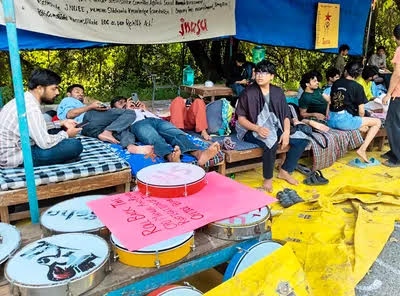
On Friday, February 9, 2024, ABVP members and left-wing student groups, including AISA, SFI, and DSF, got into a clash during the University General Body Meeting (UGBM). Videos of the clashes show both groups engaging in sloganeering and clashing at night. Both sides have claimed that their students have been injured and targeted by the other party. Videos of the incident show ABVP members obstructing the meeting by encroaching upon the dias and getting into a confrontation with the council members. The SFI has alleged that JNUSU President Aishe Ghosh has been attacked by ABVP members with water thrown at her. ABVP JNU has also alleged that Vikas Patel, the ABVP-JNU secretary, disabled student Divyaprakash, and other supporters of ABVP have been targeted by the United Left groups.

The JNUSU stated that they had earlier on the day established the necessary quorum, but the ABVP argues that the rule for quorum of one-tenth of the university strength was defied. ABVP alleged in a comment,

Disparaging casteist slurs were made against a worker handling a mic and speaker. We had agreed to initiate the UGBM even without the mic, but it wasn’t agreeable to the communists who silence others with loud noises of dafli.

They further claimed that:

The dafli, made from hard steel, was used by the anti-Democratic left to batter JNU students in order to stop UGBM.

The incident lies ahead of the JNUSU elections, which will take place after four years in the month of March. Currently, the office-bearers elected in 2019 are holding the office as agreed upon in an earlier UGBM held in September 2023. Anagha Pradeep, a JNU Councillor, has called out the administration and ABVP for together supporting the agenda that the JNUSU is illegal since, according to them, it is not a recognised body. The JNU administration had halted the elections in lieu of the pandemic and stated that they would follow the Lyngdoh Committee recommendations and must wait for PhD admissions to be completed. Representatives of all fronts had staged protests demanding a free and fair election for the Student Union at the earliest. The students had pointed out that if elections in other universities like DU have been running in parallel, then perhaps the administration is purposely dodging the election question. The JNUSU and the administration have been at loggerheads with each other since last year. Aishe Ghosh commented,

Recently, in interviews given to several media outlets, the JNU vice chancellor claimed that JNUSU elections cannot be held until the entire admission process, including that of Ph.D. admissions, has not been completed. These are patent lies and tactics at dilly-dallying, as the same vice chancellor and administration refused to hold elections in April 2023 even after the completion of the entire admission process.

She also added,

It is a deliberate strategy of the JNU Administration to curb the growth of the students’ social and political consciousness, which leads to the growth of the students as critical citizens capable of asking tough questions to those in power. The RSS-controlled administration, hell-bent on turning the campus into the breeding ground of the saffronization of education, is perennially afraid of students who are aware of and capable of seeing through their agenda.

On Febrary 10th, the ABVP staged a march owing to the incident and demanded “free and fair elections.” In response, the Left Front has also formed a human chain “of solidarity and resilience against the ABVP.” Aishe Ghosh has also raised the slogan, “Reject hooliganism!”

Read Also: “Allowed At Designated Places”- JNU Bans Protests Within 100m Of Any Academic Building; Violators May Face Rs. 20k Fine Or Expulsion

Featured Image Source: Shiksha

Sarah Nautiyal
[email protected]

The ‘Prana Pratishtha’ celebration of Lord Ram in Ayodhya on January 22 has evoked varied responses across India. Its impact is particularly noticeable in educational institutions, where some colleges experienced joyous events while others faced instances of violence and police intervention. Amidst resistance and celebration, the article aims to explore the question of religion within educational spaces by examining diverse perspectives.

On January 22, Ayodhya celebrated the grand opening of the Ram Mandir, which was celebrated like a national festival. A celebratory vibe permeated both outdoor and digital areas as the streets were decked out in saffron and echoed with “Jai Shri Ram” chants. Temples and streets flourished in the festive mood, signifying a unique happy occasion for believers. To underscore the importance of the occasion, several state governments went a step further and declared holidays for businesses and educational institutions.

As New Delhi was rife with saffron flags and bhakti music on January 22nd, the merriment was shared by educational institutions alike in the centre. The grandeur of the ‘Prana Pratishtha’ festival was evident by the active participation of educational institutions, with some expressing support and others voicing opposition. This dual participation highlighted the complexities of sentiments that many, particularly younger generations, had about the occasion.

The celebrations demonstrated a dichotomy in how individuals perceived the event—whether it was seen as solely religious and legitimate or as part of a greater political agenda. This interplay of ideologies was displayed with enthusiasm by diverse student groups across various universities.

Prestigious colleges like IITs and IISC, Bengaluru were out in force for celebrations. A student group at IIT Kharagpur took out a procession in support of the inauguration of the temple, while IIT Delhi organised the Akhand Ramayana path, followed by a bhandara and deepotsava

We’d been given a half-day, but then eventually the holiday extended up to being a full day. There were rallies from the main gate to another end of the campus, with many saffron flags.

-A Student from IIT-Delhi

In Ashoka University too, celebrations were observed through bhajan sandhya and pooja organised by students.

On Delhi University’s North Campus, festivities were observed at the Arts Faculty while candles were lit near the streets of Hanuman Mandir. The University of Delhi itself was shut for half a day until 2 p.m., according to the notification released by the authorities. Many such campuses across the country organised hawans, rallies, and even allowed the live telecast of ceremonies being held at Ayodhya.

In Shivaji College, University of Delhi, a student who was visiting the campus during the weekend for a debate tournament said,

Shivaji College had conducted an event with the campus being decorated with rangolis and diyas, as it set up a stage for live music performances and had visitors showing up.

This, however, is only one side of the story; many students expressed their disapproval and criticism, and not all student factions were in agreement with this kind of festive mood.

For instance, Fraternity Movement Jamia Millia Islamia organised a university-wide strike in remembrance of the Babri Masjid. “Boycott for Babri, Resistance is Remembrance,” said a post on X (previously Twitter)  by the Fraternity Movement, along with a video of students protesting with posters of the Babri masjid. As the videos of the protest went viral, police forces were deployed outside the premises as precautionary measures.

NIT Calicut’s students were forced to witness the cancellation of Thathva, their techno-management festival, which led to a stream of angry comments online. The festival was first postponed and then cancelled due to Central Security Agencies ordering the college after a student protested the Ram Mandir inaugural celebrations and was beaten up by the police, leaving no entity from the college with the power to intervene. Indignant NIT Calicut’s students’ comments read online, “Imagine all the work done by students to hear its cancellation due to a communal riot in the north.”

Tensions were also observed in Pune’s FTII (Film and Television Institute of India), where banners condemning the demolition of Babri masjid in 1992 were displayed with the statement ‘Remember Babri, Death of Constitution’. They took it a step further with the screening of the 1992 Anand Patwardhan documentary, “Ram Ke Naam.” The documentary delves into the communal violence that ensued after the Vishva Hindu Parishad campaigned to build a temple at the Babri Masjid site in Ayodhya. Additionally, they even invited Patwardhan on January 22nd for it.

However, according to a press statement released by the Students’ Association of the institute, chanting of the “Jai Shree Ram” slogan took place loudly outside the main gates, which the security was initially unresponsive to. Then, an agitated mob of 20–25 people entered the campus, and security was unable to contain them. Many students of FTII were brutally beaten up, and the banners were also damaged. 

While the side of Samast Hindu Bandhav Samajik Sanstha, who was involved in the clash, claims that the move of FTII students was offensive to the sentiments of Hindus, provocative statements against Lord Ram merely created more rift amongst two religious groups. However, the students at FTII clearly see this violence as an attack on their democratic rights. They also claim that no action was taken towards the offenders, and they were allowed to roam free.

A post on Instagram describes the events that led to the violence at the FTII Campus, which involved the vandalism of college property and harm to students. The press release statement reads,

We appeal to the police and all relevant authorities to take prompt action against those who perpetrated violence against the students and who entered with the intent to vandalise property on the campus of FTII, Pune.

The student fraternity of ILS stands in solidarity with the Students’ Association of FTII and has even released a joint statement with signed signatures. Additionally, multiple students of FTII have released their own statement with signatures, demanding a response from Bollywood actor and Chairman of the Institute, R. Madhavan.

Similarly, in another college, the Indian Institution of Science and Research (ISSER), Pune, witnessed a distinctive response from certain students. Allegedly, on January 22nd, some students celebrated the temple’s inauguration in the campus common room. The movie club coordinator then planned the screening of Ram Ke Naam, sending details to students with a description of the movie copied from its IMDB review page. Unfortunately, this led to an unexpected turn of events, with policemen arriving at the campus. They questioned the movie club coordinator and, without clear justification, took them into custody. The move has left students at ISSER feeling intimidated by law enforcement, especially since they perceive a lack of support from the college administration.

Similar cases of violence and protest were observed in places like Jadavpur University and Hyderabad University.

In Hyderabad University, NSUI, which is the student wing of the Indian National Congress, organised a protest against the inauguration by intending to screen Anand Patwardhan’s documentary ‘Ram ke Naam’. The screening was disrupted by ABVP students, leading to its cancellation. The screening was later conducted peacefully at the North Ladies Hostel in the evening. Students in opposition state that campus spaces belong to everyone; hence, it’s their democratic right to express their concerns, and the screening of ‘Ram ke naam’ was a symbol of their resistance and not a step to offend people.

We ensured that organisations conducting their events went peacefully despite threats and attempts to disrupt by ABVP. Campus spaces belong to everyone; all ideas exist here. However, the administration and ABVP don’t want dissenting voices to be heard. The student community strongly opposed the saffronization of campus spaces; they attended in large numbers for SFI’s ‘Ram Ke Naam’,

-Md. Atheeq Ahmed, HCU Union President (source: Maktoob Media).

The unfolding of two contrasting scenarios in various universities prompts reflection on the democratic principles by which the country aspires to abide. The celebration of religious victories and moments in educational institutions raises a fundamental question about the integration of religion within these spaces.

We observed different celebrations, including bhandaras and rallies, where students enthusiastically chanted ‘Jai Shree Ram’ and danced.

Since religion is a very personal subject for me, I  personally decided not to take part because I feel it is improper to hold large-scale religious festivities in colleges where you have such a diverse population. Students from minority groups experienced exclusion as well, and those who chose not to participate in the festivities were called anti-Hindus.

-A mass communication student from Madhya Pradesh described the events at her college. 

She went on to say, “The decision to celebrate such moments should be left to individuals, and nobody should be placed in situations where they feel alienated in their own colleges.”

If institutions are justified in endorsing such events, does it imply that religion is an inherent part of educational institutions? If so, the ramifications in multi-religious countries like India are complex, as institutions should then consider accommodating the religious sentiments of each community rather than catering to the majority alone.

Would this extend to allow students from diverse communities to practice their religion within educational institutions through their own expressions of uniform, festivities, and prayers? If such practices become widespread, it raises concerns about their impact on student identity. Will the subject of religion either further divide them in spaces where they seek empowerment and education or provide them with greater freedom to embrace their individual selves?

Students are free to choose sides and voice their emotions, whether it be joy or dissent. However, carrying out religious activities in an educational setting is inappropriate and goes against the goal of the organisation, which is to safeguard students’ rights, interests, safety, and development. In these situations, political factions’ fuel for violence and conflict goes against both religious and constitutional norms.

-A second-year Delhi University history honours student

Through this, one can note that if educational institutions strive to maintain a secular nature, any form of religious exhibition contradicts their fundamental goal of providing education free from religious influences. At the same time, they must safeguard students from feelings of alienation or offence.

Can dissent coexist alongside the celebration of the auspicious arrival of Lord Ram? If one student group is allowed to express their joy, should others be hindered when they protest against it?

Lastly, considering religion is a personal matter for individuals, how appropriate is it to introduce it into educational institutions? Can our colleges and universities become safe spaces for discussions, education, and growth, free from the spectre of violence over religious differences? Can the youth liberate themselves from the constraints of rigid political and religious ideologies?

As we grapple with these questions amid both joy and turmoil, the answers lack uncertainty. The quest for meaningful resolution necessitates a delicate balance between respecting individual beliefs and nurturing an inclusive educational environment that promotes intellectual growth for all.

Read Also – Saffronisation of Cultural Expression

Image Credits – Bloomberg.com 

DU Beat 

Jawaharlal Nehru University (JNU) has introduced stringent rules in its revised CPO manual, prohibiting demonstrations near the academic and administrative complexes. Students flouting these regulations will face penalties ranging from hefty fines to expulsion.

 On 24 November, the Jawaharlal Nehru University (JNU) Executive Council approved a 15-page Chief Proctor Office (CPO) manual containing the “discipline and proper conduct rules”. The manual stated that JNU students will now be fined Rs. 20,000 if they participate in a hunger strike, dharna or any other form of protest within 100 meters of any academic and administrative complex. Any act to incite intolerance towards a religion, caste or community or the printing, circulation or pasting of posters carrying derogatory religious, communal, casteist or “anti-national remarks” may also attract a penalty of Rs.10,000. This development follows an incident the University witnessed in October, where an “anti-national” slogan was scribbled on the University’s School of Languages building wall and the administration had later announced to set up a committee to investigate the repeated nature of such incidents in campus. Earlier, protests within 100 meters of the administrative blocks, which house the offices of the Vice-Chancellor, the registrar, and proctors among others, were prohibited as per a High Court order.

The manual has listed 28 types of misconduct including blockades, gambling, unauthorized occupation of hostel rooms, use of abusive and derogatory language and committing forgery. If a student is found involved in a hunger strike, dharna, ‘group bargaining’ and any other form of protest or is found blocking the entrance or exit of any of the complexes, they will be either imposed a fine of Rs.20,000 , evicted from the hostel for 2 months or be rusticated and declared out of bounds for up to 2 months. All forms of coercion such as gheraos and sit-ins have also come on the banned list. Arranging events such as freshers’ welcome parties, farewells, or DJ events on the campus without obtaining prior permission may also attract a fine of Rs. 6,000. If a student is found guilty of being engaged in any of the prohibited activities and is given a punishment, they will not be eligible to register for the semester and won’t receive a “no-dues” certificate until the imposed fine is paid in full. In addition to posting the punishment on the official website, the administration will also send a copy of it to the student’s parents or guardian. If the student does not show up for the proctorial enquiry, the committee will assume that the complaint was filed with a malafide intention, and the student might be required to complete community service at JNU. A complainant may also be rusticated from the University for making any false allegations against any student. Additionally, the University will no longer permit cross-examination between the complainant and the defendant, which was an important rule of proctorial enquiry earlier. A student who has received 5 or more punishments during the duration of their study shall be expelled from the University, the manual noted.

The foreword to the manual by Chief Proctor N. Janardhana Raju emphasized the strong need to reassess the current disciplinary regulations of the Office of the Chief Proctor as there were “no substantially approved rules and regulations on proper conduct and discipline of students by the Executive Council of JNU in vogue”.  According to the manual, in the event that a dispute arises about the interpretation of any of these guidelines, the Vice-Chancellor of the University, Santishree Dhulipudi Pandit or the appropriate authorities will have the last say. They will also have the power to waive, change or uphold the punishment if deemed fit. The university administration asserts that the new rules are important for maintaining academic and administrative order and preventing any disruptions. They argue that the designated protest areas within the campus are sufficient for expressing student concerns.

Responding to the uproar against the new regulations, VC Pandit, reportedly told the Indian Express that these rules have been fine-tuned on the directions of the Delhi High Court. (Source: CNBC-TV18)

This is not old not new. Passed unanimously by the EC last month as the manual had to be made legally sound. The fines are on indiscipline of drinking, drugs and misbehavior in hostels and towards women. The proctor’s office since 1969 has been taking action, imposing fines and rustications.

– JNU VC reportedly told the PTI.

 During her discussion with the Hindustan Times, she highlighted that the University has not banned protests on campus as freedom of speech is a Constitutional right, emphasizing that fines and rustications existed even during her student years at JNU. The recent move to make it public was undertaken to ensure transparency, aligning with their democratic functioning.

I have never imposed a fine on any student just because he or she participated in a protest on campus. The students even protested at my house over some water issue at a hostel. But I did not impose a fine on anyone for it. I have forgiven fines imposed by the latest regime on many students between 2016 and 2022 and closed their cases considering their futures.

– she told the Hindustan Times.

 Talking about how the recent approval by the Executive Council (EC) was aimed at ensuring the manual’s legal validity, she clarified that fines are imposed for issues related to indiscipline and that no slabs have been raised.

The manual was passed by the Executive Council of the University, which also has representatives from the faculty. The administration circulated the manual among all EC members on November 1, and it was unanimously passed by the Council during a meeting on November 24. Nobody raised objections over anything because there was nothing new in it, and no slabs were raised. We only put it in a legal language and got it passed legally. Till today (December 13), no single letter has been received by the administration or VC office from students or staff asking to withdraw the manual.

– JNU VC told the media.

 On December 12, a day after the University faced flak over its newly released stringent measures, an official clarified that protests have not been banned and are allowed at designated areas.

 We have not changed anything. These rules were already there in place. We have just introduced a few other regulations to ensure no disruption is caused to the academic process. Students still have the democratic right to protest at designated places.

– an official from the University told PTI.

 Reacting to the revised manual, the JNU Students’ Union (JNUSU) termed it an attempt by the administration to “stifle dissent” on the campus and alleged that the Proctor’s Office is being used to carry out “political vendetta against student activists and representatives raising important student community issues”. Demanding its immediate withdrawal, the JNUSU added that the manual lacked clarity on several crucial aspects, leaving room for misinterpretation and arbitrary implementation.

The stringent measures outlined in the manual are aimed at stifling the vibrant campus culture that has defined JNU for decades. Such excessive regulations are intended to discourage open discussions, dissent, and intellectual exploration, which are fundamental to the spirit of our university. Such ambiguous rules can lead to unfair and discriminatory practices, jeopardizing the rights of students

– JNUSU in a statement.

 Student bodies at the University have also condemned the move saying that it snatches away the democratic rights of students to register dissent.

Who will decide what is harming someone’s moral sentiment and what is not? How can my peaceful protest,‌‌ which is against fee hikes or injustice, be considered moral turpitude? Additionally many students in JNU are below the poverty line – so how do they expect these students to pay such high fines?

– said a student at JNU as reported by CNBC-TV18

Nine months ago, in February 2023, the University had issued a notification stating that the students can be imposed with a penalty of Rs. 20,000 for holding dharnas and face admission cancellation or a fine upto Rs. 30,000 for resorting to violence in the University. However, following its criticism, the notification was reportedly withdrawn within a week.


Read Also: https://dubeat.com/2019/12/14/mhrd-issues-a-statement-on-jnu-protests-offers-mediation-between-stakeholders/


Featured Image Credits: Deccan Chronicle


Manvi Goel

[email protected]

More than 50 academics from DU, JNU, and other institutions have written to the Delhi University VC, requesting the removal of the punishments meted out to students who were allegedly involved in the screening of the Narendra Modi BBC documentary.

On Thursday, April 6 2023, 59 academics, on behalf of the India Academic Freedom
Network, wrote to the University of Delhi, advocating for the revocation of the punishment
imposed on students for screening the BBC documentary on Prime Minister Narendra Modi
and his alleged involvement in the Gujarat riots. The letter addressed to Vice-Chancellor, Prof. Yogesh Singh, stated that the failure to obtain approval for its screening is “not a serious enough offence” to prevent students from taking examinations.

“We need not tell you that the university is supposed to be a space where students and teachers feel free to get information from any source, decide for themselves and express themselves freely. They are adults and can make decisions for themselves. We, teachers and administrators are not here to police their thoughts or censor their sources of information.” The letter stated.

The documentary, India: The Modi Question, critically explores then Chief Minister Modi’s involvement in the Muslim genocides in Gujarat in 2002. It was screened on-campus by several student groups on 27th January,2023.  The following day, Delhi Police detained 24 students from Delhi University’s Arts Faculty and a disciplinary committee barred 2 PhD students namely Lokesh Chugh and Ravinder Singh from all academic activities, including exams for one year, for allegedly
planning to exhibit the documentary.

In the memorandum issued on March 10, the DU registrar claimed that the BBC documentary is ‘banned’ and requested 6 other students to submit written apologies to the administration for screening the film without permission. The professors response, however, questioned the disciplinary actions’ justifications, arguing that they were out of proportion to the alleged violation.  “The memorandum regarding the punishment, as published in the media, states that they had violated the ban on screening of the said documentary by the government of India,” the letter stated. “We want to bring to your notice that it is known to all that the documentary was never banned and is still not banned by the government.”

The letter then specified that the documentary was “only a critical examination of the present regime in the context of the situation of Muslims.” It was signed by Satish Deshpandeand Nandini Sundar from the Department of Sociology, Ashwini Kumar from DUTA and Sucharita Sen and Avinash Kumar from Jawaharlal Nehru University, among others.

“The only condition we all must follow while exercising this right is that it should not promote hatred and violence. How could it’s screening by some students become a threat to order on the campus, is beyond our understanding.” they added. The signatories stressed the significance of creating a secure environment on campus for students to practice critical thinking. “It is not the job of the university to defend the government or disallow thoughts critical to it. We hope that our concern would be heard and the said punishment order would be withdrawn.”, the letter concluded.

Image Credits: TFI Post

Read Also: Students Detained by Delhi Police after NREGA Discussions

Manvi Goel
[email protected]