Tag

DUTA

Browsing

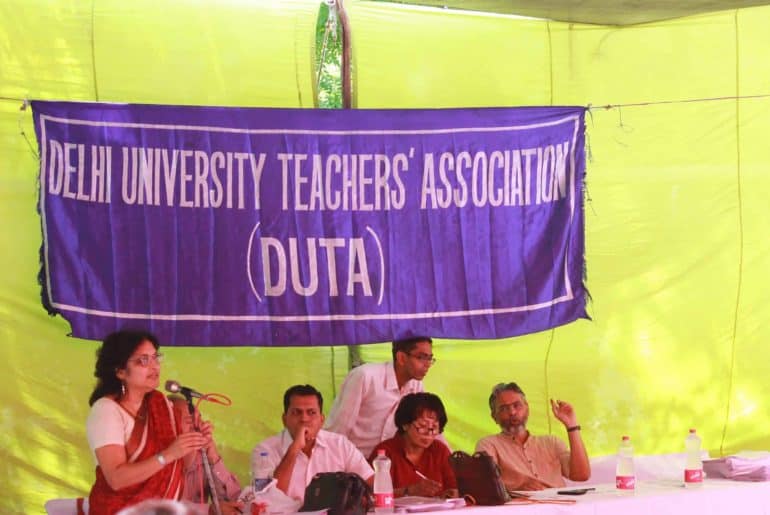
The English Department of the University of Delhi (DU) continues to be negatively affected by the Syllabus Controversy. 

The Executive Council of DU has approved the syllabus for English for the first semester, but this approved syllabus continues to be a mystery for not only the students, but also the professors. In fact, even the Head of the English Department, Professor Raj Kumar has not been made privy to the new syllabus. This continued delay with regard to the syllabus has now moved beyond ideological and ethical debates, and has started to negatively impact the students, causing mass worry and frustration across the University campuses. 

In most colleges, professors have started to teach the first-year students the old syllabus, but they are not sure about whether what they are teaching the first-year students is going to be relevant to them with respect to the upcoming examinations. Priyanshi Banerjee, a first-year student of English at Lady Shri Ram College, said, “No one seems to know anything about the new syllabus and this is causing a lot of problems for us first-years. Examinations are not going to get postponed, but considering the current slow pace of studies I don’t know how we are going to manage to complete our course work.”

Students are not even able to procure the books being taught currently because the bookstores in the college campuses are not stocking them, because of a lack of clarity with respect to the prescribed texts. Shyla Sharma, another first-year student of the English Department, said, “All of us are very anxious. It is very odd for us to see other department’s students going about their course work when we don’t even know what our syllabus is. Even the professors seem upset and lost, and this is causing a lot of confusion. We don’t even have all of our books yet, as we have been told not to buy them. I hope the syllabus is soon released.”

In spite of the mass tension, an academic debate in the midst of the syllabus controversy continues to flourish. Royina Chhabra, a first-year student of the English Department, said, “Restrictions are being put on our academic freedom. We should have a right to study what we want to, especially our history and culture irrespective of whether it is good or bad. How else are we supposed to learn and think for ourselves? This entire controversy is taking a huge toll on our education.” Many students also seem to be specifically upset about the negative debate with respect to the exclusion of the Queer Literature Paper. A first-year student of the English Department, who wanted to remain anonymous, said, “Queerness is a part of our lives. Section 377 no longer criminalises homosexuality, so why is our education system doing so? In fact, I believe that it is the responsibility of our education system to educate people about queerness because most people in India aren’t aware of, or comfortable about it. The fact that our new syllabus is probably going to be politically motivated and authoritarian in nature highly antagonises me.”

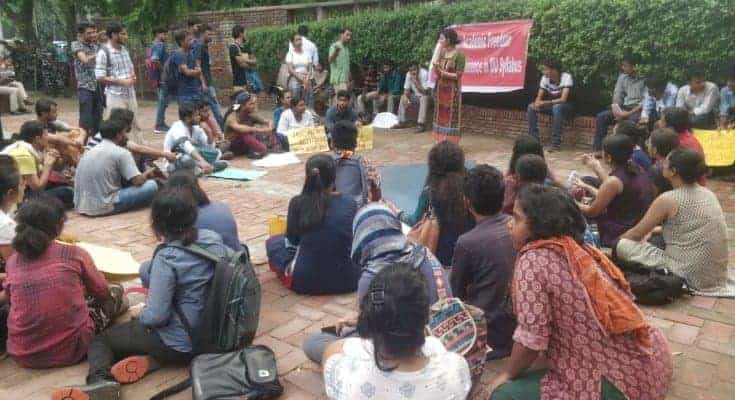
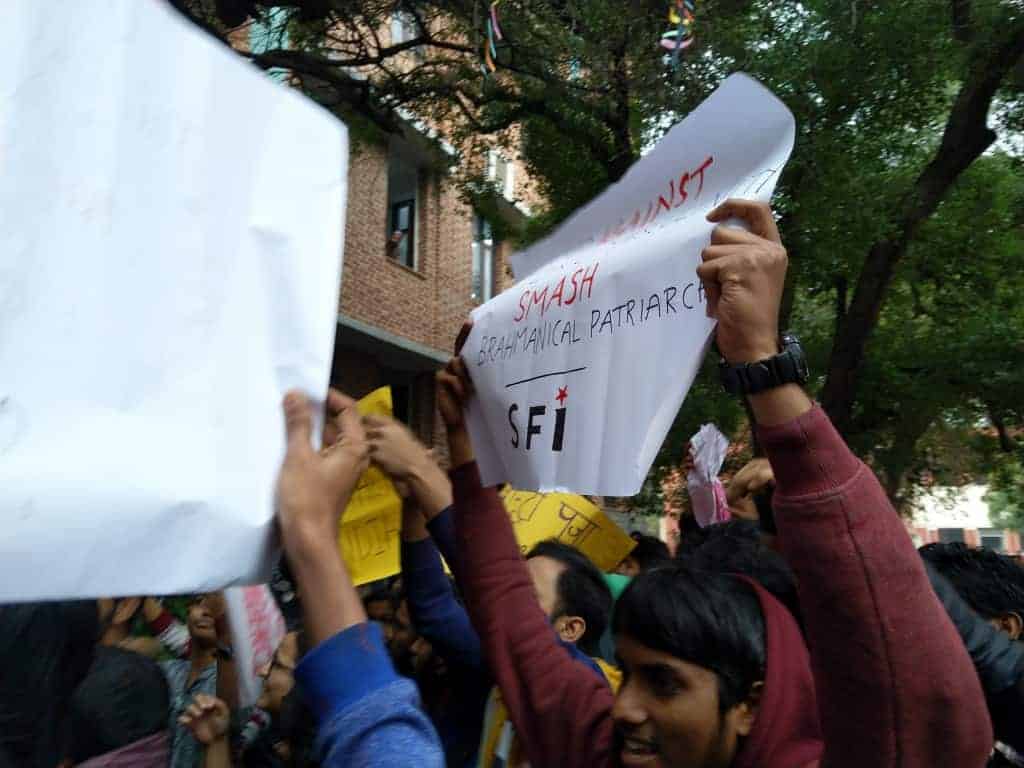
The Syllabus Controversy began when right-wing organisations like the Akhil Bharatiya Vidyarthi Parishad (ABVP) objected to the English Department for including certain study material relating to caste and gender in the new syllabus. Specifically speaking, they had an issue with the story Manibein alias Bibijaan in which the Rashtriya Swayamsevak Sangh (RSS) and the Bajrang Dal are portrayed negatively, with respect to the 2002 Gujarat riots, and the inclusion of the depiction of Hindu deities in queer literature by taking references from texts like Bhagvath Puran, Sankar Puran, and Shiv Puran. Counter-protests for academic freedom by organisations like the Delhi University Teachers’ Association (DUTA), Students’ Federation of India (SFI), All India Students’ Association (AISA), Krantikari Yuva Sangathan (KYS), and Pinjra Tod soon followed, leading to ideological and educational confrontations. This controversy has led to the syllabuses of many subjects not being released, even though the new academic year has already started. 

Feature Image Credits: Sriya Rane for DU Beat

Juhi Bhargava

[email protected]

No candidate supported by the Indian National Congress is contesting elections this time for the post of Delhi University Teachers’ Association’s President.

For the upcoming Delhi University Teacher’s Association (DUTA) Elections for the year 2019-2021, no candidate supported by the Indian National Congress is standing up for the post of President. Senior Congress leader, Kiran Walia said that the party didn’t want to divide secular forces and so chose to keep away from the DUTA polls.

Mr. Ashwini Shankar, the Chairperson of Indian National Teachers’ Congress (INTEC), the official Congress teachers group at the University of Delhi also commented on the issue. He said, “With the country in such turmoil, we wanted to put our best foot forward. Academics for Action and Development support our ideology and so this time we have decided to join our forces and support their candidate, Aditya Narayan Misra. He is a strong candidate and we have faith in him.”

The INTEC has, however, put up three candidates for the 15-member Executive Council. Walia, with full confidence said, “We have fielded three EC candidates and all three are likely to win.” These candidates are Vivek Chaudhary, sitting secretary in DUTA, Udayvir, a teacher of Electronics at Acharya Narendra Dev College, and Pradeep Kumar, History teacher at Zakir Husain College. She said that she does not believe that the ideology of the Congress party has lost its relevance in the University campus as a result of the recent Lok Sabha and State Elections.

Rasal Singh, member of the Academic Council, however, believes that the result of the DUTA Elections will reflect on the upcoming Assembly Elections. “The Modi factor will impact this election too and the outcome will impact the Assembly elections as the DUTA election reflects the mood of the intellectuals.”

The DUTA Elections 2019-2021 are going to be held on 29th August 2019, and the votes will be counted on the same day.

Feature Image Credits: The Indian Wire

Juhi Bhargava

[email protected]

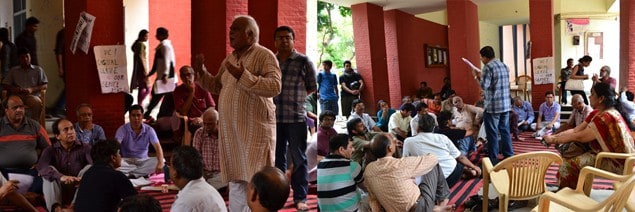
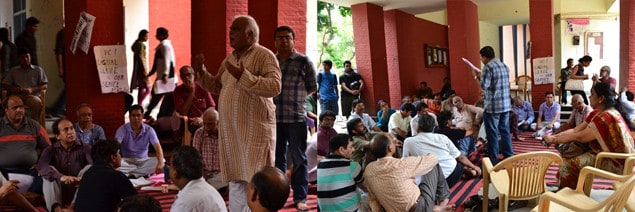
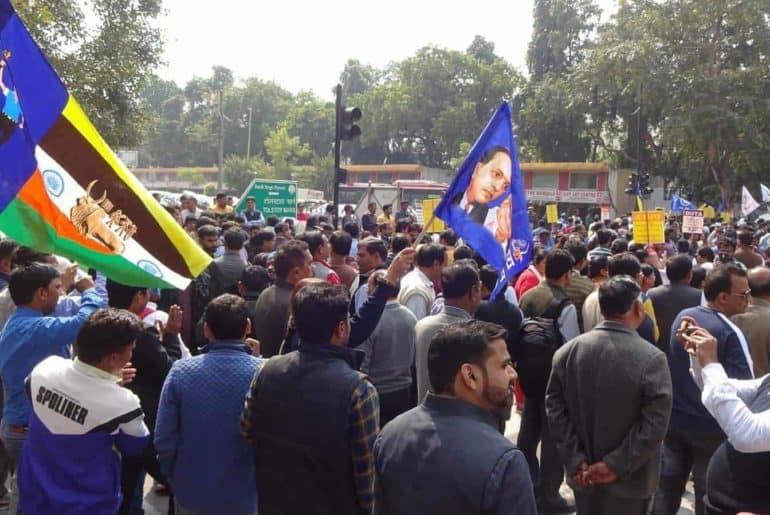
The Delhi government turned a blind eye to the written request made by the ad-hoc teachers of the University to ensure the renewal of their term from 20th July 2019 and demand funds for the creation of new teaching posts. In retrospection, the office bearers, the karamcharis and the active faculty members of the Delhi University Teachers’ Association flocked the streets in front of the University Grants Commission office to express their discontent and demand immediate action.

On the 16th July 2019, the office bearers, members of the Delhi University Karamchari Union along with the members of the Delhi University Teachers’ Association (DUTA) protested  against the government and the University administration.

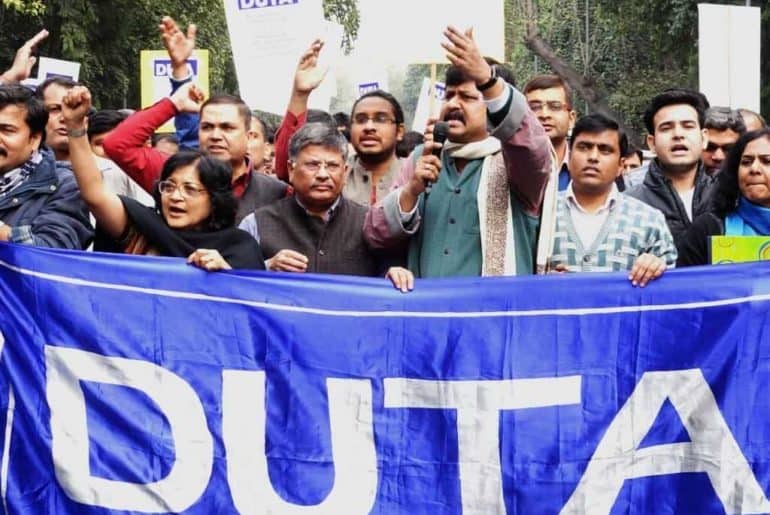
The protest started around 11:30 a.m. on Bahadur Shah Zafar Marg and carried on till 01:30 p.m. Chants of azaadi, “DU VC Down Down!”, “UGC Barbaad Ho!”, and “Hum Apna Adhikaar Maangte!” echoed as a handful of students and a large group of teachers joined the protest led by DUTA President, Dr. Rajib Ray, and DUTA Treasurer, Dr. Najma Remani, to protest the existing system ad hoc appointments, rampant corruption in the provision of Development Fund to colleges by the Vice Chanellor,  and demand timely promotions, permanent appointments for job security and service benefits, release of grants for creating new teaching posts and accommodating the Economically Weaker Section (EWS) expansion and to force stop the commercialisation of Higher Education imparted at the University of Delhi by pestering colleges to accept loans from Higher Education Funding Association (HEFA) for funding expenses on infrastructural development.

The past three weeks have remained flooded with tense conversation between DUTA and the Delhi government. On talking to professors about their struggle, Dr. Debolina, an ad-hoc professor at Ramjas College said, “The administration is just trying to create a huge pool of disposable people which it can use and then throw away when it gets a cheaper substitute. I have no security of my job as a professor; I don’t get any perks, any promotions, or service benefits. We have been protesting this culture of ‘demanding gratitude’ and ‘forcing obedience’ on us for a while now and there has been no response. If I don’t have a job for the next three months, I am going to fall in the EWS category.”

“The Delhi government has finally agreed upon paying the salaries of professors in 12 colleges funded by them and its 5% share of the development expenses but that is not enough. The 12 colleges including some premier institutions like Vivekanand College and Moti Lal Neru College also need funds for facilitating the EWS expansion and to have a higher teaching staff to meet the greater student intake in this academic session. None of this has been addressed by the Deputy Chief Minister, who also holds the Office of the Education Department, at the DHE meeting held on 12th and 15th July respectively. Although they have made a verbal commitment about releasing the 2nd tranche of OBC expansions, there is still no paperwork for it,” said Dr. Rajib Ray, President of DUTA.

Dr Swati, a professor from the Department of Germanic and Romance Studies said, “I have been on an ad-hoc appointment in the department for 12 years, and every time the University releases the applications for making permanent appointments, they refuse to entertain past experience. This has forced me to be working on such an uncertain job where I don’t know whether I will be teaching the students I am teaching now, at this time next year. Somewhere this has also impacted student psychology because they see their teachers coming and going after break-years.” “This has further created a situation where students have now started to make a choice of college not according to the best faculty but according to the most stable faculty,” said Dr. S. K. Kaushik, Professor of Mathematics, Kirori Mal College, further adding that the sole reason for this is the ‘absence of willingness of the government and the University administration’.

Despite the blazing heat, all professors matched their voices in solidarity against the fraudulent system of the University. Seeing ‘gurus’ demanding their rights, it makes one wonder, is this system really democratic and fair? If it is, then why does this democratic system turn a blind eye to the cause of its building blocks? Will the system not collapse if these building blocks disintegrate? Time will tell us, whether DU too will collapse in its essence like other Central and State Universities, or will its prestige, that comes from its strong, qualified experienced and highly intellectual teaching staff, be maintained.

Feature Image Credits: DU Beat Archives

Yaksh Handa

[email protected]

Delhi University has an active atmosphere of protests almost every other week or month. Hence, protests have almost become a part of DU life! Here’s a throwback at some impactful protests that shook DU.
Library Union
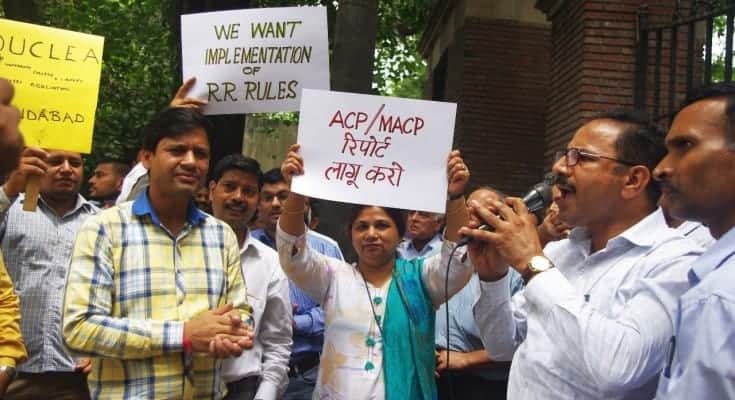
Deriving from a letter to the VC (Vice Chancellor) the Delhi University and Colleges Library Employees Association (DUCLEA) protested early in August to initiate the implementation of the Recruitment Rules Review Committee Rules and the ACP/MACP Pay Scale Committee Report. A lot of other demands like removal of library attendance system from college libraries were also raised. However, the familiar stalling of rightful demands has led to the stagnation of the report for over 18 (now 26) months.
year end 1Featured Image Credits: Namrata Randhawa for DU Beat
DSJ 
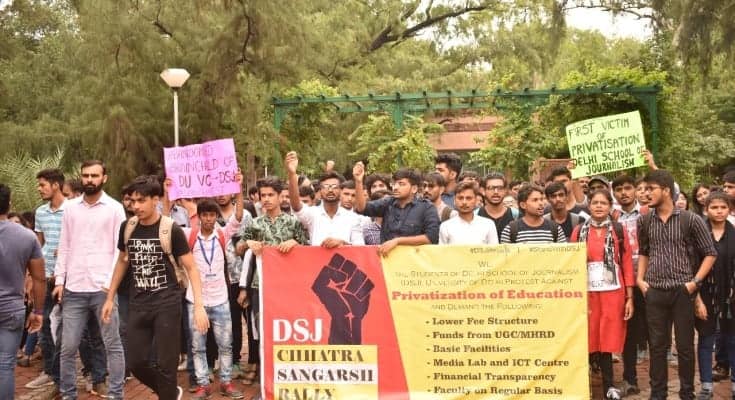
Constantly headlining the campus news flash, Delhi School.of Journalism has seen one of its most charged years given to resistance, as yet. The struggles of DSJ students to attain a reasonable quality of education by requesting the concerned authorities to justify the hefty fees were multiple but in vain; ineffective due to  delay in “administrative/authoritative approval”. A month later in September, 2018, inability to fulfill the previously promised valid concerns of the students led to another round of suspension of classes and oppression of the crusaders protesting in the DSJ campus.
year end 2
Feature Image Credits: Neerav
Young India Adhikar March (YIAM)
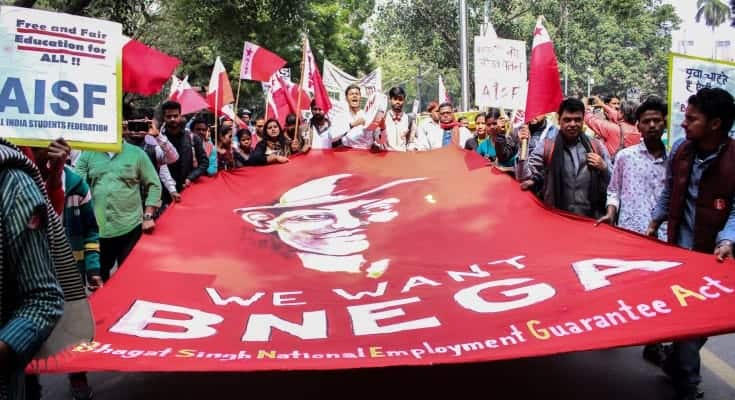
Inspired by the Kisan Mukti March, this march saw students from all over the country marching from the Red Fort to Parliament Street on the 7th of February.
year end 3Featured Image Credits: Jaishree Kumar for DU Beat
People’s March
Barely a fortnight after YIAM, students, teachers and unions marched in solidarity from Mandi house to Parliament Street to protect public higher funded education. The march was led by Delhi University Teachers’ Union (DUTA) along with various other organisations.
year end 4Featured Image Credits: Adithya Khanna for DU Beat
V-Tree Protests at Hindu College 
On 14 February, massive protests erupted in an attempt to disrupt, if not stop, the annual ‘Virgin Tree pooja’ tradition of Hindu College. Members of Pinjra Tod, SFI and Hindu College Progressive Front jointly protested and clashed against supporters of the pooja, mainly students of the Boys’ Hostel. The protests, widely covered by the media, had led to a few scuffles.
year end 5Featured Image Credits- Prateek Pankaj for DU Beat
Mathematics Department Protests 
Mass failures in the examinations for MSc Mathematics had rocked the department. They received their results on 8 February and had started protesting on 14 February. The protesters demanded to be shown copies of the answer sheets along with an independent investigation, among other things. Various other departments in addition to the Mathematics Department and organisations like AISA, SFI, KYS, and DSU joined the protests.
year end 6Featured Image Credits- Anoushka Sharma for DU Beat
DRC hostel protests
On the 23rd of February, protests broke out at the hostel gate of Daulat Ram College after mishaps at the college hostel and the rampant culture of hatred and sexism. The protesters demanded basic rights which were being violated by the DRC hostel board.  The fight continued on to the next day, the 24th, when residents marched from their hostel gate towards the Vice Chancellor’s office and staged a sit down.
year end 7
Featured Image Credits- Pragati Thapa for DU Beat
DUTA Protests 
The Delhi University Teachers’ Association had carried out sustained protests since the beginning of the year and even before that, against issues like the 13 point roster system, privatisation and the needs of ad-hoc teachers. Human chains, candlelight marches, ‘total strikes’ and a ‘Bharat Bandh’ were few of the measures adopted by the association and its supporters. The protests succeeded in bringing an ordinance by the government on 8 March to restore the old 200 point roster system.
year end 8
Featured Image Credits-  DU Beat Archives

Cover Image Credits- Pragati Thapa for DU Beat


Kartik Chauhan

[email protected]

Jaishree Kumar


University of Delhi stands at the risk of getting its funds curtailed due to the non-signing of the Memorandum of Understanding  with the centre and the University Grants Commission.

University of Delhi (DU), once again, stands on the verge of fund cuts. This time around, it is due to the non-signing of Memorandum of Understanding (MoU) with the centre and the University Grants Commission (UGC).

As reported by the Hindustan Times, the Ministry of Human Resource Development (MHRD) and the UGC entered into a pact with varsities laying down several parameters for them, during the last academic session. The MoUs lay down achievement targets and also form the basis of grants allotted to the institutions. The various parameters highlighted in the pact are related to the various targets, such as filling up vacancies, utilisation of resources, output targets in terms of programme of work, and action plan among others.

Rule 229(11) of the General Funancial Rules states, “autonomous organisations as also others with a budgetary support of more than INR five crores per annum, should be required to enter into a MoU with the administrative ministry or department, spelling out clearly performance parameters, output targets in terms of details of programme of work and qualitative improvement in output, along with commensurate input requirements.”

The rule further states, “The output targets, given in measurable units of performance, should form the basis of budgetary support extended to these organisations. The roadmap for improved performance with clear milestones should form part of the MoU.”

DU remains the only significant exception among all the 40 central universities which have signed the MoU with the centre and the UGC. Thus, it stands at a risk of getting its funds curtailed.

A senior official from UGC discussing the issue and the University’s stand on the same said, “Like last year, the tripartite MoUs are being signed again and most varsities have already entered into these pacts. However, DU continues to be an exception. Since, the varsity has not signed it, its funding can be curtailed. However, in a recent meeting the Vice Chancellor has assured that he would try to get the proposal cleared through the varsity’s executive council to pave way for the pact to be signed.”

The risk stands valid  ‘technically’ but the same issue arose last year when DU failed to sign the MoU. But, keeping in view the interest of the students, UGC didn’t take the step ahead in curtailing the funds. But, if the same leniency would be granted to the University this time around too is something which looks doubtful.

If this step of stopping the funds of the University is indeed taken, the students are bound to get affected as the subsidized fees of DU has made it possible for various students from relatively low income families to access the academics and facilities due to their merit. But, curtailing of funds would see a sky high increase in fees, making it almost impossible for such students to sustain in the University.

Finding the clauses and demands of the MoU unacceptable, Saikat Ghosh, a member of the academic council of Delhi University spoke to DU Beat. He said, “DU is entitled to adequate public funding as it is a premier public university imparting higher education to lakhs of students.The MHRD cannot bully DU into accepting unreasonable parameters and targets – that is simply bureaucratic interference of the meanest kind. As a public university, DU should not be browbeaten into accepting the clauses that demand incremental hikes in student fees and self-financing courses. DU has the statutory freedom to decide on its own targets and achievement parameters. It will not sign an MoU that encroaches on this freedom and allows politicians, bureaucrats and industrialists an upper-hand over its students and teachers in decision-making. The MHRD’s threats are condemnable and will continue to be resisted.”

On talking to DU Beat, Abha Dev Habib, a member of Delhi University Teachers’ Association said, “DUTA has been opposing signing of Tripartite MoU. The meeting of the Executive Council where it was placed was stalled. Tripartite MoU aims at restructuring higher education in terms of their funding. Central and State Universities are being arm twisted in signing this MoU, which requires universities to steadily increase student intake and fees. However, there is no commitment to provide grants for additional infrastructre or teaching- non teaching staff to cater to any such increase in number of students. This MoU is a way  of withdrawing public funding and pushing the burden of maintaining or expanding Central and State universities on parents and students.”

The University and the UGC need to come in a common agreement so as to safeguard the interests of the students.

Feature Image Credits: Niharika Dabral for DU Beat.


Shreya Agrawal

[email protected]


Two Physical Education professors of the University have been caught up in a confused state regarding their retirement from their respective colleges.

In an odd display of authority, two professors of University have received letters from their respective principals declaring their retirement age to be 62, instead of the legally stipulated 65. The two professors are from University of Delhi’s Vivekananda College and Shyamlal (Evening) College.

Calling it out as harrassment of the two teachers in the varsity, members of the Delhi University Teachers’ Association (DUTA) held a ‘black flag’ demonstration on Wednesday, 1st May, which marked the University’s 97th foundation day. The abject lack of administrative intervention has proven problematic for the two professors whose jobs are in question.

The two associate professors of the Vivekananda and Shyamlal (E) College have received letters from the principals of these colleges informing them that they would be retiring at the age of 62 instead of 65, DUTA said. The matter has assumed utmost urgency as the professors concerned will attain this in May and July 2019, it said.

As declared by the DUTA to a national daily, failure to intervene in the matter by the administration, the University has failed to protect its own resolutions which determined that physical education teachers should be placed on the faculty roster. It also alleged that the principal of Vivekananda College misrepresented the college governing body’s instruction in the letter, stating that it had directed her to seek “legal opinion”, a claim refuted by members of the body, in a letter to the principal.

At the same time, DUTA has demanded withdrawal of these “illegal letters” and also the stepping down of the officiating principals of the two colleges.

Talking to DU Beat, Abha Dev Habib, a member of DUTA mentioned the historical background of Physical Education in its transition from a sports-related activities to a part of curriculum in the varsity. She says, “Initially, the university appointed Director of Physical Education. But the Executive Council’s resolution during the 1990s allowed them to be appointed as teachers. This is all being analysed restropectively now. The University of Delhi felt it had autonomy (financial and otherwise) to take decisions for the benefit of students. However, this autonomy is being overridden by the government, increasingly.”

She also talled about the retention of talent in the university in general. “The perspective about Physical Education has transformed over time. From being just a sports-related activity encompassing National Cadet Corps, and other related activities, it has now become an imperative part of the curriculum. It is being offered as a Generic Elective subject taught by teachers.” Notably, this transition has not come of its own accord. Various teachers across the varsity have been instrumental in this bringing about this change. Habib further adds, “The Vivekananda professor has been instrumental in establishing the department itself in the college. These teachers have given more or less 25-30 years to adjust the subject to the needs of the university. They have been entrusted with the duties of regular teaching staff and in all manners, they have performed in the capacity of regular teaching staff. You cannot devalue their contribution and ask them to leave abruptly. This argument then becomes about retaining, attracting, and accomodating talented minds in the faculty. Universities redefine. In redefining sports into curriculum, the government has actively introduced various policy changes. And to supplement to the best of everyone’s interest, the government should stand by its decisions.”

Meera Sood, an Associate Professor of Physical Education from Vivekananda College is one of the two professors affected by this unreasonable declaration. She says, “In pursuant of the EC’s resolution 127 dated 10th November 1990, all Directors of Physical Education were redesignated as Professors and given the same responsibilities and duties. The University Letter CB- III/ DPE/91, sent out to colleges on 16/01/1991 declared the same. The nomenclature changed and in that also our responsibilities as reinstated professors.” Madam Sood joined the Department of Physical Education at Vivekananda College in 1994. She mentions, “The principal is being highly unreasonable and discriminating in defining my responsibilities. She is bypassing the rules and regulations set by the university. I have been told that since I was appointed as a Director of Physical Education, I will be retiring at the age of 62. However, the new rules redesignated all Directors as Professors in colleges, which then implies that I shall be retiring at the age of 65.”


Feature Image Credits: DU Beat archives


Kartik Chauhan

[email protected]


A ‘Bharat Bandh’ was organised on 5th March, Tuesday in protest against the 13 point roster system of teachers’ appointments and the Supreme Court order on tribal evictions. Various organisations, parties and leaders supported it.

Thousands of students, teachers, political figures and Dalit and Adivasi activists, among others, marched in different parts of the country demanding ordinances by the government against the 13 point roster system of faculty appointments and the recent Supreme Court order on evictions of tribal and forest dwellers.

5 March marked the one year anniversary of the 13 point roster system, the notification for which was first made by the University Grants Commission (UGC) on 5 March 2018, following an April 2017 order by the Allahabad High Court.

The 13 point roster system had been one of the major focal points of university protests over the last few months. Teachers and students alike had been protesting against the system, which was seen as a measure that could drastically reduce the number of SC/ST/OBC teachers in universities.

The Delhi University Teachers’ Association (DUTA) had held sustained protests over the last few weeks including organising a human chain, a candlelight vigil and a “total strike” demanding an ordinance by the government to restore the old 200 point roster system.

Another controversial issue had been the 13 February Supreme Court order directing the states to evict those tribals and forest dwellers whose claims over forest land were rejected as per the Scheduled Tribes and Other Traditional Forest Dwellers (Recognition of Forest Rights) Act of 2006. However, hearing pleas from the Union Tribal Affairs Ministry and the Gujarat government, the apex court put a stay on its order on 28 February. The initial order was expected to affect over 11 lakh tribals and forest dwellers.

Despite the stay, Dalit and Adivasi rights’ organisation – wary of the possibility that the stay order could get overturned – called for the Bandh, demanding an ordinance from the centre to protect their rights.

The call for the Bandh drew widespread support from various political parties. According to a press release made by DUTA on Tuesday, “prominent opposition leaders like Ali Anwar, Manoj Jha (RJD), Nilotpal Basu (CPI[M]), Kiran Walia (INC) etc” joined the association’s rally, which also “drew support from the Left parties, Samajwadi Party, Aam Aadmi Party and Bhim Army.”

According to Times of India, Adivasi Adhikar Andolan, All India Ambedkar Mahasabha and Samvidhan Bachao Sangharsh Samiti were among the groups which had called for a march from Mandi House to Jantar Mantar in Delhi on Tuesday.

Other organisations like All India Forum for Social Justice, All India Forum for Right to Education, Krantikari Yuva Sangathan etc were also a part of the protests.

As reported by The Indian Express, Ashok Bharti from the All India Ambedkar Mahasabha said, “Most leaders except for (BSP chief) Mayawati have supported the issues we raised; there has been no statement from her or her party. If the government fails to bring in either of the two ordinances before the model code of conduct is announced, we will declare our further course of action.”

Several political leaders including Rahul Gandhi, Akhilesh Yadav, Manoj Jha, Tejashwi Yadav, Ram Vilas Paswan tweeted or gave statements backing the protests, the report also said.

‘#5MarchBharatBandh’ trended widely on Twitter with over 30 thousand tweets by the night of 4 March.

Responding to the protests, Human Resource Development Minister Prakash Javadekar on Tuesday said, “Few groups have decided to agitate. I would like to assure them that they need not agitate, the government will do justice. We will bring the 200-point reservation roster and how we will do it will be clear within two days,” PTI reported.

Prior to this, the Supreme Court had rejected a special leave petition by the HRD Ministry against the Allahabad High Court’s order, following which it also dismissed a review petition filed by the Ministry.

The DUTA press release also mentioned that the association would await the government’s response and review its strike programme on 8 March, Friday.

Ms Abha Dev Habib, former Executive Councillor of Delhi University, while speaking to DU Beat, said, “It is important to have constitutionally mandated representation in teaching positions. Department-wise roster will mean that not only the first generation of teachers from ST/SC and OBC will be pushed out but also aspiring researchers and students will not find space in colleges and universities. This is so to keep them out from knowledge production and opportunity of leadership roles. The whole idea of reservation was to bring marginalised sections to the mainstream to strengthen democracy.”

Asked about whether the protests went as she had expected, Ms Habib said that she came back “full of optimism” as the “young are determined to fight for their rights!”

Feature Image credits – Abha Dev Habib, DUTA

Prateek Pankaj
[email protected]

On one hand the inquiry on financial inconsistencies has been dropped off the teacher representatives, demand action from cop alleging harassment. Read on to find out more.

On 5th March the governing body of Kalindi College, decided to call off its inquiry against Principal Anula Maurya. This action has been taken as not a single response has been made to their reminders by the Delhi University (DU) Vice Chancellor, Mr. Yogesh Tyagi.

This inquiry had been set up as a result of the report by Comptroller and Audit General of India (CAG), in which it had found financial irregularities in Kalindi College’s audit. The governing body’s Chairman Mr. Deepak Marwah has said that despite having sent five reminders over twenty days, regarding the inquiry, the Vice Chancellor has not reacted. And due to political pressure, this matter cannot be figured out.

Mr. Saikat Ghosh, a member of Academic Council, Delhi University commented, “The Kalindi College GB’s abrupt decision to withdraw the inquiry against the Principal is puzzling and shows that the DU administration is unwilling to follow a transparent and due process of examining financial misdemeanour. The teaching community insists on due process and the Principal should not fear an impartial inquiry to establish facts. If she is not guilty, she will come up clean. But to abandon procedures and politicise a routine matter of inquiry when the GFR rules are flouted, is setting a very dangerous precedent for a public institution.”

Rajesh Jha, Executive Council Member of DU Teachers’ Association on commenting on DUTA protesting the inquiry said, “At the time we got to know the GB acted in arbitrary manner, we opposed it. We stand for transparency and accountability, no one should be subjected to such arbitrary decisions. We are not in banana democracy, due procedure in such situations such be followed, and we will have no objection.”

While the members of DUTA protested, the GB members alleged that they were harassed which ended with the Chairman filing a complaint. The teacher representatives wrote a strong worded letter to the top cop stating how a humiliating and an abusive environment was created making them feel harassed and threatened. They further stated that while the police have not seized the CCTV footage, this important piece of evidence could easily be tampered with. Principal Anula Maurya could not be contacted to comment on the developments of this incident.

Image Credits: DU Beat archives

Shivani Dadhwal

[email protected]

The governing body of Kalindi College, sent its Principal on a forced leave last Wednesday after discrepancies were found in the audit by CAG which was followed by a protest from DUTA.

The Comptroller and Audit General of India (CAG) found financial irregularities in the audit of Kalindi College and the governing body forced the Principal to go on a leave to conduct a proper uninfluenced investigation. The governing body said that they just wanted to conduct a deeper investigation in the matter and wanted the investigation to proceed uninfluenced and that was the reason for sending the principal on a forced leave.  As soon as the incident took place the Delhi Union Teachers Association (DUTA) reached the college and protested against the action and demanded immediate solution regarding the forced leave. The teachers argued that there was no such financial irregularity.

Rajib Ray, President of DUTA, speaking to DU Beat said “I reached the college at around 8 in the evening and we impressed upon the governing body that in such matters they can’t remove any teacher (Principal included) as it did not fall under their domain. They could set an investigation for facts finding and then if facts support the decision they have to report to the university and then only can such an action can be taken. The governing body realised their mistake and the decision was reversed. Ordinance 18 is to be followed in matters like these where a prima facie committee is formed and only if the committee finds any discrepancies after initial investigation the governing body can request the University to take actions like sending a teacher on a forced leave.”

The teachers’ deny of any irregularity in the financial audit and stand firm that whatever happened was wrong. The Principal Ms. Anula Maurya could not be reached for a comment on the incident.


 Feature Image credits: DNA India

Aman Gupta

[email protected]

Students, teachers, organisations and unions marched in solidarity to protect Public-funded higher education. The march was led by DUTA along with various other organisations.

On the 19th of February, the People’s March organised by Joint Forum for Movement on Education, led by Delhi University Teachers Association (DUTA), Federation of Central Universities’ Teachers’ Associations (FEDCUTA), and Delhi University Karamcharis Union (DUCKU), shook the national capital.

The march started at 11 AM from Mandi House and reached Parliament Street by 12:30. Seas of red, white, chants of azadi echoed as students, teachers, unions and organisations joined the march to protest the commodification of public funded higher education, the 13-point roster system and the current state of ad-hoc professors in public universities.

album-2

The march was also supported by All India Students Association (AISA), Students Federation of India (SFI), All India Students Federation (AISF) and Krantikari Yuva Sangathan (KYS).
2019 has seen repeated strikes by the DUTA, on asking professors about their struggle, Dr. Sanjeev Kumar from Zakir Husain Delhi College says, “We have come here under the fraternity of DUTA. The media has also turned a blind eye to our movement. We want justice, not just for our students but those who will be joining universities in the future.”

Professors from across Delhi University marched in solidarity. The staff associations of Lady Shri Ram College for women, Acharya Narayan Dev College and Zakir Husain Delhi College were also present.

“These protests aren’t the longest in DUTA’s history. The political events in the country have built up to the present scenario. Over the last 10 years, the MHRD has brought forth multiple changes like the annual system, FYUP and finally CBCS. With these abrupt changes,the teachers have finally realised that this is an attempt to dismantle public-funded education. It’s no longer about ‘privatization’ of education but ‘commodification’. There is an attack on pensions, teachers aren’t regularised, there are talks of getting teachers on a contract basis, financial grants have been taken away and replaced with education loans. All these are setting the conditions for the state to withdraw and capital to move in. We can’t fight just for DUTA’s demands if we don’t fight for commodification of education.” adds Mukul Mangalik, an Associate Professor of History from Ramjas College.

IMG_20190219_140126

The march saw student and teacher unions and organizations from across the country, many of them chanted slogans in their regional languages. The spirit of resistance surpassed linguistic boundaries and was united with a common cry for azaadi.

Non- teaching staff were present at the protest too. The non-teaching staff of Kuvempu University, Shimoga, Karnataka gathered to protest for equal salaries, permanent jobs and changes in the hierarchical order.

Demonstrators formed small groups of their own while chanting the slogans, students of Ramjas College took to art to resist. They drew ‘Save Education’ and ‘Knowledge is for all’ graffiti on the ground with chalks.

A counter- protest started on the other side of the barricade. Demonstrators with the Indian Flag and posters saying ‘Pakistan Murdabad’ gathered on the other side of the barricade. The posters were soon taken down but the flags remained. Police surrounded the barricaded area. There were no attempts to barge in or counter-sloganeer from either side.

Image Credits: Adithya Khanna, Aakarsh Gupta and Jaishree Kumar for DU Beat.

Jaishree Kumar
[email protected]