Tag

DUTA

Browsing

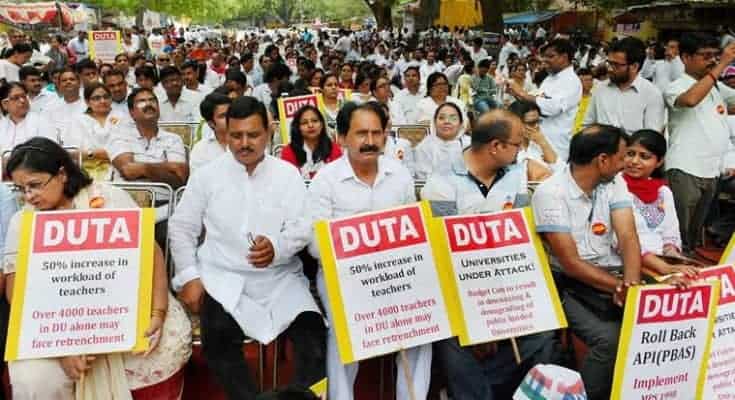
DUTA demands boycott over delays in processing promotions, parity for librarians, opposition to proposed New Education Policy (NEP) and other changes.

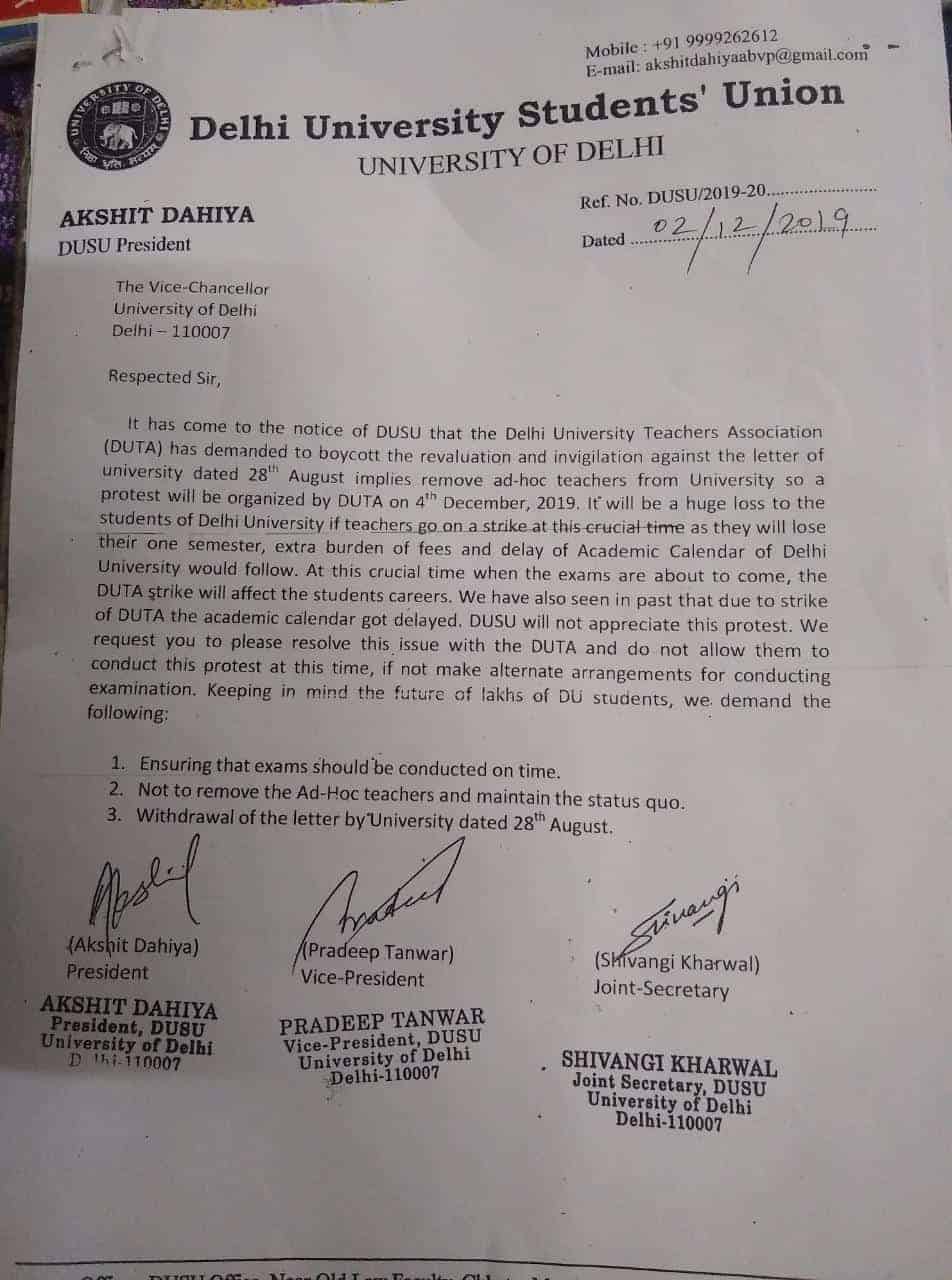
Convening on 25th November 2019, the Delhi University Teachers’ Association (DUTA) came to a few conclusions regarding the long-pending demands of the teachers and their future course of action at the General Body Meeting (GBM). In a press release summarising the discourse of their meeting, teachers expressed their agitation over the illegal Delhi University (DU) circular of August 28th, 2019 that only allows the appointment of guest teachers against full-time posts in departments and colleges, which has adversely impacted the teaching-learning process.

Teachers are also angered with the University’s administration’s inordinate delay in processing promotions for long years, causing harassment and demoralisation of teachers. The demand for stopping of illegal recoveries from teachers and an end to the harassment of the physical education teachers were also raised. Immediate utilisation of the Second Tranche positions of Other Backward Classes (OBC) expansion and implementation of the Kale Committee report also figure in the list of their demands.

The GBM also called upon the Ministry of Human Resource Development (MHRD) to respond to the demand for a One Time Regulation for Absorption of Ad-Hoc and temporary teachers. The DUTA GBM also denounced the attitude of the MHRD that has found reflection in the University Grants Commission (UGC) Regulations 2018, certain provisions of which threaten to exclude teachers in service due to unjust screening criteria and by not accounting for teaching experience adequately in the selection process.

The DUTA GBM also demanded that “the government/UGC immediately approve the provisions regarding relaxation in Academic Performance Indicators (API) for promotions made by the Academic Council and the Executive Council of the Delhi University to correct an infirmity in the UGC Regulations 2018 which has rendered the scheme meaningless.” The GBM also reiterated the demand for complete parity for librarians with the teachers. It also demands a restoration of the parity of instructors and programmers with respect to pay and service conditions.

The DUTA GBM reiterated its opposition to the proposed National Education Policy of 2019, as a proposal that seeks to privatise higher education and hand over these institutions to privatised the Board of Governors (BoGs) with full powers over educational activities and teachers. The privatised BoGs are to enjoy powers that till now were exercised by the Government or UGC, the Executive Councils and Governing Bodies of colleges. Teachers will have no say in the affairs of educational institutions. It threatens dismemberment of Delhi University (DU) by separating colleges from DU as autonomous units under separate BoGs. The DUTA GBM resolved to broaden the struggle against the proposed NEP through coordinated campaigns and protest actions with teachers, students and concerned citizens across the country.

DUTA President, Rajib Ray and Secretary, Rajinder Ray have also demanded immediate action on the DUTA White Paper on “Acts of mis-governance by the Vice-Chancellor of the University of Delhi”.

In order to press for the above demands, the DUTA GBM has decided on a complete evaluation boycott of the semester-end examinations and an indefinite strike starting from the second week of January in case the MHRD and the DU administration do not respond. The GBM also demanded that all Ad-Hoc teachers be allowed to re-join on 1st January failing which the strike may be advanced. The GBM also resolved to undertake outreach programmes, Jan Sampark programmes, Press Conferences and meetings with leaders of political parties and Members of Parliament (MPs) and other participatory action programmes will be held to highlight the issues and to spread awareness about the issues. The GBM also decided to join the All India Trade Union Strike scheduled for January 8th, 2020.


Image Credits: India TV

Bhavya Pandey 

[email protected]

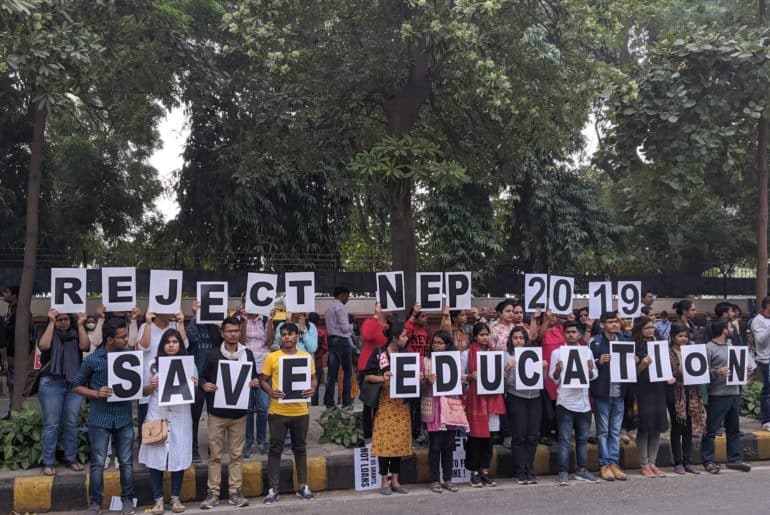
On 14th November, Students’ Union and Teachers’ Association from all central Universities in Delhi marched from Barakhamba Road to Jantar Mantar, and stood in solidarity with students from Jawaharlal Nehru University (JNU) to protest against the New Education Policy (NEP).

14th November observed a central march at Jantar Mantar against the NEP. Student Political groups from Delhi like All India Students’ Association (AISA), CYSS, Krantikari Yuva Sangathan (KYS), National Students’ Union of India (NSUI), Jawaharlal Nehru University Students’ Union (JNUSU), and Students’ Federation of India (SFI) came together to protest against the NEP, and the fee hike in JNU. The protest was led by Federation of Central University Teachers Associations (FEDCUTA) which incorporates the Delhi University Teachers’ Association (DUTA), Jawaharlal Nehru University Teachers’ Association (JNUTA) and Jamia Millia Islamia’s Teacher Association (JMITA )under it. Students showed up at the protest in large numbers with banners, masks to combat the Delhi pollution, and immense grit and determination.

NEP has paved way for Privatisation of education. It has also resulted in the constant fee hikes observed by the Universities. Under NEP, a new mechanism of Higher Education Funding Authority (HEFA) will be established to not give grants but to lend loans. DUTA also fought for permanent absorption of the Ad-hocs to have stability in colleges.

Damini Kain, Presidential Candidate from AISA, said “Public Education is a fundamental right for all. But what the new education policy is doing is, its just making education exclusive. It is deliberately excluding people that come from marginalised communities, lower caste backgrounds and other minorities. NEP is breaking the core fabric of education. It will change the entire dynamic of lending and granting into loans. And the burden of repayment of those loans will lie on the common student.”

The March witnessed many keynote speakers to apprise the students about the consequences of this policy.

Doraisamy Raja, General Secretary, Communist party of India appreciated the students and teachers of JNU to protest against the tremendous hike. He shed light on the importance of education and the threat to its integrity. He also criticised the one language ideology of the current Government.

The common demand that each JNU student and teacher had was to meet with their Vice chancellor and roll back of the fee hike. More than 40% of the students studying at JNU are below poverty line and cannot afford the new fee structure.

Aishe Ghosh, President, JNUSU, said, “All these charges that weren’t existing before like utility charges of electricity, water, food, WIFI will be paid by students even after giving a hostel fees. We’ve come here with a motive to spread this protest to every college and university ad education is for all. All we would like is for our Vice Chancellor to have a discussion with us rather than appearing on Republic TV.”

After all speaker sessions, the March began, led by Federation of Central University Teachers Associations (FEDCUTA), followed by various student organisations. The Teacher-Student-Karamchari unity was an important focus of theMarch.

Slogans like “NEP down down”, “Privatisation se azadi”, “Modi govt Haye-Haye” were chanted. Posters with “Godi Media” talking about the fake media portrayal of press were also displayed, and the banners of Teacher associations of various colleges were also seen.

Among all of these issues, the students from School of Open Learning also came to bring to light the struggles they had face being trapped in the sudden imposition of Choice Based Credit System.

A SOL student, who wished to remain anonymous, told DU Beat, “We’re fighting against the autonomy of education, yet, correspondence where most of the students from lower background study is often ignored. We have exams in December, yet we haven’t been given any books or material. And the material given is so substandard it cannot be used. And the worse, even DUTA has completely ignored us.”

Feature Image Credit : Noihrit Gogoi for DU beat

Chhavi Bahmba

[email protected]

The Staff Association of Shri Ram College of Commerce (SRCC) protested against the circular which directed colleges to appoint guest teachers against full time vacancies.

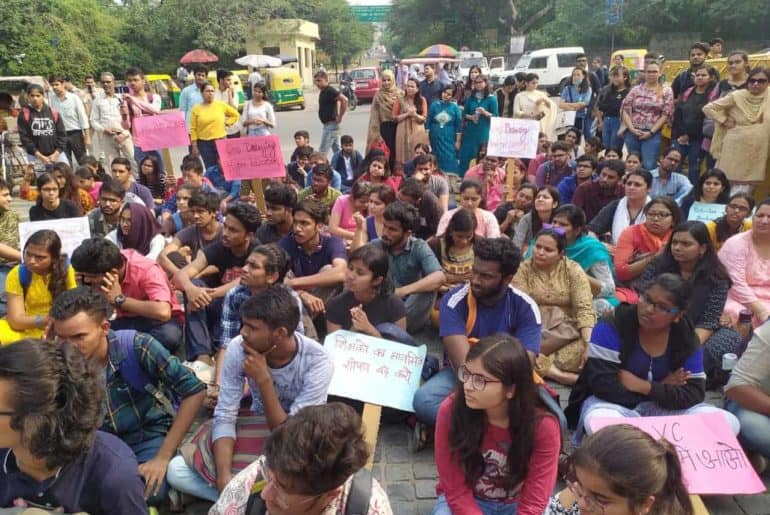
The Staff Association of the University of Delhi’s Shri Ram College of Commerce held a protest against a circular dated 28th August 2019 issued by the Assistant Registrar of the University which directs the appointment of guest teachers against full time vacancies.

On the appeal of the SRCC Staff Association, students joined the teachers in large numbers outside the college and they marched towards the Vice Chancellor Yogesh Tyagi’s office to submit a memorandum.

“Guest teachers are paid on per lecture basis only for lectures held and that too subject to a ceiling on payment / number of lectures in a week. This is unjust for young talent aspiring to become a teacher and shows a lack of concern for teaching-learning”, the staff association said.

They further added that the circular “is unmindful of the co-curricular and extra-curricular activities as well as various institutional activities in which full-time teachers participate.”

Calling the circular “unwarranted”, they further highlighted how it has caused uncertainty and distress among different colleges due to varied interpretations.

The Varsity had been filling the vacancies using ad-hoc teachers currently who are given fixed monthly stipends and are hired on a four months contractual basis. Most of these teachers are working for over a decade and are awaiting permanent recruitment as they are currently not entitled to the benefits of permanent faculty members.

Elaborating upon the uncertainty looming over these ad-hoc teachers, the statement said that “uncertainty exists as to whether or not the existing teachers working in ad-hoc will be renews in the same capacity in a few days time when the term of their current appointment ends.”

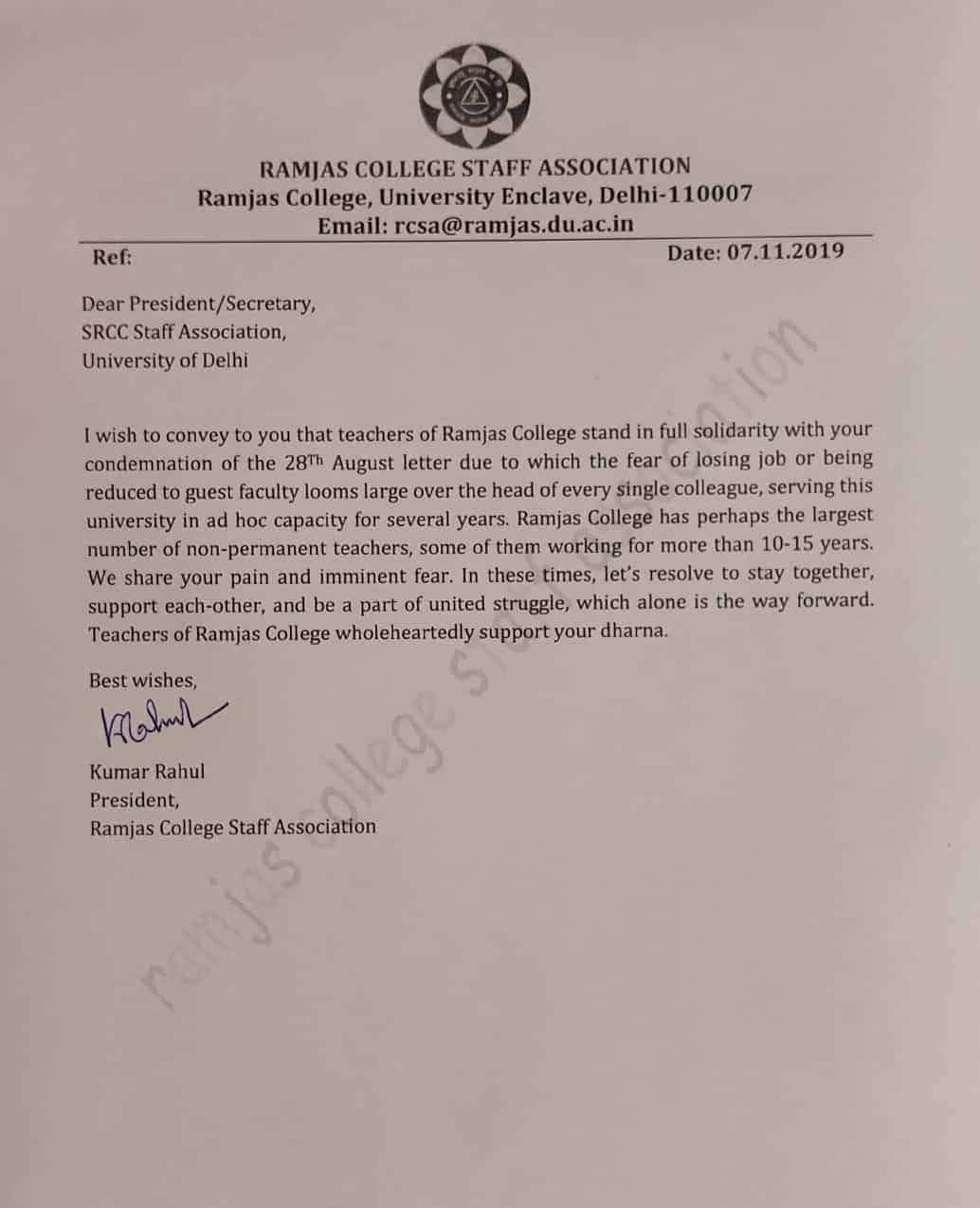
The Staff Association of Ramjas College extended their support to the SRCC Staff Association and said, “Ramjas College has perhaps the largest number of non-permanent teachers, some of them working for more than 10-15 years. We share your pain and imminent fear.”

WhatsApp Image 2019-11-09 at 9.58.29 PM
Image Credits: Ramjas Staff Association       Image Caption: The Ramjas Staff Association release a Press Release in solidarity with the SRCC protest.

The memorandum was submitted to the Proctor, University of Delhi as the VC was unable to meet the college’s representative. The proctor assured the protesting teachers that the existing ad-hocs will not be replaced.


Feature image Credits: SRCC Staff Association

Shreya Agrawal

[email protected]


The Delhi University Teacher’s Association (DUTA) held an emergent meeting at Tuesday, 24th October 2019 to discuss the varsity’s twin move to create an “Institute of Eminence” within it and replace its various statutory bodies like Executive Council by an all-powerful Board of Governors.

DUTA had a meeting wherein recent issues of key importance were discussed. The meeting’s main motive was to formalise the arguments against the decision and submit the same to the University Administration expressing their concerns while also highlighting the possible consequences.

The concept of the institute of eminence is taken as a pathway for better education, however, a thorough understanding of the label is required. Here is an explanation of the same.

The status of institute of eminence will take place with the formation of 9 autonomous centres and the replacement with a separate board of directors. The exercise in creating a separate list of Institutions is geared towards promoting a special economic zone for Higher Education brands that may pursue commercial aims with impunity and without any public accountability, said DUTA. The organisation was responding to the Human Resource Development (HRD) Ministry decision to grant ‘Institutes of Eminence’ status to 6 institutions.

Along with the University of Delhi, the government granted ‘Institutions of Eminence’ (IoEs) status to IIT-Delhi, IIT-Bombay and the Bengaluru-based Indian Institute of Science (IISc) in the public sector, and Manipal Academy of Higher Education, BITS Pilani and Jio Institute by Reliance Foundation in the private sector.

Talking about IOE, to give the institute of eminence within the University of Delhi (DU) will lead to disintegration. DUTA’s discussion was pointed towards how currently, the entire University has been awarded the status of IoE, and it is shared by all the institutions, faculty members and stakeholders jointly. But once an independent parallel structure within it is declared as IoE, it will receive the entire limelight and government patronage leading to disintegration of unity among the institutions.

The DUTA is also opposing the University Administration’s decision to do away with the current administrative or statutory bodies of the university such as the Executive Council and Academic Council with an all-powerful Board of Governors. University has decided to advance the timeline of setting up a Board of Governors in line with the New Education Policy 2019, because of the following reasons:

The new Board of Governors will not be accountable to anyone within the university. Instead, the Board of Governors will only be accountable to the Rashtriya Shiksha Aayog, which is a cause for concern. In addition to this, the members of the Board of Governors will be nominated and not elected, from outside the university, which again calls for caution.

Talking about the advancement of plans to implement the Draft New Education Policy from 2020 to October 2019 itself, DUTA said, “This timeline seeks to do away with the statutory bodies like Executive Council, Academic Council, departmental councils and college staff council by the constitution of all-powerful BOGs (Board of Governors).”

DU is going to implement this BOG-ruled autonomous structure within the varsity in the  garb of eminence, where this institute would receive a grant of INR 1000 crore in 10 years from the Centre directly and their matters will never undergo the critical scrutiny from the EC, AC or Finance Committee which raises a bigger motive for privatization.

“The ’eminence’ tag is being used to dismantle the university when the government money should have benefited the entire university and improved its infrastructure” DUTA said allegedly.

The question is hand is why the university administration is taking such dire steps, going against their unions to implement this.

In a conversation with Abha Dev Habib, Office bearer, DUTA, she told DU Beat, as an answer to the above question, “It’s all just a big facade for privatization, commercialisation and corporatization of education. Whether they call it graded university, new education policy or institute of eminence, it’s just privatization, where there will be fee hikes, all in the name of profit.” She also said, “There will be a serious loss of accountability and greater disintegration.”

DUTA also criticized the way some private institutions have been selected as Institutes of Eminence.

The Government had received more than 100 applications for the grant of IoE status. Under Public Sector, the following have applied for the scheme-

  • 10 central universities
  • 25 state universities
  • 6 deemed to be universities
  • 20 institutions of national importance
  • 6 standalone institutions

As for the private sector, 9 private universities and 16 deemed to be universities have applied in the Brownfield category and 8 institutions have applied in the Greenfield category.

Existing standalone institutions which are not universities or deemed-to-be-varsities were allowed to apply under Greenfield category for Institution of Eminence status to avail greater autonomy and get a world-class reputation.

DUTA has been quite vocal in presenting their resentment against the proposal. Many staff associations along with students throughout the varsity have protested against this proposal and the new education policy.

Where colleges like Ramjas college went on a ten-day dharna, other colleges like Gargi college and Kamla Nehru college formed a human chain to show their resistance.


Staff association and students of Gargi college and Kamala Nehru College come together and form a long queue of protest against the privatization of University of Delhi with slogans like “Education is not for sale”. Video by Avni Dhawan for DU Beat

After the emergent meeting that took place on Tuesday where all the arguments were formalised, DUTA has rejected the proposal. It was rejected on the grounds that it involves a push towards privatisation of education as confessed by Mr. Prakash Javadekar while announcing it for the first time as Graded Autonomy for universities and grant of IoE status. He had confessed that these steps constitute the initiation of liberalisation in the education sector.

“It also gives the University the freedom to determine fees for domestic students subject to one meaningless rider. The rider is a principle that no one will be turned away for his/her incapacity to pay. In the absence of any guideline on how high the fees are and the means criteria to be entitled to fee waiver/scholarship. Loans binding their future would become the only effective mechanism.” said DUTA in their press release.

The DUTA Executive also took a decision to call for a Total Shutdown of the University on Friday, 25th October 2019 and a Dharna from 1 p.m. to 3 p.m. outside the Executive Council meeting to protest against this move and also to demand the withdrawal of the 28th August 2019 letter asking for guest appointments to be made against all new vacancies.

Feature Image Credits: Abha Dev Habib

Chhavi Bahmba

[email protected]

Despite protests by teachers, the University of Delhi (DU) has signed a contentious tripartite Memorandum of Understanding (MoU) with the University Grants Commission (UGC) and the Ministry of Human Resource Development (MHRD) with regard to its funding.

In September last year, the MHRD had sent DU a notice that its funding would be withheld if it doesn’t sign the agreement which, as reported by The Indian Express, was termed “arm-twisting” by the DUTA. As reported by NDTV, The tripartite MoU requires universities to continuously increase the internal (self-generated) financial resource through fee hike, shift to revenue-earning commercial courses, engagement with other commercial activities, and manage greater part of their research activities through extramural funding.

It also mentions that release of funds and loans from Higher Education Funding Agency (HEFA) for expansion of infrastructure will depend on the institution’s performance. The DUTA had said that tripartite MoU initiate steps towards the privatisation design that forms the core of the Draft National Education Policy (NEP). “The Draft NEP 2019 aims to reduce the number of Higher Education Institutions (HIEs) while increasing the size of surviving institutions, which will be governed similarly by a privatised Board of Governors and have to have a development office to secure sources of funding other than government funding,” they added. UGC Secretary, Rajnish Jain, and sources in the MHRD confirmed that the MoU was signed last week.

Press Statement by Executive Council (EC), stated that J L Gupta & Rajesh Jha, members of EC, protested against signing of tripatrite MoU with MHRD and UGC recently, by the Vice Chancellor (VC), Mr. Yogesh Tyagi. They came to know that the VC has signed it and then, they wrote a letter to VC raising objection over its grave compromises with the autonomy of the university as conferred by the Parliament through DU Act 1922. It also stated, “This MoU imposes privatisation and contractualisation, on which they strongly dissented in the concerned committee and the EC. This MoU will change the inclusive character of higher education in India as the loans from HEFA are forced on us. When the whole University community has rejected this MoU, the VC should have gone for wider consultation with the statutory bodies and the elected bodies of students, karamcharis, and teachers rather than signing it up in a hush hush manner.” They have also demanded for the authorities to share all information and documents related to the MoU and stop its implementation in the University as it breaches the provisions of the Parliamentary Act. Rajib Ray, President, DUTA, too condemned the MoU and said, “We are yet to see which version was signed — the original or the diluted one approved by EC. Either way, we are opposed to this.” VC, Mr. Tyagi, was not available for a comment on the same.

Feature Image Credits: Aakarsh Gupta for DU Beat

Sakshi Arora

[email protected]

Over 2,700 teaching and non-teaching staff of 12 Delhi University (DU) colleges did not get salaries for the last two months as the Aam Aadmi Party (AAP) Government continues to withhold release of funds over non-formation of Governing Bodies (GB).

Out of the 28 DU colleges, 16 get only 5% of their funds from the Delhi Government while 12 receive 100% funding.

The GBs, comprising members nominated by the university and the Delhi Government, take all decisions for the smooth functioning of a college, including the appointment of teaching and non-teaching staff.

Some Principals of various colleges across DU wondered why the GB term could not be extended. “In the past, the term has been extended for almost six months. It can also be done now until the process of formation of the Governing Body is completed,” said a Principal whose college receives 100% funding. “The government should understand that we have to pay salary to the staff and their arrears.”

Dhananjoy Shaw, Principal of Indira Gandhi Institute of Physical Education and Sports Sciences (IGIPESS), said the fund crunch has affected student activities as well. “We haven’t been able to pay salaries to our staff for two months. Since some student activities had been planned before, we are executing them at the lowest possible cost,” he said, adding that managing day-to-day expenses will be difficult from October.

A contrary argument came to the fore when an official in the Delhi Government said that DU is insisting on not forming GBs in these colleges. “It is clear that there is an attempt to shield colleges from accountability and intent to continue corruption,” the official said.

“I am able to manage our daily expenditure somehow as this is not my only income source. But there are many employees whose day-to-day expenditures depend completely on their salary. Due to the ego clashes between the Vice Chancellor Yogesh Tyagi, and the AAP Government, it is the employee who is suffering.” another DU official grieves. 

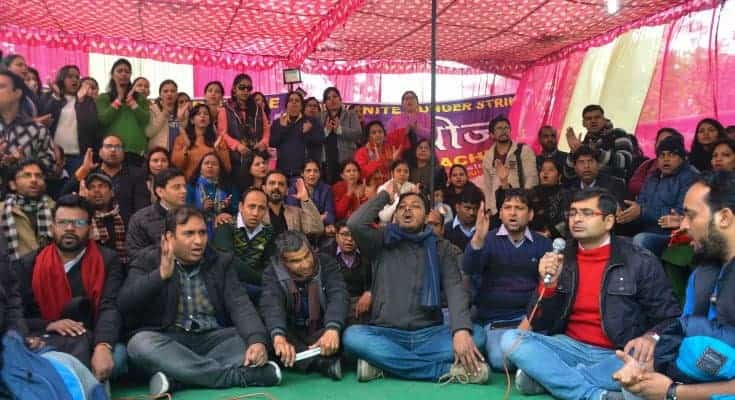
In a protest organised by Delhi University Teachers’ Association (DUTA), outside Vidhan Sabha on Friday, staff members said that “uncertainty in getting salaries has led to crisis” in these 12 colleges. “The worst-hit are the teaching and non-teaching staff working on ad hoc or contract basis,” DUTA said in a statement.

Delhi University College Karamchari Union (DUCKU) plan to sit on strike on 1st and 3rd October. 

The Vice-Chancellor and Arvind Kejriwal did not respond to requests for comment.


Feature Image Credits: DNA India


Bhagyashree Chatterjee 

[email protected]


The Delhi University Teachers’ Association (DUTA) on Thursday, 12th September, raised its voice against the construction of a 39-storey high-rise housing society at the North Campus citing safety and privacy concerns.

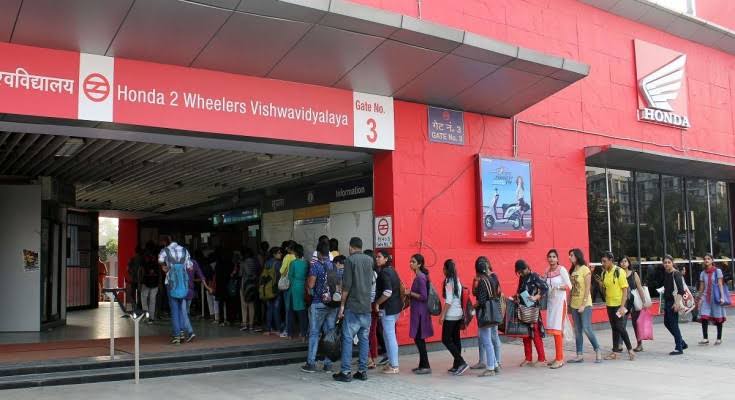
DUTA has opposed the construction of a 39-storey building in North Campus saying it “would significantly alter the social and cultural landscape of Delhi University” and also compromise the “safety of women students”. The building is coming up adjacent to Vishwavidyalaya Metro Station, near Gate Number 3 and 4. DUTA also stated that the land originally belonged to the Ministry of Defence and was acquired for public purpose by the state government for the construction of metro station by Delhi Municipal Rail Corporation (DMRC).

Consequently, the DMRC sold two-thirds of this land by granting perpetual lease of ninety years to a private builder called ‘Young India’, in the guise of property development and by changing the land use from “public and semi-public facility to residential”, the DUTA alleged.

Sudhanshu Kumar, the Vice President of DUTA, stated, “This is the height of privatisation. It (building) would seriously compromise the safety and privacy of women students on campus as it stands in close proximity to several hostels that house women. It would also pose a serious safety issues for all students on campus, restricting their right to move freely in their own campus. It is clearly a ghotala committed by the State Government, DMRC and ‘Young India’.”

DU had also written to the Prime Minister’s Office, the Home Ministry, as well as the Ministery of Defence on this matter. Officials said that the proposed building is not viable keeping in mind security concerns for the North Campus students, since the building will have a bird’s-eye view of five of the girls’ hostels on the campus – Miranda House Girls’ Hostel, the Central Institute of Education, University Hostel for Women, Meghdoot Girls Hostel and the Girls’ Hostel of the Department of Social Work; apart from several other University buildings.

They said that there is already a severe paucity of spaces for students on campus, for their accommodation, recreation and for other academic activities and the use of this space for a residential complex is questionable in its intent. The Association has also notified that it “will take up the matter with the President of India, who is the visitor to the University”, in conversation with the Dainik Jagran.

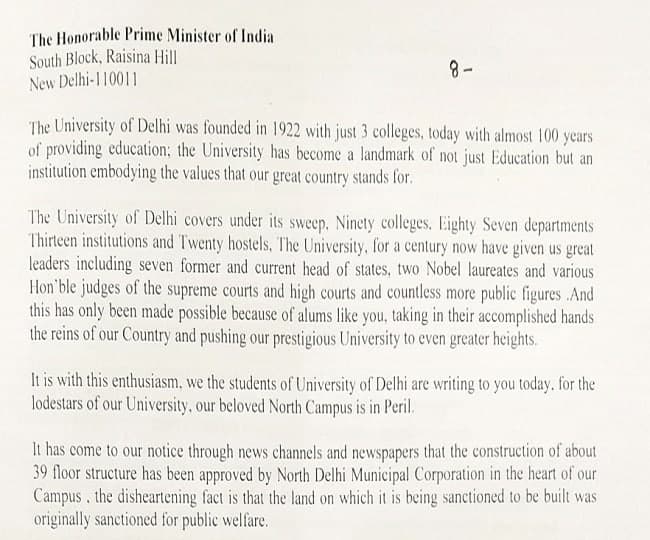
Meanwhile, women living in the varsity’s 20 hostels have written a letter to Prime Minister Narendra Modi, raising concerns over the construction of the high-rise building in the campus, saying that it will “infringe their privacy” and “prejudice the security” of students.

Image Caption: Female students, living in the campus’s 20 hostels, have written a letter to Prime Minister Narendra Modi raising concerns over the construction of the high-rise building in Campus. Image Credits: Jagran Media
Image Caption: Female students, living in the campus’s 20 hostels, have written a letter to Prime Minister Narendra Modi raising concerns over the construction of the high-rise building in Campus.
Image Credits: Jagran Media

The letter reads, “…it (the construction of the structure) would directly infringe the privacy of all the women’s hostel in close proximity to the land, it would prejudice the security of the students who attend departments and colleges in North Campus, since being a private structure the activities that will take place in the building will not be open to public censoring and if such a building is to be constructed in the University area, it would curtail the students’ freedom to move around the campus…”

DU also insists that the construction of this building will come in the way of the Master Plan of Delhi, 2021, that has been envisaged for the city’s infrastructure. Moreover, according to the documents accessed by Mail Today, 228 trees have been felled for the construction of this building.

Feature Image Credits: DU Beat Archives


Bhavya Pandey

[email protected]

Bhagyashree Chatterjee

[email protected]

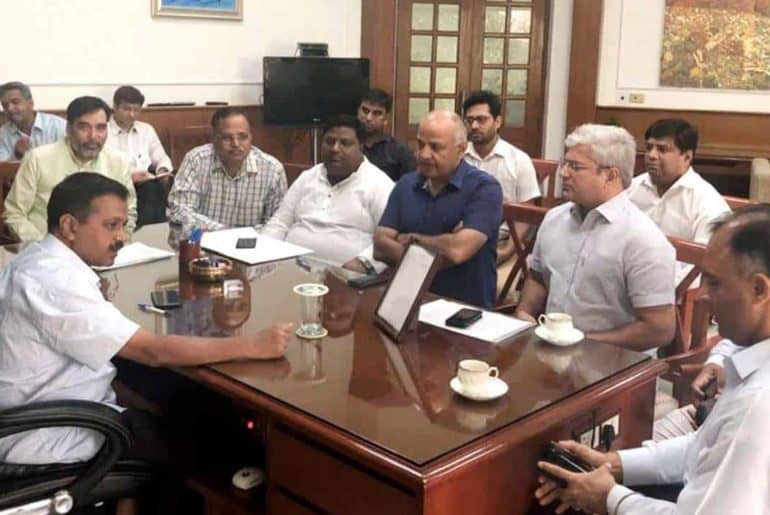
On Monday, 9 September, 2019, the Delhi University Teachers’ Association (DUTA) corresponded to the Delhi Chief Minister Arvind Kejriwal regarding the issuance of salaries for the employees of the 28 colleges that are either fully or partially funded by the Delhi government.

The complaint is lodged with regard to the payment of due salaries owing to the stoppage of grants by the Aam Aadmi Party (AAP) relaxation. Where the formation of governing bodies prompted a deadlock between the University and the city government, the accusations from both ends claim to have delayed the process further.

Although, earlier in June Deputy Chief Minister and Education Minister Manish Sisodia directed the Education Secretary, Sandeep Kumar to ensure the release of funds for three months to the 28 colleges, the employees of the 28 partially or fully funded colleges, under the Delhi government are constantly being subjected to delayed payments of salaries and other remunerations due to prolonged stoppage of grants by the AAP dispensation, said according to a letter by DUTA.

“You would agree that this action of denial of salaries to the teaching and non-teaching staff of these colleges amounts to a violation of basic human rights. Your reasons, whatsoever they may be, do not warrant such an assault on the living conditions of the employees,” it said.

It further quoted, “The government must also immediately release funds for the additional posts that are to be created for the teaching and non-teaching staff in the wake of the EWS reservations. ”

With these delays affecting the teachers of the institution directly, the futility in their responses have apparently affected the students of the varsity as well.

The necessary increment in the number of students across all disciplines under EWS have resuscitated all the aforementioned colleges with additional funds for salaries and infrastructural development to add for the proper functioning of the colleges with regard to academic and administrative responsibilities, says the association. While, some of the new courses that are incepted after receiving the necessary approvals designated in the administration, most of them are devoid of funds and appointment of teachers required for continuation of these courses.

“They (DU) are not forming governing bodies. They are deliberately not doing it because they want to do wrong appointments. They should bring governing bodies and let those bodies decide. How can we give funds when they are not bringing governing bodies?” says Deputy CM Manish Sisodia in response to this issue.

Where the University claims to have formed a committee to look into the issue, it has further speculated the matter and has stated some names to the government concerning the issue.

Where the twelve colleges that are fully-funded by the Delhi government includes Indira Gandhi Institute of Physical Education & Sports Science, Shaheed Sukhdev College of Business Studies, Shaheed Raj Guru College, Deen Dayal Upadhyaya College, Dr Bhim Rao Ambedkar College, Acharya Narendra Dev College, Bhagini Nivedita College, Keshav Maha Vidyalaya, Maharaja Agrasen College, Aditi Mahavidyalaya, Mahirishi Balmiki College of Education and Bhaskara Charya College of Applied Science

The sixteen partially-funded colleges are namely, Shivaji College, Motilal Nehru CollegeLaxmi Bai College, Shaheed Bhagat Singh College, Maitreyi College, SPM College for Women, Satyawati College, Vivekananda College, Rajdhani College, Kamala Nehru College, Gargi College, Swami Shardhanand College, Kalindi College, Bharti College, Sri Aurobindo College, and Delhi College of Arts and Commerce.

It is however paradoxical that in a recent tweet by the Delhi CM on the account of Teachers’ Day, he claims to be indebted to the teachers for their contribution in building the society, the DUTA probe sends his words otherwise.

Feature Image Credits: DU Beat Archives

Faizan Salik

[email protected]


At 6:30 a.m. on Tuesday, 10th September, the Pune police searched the residence of Hany Babu, a professor in the English Department of the University of Delhi (DU), in relation to the Elgar case.

On Tuesday, 10th September 2019, Pune police conducted a series of searches in the residence of Hany Babu, a professor in the English Department of the University of Delhi (DU), in Noida, Uttar Pradesh. The searches were conducted in connection to the Elgar Parishad case of 2017. He was investigated due to alleged Maoist links. Though no arrest was made, this development was confirmed by Assistant Commissioner of Police (ACP), Shivaji Pawar.  “We have conducted a search operation at Babu’s residence in Noida in connection with the Elgar Parishad case registered at the Vishrambaug police station in Pune,” Pawar told India Today, adding that police have recovered some electronic devices.

The Elgar conclave was held on 31st December 2017, to commemorate the battle of Koregaon-Bhima, and the speeches made during this conclave aggravated the caste violence around the Koregaon Bhima village in the district on 1st January 2018. This led to the death of one person, and several others were injured. Police have arrested nine persons related to the case so far.

Professor Hany Babu’s Public Statement on the police intimidation and raid at his house read:

I am Hany Babu, residing with my family in Noida. I have been teaching at the English Department in the University of Delhi as an Associate Professor for close to a decade.

At 6:30 AM in the morning, 20 people knocked at my door, claiming that they belonged to the Pune Crime Branch. Five of them were in uniform, the rest were in civil clothes. I was told that they wanted to conduct a search of my residence. When asked for a search warrant, I was told that there was none and that this case doesn’t need one. Following this, I requested for some form of identification to be shown to me. An officer with the name Dr. Shivaji Pawar showed me his ID. After this, the officers entered my residence and looked through every room of my apartment. The search went on for six hours, at the end of which they said they would be seizing my laptop, my hard disks, my pen drives and books. They made me change the passwords of my social media accounts and my email account. They have complete access to my accounts now through the changed passwords and I no longer have access to these accounts. I would like to state that as a teacher, my work is heavily dependent on what I’ve saved in my laptops and external hard disks. It also contains the research work that I’ve been pursuing for years. This work is not something which can be duplicated in days. These are years of my hard work. I don’t understand how a government agency can seize my work without providing me the reasons for it, or the basis on which a search was conducted at my residence. They did not have a search warrant with them and they did not explain further as to why they don’t possess the same. While the search was ongoing, they also seized the phones of my wife and my daughter, barring us from communicating with our friends.”

In a press release by Delhi University Teachers’ Association (DUTA), Rajib Ray, the President of DUTA condemned the act, claiming that such raids without search warrants are against the very essence of democracy, individual freedom, and open the door for planting evidence.” He also states that such intolerance towards criticism and dissent was the basis for the insidious attempt that was made last year to amend the Delhi University Act and apply ESMA, and that “this attack on academic freedom and freedom of expression will be opposed tooth and nail by the teachers of Delhi University and other academic institutions in the country.”

The search operation has been met with a massive uproar. A protest was organised on 11th September near the Faculty of Arts, North Campus, to raise questions on the essential nature of dissent in a politically active space like DU, and its lack thereof in the face of desperate attempts to annihilate contrasting voices. This is the latest case in a series of witch-hunts aimed at making the college spaces more “positive”.

Feature Image Credits: Hindustan Times

Shreya Juyal

[email protected]


Rajib Ray, on Friday, was elected as the president of DUTA for the second term, defeating AK Bhagi by 269 votes.

Rajib Ray was elected as the president of Delhi University Teachers’ Association (DUTA) for the second term, on Friday.

Ray, belonging to Left-affiliated Democratic Teachers’ Front (DTF) defeated right-affiliated National Democratic Teachers’ Front’s (NDTF) candidate AK Bhagi by a margin of 269 votes.

Elections took place on Thursday with a turnout of 82.36 per cent where Ray managed to win 3,750 votes in comparison to Bhagi’s 3,481 votes. 518 votes were found to be invalid, according to officials.

Speaking on his victory, the second time DUTA president said, “It’s a significant win for me and the DUTA because, despite getting little relief in the last two years, teachers have kept faith on the Union.”

Ray elaborated upon the issues faced by teachers of the varsity and laid out his plan for the tenure as he said, “I have to enable all DUTA Executive members, regardless of their political or ideological affiliations, the most confident and conducive ground to fearlessly raise issues and work for teachers.”

“The union and this University owe a lot to the contribution of our colleagues who have been working on a temporary and ad-hoc basis. They deserve to be absorbed in permanent jobs. DU teachers also need time-bound promotions and seniority restored to them. That is non-negotiable. DUTA will put a focused effort in this direction”, he further added.

Further augmenting his vision for the teachers, he said, “Teachers are extremely unhappy with the NEP in its present form. We will continue to put pressure on the Government to be more open-minded about the policy framework and make changes that are genuinely pro-teacher. The educational policy must strengthen the public-funded system rather instead of weakening its foundations.”

Rajib Ray was elected as DUTA president in 2017 as well. The tenure of a president lasts for two years.


Featured Image Credits- Democratic Accent

Image Caption- Rajib Ray belongs to left-affiliated Democratic Teachers’ Front (DTF).


Shreya Agrawal

[email protected]