Tag

DU

Browsing

This June, remember to hold onto your anger and pain as you set out to celebrate your pride. Pride was, never a celebration alone to begin with. It was and will always, remain a fierce riot.

When I joined DU Beat, I was a lost correspondent with too many opinions on Netflix and zero knowledge about graphics ideation. But one thing I knew for sure was that I wished to write stories rooted in my immediate cultural experiences. Stories about people. Stories about students. Stories about queerness.

I never viewed queerness as something that was associated with a sexual identity but rather as something that served as a deviation from a set norm. Queering of narratives, discourses, readings and even something like non-linear documentation of time always interested me. As a marginal figure in my most immediate circles while growing up, I felt the need to understand and by extension empathise with anything that occupied a position of marginality around us.

Ever since I stepped foot into DU, I realised that there are hardly any places more queer than those afforded by educational spaces – where marginal social identities offset hundreds of students from the larger crowd of normal adherence. And such varsity spaces become intersectional convergence points for glorious bonhomie – and sometimes sites of extreme cruelty. Taking pride in visiblising intersectional identities in university spaces like ours are more often than not the share of a privileged few – their economic and social position allowing them affordances most are denied. The same identity that becomes the pride of a select few – comes at a cost for others. For most people of such social minority identities, making common knowledge of your lower caste identity comes at the cost of having your narrative being baited by upper caste saviours, your gender identity becomes a double edged sword in your path of progress and your sexuality a constant site of speculation and amusement for those around you.

But amidst the pride colours, pride watchlists and other glittery extravaganza is the overlooked loneliness of growing up queer. To survive a childhood of conflict with your truest point of self-identification, knowing that perhaps the biggest truth about you will always be held as a questioned truth by those around you and eventually coming to a city this big and finding yourself lost amidst a sea of unknown faces – each presenting to you hierarchies of power previously unknown to you. You are immediately swept into a whirlwind of heterosexual college romances, and your heart yearns for that singular same-sex romance that you only see in your annual token queer Netflix romantic comedy and before you know it you have set sail on the flood-prone waves of the hookup culture. Eventually your life is a string of making your way from one bed to another, from looking for ‘spots’ and asking for ‘places’.

But every year in June, corporations and allies around you urge you to forget this language of heartbreak and make you drown in their definition of a glitzy celebration of queerness. To all those queer souls lost this Pride month – to you I say, remember Pride began as a protest, a riot to be precise. Take the anger in your heart and hold onto it – for being queer comes at great pain of surviving a staunchly heterosexual society. To all the allies planning your next pride march, make sure to administer a consensual hug to the next queer you meet this month – queerness is a struggle with loneliness and for all your good intent some loneliness of the self that will take this community an entire life to overcome.

Anwesh Banerjee

[email protected]


And the mid-sem break is finally upon us! For two years studying in the most prestigious public university of the country (terms and conditions applied) have entailed me telling my debatably more fortunate friends in private universities that my six month long semester now squeezed into four pathetically short months, flies by without a singular mid-semester break. Back in the days of Google Meet University, it did not really matter, since 8:30 classes were about switching on your laptop and falling asleep again (God bless all the people who figured out how to record lectures) as opposed to making your way through cow-dung in Old Gupta Colony and haggling with rickshaw-drivers over twenty bucks. 

At the stag end of my degree, the promise and fruition of a well earned semester break is nothing short of enticing. But even as I groan over all the pictures of my hometown decked in glorious lights, all set to don the garb of an open art gallery for ten days, I realise there are among my peers who will not go home during this break and juniors who will not be able to go home. Attendance sucks really. Having exhausted medical claims for lazy Wednesdays and hungover Fridays, people find themselves now faced with the risk of staking five full marks at the cost of returning home for festivities. 

But it is moments such as these that make me wonder truly what it means to be an outstation kid in this lonely little city during festival week? We all come away from our homes with suitcases packed with dreams which can never be appropriately weighted by airport authorities. We come with hopes that are beyond the beeps of securities at transit. We look for houses, negotiate rents, put up with scheming landlords and adjust our intestines to the atrocious fare that is served in the name of daily food. In the end, we find our own corners, deck them up with fairy lights, save up for Alexa and make it our goal to purchase fresh flowers at least once a week. You know a city is unkind when the price of chrysanthemums makes you rummage your pockets to check if you have enough for dinner later, and you settle for the familiarity of white peeling tuberoses. 

But soon we realise that for houses to become homes, they must pass the litmus test of establishing unconscious hierarchies with which come inevitable power dynamics. Dynamics that bring with them the quiet company of many heartbreaks and disappointments. Eventually you are left straddling the remnants of a home back where you came from – a home that grows seemingly distant with every passing day – and the burden of making peace with the home you promised to build yourself here. Oftenstance, situations arise when the need to anchor oneself leaves one feeling even more vulnerable, and we assume the hybrid identity of outliers – neither here nor there. Neither able to go back in full throttle nor able to make peace with the newness of where we are now. Festivals don’t help either. 

In a search of making sense of an existence this deeply in a moment of flux, we often find ourselves longing to go back to the warm glaze of a city waking up to colours and words of joy on a festival of homecoming. We find ourselves craving the sweets that Maa would make in the kitchen – samples to be nibbled at, the actual specimen only made available when the guests arrived. At that moment the journey of coming to the big city becomes an exercise in meaning-making and fighting urges to not succumb to the comfort of familiarity in the most unfamiliar of circumstances. 

To all the people who will not be returning home for your festivals this mid-sem break, because of you have heartbreaks to tell your pillow about, playlists of crushes to hear on loop, professional disappointments to cope with and peace to be made with waning family ties, I loan a few words of Vikram Seth. he writes, “All you who sleep tonight, far from the ones you love…. The whole world shares your tears, Some for two nights or one, And some for all their years.”

Anwesh Banerjee
[email protected]

The Tis Hazari court granted bail to DU Associate Professor, Ratan Lal, who had been arrested on Friday by Delhi Police responding to an FIR lodged against him in regards to the ‘shivling’ comment controversy. Read to find out more.


Delhi University Associate Professor, Ratan Lal, who was arrested on Friday night, 20th May 2022, after an FIR was lodged against him for making alleged objectionable remarks through a Facebook post, has been granted bail, on a bond of Rs. 50,000 and a surety of likes, by the Tis Hazari court.

The complaint, which was lodged by a Delhi-based lawyer, Vineet Jindal, alleged that Lal had recently shared a “derogatory, inciting and provocative tweet on the Shivling”.

The DU professor had been arrested by the Cyber Police Station, North under IPC sections 153A (promoting enmity between different groups on grounds of religion, race, place of birth, residence, language, etc., and doing acts prejudicial to maintenance of harmony) and 295A (deliberate act to outrage religious feelings of any class by insulting its religion). The Delhi police had been seeking a 14-day judicial remand of Professor Ratan Lal in order to facilitate a proper investigation in the case, considering that they had received six complaints against him so far.


Appearing on behalf of the police, Additional Public Prosecutor, Atul Shrivastava, told the court that, “prima facie some comments have been passed that have the potential to disturb public tranquility”.

Accordingly the FIR was registered… the most important aspect, not expected from such an educated person, was after making such type of remarks, he has not stopped there, he has been defending himself through different videos uploaded on YouTube,” Shrivastava argued.


On the other hand, Professor Ratan Lal’s lawyers (Advocates Amit Srivastava, Aditya Kumar Chaudhary, Dr Satya Prakash, Sanjay K Chhadha, ND Pancholi, Rahul, Mukesh, Deepak Jakhar and Karish Kumar Mehra) had moved his bail application before the Chief Metropolitan Magistrate, Siddhartha Malik, arguing that his arrest was in violation of the Supreme Court guidelines as mentioned in the Arnesh Kumar judgement.

What circumstances happened that you had to make an arrest? He was not a criminal or a habitual offender. He is a professor in a reputed college… You had proper time, you could have served notice, waited for a reply, and if there was an unsatisfactory reply then you could have arrested. This is contempt of Arnesh Kumar judgment and the officers involved in this arrest should face departmental enquiry,” Lal’s lawyer submitted.


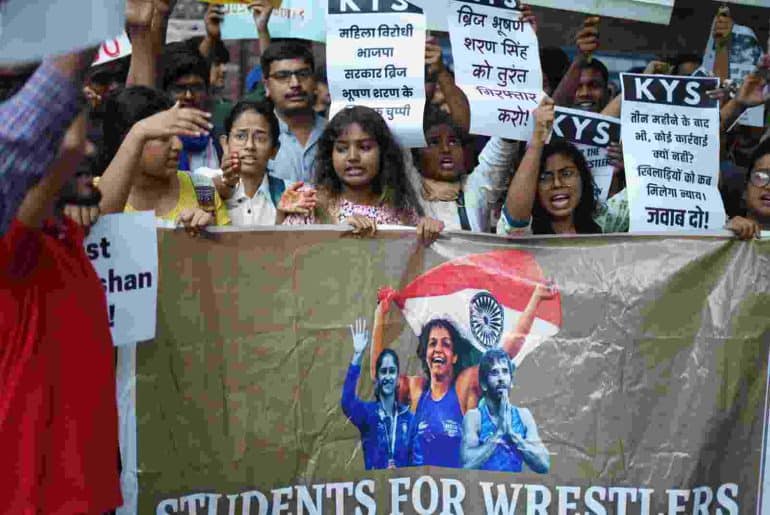
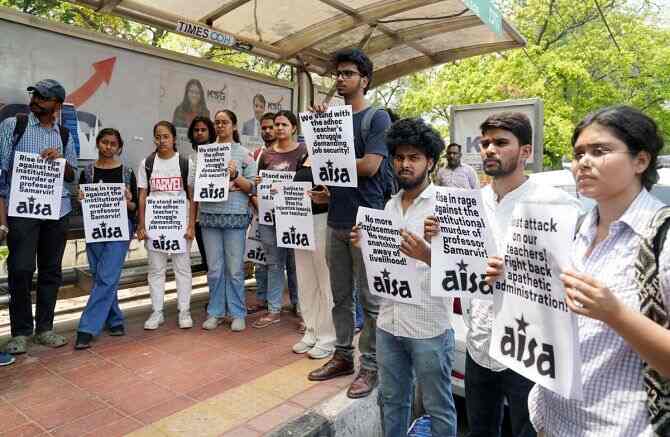
On Saturday, 21st May, 2022, students as well as student organisations had held a protest outside Arts Faculty, DU against the arrest of Professor Ratan Lal. This included organisations cuh as AISA, Krantikari Yuva Sangathan (KYS), and DSU taking a stand in support of the professor. The students participating in the protest held placards saying “Stop attack on our teachers”, “Stop curbing democratic voices”, and “Release professor Ratan Lal”.

The FIR has been lodged against Prof. Lal under the section of blasphemy, an act which has no place in a country such as India which is not a theocratic state. Our constitution recognizes itself as a secular country, promoting all contending schools of thought, including those that are against institutional religions. Therefore, blasphemy must be decriminalized. It is only a tool in the hands of religious fundamentalists to quell voices who stand firmly against religious mongering,” said Noel Benny, SFI Delhi State committee member, while addressing the student gathering.


SFI Delhi also issued a statement in solidarity with the professor, condemning his arrest and the arbitrary action of the state.

This punitive action against Prof. Lal is characteristic of a Brahminical state. Brahminism since its inception as a hegemonic ideology has always violently suppressed its opposers… The current instance of using state machinery and constitutional provisions to penalize critics is only a manifestation of the oppressive ideology, which reaffirms that the state continues to follow the traditions of the Brahmanical order,” read the statement made by SFI Delhi.


Taking its decision, in addition to granting bail, the court directed the DU Professor to refrain from making any new social media posts or from engaging in different means of interaction such as interviews concerning the ‘shivling’ controversy.

In regards to this issue, Professor Ratan Lal had previously argued and made a statement that all he had done was impose a question to the general public as a student of history. 

People can be hurt by anything. Academic discourse cannot be sidelined on account of perceived hurt. I had asked a simple question to enquire if the so-called shivling was broken or cut. Mullahs and Pandits don’t need to comment on it. An art historian should answer this question,” said Professor Ratan Lal.

The court said that considering that the concerned remark by the professor had not been made with the intention of inciting any particular group or promoting tension/ enmity between people and had been made on a structure that was being claimed by different groups as different religious symbols, the court considered that “the post of the accused may be a failed attempt at satire regarding a controversial subject which has backfired, resulting in the present FIR.”

The presence of an absence of intention to create animosity/hatred by words is subjective nature as is the perception of the recipient who reads/hears a statement,” the court order stated.

The court also remarked that the feeling of hurt by one individual cannot be considered representative of an entire community or group of people. Thus, any such complaints should be considered in the larger context of the actual facts and circumstances.


This controversy also launched a lengthy discussion on the concept of tolerance as it exists in the Indian culture and the array of opinions that people might have on this subject.

It is observed that Indian civilisation is one of the oldest in the world and known to be tolerant and accepting to all religions. The presence or absence of intention to create animosity/ hatred by words is subjective in nature as is the perception of the recipient who reads/hears a statement,” the court remarked.

The Chief Metropolitan Magistrate also commented that with India being a country of more than 130 crore people, there can be 130 crore different views and perceptions on any given subject.

The undersigned, in personal life, is a proud follower of Hindu religion and would call the post to be distasteful and an unnecessary comment made on a controversial topic. For another person, the same post can appear to be shameful but may not incite the feeling of hatred towards another community. Similarly, different persons may consider the post differently without being enraged and may in fact feel sorry for the accused to have made an unwarranted comment without considering the repercussions,” said the court, talking about how different people might view the controversial post differently.


https://images.assettype.com/barandbench/2022-05/95080cc7-8d4c-4537-9525-eb04df387e6d/State_v__Ratan_Lal.pdfThe judge noted that the anxieties of the police could be understood and had not been completely ill-placed as they were only trying to accomplish their task of maintaining peace and order amongst the people. However, the court made its decision considering all the facts that were presented before them.

It is true that the accused did an act which was avoidable considering the sensibilities of persons around the accused and the public at large. However, the post, though reprehensible, does not indicate an attempt to promote hatred between communities,” they stated.


Additional Resources:

https://images.assettype.com/barandbench/2022-05/95080cc7-8d4c-4537-9525-eb04df387e6d/State_v__Ratan_Lal.pdf

Read Also: DU Professor Booked for his Remarks on “Gyanvapi”

Featured Image: @profdilipmandal on Instagram


Manasvi Kadian

[email protected]

The UGC-approved guidelines make internships compulsory for students pursuing undergraduate courses. The guidelines come after the UGC’s previous attempt at bolstering student participation in internships and other similar activities. Read to find out more.


On Tuesday, 10th May 2022, the University Grants Commission (UGC) approved the guidelines for making research internships compulsory for students pursuing undergraduate courses. These guidelines come in accordance with the National Education Policy (NEP) 2020 which also aimed at making such internships compulsory for all graduation courses. The guidelines mention two purposes of these internships– “to enhance employability of an individual student” and “to develop research aptitude of an individual student”.


The integration of Research, Innovation and Technology Development is the foundation of Atma-Nirbhar Bharat (Self-reliant India). An institutionalisation of Research Internship at Undergraduate Levels is expected to play a pivotal role in catalysing inter-disciplinary/multi-disciplinary/transdisciplinary and translational research culture embedded in NEP 2020,” read the guidelines from UGC.


Internship Length


While this step makes internships compulsory for all students, the length of the internship would depend upon the duration of the course a student might be pursuing. Students pursuing a four-year degree course with research would have to do 10 weeks of internship along with one year of actual research work. The students pursuing a four-year undergraduate course without research will also have to do at least 8-10 weeks of internship. Even in the case of students wishing to exit their FYUP programme after the second or the fourth semester, the completion of one internship of 8-10 weeks is compulsory.


ugc internships

Source: news.careers360.com


Credit System

The completion of the internship would award the student with 10 credits upon a completion of 450 hours. This means that 1 credit implies a minimum of 45 hours of engagement in internship work and activities. Students in FYUP would have to complete an internship amounting to a minimum of 20 credits.

In addition, the UGC has also proposed to respective higher education institutions (HIEs) to offer Research Ability Enhancement Courses (REAC) worth 10 credits.

Few Research Ability Enhancement Courses (RAEC) in research and analytical tools and techniques, worth 10 credits, to be offered during the 7th semester as pre-requisite courses for 4-year degree (Research) students, …. Research work in the form of dissertation/project work preferably in interdisciplinary/multi-disciplinary/trans-disciplinary areas worth 30 credits,” read the draft.


Research Supervisors

Under research projects, students will be attached to research supervisors, preferably belonging to other HEIs, for a specified duration at the research facility of the supervisors to conduct a time-bound internship project. Students would be given hands-on training in research equipment, methodologies, techniques, etc., and would learn other aspects of research training, allowing them to gain experience.


Research internship experience can be gained by working with faculty/ scientists in education institutes, research institutions, industrial research labs, nationally reputed organisations and individual persons distinguished in specific fields,” the guidelines read. 


Application

Students would be allowed to apply for internships on their own or through faculty mentors by registering on an online portal. After registration and application, students will be selected based on the selection criteria specified under different internships. Further communication would take place with the potential intern through the portal itself or via email, with the host organisation asking for confirmation or acceptance. After that, the students can join the internship upon getting permission from the parent organisation.


Monitoring and Evaluation

Student will undergo internship in the supervisor’s lab/ working space at the host organisation. During the period of internship, the parent HEI through the mentor will arrange to keep track of the activities and performance of students as interns at the host organisation, based on periodic reports submitted by students,” the draft reads.


After completing the internship, the students will also have to submit an internship report, copies of which will be submitted to their parent organisation and the host organisation. 


Upon completion of the internship, the student would be given a certificate by the organisation.


Read also: “Ensure Reserved Category Seats Are Not Left Vacant, DU VC is Urged”

Feature image: Financial Express


Manasvi Kadian

[email protected]

The Maulana Azad National Fellowship Scheme provided 5 years of financial support to minority scholars.

On 12th January 2022, members of the SFI (Students’ Federation of India) demonstrated against the government’s discontinuation of the Maulana Azad National Fellowship Scheme in front of the Ministry of Education, as well as at the University of Delhi and Jawaharlal Nehru University. Also part of the protest were members of the All India Students’ Association (AISA), Maulana Azad National Urdu University, Students’ Union (MSU), Krantikari Yuva Sangathan (KYS) and JNU Students’ Union, as well as students from institutions across the capital. The Maulana Azad National Fellowship was launched in 2009 and provided financial support for five years to students from six notified minority communities: Buddhists, Christians, Jains, Muslims, Parsis and Sikhs who were pursuing MPhils or PhDs.

While the government has claimed the decision to roll it back was taken because it overlapped with other schemes, opponents have argued that this justification is invalid, as students cannot benefit from more than one educational scheme in any case. They have also pointed out the discontinuation of other government aid such as the pre-matric scholarship for SC, ST, OBC and Minority students. They see this decision as part of a larger attack on minority scholars.

Shakir, a PhD student from DU, and a recipient of the MANF, told edexlive.com that following the decision he will essentially have to stop my research, or rush through it to submit it soon.” 

My academic journey will stop here. There are costs associated with being a research scholar that I cannot bear without this scholarship.” – Shakir, in conversation with edexlive.com

The protestors have alleged that they were manhandled by the police, being dragged across the road and shoved into buses despite demonstrating peacefully. Several students sustained injuries, and over 100 were detained at the Mandir Marg Police Station.

As far as I saw, all of the policemen at the protest were men and they seemed hostile right from the beginning. They soon began to push and shove us around, including the female protestors, and even those who were not seriously injured came out of the experience battered, both physically and otherwise.” – an MA student at the demonstration.


The student is not a member of any student political organisation, but attended the protest as she fears that the discontinuation of the MANF and other schemes like it will prove disastrous for her career as a scholar.

Feature Image credits: DU Beat

Shriya Ganguly

[email protected]

Brace yourselves for a mocktickle upon the grief that has swallowed our dreams and continues to haunt us- reopening of colleges. Read ahead to know what mocktickle actually means. 


As reopening feels like a distant dream, the only thing left for us to do is feel hopeless. But for how long? This was supposed to be a phase, a time period that was supposed to end but has become an ever going dream, nightmare perhaps.

Apart from being sad and angry on a regular basis, this time and age of learning demands tons of things to be learnt but are we in any position to learn when our dreams have been made into torn papers that can never be in their original shape. Thus to lighten your hearts we present a mocktickle (yes I came up with that word, getting it registered soon, say hi to the Tharoor in me!) – an article to tickle you while mocking the situation we live in.

  • Visualise, Imagine, Dream

The perfect way to kill time until reopening is to stalk all your seniors and gaze at their fest photos. Try imagining yourself in their place and derive pleasure from this dreamy scrolling of Instagram. If you are a part of any society or aspire to be one, provoke the stalker inside you and search the entire history of your society. Watch every youtube playlist, every performance, every Facebook post that ever existed about them. (This actually gets you brownie points during auditions just don’t overspeak)

  • Learn, Learn and Do it!

Learn those skills that your parents have been shouting for at the top of their voices for two years now. Just in case if reopening actually ever happens how will you survive it? The hopelessness won’t cook your meals nor will the excitement clean your clothes. (There are actually tons of tricks that can come in handy if you are an outstation student so listen to what your parents say closely)

  • Have a Tissue for this Point!

Let’s accept how lucky are those who have already got the chance to stay in Delhi. To push yourself further towards being a Nihilist watch those photos clicked in front of red walls. Cry over those group photos of societies who are practising while leaving outstation students and understand the depth of sadness.

  • Be Social

It’s about time that you finally take out some time to get to know your classmates. The best way to do this is to scroll over the DPs in WhatsApp groups to actually know your classmates. (If you can make an effort to socialise, even a small birthday wish or a ‘good luck’ before exams can bring smiles.)

  • Thoda Dukh Thoda Productive

In spite of all the hardships we are going through owing to Covid, we can’t deny that this is one of the most crucial times of our life. Owing to the availability of time and resources one can easily manage 2-3 commitments together. If you can gather the courage to actually work in these gloomy times we salute you! And if you are the brave one who chose to prioritise their mental health over running in a rat race, then we bow to you for that is equally productive.


Read Also: An Ode to My Exhaustion: Letting Go & Letting Loose

Featured Image Credits: Grindfiti


Kashish Shivani

[email protected] 

As a semblance of normalcy begins to return to functioning around us, Delhi University performance-based societies choose to go offline with their workings – a decision that risks alienating outstation students who are still hesitant to return to campus. Read on to find more. 

Delhi University sees a diverse crowd in all terms. The play of privilege has come to the forefront in the era of the digital divide. We witnessed students committing suicide, leaving education, and going to all ends to just afford a phone or laptop for studies. In this phase, where do the cultural societies of Delhi University stand?

In the online scenario, all the performing societies were forced to operate in the online space, as a result of which we saw many online productions, audio plays, and virtual open mics. But the transition phase in DU societies has begun even before the colleges are officially reopened. A few months back a lot of performing societies started functioning offline, some with or without permission from the college authorities.

These mainly comprise drama societies, music and dance societies which need offline spaces to carry on with their operations smoothly. But since DU is not a university of Delhi students only, the question that ‘Do DU societies belong only to Delhi people?’ seems pretty valid in a scenario where outstation students are being repeatedly sidelined by the indiscriminate move to go offline with functioning.

Just a few days back Mood Indigo, the fest of IIT Bombay, organized the prelims for its street theatre competition, where some of the prominent societies performed with their productions like Ibitida, Hindu College, Hansraj Dram Soc, Kahkasha JMC, Lakshya, Kamla Nehru College, Anubhuti, Sri Venkateswara College, and many others. DU Beat talked to Simran from Hansraj Dram Soc to understand their take on conducting offline practices and workshops in collaboration with other societies.

We first years came into the society to perform and sadly it was not happening. Offline practices were essential for us to learn how DCTC worked as we will soon become seniors and the onus of training others will be on us.”

An outstation member of Kshitij, the street play society of Gargi College which organised an offline workshop in collaboration with Hansraj Dram Soc, on grounds of anonymity, shared their views with DU Beat,

If we talk about outstation students, someone who has never seen their college, for them, online meets are everything, that screen becomes more than just a screen. Offline meets are not fair to them, and they cannot be expected to travel long distances to attend, it is just not fair. They are missing out on experiences and lessons because of the circumstances. In the end, it comes down to whose perspective you choose to see – that of the helpless first year or the third year who will choose the offline mode due to the sheer rigour and space it allows one to work in.” 

The culture of performing societies is surely a source of pride for the University of Delhi but another thing that the nukkad nataks propagate is the call for equality. In such a situation, when being in Delhi means being able to experience the societies, aren’t these societies becoming elite spaces? Various outstation students, who can afford to be in the city for internships or societies have moved here already, so who is actually being left behind? For these answers, we talked to Jai Mahajan from Shunya, Ramjas who shared his society experience.

Being in an online space has affected theatre but we are trying our best to level the playfield. Shunya is trying to come up with a fusion of both online and offline work. Surely people in the offline mode are learning and adapting quickly, but it’s up to seniors how they balance the collaboration.” – Jai, a member of Shunya, Ramjas

In the month of November, Shunya conducted its first series of month-long offline workshops. Students across departments and years from the college attended the workshops, which were conducted by incumbent and erstwhile members of the society on a wide range of topics relating to theatre. But the attendees also included a large number of outstation students who flew down to the city specifically to attend these workshops. Although safety precautions were adequately taken for the same, the decision to conduct these workshops in the offline mode, which many society members too could not attend, still remains under question.

As the auditions of performing societies were conducted in the online mode in the time of the digital divide, it already pushed out students from backward sections of societies. Several talented students could not audition due to unstable internet, and some had to travel elsewhere just for the sake of giving their auditions. And after that exclusion, the dispersion of outstation and Delhi students brings forth the question of representation. Performances talking about the evils of caste and class while propagating on those same foundations are making a farce of the art form.

We can’t lose out on practice just because the colleges are online now. To get on the stage and win awards and experience that feeling of dancing in front of people cheering for you hoping that you win. To learn things online is really difficult, offline practice is of the utmost necessity if you want to bring the best out of your crew. There is no formal permission as such but socs have never totally depended on college to practice even when it was offline.” – A member of a dance society

DU performing societies have been known for their rigorous working, but the entire working process changed owing to the prevailing conditions. Talking about how his society operates, Tushar, a member of The Dramatics Society of Dyal Singh Evening College, Junoon said,

Most of the members of our society are from Delhi, offline meets are recorded, and activities are discussed in the online meets. The same activities are done in the online mode with some tweaks to make them feasible.”

Meanwhile, Jai from Shunya, Ramjas shared how audio plays helped them bridge the gap to some extent.

Some of our members are from Kashmir and places where there is low connectivity; for them, we practiced and explored auditory drama on phone calls.”

Shruti, the President of Lakshya, KNC, shared her society experience of working in the online mode. For better functioning, they divided the team into two where outstation members worked on the stage production, working with characters, while the Delhi students worked on street play.

At least some of the students would learn and know something; this year we are focusing more on learning and teaching.”

There are also various societies that chose not to function in the offline space. Siddhi from LSR Dramsoc shared her take on the issue,

Even though the offline experience was beautiful, we chose not to practice in offline mode since we have people from other cities as well in our society. We need to adapt to the times, and to pass on the culture, we talk about our past experiences and activities, so our juniors know about the working. DCTC as a group needs to think and engage in dialogue to come to a better and more feasible conclusion.”

While sharing her experience of being an outstation student, a member of a drama society said in a conversation with DU Beat,

It doesn’t feel like a team anymore; the production doesn’t feel ours. If offline working brings back the culture of theatre it also breaks the team apart in two. It’s a sort of slow coercion over outstation students to leave since we don’t play any active part. We feel like outsiders instead of outstation students, where we realize being in Delhi is a privilege that we can’t afford.” 

Despite the brouhaha surrounding the debate around offline and online functioning, there are societies that have accepted the online mode and have gone ahead with annua productions; for example, the Shakespeare Society of St. Stephens College performed their annual production for the year Chateau Manor House on Zoom a few weeks back. The reluctance of many societies to adapt to the same mode is, on one hand preserving the physical essence of these performance societies. At the same time, it risks non-functioning and becomes largely emblematic of the larger hegemony present in these societies to refuse to adapt to changing times and tweak and challenge procedural functionings that have been set in stone for years now.

Image Credits: Sabha, the dramatics society of St. Stephens College 

Read Also: The Rise of OTT: Destruction of The Theatre Culture?
Remembering Safdar Hashmi: Inquilab and Theatre

Kashish Shivani ([email protected]

Anwesh Banerjee ([email protected]

In their recent memorandum to the Executive Council, Akhil Bharatiya Vidyarthi Parishad (ABVP) put forth a demand for the increment of 10% seats in all courses. Wandering over the possibilities, if they are feasible on the ground or is this just a demand to be said on paper?

In a memorandum asking for the reopening of campus, Akhil Bhartiya Vidyarthi Parishad (ABVP) included a demand to increase seats for all courses by 10%. With more and more students applying at the university every year, such a demand might look like a problem solver. But this ajooba can’t be done just like that (finger snapping). We wondered if this could really be possible, and there are various odds standing in the way of the expansion of DU.  

Year after year, the cut-offs of the University of Delhi have been soaring high. This year as well 4,38,696 students have applied for the Undergraduate courses. Last year, in 2020 this number stood at 3,53,919. In the wake of a 20% increase in applicants, this year and a significant rise in this number each year might make this prospect appear wonderful. But after taking a closer look at the plethora of problems that the University has hurled upon itself it might appear as a not-so-wonderful idea. 

As we know since last year, some colleges of the University have been struggling with a financial crisis. Lack of funds, non-payment of salaries, and problems faced by Ad-hoc teachers form the avalanche of problems that colleges have been facing lately. The introduction of new seats would put more pressure on the existing funds and infrastructure. This increment would also mean a change in the faculty and student ratio. According to a report in July, out of 1076 sanctioned posts, 846 teaching posts were lying vacant.

After the introduction of the EWS quota back in 2019, the varsity had various seats lying vacant in the category. Even in 2020, the EWS category had more vacant seats than in 2019. As reported by the Times of India, despite special drives and several cut-offs about 5.6% of seats of the EWS quota were still vacant. When DU hasn’t been able to work its way around an increment of seats within a quota, how will it be feasible for the entire university? Shouldn’t our first focus of attention be on filling all the seats in the existing seat count? About 1.5% of seats were left vacant under the OBC quota in 2020, 0.6% were vacant seats under the SC quota and even the ST seats saw the most vacancy in the year 2020.  

Already under the plethora of problems, our beloved Delhi University has also implemented the New Education Policy starting from the year 2022. No talks around extra funds for the same have begun and teacher’s resistance against it continues. Under the Four Year Undergraduate Programme (FYUP), students will have the choice of studying at the university for the fourth year as well, irrespective of what number of students who opt for it, it will lay force on the existing resources. The varsity will have to be prepared to host students for one more year. 

Professor Abha Habib, the Treasurer of DUTA said in a conversation with DU Beat, 

“It is an insignificant demand, a long and due process is followed after sanctions from various committees and UGC. Instead of putting more load on the same University, more attention should be laid on state universities. Why should students be forced to move out of their states for education, premier institutes should be established within states or the existing ones should be improved. There is no scope for expansion in various colleges.” 

Outstation students have to spend a lot on travel and stay for being in Delhi University. Costly PGs and barely cooked food are complementaries to the problems of staying outside your city or state. To understand such a plight DU Beat talked to a parent, Monika Sethi, mother of Ananya Sethi who is a second-year student. 

“ Kids from tier-1 cities get to study in their own state but people from Uttar Pradesh and other states have to send their kids outside because of the dearth of opportunities here. The situation then becomes like there are two households to be taken care of including all the travel costs.” 

Just to accommodate the growing number of students, the existing quality of education (which in itself consists of loads of unsolved problems) can’t be compromised. A lot of questions will have to be answered and a lot more issues to be resolved before the University can even think about the increment of seats. 

Read Also: Why should DU increase its number of seats?

Feature Image Source: Times Of India 

Kashish Shivani

[email protected]

With the rosy season of auditions going on, this is an introduction for freshers to the dark side of DU Societies.  

As the audition season approaches, one could have seen the college areas buzzing with auditions. On the online campus, it’s a bit different; the society’s social media pages, which have been abandoned for long, now become the main agenda of society meetings. All of a sudden, reels are being posted, and you see clips of happy members of societies playing along, some on screens while some on the ground, and a Ritviz song playing in the background. The usual words that will be used in these videos are “family”, “creative community” and every adjective you can imagine for a bunch of happy undergrads. But are societies really this happy, or is it just the poster happiness to lure in freshers?

(Obviously, not all societies fall into this category, the main aim is to introduce freshers to the toxic side of DU societies.) A lot of societies are run by seniors who exercise control over all the functioning. At some colleges, administration or the teacher or convenor intervene, but at some, they don’t pay any heed. Some societies have also faced such extreme obstruction of administration that even their performances have been canceled, whereas the bullying by many societies goes unchecked due to no surveillance. (Societies should ideally lie between this tussle of control, where admin maintains minimum control but a required check, but hey, we are in DU!)

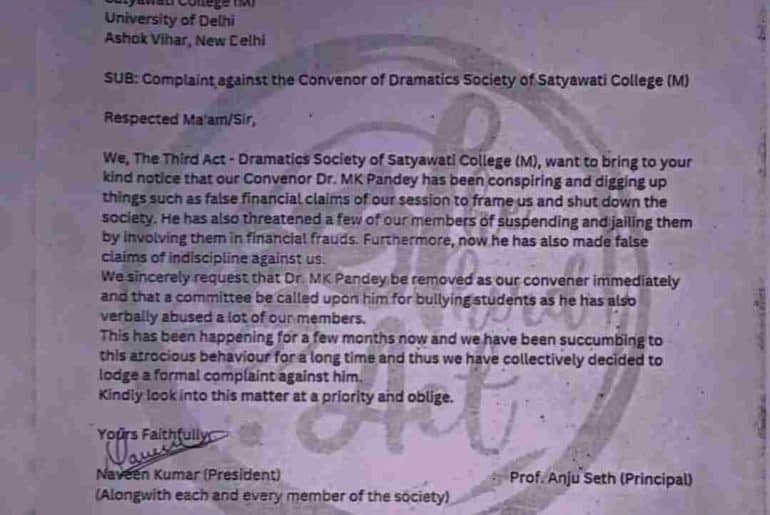
A hierarchy is maintained among all the members to maintain ‘discipline’. But this setup often leads to toxicity as seniors in positions of responsibility take undue advantage of their power. The societies that should act as communities housing creative talent become a powerhouse of trashy politics and toxicity, where bullying and ragging houses.

Recently, such a situation came to light during the auditions of Finance Investment Cell of Hansraj College, about which a first-year student said,

During our Finance Investment Cell interviews, the core team members made us dance against our will, I felt uncomfortable but since I wanted to get into the soc, I had to go with the flow. Later on, they were boasting about the fact that they made us do squats, dance, and sing in the interviews during our induction meeting.” 

First Years who are already ridden with anxiety get pushed underneath the wish of being in the cool circles of college and fail to report such behaviors, and the cycle of toxicity continues. Another student from a dance society shared their experience in a conversation with DU Beat.

This certain level of hierarchy restricts our freedom as an artist and as a person. The role of unions should be to represent the members of the society and to guide us, but it feels like someone has given them authority and they just want to show it off.”

Even in the online mode, several students have suffered terrible things at the hands of societies. With the second batch moving into the online campus, we need to configure our thinking accordingly. If the cultural front of the university keeps on reeking privilege and toxicity, the development of the individual would be a far-gone concept here. It’s high time proper redressal forums (talking about Cultural Secretaries) work in every college to respond to all grievances and dismantle these toxic hierarchies.

[email protected]

Kashish Shivani

On the occasion of Teacher’s Day here is looking at one of the most loved scenes of comedy, from one of the most beloved comedies of our times and asking if we realise the cost of the humour we so amply glorify.

It was genuinely all fun and games.

Every time people, peers, and elders, would sit down to discuss 3 Idiots, the film, invariably the Teacher’s Day speech would come up. Look at how Rancho so smartly explains his point to Raju. Did you see how Chatur was put in place? Serves him right. Love watching Virus being put in his place, it’s such fun!

Growing up around people who revered the now cult classic as a rip-roaring comedy on the farcical nature of our education system and parental expectations from children, aspects of the film ever hardly struck me as odd. Until recently while speaking to one of my high-school teachers I was pleasantly taken aback to hear,

I have no respect for a film that makes such comedy out of a public humiliation of teachers and that too by making them the butt end of rape jokes. It is obscene and crude.

Here was a man, a teacher at that, who disliked what is arguably one of the most impactful and successful films of recent years. Not because it spoke about herd mentality, and emphasised excellence over success, but because of the way it treated it’s teachers in the process of proving a point.

Of course not all teachers deserve to be worshipped on altars. Some are mean, insensitive and just bad at their job. But is it okay to make an entire nation laugh by making your professor the butt end of rape jokes? Think about it.

The scene in question serves a dual purpose in the narrative of the film. It is to explain to Raju the importance of excellence and enjoying your curriculum as opposed to rote learning the same. But at the same time it is yet another widely lauded vilification of the figure of the nerd, who is close to his professors, knows nothing but studying, is socially awkward and of course is the butt end of bullying and abuse. And in the context of the film, this very same stooge of the professor becomes the instrument by which the cool students get back at the professors they hate so much.

My argument is simple. In no way am I endorsing a cut-throat competitive world or a teaching persona who believes your life is of no worth unless you pursue engineering or medicine. My problem is simple and different. How can we, as a society come together to hate b laughing at them and making them the butt end of rape jokes? The perpetrators of the crime literally go on to celebrate the victory of the same in the next scene and by the end of the film are hailed as heroes. The nerd is the one who is made to appear in poor light.

Humour is tricky business. Comedy is purposely designed to critique societal norms and the establishment but if the core purpose of comedy is to relieve through laughter then isn’t it important to question where that humour or laughter is coming from? Really think about it. Sexual harassment and abuse in academia is a widespread problem across the world. Horror stories of students, male and female, being abused by professors and teachers galore. We all have that one friend who confided in us about that one evening, in one empty tuition class, when the teacher they revered for so long transgressed from all acceptable social norms.

Another, easily overlooked aspect of the scene in question is the use of language as a tool of oppression. The student in question, Chatur, grew up in Pondicherry and Uganda and speaks, quite unconvincingly, broken hindi. How is it alright to use this as an excuse to vilify him and the teachers he so deeply adores? As a student of a university as large as Delhi University, every day I see students from distant parts of the country, struggling to convey the most basic of questions. Why? They do not know Hindi and their English is not perfect. But they still try. And even as they try and helplessly request people to not speak in hindi, there are people in abundance who think it fun to reply to their questions in hindi just for the sake of a few laughs. It is 2021 and yet linguistic chauvinism is a tool of abuse in the student community.

In the post-MeToo scenario, films, especially cult classics like the one in question, need to be recognised for their casual humouring of abuse. As an outcast nerd myself, I do not know how long it will take for society to actually come around to stop vilifying us. But that is a different issue altogether. But what we can start off, as students, is to recognise these instances of trivialisation of deeply troubling issues such as abuse in educational spaces. Our teachers are not without their faults and by god we are part of a deeply fundamentally flawed education system. But really our teachers and by large our students deserve better representation than this.

Now that I think, is it really all fun and games?

Anwesh Banerjee

[email protected]