Tag

Delhi University

Browsing

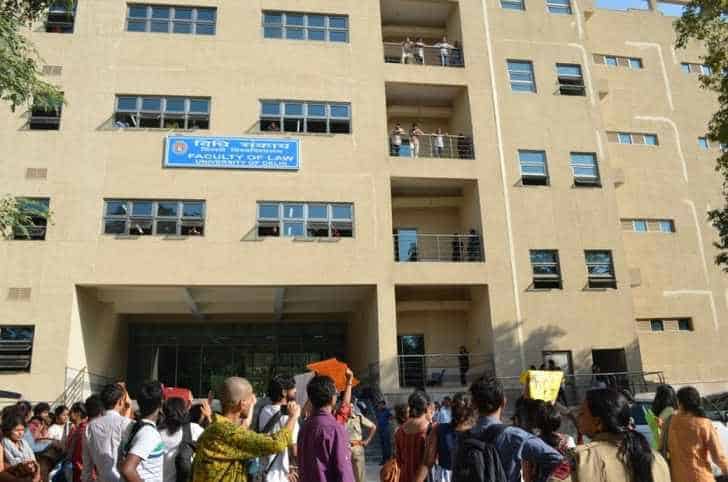
Following the detainment of student protestors against the harassment of women students at IPCW on Wednesday 29th March, Delhi Police has further detained numerous individuals during SFI and AISA protests at Arts Faculty on Friday, 31st March.

On Friday, 31st March 2023, student protestors at Arts Faculty in North Campus were brutally detained by Delhi Police and dragged towards buses to transport them to the police station. The protestors included individual students along with members of the Student’s Federation of India (SFI) and the All India Students Association (AISA).

The SFI and AISA attempted to stage a peaceful protest outside Indraprastha College for Women gates. However, due to heavy police deployment at the IPCW campus, the protest was shifted to Arts Faculty. The “Azadi March” from Miranda House to the Arts Faculty soon invited police crackdown. The police have not only detained several student protestors but, allegedly, also innocent bystanders and media personnel. SFI and AISA have alleged that the activists have been ‘manhandled’ and ‘harassed’ by the police.

I took out my phone and showed them my media ID but one of the officers didn’t listen and continued dragging me towards their bus,” – Bharish, a DU Beat photographer covering the protest.

A release by AISA DU dated 31st March, 2023 states, “We call for immediate termination of Satender Yadav, the ACP Civil Lines. He has ordered a brutal crackdown on AISA’s Azadi March and has himself manhandled Anjali, AISA DU Secretary.”

SFI and AISA have been calling for protests ever since the Indraprastha College for Women’s fest was marred by unknown men. On 28th March 2023, Indraprastha College for Women hosted its annual fest, during which several drunk men scaled the college walls and harassed women students. The miscreants wrote and chanted vulgar and obnoxious messages and created an unsafe space for the fest-goers. There was alleged inaction from the administration or police to control the chaos. Since then, the principal has also failed to address the matter. 

The student organisations have demanded that Delhi Police and the IPCW administration take accountability for allowing the situation to take place and not providing adequate punishment to the unknown men behind the situation. They have also demanded to know the reasoning behind Delhi Police letting the perpetrators behind a similar situation at Miranda get away despite escorting them out of Miranda House at the time. 

Today’s protest at the Arts Faculty follows a similar scene observed on Wednesday, 29th March at the IPCW Campus where student protestors were detained at Burari Police Station. 

This is a very sad state of affairs which is happening from last few months. We are seeing how administration with the help of police has been dealing with the students who have been peacefully protesting against the events that are happening in the university campus.” – Samaa, Co-convener at SFI DU. 

Allegedly, the classroom windows of IPCW have been covered with sheets to ignore the protests happening outside. Individuals present at today’s protest also allege that the walls of IPCW have also been painted saffron.  Students, along with the support of SFI and AISA have been demanding answers from the administration for the past few days, staging protests in an attempt to receive an answer from the authorities. These protests have so far been met with inaction from the University of Delhi and brutal action from Delhi Police.

Read Also: Delhi Police Detains Student Protestors at IPCW

Feature Image Credits:

Bhavya Nayak

[email protected]

On Wednesday, 29th March 2023, Delhi Police brutally detained student protestors calling for Delhi Police and the IPCW college administration to take accountability for the lack of repercussions towards the unidentified intruders at IPCW’s fest.

On 29 March 2023, the Students Federation of India (SFI) and All India Students Association (AISA) gathered around Indraprastha College for Women to protest against the incursion by unidentified men on the previous day, on the day of the college’s fest, demanding questions from the authorities for the same. The protest, which started at about 11 a.m., was interrupted by Delhi Police, and they started detaining the protestors hardly 20 minutes into the protest. There was a protest inside the college by the students of IPCW as well.

On 28 March 2023, during the annual fest of the college, several drunk men scaled the boundaries of the institution and harassed the women students. Students who were waiting at the entry gate formed a huge crowd on the verge of a stampede. Allegedly,  there were no security measures in place except the gate not letting the people in. Soon enough, several men started causing havoc by climbing the trees and walls and jumping inside the premises.

The miscreants were screaming slogans of “jai shree ram” etc. and were hooted on by all other men in the crowd. One of the IPCW people (either someone from admin or security) jumped on the wall to calm everyone down and then the gates were opened to everyone, irrespective of whether they registered, or had student or govt ids, as a last-minute emergency action.,” – Molina Singh, a student who was in the crowd.

The drunk miscreants who allegedly smuggled alcohol and drugs inside the campus also took to hooliganism holding placards displaying obnoxious and vulgar slogans. Students present there reported use of slogans like, “Miranda nahi chhoda to IP bhi nahi chhodenge” (We didn’t leave Miranda so we won’t leave IP either), “We are single”, “Hindu ka yeh naara hain, IP college humara hain” (Hindu raises this slogan, IP college is ours). The harassment and vandalism continued while several women were escorted out by the organisers. 

 The miscreants wrote vulgar and obnoxious texts and flashed them to the female crowd

According to the students, the hooligans also tried to scale the walls of the IPCW hostel post which the entire college was locked down with students inside as per the instructions of the administration. 

The harm was verbal. They also would not stop shouting slogans of a certain religion and grouping up, and they were approaching random friends of mine, or ogling others down. There were Dettol bottles in hands of volunteers who were nursing wounds, ambulances were called, and we heard that a certain man blacklisted on the first day of the fest due to harassment of students had entered again” – an attendant in conversation with DU Beat

The police personnel present there were not proactive in stopping the vandalism. While the police officials stated that an FIR was lodged against 7 men, the protestors sought a chargesheet of the same which was not provided.

Students, who assembled to protest the following day demanding answers from the administration, were manhandled. Students also reported being groped. Reportedly, some people were severely bruised due to the manhandling and then detained at Burari Police Station in an attempt to disrupt the protest. The detainees were later released. 

After releasing us, they wanted to deport us back to IPCW so that the authorities could abuse us more but we refused and decided to walk out of the police station to go back by ourselves. We were extremely, violently manhandled and the police wanted our details even though they had no criminal proceedings against us,” – Titas Goswami, a third-year student from Miranda House in conversation with DU Beat

A press release, dated 29 March 2023, by the SFI DU stated, “Women are being harassed and mishandled inside the campus. When they decide to register their dissent against it, they are again harassed and mishandled by the police.”

It was reported by the volunteers of the fest, that a footfall of 10,000 people was expected. While the admin rejected the idea of having external security, the 20-21 students themselves were reportedly asked to control it. The miscreants were vandalising the walls and the admin allegedly asked for all gates to be shut down. The gates were only opened up for the car of a professor to be checked in when the pushing and shoving happened and that’s when the stampede started. Reportedly, people also tried to harass the professor inside the car and started piling and falling up.

Men started purposefully pushing the girls and then piling upon them, emerging with victorious smiles. Volunteers had to drag the girls out. People started panicking and there were no medical facilities available. One of our volunteers broke her leg in the stampede. Some girls had panic attacks while the men were trying to touch them inappropriately in the pretence of helping them.” – an anonymous member of the organising committee


After the ruckus volunteers were asked by the principal to escort the girls out. We were told to inform them that if they wanted to save their lives they must leave. And during the ruckus, the police instead started hitting our non-teaching staff volunteers and guards.” – an anonymous volunteer

A video of the principal alongside some identified Union members enjoying and dancing while this whole ruckus has also surfaced once making the students question the Accountability of the administration even more. 

After the entire chaos happened, the administration gave permission to complete the fest with the remaining students. A video has also surfaced showing the principal dancing alongside some students.

Similar incidents have occurred most recently at Miranda House’s Diwali Fest and before at Gargi College’s Reverie 2020. The continuation of such occurrences makes it appear that fests at women’s institutions are in danger. Although the DU Administration and Police are skilled in detaining protesters past destruction, the lack of such security as preventive measures results in hazy situations.

Read Also: Discovering DU: Indraprastha College for Women

Feature Image Credits: Unknown

Hritwik Pratim Kalyan

[email protected]

The student body of Lady Shri Ram College for Women has expressed dissent over the decision of the college authorities to host the controversial BJP minister for its annual sports meet.

The Department of Physical Education, Lady Shri Ram College along with the National Sports Organisation (NSO) LSR organised its annual sports meet – the Dr. Bharat Ram Sports meet – from 20th to 22nd March 2023. Mr. Anurag Singh Thakur, the current Union Minister for Information & Broadcasting and Youth Affairs & Sports was welcomed as the chief guest for the inaugural ceremony on 20th March 2023. This move undertaken by the college authorities has not gone down well with the student body. The guest has been infamous for his controversial remarks amidst the anti Citizenship Amendment Act (CAA) protests in Delhi in 2020. The student body is seeking clarification on why, after having claimed ‘apoliticism’ as a core principle, a right-wing politician was invited to campus by the college administration.

“It is supposed to be the responsibility of the department and its union to conduct thorough background checks on whoever is invited within college, which was apparently overlooked and disregarded this time.” – an anonymous final year student at LSR

Students are outraged at the ignorance of the college on separating the sportsperson from the politician for certain personal agendas. Questions are also being raised about the lack of transparency in the decision process and the obscurity of the invitation. 

“Being an NSO student, I expect to have known about the decision prior to the rest of the student body. However, it is highly disappointing how we were just informed rather than being involved in the process.” – an anonymous NSO student, currently in their second year.

A General Body Meeting with the students, the unions and the staff advisors was called at 9 AM on Thursday, 23rd March to address the issue and seek further explanation. According to sources, staff advisors did not show up for the meeting and the dialogue proceeded solely between the NSO Union and the student body. 

“Whatever has happened in the past cannot be undone. All we demand is an official letter of regret by the administration holding the college and its authorities accountable.” – attendees of the meeting.

Criticism has also been raised by certain students about how there is varying liberty across the departments within college when it comes to inviting guests and personalities .

“We have been trying since a long time to have certain poets and authors on campus but the restrictions that are imposed on us make the entire process unworkable.” – a second year student from the English department of LSR.

Organisations such as the Students’ Federation of India (SFI) LSR have been particularly critical of the college administration following this situation.

Read also: LSR’s Department of English Calls for GBM in Light of Political Scenario

Feature image credits: India Today

Rejecting the alleged ‘sham of DU Literature Festival’ which was organised in Ramjas College from March 17–19, AISA organised a ‘People’s Literature Festival’ on March 17, coinciding with the former.

On March 17, the All-India Students’ Association (AISA) organised a ‘People’s Literature Festival’ at the University Arts Faculty from 11 a.m. to 6 p.m. The festival enjoyed the attendance of hundreds of students and prominent speakers from the fields of film, academia, and journalism.

With a slogan of celebrating ‘Krantikari’ literature in place of ‘Sarkari’ literature, the festival was organised in direct opposition to the DU Literature Festival, which was held from March 17–19, 2023, on Ramjas College grounds. The organisation alleged that the latter was hosted “with a whole range of BJP-corporate intellectuals”, who “spewed communal venom on the platform of a public university”, as accused by AISA’s press release and social media handles.

“Rather than calling for the cancellation of the Lit Fest, we wanted to bring about a positive campaign as an alternative” – Anjali, AISA DU Secretary.

Anjali further described the program as “an attempt to reclaim the democratic space of dissent in the University.”

The festival had a focus on “revolutionary traditions in literature”, hosting a range of interactive speaker sessions on the topics of resistance, cinema, media, caste, history, literature, and people’s movements. It featured a line-up of speakers such as ‘Anarkali of Aarah’ director Avinash Das, ‘Mooknayak’ editor and journalist Meena Kotwal, historian S. Irfan Habib, and professor Apoorvanand, among others.

The program also included an open mic session of poetry recitation by the University students, along with Professor Nandita Narain, who inaugurated the event with a rendering of ‘Hum Dekhenge’ by Faiz. The team of ‘Raschakra’ performed a theatrical reading of ‘Afghani Dukhtaran’, a play written by Purwa Bhardwaj and directed by Vinod Kumar, centring on the literature and resistance of the women of Afghanistan against years of oppression. The festival concluded with a cultural performance and songs of resistance.

Read also: IP College Lit Fest- The Artist, Society and A Pinch of Heroin

Feature Image Credits: DU Beat

Sanika Singh
[email protected]

Did you know that the University of Delhi offers a Student Exchange Program? DU Beat recently got in touch with Dominik, an exchange program student from Austria who’s currently enrolled in Hindu College, University of Delhi. Read on to find out all about this program from a candid conversation with Dominik and his journey so far.

Applying to Attend Delhi University

A history student from the University of Vienna, Dominik is currently enrolled in Hindu College as an exchange program student. Talking about his experiences while applying for the program, he says, 

“It was a long process. It took me six months to get everything through. It could have taken even longer if I hadn’t begun on time.”Dominik

The University of Delhi is in a partnership with the University of Vienna under which students and professors from the two universities are given the opportunity of an exchange program, post a rigorous selection process. In stark contrast with Delhi University’s generally ignorant and secretive nature surrounding the student exchange program, Dominik talks about his home university’s efforts in helping him contact a previously unresponsive DU.

“Getting in touch with the University was the hardest part. My home university professors would constantly email on behalf of me and helped me get in touch with Delhi University. This followed extensive research on available courses and colleges.” Dominik

A mandatory prerequisite for the program is a language proficiency test. For Dominik, he was required to submit his English language proficiency test scores. The next crucial stage involves several rounds of interview sessions with professors and exchange program officers, who evaluate the student’s overall suitability for the program. The important documents which are essential to be kept handy are a motivation letter, CV, cover letter and academic transcripts. 

“It’s so hard to get anything done, get a signature or a stamp. They send you back and ask you to come back later, and there’s no actual reason for it.” Dominik

University Culture

The conversation further delved into life at university and the cultural aspects of it. Dominik shares,

“One thing that’s great about the university culture here is that you are really close to your professors. They know your name, they really help you out, you have their phone number. This is something which is unimaginable in Austria.”  Dominik

He further emphasised on the attendance system in Austrian universities, saying, 

“One thing that’s really different in Austria is that we don’t have an attendance policy, you have a choice whether to attend classes, so there’s a lot of freedom and time to pursue other things that way.” Dominik

Academic Contrasts

The selection of your course is a crucial step involved and conducting extensive background research before applying is a good idea. Dominik shares his personal experience of going through hundreds of answers posted on websites which eventually helped him make the choices. Availability of a certain course or paper also plays an important role, since unlike Austrian universities, Delhi University has a pre-structured curriculum. Discussing academics, Dominik adds,

“In Austria, you can choose amongst various different courses and you have the option to decide which course to study in which semester. In the framework of sixteen credits, you can build your own course so to say and try out what suits you best.”  – Dominik

Speaking of his experience of studying history in Delhi University, he comments,

“You can learn about colonial history from the victim’s side, and not from the oppressor’s side. You can feel the emotions still attached to this history, so it’s really interesting to learn from this perspective, and break free from the Eurocentric point of view of history.” – Dominik

Words of Advice

“Don’t give up. It’s a long process but it’s so worth it. There’ll be bureaucratic hurdles; all this hard work and problems will be forgotten and you’ll only have nice memories then.” – Dominik

Feature Image Credits: DU Beat

Sigy Ghosh

[email protected]

Read Also: DUSU Establishes DU’s First Foreign Students’ Cell

The university that all of your schoolmates drooled over. Red bricks and skyrocketing cutoffs. Living with the cream of the crowd in the city of dreams, Delhi. What does it take to come far from home and survive this fantasy?

Dream incessantly, asleep or awake. When you’re on the metro listening to high volume EDM’s and the aunty
next to you is squishing and pushing just enough to make it to the last empty seat. Dream, looking at the autumnal hue of the Celtis tree while your professor reads out the last lines of a background reading, you with all the determination of a first-sem-out-of-the-womb of a school cocoon had written on your to-do list to complete last week. Dream, you made it to the interview round of a hard to get into, corporate job recruitment drive like college society. Dream, when you fake smiles awkwardly at a volunteering programme you signed up for, because Freuds super ego can handle your social anxiety in a faceless swarm of people. Dream, when you’re a pile of slob sitting on your undone assignments and dirty laundry. Dream, on Diwali evenings
far from home when fairy lights don’t suffice for your mother’s handmade kaju barfi . Dream kid. You are finally living it: The DU Dream.

Be it the first or the fifth list, you are just happy that you made it to Delhi University. Well, that is nothing but
a half-truth. While some of you are sullen for you got a college far less than what you had hoped for in the last two epochs of your school life, the others beam with unsurmountable joy as they witness the first day and the first step towards the college of their dreams. All this would soon melt into a horizon of memories, a marvel you would look at when the first six months pass by. You, the light that recoils in fright, you don’t even know who you are. You chant that you feel ugly on the outside and worse on the inside. You want to fill the voids
and be whole. You will be soon enough, even if partly so.

In between the rickshaw rides and lose change problems. The rent payment and unpaid internship struggles. The all-nighter study sessions, one night before the exam. The PG ka rukha sukha khaana. The maheene only do baar nahana. The Majnu ka Tila and Humayun’s Tomb. The month-end when dessert is a single spoonful of sugar. The cold coffee and iced tea, the Kamala Nagar shopping spree. The morning classes and Delhi’s unpredictable afternoon rains. The last minute presentations. The resume building and the fans that fall off ceilings. The break-ups and breakdowns. In the thick and thin of it all, piece by piece, it is as if all this time you have been trying to achieve this very thing, to separate the good parts of you from the rotten. You seem to have become whole.

I welcome you to this dream with a strong heart. You, who will stand tall and love the fresh air that comes from
following this ever-onward road. You, who will stride in bold steps, and feel a sense of pride in each one.  And this journey is not about a destination, an arrival point or a finish line, for there is no such thing. This dream is about the people you meet and how you made them feel. For it will take you to places unchartered within yourself and beyond. Friends come, friends go, often-times you would be alone. Then make solitude your
companion, take it as it comes, good or bad, and keep moving forward.

Aayat Farooqui

[email protected]

Throughout its storied history, Delhi University has gained a reputation as a political university. This article takes a look at the political perception of DU and its credibility.

If there is one thing you know about me, reader, it is that I absolutely love telling stories. In fact, I was indulging this exact habit a few weeks ago in a conversation with a friend as I regaled him with the ridiculous tales of DU politics I’d come across during my first month as a correspondent at DU Beat. As I finished my story about yet another instance of some student organisation appealing to their college’s admin on some glamorous student issue that would be great for attracting votes, he laughed and said something that would stick with me for a while. He told me, “Man, you’re a DU student, of course you get dragged into political events.”

“What a strange remark,” I thought, “And really? With JNU right there?” Therefore, I decided to try and figure out why universities like DU have been entrapped in prisons to the politics of the time and here we are. The answer? It starts – just like DU – in the 20s.

Delhi University was established in 1922, with just four affiliate colleges: St. Stephen’s, Hindu College, Zakir Hussain College and Ramjas College. A place like Delhi University, with the space for intellectual stimulation and debate that it offers, was always going to be an incubator for students that cared about where their country was going and were ready to do something about it. Thus, it is not a surprise that students of the varsity were actively involved in the freedom struggle. St. Stephen’s and Ramjas actively participated in the Non Cooperation and Civil Disobedience movements. Hindu College was at the front of the nationalist movements in the 20s – it is the only college since 1935 in Delhi to have a student parliament. This parliament gave a platform to leaders like Mahatma Gandhi, Subhash Chandra Bose, Jawaharlal Nehru and Motilal Nehru. The people that walked the halls of these institutions – students and staff alike – were nationalists.

In the 70s, Indira Gandhi’s government declared the Emergency and the country grappled with an authoritarian regime that refused to listen to the opposition. In such a situation, it seems you can always count on the youth of a nation to bring their fire and their impassioned appeals for change. And they did not disappoint at the time either! Delhi University saw the rise of the two major student organisations, the National Students Union of India (NSUI) and the Akhil Bharatiya Vidhyarthi Parishad (ABVP). The former is the student front of the Congress while the latter is backed by the Rashtriya Swayamsevak Sangh (RSS). Alongside them, other student organisations such as Students Federation of India (SFI) and All India Students Association (AISA) also arose, albeit nowhere near to the dominance of the NSUI and ABVP. At the time, the ABVP regularly campaigned against the government, establishing itself with its anti-authoritarianism and anti-emergency protests. This period of tension culminated with the arrest of the Delhi University Student Union (DUSU) president at the time, Arun Jaitley. As Shraddha Iyer declares in her piece for DU Beat, “The arrest of Arun Jaitley had one implication for students: the centre fears their ability to mobilise against them.”

Delhi University has since been home to all kinds of political debates and discussions between different ideologies. While most students do not buy into the exact ideologies of the numerous student organisations waiting to spend lakhs to buy their votes, there is a general acceptance of free ideals and a willingness to raise their voices in favour of what is right and against what is wrong.

In 2020, with the controversial CAA being passed around in the Houses of Parliament, there was a line of protests across the nation. At the forefront? The young minds of one of the country’s most respected universities. DU students did not shy away from arranging mass protests against the bill. They showed, very adamantly, that the majority of the next generation of this grand nation did not agree with the kind of administration that was being set in place for the future that they were to inherit. They claimed that the CAA was unconstitutional as by excluding Muslims it went against India’s core tenet of secularism, Against the central government’s repeated attempts to shut them down – some of which were ridiculously dirty – the students raised their voices even higher. The protests were disrupted by the pandemic in the end, but the students had proved that 50 years on from the events of Emergency, the students of Delhi University were still ready to fight for what they cared about.

Alongside these admittedly impressive showings of power by the students, the dirtier side of student politics has also flourished. Student politics are seen as a platform before taking the next step and joining politics at the government levels. Every year in September, the DUSU elections take place at the university. The campuses are gripped by election fever as lakhs are spent by student organisations to butter up the newest batch of students. There is a frenzy for power and authority as the streets are filled with processions of people proclaiming slogans of their respective affiliations. Student organisations feel that the September winds bring back importance to the always prevailing student issues and decide to launch protests across campuses. As I write this article, on September 14th, there are protests taking place in various colleges such as Ramjas, Shyam Lal College, Zakir Hussain, Lakshmibai College and more. All of them are carried out by the ABVP on issues ranging from fee hikes to, for some reason, a boys’ common room. There are seemingly infinite wads of cash thrown by all organisations at alcohol, parties, trips to the water park and fast food for students in a bid to secure their loyal votes.

It gets darker, there are regular reports of politically incited violence on the campuses of the University. It is particularly harsh for the candidates in the running for the positions of the DUSU. In September 2019, the ABVP alleged that the NSUI attacked their candidate for Joint Secretary. Two days later, the NSUI alleged that the ABVP attacked their candidate for vice-president. In 2022 alone, there have been multiple allegations against the ABVP by the NSUI and SFI accusing the rightist organisation of violence.

In the end, it seems my friend was right about DU being political. It may be a perception that’s a little too absolute and dismissive, but it is right to some extent. Delhi University can be a political hotbed. However, more often than not, this is a direct consequence of being a space for debate and discussion of different ideologies right at the capital of the country. Hundreds of students from different backgrounds from different parts of the nation attend this famed university. That kind of exposure brings with it intellectual debates and discussions hidden within the fun of campus life.

All DU ever asks its future students is one thing: what are you willing to stand for? For the pre-independence students of the university it was freedom. For the students in the 70s it was anti authoritarianism. For the students in 2020, it was a sense of secularism and unity. As the elections roll around and the exaggerated showings of student support start, DU and its historically active alumni now ask you, dear reader, “what will you stand for?”

Read also: Prisoner to Political Parties

Featured Image Credits: The Hindu

Siddharth Kumar

[email protected]

TW: Sexual Harassment

A sexual harassment incident is something which can leave an individual scarred for their entire lives. The least that could be done is to identify the accused and bring justice. The ICC of DU works in the same regard. However, it is found to be missing whenever such horrific incidents see the broad daylight. Why is ICC dormant when they are needed the most? Read ahead to find out more.


Basking in the morning sun while discovering the Delhi Metro and the joy of stepping into the college corridors brings a feeling of accomplishment. A transition from school to college brings with it a million of sacred dreams that can’t wait to be unraveled and rejoice the world stage. Somewhere it becomes the duty of the institution to protect those dreams and let the innocence cherish the moment in hand. However, a question of safety and security is a product of oblivion of these dreams.

Living in a city like Delhi, people do fear about their safety and security, especially women. Yet, they sleep at nights dreaming about the endless things they can do and achieve. Their dreams are not hindered by the question of safety but as soon as the Sun comes out, it becomes too obvious to think about it before stepping ahead. Hence, university remains the only place to live those dreams carefree. However, what if even the university becomes the place putting a question mark on one’s safety and security. What if University becomes the place which we term as “unsafe”?

In the recent months, it has become too obvious that the university is not providing a safe space in this regard. From the incident of Ramjas Debating Society to the scars of the festival of Holi, University of Delhi (DU) has put its DUites under the question of safety and security? It is true that as a woman we have to think about an endless list of things before stepping out of our residence. However, college is surely not the place where a student has to worry about these things but here we are, wrapped up in our thoughts of if going to a certain place will be safe for us?

A question of safety will always be present at the back of our minds but if a mechanism comes into place which redresses our concerns in regards to harassment then a sense of security can blanket the students and teachers of the varsity. One such committee is the Internal Complaints Committee (ICC) which addresses the grievances of students and teachers in regards to any form of sexual harassment. Now, the mechanism seems pleasing since the committee is present in most of the colleges and societies apart from a centralized committee of the varsity. The question arises when we take a look at its functioning.

When a Ramjas Debating society’s member was stripped off his credentials for alleged harassment or a student of DU had to face sexual harassment, where was the ICC at those times? Isn’t it the duty of ICC to keep the varsity a place free of harassment? Aren’t they responsible to spread awareness regarding the same? Where was it when such heinous crimes were unraveling themselves? There is an endless list of questions that need to be asked and answered for the scope of improvement of the safety and security of the campus.

In conversation with DU Beat, a member of ICC explained the functioning of the committee in DU. The member explained that the ICC expects the complainant to come forward or directly come to the office and give the committee a written complaint. Once the complaint reaches, it is taken up in a meeting. If the entire committee agrees on the authenticity of the complaint and if it falls under the jurisdiction of ICC then the complaint is taken forward. As this is the final step where the complainant can withdraw their complaint, ICC asks them if they want to pursue it or not. Once the ICC get their consensus, they are asked for 6 copies (as recommended by law) of the complaint. Then, as ICC is law bounded, they send the whole complaint to the respondent, without censoring anything, and give them a 10 days period to submit their clarification or response to the complaint. After this, both the parties are called in a manner where they don’t see each other and individual hearings take place. Then, ICC gives them a chance to call the witnesses which is followed by witness testimonies. At the end, the committee comes up with their findings and send them to both the parties involved. If nothing else comes up that could change the nature of the proceedings then the committee arrives at recommendations, and according to those, further actions are taken.

Since there are a lot of complaints at a given point of time and law has given us 90 days to resolve an issue, it generally takes 4-5 months to resolve a complaint.

-Member of ICC, DU

Upon asking about the reason behind the recent jump in harassment cases in the academic space, the member stated that it could be attributed to the pandemic where people did not understand the consequences of the things they do behind their laptops and mobiles. Further, the member claimed that the varsity has a persistent issue of gender sensitization. For the part of ICC, as the member claimed, it is taking more and more steps to make people sensitized about the gender, to make students aware about what is right and what is wrong.

The harassment cases haven’t increased exponentially but they have increased, particularly in the cyber space.

-Member of ICC, DU

Further the member added that there are certain guidelines issued by the ICC in regards to the recent trend of cases that are coming to the committee but it is difficult to enforce them at the grassroot level. Additionally, the member informed that the apex ICC has no jurisdiction over individual ICC of various colleges and hence cannot intervene in their matters. However, if the grievances of a student have not been resolved at the college level, they can directly write to the ICC of DU and then further steps can be taken in the case.

On asking about what if a particular ICC is not functioning properly, the member said, ”I can’t comment on it but you can ask the Proctor of the University. There are other mechanisms to address the issues related to the functioning of ICC of a college.”

When the question about how the ICC intends to improve its functioning was popped before the member, they responded by stating their wish to include more members. However, as they stated, the law has bounded ICC to include only 10 members.

As the member said that the ICC’s duty is to deal with the sexual harassment cases and the problem of gender sensitization only then, who is there to keep a check if the guidelines are followed or if a subordinate ICC is functioning properly? Just as the High Courts have a superintendence over all the subordinate courts, who is there to supervise the subordinate ICCs? What happens if a sexual harassment case is shut down for all the wrong reasons? Who is there to keep a check on the functioning of the redressal mechanism?

Read Also: The Story of the ICC

Featured Image Credits: newslaundry

Ankita Baidya

[email protected]

Two members of the Executive Council of Delhi University have sent a letter to the Vice-Chancellor urging him to make amendments to the recently-approved UGCF-2022. Read to find out more.


Recently, members of the Executive Council Of Delhi University have written to the Vice-Chancellor, Yogesh Singh, urging him to make amendments to the recently approved Undergraduate Curriculum Framework-2022 (UGCF-2022) which is planned to be implemented from the academic year 2022-23.

The framework, which was formulated by the National Education Policy (NEP) cell, has come to face opposition by a section of teachers. Claiming that this may lead to a dilution of the “academic rigour”, two Executive Council members, Seema Das and Rajpal Singh Pawar, have pointed out the shortcomings of the framework in their letter.

…. Based on New Education Policy (NEP) 2020, the Undergraduate Curriculum Framework (UGCF) 2022 has been haphazardly made by an extra-statutory body, i.e. NEP Cell, leading to the dilution of academic rigour,” the letter read (Source- PTI).

The reduction of the overall required credit from 196 to 176 in four years and 148 to 132 in three years would end up significantly reducing the workload. Thus, the new curriculum would lead to a massive displacement of the teaching staff, especially of the ad hoc teachers, as highlighted by the letter.

As per authentic information, the student-teacher ratio is being doubled in comparison to the present student-teacher ratio across subject/ discipline by the UGC and hence, the University of Delhi… This will drastically reduce workload,” the letter read further (Source- PTI).

The removal of English, as a compulsory language course under BA and BCom and as an option under Ability Enhancement Courses, will also significantly affect the workload of the English department in colleges.

Furthermore, the total weightage of the CBCS/ LOCF core papers has also been reduced from 70-75% to 45-50% under the new framework, reducing workload even further.

Additionally, under DU’s recent directive, no ad hoc or guest teacher can be appointed until every already-employed teacher is taking 16 periods per week. It is believed that this will lead to a situation where the importance of quality research is grossly underestimated and which will ignore the “importance of research done by the faculty members.”

NEP’s Multi Entry-Exit system (MEES) and Academic Bank of Credits (ABC) are also believed to institutionalise “a fluctuating workload and roster” which will hamper “the implementation of the constitutionally obligatory provisions of reservation for SC/ST/OBC/EWS in teaching jobs.”

We request you [the VC] to consider and take into account the above-mentioned facts in the course of implementation of the UGCF and bring the required amendments without any further delay,”  thus, the members have urged in their letter.


Feature Image: University of Delhi official


Manasvi Kadian

[email protected] 

This June, remember to hold onto your anger and pain as you set out to celebrate your pride. Pride was, never a celebration alone to begin with. It was and will always, remain a fierce riot.

When I joined DU Beat, I was a lost correspondent with too many opinions on Netflix and zero knowledge about graphics ideation. But one thing I knew for sure was that I wished to write stories rooted in my immediate cultural experiences. Stories about people. Stories about students. Stories about queerness.

I never viewed queerness as something that was associated with a sexual identity but rather as something that served as a deviation from a set norm. Queering of narratives, discourses, readings and even something like non-linear documentation of time always interested me. As a marginal figure in my most immediate circles while growing up, I felt the need to understand and by extension empathise with anything that occupied a position of marginality around us.

Ever since I stepped foot into DU, I realised that there are hardly any places more queer than those afforded by educational spaces – where marginal social identities offset hundreds of students from the larger crowd of normal adherence. And such varsity spaces become intersectional convergence points for glorious bonhomie – and sometimes sites of extreme cruelty. Taking pride in visiblising intersectional identities in university spaces like ours are more often than not the share of a privileged few – their economic and social position allowing them affordances most are denied. The same identity that becomes the pride of a select few – comes at a cost for others. For most people of such social minority identities, making common knowledge of your lower caste identity comes at the cost of having your narrative being baited by upper caste saviours, your gender identity becomes a double edged sword in your path of progress and your sexuality a constant site of speculation and amusement for those around you.

But amidst the pride colours, pride watchlists and other glittery extravaganza is the overlooked loneliness of growing up queer. To survive a childhood of conflict with your truest point of self-identification, knowing that perhaps the biggest truth about you will always be held as a questioned truth by those around you and eventually coming to a city this big and finding yourself lost amidst a sea of unknown faces – each presenting to you hierarchies of power previously unknown to you. You are immediately swept into a whirlwind of heterosexual college romances, and your heart yearns for that singular same-sex romance that you only see in your annual token queer Netflix romantic comedy and before you know it you have set sail on the flood-prone waves of the hookup culture. Eventually your life is a string of making your way from one bed to another, from looking for ‘spots’ and asking for ‘places’.

But every year in June, corporations and allies around you urge you to forget this language of heartbreak and make you drown in their definition of a glitzy celebration of queerness. To all those queer souls lost this Pride month – to you I say, remember Pride began as a protest, a riot to be precise. Take the anger in your heart and hold onto it – for being queer comes at great pain of surviving a staunchly heterosexual society. To all the allies planning your next pride march, make sure to administer a consensual hug to the next queer you meet this month – queerness is a struggle with loneliness and for all your good intent some loneliness of the self that will take this community an entire life to overcome.

Anwesh Banerjee

[email protected]