Tag

admissions

Browsing

Here’s everything you need to know about the B.A. (Honours) Sociology course offered at DU!


With the introduction of the NEP and the FYUP for the 2022-23 session, courses are bound to face a drastic shift. However, it helps to know what the course has looked like up till now. 

What Did the Course Structure Look Like?

B.A. (Honours) Sociology was divided into six semesters, two every year. The first two semesters had Introduction to Sociology – 1,   Sociology of India-1, Introduction to Sociology-2 and  Sociology of India -2. The second and third semesters consisted of  Political Sociology, Sociology of Religion, Sociology of Gender, Economic Sociology, Sociology Of Kinship, and Social Stratification. The last two semesters consisted of Sociological Thinkers, Sociological Research Methods, Sociological Thinkers-2, and Sociological Research Methods-2.

How High Were the Previous Cut-offs? 

Cut-offs ranged from 98.75% in Miranda House College and Lady Shri Ram College for Women  to 91% in Bharati College for Women in 2021.

Refer to the links below for detailed cut-offs:

What Career Choices are Available After This Course?

  • Academics
  • Social Work
  • Law
  • Management
  • Policy Making
  • Human Resource Development
  • Research
  • Civil Services

Which Colleges Offer This Course?

Colleges that  offer B.A. (Honours) Sociology  course include Shree Venkateshwara College, Lady Shri Ram College, Miranda House, Hindu College, Kamla Nehru College, Jesus and Mary, Janki Devi Memorial College, Maitreyi College and Bharati College.

What Do Students Think About This Course?

Studying sociology in Delhi University is a dream come true. It has made me think about situations and things in a very different way than before. Sociology of gender in the 3rd semester is one such paper which has been the most enriching and interesting for me personally. It has made me think analytically about the concept of gender itself.

Anonymous

Are there any Notable Alumni from B.A. (Honours) Sociology?

  • Dipankar Gupta (Professor and Author of Redefining Caste in India)
  • Deepak Mehta (Professor at Ashoka University, Researcher)
  • Jit Uberoi (Author of Science and Culture)
  • Amita Baviskar (Professor at Ashoka University)
  • Gopa Sabharwal (Professor at Lady Shriram College)


Read Also: #Admissions2022: College Profile- Hansraj College

Featured Image Credits: DU Beat Archives

Devanshi Panda

[email protected]

The skyrocketing cut-offs at the University of Delhi is something that the nation already knows about. It’s a very daunting task to get into the University of Delhi once the cut-offs are released. However, there is a very limited yet diverse quota for those students who excel in other Extracurricular Activities along with their academics, the Extra-Curricular Activities (ECA) quota.

Pre Covid, the ECA selections included an auditioning process and then allotment of colleges to the aspirants, but since last year, the auditions were dropped (will the auditions be there this year or not will be notified soon). As the entire admissions process was online, the students were judged on the basics of the certificates they submitted. 

ECA is one of the biggest reasons why the crowd at the University of Delhi is such a diverse one. You get students scoring very high in academics and students who have made a mark in an extracurricular field all at one place. All the artists out there have a very fair yet scrutinized chance of getting into DU. As the percentage drop for ECA students is very high, the seats are very limited for them. The allotment of colleges is a centralized procedure, i.e after the entire process, the University itself allots colleges to the aspirants with respect to their positions in the merit list and in line with their preferences.

“According to me, the only thing to keep in mind if applying for DU through ECA admissions is by checking the notification board of the Delhi University official website on a daily basis. Don’t miss a day and keep looking for the new updates. Last year the ECA admissions were a bit different than the previous years but I could easily figure out the whole process only with the help of the information available on the University website as well as the college websites. Moreover, there are many official email IDs to which you can send your queries or concerns and believe me and don’t worry they reply. So if you ask me, I would suggest not to take stress and to be updated for new instructions from the notification board.”

Mahasweta Sarma, Political Science (Hons), Miranda House, Indian classical and light (vocals) category

A complete list of ECA quotas of admissions in years 2020-2021 is available on Delhi University’s official website, along with the names of colleges and the quotas that they reserve for each activity. The University will definitely upload a fresh list this year as well.

Categories under ECA

Various ECA categories under which the student can secure admission at the University of Delhi are:

  • Creative Writing (English and Hindi)
  • Debate (English and Hindi)
  • Digital Media (Photography, Animation and Film Making)
  • Divinity
  • Fine Arts
  • Music (Indian and Western: Vocal and Light)
  • Music (Instrument: Indian and Western)
  • Theatre
  • Quiz
  • National Service Scheme
  • National Cadet Corps
  • Dance (Indian Folk and Indian Classical)
  • Yoga

The procedure of Admissions in 2020-2021

Last year the ECA admissions were primarily ruled out as due to COVID-19 protocols physical auditions were not possible so the University cancelled the ECA admissions. But later the admissions process was restored without the auditions. The following steps were supposed to be taken by a student who wanted to get the admission via ECA category.

  1. Register as for the ECA category under the DU UG Admissions portal.
  2. Select the categories you want to apply for and upload the certificates relevant to that particular category. Duly check the dates along which the certificates will be accepted.
  3. maximum of 5 certificates was allowed to be uploaded last year under each ECA Category.
  4. After some time, the University releases a merit list with the descending order of marks that the student got against the certificates they uploaded.
  5. If there are any discrepancies with the allotment of marks, there is a window given to resolve that and then the University releases a fresh list. Kindly be very alert during this window period.
  6. Once the final merit list is out, students are given options to select their desired college, under their respective categories. A maximum of 10 colleges, in the order of preferences, were allowed last year.
  7. Then the University allots the colleges to the aspirants and then there is a window period given when the student needs to submit their fees and confirm their admission in the allotted college by the University.
  8. After that, the allotted college contacts the student to sign an undertaking, which complies the student to represent the college at various levels under the ECA category they have secured their admissions in.

Some points to keep in mind while applying under ECA by an ECA Student

  1. It is mandatory to first register and apply on the common UG Admissions portal at the University’s Website.
  2. If you want then apply under more than one ECA category, the seats for ECA students are very few, so give your best shot under maximum categories.
  3. Students usually do not fill in all of the 5 slots available for certificates. Especially, during these unprecedented circumstances, when the auditions are least likely to happen, your certificates will carry a lot of marks. Give priorities to International, National, State, District, and then School level competitions certificates.
  4. Thoroughly go through the notification that the University releases for the admissions for ECA students.
  5. The window period for rectifying your marks in the merit list is quite scrutinized, be very vigilant during that time.
  6. Select the colleges by your preferences and try filling up all the columns to be on the safer side.
  7. If auditions happen, then be well versed with the current affairs, especially for the students who want to apply under the Debate or Creative Writing Category.

Read Also

DU Brings Back ECA Admissions Without Trials

Abhivyakti Mishra 

[email protected]

As the nation rages its battle on COVID-19, the Delhi University Admissions Branch has also come into action. These actions relate to easing the admission process for students during this pandemic. 

The Admissions Branch of the University has issued a formal letter to all the college principals. This letter mentions the measures that all 91 colleges under the varsity have to abide by in order to, ‘ensure smooth conduct of DUET 2020 and for student friendly merit-based admissions in the university.’

The colleges would have to upload all necessary information pertaining to the college and its admission process on the college website. Additionally the colleges have to form an Admission team that will have to ensure a smooth admission process. Apart from this the colleges have to prepare a comprehensive list of FAQs related to the various courses offered by the college to help the students choose their desirable course.

The list of the Generic Elective subjects or the compulsory inter-disciplinary subjects according to each will also be uploaded by the colleges on their website. The branch has also directed the colleges to deploy student volunteers to help the fresher.

Furthermore the varsity will be increasing the number of EWS or Economically Weaker Section seats from 10% to 15% this academic year in accordance to the 2nd phase of expansion of EWS. The colleges will have to mention the number of EWS seats in their respective websites.

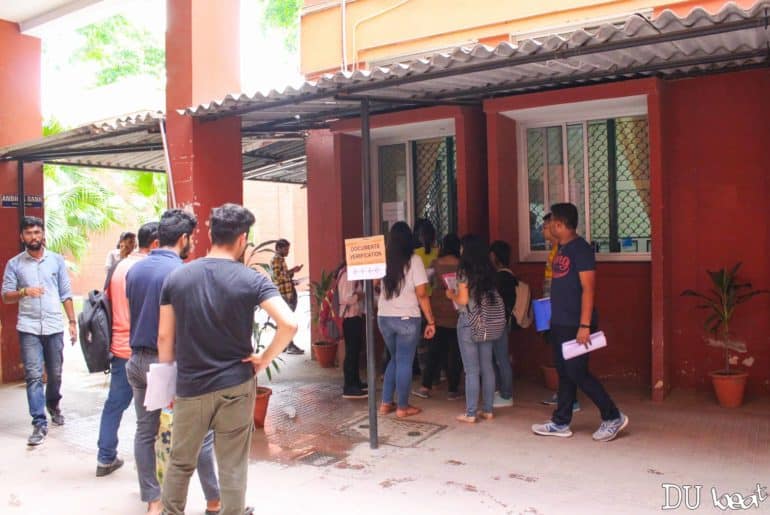
Following the government’s national lockdown directive, the Admissions Branch has also advised the colleges to minimize the physical verification of the mandatory documents during the admission process. 

The University, during the 2019-20 admission, had sought to largely make the admission process online and was successful to a great extent. The registration process is done online to a full extent, however, the physical verification which needs the students to go the respective colleges isn’t. It is yet to be seen as how the administration will handle this. Last year alone more than 3,00,000 students had applied in various courses and thus it remains a mammoth task for the university officials to conduct the admissions process successfully.

Featured Image Credits: DU Beat Archives

Aniket Singh Chauhan

[email protected]  


Delhi University Entrance Test has been delayed until further notice due to the coronavirus outbreak.  

With the Covid-19 outbreak, the Prime Minister announced a 21-day pan-national lockdown on the 25th of March. This has led to most of the functions in the country coming to a halt or being delayed. Such has been the case with the Delhi University Admission Test (DUET) which is conducted by the National Test Agency (NTA). The application process for the same had to be started this week, however due to the unanticipated pandemic outbreak, these processes have been delayed. Extensions for applications of several examinations have been announced by the NTA. Exams like JEE Mains and NEET UG have also been postponed. 

The application process was initially supposed to have begun on the 2nd of April. Apart from the lack of staff to manage the applications under the lockdown, the process also requires 12th board marksheets, exams for which have been postponed in most states. Consequently, the operations for the application process have been suspended until further notice. 

DUET is a two-hour examination conducted across different centres. The exam has 100 questions; 4 marks are awarded for every correct answer, while 1 mark is deducted for incorrect. NTA conducts examinations for entrances to both undergraduate and postgraduate programs offered by the Delhi University. The following are the subjects:

  • B Tech (Information technology and mathematical innovations)
  • BA Hons Business Economics
  • Bachelor of Management Studies
  • BA Hons Humanities and Social Science
  • Bachelor of Business Administrations (Financial Investment Analysis)
  • B Ed
  • Bachelor of Science in Physical Education
  • Health Education and sports
  • BA Hons Multimedia and Mass communication
  • Five Year Integrated Programme in Journalism

In PG courses, apart from those that offer interdisciplinary or professional courses, students are admitted to departments, 50% on the basis of merit and 50% on DUET rank. The entrance test may or may not be followed by an interview or a group discussion. 

Feature Image Credits: DU Beat archives

Aditi Gutgutia

[email protected]


In an attempt to solve the annuala admissions chaos, University of Delhi (DU) has decided to form a separate branch to overlook the tedious admission process for a more organised admission session. 

Like the examination committee, DU has decided to organise and streamline the entire admission process. The decision has been taken in lieu of this year’s admission process which witnessed late cut-offs and multiple complaints. 

University of Delhi has an intake of lakhs of students from all over India accompanied by sky-high cut-offs. It becomes more imperative that the entire process is closely supervised.

Rasal Singh, member of the standing committee on the admissions for the session 2019-20 said, “Delhi University is India’s biggest and premier central University. Lakhs of students from all over India and abroad come here for admissions. We don’t have a dedicated and full-fledged admission branch for a consistent admission policy and its hassle-free implementation. The lack of it, hence, leads to unnecessary delays and makes it complicated too.” 

This session marked delayed admissions and incomplete procedure. There were many changes in the admission policy at the last minute that even led to the University being dragged to the court. After that, the policies framed had to be withdrawn; like Mathematics being compulsory to be counted in Best of Four to pursue B.A. (Honours) Economics from the University. 

The procedure for admission in the University includes formation of an admission committee usually consisting of members of the Dean of Students’ Welfare (DSW) office, college principals and teacher representatives from the colleges, nominated by the Vice Chancellor. Along with it, there is also an advisory committee, which overlooks the admission process.

Each year, there is a new set of officials appointed for carrying out the process of admission, which is unstable, therefore a stable body is needed. 

The University conducts admissions for the undergraduate programmes in 63 colleges, postgraduate admissions in over 50 departments, and also M. Phil and PhD admissions. That means even if the undergraduate admissions wrap up before July, the post graduate and PhD admissions go all year round. Like right now, the admissions for postgraduate and PhD courses is still going on. 

Rasal Singh also added, “The M. Phil/ PhD admissions are still ongoing, so in the University, the admission is almost a year-long process. Hence, having a branch to exclusively deal with it is very much required.”

The admission process is likely to be headed by the Dean and other officials. However, the date for functionality and formation of the admission body hasn’t been announced.

Feature Image Credits:  Hindustan Times

Chhavi Bahmba

[email protected]

This petition had been filed against the order, on 11th July, by a single judge dismissing the plea of the professors, challenging inclusion of Supreme Council members in the admission process.

The bench consisting of Chief Justice D N Patel and Justice C Hari Shankar issued a notice to the Delhi University (DU), St Stephen’s College, its Supreme Council, its Principal and the University Grants Commission seeking their stand by 16th October. This comes after three professors filed a complaint against the inclusion of a member of the Supreme Council in the matters of selection of Christian students.

The Supreme Council is much more powerful than the governing body. It comprises of the clergy and members of Church of North India and also includes its nominees.

The petitioners — N P Ashley, Abhishek Singh and Nandita Narain — who are members of the college’s governing body were opposed to the alleged “interference” of the church in the admission process, claiming it was against the norms of the institute.

Including the Supreme Council would make the decisions of the governing body invalid, as it hold greater power and including its member into the selection committee could mean an unfair analysis of students who are selected. Merit would end up becoming secondary and faculty would have very limited say in the admission process.

The college that takes up its students through a rigorous entrance and interview engages in the same to filter out the most deserving candidates for the seat. This would not be possible if a Supreme Council member becomes a part as it would directly affect this process of selection.

According to their petition before the single judge, the Supreme Council, in a meeting held on 12th March, had decided to have an additional Christian member, nominated by it or the governing body, to be part of the interview panel.

(Extracts from Hindustan Times)


Featured Image Credits: Shawn Wilson

By Stephen Mathew

[email protected]

The University of Delhi (DU) will hold a special drive for DU Admission 2019 before the 8th cut-off. Read on to find out more.

The Delhi University Committee members will hold a meeting on 20th August to decide on the status of another special drive for its student before announcing the supposedly final and 8th cut off list of the admissions for the undergraduate courses. This special drive is aimed to help the selected students in the admission process. The schedule for the special admission drive is likely to be released on August 21, 2019.

A reported by Millennium Post, there are only limited seats left across the colleges and the majority of the seats left vacant fall under the Scheduled Tribe (ST) category.

This meeting was postponed from last week as most of the seats under the Economically Weaker Section (EWS) quota were filled. Hence, the varsity decided to hold another meeting.

A special drive was held previously; under which students were allowed to change their category for admissions, before the release of the 6th cut off list. This was aimed at applicants who failed to report on time even after registering for online admission under the reserved category and also to fill the minority seats under the Sikh quota. However, the official data still needs to be collected on the number of students who changed their category under this drive.

The previous year, there were 10 cut-off lists in total released by the varsity. This year varsity has registered ‘over admissions’ with the addition of seats under the Economically Weaker Section (EWS) quota. The data shows that the applications received this year amounted to over 3.67 lakhs for 64000 seats in undergraduate courses. The EWS category which had over 6000 seats saw 9091 students applying for it.

Feature Image Credits: Adithya Khanna for DU Beat

Antriksha Pathania

[email protected] 

The Executive Council of the University of Delhi (DU) has approved the semester system for the School of Open Learning (SOL) and  Non-Collegiate Women Education Board (NCWEB) starting from the current academic session.

The Executive Council of DU was called on Saturday to discuss the introduction of semester system in the SOL and NCWEB, and it has decided to introduce the semester system from this academic session.

The SOL and NCWEB are currently following the aannual system in which the exams are conducted in the month of May. 

It was decided in an earlier meeting that the Choice Based Semester System (CBCS) would be introduced in these two institutions from the academic session of 2019-2020.

The semester system would enable these two verticals to be identical to regular colleges.

Some officials expressed dissent, as they felt that this move has been taken in a hurry and would affect the students who have enrolled on an annual basis as classes have begun and the study material has also been handed over.

Akansha, who is a B.Com. student in SOL, seemed disappointed and had this to say-  ”There are mainly three reasons for choosing correspondence, those who choose it for convenience and do not have time for regular classes would be pissed as this defeats the purpose and who cannot afford regular education or do not have enough marks to get onto a regular college. I am pissed.”

SOL enables the students to enrol themselves in various courses and programs without being physically present to attend classes unlike other colleges in DU.

This means that students enrolled in undergraduate honours courses will have their examinations under the Central Examination Centre, since SOL offers very few honours courses. Notifications for the schedule of examinations and filing of forms for the students of NCWEB shall be along with regular semester students. Whereas  semester exams for non-honours students would be undertaken by SOL.

The annual system only has one examination whereas the semester system has two examinations during the months of December and May.

The fee structure also varies as semester system requires fee payment to be done in two instalments unlike the annual system with single payment.

The SOL, which was founded in 1962, is one of the largest distance education institute in the country with over five lakh students in its fold, and around one and a half lakh students enrolled annually.

NCWEB, which is exclusive to women, provides weekend to females residing in the national capital.

Feature Image Credits: DU Beat

Stephen Mathew

[email protected]

The party members of Chathra Yuva Sangharsh Samithi (CYSS) protested in front of the Arts Faculty today. They demanded a reduction of fees and, hostel facilities for the he OBC and EWS category students.

CYSS, the student wing of Aam Aadmi Party, held a protest in the Arts Faculty. The protest began at 11:30 in the morning continued till three in the afternoon. The protest saw many party workers with banners and posters, shouting various kinds of slogans. 

The march was being led by, Delhi-region State President, Mr. Sumit Yadav. The protest was organised against the fee hike in various colleges and the lack of admissions of students of OBC students postgraduate hostels. It aldo focused on the provision of admissions to OBC and EWS category students in law and other postgraduate courses.

The University had recently increased the fee in various colleges like Mata Sundari. The lack of reservations has been an issue in the University of Delhi (DU) hostels where students are given seats on rank and vacancy basis making it impossible for students of reserved categories to secure admissions in hostels.

However, other than these issues, the issue of a young Muslim girl wanting to seek admission was also raised. 

Afshan, a postgraduate aspirant, wanted to seek admission in DU after completing her graduation from Zakhir Hussain College. She believes that she was prohibited from giving her entrance because of her name which indicated she was a Muslim. 

In addressing the gathering and DU Beat, Afshan said in her speech, translated from Hindi here- “I graduated a year back in 2018 from the University, people here say things like ‘Beti Padhao, Beti Bachao’ yet I have been struggling for two years now for getting my admission done. There was a girl in Unnao who was silenced for asking justice and that’s what they are doing to me. I wanted justice for my education and my leg shivers stating what they’ve done to me. I’ve been blackmailed and told they will ruin my documents as well. I filed a complaint, yet there is no investigation. They say they’ll abduct me. I feel shivers down my spine.” 

She later tried to get in the conference hall of the University, yet she was stopped. There were policewomen ready to tackle her. After a long quarrel, she was finally admitted in the conference hall.  

Later, DU Beat interviewed Mr. Sumit Yadav, Delhi-region State President. He stated, “DU is considered one of the best institutions in the country. All the students across the country even people from rural places of Delhi like Najafgarh choose DU because they get a great education at lower price. Now due to privatisation, they’ve increased the prizes. Our party has always been against privatisation and we’ve been raising our voices for the same.”

The various slogans shouted out were “Chhatro par ab reham, karo fees hamari kam karo ( Have some mercy on the students, reduce fees now)” and “Rehne ko awas chahiye humko Chathrawas chahiye (We need shelter to stay, we need students to have homes)”. They also had slogans critiquing the Vice Chancellor’s inability to provide adequate hostel facilities.

The Party members marched towards gate number four but were stopped by the guards and were not permitted to cross. The situation turned hostile when members tried to climb the gates and cross it over. The guards were forced to push them back. 

“We are protesting here against the fee hike in various colleges which has been implemented this year, that is from ten thousand to twenty-five thousand rupees. It deters students from poor backgrounds from courses diversity courses  as they cannot afford such high fees. We are also protesting again courses as of hostel facilities because of which students are exploited by PG owners to pay very high fees,” said Mr. Hariom Prabhakar who is the General Secretary of CYSS, while in conversation with DU Beat.

Feature Image Credits: Stephen Mathew for DU Beat

Stephen Mathew

[email protected]

Chhavi Bahmba 

[email protected]

The University of Delhi will be conducting a special admission drive for students belonging to the reserved categories from 29th to 30th July 2019.

A formal announcement was made by the University on 26th July 2019 which confirmed that a special admission drive will be conducted for students belonging to the reserved categories.

This drive will consider the left out students of reserved categories along with those students who were not able to pay their fees or missed their chances because of any other reason.

The students belonging to the reserved categories-Scheduled Caste/Scheduled Tribe Other Backward Class/ Economically Weaker Section/Persons with Disabilities/ Kashmiri Migrant/Children of Widow/ Minority (Sikh) who missed to apply in their respective categories at the time of registration can do so by requesting a change. Such applicants will also be considered for admission in their specified category in the entrance based undergraduate courses in the subsequent lists. Although, those candidates cannot claim admission in the lists that have been already announced.

All those women applicants who are residents of NCT Delhi and have already registered but could not apply for admission in Non-Collegeiate Women’s Educational Board  (NCWEB) shall be considered for admission in NCWEB automatically. They will be admitted if they meet any of the preceding cut-offs. Also, applicants who were admitted but could not pay the fee shall be given a second chance.  

All the applicants who cancelled their admission or could not take admission during the preceding cut-offs will also be considered for admission under this list, if seats are available.

In addition to the special drive, the University is also planning to conduct a detailed audit of the admission procedure. The main motive behind this audit is to look into the colleges that have admitted more number of students than the designated seats.

A University official also pointed out that some seats for the reserved categories have not been filled up yet.

3.67 lakh applications were received by the University for undergraduate admissions this year, out of which 2.58 lakh applications were completed with fees payment. The large number of applications shows the level of competition that the students had to face to grab one of the 64,000 available seats.

The seventh cut-off list will be announced on 6th August 2019 and the process of document verification will go on from 6th to 8th August 2019.

Feature Image Credits: DU Beat Archives

Priya Chauhan.

[email protected]