Tag

DUTA

Browsing

An ongoing row between the University of Delhi and Delhi government has resulted in the freezing of funds for 12 DU colleges. This has not been a ‘happy’ new year for many teachers of the University of Delhi. Around 12 colleges including Gargi College, Kamala Nehru College, Shaheed Sukhdev College of Business Studies, Shaheed Rajguru College, Maharaja Agrasen College, and Deen Dayal Upadhyaya College, which get 100% funding from the Delhi government have no resources left to pay their staff, after the Delhi government froze funds in July over a tussle on the names for governing body with the university administration.

The professors of 12 DU colleges have been caught in this crossfire between the University and the government.  Professors claim that they do not have money to pay off their regular bills. These professors had to greet the New Year with empty pockets.

S K Garg, the principal of Deen Dayal Upadhyaya College, which is fully funded by the Delhi government told India Today, “We are neither in a position to pay salary to our staff nor do we have funds for paying electricity, water, and telephone bills. Financially, everything is held up, as we have not paid our outsourced security staff and sanitation staff,” He also informed that the college had to divert funds to ensure the basic functioning of the college.

The President of DUTA, Mr. Rajib Ray, told DU Beat that he has written to the Vice Chancellor and the Delhi Government regarding the tussle. “It is very unfortunate that the professors are suffering due to the non-payment of the salaries,” Ray told DU Beat.

The principals are particularly concerned about the salaries of the non-teaching staff because their everyday needs may be affected due to this delay.

Aware of the crisis, a senior official of Delhi government’s education department under the condition of anonymity told Mail Today, “Delhi government will release the salary as soon as the names of the panel of members of governing body are submitted to us by the university.”

Feature Image Credits: Indian Express


Sandeep Samal

[email protected]

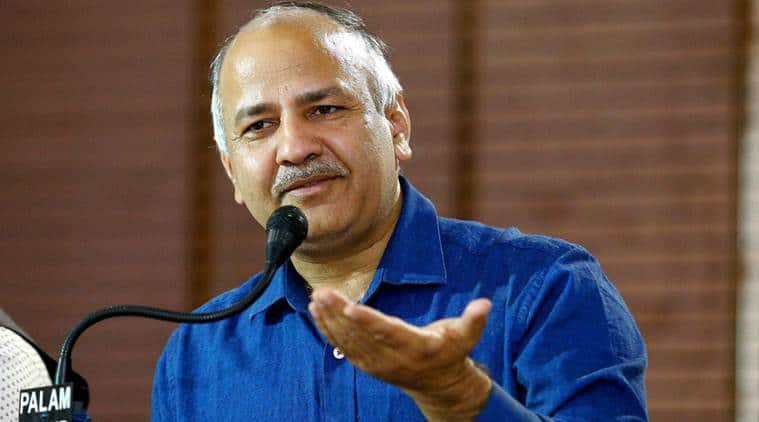
A delegation from DUTA (Delhi University Teachers’ Association), including the DUTA President Rajib Ray, met the Deputy Chief Minister of Delhi, Manish Sisodia, to plead to the state government to roll back its order of freezing funds of the 28 University of Delhi colleges it funds. The teachers collectively requested the government because the colleges are finding it difficult to fund salaries for teaching and non-teaching staff in those colleges.

In a written appeal to the Delhi Government, they wrote, “We support your insistence that governing bodies must be fully constituted at the earliest. However, we have now learnt that the colleges are finding it difficult to release salaries to teaching and non-teaching staff. Any delay in the release of salaries will cause a crisis in the personal lives of the employees and their families.”
On 31st July, Manish Sisodia, the Delhi Minister of Education directed a freeze of grants for the 28 colleges it fully or partially funds. In a tweet, he claimed that it was a “deliberate and mala fide attempt to delay the formation of governing bodies by DU”. On 14th August, the list of governing bodies was finally sent by DU but was rejected by the government on procedural grounds. The stand-off has been since October last year when Delhi University was required to send a list of its governing bodies of all the colleges.

Image Credits: Indian Express

Vijeata Balani

[email protected] 


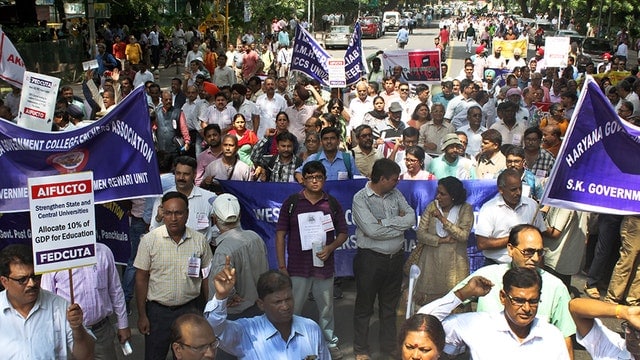
The All India Federation of University & College Teachers’ Organisations (AIFUCTO) and Federation of Central Universities’ Teachers’ Associations (FEDCUTA) held a protest and courted arrest at Jantar Mantar, Delhi, on 5th September against the nondisclosure of the Chouhan Committee Report for 7th Pay Review Committee (PRC) and raised other demands regarding public higher education institutions in the country.
As per the Delhi University Teachers Association (DUTA)’s press release of the protest, “Pay Review Committee Report was submitted to MHRD more than six months ago. The PRC, that deals not only with pay revision but with all aspects of teachers’ service conditions, including permanent recruitment, promotions and pension, is expected to have made positive recommendations to address the grievances of teachers regarding contractualisation and adhocism of services.” AIFUCTO also sent a letter to the Prime Minister to intervene and implement the PRC recommendations, saying “We have repeatedly written to MHRD and UGC to share the content of the 7th Pay Review Committee Recommendations, a practice that has been followed by all previous governments because AIFUCTO is the apex organization representing the university and college teachers in the country”. Despite meeting with Human Resources Development Minister Mr Prakash Javadekar in May this year and being assured of the report’s release in a month, there are no signs of action regarding the same. Along with the PRC report declaration, the protesting teachers also raised demands of increasing the education allocation to 10% of the GDP, 100% funding of Government State and Central Universities and resisting the privatisation of Universities via granting autonomous status.
Rajya Sabha MP, D. Raja(CPI) also led a delegation of AIFUCTO and FEDCUTA Office Bearers to meet the HRD Minister on the day of the protest. The delegation also included the newly elected President of DUTA and FEDCUTA, Dr Rajib Ray, who said that the Minister assured of the disclosure of the PRC recommendations soon, but could not explain the delay. Mr Ray also said that such a move has been unprecedented because the PRC recommendations are to be made public every time. He also stressed the importance of a written document rather than verbal assurances, and that equal assistance must be provided to Central and State Universities.


Image Credits: National Herald

Rishika Singh

[email protected]


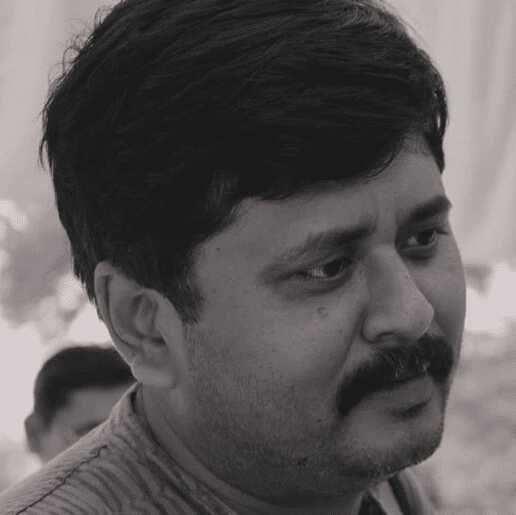
On Thursday, the Delhi University Teachers’ Association (DUTA) conducted its elections for the post of President and fifteen Executive Committee members. Rajib Ray, a professor of Philosophy from Kirori Mal College and the leftist Democratic Teachers’ Front (DTF), was named the President of DUTA on Friday morning by scoring 2636 votes.

The elections were held in Arts Faculty, North Campus. Teachers from colleges across Delhi came to cast their votes from 10:30 a.m. to 5 p.m. on Thursday evening. This year, the voter turnout was massive as it amassed to an estimate of 7,200 members.

Rajib Ray told The Hindu, “We are looking forward to fighting against the failures of the government and other authorities. Timely disbursement of pension and setting up of a review committee are our top priorities.”

In his manifesto, Ray questioned the prevalent education policies and raised important issues such as those of privatisation and autonomy of DU colleges. He said “Education policy is currently being dictated by the NITI Aayog, whose CEO recently proclaimed that the government should “hand over schools, colleges, jails to the private sector”. Its Draft Action Plan is being pushed through various UGC Regulations. The Draft on Graded Autonomy defines three categories of universities based on NAAC scores and NIRF rank.” He even criticised the DU administration by saying that “The DU administration has been deaf to the denial of promotion to thousands of teachers and forced them to go to the Court. It has surrendered to the Ministry of Human Resources Development directive to appeal against the positive Court order on pensions.”

His main motto is to defend public education. With such a win, a lot is expected from his tenure as the new President of DUTA.


Feature Image Credits: Democratic Teachers’ Front

Bhavya Banerjee
[email protected]

Elections for the Delhi University Teachers’ Association (DUTA) are scheduled to be held on August 31, 2017. The elections would be held for the post of the President and 15 members of the executive committee for 2017-2019, a report in Hindustan Times indicates.

Three different teachers’ bodies have already fielded their candidates for the post of President, who have to file their nominations on 22nd and 23rd of August. The Democratic Teachers’ Front (DTF), which is a left-affiliated body, has announced Professor Rajib Ray as its candidate. Professor Ray is an associate professor of the Philosophy Department at Kirorimal College, North Campus. The University Teachers’ Forum (UTF)’s fielded candidate is Dr. Surender Singh Rana, a professor of Political Science at Shivaji College. The BJP-affiliated National Democratic Teachers’ Front (NDTF) has announced Professor VS Negi of Shaheed Bhagat Singh (Evening) College as its presidential candidate. Professor Negi was the runner up last year, when, according to a previous report in DU Beat, his final tally was 2164.

The past 2 elections for the post of president were won by Ms. Nandita Narain, Associate professor of mathematics at St. Stephen’s college. Professor Narain is affiliated to the DTF.


Feature Image Credits: CNS Kashmir

Shireen Manocha

[email protected]

The year 2016-17 has been a year of constant campus activity and mobility. Many protest, dharnas, drives and other such events have taken place rampantly across the campus with the students and teachers unifying to protect their cause. From student politics to intra college protests against unfair means, DU has seen yet another year of mobility and expression on campus. Here we take a look at some of the protests, dharnas and drives which shook campus:

  • May 2016- Hindu College cancels girls’ hostel admission: After heavy protest and strikes by students and teachers of the college and later by DUSU led to the intervention of Delhi Commission of Women (DSW) in the issue of exorbitant fees of Hindu College girls’ hostel, the college cancelled the girls’ hostel admissions for this year.

Read the whole story here.

  • May 2016- SFI protests against the callousness in investigating Jisha’s rape and murder case in Kerala: A huge gathering of people along with the Students’ Federation of India (SFI) participated in a protest at Kerala House against the inefficiency of the authorities and the carelessness and insensitivity with which the case has been handled. They raised their voice against the increasing brutality and offences not only against women but also against the underprivileged sectors of the society. The protest focused on how such crimes are nothing but an “exercise of naked power” on women in the patriarchal society of today.

Read the whole story here.


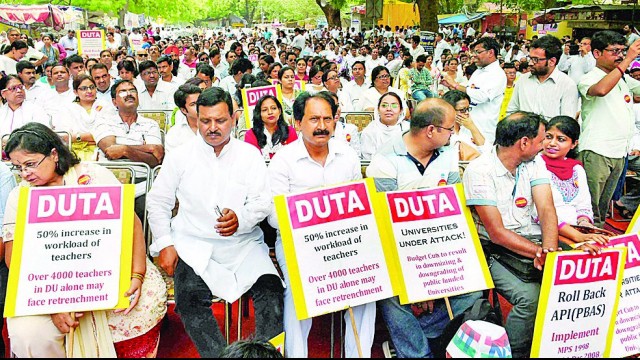
  • July 2016- DUTA protest delays results of students: Teachers of Delhi University protested against an UGC notification that increased the working hours of teachers and this led to Delhi University Teachers Association (DUTA) boycotting the admission and evaluation process of University. Only after the notification was withdrawn, teachers joined the evaluation process.

Read the whole story here.


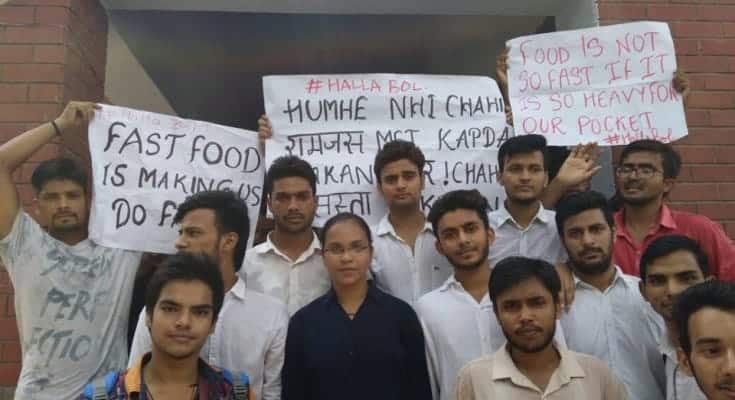
  • August 2016- Protests at Ramjas College regarding canteen prices: Ramjas College saw organised protests held by its students on 11th August, 2016. The protest primarily targeted the exorbitant increase in prices in the canteen since the start of this academic year. The canteen staff apparently charged higher prices than those mandated by the college. In what a student called an act of “corruption,” the canteen staff would charge a first-year student INR 50 for an item that actually cost INR 30. Speaking out against this practice, a group of students spread word through social media and organised a protest by inviting the Ramjas community to gather at the college gate and march towards the canteen.

Read the whole story here.


  • August 2016- Protests at Daulat Ram College questioning the governing style of the chairperson: Protests regarding the governing body took place in Daulat Ram College on 6 and 8 August 2016. Both students and teachers came together to question the governing style of the chairperson, Ms Suneeta Sudarshan. The protest revolved around key infrastructure problems that the college faces, as well as the chairperson’s reluctance to handle these issues. The protest concentrated primarily on the issues of infrastructure such as unhygienic washrooms, inadequate space in classrooms, and the unstable condition of the college building itself.

Read the whole story here.


  • September 2016- Mass failure in Law Faculty, students protest in agitation: The students of the Law Faculty, Delhi University sat on a hunger strike from 2 pm, 14th of September. The strike was against the mass failures of students that had occurred for the second year in a row. Alleging some problems with the results, they went on an indefinite hunger strike, urging the authorities to look into their grievances.

Read the whole story here.


  • October 2016- Law faculty students go on hunger strike: The students of law faculty went on a hunger strike demanding supplementary exams and rechecking of their papers. The strike also found the dean of the faculty going on a parallel hunger strike. The strike was called off after discussions and assurance of the Vice Chancellor.

Read the whole story here.


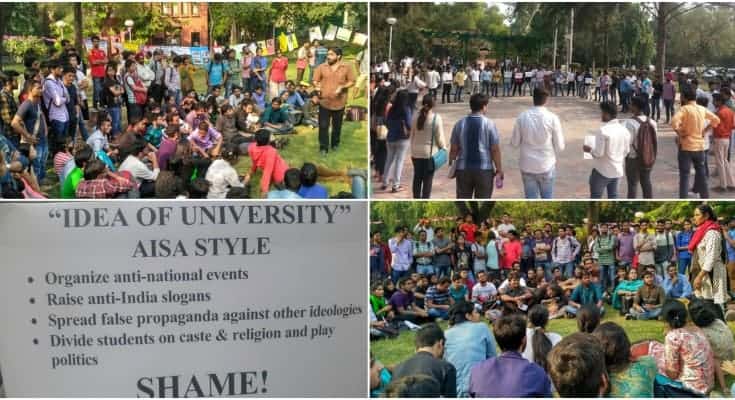
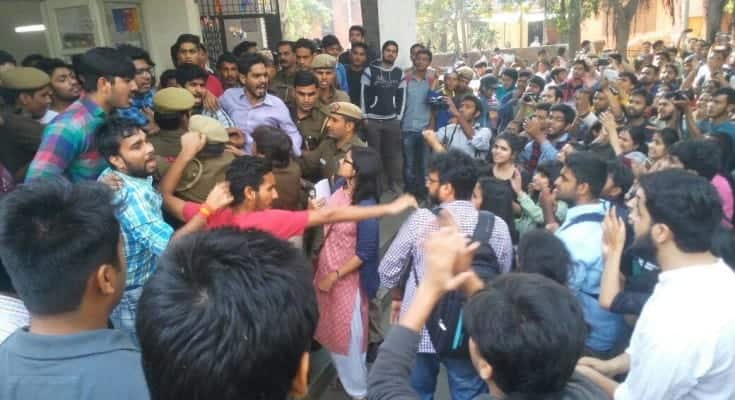
  • October 2016- AISA’s meeting disrupted by ABVP: AISA’s seminar on ‘Idea of University’ was disrupted by ABVP members who latter even roughed up several members of AISA including its president. Both sides got into a scuffle, after which the event was cancelled. The surprising fact was, all of this happened even after heavy police presence.

Read the whole story here.

aisa-vs-abvp-the-never-ending-battle

Battle of ideologies: ABVP vs. AISA

  • December 2016- The Pinjra Tod Movement: What began as a Facebook page turned into a great call for revolution within academic institutions to relook on its hostel policies which cage students with curfew times. The movement not just grew largely in Delhi University but also spread to other parts of the country.

Read the whole story here.


  • February 2017- ABVP protests against Umar Khalid and disrupts two day conference: A two day seminar on Cultures of Protest, organised by Wordcraft, the Ramjas literary society and the English department of Ramjas college, was disrupted when members of the ABVP protested against Umar Khalid speaking at the conference. Khalid is a PhD scholar from Jawaharlal Nehru University and a student activist who was slapped with sedition charges last year. ABVP’s reason for obstructing the conference was the presence of Umar Khalid and Shehla Rashid, JNU students, who were amongst the speakers at the conference.

Read the whole story here.


  • March 2017- Students, teachers AND politicians join in thousands to protest against ABVP’S hooliganism: A historic march consisting of over a thousand students, teachers and politicians started from SGTB Khalsa College and culminated at Arts Faculty. Students and teachers from colleges across University of Delhi, Jamia Millia and JNU joined in huge numbers to protest against the hooliganism that was allegedly perpetrated by ABVP karyakartas on 22nd February at Ramjas College. The march, which was called ‘Save DU’, garnered many students who were first-time protesters.

Read the whole story here.

abvp-hooliganism-at-its-best

Scuffle between ABVP and Ramjas college students

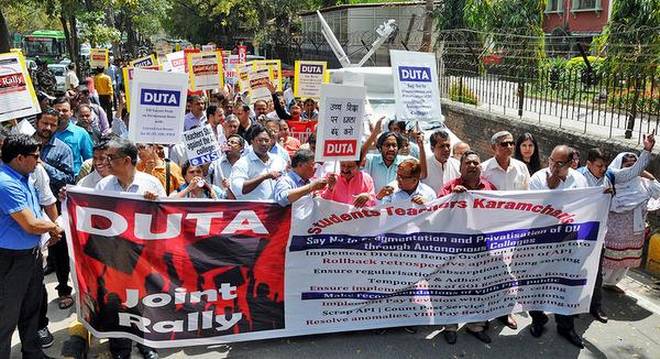
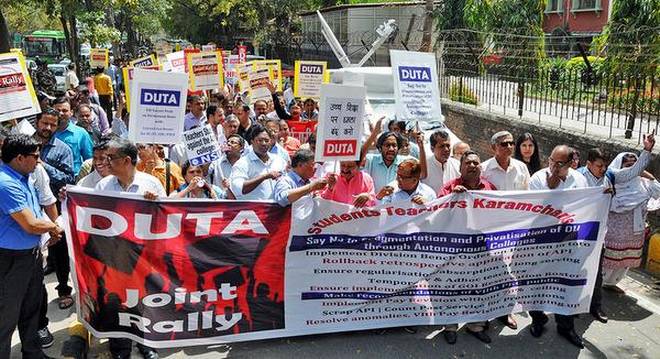
  • April 2017- Students and Karamcharis join DUTA in its MARCH AGAINST ‘AUTONOMY): With growing demands against the grant of ‘autonomous’ status for colleges, Delhi University Teacher’s Association (DUTA) called had called for a joint protest of students, teachers and karamcharis on 29th March.

Read the whole story here.

 the-dangers-of-autonomy

Protest over the ‘dangers of autonomy’


Picture Credits: DU Beat Archives

Anahita Sahu

([email protected])

With growing demands against the grant of ‘autonomous’ status for colleges, Delhi University Teacher’s Association(DUTA) called had called for a joint protest of students, teachers and karamcharis on 29th March.

What drew along the course of the  March?
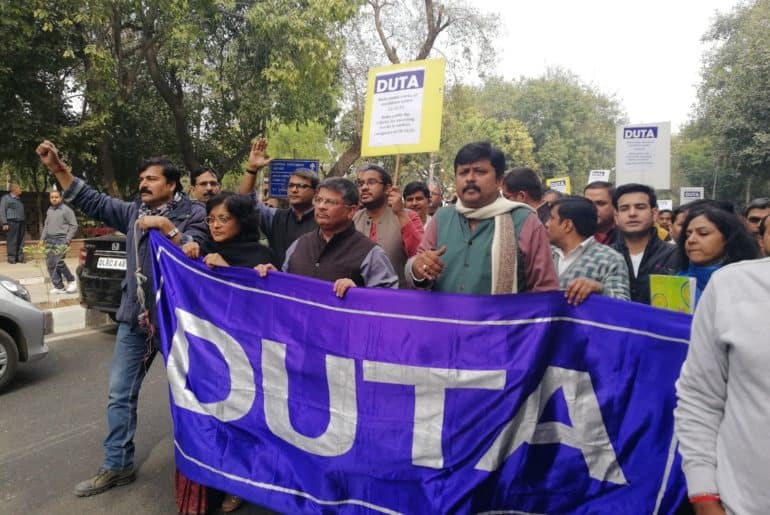
On 29 March 2017, the Delhi University Teachers’ Association (DUTA) organised a march from Mandi House to Jantar Mantar in protest against the recent actions of the government in light of the demands for autonomy by certain colleges in the University. The government has supported these demands for autonomy without any exhaustive deliberation in the Parliament or even in any public domain. The march was a rally against the privatisation of education through the fragmentation of Delhi University. Teachers were quoted as saying that “education was not for sale” and that the government’s move would lead to quality education becoming unaffordable.

The teachers, students, and non-teaching staff, numbering more than three thousand, rallied against the proposal of the government to grant autonomous status to colleges on the basis of commercial ideas of accreditation and ranking. They stated that this would lead to self-financing and ergo the commercialisation of education. DUTA was also supported in their demand by the Delhi University and College Karamchari Union (DUCKU) as well as several student organisations such as the National Students Union of India (NSUI), the Chhatra Yuva Sangharsh Samiti (CYSS), the Students Federation of India (SFI), and the All India Students Association (AISA).

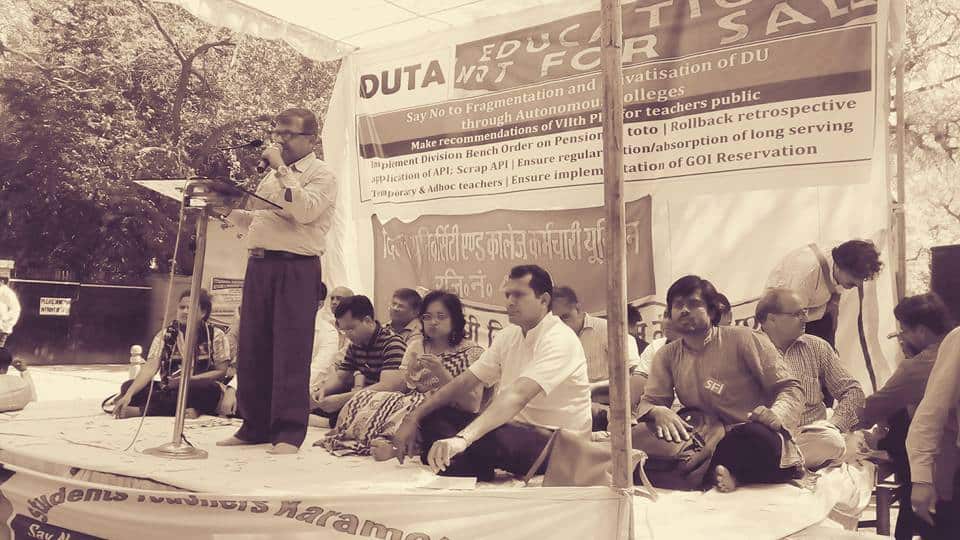
Protesters held banners asking the government to “Say No to the Fragmentation and Privatisation of DU through Autonomous Colleges


Why is ‘Autonomy’ not so good for DU Colleges?
The march was conducted specifically against the granting of the autonomous status to certain colleges by the government. To understand why this move matters, it is imperative to look at the actions of the government with scrutiny.

A leaflet given out during the march stated that the Autonomous Colleges Scheme aims to privatise and commercialise higher education by reducing the gap between public and private institutions in terms of fee structure.

DUTA claims that the granting of autonomy will in actuality only give autonomy to the management instead of providing academic autonomy. It shifts the focus from the betterment of education to the generation of resources by granting autonomy, and thus power, to the governing bodies and trustees of these colleges. The aim then essentially becomes to improve infrastructure and indulge in greater physical maintenance as opposed to providing a platform for academic growth.

As these colleges, which currently receive 95% of their funds from the University Grants Commission (UGC), will no longer be able to rely on government subsidies, they will turn to other measures including raising students’ fees and cutting costs to raise revenue. This affects the students as well as the teachers and the non-teaching staff. Firstly, students from economically and socially vulnerable backgrounds will have fewer avenues for availing quality education. Moreover, when education becomes expensive, the historically deprived sections of society such as women and Scheduled Castes and Scheduled Tribes are further adversely impacted. Secondly, the autonomy of the management may lead to a decline in the job security or career advancement of the working staff. Working conditions may deteriorate and the pay structure may be compromised in the face of a profit-minded management.

DUTA claims that these harms outweigh the benefits that the government claims will occur. The autonomous status may allow colleges to start new academic courses and change their style of teaching, but they will not be free from the semester system or the Choice Based Credit System (CBCS). Additionally, colleges will still need to affiliate with DU in order to give degrees. This results in a mere “ceremonial connection with DU”, as stated by Abha Dev Habib, an active member of DUTA. Thus, as a direct consequence of the cutting down of funding for higher education, the granting of autonomy will only privatise and commercialise education.

Members speak out at the rally against autonomy


What were the consequences of the march?
Students and teachers who took part in the march are confident that the government will be forced to take notice of the citizens’ demands.

Ms. Abha Dev Habib, a member of DUTA acknowledged that the response from teachers was “tremendous” and that “the mobilisation for the programme was very successful”. She talked about Arun Jaitley’s inclusion of autonomous colleges in his budget speech with the establishment of the Higher Education Financing Agency (HEFA). Speaking of the current situation in autonomous institutions in our country she said, “IITs are a clear example of the rising fee structure in public institutions and the government’s plan of closing the gap between private and public educational institutions.”

Ms. Nandita Narain, the president of DUTA called upon all stakeholders of the institutions to join them in coming days. Giving a wake up call to the govt. she said, “Privatisation is not going to be accepted by the community and the people at large. We are going to fight all out.”

In the recent pasts universities have seen a lot of disturbances. Happenings around the campus like forcing the autonomous status on St. Stephens College, the fiasco at Ramjas College, attack on free speech and the massive seat cut in JNU admissions makes it eminent that the incumbent government is not so happy about the environments in campuses, and is determined to change it by hook or …!


Image Credits: The Hindu

Vineeta Rana

[email protected]

13 Ad hoc teachers were given termination letters in the middle of the semester in Miranda House on August 29, 2016. The move is being described as an ‘administrative lapse’ by the Principal and has been strongly opposed by the Miranda House Staff Association (MHSA) on the grounds that the teachers were appointed according to the latest ordinances issued by the University and in line with the requirements for the CBCS course framework. DUTA and MHSA held a joint press conference on September 5, 2016 to throw more light on the issue and to convey their strong protest against the sudden, arbitrary retrenchment.

What happened?

On August 23, the MHSA was informed of the college’s decision to terminate the contracts of 13 Ad hoc teachers across different departments. The move came after an ‘administrative lapse’ was discovered in exceeding the number of teachers that could be hired beyond a second tranche cap. The college had hired 210 teachers but had a cap of 194, making the terminated Ad hocs ‘surpluses’. The departments were asked to make changes to their previously approved workloads in order to terminate the required number of Ad hocs. The changes would have led to an increase in the workloads of all the professors, against the UGC workload norms, and an increase in the size of tutorials, against the CBCS requirements. Many departments refused to make these changes. The matter was also brought up with the Delhi University Teachers Association because of the grave injustice of the move being suggested. A DUTA team met the Principal, Dr. Pratibha Jolly, on August 26, 2016, and requested her to hold a Governing Body meeting before taking any decision. The matter wasn’t brought up with the University, despite Miranda House being a University-maintained and UGC funded college, neither was a Governing Body meeting called before 13 Ad hoc teachers were handed over termination letters on August 29, 2016 in the Principal’s absence, who left the country one day prior to this and hasn’t been available in college since then. A Delhi University official, on the condition of anonymity, told the Times of India that no one in the University knew about the situation till they read reports about it in the media. The one-line termination letter offered no reason for the termination and came out of the blue for 13 teachers who had already been teaching in Miranda House for over a month, if not more. The affected teachers were neither given any notice prior to the letter, nor any compensation, monetary or otherwise, of any sort. The move has also disturbed the reservation roster of the college, which needs to be according to the specific reservation requirements per category.

The larger issues at hand:

While the issue of the lives of 13 teachers being toyed with is already grave enough, it has even more implications if we consider the bigger issues that manifested themselves in Miranda House, and how they are going to end up affecting all colleges sooner or later. There is a discrepancy in the cap that colleges are expected to follow according to a 2004 UGC workload guideline and the requirement of teachers according to 2013 university ordinances and the CBCS requirements. The former allows Miranda House to have just 194 teachers whereas according to the latter, the requirement is of 210 teachers. Having followed the CBCS requirements, Miranda House found itself crossing the second tranche cap and decided to terminate 13 Ad hoc contracts, not having hired 3 of the 16 positions they had to fill. In other colleges, the situation has manifested itself in a different way – the required numbers of teachers aren’t hired in the first place and the employed professors are being overworked beyond the workload guidelines. It needs to be realised that stretching the existing number of teachers thin is not just flouting guidelines but also affecting their quality of work and the education being imparted in some of the top colleges of the country. It also has implications for the credits that students under CBCS are supposed to receive. Under CBCS, an hour of class counts for a credit and there are strict tutorial size requirements as well. With the academic life of the college being disrupted in the middle of the semester, and classes still untaught despite nearly a month and a half of classes, the current situation needs to be understood as a crisis in need of immediate attention.

What now?

The MHSA and DUTA are calling for the Governing Body to intervene and hold an emergency meeting to resolve the issue to protect the unfairly terminated teachers. They are asking for all 13 teachers to be reinstated by the college administration. The MHRD also wrote to the college, demanding an explanation for the sudden retrenchment of the teachers and how the college planned to continue regular classes. The college replied that it was going to call a Governing Body meeting soon and is trying to look for a solution. Meanwhile, the 13 Ad hoc teachers remain vulnerable, their classes untaught and the Principal still unavailable. DU Beat met two of the 13 affected teachers during the Press Conference to ask what they were planning to do about the issue at their own level. The teachers, for the time being, have put their trust in the MHSA and DUTA to protest on their behalf and protect their interests. The situation in Miranda House has exposed several issues in the functioning of the University, and the general attitude towards Ad hoc teachers,who are often treated as second-class citizens in their own workplaces and are overworked and undercompensated. DU Beat stands in solidarity with the MHSA, DUTA, and the Ad hoc teachers’ community of Delhi University. Feature image: Daily Mail Shubham Kaushik [email protected]  ]]>

Miranda House, Delhi University. DUTA and the Miranda House Staff Association have raised their voice against the termination of the teachers, who had otherwise been appointed till November of this semester. The Principal of Miranda House claims that she made an administrative lapse in appointing 210 teachers. According to the authorities, the college can only provide the salaries for 160 sanctioned teachers and up to 193 posts that were promised as a part of the second tranche of OBC expansion. However, MHSA and DUTA oppose this and claim that the cap should have been considered prior to the appointment of the new ad hoc teachers. MHSA had even volunteered to raise funds from the permanent staff. College teachers had also been asked to redo their timetables in MH, which had recognised 16 ad hoc teachers as ‘surpluses’. Departments, such as the English Department of Miranda House had refused to make these changes on the grounds of being contrary to the guidelines set by the UGC. Earlier UGC had attempted to change the workload but this decision was withdrawn later. The work load had then slipped back to 16 Hours per week for assistant professors and 14 hours for the associate professors and professors. Nandini Dutta, who teaches Economics at Miranda House said to Times of India, Our Timetables were drawn up as per the 16-14 hour norms. Now the college is insisting on 15 and 18. None of the documents placed before us to justify this are recent or valid.” According to MHSA and DUTA, the Principal had taken a decision without having consulted the governing body of DU or UGC. They have extended their full support and are demanding that the ad hocs should be reinstated. Thus, MHRD has taken up the matter and demanded an explanation for the same. Meanwhile, a large number of classes and study slots remain untaught and unattended because of the unavailability of teachers post the termination. DUTA and the MHSA will be organising a joint Press Conference addressing the issue at the DUTA office at 1.30 p.m. on September 5, 2016, and invite everyone to attend the conference to extend their support. Featured image credits: dailymail.co.uk Tooba Towfiq [email protected]]]>

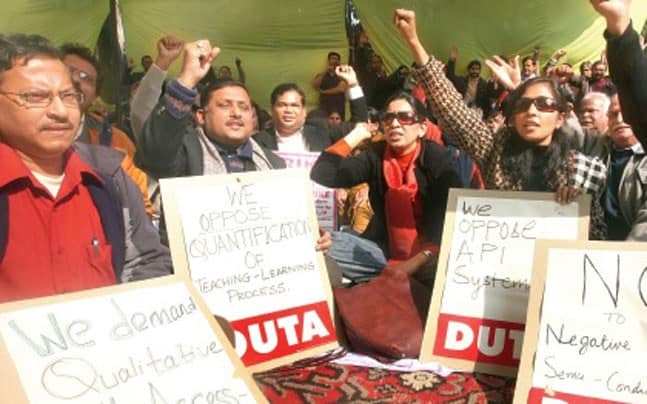
In a move that will come as a relief to thousands of final year students awaiting their semester 6 results for purposes that include VISA applications and Masters’ applications, the Delhi University Teachers’ Association (DUTA) decided to exempt the evaluation of the answer scripts of the erstwhile FYUP, that is, final year students from its protest action of evaluation boycott. At the same time, it has called for an intensification of protest and movement for the roll back of the API based promotion scheme.

The recent protests by DUTA resulted in the government backing out on the recent policy that would have resulted in an increase in the teaching hours required from each teacher, and would also lead to potential loss of employment for several of them. However, the government decided to continue with the API based promotion scheme, which, according to DUTA has proven to adversely affect teaching and learning. Another reason cited for the intensification of protests is the denial of permanent appointments and promotions of teachers for the last several years.

The intensification of protest will impact the first and the second year students, with the continued boycott of the evaluation of their answer scripts. It will also have serious ramifications for the upcoming admission process, with DUTA vowing to boycott all aspects of it.

Feature Image: The Hindu

Shubham Kaushik

[email protected]