Tag

DUTA

Browsing

The recent strikes by the University ad hoc teachers still go unheard as the University approves contract hiring of teachers for vacancies.

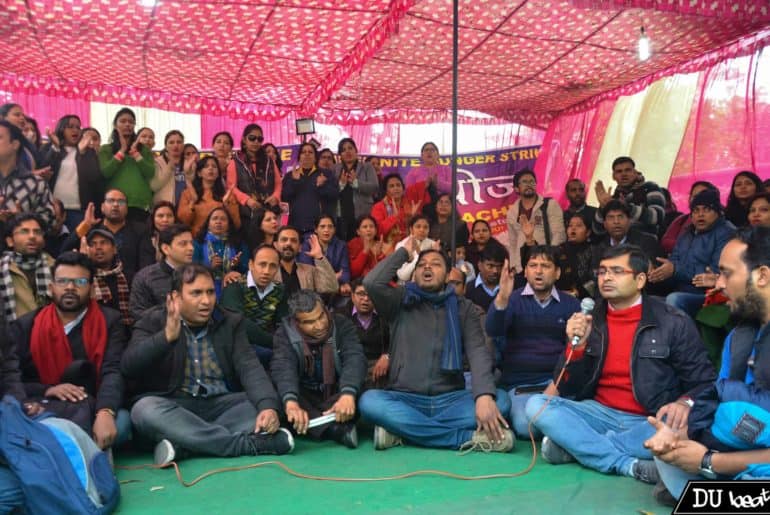
The 17 th January march by Delhi University Teachers’ Association(DUTA) at Ram Lila grounds sems to turn unfruitful as the University approves the contractual hiring of teachers after introducing ordinance XII E, enabling the hiring of contract-based lecturers who will be employed for vacancies spanning one year. This was passed with a provision to have 10 percent of the permanent positions as contractual appointments.

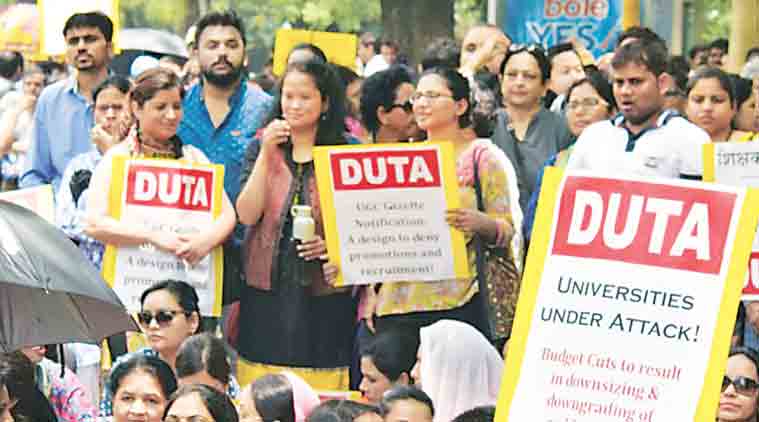
DUTA conducted a long march on the 17th January 2019 from Ramleela Maidan to Parliament Street in lieu of the several demands placed by them, including the proper absorption of the ad hoc and temporary teachers through a one-time regulation into the university, the resolution of the reservation issue through an ordinance and the restoration of the 200 point roster which the Supreme Court set in July 2018 which treats university/college as a unit. This became necessary after the recruitment policy in the University observed a halt on account of a letter drafted by the University Grants Commission, dated 5th March 2018 which asked the colleges to implement reservations by considering the subject as a unit, resulting in a significant reduction in the jobs for the reserved castes.

The DUTA strikes have been an ongoing struggle as protests began on 2nd January 2019, when the professors across Delhi University agitated against the unavailability of permanent positions, pensions, and maternity leaves for the ad hoc teachers. Such demonstrations and protests have been witnessed in the past too, but to no avail. The strike had more than five thousand people, including the teachers and students as active participants. The march was initiated from Zakir Hussain College at 11 AM and continued to Ramleela Maidan and Parliament Street. The protestors were detained by the police and lathi charge was issued on them, leading to many teachers and students suffered injuries.

The introduction of the contractual appointment as a response to the Ministry of Human Resources Development in these teaching positions will not lead to any substantial benefi, as it will create a feeling of insecurity among the ad hoc teachers who are already agitating against their lack of employment privileges.

In response to the past happenings, Professor Rajib Ray, President of DUTA, in his interview to The Tribune commented, “We hold the Vice-Chancellor squarely responsible for the complete administrative paralysis and subversion of the statutory bodies in the University and demand that he should act or go.”

The present situation still does not have any tangible outcomes, despite the active protests. The University has not issued any recent statement on the same issue, providing a bleak future to the entire agitation.

Feature Image Credits: Aakarsh Gupta for DU Beat.

Avnika Chhikara

[email protected]

Exploring the history of the events that triggered the ongoing unrest within DU’s academia.

In October 2017, the University Grants Commission (UGC) had introduced rules, making reservation applicable at the department level instead of university level. The UGC rules had followed an Allahabad High Court order of April 2017, which was upheld by the Supreme Court. The High Court had struck down a UGC circular on institution-wise quota to fill vacant Scheduled Caste (SC) and Scheduled Tribe (ST) posts, pointing out that there were departments without any SC/ST teachers. The new UGC rules had led to widespread protests across universities with professors, and critics saying that such a move will deprive many reserved candidates of their jobs.

In March 2018, UGC issued a fresh order with new clauses that asked for a roster system, sparking an instant backlash in the university system. Delhi University Teachers’ Association (DUTA) said that, till now, the UGC had specifically prohibited the practice of making department-wise cadres, as that would lead to the denial of reservation in small departments. In June 2018, DUTA organized ‘satyagraha’ amid reports of autonomisation of the University of Delhi (DU), by calling off the evaluation for this semester’s examination papers. Members cited this move as ‘anti-education, and anti-people policy pronouncements of the Union Ministry of Human Resource Development.’ In particular, the teachers were strongly opposed to the 30%-70% funding formula, the tripartite Memorandum of Understanding (MoU) requiring steady increase in students’ fees, graded autonomy, and the scheme of autonomous colleges. The DU administration later via a press release pleaded teachers to start the evaluation soon. In response to the ongoing protest about reservation roster, the Ministry of Human Resource Development (MHRD) drafted a bill that stipulates for the maintainence of the vacancy roasters university wise at all centrally funded higher education institutions to implement reservation of faculty members in November 2018.

In December 2018, agitation with respect to the government’s failure to implement the Seventh Pay Commission in totality for universities translated into more protests. The notification for implementation of revised allowances, and pensions, consequent to the Seventh pay Commission, and disbursal of the required funds for its implementation are still pending, according to the memebers of the DUTA.

In January 2019, a two day shutdown was triggered by the Vice Chancellor’s (VC) refusal to table the report of the Recommendation Committee constituted to review the UGC gazette notification related to teachers’ service conditions. Dr. Rakesh, a member of DUTA spoke to DU Beat. He said, “VC has launched new terms to count the served time period, which harms us. He hasn’t enforced the UGC guidelines, which relieves the ad hocs.” Thousands of teaching, and nonteaching permanent posts remain vacant, while teachers and karamcharis have been working on ad hoc posts for many years. Ad hoc teachers lack job security, and employment benefits. They demand regularisation, and absorption of temporary, and ad hoc teachers. They also accused the government of sweeping the reservation roster issue under the rug, owing to their silence on the matter. Dr. A.M. Khan, a member of DUTA, expressed dissatisfaction with the Ministry, VC and the Government, saying, “There were very high hopes with regard to the new government, but unfortunately the opposite happened. Thus, everyone is on the streets today”.

Feature Image Credits: Aakarsh Gupta for DU Beat.

Nikita Bhatia

[email protected]

The Delhi University Teachers’ Association (DUTA) held an Executive Meeting on Saturday, 12th January 2019.

The resolution for the same is a comprehensive account of the crisis being confronted by the teachers of the University in lieu of the Central Government’s withdrawal of government funding from public-funded universities. This was termed as a “highly misguided policy” and “commercialisation of higher education”. This has led to a delay in the announcement of revised allowances and pensions of teachers. The exploitative conditions in terms of long working hours and lack of job security and employment benefits for ad hoc teachers have also contributed to the rage and unrest among teachers.

In addition, DUTA has also directed rage and disappointment against the Vice Chancellor (VC) of the University of Delhi, and condemned him for his inaction and lethargy in carrying out timely appointment procedures for teachers. They expressed strong criticism towards the VC for capitulating to the Government’s agenda by not even allowing the tabling of the report of the sub-committee set up to facilitate the adoption of the UGC Regulations 2018. Owing to the same, several young ad hoc teachers had declared a hunger strike in effect from 4th January 2019, which has now continued for nine days in the blistering cold.

In the resolution dated 12th January 2018, the DUTA has declared solidarity with the teachers on hunger strike, and has demanded that the Government bring in a one-time Regulation for the absorption of temporary and ad hoc teachers. They have proposed a one day strike and dharna at Gate No.1, DU to highlight their demands for the re-convening of the adjourned meeting of the Academic Council. They have also announced an immediate action programme of One Day Strike along with a Long March to MHRD on 17th January 2019.

Emphasising that these consequences emanating from a reduction in Government funding will soon affect the students as well, and has called for support by all sections of the university community, including and especially students.

Feature Image Credits: The Indian Express

Nikita Bhatia

[email protected]


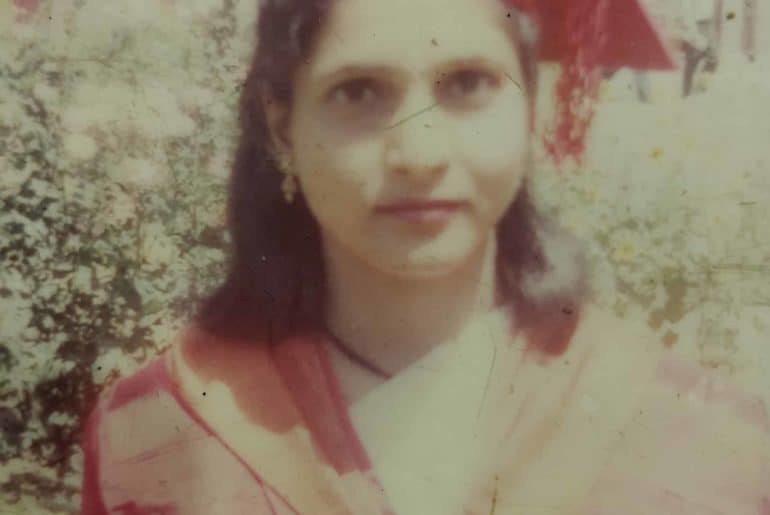
A first hand account of Dr. Asha Devi, an ad hoc professor at Hindi Department of Aditi Mahavidyalaya. She talks about the difficulties ad hoc teachers have been facing for over two decades. 

“I joined the University of Delhi (DU) as a lecturer in Aditi Mahavidyalaya in1996 on ad-hoc basis. I used to change three buses to reach the college since it was two hours away from my residence.  With a Doctorate in Hindi, double Masters in Hindi, and Mass Communication, I was sure that I’ll soon get a permanent job in the University. I was also the Class 12th topper in Hindi in CBSE Examinations, 1985. I still have the journal where my interview was published. Even at that time, I had said that I wanted to be a lecturer when I was asked about my goals.

I did my Bachelors, Masters, M.Phil and Ph.D in Hindi from DU. I cleared NET with JRF in 1991 in the first trial. In 1999, my daughter was born, and being an ad-hoc I wasn’t given maternity leave. I was thrown out of my job but I did not lose hope. I continuously kept teaching in various colleges of the University as a guest lecturer, and even agreed to give a single lecture a week. In 2001, the interviews for permanent posts of faculties were conducted in Aditi Mahavidyalaya. I wasn’t selected despite a good interview because the already appointed lecturers were given preferences. I joined Aditi Mahavidyalaya again in 2002, again on an ad hoc basis. In 2004, the interviews for permanent posts were conducted again, but due to nepotism, I was thrown out from my job for the third time. Even now, when I think about the 2004 interview, I feel extremely miserable, helpless, and depressed. The thought that someone else took my job because they had better contacts and money than me still haunts me.

Since then, I have been filling the application forms for other colleges of DU spending around INR 500 to INR 1000 on each form. Every year, thousands of applicants fill these forms, but the interviews never take place. If they do, I for sure never get selected, despite proper experience, and qualifications. I taught in a private university for a year where my salary was even lesser than what I used to get in DU.

Since I have been teaching in Aditi Mahavidyalaya for long, it feels like my second home. However, there is still a fear that this home will never accept me completely, and would throw me out. My daughter is pursuing her graduation from Miranda House. She often asks me to join her college, but it is not that easy. I can only dream of teaching as a permanent faculty. Every four months, I have a weird feeling in my gut which leaves me wondering whether I’ll get the letter this time or not. I am the sole bread earner of the family. I have two kids, and less money to spend on their education. I am under many loans. I want to make sure that they don’t suffer because of the system, like I have.

One thing I am sure of is that is I know my job very well. Otherwise, I wouldn’t have been teaching for 20 years. Since 1996, I have also been the in-charge of many committees, and societies of Aditi Mahavidyalaya. I was the convener of NCC for nearly six years. I used to be given tasks to take the NCC students for outdoor camps. If I were so impotent, who would assign me tasks like these?

Sometimes, students of other disciplines tell me that they want to attend my lecture. This makes my day. Whatever happens in college affects me a lot. I tell my daughter everything that happens in a day. It occupies a huge part of my life. It’s too late for me to learn something new, and start all over again. All I want to ask is: What is my fault?, The fact that I didn’t give in to the system or, deserved to be treated fairly.

Feature Image Credits: Dr. Asha Devi

After a UGC circular that hinted at bringing the University of Delhi under the Essential Services Maintenance Act (ESMA) gained much criticism, the Ministry of Human Resource Development (MHRD) issued a clarification and refuted the speculation. 

The clarification came out with a tweet by Mr. R. Subramanyam the Secretary of Higher Education. His tweet said that the idea to ban strikes in the examination services came from some affected students during the Delhi University Teachers’ Association (DUTA) strike, however, the ministry has decided not to proceed with the suggestion after examining it.

MHRD Minister, Mr. Prakash Javadekar, also tweeted that the Ministry does not intend to put any restrictions on universities, however, he didn’t pointedly comment on ESMA.

The Essential Services Maintenance Act is an act of parliament which has been established to ensure the delivery of certain services such as public transportation, sanitation and health services so that they are not affected during strikes. 

The move to include DU under the ambit of ESMA has come as the University witnessed a prolonged evaluation boycott twice in the past two years. In 2016 DUTA had boycotted the evaluation for 55 days in protest against the changed workload condition. This year witnessed another boycott for over 40 days in protest of the recent schemes of government such as autonomy, change in roster policy, etc.

The implementation of the ESMA implies that the teaching, as well as the non-teaching staff and students, will be prohibited from indulging in actions that will disrupt and affect activities in the University. A seven-member group had been formed earlier this month to submit a report within thirty days as MHRD directed for a committee to examine the feasibility of bringing the teaching and evaluation methods of a university under ESMA.

ESMA has received criticism on behalf of many, especially the Federation of Central University Teachers’ Association when their former president, Aditya Narayan Mishra, stated that the MHRD’s new order was an attack on the debate, discussion as well as the spirit of enquiry and scholarship. There has been widespread criticism of ESMA for some of its clauses. According to the Clause (VIII) of ESMA, it states that anybody can be arrested for investigation even without a warrant.

Feature Image Credits: DU Beat

With inputs from India Today.

Avnika Chhikara

[email protected]

In a flash protest, the DUTA raised several demands criticising the privatisation policies of the government such as the loan-granting system under the Higher Education Funding Agency, release of pensions, the removal of the Dyal Singh College’s Chairman, and so on.

The Delhi University Teachers’ Association (DUTA) raised some crucial issues regarding the higher education funding policies of the central government in its flash protest in front of the Vice Chancellor Lawns at 11 p.m on 27th September 2018. It was protesting against the tripartite Memorandum of Understanding (MoU) that the Ministry of Human Resources Development (MHRD), University Grants Commission (UGC), and University of Delhi (DU) were supposed to sign, in order to access loans from the Higher Education Funding Agency. According to a recent report in The Indian Express, the MoU reportedly calls for the universities to “ensure gradual annual increase in the user charges/fee charged by it for various courses and facilities.” This essentially reflects that Universities would have to generate 30% of their funds through their self-financing.

Rajib Ray, President of DUTA, speaking to DU Beat said, “The tripartite MoU basically gives you (the University) a target for generating revenues and a huge segment of the revenue will come from the user charges and that is, the students. And if anybody is adversely affected, it is the students.”

DUTA was also protesting against the changes in the roster according to a 5th March letter by the UGC that reportedly led to a decrease in the number of reserved seats posts for teachers; a release of pensions for teachers who have retired; promotions for the non-permanent teaching faculty (currently DU has the most number of non-permanent faculty members at 60% of the total teachers); and the removal of the Dyal Singh College Chairman, Amitabh Sinha, over the recent fracas that happened there (the Chairman had shut down the college 24th September to hold a Governing Body meeting that had led to a clash between the students and teachers with the ‘private bouncers’ of the Chairman.) Teachers from Dyal Singh college, Mr. Sachin N and P.K. Parihar, speaking at the protest spoke against the way the Chairman of the college had suspended the Principal of the college in a gross misuse of his powers.

Several students from All India Student’s Association (AISA) and Students’ Federation of India (SFI) were also present in the protest, extending their support. Kawalpreet Kaur, the President of AISA in Delhi University told DU Beat, “The MoU is against the idea of the public funded university. The idea of making education a loan-based commodity is very dangerous because students from marginalised backgrounds won’t be able to afford (the fees). Also, the Chairman of Dyal Singh College, who is a part of a non-academic body, is setting a dangerous precedent by not letting the students and teachers come into the college and by harassing the Principal of the college.” Mayank, an activist from SFI also told this correspondent that the SFI was demanding the removal of the college Chairman because it was against the “culture of hooliganism that he (the Chairman) was spreading.” Mayank also demanded that the Chairman should apologise for the alleged manhandling of the students and the teachers on 24th September by his “hired bouncers”.

An Executive Council meeting of the University supposed to be held that day to deliberate on the issue of MoU. Previously, the MHRD had written to the University to sign the MoU, failing which the funding from UGC would be withheld.


Feature Image Credits: DU Beat.

Sara Sohail

[email protected]

In an attempt to reform higher education, the central Government today announced a complete overhaul of the apex higher education regulator- University Grants Commission (UGC), repeal of the UGC Act, 1951 to adopt a fresh legislation to set up the Higher Education Commission of India (HECI).

The new Higher Education Commission of India is meant to focus only on the academic part of the universities. Finances would be under the direct jurisdiction of the ministry, according to the draft. 

The HECI Act, 2018 is expected to be pitched in the Parliament in the upcoming monsoon session. The Ministry of Human Resource Development will be uploading the draft of the act on its website to be vetted by the public and for inviting feedback. 

Dr.Rajib Ray, the President of Delhi University Teachers’ Association was very  critical about the overhaul of the UGC and told DU Beat that, “It is very unclear that how this step will address the need of higher education in a better way.” He informed DU Beat that DUTA will be holding a meeting on 3rd July to deliberate further on the draft. He raised his concerns over the absence of representation of SC/ST/OBC/PwD/women in the twelve membered commission.

Dr. Nandita Narain of DUTA in a conversation with DU Beat correspondent alleged that the aim of overhauling UGC is an attempt to corporatise education sector.

In a conversation with DU Beat, Mr. Saket Bahuguna, the media convener of ABVP said that “This draft aims to bring reforms in the field of higher education. The ABVP will discuss the draft and propose the recommendations to the MHRD, once it is out for public feedback”

Educationists, stakeholders, and others can furnish their comments and suggestions by July 7, 2018, until 5 pm.

Feature Image Credits: The Indian Express.

Sandeep Samal

[email protected]

The deadlock between DUTA and the University of Delhi’s (DU) administration finally terminated on the 16th of June 2018, a result of the meeting between the Vice Chancellor of DU and the DUTA office bearers. Two days later, on 18th June, the DUTA ended their boycott of evaluation of DU examination papers, in the interest of the student community.

While appealing to the DUTA to lift the nearly month-long evaluation boycott, the VC, on Saturday, had taken serious note of the crisis precipitated by the University Grants Commission’s (UGC) 5th March Notification on the Roster. Through a phone call conversation, Executive Council member of the DUTA Yogendra Yadav informed DU Beat , “The meeting between the VC and DUTA had continued for five hours.”

Notably, the DUTA had been agitating against the UGC’s circular dated 5th March that included a number of provisions which would have allegedly denied reservation of teaching positions in smaller departments to members of the ST, SC and OBC communities. Moreover, it would have derailed the process of permanent appointments and displace ad-hoc teachers who have been teaching for many years.

In Saturday’s meeting, the VC had broken the deadlock by assuring the DUTA that the DU administration will try to get all working ad-hoc faculty continued in the new session. Moreover, regarding the issue of the counting of past services, he had agreed to allow a five-member DUTA delegation to represent its position before the University Committee.

Subsequently, on 18th June, the DUTA held an emergency Executive Meeting followed by a General Body meeting in order to decide their future course of action after the VC’s assurances. In the same, the DUTA decided to terminate their evaluation boycott while resolving to take forward its agitation through alternate modes.

DUTA President Rajib Ray told the DU Beat correspondent, “The student community of DU has always been supportive of our struggle including the time of the evaluation boycott. We have taken note of the appeals made by students and we will ensure that examination results are declared on time so that the interests of students are not hurt.”

DUTA Executive Dr. Surendra Kumar who had been an active participant in the DUTA agitation told this correspondent, “While DUTA has agreed to give up the evaluation boycott for the students, we have not agreed to give up our agitation per se.”

When asked about the future course of action, he remarked, “Regarding the Reservation Roster, the DUTA will review the situation after the 2nd July Supreme Court hearing on the Review Petition. The need of the hour is to mobilise wider political support on the issue of the Roster to ensure that the Constitutional rights of the SCs, STs and OBCs are protected.”

The official circular of DUTA summarizing the minutes of the meeting held on Monday concluded, “The withdrawal of the evaluation boycott is in the spirit of empathy and solidarity. It now remains to be seen whether the MHRD (Ministry of Human Resource Development) and DU’s administration are able to go beyond usual platitudes and are able to show genuine concern for the students and teachers.”

Arushi Chabbra, a student of B.Com Honours who appeared for her final semester exams from Indraprastha College for Women told this correspondent, “We are glad that the DUTA listened to our demands and decided to give up their evaluation boycott. The relationship between the students and the teachers in DU should essentially be symbiotic. We supported them in their struggle, now they must show their support by starting the evaluation process at the earliest.”

Feature Image Credits: India Today


Vaibhavi Sharma Pathak
[email protected]

The conference registered the presence of a string of politicians and speakers from CPI-M, AAP, RJD and Congress party, each unequivocally calling out the UGC roster for its “unconstitutional nature”.

The Delhi University Teacher’s Association (DUTA) today held a press conference at the Press Club of India, Raisina Road. The occasion saw DUTA gain the support of the major political parties in its on-going movement against the 5th March University Grants Commission  (UGC) roster which potentially curtails the reservation in the appointment of teachers.

Rajib Ray, President of DUTA, began the conference by highlighting the implications of the 5th March 2018 UGC notification regarding Reservation Roster for SC, ST, OBC category in teaching posts in universities and colleges across the nation, which directs institutions to make the roster treating a Department as a unit in place of the UGC guidelines of 2006 which considered College/University as a unit. He further spoke over how the latest provision could only lead to delays in fulfillment of required seats, hence pushing a large number of teachers from the SC, ST, and OBC background out from university spaces and putting the future of ad-hoc teachers at jeopardy.

Image by P.V. Purnima for DU Beat

Among the political figures present were Sitaram Yechury, secretary general of the Communist Party of India, Manoj Jha, Member of Parliament, RJD, Amarjeet Kaur, Udit Raj, and Dev Rajan. The politicians of all the parties overtly blamed the government for systematically scaling down the constitutional values in the academic administration and called for the roster development to be seen in the backdrop of a larger national narrative. They also asked the government to restore the status quo till the Supreme Court comes with a decision over the Special Leave Petition ( SLP).

In addition to these major actors, sources later claimed that DUTA resistance has also found support from Samajwadi Party, Jharkhand Mukti Morcha and, interestingly, Anusuchit Jaati Morcha of BJP.

However, questions regarding the evaluation boycott were strategically dodged, keeping the final year students and their higher education application prospects at loss. On being asked about the same, a Professor/Member of DUTA told our correspondent, “ The ball is in the government’s court. Rather than questioning the morality of the teachers, the government and the association should engage in a positive dialogue and resolve the deadlock, for everyone’s sake.”

Interestingly members of Akhil Bharatiya Vidyarthi Parishad (ABVP) staged a peaceful sit-in and handed out roses to the teachers, requesting them to begin the evaluation.


Feature Image by P.V. Purnima for DU Beat

Nikhil Kumar
[email protected]

Delhi University Teachers’ Association (DUTA) as part of its ‘satyagraha’ against autonomisation of the University of Delhi (DU), had called off the evaluation for this semester’s examination papers. The DU administration in their press release pleaded teachers to start the evaluation soon.

The press release quoted teachers’ mandatory duty to ‘actively participate in evaluation process’ according to the ‘service agreements, and Executive Council Resolutions of 2003 and 2014’. Further, it stressed on students, their future and how that can get hampered due to this boycott.

In response, DUTA released a statement which said, “The DUTA was forced to take this harsh step because of attack on Reservation Policy through 5 March 2018 UGC notification and because of fear that some of the DU colleges may be made autonomous colleges.” Teachers have been denied promotions, pensions, and appointments which has led to the discontentment.

DUTA also reaffirmed student support for ‘grave issues that are at stake affect the stability and quality of the teaching-learning process’. The students have previously supported DUTA in its march in Parliament Street and actively responded to the call for suspension of classes.

Shimona Sharma, a graduating student shared that, “As much as I support DUTA’s decision, I also am worried I will miss postgraduate admissions for that. It would be ideal if DUTA can reach a compromise and start with the evaluation of answer sheets of third-year students.” In 2016 too, the DUTA had boycotted the evaluation, but it later exempted the final-year students.

In its retort, DUTA advised the varsity administration to stop reminding teachers of their duties and to enter into a ‘genuine dialogue and take concrete visible steps’. They are seeking assurance towards resolution of issues, and plan to take the evaluation issue at their next meeting on 13 June 2018.

Feature Image Credits: The Indian Express

Raabiya
[email protected]