Tag

DUTA

Browsing

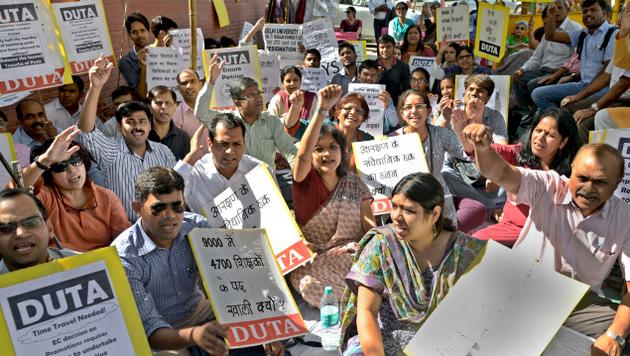
In a recent press release, the Delhi University Teachers’ Association (DUTA) has decided to continue its boycott of the recent semester exams evaluation till 16th June 2016, when the General Body (GB) will convene again to review the situation. The protest is in response to a notification by the UGC giving nod to the implementation of the  Academic Performance Indicators (API) system and other amendments that DUTA calls ‘retrogressive’ and an ‘attack’ on the higher education system of the country. This is a setback for the graduating students of the varsity as this has put on hold the post-graduate admissions to the varsity and might even stall the declaration of the semester exam results. Calling the gazette notification ‘draconian’, the DUTA has gone far to claim that if the government fails to roll back the notification, it might consider boycotting the admission process as well. The API system allows for teachers to be evaluated on the basis of students’ performance, a manoeuvre DUTA has called ‘unreasonable’.  Given the increase in the working hours of assistant professors from 16 hours to 24 cumulative hours and of associate professors from 14 to 22 cumulative hours, the DUTA claims that such a move will result in the loss of over 4,000 jobs and will work against the interests of both teachers and students. The Akhil Bhartiya Vidyarthi Parishad (ABVP), in contrast to its previous position has demanded an immediate rollback of the notification and urged the teaching community to ‘resume evaluation work immediately’ to avoid compromise of the students. Agreeing to one of the demands of the protesting teachers, the UGC, on 10th June 2016, decided to set up a 5 member pay revision committee for academic staff. The committee will be chaired by UGC member Prof. V S Chauhan and will submit its report in six months. With no end in sight, the UGC has claimed that the system will bring ‘more flexibility’ to the academic environment and ruled out any claims of loss of jobs due to it. Image Credits: www.tribuneindia.com   Sidharth Yadav [email protected]]]>

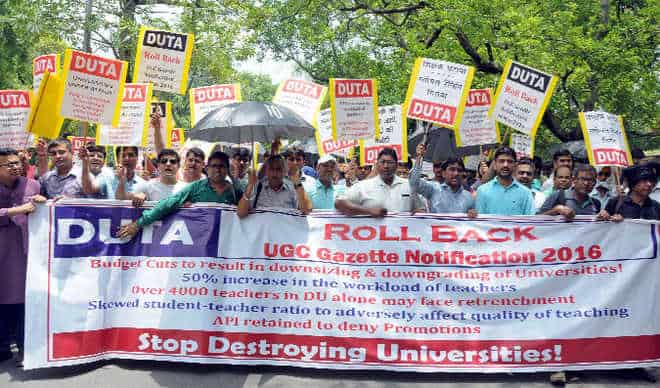
The Delhi University Teacher’s Association boycotted the evaluation of scripts for undergraduate examinations as on 24th May against the UGC Gazette Notification of 4th May which will lead to loss of jobs for around 5000 ad-hoc, temporary and guest teachers. Most of them have been teaching in the university for many years.  All twelve evaluation centers were closed on the first day of boycott. Evaluation halls at Daulat Ram College and Miranda House were locked; the ones at Keshav Mahavidyalaya, Dyal Singh and Gargi colleges were vacant, as reported by a popular national daily. 

According to a DUTA statement, the Amendment was issued under the guise of addressing the teacher’s grievances against the infamous API system which had led to large scale denial of promotions and devalued research and teaching. It also contained a secret clause that had a direct impact on the teachers’ working hours. For Assistant professors, the workload increased from 16 hours of direct teaching to 18 hours, plus 6 hours of tutorials. Similarly for Associate professors, working hours have been increased from 14 to 22 hours.

“DUTA demands that the government withdraws the Gazette notification immediately and initiates a dialogue with Teacher’s Associations on the issue”, said the statement.

Teachers across the University expressed their anger over a four day boycott during which period, Staff Associations will hold meetings and pass resolutions on the issue. A General Body Meeting of DUTA will be held on 28th May to analyse the situation and decide further course of action. If the government does not withdraw the notification, teachers might even boycott the admission process.

Image credits : timesofindia.indiatimes.com 

Arindam Goswami

[email protected] 

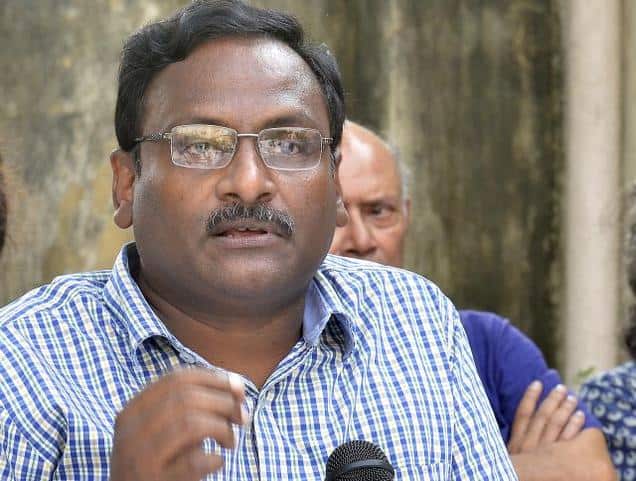
Ram Lal Anand Professor G.N. Saibaba, who was suspended from the university, following his arrest by Maharashtra Police in 2014 for alleged maoist links, recently became a centre of attack after his visit to the college. The English professor, who is out on bail, went to the college to submit a letter where he allegedly became a target of anger and protest by members of ABVP (Akhil Bharatiya Vidyarthi Parishad).

While Professor Saibaba might be hopeful of a fresh start, his request for reinstatement has invited mixed reactions. A group of students, led by the members of the ABVP, strongly oppose the professor’s rejoining unless he is cleared of all the charges by the court. Talking to us, ABVP’s Delhi State Secretary, Bharat Khatana, said, “Saibaba has been suspended by DU and despite that he is coming to the college and addressing students. We believe that unless he gets a clean chit from the court and the Governing Body (GB) of the college, he must not be allowed to enter the college premises.”

Despite the relentless protests and public bashing, DUTA strongly condemned the attack on Dr. Saibaba. DUTA President Nandita Narain, while emphasising on the lack of security for the professor, told us, “Had it not been for the protection given by some faculty members and hundreds of college students, Dr. Saibaba could have suffered grievous injury. The DUTA expresses grave concern that the college administration as well as the local police did not prevent this violent intrusion, even though similar incidents had taken place over the last few days. The DUTA appeals to the VC for his immediate intervention to prevent this breakdown of governance in this university maintained college.”

Sharing the same sentiment, Narendra Pande, Associate Professor from the Department of History and a colleague of Saibaba told us, ” There are two important things which we must keep in mind. One is that, rule of law must prevail and second that,any suspended employ has a right to approach his workplace. We met the chairman of the Governing Body of the college, Mr. R.M. Kohli today and he will soon foresee the situation himself. The Staff Association, which is the teacher’s collective body of the college, passed a resolution with consensus to expedite the functioning of the one—member committee which has been formed by the college to look into the issue.”

The Staff Association plan to impress upon the Chairman of the Governing Body as well as the Principal of the college to take steps in order to stop the breakdown of normal functioning of the college and the creation of a conducive and safe environment for teaching. The Supreme Court had earlier this month granted the professor bail on the pretext that Maharashtra government had been “extremely unfair” to him.

To recall the important twists and turns of the case, read our timeline of Saibaba’s case here. 

Image credits: www.thehindu.com 

Riya Chhibber

[email protected] 


With the issue attracting multitudes of attention with every passing day, the Dadri lynching incident has been a subject of regret ever since it surfaced. The primary question in each mind is whether this is the kind of development and leadership India wishes to progress under. While communal tension is something that has always been existing in India, the exploitation of this tension to such gravity is what concerns everyone. DU i

The Delhi University Teachers’ Association (DUTA) organised its Executive meeting earlier this week, where all members unanimously condemned the incident. The members expressed utter shock on the fact that the activities of the mob, which took away the life of that 50 year old man, were pushed by rumours that the family had eaten beef. The Association believes that this tragedy highlights the rising climate of hatred and tension across the nation.

Prof. Satish Deshpande, a DUTA member remarked, “I believe that under the present government, such incidents are not new. It’s the climate in which these incidents occur which is dangerous. The idea that the victim deserves such treatment is something of grave concern. The aberrational element is that the wrong people feel empowered, especially because of the fact that the government is not actively negating or condemning the incident. Strict law and order is needed to combat such situations.”

Areeb Mohammed, a student from Shaheed Bhagat Singh College, remarked that incidents like Dadri should not be allowed to disrupt the communal harmony of the country. “We are a free and secular country and that is what I’m proud of. We should raise our voice against such incidents to ensure they do not happen again.”

Featured Image Credits: timesofonam.com

Arushi Pathak
[email protected]

Amidst uproars over the exploitation of employees and claims about the government’s commercialisation project engulfing the University by Left wing Democratic Teachers’ Front (DTF), various teachers associations announced their candidates for the Delhi University Teachers’ Association (DUTA) elections slated for the 27th of this month. DTF, in a press release has appealed to the teachers of the University by attacking red tapism.

Nandita Narain, Associate Professor of Mathematics at St. Stephen’s College and the incumbent DUTA President has been nominated by the association for the position of President again this year. For the DUTA Executive, the nominated candidates are Angad Tiwari (Department of Hindi, Sri Aurobindo College- Evening), Bhupinder Chaudhry (Department of History, Maharaja Agrasen College), Vijaya Venkataraman (Department. of GRS, Faculty of Arts, DU) and Vivek Mohan (Department of History, Delhi College of Arts and Commerce). The Congress backed Academics for Action and Development has announced Sanjay Kumar from Zakir Husain College for the position of President. The National Democratic Teachers’ Front, which is led by BJP, has nominated V S Negi (Department of Geography, Shaheed Bhagat Singh College- Evening) for the position of President. For DUTA Executive, Anil Sharma (Department of Hindi, Zakir Hussain PG College – Evening), Ashok Kumar Yadav (Department of Commerce, Shyam Lal College- Evening), Shambhu Nath Dubey ( Department of Political Science, ARSD College) and Sunil Kumar (Department of Political Science, Dyal Singh College) have been nominated.

In another development, the varsity declared that the Delhi University Students Union (DUSU) elections will be held on September 11.The elections will decide the office bearers in the union and the central council and will be closely watched by major national political parties. The last date to file nomination is September 2 and the date for withdrawal is September 4. This year will also witness the debut of the Aam Aadmi Party’s Chhatra Yuva Sangharsh Samiti (CYSS).

The varsity on July 28 also announced the names of officials responsible for the fair conduct of DUSU elections. “The Vice Chancellor has appointed DS Rawat of Department of Chemistry as the Chief Election Officer, Satish Kumar, OSD (Examinations) as Chief Returning Officer and Anju Gupta, Director of Non-Collegiate Women’s Education Board as the Returning Officer for the conduct of 2015-16 elections,” said an official statement.

Sidharth Yadav

[email protected]


On Wednesday, 21st May, 2014, the University Grant Commission (UGC) sent letters to many colleges and departments of Delhi University, asking not to appoint ad hoc teachers since the salary of these teachers is not pertinent according to the commission’s guidelines.

As per the letter, the vacant posts those are presently filled by the ad hoc teachers should be allotted to contract or substitute teachers and these appointed teachers will be given full salary except allowances, gratuity and increment. Guest or part time teachers may be appointed against the posts falling vacant due to retirement, death or resignation. There is an approximate of 5000 ad hoc teachers appointed in the university who are being affected by this change.

“All ad hoc teachers arein state of panic and this process that UGC is asking for is completely illegal. According to the UGC, the ad hoc teachers will get full salary except the allowances which almost halves their salary. This is very disadvantageous” says Nandita Narain, President of DUTA. Delhi University Teachers’ Association (DUTA) had asked for the withdrawal of the letter and a clarification to be issued respectively. The executive committee of DUTA also called emergency meetings on 22nd and 23rd of May to delve into the matter in detail.

“We want to know the grounds on which UGC has sent these letters to the colleges because there is no transparency. There is huge contradiction between what UGC says and what is being done by university. We have written to UGC, the university and various colleges. UGC is ready to give the clarification in written form, most probably on Tuesday, 27th of May,” she added.

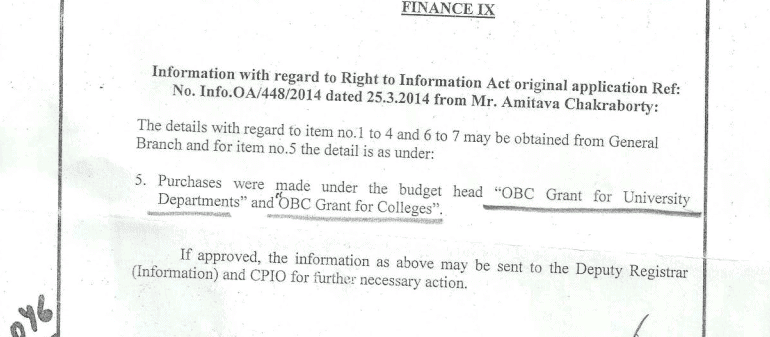
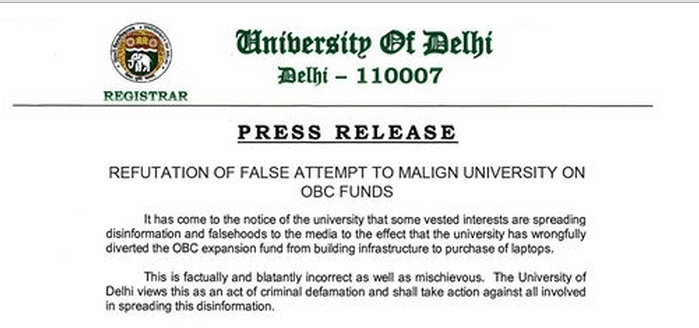
Joint Secretary Raju Rawat and DU teacher Amitav Chakraborty in March this year, the Four Year Undergraduate Program once again came under the scrutiny of the media and organisations like DUTA. The RTI consisted of 7 points including questions regarding the exact number of laptops purchased to be distributed to the FYUP students, the name of the tender finalised for the purchases, and the Budget Head under which the funds for the laptops were taken from. A copy of the RTI can be seen here. The response to the RTI (which can be viewed here) stated that the 62,600 laptops (60,000 for students, 1350 for students of EOC and 1250 for teachers) had been purchased under the Budget Head ‘OBC Grant for University Departments’ and ‘OBC Grants for colleges’. With each laptop costing Rs. 27,565.50 under the MRP, that amounts to a total of Rs. 1,72,56,00,300. The University has since then received flack for apparent misappropriation of funds in order to propagate the FYUP. In a Press Release and letters written to various media houses and newspapers, DU Registrar Alka Sharma pointed out that the OBC Expansion Grant, as declared in 2008, had been allotted for infrastructural facilities, non salary expenditures, IT infrastructure and equipment, and hence the purchase of laptops under it can be termed as ‘legitimate activity’. PRDU Organisations like the Democratic Teacher’s Front and DUTA, have however, have issues statements saying that the allocation of funds from the OBC Grant towards the FYUP laptops still counts as ‘diversion’, because the infrastructural facilities it was meant to be used for “construction of IT-enabled large-sized classrooms, extra Science laboratories and lab equipment, Computer Labs, furniture and faculty rooms”, which the University did not follow, especially last year, which led to infrastructure related problems for the FYUP students.]]>

Delhi University Teachers Union (DUTA) and other prestigious research and teaching communities of Universities across Delhi have created a list of “Demands” which they feel are urgently required to be met.This jointly prepared formal agenda has been prepared so that various political parties contesting for the Lok Sabha elections, understand the shortcomings of the current education system in the country and act upon it immediately.

The 3 page formal agenda describes key demands like democratising the education system (giving a voice to all stakeholders like teachers, students professionals) rather than limiting the decision making bodies like the AC, EC and Staff Council within a small group of people who are generally not from an academic background, a public expenditure of 6% of the GDP for Public Education as was suggested by the Kothari Commission in 1964, reduction of bureaucratisation and privatization of education.

The agenda also reiterates DUTA’s struggles against FYUP and states how large scale academic restructuring like Delhi University’s  Four Year Undergraduate Programme which was introduced hastily without honouring democratic procedures has the potential to cause more harm than good.

The weak leadership provided by the VC, Principals and Directors whose appointments are influenced by political and money power have also been criticised in the agenda as an inhibitor to quality education.

Some key points of the list of demands include:

a) States should not abdicate their responsibility to the people and concentrate more on public education.

b) The immediate implementation of the recommendation of  247th Joint Parliamentary Committee of MHRD which incites that the ‘paradigm of efficient governance’ be changed to the ‘paradigm of democratisation’ of decision making process of all stakeholders.

c) Minimisation of the role of MHRD, State Bureaucracy and UGC in the functioning of higher education.

d) Contractualisation should be discontinued, and the lack of posts lying vacant should immediately be filled.

e) The recent Debilitating experiments in DU be halted.

 On speaking to Abha Dev Habib, a DUTA representative about the possibility of DUTA meeting with members of political parties, she said that the organisation had done so on the 18th of February, earlier this year, when a large number of MPs joined the protest against the FYUP led by students and teachers. She also spoke about DUTA’s plans to address the new government that will be formed post the upcoming elections.]]>

Delhi University Teachers’ Association (DUTA) conducted their cultural protest, Jashn-e-Azadi, on 27th March in front of the Kirori Mal College hostel gate against the rising instances of ‘totalitarian misgovernance’ by the University authorities. The stage was opened by a speech by DUTA president, Nandita Narain, who called out the authorities on the recent passage of the code of conduct which, she said, is meant to crush any dissenting voice in the university. She also pointed out the one-year MA course will only lead to further degradation of the academic standards of the university, which is already reeling under the affects of Four Year Undergraduate Programme (FYUP). Other points of concerns were FYUP itself, the second term of office of the VC and immediate filling of vacant posts in the faculty.

Artists followed her speech with their own forms of protests on stage. While former Indian Ocean member Sushmit Sen performed with his band, Sushmit Sen Chronicles, belling out one fusion number after another, folk artist Ratan Gambhir talked about the increasing commercialisation of education. Narain brought the evening to an end by again calling out for the urgent need to group and protest against the increasingly draconian nature of the university governance. She said that culture is one of the sharpest ways of protest and Jashn-e-Azadi was only one in a line of similar events, pointing to the cricket match which was played after the protest march on 14th February. She ended by saying, “Jab jab andhakar ka samay ayega, tab tab hum andhakar key bare mein bolengein, gaayengein”.

Featured Image Credit: Iresh Gupta for DU Beat

th, Delhi University’s Executive Council accepted the proposal to amend the Statute 11-F (4) of the Statutes of the University, where it has been proposed that now the Vice-Chancellor would be eligible to seek a second term. Earlier the statute mentioned that the Vice-Chancellor’s term can only be extended for a year at maximum at the recommendation of the Visitor i.e. the President of India. In 2009, the HRD Ministry wrote to all central universities to create a provision of seeking second terms for VCs when VCs of only 7 Central Universities could serve for a second term. The heads of the remaining CUs including DU and JNU were eligible for a single term only. This matter came up for discussion by the Executive Council of Delhi University this week. Former DUTA president and chairperson of AAD, Aditya Narayan Mishra said,” I am not opposed to any individual but on a matter of principles I believe that a five year term is a good enough to provide academic leadership to any institution. The VC as of now will only get to avail the right to stand for second term but all the procedure for electing the VC would take place according to the set guidelines.” The decision has received tough opposition and resentment by many teachers calling the day as ‘black day in the history of Delhi University’.’The V.C presiding over the meeting with an agenda that is going to be beneficial to him is very improper. It is not a good idea to perpetuate one person and not good for the University. It is against the wisdom of the parliament and the Delhi University Act and only for one person’s benefit”, said Nandita Narain, President of Delhi University’s Teacher’s Association (DUTA). With the latest amendments, the VC now has the authority to make a search committee for the next person to hold office, which would constitute three members. It would allow the Vice Chancellor to nominate two out of the three members. The visitor, who is the President of India, will recommend the remaining name. “The E.C members are a bunch of yes-men to the VC who could be manipulated by threats and scares of being targeting in hundreds of ways. This is constitutionally undemocratic when principals and Executive Council members are targeted”, said Narain. “There is a huge conflict of interest within the statute itself as only one clause of re-appointment is amended without amending the clause for setting up the search committee where the outcome can be easily influenced by the VC.  A nexus can set in and the VC is sending out a signal, ‘I may continue so you better behave yourself’. I want to say that movement can’t be curbed and it will continue in all possible ways which we can think of in spite of the demoralising signals the VC is sending out”, said Abha Dev Habib, an E.C member and an Assistant Professor at Miranda House, Delhi University. The professional code of ethics for teachers as approved by the Executive Council is an exhaustive set of guidelines created by UGC in 2010 that describes the ideal code of conduct for higher education teachers. The Code of Professional Ethics makes “violations” punishable that has emerged as a cause of alarm where it mentions that “If the circumstances so warrant, the Vice Chancellor may direct the governing body of the college to initiate action against a teacher on the grounds of misconduct, failing which the Vice Chancellor may take such action as provided for in the Act, statutes and ordinances of the university.” “He has enlarged the scope of what is called‘misconduct’. He has given himself the power to take direct action against any teacher even if governing body doesn’t agree. He wants to crush any kind of dissent on the syllabi and conduct of teachers. He is ‘all in all’ which is very draconian and like being back to the period of Hitler in 1939”, said Nandita Narain on the amendments to the ordinances. Image Credit: Parandeep Goswami]]>