Bihar Governor’s directive mandating “five hours of daily teaching” for university faculty has triggered sharp backlash, with FUTAB and DUTA contesting the interpretation of UGC norms.
The Bihar Governor’s recent directive mandating ‘five hours of daily teaching” for all University faculty in the state has sparked protests. The Federation of University Teachers’ Associations of Bihar (FUTAB) has launched a formal protest against the directive, claiming it to be in violation of the University Grants Commission (UGC) 2018 norms. The 2018 regulations set forth a national standard for appointment and workload of teachers.
The Delhi University Teachers’ Association (DUTA) has also joined the pushback, penning a letter to the Governor-cum-Chancellor Syed Ata Hasnain to withdraw the controversial order.
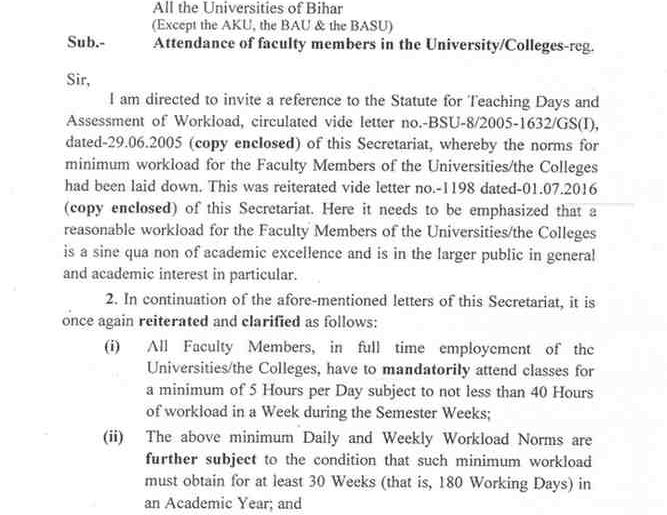
The directive was sent to all vice chancellors of universities/colleges in the state on 7th April 2026, via Kalpana Srivastava, the Officer on Special Duty (OSD-Judicial). The notice mandates all faculty members in employment of the universities to “attend classes for a minimum of 5 hours per day….not less than 40 hours of workload in a week.” The notice further states the UGC Workload norms to be the basis of the directive.
The main point of contention was the interpretation of the ‘five hour rule’. The teachers’ body contested that the norms define the five-hour rule as “stay-in hours” and not “direct teaching hours”. FUTAB president Kanhaiya Bahadur and general secretary Sanjay Kumar contested the directive in a letter to the Governor’s Secretariat, dated 13th April. They argued that the norms merely require the physical presence of faculty in college for five hours per day, and not direct teaching.
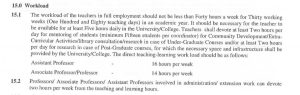
The UGC regulations set down a workload of 40 hours per week across a minimum of 30 working weeks per year. Teachers must be available for at least five hours daily at the university/college. Teachers are also asked to dedicate two hours a day to mentoring students. The guidelines also describe explicitly the limit for the number of direct teaching and learning hours allowed for faculty. No more than 14 hours a week is allowed for Professors and Associate Professors, and 16 hours for Assistant Professors.
The letter from FUTAB noted that this distinction between “stay hours” and “teaching hours” was previously clarified by the Ministry in the Rajya Sabha and through official press releases in 2016, as reported by The Indian Express. “A teacher stays for five hours, but teaches for the specific hours allotted by rank,” the letter stated.
The teachers’ body has threatened intensified protests if the order is not withdrawn soon. In a statement with The Indian Express, president Kanhaiya Bahadur shared “We have written to the UGC to provide a fresh clarification. If Raj Bhavan does not withdraw the letter within a month, we will escalate our agitation.”
A spokesperson for the Bihar Governor’s Secretariat announced that the matter is under review. “The Governor is looking into the issue. We will examine the legal and practical aspects of the letter issued by the OSD (Judicial),” the official said.
Image Source: Governor of Bihar (Official Website)
Read Also: Delhi University Revises UG Exam Timetable, Sunday Papers Added for NEP Students
Anjali Paruvu


Trending