NTA cancels the earlier NEET examination amidst leak allegations, prompting sharp reactions from student bodies over growing institutional mismanagement and uncertainty.
On May 12th, the National Testing Agency announced that the NEET UG Examination, which took place on 3rd May 2026 and is a crucial exam for medical aspirants across the country, stands cancelled. This decision was made after an alleged leak of questions was detected, despite there being heightened security measures across test centres in the country, according to the NTA.
This year, more than 22 lakh students appeared for the NEET examination which came under scrutiny after claims surfaced that a “guess paper” circulated before the test closely matched several actual questions, particularly in certain areas of Rajasthan and Uttarakhand, according to a report by NDTV. The NTA then acknowledged complaints regarding possible malpractice, and the matter was soon referred to investigative authorities. The controversy intensified after the Rajasthan Police Special Operations Group reportedly found significant similarities between the circulated material and the examination paper, prompting nationwide concern over the credibility of the medical entrance test. Growing public outrage and mounting pressure eventually led the NTA, on May 12th, to cancel NEET UG 2026 and announce a fresh examination. Multiple detentions have already been made regarding the matter in Rajasthan, with over 45 people under scrutiny.
This situation not only raises questions about the competence of the NTA itself, but also puts the futures of students on the line. The examination had integrated GPS-tracked movement of question papers, biometric verification, AI-assisted CCTV monitoring and deployment of 5G jammers in test centres across the country this year. In conversation with DU Beat, a medical aspirant who attempted the examination for the first time earlier this month, said,
“I feel that this is likely NTA’s greatest screw-up because this is not the first time this has happened, 2024 being the biggest example. It’s just so disappointing to see this happening despite the NTA having three years to learn from their mistakes. Giving a retest like this is basically just toying with people’s futures and their lives. Many might say that this is an opportunity to improve ranks or marks, but it’s not just about that second chance; this is about those who have given years to this three-hour exam just for it to get cancelled because of a leak. It really questions the NTA’s integrity and the security of conducting these examinations.”
For many students, the cancellation implies restarting preparation with added emotional distress and travel costs for those aspirants living in rural areas. For those who have taken several drop years in hopes of clearing the examination, this may just lead to another year wasted with no fault of their own.
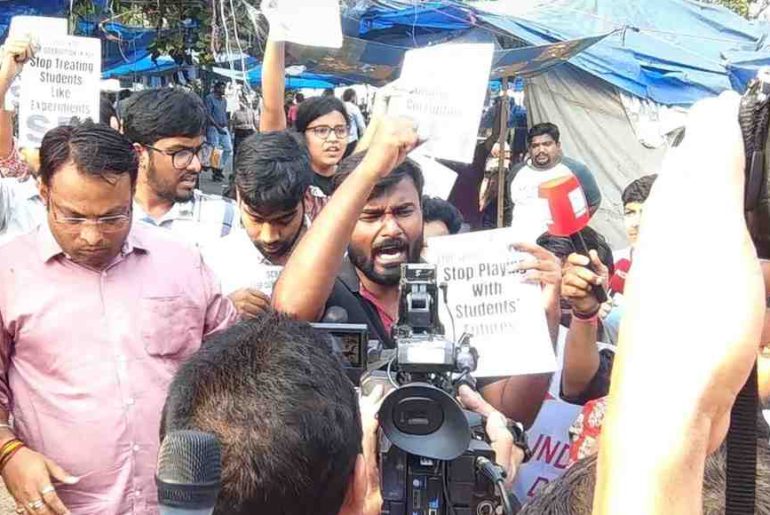
Soon after the cancellation was announced, members of the National Students’ Union of India (NSUI) took to the streets outside the Education Ministry in Delhi under the leadership of NSUI National President Vinod Jakhar. They demanded the resignation of Union Education Minister Dharmendra Patel, who refused to take any questions from the media, according to many news channels, and also to ban the “corrupt NTA”. ABVP and AISA also released official statements on their social media regarding the matter. SFI activists were even “brutally detained” during the peaceful procession outside the Shastri Bhawan, which included the SFI All India President Adarsh M Saji, All India Joint Secretary Aishe Ghosh and Delhi State President Sooraj Elamon. They wrote, “NTA has proven its inefficiency over the years and the NDA government hasn’t moved a finger. It proves the nexus between the coaching mafia and the government agencies.”
Evidently, the student body at large is outraged over this controversy. However, the NTA has given some official instructions regarding the re-examination. They have mentioned that the new examination dates and reissued admit cards will be communicated through official channels in the coming days, the matter having been referred to the Central Bureau of Investigation (CBI). Also, no fresh registration or fee will be required; the data from the earlier examination will be carried forward to the re-conducted one. This crisis also comes at a time when educational institutional failure is already at large, considering the uncertainty surrounding semester examination timetables within the Delhi University administration itself.
Earlier today, the Federation of All India Medical Association (FAIMA) also moved to the Supreme Court regarding the matter, seeking to replace the NTA with a “more robust, technologically advanced and autonomous body.” The plea demands the formation of a “High-Powered Monitoring Committee” to conduct the NEET UG re-examination of this year until the new body is formed, as well as a shift to Computer Based Test (CBT) mode and the release of results of the cancelled examination to detect anomalies. This committee is proposed to be chaired by a retired Supreme Court judge, a cybersecurity expert and a forensic scientist.
Image source: @sfidelhi on Instagram
Read Also: Delhi University Revises UG Exam Timetable, Sunday Papers Added for NEP Students
Manya Marwah




Trending