Author

DU Beat

Browsing

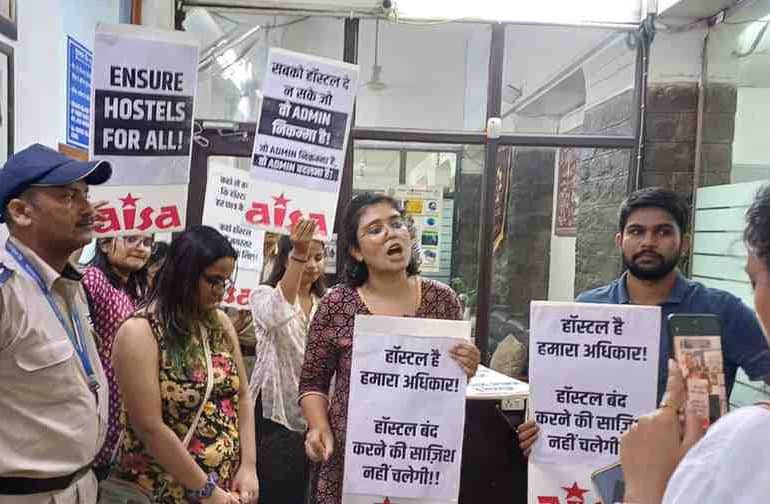
A protest organised by AISA student body took place today, on 31st July, 2025, at Ramjas College’s front gate, as the college shuts down all admissions for both of its hostels with the start of the 2025-26 academic session. 

On 30th July 2025, Ramjas College issued a notice informing students that the hostel would not be accepting admissions for the academic year 2025-2026. The notice mentions the building being under a structural stability test as the main reason for the hostel shutdown. As a response, a student protest organized by All India Students’ Association (AISA) took place today, i.e., on 31st July, 2025, at Ramjas College’s front gate from 2 pm onwards, resisting this shutdown and demanding hostel rights for all students. The students called out the action for adding to the increasing inaccessibility of affordable accommodation in DU, a move that furthers the exclusion of marginalised students.

The hostels accommodated 210 people every year and had a specific number of seats available for the reserved category students (SC/ST, physically challenged, sports persons, foreign students, etc.) to occupy.

With PG and flat rates in North Campus skyrocketing, Anjali, a Delhi University student and representative of the All India Students’ Association (AISA), says:

This model is pushing students toward unaffordable private accommodations and chipping away at the public character of DU. With lakhs of students arriving from across India, hostels are not a luxury; they are a right. We will fight tooth and nail to defend that right for all.”

She also explains how this isn’t just an isolated event but a visible pattern for exclusion:

What’s happening at Ramjas is not new; it’s part of a disturbing pattern across Delhi University. Hindu College Boys’ Hostel has remained shut since the lockdown. KMC dismantled seat allocations for PG students. And now Ramjas has shut down both hostels just as freshers arrive.”

Hindu College’s Boys Hostel is being demolished and rebuilt with the promise to accommodate more students since 2023. LSR College hostel has also remained closed for “maintenance reasons” since March of 2023.

Anjali further talks about how, despite having space for building affordable hostels for students, the university land is being used for private constructions:

This is a strategic move to exclude students from marginalised backgrounds. AISA has long fought for student accommodation. Back in 2016, we launched the “Room of My Own” campaign and submitted a list of vacant DU-owned land that could be used to construct hostels. Yet in 2019, a 39-story private building was being made on university land in front of Vishwavidyalaya metro.”

While the hostels are aged and rundown, it is the responsibility of the university, according to the UGC guidelines, to ensure that students from all sections of society studying here have affordable and safe living situations. The decision to close down the hostel directly contradicts this mandate. 

With multiple college hostels currently non-operational, concerns over affordable and inclusive student housing remain unaddressed.

Read also: Legal proceedings initiated against Ramjas College Professor accused of Sexual Assault; POCSO Act invoked

Image Credits: AISA 


Gaurika Bahl
[email protected]

Delhi University introduces greater flexibility in minor subject selection under UGCF, removing GE paper restrictions to promote interdisciplinary learning and ease progression to postgraduate studies.


In a significant academic reform aligned with the principles of the National Education Policy (NEP) 2020, Delhi University (DU) has announced greater flexibility for undergraduate students in choosing their minor disciplines under the Undergraduate Curriculum Framework (UGCF). The university released a notification on Tuesday making it clear that students will no longer be required to opt for specific General Elective (GE) papers in order to pursue a particular subject as a minor.

Until now, students aiming to take up a subject as a minor had to select related GE papers in earlier semesters. This often restricted academic freedom, particularly for those wishing to explore disciplines outside their primary area of study. The latest move by DU removes this limitation, thus widening the scope for interdisciplinary education. According to the official notification, the minor can now be chosen independent of the GE papers taken earlier. This change is expected to benefit students who are aiming for postgraduate studies in fields apart from their major, as it will now be easier to qualify for diverse academic paths without being confined by past elective choices.

A senior university official explained that the structure was originally implemented to uphold academic standards and ensure that students had sufficient subject familiarity before applying for postgraduate programs.

This reform is part of a broader shift in Indian higher education policy. The University Grants Commission (UGC) recently introduced new guidelines that promote flexibility and student autonomy in selecting both undergraduate and postgraduate programs. The 2025 UGC reforms have made it clear that any student, regardless of their academic background, can pursue a postgraduate course in any discipline, provided they clear the requisite entrance examination. In this context, Delhi University’s step appears both timely and in alignment with national academic trends.


For students, the revised policy means greater agency in shaping their academic trajectory. A student majoring in political science, for instance, can now opt for a minor in economics or philosophy without having taken prior GE papers in those disciplines. However, sceptics believe that this will result in a non-proficient academic career. A student who would obtain a minor in a non-parent subject would not be acquainted with this discipline well enough. Having studied GE papers of one subject would at least instill a sense of familiarity with the discipline. 


Read also : NEP Approves Research Supervision for NEP-UGCF Amidst Concerns on Implementation


Feature Image source-  Telegraph India 


Madhav Choudhary 

[email protected]

As August nears, the three-decade-old NAAC gradation system is being revised into a completely digital, more transparent and most importantly, simpler model. 

Replacing the old framework of seven-point rating scales, institutions will now be marked only as either ‘Accredited’ or ‘Not Accredited’. The AI-based model will also have a more advanced maturity-based graded system.

In a conversation with NDTV, Professor Sahasrabudhe said that: 

Until now, only 40 per cent of Indian universities and 18 per cent of colleges are accredited. With this reform, we target over 90 per cent of higher education institutions across the country in the next five years to come forward and get accredited. The earlier model assessed nearly 90 parameters, with 70 per cent supported by documented proof and 30 per cent evaluated through peer team visits. However, the visits often led to complications and concerns over credibility. 

Thus, the revised model will essentially eliminate the need for physical visits for basic level assessments, and Institutions will be rated on credibility score and progressive evaluation levels. 

A rotating panel of 100 stakeholders – including faculty, former vice-chancellors, industry professionals, and NGO representatives will be in charge of reviewing these documents. Each institute will start with a basic score of 0.5, and this will further progress based on the submitted documents. False submissions will result in a three-year ban from seeking accreditation.

Initially, the fear of not getting a good grade in the existing system had put off hundreds of institutions from applying for accreditation in the past, as reported by the Indian Express. Under the revised system, foreign institutions seeking to set up their campuses in India will also be eligible for NAAC accreditation. It will reportedly set a new standard measure for the stamp of guarantee of quality education. The existing five-year-longfive-year long process is also brought down to just three years.

Professor Sahasrabudhe further added that:

Those who get the accreditation can next opt for Maturity-Based Graded Accreditation with five levels set to be introduced, ranging between Level 1 and Level 5. Colleges and universities can keep upgrading themselves with one level after another. Level-1 and Level-2 are relatively easy to get and can be obtained online. Level-3 will be a hybrid one with online and field visits to the institute by the NAAC team.   

Though an institute already offering high-quality education can directly apply to a higher level, skipping the need to follow this long process. Level-4 and Level-5 will be extremely difficult to obtain and have stringent qualifying criteria. The latter will only be awarded to institutions offering education on par with international standards, Sahasrabudhe added in his address. 

Read Also: DU Aims to Tighten Anti-Ragging Protocols Ahead of Academic Year

Image Credits: DU Beat

Shreya Bhushan 

[email protected]

Delhi University has introduced stringent anti-ragging measures, including mandatory declarations, awareness campaigns, patrols, mentorship, grievance platforms, and control rooms, ensuring safety and smooth induction of new students.

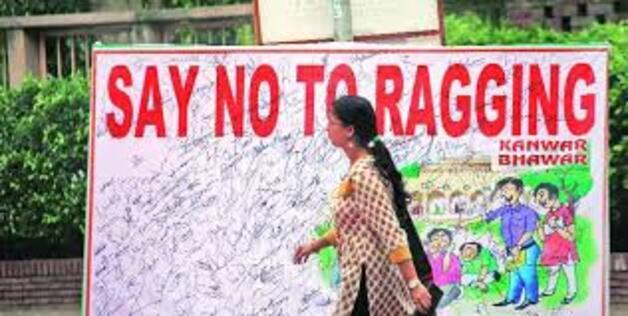
A meeting of the Proctorial Board, held on Monday, finalised the introduction of new measures to Delhi University’s anti-ragging policy, ensuring a strict and robust stance against ragging across institutions to facilitate the smooth induction of the newly admitted students.

As opposed to the earlier approach of restricting surveillance to “sensitive areas”, the revised policy seeks to reach as many areas as possible.  Additionally, the new policy includes the integration of technology through the use of online portals, Delhi Police and the Anti Ragging App.  

All newly admitted students and their parents/guardians are required to submit an anti-ragging declaration through the national portal, www.antiragging.in. This mandate follows the directions of the Hon’ble Supreme Court to combat ragging in educational institutions under the recommendations of the Raghavan Committee. 

Anti Ragging Week
Under the UGC guidelines, DU will observe Anti-Ragging Day on 12 August, with an entire week dedicated to anti-ragging awareness campaigns and discussions from 12 August to 18 August, in both Hindi and English.

Anti-Ragging Committee and Vigilance Squads
Colleges and requisite hostels have been made to restrict outsider access. There is a proposal for the formation of an Anti-Ragging Committee and Vigilance Squads with the help of students from the National Social Service and National Cadet Corps.

Police Surveillance
Regular patrolling will be conducted outside key campus areas, especially in women’s colleges. Using vehicles like Vamika, Delhi Police has ensured that plainclothed female officers will be present within and outside college campuses to prevent any sort of harassment against female students.

PG Verification
Students opting for paying guest accommodations, which has become extremely common, have been advised to verify their PGs with local police authorities to caution them from any exploitative practices in their accommodations.

Mentorship System
The university has rolled out a mentorship system where new students will be paired with faculty mentors outside their academic departments. An official in conversation with the Times of India stated that:

These mentors are expected to help new students navigate personal and emotional challenges that often come with the transition.” 

Control Rooms
For instances of emergency, two control rooms, one each on the North and South Campus, are operable,  from 1 August to 8 August. The numbers for the control rooms are:

                      • North Campus: 27667221
                      • South Campus: 24119832 

An online platform will be launched for grievance redressal,  which will also include a referral process for cybercrimes related to ragging. All institutional authorities are required to submit weekly compliance reports during the first three months of the academic year, followed by monthly reports to the University Proctor at [email protected].

Students have been asked to install both the UGC anti-ragging app and the Delhi Police’s Himmat app. The University of Delhi, in collaboration with  Delhi Police, has committed to ensuring an effective implementation of anti-ragging measures across all campuses.

Read Also-Unlawful Detentions, Custodial Torture. Delhi Police Faces Scrutiny Over Crackdown on Student Activists

Featured Image Credits: Yaksh Handa for DU Beat

Divyanshi Dusad

[email protected]


Delhi University’s School of Open Learning has introduced a new class schedule, according to which students will now have classes on regular weekdays along with already existing weekend classes. This new system aims to accommodate the large number of SOL students.

The School of Open Learning at Delhi University, which previously held classes only on Sundays, has now decided to extend the number of classes for its students. Students at SOL will now attend classes on regular weekdays from Mondays to Saturdays, starting from the first week of September in the 2025–2026 session. The reason behind this big step, according to SOL officials, is to accommodate the rising number of students enrolling in SOL courses every year, which leads to overcrowded classrooms, commotion, and limitation of resources. To rectify this very concern, a new two-shift system is going to be introduced, running from 8:30 am to 12:30 pm, followed by an afternoon shift which will be held from 1:30 to 5:30 pm.


An official, in conversation with The Times of India, said,

The addition of weekday sessions offers greater flexibility to students. They can choose to attend classes on weekdays, Sundays, or both, according to their preference.” This majorly becomes relevant after the enrolment of 1.3 lakh students at SOL yearly, with increasing admission rates.”


Another addition to managing the rising number of students is the construction of a new four-storey building at the Tahirpur site, which is inclusive of a lift and 30 classrooms, also allowing 40 more classrooms to be constructed with it soon. The Tahirpur campus is the major campus for SOL examinations, and it will now also be utilised for regular classes. This new development is keen on better education and enhancement of SOL students. However, students enrolling in SOL for balancing work and education or other responsibilities might face challenges after the new regulation. “Having weekday classes will fundamentally change the aim of SOL, which was to provide education to people who are working,” said a professor from Delhi University.

Read also : Delhi University Issues Final Notice for CW Category Admissions for 2025-26  

Featured image credit : Devesh for DU Beat

Umang

[email protected]


Delhi University to release CSAS-UG 2025 second seat allotment today at 5 PM. Major reshuffling expected as thousands seek upgrades.

The University of Delhi (DU) will release the second round of undergraduate seat allotments today, July 28, at 5 PM, as part of its ongoing centralised admission process for the 2025-26 academic session under the Common Seat Allocation System (CSAS-UG). Candidates who applied in the second round can check the allotment list on the official website once it is published.

Ahead of this round, the university had published a list of vacant seats, allowing candidates to re-arrange their preferences between 5 PM on July 24 and 4:59 PM on July 25.

This round of allocations is expected to reflect significant internal reshuffling. While 16,126 candidates chose to freeze their seats after the first round, a majority of 43,741 students opted for upgrades. These students are now awaiting the second list, hoping to move to their preferred colleges or programmes. The updated allotment will reflect these changes, offering candidates another opportunity to secure a seat based on merit and availability of seats.

According to the official schedule, once the second allotment list is released, candidates must accept their seats online between 5 PM on July 28 and 4:59 PM on July 30. Colleges will then verify and approve the online applications by July 31.

To confirm admission, students must pay the requisite fee through the online portal by 4:59 PM on August 1. Failure to do so may result in the cancellation of the allotted seat. 

Additional rounds of seat allotment may be conducted by the university if vacant seats remain. 


Image Credits: Devesh for DU Beat

Neeraja Unnikrishnan
[email protected] 

Also Read: Few Days to Reopen, Still No Syllabi: What’s Happening at DU?

With just days before reopening, students and teachers remain in the dark, syllabi remain unnotified, decision-making bypasses experts, and institutional autonomy is under threat.

With less than two weeks to go before Delhi University reopens, teachers and council members are raising concerns over the rushed, unclear rollout of the NEP. The University is set to introduce over 82 postgraduate courses under the new PGCF and begin the fourth year of the UGCF for the first time. But shockingly, the syllabi for these new courses haven’t even been notified yet.

Associate Professor of  Physics at Miranda House Abha Dev Habib, and also Secretary of the Democratic Teachers’ Front, posted a detailed statement on Facebook titled “Killing a University!.” She wrote,

Courseworks and syllabi for the UGCF courses for semester VII and VIII, which concern over 60,000 students have not been notified even as these were passed by the EC of 23 May and 12 July 2025. Without information on time, how labs will be prepared or students informed of Elective papers or teachers will prepare for new courses, nothing concerns the University anymore,”

Dr. Mithuraaj Dhusiya, elected member of DU’s Executive Council, shares the same alarm.

DU is still not prepared for the 4th year NEP-UGCF in terms of infrastructure, manpower and academic syllabus. It is extremely shocking that both students and teachers don’t know yet what they would be studying or teaching in the 4th year,”

And such problems go beyond syllabus interference as Rudrashish Chakraborty, an Associate Professor at Kirori Mal College and an elected member of the DUTA Executive says,

The colleges are looking at a situation where theoretically there is a potential increase of 33% students in the institutions with no promise of extra funds. This is a very well-planned effort to dismantle the largest public-funded University in the country”

What’s most alarming is that recent syllabus changes aren’t coming from within departments, but are being imposed by people with no expertise in the subjects, highlighted by Professor Rudrashish Chakraborty:

These outsiders are neither experts nor even belong to the subjects concerned, they act as paratroopers in Standing Committee meetings at the behest of the University administration.” He points out that academic decisions are being overridden, and “no self-respecting academic is allowed to survive in the University of Delhi without compromising on his/her academic integrity.” Referring to the resignation of the Head of the History department,

Abha Dev Habib warns,

Committees have been set up to dictate terms on syllabi already passed by AC-EC. This is unconstitutional and is the result of excessive interference by BJP-RSS.”

Media coverage in recent months has highlighted growing concern among faculty over DU’s readiness to implement NEP-based curriculum. According to India Today, faculty members have also raised alarm about rising teaching loads. Faculty members are expected to engage in 40 hours of work weekly, yet there has been no new staff recruitment. Abha Dev Habib told India Today Education, “The UGC regulations, 2018, clearly specify 14–16 teaching hours. Forcing teachers beyond that violates norms,”

With only days remaining before the university reopens, the situation remains uncertain for thousands of students and their professors alike.

Read Also: Uncertainty Shadows The Fourth Year of Delhi University’s NEP Rollout.

Image credit:  Arush for DU Beat


Juhi Bansal

[email protected]

The court upholds compulsory retirement of the assistant professor in 2018 sexual harassment case, affirming ICC’s findings.

The Delhi High Court has upheld the compulsory retirement of an Assistant Professor at Delhi University’s Bharati College, following multiple allegations of sexual harassment by students. In a strongly worded judgment, Justice Subramonium Prasad dismissed the professor’s plea challenging the findings of the Internal Complaints Committee (ICC) and the disciplinary action taken by the college’s Governing Body. The Court described the professor’s conduct as “so profane” that it declined to reproduce the objectionable Facebook and WhatsApp messages in its order. 

The court observed- 

Teachers shape the career of young aspiring students for a better future. The act of sexual harassment done by these very teachers, who are considered as our guides and mentors, against young female students who have just attained majority, has a deleterious effect on the psyche of such students.”

Four complaints-three from current students and one from an alumna were filed in February 2018, alleging sexually explicit messages and inappropriate conduct by the professor via social media. The situation came to public attention when a video of students confronting the professor about his behaviour went viral, sparking protests and demands for action from the student body. In response, the professor was barred from entering the college campus and placed on leave. The matter was formally referred to the ICC in accordance with the Sexual Harassment of Women at Workplace (Prevention, Prohibition and Redressal) Act, 2013 (POSH Act) and relevant UGC regulations.

The ICC, after examining the documentary evidence, digital records, and oral testimonies, submitted its report on August 28, 2018. The Committee found all four charges of sexual harassment to be substantiated and concluded unanimously that the professor was guilty of misconduct. The evidence and testimony of the complainants, the Court observed, “remained unimpeached.” The inquiry process concluded in July 2018. The Court noted that the delay in finalizing the report after May 2018 was due solely to the conduct of the professor himself. Following the ICC’s recommendation, the college’s Governing Body issued a show-cause notice to the professor in October 2018, asking why the penalty of compulsory retirement should not be imposed. After granting him an opportunity for oral submissions, the Governing Body accepted the ICC’s findings and resolved to compulsorily retire him with immediate effect. This decision was subsequently approved by the Vice Chancellor. 

Before the High Court, the professor challenged the constitution of the ICC, the procedure followed during the inquiry, and the conclusions drawn by both the ICC and the Governing Body. He claimed that the authorities failed to uphold the principles of natural justice and that he had not been given a fair hearing. However, the Court found no merit in these claims. Justice Prasad held that the ICC and Enquiry Committee had been duly constituted under Rule 7(7) of the POSH Rules. The procedure adopted, the Court said, was not arbitrary or unreasonable but rather aligned with legal guidelines and regulations.

The Court also noted that the professor had been granted ample opportunity to present his defence and that the Executive Authority’s failure to issue a detailed speaking order did not amount to procedural prejudice. The principle of audi alteram partem that no one should be condemned unheard was not violated. With all issues decided against the petitioner, the Court dismissed the writ petition, upholding the disciplinary action taken by Delhi University and affirming the credibility of the ICC process.


Read also: Bharati College Student Harassed by a Professor

Feature image credits- DU Beat

Madhav Choudhary 

[email protected]

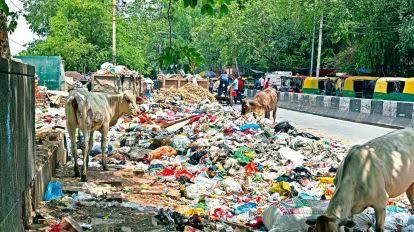
Delhi University noticed a hike in the amount of waste guarding the walls of college campuses, giving way to health and safety concerns.

With the monsoon in full swing, the waste crisis at Delhi University has only worsened, as clogged drains and stagnant rainwater exacerbate the already deteriorating conditions around campus walls. Piles of garbage and construction debris have increasingly lined the perimeter walls of colleges, especially Shaheed Bhagat Singh College in South Campus, raising serious health and safety concerns.

Waste, including rubble, household trash, and discarded furniture, is routinely dumped along the college’s boundary facing the main road. Despite efforts by the Municipal Corporation of Delhi (MCD), including clean-up drives and the recent installation of hidden CCTV cameras by the college, the situation has only worsened in recent months. Residents and local contractors continue to dispose of waste—often under the cover of night.

Rajinder Chauhan, a local snack vendor, in a conversation with Hindustan Times remarked:

MCD came around six weeks ago to clean this up, but it was half-hearted. The area wasn’t restored properly. People are still dumping trash here.

College Principal Arun Kumar Attree formally raised the issue with the MCD in a letter dated 21st November 2024, warning that the unhygienic conditions posed a threat to students, staff, and nearby residents. Student group ABVP also stepped in, with third-year BCom student Mohd Adnan Khan confirming a complaint had been filed, urging immediate intervention.

Neighbouring College of Vocational Studies (CVS) has reported slightly better conditions due to the presence of a garbage collection facility nearby. However, the issue persists across South Campus, particularly worsening during the monsoon season. 

Principal Attree believes the bulk of the dumping originates from surrounding areas such as Chirag Delhi and Sheikh Sarai. Chetan Sharma, Chairman of the Federation of GK-2 Complex RWA, noted that this reflects larger issues of irresponsible public behaviour and unchecked urban waste disposal.

On 10th July 2025, Delhi Chief Minister Rekha Gupta addressed the public, proudly highlighting the city’s improvement in flood management. She cited the absence of waterlogging at the historically flood-prone Minto Bridge as a sign of progress not seen in the past 27 years. However, this has sparked questions about the disparity in attention given to student-affiliated areas, which continue to suffer under neglect.

With the arrival of the new academic session just days away, urgent action is needed. Yet, no official response from the MCD has been recorded so far.

Read Also: Unlawful Detentions, Custodial Torture. Delhi Police Faces Scrutiny Over Crackdown on Student Activists

Featured Image Source: The Indian Express

Ananya Agarwal

[email protected]


The apex court on Friday issued pan-India guidelines to combat the ‘systemic failure’ caused by Educational Institutions in effectively coping with Suicide deaths across College campuses. What followed is a 15-rule guidebook for Educational Institutions to provide aid to students far away from home without academic or institutional support.

In light of the recent suicides on the college campuses, a bench comprising Justice Vikram Nath and Sadeep Mehta issued directives aimed at solving this crisis through fifteen binding guidelines for educational institutions in India, including colleges, universities, schools, and private coaching centers.

The judgement emerged during proceedings in a case involving the suicide of a 17-year-old NEET Aspirant from Andhra Pradesh who was staying at a hostel while preparing for a coaching in Visakhapatnam. After a plea in Andhra Pradesh’s High Court, the student’s kin appealed to the apex court, and as an extension, a CBI probe has been ordered to manage the crisis.

The directives issued are given below –

  1. All educational institutions shall adopt and implement a uniform mental health policy inspired by the MANODARPAN initiative and the National Suicide Prevention strategy. This will be a year-long exercise that will be updated regularly.
  2. Institutions with more than 100 students enrolled shall appoint one counsellor, psychologist, or social worker who is trained in adolescent mental health training. 
  3. An appropriate student-to-counsellor ratio should be maintained so that a smooth procedure can be available in stressful times, such as Examinations. 
  4. Institutions should refrain from any activity that will create a visible segregation of students based on their academic performance.
  5. All educational institutions should place immediate referrals, such as mental health service helplines or suicide prevention helplines. 
  6. All teaching and non-teaching staff shall undergo mandatory training at least twice a year, conducted by certified mental health professionals, on psychological first aid, identification of warning signs, response to self-harm, and referral mechanisms.
  7. All educational institutions should be equipped to engage with students from vulnerable communities. This includes, but is not limited to students belonging to the SC-ST community and the LGBTQ+ community, 
  8. All coaching hubs and big cities hosting aspirants such as Delhi, Jaipur, Kota, and Sikar, should involve higher authorities in developing a framework for monitoring the mental well-being of students.
  9. All residential-based institutions shall install tamper-proof ceiling fans or equivalent safety devices and shall restrict access to rooftops, balconies, and other high-risk areas to deter impulsive acts of self-harm.
  10. All educational Centres should provide career counselling services for students and parents alike, creating an awareness of unrealistic academic pressure and professional pathways.


This marks a sweeping opening gambit reflecting the immediate measures to curb the severe accidents of suicidal death occurring on college campuses. This move is inclusive of the right to life under Article 21 of the Constitution. The court ordered the setting up of a district-level committee under the chair-person of the District Management. The court clarified that:

We believe that these guidelines shall be read as complementary to the ongoing work of the National Task Force and would inform and assist the National Task Force in the development of a more comprehensive and inclusive framework.” 

The Court also pointed out that despite constitutional and international obligations, there remains a legislative and regulatory vacuum in the country concerning a unified, enforceable framework for suicide prevention of students in educational institutions, coaching centres, and student-centric environments. 

This initiative highlights the Judiciary’s outreach in serving the needs of students to effectively overcome the mental extremes they face, along with involving parents and educational institutions in a historic decision. 

What comes additional to this decision is an upper-hand provided by the judiciary in focusing on student-centric development, where more emphasis should be given on personality development and prioritizing extracurricular activities, expanding the horizon of students to explore themselves more, and actualizing the gravity of mental health issues, especially in adolescents, where the suicidal death is reported to be over 10,730 in 2021 according to the National Crime Records Bureau. 


Image Credits – Devesh for DU Beat

Kinjal Sharma
[email protected]

Read Also: Delhi University Issues Final Notice for CW Category Admissions for 2025-26.