
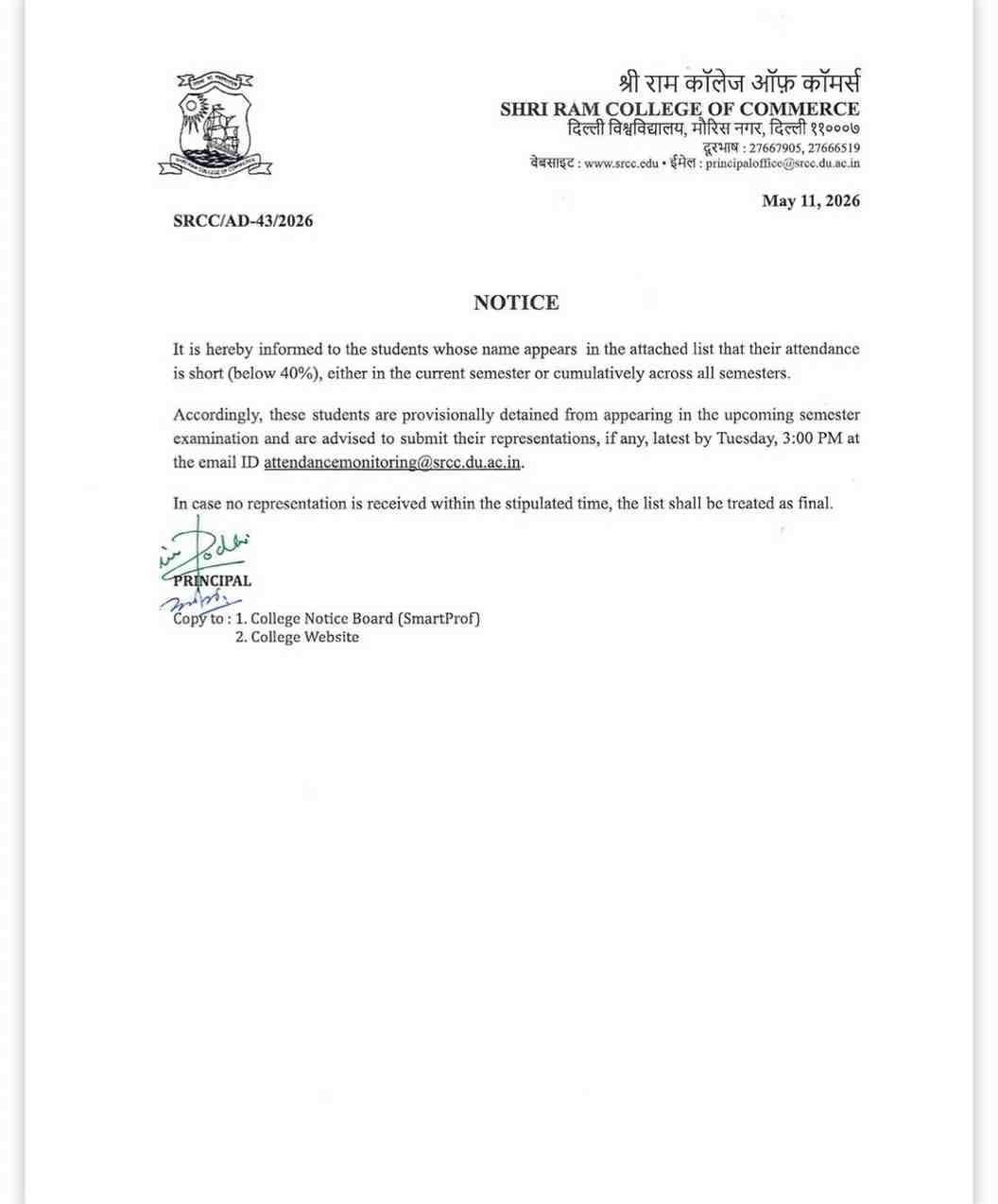
As Delhi University colleges detain students over attendance shortages, inconsistent implementation of Ordinance VII and varying relaxation policies across colleges have sparked confusion and scrutiny.
News of students being detained for failing to meet the minimum attendance criteria has been on the back burner for the past couple of weeks. Colleges evaluate students’ final attendance as the academic session comes to an end, with the end-of-semester examinations commencing shortly.
Recently, around 465 students of the Shaheed Rajguru College of Applied Sciences for Women were declared ineligible to appear for the upcoming end-of-semester examination cycle due to attendance shortage. Principal Dr Payal Maggo commented on the decision. “We will follow university rules, and students with less than 66.67 per cent attendance are not allowed to sit examinations.” The students were granted relief after the Delhi University Students’ Union (DUSU) president, Aryan Maan, submitted a plea letter, raising the issue. Shri Ram College of Commerce also released a provisional list of 82 students across all the batches who would be detained.
Lady Shri Ram College for Women adopted a different policy. In a notice by the attendance committee, the college allowed relaxation of the rules to students in semesters 6 and 8 while emphasising that it takes serious cognisance of the defaulters. Students in Semesters II and IV must, however, meet a 66.67% attendance requirement (including medical/ECA) or face paper-specific detentions. Those with less than 25% attendance are detained on two papers, while those between 25% and 40% are detained on one paper. Students with an attendance in the range 40%–66.67%, who were already short of attendance previously, are also detained in one paper, whereas first-time defaulters in this bracket may sit for exams by signing an undertaking to make up the deficiency.
A lot of discrepancies have been flagged out in the implementation of the prescribed attendance policy by the university in different colleges, and a lack of clarity regarding the same remains.
Ordinance VII mentions the university’s policy by stating that, to appear in any semester examination (I through VIII), a student must have attended at least two-thirds of all lectures, practicals, presentations, and tutorials combined. If a student’s attendance falls below 66.7% but is at least 40%, the principal has the discretion to allow them to sit for the exam. In odd semesters, students are allowed to sit under the discretion that they must make up the deficiency in the following semester of the same academic year. In even semesters, students must make up the deficiency by combining attendance from the previous semester. For students in their final semester (VI or VIII) seeking to exit with a degree, eligibility can be determined by calculating the combined attendance across all academic years to reach the two-thirds requirement.
Students can receive “deemed attendance” for periods of absence due to university-sanctioned activities or medical emergencies. The total benefit from medical exclusions cannot exceed 1/3 of the total lectures delivered in a semester.
The university provides significant discretionary power to colleges. The principal may permit a student to appear for an exam even if they haven’t met the 40% threshold, provided the principal believes the student will make up the deficiency in the succeeding academic year. Additionally, eligibility is also tied to satisfying the principal’s requirements for written or oral tests. A principal can detain a student if their performance in these tests is unsatisfactory, regardless of attendance. The principal also has the power to strike off the name of any student who is “grossly irregular” in attendance despite warnings.
Image source: SRCC Official Instagram (@srccofficials)
Read Also: NEET Cancelled: The Fate of Students amidst Institutional Chaos
Divyanshi Dusad
divyanshidusad@gmail.com


Comments are closed.