
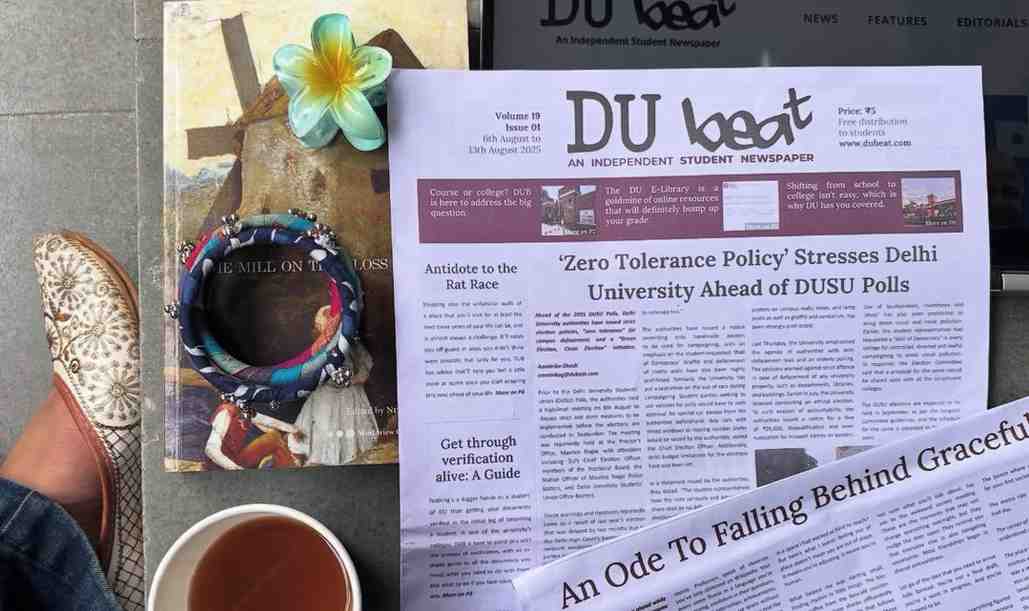
Where does the future of press lie? Does it even lie, or is it just another petrified reality waiting to become a manufactured myth?
A free press is said to be the fourth pillar of a democratic nation, or at least that was the norm. It is regarded widely as a highly potent part of a larger system of checks and balances that keep the nation tied together through politics, economics, justice and beyond. And it is the association of “free” with press that preserves it as a critical component especially at a turning moment in time like today where news is filtered for profitability and truth itself is accustomed to be molded like clay.
As a student journalist working for about a year now, in the limited time that I’ve found myself associated with this field, I’ve learned beyond the good-to-knows, that is, the way to stir up a headline or chase a story—the past months have pushed me to a larger realisation of what it truly means to listen, who gets to be heard, and what are the costs of speaking up.
India is a country of too many people from too many regions and too many diversities—here, too is to be regarded as liberating, as is the term “overpopulating” in overflowing our landscape with stories far more than the news channels or filmmakers can ever fully capture. ‘Untold stories’ in India thus becomes more than a buzzword but experiences lived and unheard, but yet a reality that finds itself limited again to the mainstream. In the ‘unhearing’ of such stories, what renders invisible is the people for whom it is not a story: those who are too marginal, too inconvenient, or worse, too disruptive to even be considered for Page 4, let alone front headlines.
Before I had the vocabulary for it, I had already felt patriarchy shape my world. Before I understood class, I had already encountered the sharp divide between those who have and those who do not. Yet, as an urban upper-caste individual, there also remains parts of my inherited identity that are silent; I just had the privilege to never notice or question them because they were stories I did not hear because I did not have to ever live through them. Journalism, at its best, breaks that silence.
I would like to believe that I have come of age at a time when the institution of journalism itself feels increasingly fragile by the passing day. This decline of the freedom of the press is not relatively new, but perhaps more visible to the eye of the common layman who continue to persist beyond the scholars, writers, journalists, and critics that have lived and died warning us about censorship, the corrosion of independent media, and the damage this does to the very ecology of democracy that journalism is meant to sustain. These warnings are not breaking news (pun intended), but the familiarity of such a warning may be part of the problem.
In conversations, I have found myself realising the unsettling reality that the risks of pursuing journalism often seem to outweigh the rewards: the best-paying positions frequently exist within systems that are deeply entangled with power and the ABCs of journalism are negotiated on the daily, unfortunately resulting in the death of the fourth pillar and a failure of what it truly stands to support. Yet in between the fading light, student journalism presents itself as something radically different: as something not yet entangled in the futile war between politics and spectacle.
I remember an ideation meeting we had for the DU Beat Print edition; I mentioned, almost apologetically, the opening of a new café on campus as the news tip of the week. It didn’t feel like “real news” to me, given what “real” had been ingrained into me, and it wasn’t until my editor responded with something that I realised that journalism, especially student journalism, is not only about documenting crises but also to function as an archival. It preserves the textures of everyday life, the clothes people wore, the food they ate, the spaces they gathered in, and the conversations they had. Journalism becomes a record of that very existence that tells future readers what happened, alongside how it felt to live through it.
In the brief and privileged opportunities that I’ve had to step into larger mainstream newsrooms, I’ve come to notice the behind the scenes of press production that positions itself as neutral, but is rarely unbiased. Behind every headline and breaking news, is a thorough process of filtration and of calculation: the economy of news, who funds it, who controls it, and most importantly who benefits from it. It is perhaps as ‘1984’ as it gets.
As we encounter days of what is meant to be a celebration such as International Press Freedom day, I instead find myself lingering in thoughts of the words edited out and the stories that are censored before the screens can ever house them. It is perhaps uncomfortable to think of how easily we scrutinise dissent and how quickly a protest is delegitimised, especially in student-led spaces where frequently power speaks louder than truth. But it is within such thoughts, and the questioning of such realities that possibility emerges: student journalism, independent media houses, and smaller platforms continue to carve out within the controlled mainstream such spaces of resistance even without the reach of resources. What they rely on though is by far the most important tool of journalism: the willingness to ask difficult questions and seek it answers.
Perhaps in reimagining the future of freedom, of truth, and of journalism in a landscape that silences, the Big 4 hides behind the smaller newsrooms, campus publications, independent newsletters, local reporting and spaces where journalism is still driven by curiosity instead of control. Question what you read and what is shown to you: interrogate and listen in between what is left unsaid. The strength of the fourth pillar does not only depend on those who build it but equally so on those who engage with it.
Read Also: Unclean Spaces and Neoliberal Urbanism: Graffiti as “Counterliteracy”
Image Credit: Aaratrika Ghosh for DU Beat
Anjali Kumari Jha
[email protected]

Comments are closed.