
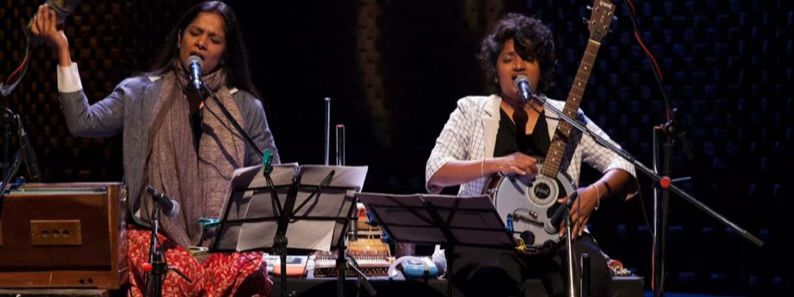
In this insightful conversation with DU Beat, artists M.D. Pallavi and Bindhumalini discuss Threshold—their collaborative project born from the 2017 “Under the Raintree” women’s festival—where music becomes a dialogue on gender, identity, and self-expression. Performing at the KNMA Music Festival, day 3 on October 11th, they explore women’s voices across time and culture. As they beautifully say, “a lamp on the doorsill sheds light both inside and outside”—a fitting metaphor for their art that bridges tradition and introspection.
DU Beat- You describe threshold as a musical conversation between two artists. First and foremost, how did this collaboration come about, and what does the idea of ‘Threshold’ mean to each one of you, especially in the context of music and your personal journeys?
Bindumalini – Threshold started with the specific women’s festival curated in Bangalore called the Under the Raintree Women’s Festival in 2017. Pallavi was asked by the main curator of this festival to curate the music section of this 3-day festival. The last day it was all about the duet. The curator had also put up a condition to Pallavi that apart from curating the whole festival, the music part, she also had to be one of the performers. That is when we collaborated for the first time, and Pallavi invited me, and our conversations could not be away from the context of women, which the whole festival was about, and from there, conversations started about gender and women. That’s the genesis of ‘Threshold’.
M.D. Pallavi: And Threshold, if I may continue with what Bindu said, there’s a poem that we picked from Lingama, who belonged to the 12th century, which talked about a lamp on the doorsill shedding light both inside and outside, and that’s what Sharana is also trying to achieve: to look both inside and outside. So that we thought was a very apt title for what we are also trying to do.
DU Beat- Gender is central to your performances. Could you share how your personal experience as women and artists influences the way you interpret or reimagine traditional or contemporary songs?
M.D. Pallavi- For a long time I was unaware about the lens of gender in my music or in the work that I was doing, but gradually, say in the last 15 years, I became more aware about the poetry of who it is written by, and I also became more aware over the years of how to see the delicate differences between the male and the female perspectives. And in this project we are particularly focusing on poems and songs written by women, and it has helped us understand in a way how different these poems are even though they are very similar to the ones written by men.
Bindhumalini: I would say in my house, it was my grandmother and mother who laid the path for me, and it was not like anybody was supporting them as such. My grandmother started her journey in music after the age of 45, and she saw in music an anchor which held her together through various aspects of life. So for me whatever I have received in terms of art from my house has been through women only. But as Pallavi said, even I was not told to look at things from a gendered way, from the lens of a woman as such. Slowly it started to come into my awareness, and then doing research and creating this project was an eye-opener in many senses.
DU Beat- So you are choosing the narratives and voices of women especially, which are unheard. How do you usually select these texts and poems, and when you started, how much time did it take to curate them?
MD Pallavi: Firstly, we started to look at stories of women who had sort of broken barriers in terms of music and came out into the world. And it could be about people lesser known or about people we knew but did not know about this side of them, and then we could also sort of just present them with the same text, similar kinds of poems, which disseminate the same ideas. We also try to draw parallels between songs and stories of women from different time periods and places. For example, will there be any similarities between the struggles of a woman from Morocco or a sex worker from Karnataka, or are there any parallels between La Ded in the 14th century saying something which is similar to what Mudupalini is saying in the 18th century in the court of Travancore? And we have a stone assembly found by researching for this.
DU Beat- I also wanted to know from both of you if you come from the same musical traditions or are trained in different musical traditions, and if yes, then how do you negotiate these differences in the musical vocabularies? Also, while performing together, do you seek to retain your individuality, or does that subsume itself under this larger project called ‘Threshold’?
Bindhumalini: Well, that’s interesting because, definitely, our individual trainings helped us in certain ways. At the same time, both of us are aware of the possibilities, the potentials and also the limitations. So if you see the threshold, a few things drive it. There is a Hindustani bandish that we perform, and in that case, if it’s a tradition-driven performance, then we try our best to do justice to that. But at the same time there is a complete freedom for self-expression, and mostly it is given by the energy that we establish and the emotion that we perform at that point. The third aspect is a bit tricky. We sometimes represent certain ethos of some musical traditions, but we are not really the practitioners of that at that specific moment, but we sing it, and in that moment it’s mostly us, but it may point at something. While we are being true to ourselves, at the same time we might also be hinting at something from which we are trying to draw it.
M.D. Pallavi- I would pretty much repeat what Bindu said. And the fact that both of us enjoyed doing experiments. And the fact that we both have learnt classical form, so there is a grammar that we both fall back on, but there are times when we are beginning the rules and presenting them, and then there are some points when we are being very loyal to our forms. And it is very difficult to find a collaborator who can co-conspire with you in all of this, and in that way we are both very lucky.
DU Beat – You will be performing at the KNMA Music Festival, and it is themed after ‘Voices of Diversity’. What does this diversity in music mean to you, and how do you see your work contributing to a larger dialogue about inclusivity in art?
M. D. Pallavi- When we talk of diversity, we need to see diversity of artists on stages, and a lot of the times what happens is that music festivals mostly repeat the same kind of artists. So I think it’s very important they look for diversity both in terms of performers and art. Also, while creating it, it is important to think of the experience one wants to give to the audience, and that’s why it’s also very important for festivals to be open to possibilities in terms of providing different experiences.
Bindhumalini: Let us take note of these curations mostly happening in the urban spaces, and the audience are also of a certain kind. My experience of diversity has definitely been in these kinds of spaces, but also what I have really enjoyed is when I had gone into rural India, and their diversity has a different shape. The experience is totally different when I go on yatras or in villages which are on the border of Rajasthan and Madhya Pradesh, and there are the kind of people who become your audience – from the children to the men and the women – and then it’s happening the whole night. Then there are local artists. That is what diversity looks like to me. I don’t know if this really answers the question, but I felt like sharing the experience.
Read Also- DU Beat in Conversation with Bhushan Kargaonkar, the Director of Lavani Ke Rang
Image credits- Banglore International Centre
Madhav Choudhary

Comments are closed.