
Tag

KNMA

Browsing

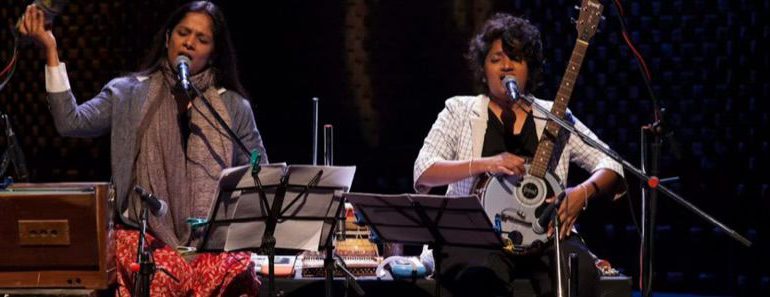
In this insightful conversation with DU Beat, artists M.D. Pallavi and Bindhumalini discuss Threshold—their collaborative project born from the 2017 “Under the Raintree” women’s festival—where music becomes a dialogue on gender, identity, and self-expression. Performing at the KNMA Music Festival, day 3 on October 11th, they explore women’s voices across time and culture. As they beautifully say, “a lamp on the doorsill sheds light both inside and outside”—a fitting metaphor for their art that bridges tradition and introspection.

DU Beat-  You describe threshold as a musical conversation between two artists. First and foremost, how did this collaboration come about, and what does the idea of ‘Threshold’ mean to each one of you, especially in the context of music and your personal journeys?

Bindumalini – Threshold started with the specific women’s festival curated in Bangalore called the Under the Raintree Women’s Festival in 2017. Pallavi was asked by the main curator of this festival to curate the music section of this 3-day festival. The last day it was all about the duet. The curator had also put up a condition to Pallavi that apart from curating the whole festival, the music part, she also had to be one of the performers. That is when we collaborated for the first time, and Pallavi invited me, and our conversations could not be away from the context of women, which the whole festival was about, and from there, conversations started about gender and women. That’s the genesis of ‘Threshold’.

M.D. Pallavi: And Threshold, if I may continue with what Bindu said, there’s a poem that we picked from Lingama, who belonged to the 12th century, which talked about a lamp on the doorsill shedding light both inside and outside, and that’s what Sharana is also trying to achieve: to look both inside and outside. So that we thought was a very apt title for what we are also trying to do.


DU Beat- Gender is central to your performances. Could you share how your personal experience as women and artists influences the way you interpret or reimagine traditional or contemporary songs?

M.D. Pallavi- For a long time I was unaware about the lens of gender in my music or in the work that I was doing, but gradually, say in the last 15 years, I became more aware about the poetry of who it is written by, and I also became more aware over the years of how to see the delicate differences between the male and the female perspectives. And in this project we are particularly focusing on poems and songs written by women, and it has helped us understand in a way how different these poems are even though they are very similar to the ones written by men.

Bindhumalini: I would say in my house, it was my grandmother and mother who laid the path for me, and it was not like anybody was supporting them as such. My grandmother started her journey in music after the age of 45, and she saw in music an anchor which held her together through various aspects of life. So for me whatever I have received in terms of art from my house has been through women only. But as Pallavi said, even I was not told to look at things from a gendered way, from the lens of a woman as such. Slowly it started to come into my awareness, and then doing research and creating this project was an eye-opener in many senses.


DU Beat- So you are choosing the narratives and voices of women especially, which are unheard. How do you usually select these texts and poems, and when you started, how much time did it take to curate them?

MD Pallavi: Firstly, we started to look at stories of women who had sort of broken barriers in terms of music and came out into the world. And it could be about people lesser known or about people we knew but did not know about this side of them, and then we could also sort of just present them with the same text, similar kinds of poems, which disseminate the same ideas. We also try to draw parallels between songs and stories of women from different time periods and places. For example, will there be any similarities between the struggles of a woman from Morocco or a sex worker from Karnataka, or are there any parallels between La Ded in the 14th century saying something which is similar to what Mudupalini is saying in the 18th century in the court of Travancore?  And we have a stone assembly found by researching for this.


DU Beat- I also wanted to know from both of you if you come from the same musical traditions or are trained in different musical traditions, and if yes, then how do you negotiate these differences in the musical vocabularies?  Also, while performing together, do you seek to retain your individuality, or does that subsume itself under this larger project called ‘Threshold’?

Bindhumalini: Well, that’s interesting because, definitely, our individual trainings helped us in certain ways. At the same time, both of us are aware of the possibilities, the potentials and also the limitations. So if you see the threshold, a few things drive it. There is a Hindustani bandish that we perform, and in that case, if it’s a tradition-driven performance, then we try our best to do justice to that. But at the same time there is a complete freedom for self-expression, and mostly it is given by the energy that we establish and the emotion that we perform at that point. The third aspect is a bit tricky. We sometimes represent certain ethos of some musical traditions, but we are not really the practitioners of that at that specific moment, but we sing it, and in that moment it’s mostly us, but it may point at something. While we are being true to ourselves, at the same time we might also be hinting at something from which we are trying to draw it.

M.D. Pallavi- I would pretty much repeat what Bindu said. And the fact that both of us enjoyed doing experiments. And the fact that we both have learnt classical form, so there is a grammar that we both fall back on, but there are times when we are beginning the rules and presenting them, and then there are some points when we are being very loyal to our forms. And it is very difficult to find a collaborator who can co-conspire with you in all of this, and in that way we are both very lucky.


DU Beat – You will be performing at the KNMA Music Festival, and it is themed after ‘Voices of Diversity’. What does this diversity in music mean to you, and how do you see your work contributing to a larger dialogue about inclusivity in art?

M. D. Pallavi- When we talk of diversity, we need to see diversity of artists on stages, and a lot of the times what happens is that music festivals mostly repeat the same kind of artists. So I think it’s very important they look for diversity both in terms of performers and art. Also, while creating it, it is important to think of the experience one wants to give to the audience, and that’s why it’s also very important for festivals to be open to possibilities in terms of providing different experiences.

Bindhumalini: Let us take note of these curations mostly happening in the urban spaces, and the audience are also of a certain kind. My experience of diversity has definitely been in these kinds of spaces, but also what I have really enjoyed is when I had gone into rural India, and their diversity has a different shape. The experience is totally different when I go on yatras or in villages which are on the border of Rajasthan and Madhya Pradesh, and there are the kind of people who become your audience – from the children to the men and the women – and then it’s happening the whole night. Then there are local artists. That is what diversity looks like to me. I don’t know if this really answers the question, but I felt like sharing the experience.


Read Also- DU Beat in Conversation with Bhushan Kargaonkar, the Director of Lavani Ke Rang


Image credits- Banglore International Centre 


Madhav Choudhary 
[email protected]

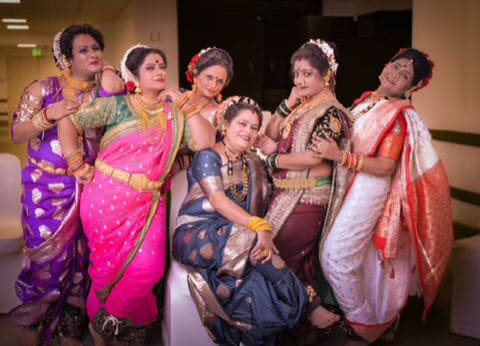
Curated by T.M. Krishna, the Kiran Nadar Museum of Art (KNMA) Music Festival, being held in Sunder Nursery from 9–12 October, brings together artists from the length and breadth of India. The theme, ‘Voices of Diversity’, carries KNMA’s spirit of making art more inclusive, accessible and a reflection of lived realities. The festival opened with ‘Lavani Ke Rang’, a dance-music-theatre production performed by traditional Bari artists directed by Bhushan Korgaonkar. 

In this interview, we speak with the Director of ‘Lavani Ke Rang’ to understand the inspiration behind the production and the legacy of Lavani.

DU Beat: What is Lavani Ke Rang and what inspired you to create this production? 

Bhushan Korgaonkar: Lavani Ke Rang is a theatre production. Now it can be categorised under dance also, music also or theatre. That’s the beauty of Lavani because it includes everything. Lavani Ke Rang is a production that is based on my book titled Sangeet Bari. I wrote this book in 2014 and it chronicles the real lives of traditional Lavani artists who come from matriarchal traditions. It also mentions various types of Lavani songs and the different ways in which Lavani used to be performed and what are the changes in the art form over the period of time. It’s all there in the book, and based on that, we have actually created more than two productions, and Lavani Ke Rang is one of the most successful productions, I would say. It’s a 90-minute production and the speciality of this, and all our productions, is that we work with these very artists. That’s the real charm because what has happened is that Lavani, as an art form, has gained some kind of popularity but not the artists—not the Khandaani artists who have lived these lives and who are living these lives. So, through our productions, we try and make them meet the audiences, the other non-traditional Lavani audiences. That’s what the production is all about. Also, when we started this production, when we started all our work, it was in the original language, that is, Marathi. But we realised that a lot of people who don’t understand Marathi are also very curious, and they used to come and attend our shows irrespective of the language barrier. In fact, because of their suggestion, we have also created these multilingual versions. So, Lavani Ke Rang narration is in Hindi. Although the Hindi has a Marathi flavour, but it’s in Hindi so that people who understand Hindi can also understand that. I also conduct lecture demonstration sessions, which are primarily in English. So, the narrative part of all our productions is either in  Hindi or English, and the Lavani songs are in Marathi. 

DU Beat: You have an award-winning book credited to your name, Sangeet Bari. So, what exactly is the Sangeet Bari style of Lavani and how does Lavani Ke Rang show that style?

Bhushan Korgaonkar: Sangeet Bari’s style of Lavani is the intimate experience of Lavani. It has a rich tradition of several years, several centuries and it is still continuing where artists from matriarchal communities dance to entertain men. That has been the traditional format. Now, there are two ways to look at it—that it’s extremely patriarchal and why should they do this? This is one way to look at it. Now the other way is to look at it from a holistic point of view where we can see the art, and then see if we can bring that art because the art is amazing. Their captivating performances are brilliant, but it’s just the linear equation that women dancing to entertain men is problematic. So, why not bring them to a platform where they can entertain everyone irrespective of their gender and preferences? So, that has been our effort. And also to add to this point, we have also introduced a transwoman—a transgender artist who also dresses up like a woman and they perform with us in this book.

DU Beat: Your book also talks about the lives of Lavani performers, their experiences and their narratives. So, how exactly does Lavani Ke Rang reflect that in its dance performances? 

Bhushan Korgaonkar: We narrate their stories, and these are all real-life stories. We talk about their systems. So, your earlier question was, What is Sangeet Bari? So, Sangeet Bari is basically a centre. These are like performance centres situated in Maharashtra, which host different groups of dancers to come and perform. Rather, these are residential places. So, the artists, around 100–150, stay in that premise throughout. These are government-regulated centres. Each group, which is known as Sangeet Party, hosts around 10 girls and 5 men who play the musical instruments—there are two of them who are like helpers and three musical accompanists. So, this is the system. Every evening, there are public stage show performances and there are also private performances. So, a single man or a group of men can go and request for a private performance. Because it’s a closed-door performance, it is looked down upon in the society. But, because of this very reason, there has also evolved a different type of Lavani, which is the Baithakichi Lavani, which is similar to Thumri—where performers sit and sing, and do adakaari and perform. Along with this style, there are other types of Lavani songs also. All these different types are demonstrated in our show Lavani ke Rang.

DU Beat: Just to get it right, is the term you mentioned “Sangeet Party”?

Bhushan Korgaonkar: Yes, “Sangeet Party”. “Party” as in the English word—like a political party. So, “Sangeet Party”.

DU Beat: There is this common perception that people have nowadays that Lavani is just flashy, fast and sensational, dance numbers on TV and in movies; And there has been a lot of criticism around the same as well. So, how does Lavani Ke Rang challenge that? And how does it show that Lavani is so much more than that? 

Bhushan Korgaonkar: Yeah, exactly. Glad you asked that question. Lavani, as I said, is gaining popularity. But the image that Lavani has or the kind of Lavani that we get to see is only this fast-paced and highly, I would say, acrobatic style of performance. Now, is it Lavani? The answer is yes. That is also Lavani. But is that the only thing Lavani is all about? The answer is no. There are so many other nuances and so many other styles. So, through our show, we show all—not all—but many of these different styles, which are very slow-paced, which use a mix of rhythm—it starts slow and then picks up, and then again, it slows down. So, we show all these different types and styles. We also show a type where a woman artist takes the character of a man, and she behaves like a man and performs. Different topics are also covered in Lavani Ke Rang. We try and show these topical, subject-based Lavanis

DU Beat: What is your vision for Lavani Ke Rang? Where do you see it going in the future?

Bhushan Korgaonkar: We have already done a couple of foreign tours, and also nationally, we have performed at many festivals. But these, as I always say, are like very token recognitions. ‘Okay, we have a festival, you come and perform’—which is great for the form, for the artists, for everyone, and for the audiences also. But there has to be sustainability. Like, how these artists who have this talent and who have familiar traditions can sustain only on these shows, and don’t have to dance at those centres where everything is reduced—in the sense—where they don’t get enough respect that they deserve as artists. So, we are also trying to find an answer to this question. But, I think the more we do these types of shows… and we have also created various modules. In fact, I am at Studio Safdar right now, and I have an AV lecture on Lavani scheduled in an hour’s time—just because I was in Delhi, had a free day and Studio Safdar was kind enough to host me here. I have done and I’ll be doing this—these types of things…As much as possible, we’ll reach out to more and more people. Through that, through word of mouth, through recommendations, we get and take leads, and then, you know, things happen. 

DU Beat: What message would you like to give the younger generation about why Lavani and other folk styles are important, and why they should be preserved today? 

Bhushan Korgaonkar: I think if they come and watch these forms, not just Lavani Ke Rang, but also any other form, they will realise…and I can share our experience with the young generation—Gen Zs and everyone—that those who come, for whatever reason, they get hooked to it. They get glued to their seats and leave their phones for at least one or two hours, and they realise the importance and significance of this form. Because the form, although it’s ancient, talks about your sexuality and your desire in a very strong and a very, I would say, desirable way—in the sense, it comes in a very organic way. And also, I will just deviate a bit, but what happens with Lavani performances when they are performed by people who don’t have any Lavani background is that they get confused, and they do too many sexy movements. I mean, they try and exaggerate the sexiness, which kind of kills the performance because it makes it look very same. So, you can enjoy one at a time, but then if you keep on watching that, you’ll get bored. So, through Lavani Ke Rang or through all our shows, we try and showcase the range. The young generation, especially when they come, realises that this ancient art form has so much of freeness or the freedom of expression, and there are so many topics which the Lavani songs cover. The way our dancers interact with the audience, they (audience) realise the importance of live theatre and our folk tradition, where the audience is not a mere spectator, but a part and parcel of the entire performance, and they have to participate. A lot of them come and meet us and share their experience that ‘thanks to you, we were away from our phones for two hours’. I think that’s the biggest compliment we can get today. 


Read Also: DU Beat in Conversation with Wild Wild Women (WWW)


Image Credits: KNMA Music Festival


Nasheta Zaidi

[email protected]