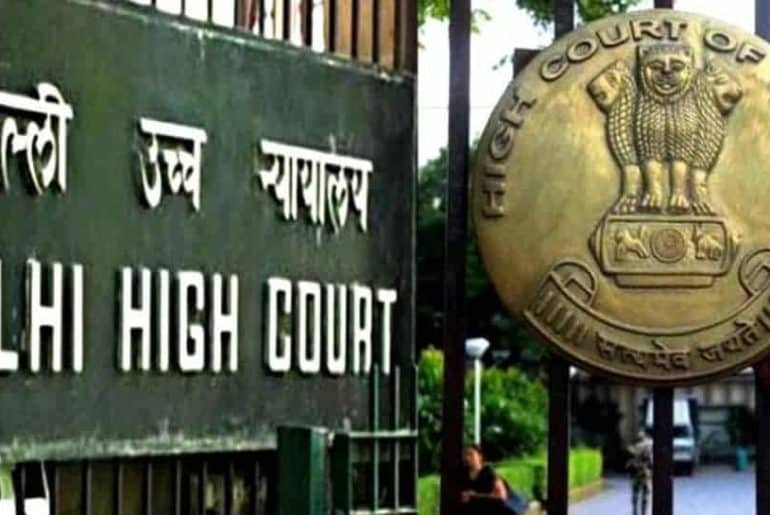
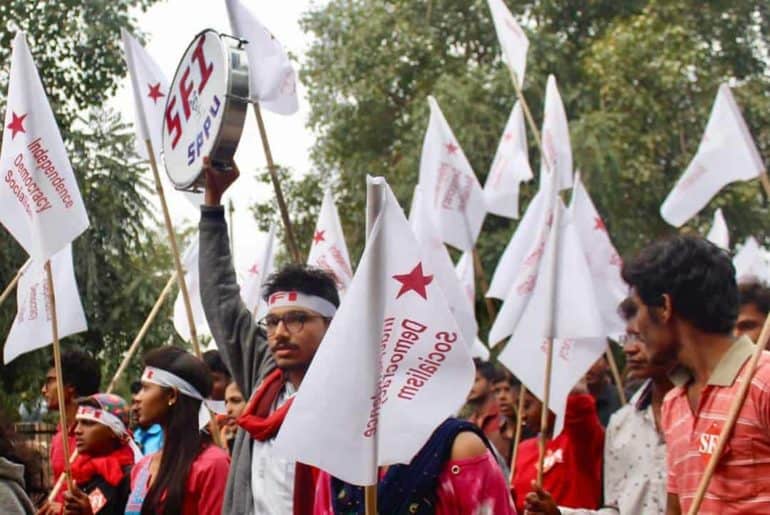
The Delhi High Court rejected the Students’ Federation of India’s (SFI) plea to contest for the elections, as well as the postponement of the elections, making it impossible for them to contest the Delhi University Students’ Union (DUSU) elections.
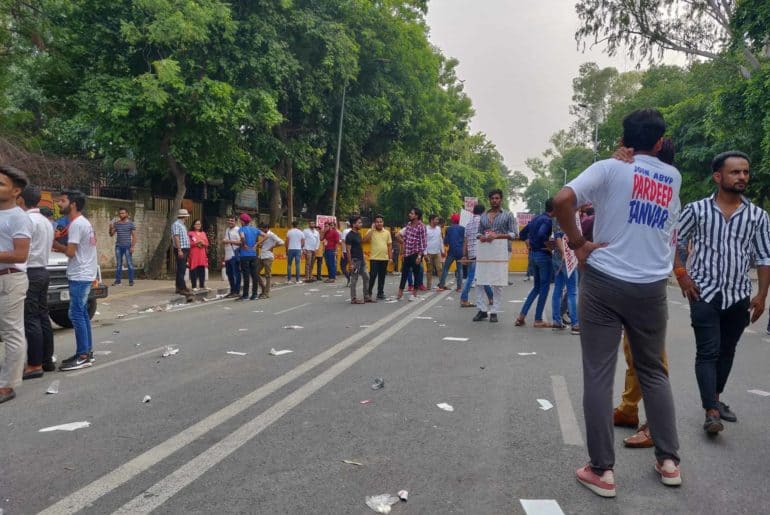
On 4th of September, the DUSU nominations were scheduled. Many political parties, along with their candidates, waited in the restricted Chhatra Marg to file their nominations. Amidst all this, the SFI was allegedly attacked by the Akhil Bharatiya Vidyarthi Parishad (ABVP) “goons” at gate number four of the Faculty of Arts, North Campus, as said in their official statement which made them miss their deadlines. They even claimed that their nomination form was torn up and they were prevented to file a nomination twice. However, the ABVP denied any such accusation by saying it’s a political move by the SFI, and that they were present nowhere near the scene, as only candidates were allowed inside.
Demanding justice, the SFI filed a complaint at the Maurice Nagar Police Station, and had sent a petition to the Delhi High Court, demanding justice to file nomination later and to postponement the elections.
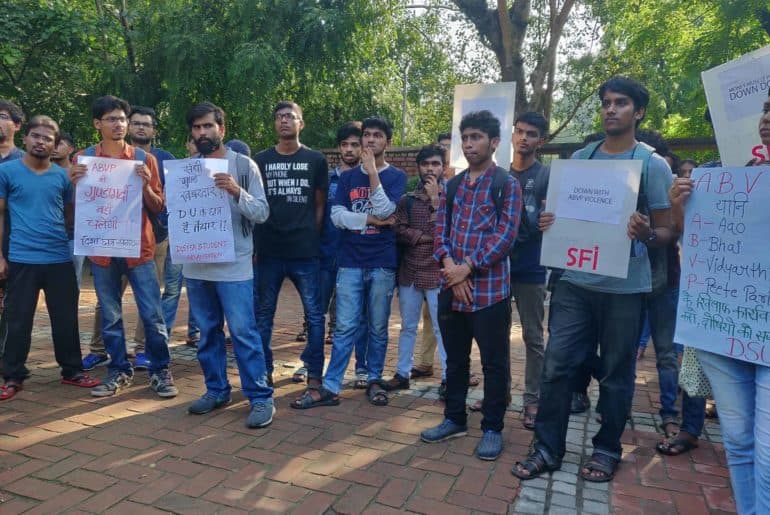
The party had filed the plea on 6th September, and the students had protested on the previous day about the issue on campus. Activists of the SFI and the All India Student Federation (AISA) were attacked twice by ABVP on the same day, as they say.
“No SFI member was able to file their nominations. However, one AISF member managed to file his nomination,” said Utkarsh, an SFI Delhi State Secretariat member.
The verdict on the case was announced earlier, while the Delhi High Court strongly condemned the violence against the candidates. They had denied the University of Delhi (DU) SFI student activists’ plea to let them file nomination for the just happened DUSU elections. The court also denied their plea to postpone the elections as well.
Tom Pious, a student of the Law Faculty at DU and a core committee member of the SFI Delhi unit said, “The judge condemned such acts of violence inside a university and asked the University to file a report on the same on 17th October. The verdict did not come as a relief to us because the elections were just happening. That’s why we weren’t able to contest the elections this time.”
Justice Sanjeev Sachdev condemned the alleged acts of violence on campus and asked the University to file a report by the next hearing.
This case also raises many questions regarding the tolerance of violence in the DUSU elections and the safety of candidates.
Scuffles, violence and threats are not unheard of during the election season. The nomination day saw its repetition.
The DUSU nominations were scheduled for the 4th of September. Political parties, supporters and candidates waited in the barricaded Chhatra Marg to file their nominations.
In the official statement released by SFI, the incident occurred around 2:35 p.m. when they were attacked, and their nomination form torn up in front of gate number four of the Faculty of Arts, North Campus by ‘ABVP goons’.
The SFI attempted to file the nomination again, around 2:55 p.m. when they were attacked for the second time. With their nomination forms torn up, and unable to meet the deadline of 3 p.m., the SFI couldn’t file their nomination. Only one candidate from the AISF, Alan Paul Varghese managed to escape the violence and submit the form.
The scuffle resulted in injuries to Vikas Bhadauria, the Delhi State President of SFI and Paramanand Sharma, a visually impaired student.
Recalling the incident, Utkarsh, the Delhi State Secretariat member of SFI claims that ‘around 20’ people attacked them the first time and ‘over 80’ people attacked them the second time.
The attacks allegedly continued to the Jawaharlal Nehru University (JNU) where during the presidential debate, SFI members were attacked by the ABVP in the middle of the debate.
Sources told DU Beat that the SFI were attacked by the same group of people at JNU.
So far, an FIR has been lodged with the Maurice Nagar Police Station and soon, a writ petition will follow through in the Delhi High Court.
Allegations from the SFI have always been refuted by the ABVP. Ashutosh Singh, the Delhi Media Secretary of the ABVP said to DU Beat, “No it’s completely false. Only the candidates were allowed to enter the premises and outside the authorised premises lot of police force is present. So it’s completely a false allegation. As we are winning the elections SFI and AISF are trying to defame us.” (sic)
The SFI happens to share a rocky history with the ABVP. This is the third documented attack on the SFI this year. Just a week ago, the SFI held a protest at the Faculty of Arts after three members were attacked near the Vijay Nagar drain. An FIR was lodged in the Model Town police station.
The Students’ Federation of India (SFI) gave an open call for an alliance of all “Left-Progressive” student organisations to fight the upcoming student union polls together.
Students of the University of Delhi (DU) will elect their representatives in the Delhi University Students’ Union (DUSU) on 12th September, which means the various student parties are currently campaigning.
The SFI, amidst this, has given a call for a “broader left coalition” to fight the upcoming DUSU polls. The party gave a lengthy rationale for this call. “We only have our solidarity to resist the politics of money, muscle and arrogance,” the SFI’s statement read. While asserting that the various left organisations have agreed to come together on a common minimum programme, the statement admits that “There can be some confusion flowing from how do we define the progressive forces which can lead to various conceptions of unity also.” Calling for a “unity which would electorally reflect the united struggles of the progressive students in Delhi University,” the statement denounced “the short-cut of the opportunistic electoral alliance by compromising the ideals of progressive student movements”. The statement also said that the alliance would fulfil “aspirations and demands” of DU students to see a “grand left alliance in DU on the lines of JNU.”
Speaking to DU Beat, Sumit Kataria, Vice President of SFI Delhi, said that there are two aspects behind this call given by his party – one, the electoral calculations; two, regarding campus protests. Saying that the SFI and the All India Students’ Association (AISA) – “historically the two major left organisations” in DU – have counted on a diverse voter base, Mr. Kataria pointed out that both parties have had certain colleges as their respective strongholds, and that it would make sense “to combine this influence electorally” to have a higher vote share to go against the incumbent Akhil Bharatiya Vidyarthi Parishad (ABVP). From the voters’ perspective, he said that many students who support both parties “get disillusioned due to the lack of an electoral alliance and end up not voting for anyone.”
Secondly, regarding political activity on campus, Mr. Kataria says that the left parties have organised joint protests on multiple issues. However, he alleged that some of these organisations had taken “sectarian positions” when it came to the DUSU elections.
Has the SFI made similar calls in the past as well? Did it receive a positive response? Mr. Kataria says that while the AISF and the All India Democratic Students’ Organisation (AIDSO) have been contesting the DUSU polls along with the SFI as a united panel for the last three years, this panel is incomplete “without some left organisations who have adamantly stuck to their sectarian positions.”
However, parties such as the ABVP seem to be much ahead in the campaigning department. The party has already released a list of potential candidates and can be seen rallying across the campus. Similarly, the National Students’ Union of India (NSUI) officially launched in campaign through a press conference yesterday – 27th August.
On the other hand, the left parties are trying to come to a common ground for an alliance. It cannot be denied that the ABVP and the NSUI seem to be strategically ahead of the left parties. Mr. Kataria agrees. “We should (have done) that (alliance-making) earlier,” he said. However, he also added that the names of the candidates released by the ABVP were only probables and not the final names. “Discussion on alliance is going on,” he said.
What about the response? Mr. Kataria told us that AISF, AIDSO, and AISA were supposedly discussing the matter among their respective organisations. “Still, AISF most probably and AIDSO will join but from AISA we have not got any satisfactory reply,” he said.
Sources say that the AISA is also closing in on finalising and announcing its candidates for the polls.
We contacted the representatives of ABVP, AISA, and NSUI for detailed responses, but they did not comment by the time of the publication of this article.
Feature Image credits – Jaishree Kumar for DU Beat
As the Delhi University Students’ Union (DUSU) elections come closer, the SFI (Students’ Federation of India) has come out with allegations of being attacked by the Akhil Bharatiya Vidyarthi Parishad (ABVP).
During the early hours of 26th August, members of the SFI were putting up posters near North Campus’ Vijay Nagar drain. As recalled by eyewitnesses, men in a Scorpio showed up which had posters supporting the ABVP and Sahil Malik, ABVP’s likely presidential candidate for this year. Minutes later, a Swift pulled over and men emerged with hockey sticks and ‘a stick with numerous nails on it’.
The men demanded to the SFI members that they pull the posters down, outnumbered, they obliged. But minutes later, the men attacked the members of SFI.
The three injured activists are Noel, Sumit, and Himanshu. One of them suffered a head injury and the other suffered two fractures in his hands.
DU Beat spoke to Himanshu, who suffered a fracture in his hand. He stated, “We rushed to the hospital in a cab, after that, we went to the Maurice Nagar police station but the case was moved to the Model Town police station.” Himanshu alleges that Sahil Malik was also a part of the gang that attacked him.
The pictures from the day the incident took place. Image Credits: SFI
Anagha, another eyewitness who escaped the attack recalls the ordeal, “There were a lot of females present so we tried to negotiate to not escalate the situation but as soon as we started removing the posters, the men attacked us. Some of us ran to safety. Sumit is currently hospitalised. Noel has a head injury.”
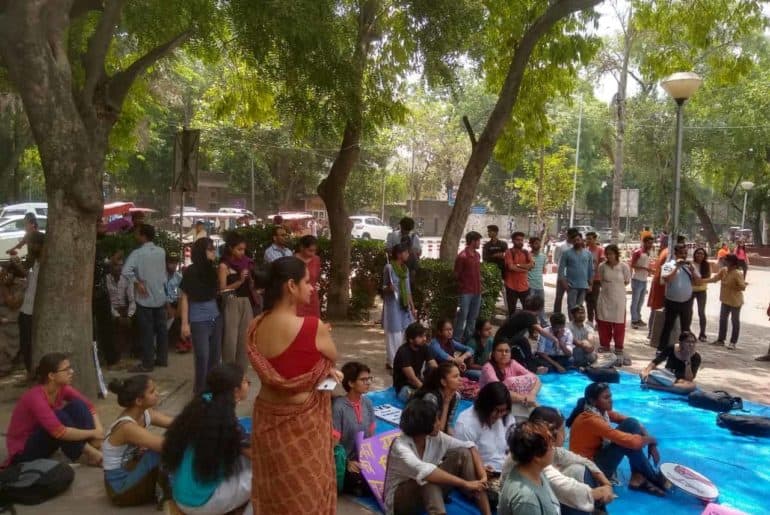
Members of the SFI gathered at the Faculty of Arts on solidarity with organisations like Krantikari Yuva Sangathan (KYS), Pinjra Tod Collective and All India Students’ Association (AISA). The gathering raised slogans against hooliganism, the culture of violence and the ABVP. The sloganeering continued as people took turns to speak out against the culture of violence in DU.
Not the first attack.
This isn’t the first alleged attack on the SFI. Previously, multiple allegations of SFI members being attacked in the North Campus lanes have surfaced on social media.
On the 17th of May, members of the SFI were attacked by unidentified men, allegedly from the ABVP. On the same at the Faculty of Arts, Sidharth Yadav, Delhi Secretary of the ABVP refuted the allegations calling them ‘baseless’ and ‘old tactics’.
Earlier this year as well, videos of SFI members being attacked at the Vishwavidyala metro station had emerged.
Do the repeated attacks deter the SFI?
“I will continue with my activism despite the attacks. I don’t think it has deterred any of my comrades; in fact, our numbers have grown. We’ve only been more motivated to fight back. It has fueled us to go forward with our movement.” says Anagha with a hopeful smile.
On the other hand, Monika from the ABVP denied the allegations, she stated “No, as far as our info is concerned none of the ABVP members was involved in the attack. Since, DUSU elections are approaching and ABVP is getting student’s trust and moving in a positive direction. That’s why they are defaming us.”
Sidharth Yadav, the Delhi Secretary of the ABVP was unavailable for comments. Sahil Malik did not respond to DU Beat’s messages.
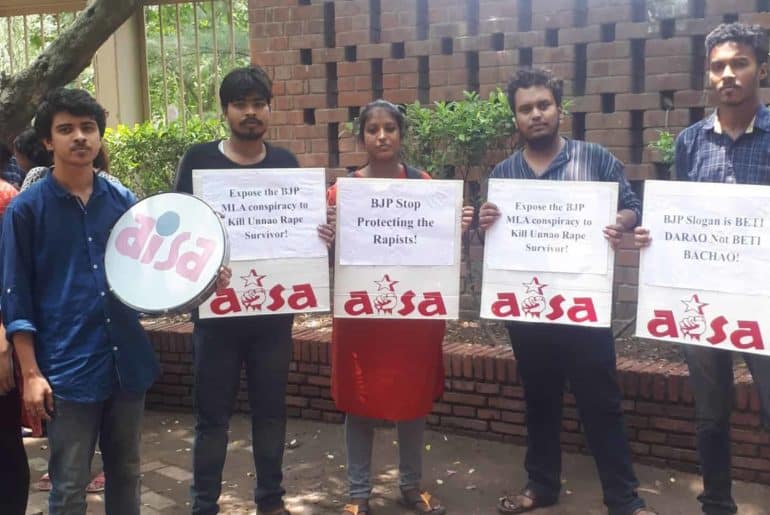
Various University of Delhi (DU) Student Organisations gathered to protest against the planned attack on the Unnao rape victim. Read on to know more.
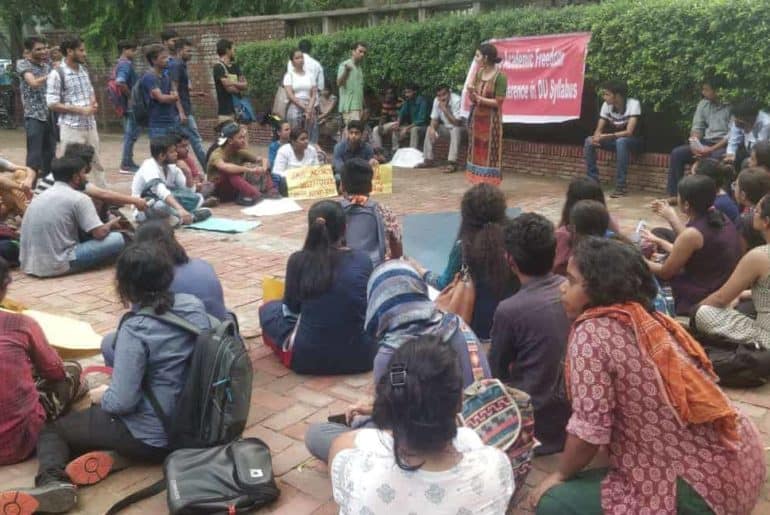
Student organisations of DU held a joint protest in front of the Faculty of Arts, North Campus, on 1st August 2019, to show their dismay over the lack of protection provided to the Unnao rape victim, and the delayed actions taken by the Supreme Court and the Government with respect to this incident. They also condemned the BJP Government, especially Yogi Adityanath, the Chief Minister of Uttar Pradesh, for being complicit with the accused.
All India Students’ Association (AISA), All India Students’ Federation (AISF), Krantikari Yuva Sangathan (KYS), Pinjra Tod, Students’ Federation of India (SFI), etc., were some of the student parties that had joined the protest.
Shreya Singh, a member of the All India Democratic Students’ Organisation (AIDSO) said, “This protest is not only for the Unnao rape victim, but for the lack of safety provided by the Government to girls and women in the country. This protest is against patriarchy. It is for true equality and real freedom for women.”
In the shadow of the Unnao Rape Case, Siddhant Raj, a member of the Progressive Democratic Students’ Federation (PDSF) questioned the Government, the police, and the Supreme Court’s capabilities to protect the girls and women in the country. Many present also condemned the BJP Government’s hypocrisy with respect to the status of women in the country. Harish Gautam, a member of KYS said, “The BJP MLAs go around chanting slogans of ‘Beti Bachao, Beti Padhao’ and promote themselves by clicking selfies in front of campaigns like this, but when it actually comes to it, they do nothing to protect the girls in the country. Right from the beginning, the Unnao rape survivor was being threatened but the BJP Government failed to provide her with any security.” Shreya Banerjee, a member of AISA agreed to this and said, “Beti Bachao, Beti Padhao has been murdered.”
On 28th July 2019, the Unnao rape survivor and her lawyer were critically injured and the rape victim’s relatives killed in a car accident in Rae Bareli, allegedly planned by the BJP MLA Kuldeep Singh Sengar, the main accused in the rape.
The University of Delhi (DU) recently saw a row emerge over the proposed syllabus changes in some undergraduate courses. To understand this better, we spoke to some of the key players involved.
The story developed rapidly in the last couple of weeks in what has now become an ideological battle as various organisations clashed over proposed changes in a variety of the University’s undergraduate programmes – English, History, Political Science, Sociology. Both sides levied a number of accusations on the other – in essence, ranging from trying to manipulate academic spaces to spreading propaganda against certain ideologies. However, some claim that the issue is not a Left vs Right matter at all.
A few characters seem important to this story: Professor Rasal Singh, the Academic Council (AC) member who opposed these proposals; the Akhil Bharatiya Vidyarthi Parishad (ABVP), the student wing of the Rashtriya Swayamsevak Sangh (RSS), which protested against these changes; a host of Left organisations like the Students’ Federation of India (SFI), All India Students’ Association (AISA), Collective, and others, who staged counter-protests against the ABVP’s demonstration; Professor Saikat Ghosh, another AC member who defended the recommendations of the departments. Our conversation with Professor Sanam Khanna, who was involved in the syllabus drafting exercise, is also of great interest.
But first, here’s the background. After objections from within the AC and the protests by the ABVP over the alleged negative portrayal of the RSS and its affiliates, and what was called “inclusion of false facts relating to Hinduism and nationalist organisations,” organisations like the SFI, AISA, Collective and others staged a ‘joint protest’ in return. As reported by The Indian Express, the University’s English department has decided to drop the “objectionable” portions as it did not want to “hurt anyone’s sentiments”. With “minor modifications,” changes in the Political Science and Sociology courses were reportedly passed, while the Head of Department of History said that the department may “consider changes”.
{One}
In a long text sent to us by Professor Rasal Singh, he detailed the reasons for his opposition to the proposed syllabus changes. Some of the more widely reported reasons were his objections over the alleged depiction of the RSS and its affiliates as “looters” and “murderers” in the story Maniben Alias Bibijaan – a background to the infamous 2002 Gujarat riots – and also the usage of Hindu deities, such as Vishnu, Shiv, Kartikeya and Ganesh, in readings about queerness, based on what he called secondary sources “written by Leftists on the basis of foundational texts of Indian culture like the Bhagavata Purana, Skanda Purana, and Shiva Purana.”
While his right-wing leanings might be apparent above, he also cited some concerns – which were not as widely reported – that perhaps blur the typical ‘rightist’ and ‘leftist’ lines, as we generally understand them. Among these were the alleged removal of the histories of Amir Khusrau, Sher Shah Suri and Dr B.R. Ambedkar, along with those of the Rajputs; the absence of social movements like Bacha Khan’s Khudai Khidmatgar movement; the removal of topics on environmental discussions and nature worship in Sociology courses. In addition, he also alleged that the English Department had made close to “100 per cent” changes in the syllabus, instead of 30 per cent, as supposedly mandated under the rules of the Choice Based Credit System (CBCS) curriculum. Yet, he also stated that the syllabus showed “tremendous predominance of leftist ideology and a ceaseless opposition towards nationalist ideology, Indian culture and the RSS”.
For more details on why the revised syllabus faced objections, read this author’s previous piece here.
We asked Mr Singh what was a bigger reason for his objection – the content of the proposed chapters or the English department allegedly not following the ‘30 per cent’ CBCS rule. While he said that the latter was also an issue, the content of the chapters remained more problematic. Objecting to what he called the “monopoly” of one ideology (read leftism) in the syllabus revision exercise, he said that a more inclusive process, accounting for teachers with “diverse ideologies and specialisations,” would have been less controversial.
At this point, we wondered whether Mr Singh had some reservations about the ideology of the left itself. He denied. He said that he did not have any issues with the priorities and politics of the left, but with their “exclusive” presence in the process. “Inclusion of other ideologies in the process would have made for better discourse,” he said. Mr Singh’s reservations over the inclusivity of the process also extended to the sources of information supposedly used. Claiming that most news sources used for the Gujarat and Muzaffarnagar riots case studies – The Wire, Scroll, Al Jazeera, to name a few – were ideologically-driven and not mainstream either, he said that other sources, such as Aaj Tak, ABP News, NDTV and The Indian Express, should also have been used.
An SFI press release had mentioned other instances of what they called attempts by the RSS and its “frontal organisations” to “tamper with the education curriculums”. There had also been allegations – such as the one by Professor Nandita Narain, former President of Delhi University Teachers’ Association (DUTA) – that the ABVP protest turned hostile wherein the protesters allegedly demanded that the Heads of Department of English and History departments of the University and AC member Professor Saikat Ghosh be “handed over” to them. Mr Singh – an ABVP leader during his student days – denounced violence and misbehaviour against teachers perpetrated by any organisation. However, he claimed with “full responsibility” that these allegations were false. Christening the ABVP “the most culture-conscious party” out of all student organisations, he said that while the protesters did enter the Vice-Chancellor’s office, they did not enter the Council Hall. “I’m disappointed that some AC members called the students ‘goonda’; students are also important stakeholders [in determining the syllabus],” he said.
{Two}
“This is the most ridiculous allegation that can be heard,” says Siddharth Yadav, the Delhi State Secretary of ABVP, when we ask him about the veracity of the alleged hostile nature of his party’s protest. “We have fundamentally opposed the changes, both technically and ideologically. Why would we demand the teachers be handed over? I don’t even know who comes up with these things. Technically we oppose the process which was adopted for these changes. We have been demanding student representation in the academic council for a long time. A handful of teachers made the entire course without any discussion with the stakeholders. This was our second protest in a row to prevent the mishappening,” he adds.
In their press release, the ABVP had said that they don’t want the “anti-Hindu mindset of the left” to dominate the curricula. However, professor Rasal Singh of the AC had raised other objections also. Was the ABVP against those issues as well or only against RSS’ alleged negative portrayal? We posed this question to Mr Yadav, to which his response was: “Ideologically we are opposing a lot of changes. All Dalit writers have been removed from ‘Hindi Upanyas’ curriculum, Ambedkar’s name has been removed from Dalit thinkers, Godhra riots have been wrongfully presented, a lot of ancient history has been deleted and only the colonial period is focused upon, Maoism and Naxalism is shown as a social movement, Hindu gods and goddesses have been wrongfully commented upon by relying on secondary sources and the list goes on.”
Saying that “all we wanted” was a “review of the syllabus”, Mr Yadav said that there was “a lot more than what is being told. I hope it comes out soon.”
{Three}
The Vice-President of SFI Delhi State, Sumit Kataria, says, “Whenever the BJP has been in power, they’ve always attacked our education system”.
There is a general belief that the academia is largely populated by left-liberals. From some of the most prominent historians of our country, who tend to belong to Marxist schools of thought, to litterateurs critical of the right-wing, there probably is a presence of a more left-oriented academia. After all, the ABVP and Professor Rasal Singh expressed clear displeasure over the alleged leftist character of the revised syllabi. This situation is perhaps not even unique to India either; conservatives in the United States have been claiming for quite some time now that their voices in the university spaces are shrinking. We asked Mr Kataria if he felt that there was a general dominance of the left in academia and if that could make the right-wing voices feel that they are not heard properly. “To say that there is a general dominance of the left ideology is a very ahistorical statement. When has the left ever dominated the academia? It [academia] has always been dominated by the elite and the upper caste sections in India. The left is not in power, so how can we dominate?” he responds. “It is the right-wing organisations’ propaganda and nothing else.”
Now that the revised syllabus has been taken back, essentially ending things the way the ABVP wanted, do parties like the SFI consider it a loss? Mr Kataria says, “It doesn’t mean that ABVP has won. It is our education system that has been defeated and not SFI or any other organisation…These are just attempts at destroying our democratic education system.”
{Four}
Professor Saikat Ghosh. AC member. Professor of English. Allegedly wanted by the ABVP to be “handed over”. Speaking to Mr Ghosh brings a few twists, and confusions, in the story.
He tells us that the information about the alleged “handing over” demand of the ABVP was given to him by the security personnel at the Viceregal Lodge, where the office of the Vice-Chancellor is located. “We were told by the security guards to disperse from the University premises at the earliest as the threat of violence is real.” He further added, “We were escorted out of a back entrance of the Viceregal Lodge in a clandestine way. We were also told that the lights surrounding the Garden outside the Viceregal Lodge were switched off by the ABVP to ensure that CCTV becomes ineffective in the case of an actual physical attack.”
“Unfortunate and indicative of vindictive rejection of the English Dept’s academic autonomy,” was how Mr Ghosh described the resultant withdrawal of the proposed syllabus by the English department. Claiming that the department’s “academic arguments are not being heeded,” Mr Ghosh alleged that the University Undergraduate Curriculum Revision Committee – tasked with overseeing the revision process – had “taken the role of a bully on behalf of the ABVP and NDTF (National Democratic Teachers’ Front)” – both linked to the RSS.
While Mr Singh had called for consultations with more teachers to ensure inclusivity in the process – he said only around 15 teachers of the English department drafted most of the new syllabus – Mr Ghosh contradicted him. “Prof. Rasal Singh is conveniently hiding the fact that 120+ teachers from across 50 DU colleges participated in the English syllabus revision,” he claimed. He further said that an “open call” was given in the English teachers’ General Body Meeting (GBM) in 2017 for voluntary participation in the syllabus revision, of which the “right-wing” teachers chose not to be a part. “Students, alumni and peers in the international academia recorded overwhelming praise,” he said about the revised syllabus, which was supposedly open for “public review and feedback for a month”.
“The NDTF and ABVP seemed to be sleeping through the entire exercise. The RSS is politicising it and not engaging with the academic merits of the syllabus,” he alleged. When we asked Mr Singh whether this was true, he replied that he said “whatever is fact.”
Mr Ghosh profoundly disagrees about the whole issue being an ideological one. He has been associated with the SFI in the past, but strictly maintains that his support for the syllabus has been on academic grounds and that he has not “asserted any party agenda.” He also said that many of the teachers involved in the exercise did not belong to any political background.
“The issue is not a battle between the Right and the Left. It is being given an ideological colour by those who don’t want the English department to give its students a world-class syllabus that allows them to engage with contemporary social and aesthetic concerns. The people opposed to the English syllabus are being unfair to thousands of students who dream of pursuing an English Honours degree from DU colleges,” he said.
Was the process really ideological in nature? Were only members of a certain ideology considered for the syllabus revision exercised, as alleged by some? Or was there an attempt made by the departments to accommodate as many teachers in the drafting exercise as possible, as was claimed by some others?
Professor Sanam Khanna, a teacher of English at Kamala Nehru College, also participated in the syllabus revision exercise. She said that the whole syllabus drafting exercise, which began two years ago, went something like this: “The English department called a General Body Meeting of all teachers from across the University. From the GBM, subcommittees were formed to look after clusters of papers. The drafting process starts from there based on what the teachers feel the students need, the shortcomings of the current syllabi, and feedback from their departments.”
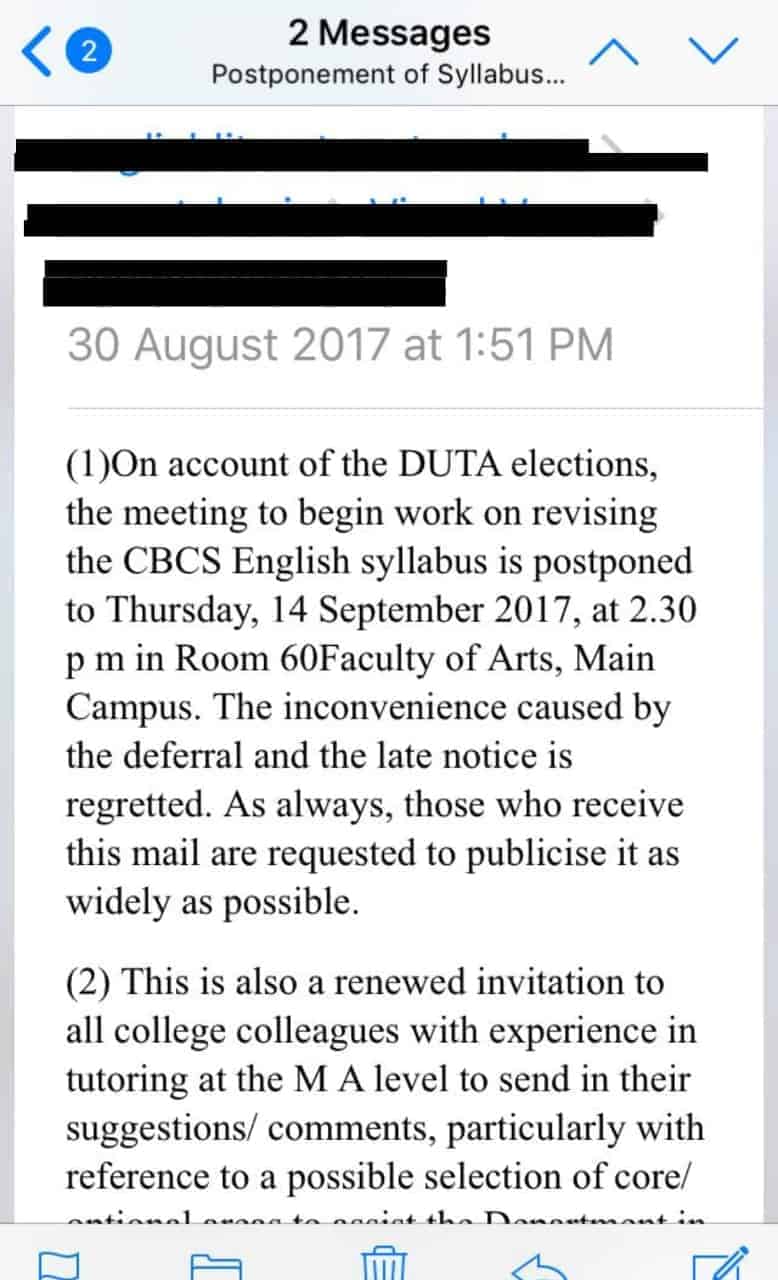
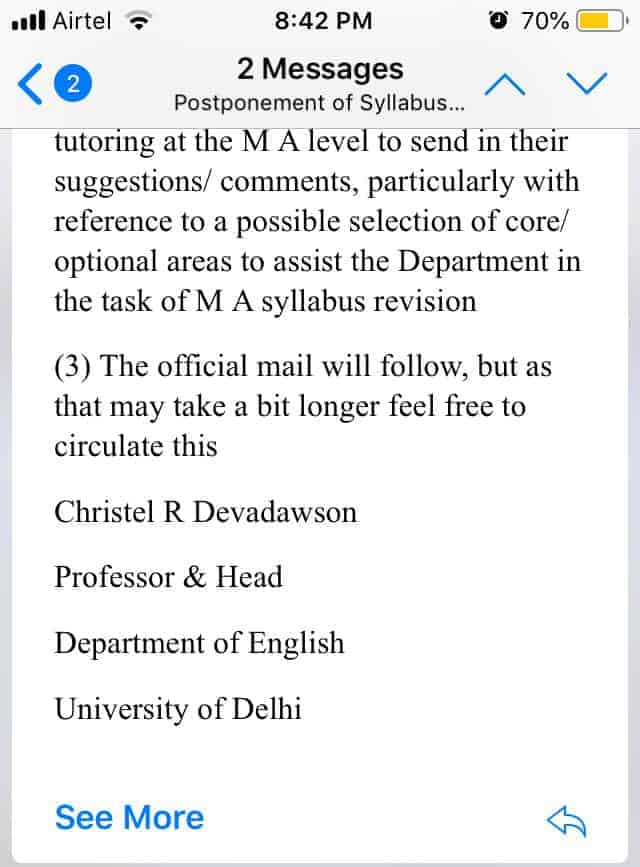
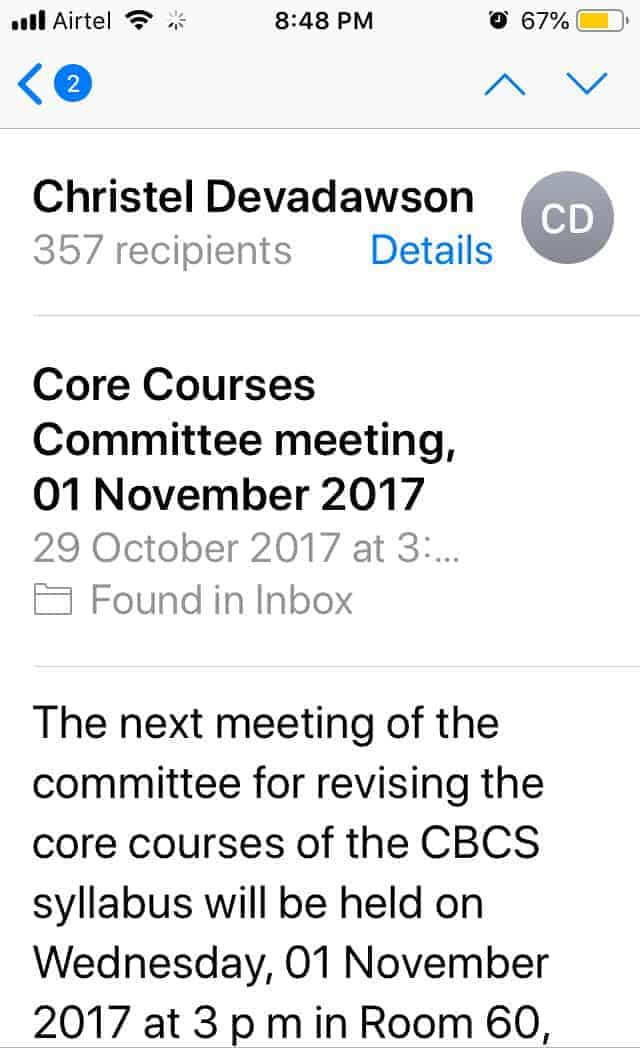
DU Beat got access to some of the emails, dated 2017, which were sent as intimation regarding the syllabus drafting exercise.
E-mail 1E-mail 2The emails accessed by DU Beat show that invitations to be a part of the syllabus revision process were sent to a large number of professors and colleges.
The first and second images of the email dating 30 August 2017 show that the revision exercise was already underway at least as early as September 2017. Here, a clear request has been made for publicising the email as widely as possible and suggestions and recommendations have been invited. The email was sent by Professor Christel R. Devadawson, the then English HoD. The second email – also by Professor Devadawson – dated 29 October 2017, was sent to 357 recipients. The email seems to be about the committee on revising the syllabi for the core courses – an indication that multiple people were involved in the drafting exercise. “Mails such as these were sent to all principals and colleges as well as English teachers’ groups and email lists, inviting suggestions and participation,” Ms Khanna said. “So how can anyone say the process was ‘limited’? Whoever was interested came, attended and worked for over two years,” she added.
Ms Khanna also denied any ideological motivation behind the syllabi. “This is a huge collective effort. It decolonised the study of literature. For the first time in DU, so many Indian authors have been introduced in the syllabus. More than 100 Indian authors across different time periods and genres [were included]. What is leftist here? It is deeply painful to hear such unacademic responses,” she said.
We tried contacting Professor Sunil Kumar, the HoD of the History Department, via email but he did not respond to our queries by the time of publishing this article.
{Five}
What may have started as a purely academic exercise has now taken the form of an ideological and political tussle. The organisations holding protest after protest all come from one or the other ideological leaning; and the demonstrations seem to have taken an ugly shape. While all the politics is fair and well, we do wonder if the agitating parties have gone through the newly proposed texts. For all their claims of holding dialectics and discussion in high regard, did the right engage enough with the left and vice-versa? We may never know.
However, as things stand, another protest was held on 23rd July. Two days earlier, the revised syllabus was put before the Executive Council of the University for final approval; it was sent back for revision. Mr Singh welcomed this decision of referring back what he called the “propagandist” and “non-inclusive” syllabus to the respective departments. He said that the syllabi of these departments should be “comprehensively reviewed by including more teachers and stakeholders in the exercise.” He however expressed disappointment as “the teachers are hardly given any reasonable time to comprehensively and critically analyse all contents of these departments. The cosmetic and superficial approach on such an important academic matter will not serve the purpose.”
An oversight committee is now tasked with finalising the syllabi by 31 July. The syllabi of these departments was supposed to take effect from the current session onwards. While the revised syllabi of many other courses has been approved, as available on the University website, that of these departments hangs in the balance. Ms Khanna hints at this when she says, “We are worried about our students who are without a syllabus when every day is precious in this short semester system.”
On 17th May, three activists from the Students’ Federation of India (SFI) were allegedly attacked with lathis by unidentified men at the Faculty of Arts after they were protesting along with the St. Stephen’s College Staff Association. They blamed Akhil Bharatiya Vidyarthi Parishad (ABVP) for the attack.
Three SFI activists, who wish to remain anonymous, were allegedly attacked by goons when they were resting after a protest by the St. Stephen’s College Staff Association. One of the activists suffered head injuries.
An activist recalls the ordeal, “It was raining, suddenly almost five people with faces covered with handkerchief came and asked whether we were from SFI. When our answer was affirmative, they first abused us and then attacked us with the lathis they had with them.” He added that one of them tried to attack the female activist, but she was standing far away and started calling for help. “After seeing people coming towards us, the attackers fled.”
In the social media posts, SFI has blamed ABVP for the attack. “Yes, it can’t be proved, but it is obvious,” claims one of the activists. “They first identified us as members of SFI and then attacked us. It is a sheer display of their money and muscle power.”
A police complaint has been filed at the Maurice Nagar Police Station in lieu of the incident, however, the activists don’t have a lot of faith in the authorities either. “We were attacked after the Virgin Tree protests at Hindu College, we have been attacked at the Vishwavidyala metro station, we had photos, videos and even CCTV footage of the incident. Yet, the police failed to take action.”
Refuting allegations, Sidharth Yadav, Delhi State Secretary of ABVP denies allegations. “Time and again they come out with their own thought-out incidents followed by tagging ABVP as goons. It is an old tactic, but whatsoever it may be, it must be thoroughly inquired. The allegations must also be investigated and any perpetrator must also be caught.” He added that a police complaint is a must and if anything comes up in the investigation or any name from ABVP comes up, strict action should be taken. “But I don’t think that would be required, it is just their old style of propagating false news against us. Their previous allegations, too, have failed to furnish any material evidence, despite them beating our members at Hindu College and walking away scot-free.”
Feature Image Credits: Students’ Federation of India
The University’s contracted sanitation workers continued to raise their demands by organising a hunger strike, two days after the May Day protest.
Starting around 9:30 a.m, the safaikaramcharis (sanitation workers) of the University of Delhi (DU) supported by multiple student organisations, sat on a hunger strike to raise demands of securing their livelihoods, among other things. This comes after a protest that was organised on 1st May 2019 on the occasion of International Labour Day.
The safaikaramcharis were supported by various student organisations. Among these were students from Students’ Federation of India, Parivartankami Chhatra Sangathan (Pachhas), Pinjra Tod, Collective etc.The hunger strike was marked by sloganeering, speeches, songs sit-ins, and a display of solidarity, went on near the Faculty of Arts building of the University from 9:30 a.m. to 6:00 p.m.
The protesters demanded reinstatement of jobs following change of tender, permanent jobs for permanent work and payment of held up salaries, Provident Fun, Employees’ State Insurance and bonus amounts.
However, unsatisfied with the response of the administration, the protesters had decided to carry out a signature campaign and a hunger strike on the following two days.The following day, the protesters organised a signature campaign. Over 400 students from different courses and colleges joined in to express solidarity with the safaikaramcharis.
However, even after today’s proceedings, the protesters said there had been no response from the side of the administration. Thus, to carry on the demonstrations, a protest outside the Deputy Proctor’s office and a rally have been scheduled for 4th May and 6th May 2019 respectively.
On talking to DU Beat, Diya Davis, a member of Pinjra Tod and one of the protesters present at the venue today, said, “It is very clear that the University is hand in gloves with NexGen in terminating the workers. This is to simply teach a lesson to all workers that if they demand for fair wages and other constitutionally granted rights, they will be easily replaced. Workers organizing and raising voices against their exploitation threatens the admin and these private contractors.”
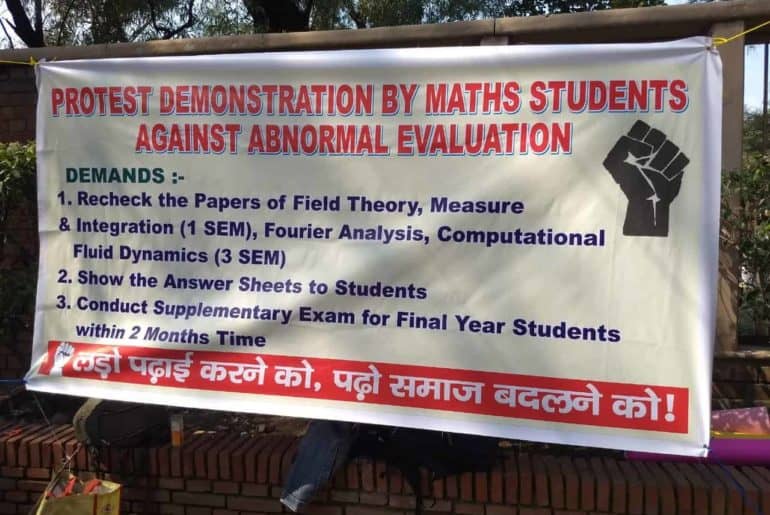
M.Sc. Mathematics students in DU received their results on 8th February 2019, and have been protesting the large-scale failing since 14th February 2019.
Since 14th February 2019, the students of M.Sc. Mathematics Department of University of Delhi (DU) are protesting against the administration for allegedly failing 35 out of 45 students in the Fluid Dynamics Exam. They further claim that 150 out of 300 students failed the first semester Field Theory paper and 130 out of 300 failed the Measure and Integration paper. The students believe that the reason for this is that the faculty feels that the answers of the questions coming in the exams must be according to the notes by the teachers; the students who referred several books to answer the questions were detained. Apart from this, there are students who have been marked absent though they were present for the exams.
The demands of the students are as follows: Firstly, an independent investigation committee, not comprising of any faculty member of the department to re-evaluate the abovementioned three papers, free of cost. Secondly, each student must be shown the answer-sheet of the exams, be it an internal in-house exam or semester exams. Thirdly, the protesting students want the faculty members to lay more emphasis on research-oriented projects where they are allowed to show creativity instead of the ongoing ‘ruttafication’ culture prevailing in the University. Lastly, they are also demanding that students should be allowed to clear their backlogs through re-examinations within two months after every semester. Currently, students have to wait for a year to sit for the re-examination.
On 20th February 2019, the form of the strike was changed into a relay hunger strike. On the same day, C S Lalitha, HoD of the Mathematics department gave a written assurance to the students to fulfill their demands. She also accepted the demand for a feedback mechanism wherein the students are assigned the power to review the teachers’ performance by grading them. The students also demanded action against the anti-women nature of the department. However, these demands were not met by the administration despite passing of the deadline.
Image Credits: Students of M.Sc. Mathematics department
The students have also complained of backlogs in the department, from about 370 students taking admission, and only 30% of the students being able to complete the degree exam. They claim that this is because the exams are designed in a way of testing their memory rather than analytical skills. A student informs DU Beat, “Just because I used the variable ‘X’ instead of ‘Y’, my marks were deducted.”
Srijani Kar, a second-year student informs DU Beat, “There are few students in the mathematics department who complete their masters in two years because of evaluation of this kind and wait to clear backlogs and give improvement tests. Students are unable to be eligible for the NET and JRF, they can’t study further, and can’t get scholarships. The final-year students will be stranded.”
On 27th February 2019, the students have also alleged that Professor Prakash Chandra Jha, Dean of Mathematics Department said that an investigation committee checked their papers, and there hasn’t been any increase in marks except that of two to three students. He also asked the students to take INR 10,000 from him and get their papers re-evaluated. A student further adds, “He asked some of us take money from him personally and get our answer scripts re-checked. However, we denied because this fight is for each one of us. He further stated that the answer sheets are ‘confidential’ and cannot be shown to us.”
DU Beat spoke to Professor Jha. He said, “The issue doesn’t fall under my preview. I don’t look after the examination.”
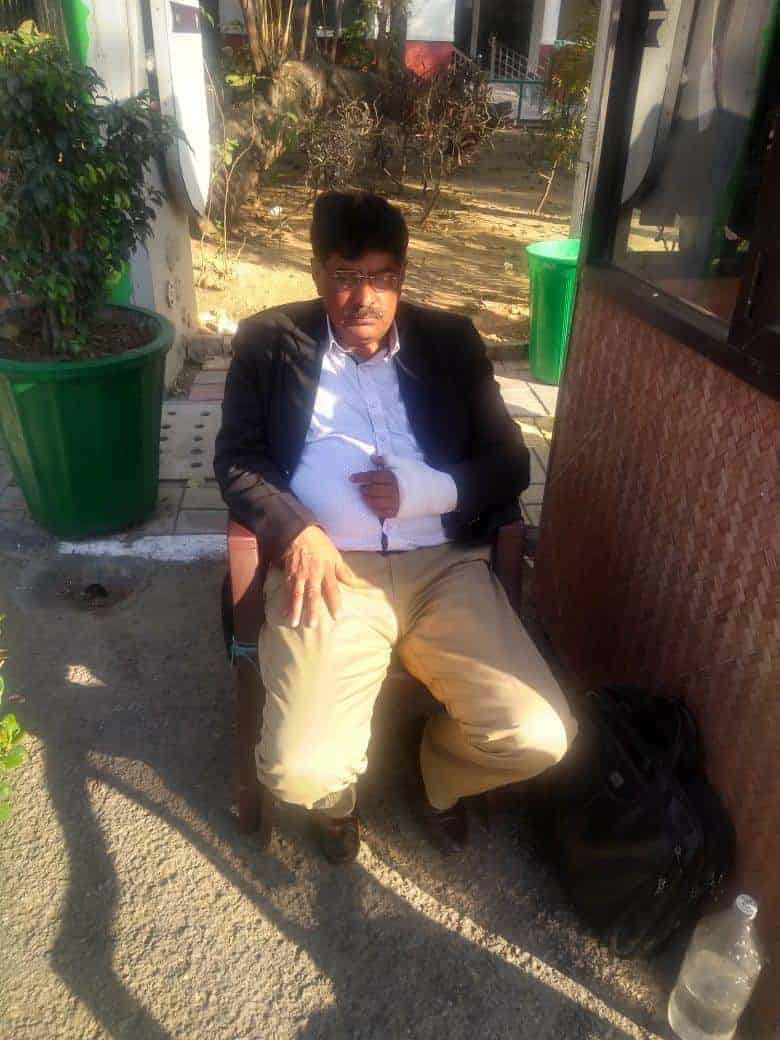
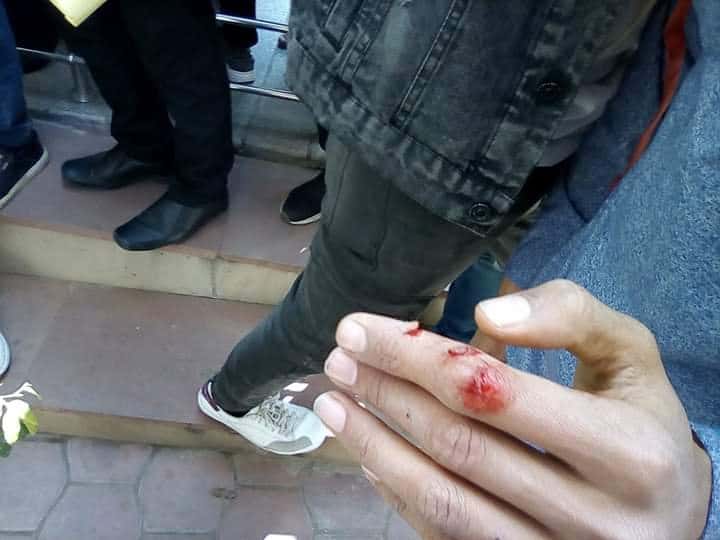
On 1st March, the students staged a protest outside the department for their long standing demands. The protest was organised by Bhagat Singh Chatra Ekta Manch ,Law Students’ Initiative , Democratic Students Union DSU, and was supported by Students’ Federation of India (SFI), All India Students’ Union (AISA), Pinjra Tod, and Krantikari Yuva Sangathan. However, the protest turned violent hurting the students and the security guards. Gajesh Singh, the Chief Security Officer, hurt his leg and fractured his hand in the violence that broke out. According to the students, the department gate was locked by the guard, and when they asked for entry, the guard abused the students. They also allege that the security officers turned violent on the protestors.
Mr. Singh, Chief Security Officer
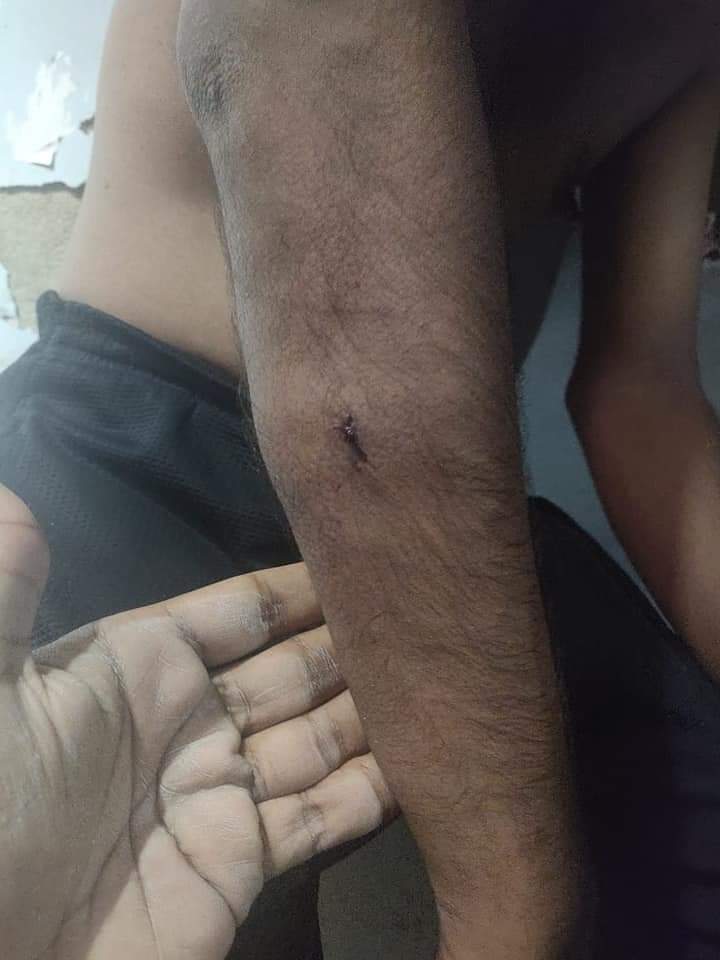
Attack on one of the students. Image Credits: Srijani Kar
However, Gajesh Singh,Chief Security Officer, informs DU Beat that there were around forty to fifty students who wanted to lock CS Lalitha in the department. They had brought locks with them. Singh says, “The students did not inform the administration regarding the protest. They wanted to lock her (the HoD of the department) inside the campus. Humne bacchon ko bola baat karlo madam se, unhone mana kardiya (I asked the students to talk to ma’am, but they refused)” “When I did not allow them to go inside, they started pelting stones on me and the other guards. They brought stones with them. In midst of all this, I fractured my hand. The students also beat up the other guards.” The guards are in the process of filing a FIR against the students.
Bijinder Singh, another guard on duty substantiates the whole incident. He said, “The students’ wanted to lock the HoD inside the department. In the midst of all this, violence broke out.”
DU Beat spoke to Kawalpreet Kaur, Delhi University AISA President. She said, “Delhi Police was seen assaulting the students. The administration had denied meeting the students. If the management doesn’t listen to the student grievances, what will they do? The students are fighting for their rights, and we support them.” On asking her why the protest turned violent when AISA always condemns the use of violence and hooliganism in the University, she added, “The HoD called the security and they beat up the students. We condemn the violence that broke out during the protest. However, the student political wings in the University are there to help the students fight for their rights.”
“SFI also condemns the attack on the democratic space of the University and administrative highhandedness. Again, SFI would like to extend its solidarity with the Maths Faculty of DU”, expressed the SFI press release.
Siddharth Yadav, Delhi State Secretary of Akhil Bharatiya Vidyarthi Parishad condemned the same. He said, “We stand by the demands of the students but the way opted for raising the demands must be non- violent. For raising genuine issues, beating security guards, throwing stones, trying to kidnap the teachers must not be the way. Left organisations have started practicing the same which they do in Jawaharlal Nehru University which indeed would not only bring down the weight of the demands but spoil the campus environment as well.”
DU Beat tried contacting C.S. Lalitha, however, she was unavailable to comment.
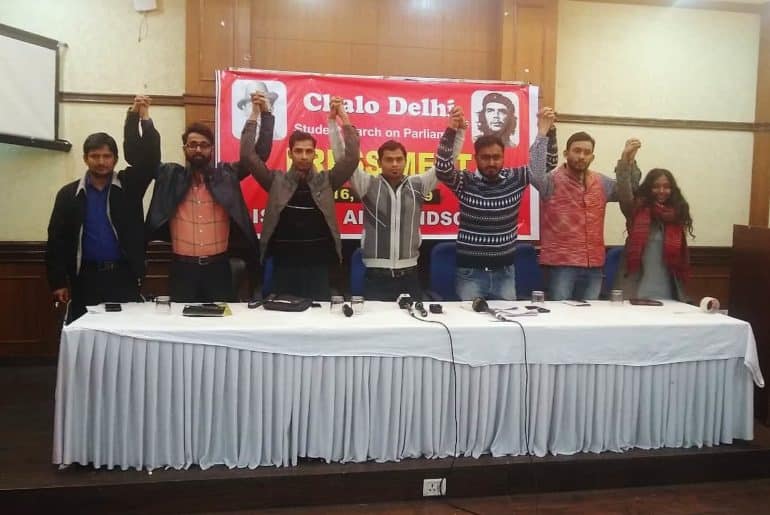
The Left student organisations to march to Parliament over communalism,privatisation of education on 18th February 2019.
After the protest march for farmers, the students plan to march in protest against the Modi- government on higher education and its anti-student policies on 18th February 2019 to Parliament of India. The march is part of a Pan-India campaign that is being organised by several student organisations including the Students’ Federation of India (SFI), All India Democratic Students’ Organisation (AIDSO), Progressive Students’ Union (PSU), All India Students’ Bloc (AISB), and All IndiaStudents’ Federation (AISF) with the slogan ‘Save Education, Save Democracy,
Save Nation’. Students have been one of the worst affected sections in the country under the NDA regime, according to the organisations’ Press Release.There have been a series of attacks, on multiple levels and character, which have
resulted in weakening of Indian education system on one hand and sabotaging the very idea of education and its social responsibility, on the other.
The main demands of the ‘Chalo Delhi’ march is to establish a nation-wide, fully state-funded, and free Common Education System from kindergarten to Post Graduation, government spending to at least 6% of the GDP and 10% of the central budget on education, and guaranteed employment to all. The students also aim to stop communalisation of education, implement the existing reservations properly, and ensure social justice in government as well as private
institutions. The protest will also highlight the need to release money for all pending scholarships immediately, establish more fellowships for research scholars from deprived and underprivileged background, protect federal
character of education, and stop gender discrimination and atrocities on girl students. The student organisations have said in a statement, “There is also a serious threat of unemployment before the youth in the country. Rate of unemployment has been the highest in 20 years. The promise of creating two crore job opportunities every year was forgotten immediately after Modi came to power, and the educated youth live in a condition of disarray. No rhetoric can mask the truth, India lives in a dangerous reality.”
Neelanjita Biswas, a member of SFI, in conversation with the DU Beat correspondent said, “The Leftist student organisations have planned a march on 18th February 2019 to save education. There is a nationwide attack on education and unfair budget allotment in the education sector. It seems as if the nation is frustrated by the current government policies- kisans (farmers), karamcharis (the working class), and now the students. It is high time that students fight for their rights.”