Tag

protest

Browsing

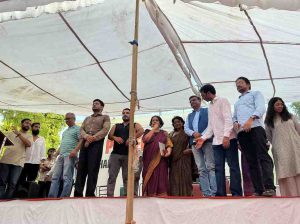
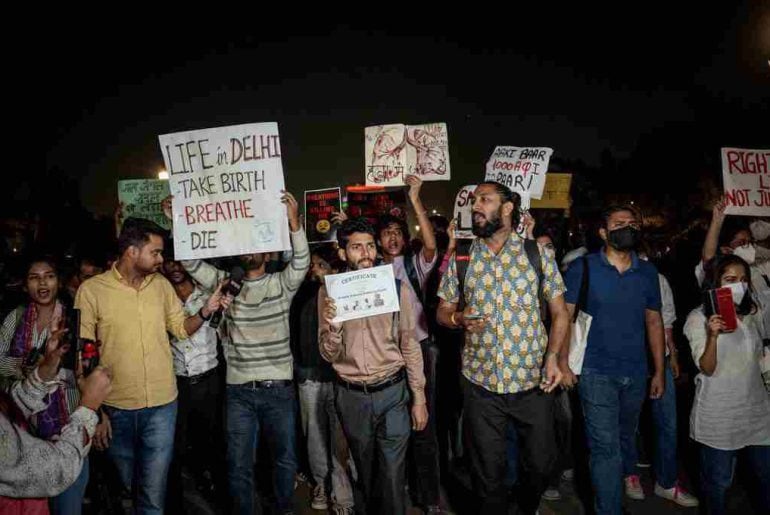
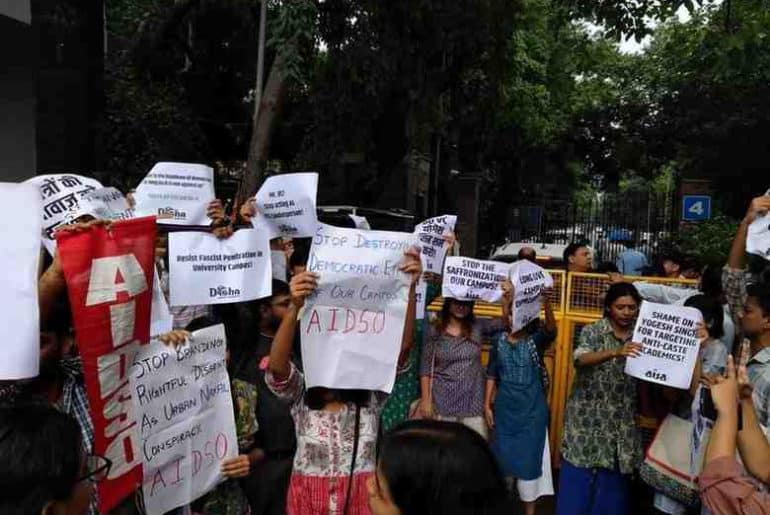
Students at Shaheed Bhagat Singh College protest a controversial fee hike, citing poor infrastructure and a lack of transparency. Tensions rise as the Delhi Police monitors the scene while the administration remains silent. The demonstration highlights growing unrest over educational costs and unmet promises. Urgent changes are demanded.

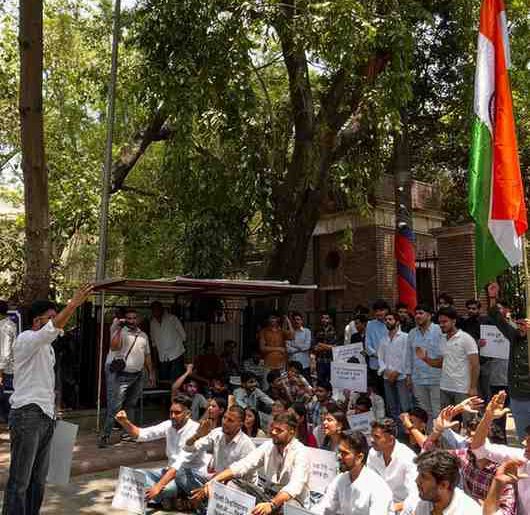
At 1 a.m. on 28 August 2025 Shaheed Bhagat Singh College’s gates encountered unfamiliar knocks. A group of students dissatisfied with the fee hike citing infrastructure development and quality reassurance showed up ready—per aspera ad astra—to protest their way to change. In a statement to DU Beat, one student mentioned the collapsing ceilings of the newly built reading room at the onset of the first monsoon rain and the poor quality of the reconstructed walls. He said, “in the past two years, we have experienced an annual fee hike. Yet, the quality of development is not maintained. What we demand today is a reduction in these continual hikes and an infrastructural development through the Delhi University’s official grants.” 

With chants of ‘the fate of education in Bhagat Singh’s country’, the SBSC’s entrance was swarming with Delhi Police cars, who kept a close eye on the protesters even inside the campus. The entrance was blocked several times today, and two guards, one male and one female, were the only ones handling the crowd. With no words from the Principal, Prof. Arun Kumar Atree, the protest is foreseen to continue until tomorrow. This leads to ambiguity in the formal fee payment process and does not provide any relief. 

Read Also: Students Stage Mega Protest at Deshbandhu College Against Fee Hike and Poor Facilities

Image Credits: Shreya Bhushan

Shreya Bhushan 

[email protected] 

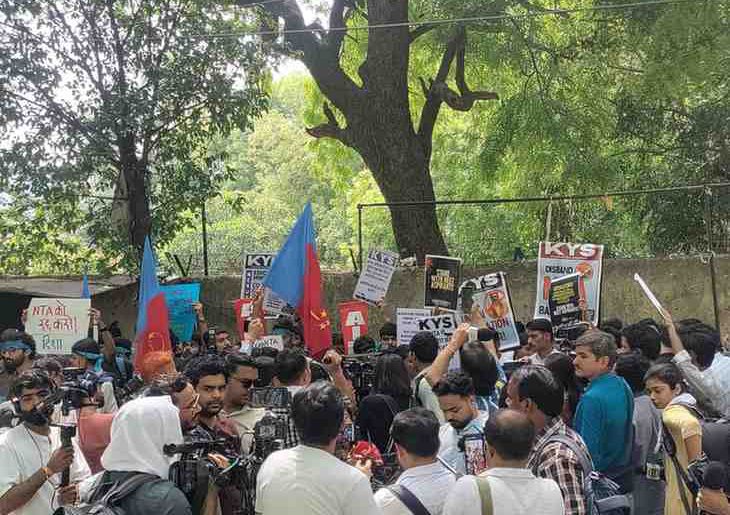
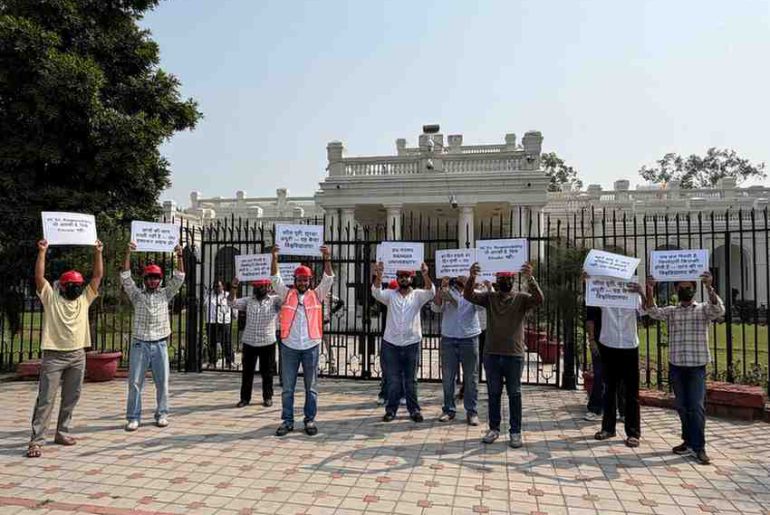
Students of Deshbandhu College, DU, staged a massive protest against fee hikes and poor facilities, highlighting issues in labs, sports infrastructure, Wi-Fi, medical room, and basic amenities.

Deshbandhu College, University of Delhi, witnessed a massive student protest today as several students gathered outside the Admin Office to demand better facilities and to oppose what they termed as “unjustified fee hikes.” The protest was organised under the leadership of Sarthak Singh, President of ABVP, Deshbandhu College, who spearheaded the campaign with the slogan: “No More Excuses, No More Lies – Students’ Voices Will Rise!”

The protest began at 11:00 AM on 22nd August, drawing students from various departments who expressed anger over infrastructural gaps and rising costs of education. Holding placards and shouting slogans, students demanded immediate redressal of their grievances.

At the heart of the protest was the demand for reliable Wi-Fi connectivity, which students argued is indispensable for academic work, research, and digital submissions. Many students complained that repeated assurances by the administration had yielded little progress, leaving them at a disadvantage compared to other colleges. Equally pressing was the issue of the college medical room, which, according to students, lacks both equipment and personnel to handle emergencies. Calls for a functional and well-equipped facility echoed throughout the demonstration.

Speaking at the demonstration, Sarthak Singh, ABVP leader, said:

Education is a right, not a privilege. We will not tolerate exploitation in the name of infrastructure when students lack access to even the most basic facilities. The administration must listen to us.

Another female ABVP leader of Deshbandhu College raised some important concerns: 

There are some very common problems, such as girls’ washrooms, Wi-Fi connectivity, and drinking water. The college holds zero accountability towards these basic responsibilities, and we must raise our voice in unison to demand answers from the administration. 

A major concern among students has been the inadequate state of the science laboratories, where a persistent shortage of essential chemicals and basic apparatus has disrupted regular academic work. Many practical sessions remain incomplete, leaving students unable to meet required coursework standards. Alongside this, the college’s sports infrastructure has also drawn criticism. Facilities are limited, equipment is outdated, and the available space fails to cater to the needs of a growing student population. Together, these shortcomings reflect what students describe as a broader neglect of academic and extracurricular resources.


Read also: NSUI Launches Protest Demanding DU to Implement 12 Days of Menstrual Leave Per Semester Policy

Featured Image Credits: DU Beat 

Madhav Choudhary 

[email protected]


The National Students’ Union of India (NSUI) launched a protest on 13th August at the Arts Faculty of Delhi University’s North Campus calling for 12 days of menstrual leave per semester for female students of DU. Using the slogan, ‘From Pain to Power,’ and imprinting nearby walls with red handprints, the protest gained traction from students across the DU circuit.

The demonstration, carrying out a signature campaign in furtherance of their advocacy, was held under police supervision.

“Every signature is a stand for dignity, equality, and the right of female students to rest without stigma,” NSUI had claimed via a post on their official Instagram account.

Varun Choudhary, the nationwide President of NSUI emphasised on menstrual leave as a basic right for every female student, stating that, We will continue the fight until Delhi University implements this rule, as this provision exists in many universities in India and abroad. NSUI has also fought for this in Panjab University,” he said.

According to the student outfit, menstrual health significantly influences female students’ academic outcomes, mental well-being, and active involvement in campus life. They emphasised that neglecting this concern often leaves students with the difficult choice of missing classes, or they get bound to endure considerable discomfort merely to satisfy attendance criteria, not excluding other curricular commitments that they have.

NSUI urged Delhi University to formulate policies that accommodate female students’ plight in order to make campus more inclusive and gender sensitive. The organisation vowed to continue their efforts to urge educational institutions to implement multi-stakeholder policies. 

Image Credits: NSUI Delhi via Instagram 

Divyanshi Dusad
[email protected]

Also Read: DUSU and Central Council Elections 2025-2026: Official Timeline Announced 

SFI staged a protest at the Arts Faculty, DU on 6th August 2025, demanding action against ABVP for its alleged role in multiple campus sexual violence cases across India.

SFI (Student Federation of India) members led by Sohan Yadav, President of SFI Central Delhi area, demonstrated a protest at the Faculty of Arts, University of Delhi on 6th August 2025. The demonstration was held in solidarity with a student from Fakir Mohan Autonomous College in Balasore, Odisha, whose tragic death in July has sparked national outrage and renewed scrutiny of the alleged misconduct and impunity associated with members of the BJP-affiliated student group, ABVP.

The 20-year-old student died after self-immolating on campus in July 2025. The victim had reportedly faced sexual harassment from a faculty member and had filed multiple complaints, which were allegedly ignored by the college administration. The case took a shocking turn when the Odisha Crime Branch arrested Subhra Sambit Nayak, the state joint secretary of ABVP, and Jyoti Prakash Biswal, a student and initial “witness” who had recorded the incident instead of intervening. Both were charged with abetment to suicide and criminal conspiracy. The arrests drew intense backlash and further highlighted the alleged impunity enjoyed by ABVP leaders across educational institutions.

Coming on the heels of the IIT-BHU rape case, this incident has fueled growing public concern over the ABVP’s repeated involvement in campus violence and sexual abuse allegations. The accused—Kunal Pandey, Saksham Patel, and Anand (alias Abhishek Chauhan)—were later identified as members of the BJP’s Varanasi IT cell, with Pandey and Patel holding convenor positions. The delayed arrests and eventual bail granted to two of them in July 2024 sparked nationwide outrage. Protests by students and civil society groups demanded institutional reforms and the implementation of gender-sensitisation mechanisms. Allegations also surfaced that ABVP even attempted to disrupt campus protests

Further, recently the Rajasthan police booked three ABVP members, who were accused of canvassing for a student leader seeking a ticket from the ABVP for students’ union elections in the university.

Sohan Kumar Yadav addressed the crowd and importantly, pointed out 

Why was there such a wilful negligence by the Chief Minister’s Office who had received all the complaints? This shows very clearly the involvement of the state government. 

Sohan Yadav further claimed in the protest that ABVP’s alleged involvement in multiple rape cases in University campuses across the country is a recurring trend, and the body must claim responsibility for the same. 

SFI Student members demanded strict action against the alleged involvement of ABVP in these rape cases and termed it a ‘rapist organisation’ which shields people who outrage the modesty of women, especially on educational campuses. 

Read also:  Minor Girl Rescued After Gang Rape Near Moolchand, Alleged Police Inaction

Featured image credits-  SFI Instagram page 

Madhav Choudhary 

[email protected]

Seven youth activists were allegedly detained without due process, tortured in custody, and later released, raising serious concerns over legality and institutional silence.

Over a span of 11 days in July, seven students and youth activists were detained by the Delhi Police Special Cell in a manner that civil liberties groups allege have amounted to enforced disappearance. The arrests, which began on July 9, have drawn criticism over alleged procedural violations, custodial torture and intimidation, including threats of sexual violence. 

The detained individuals were affiliated with student-led platforms such as the Bhagat Singh Chhatra Ekta Manch and the Forum Against Corporatization and Militarisation.  

On July 9, Delhi Police detained Gurkirat, Gaurav, and Gauraang, members of the Bhagat Singh Chhatra Ekta Manch, without issuing any formal arrest warrants or prior notifications, an action that appears to violate procedural safeguards outlined under Sections 35 and 36 of the BNSS. Two days later, activists Ehtmam-ul Haque and Baadal were also taken into custody under similar circumstances in Delhi.
Samrat Singh, a psychologist and social worker based in Yamunanagar, Haryana, was reportedly picked up from his residence without any involvement from the local police, raising concerns over the legality of cross-jurisdictional action by Delhi authorities. 

While all seven activists were released by July 21, rights groups have said that the circumstances of their detention and treatment in custody merit closer scrutiny. The use of coercion, threats of sexual violence, and blatant disregard for due process remain matters of serious concern. 

Legal groups and those detained allege that the arrests were made without warrants, and that standard procedures—including informing the accused and producing them before a magistrate within 24 hours—were not followed. Family members and legal representatives claim that for several days, they were unaware of the whereabouts of the detainees, effectively making the situation one of enforced disappearance under international human rights norms.  

The Campaign Against State Repression (CASR) said the detentions violated Article 22 of the Constitution, which guarantees the right to be informed of the grounds of arrest and to consult legal counsel. The group also said there was no adherence to the Supreme Court’s D.K. Basu v. State of West Bengal (1997) guidelines, which mandate the preparation of arrest memos and timely communication with families. 

A report by Maktoob Media, based on interviews with the released individuals and legal advocates, stated that several of the detained activists alleged they were subjected to custodial violence, including beatings, electric shocks, and verbal abuse.  

The Bhagat Singh Chhatra Ekta Manch (BSCEM) stated to DU Beat:  

This level of repression with abduction, week-long illegal detention, and custodial torture including electrocution, being forced to strip naked, sexual harassment, heads being dunked into unflushed toilet bowls is not an isolated incident.” 

The statement continued, “These actions reflect the broader crackdown on democratic voices under the Surajkund Scheme, which aims to criminalise and silence all forms of dissent.” 

Among the most serious allegations were threats of sexual violence directed at female detainees, who were allegedly warned they would be raped with rods if they did not comply with police demands. In some cases, activists claimed they were coerced into signing declarations renouncing political involvement or agreeing not to return to Delhi. 

The Campaign Against State Repression (CASR), in its statement, alleged that the treatment meted out to the detainees amounted to sexualised violence and custodial abuse in breach of both Indian legal provisions and international human rights obligations. The group urged the courts to initiate an independent judicial probe into what they described as unlawful detentions, disappearances without disclosure, custodial torture, and gender-based threats made against the activists during their confinement. 

Among the seven detainees, the case of Rudra, a 20-year-old student of Philosophy (Honours) from Zakir Hussain College, Delhi University, has received particular attention. Rudra disappeared shortly after boarding a train to Delhi on July 18. His phone was switched off within hours, and no information about his location surfaced until he was released on July 21. Activist groups say Rudra’s temporary disappearance typifies an emerging tactic of off-the-record detention meant to silence political speech while evading legal scrutiny.  

Twenty-nine civil society and human rights organisations issued a joint statement demanding an independent judicial inquiry into the detentions. The signatories included the People’s Union for Civil Liberties (PUCL), the Association for Protection of Civil Rights (APCR), Women Against Sexual Violence and State Repression (WSS), and student organisations such as AISA, SFI, and BSF. According to a report by Maktoob Media, the statement described the detentions as part of a broader attempt to criminalise student and youth dissent, particularly among those opposing state policy in conflict-affected regions. 

The joint statement urges the need for judicial oversight, accountability for police actions, and an end to the use of preventive detention in such cases. 

The All India Students’ Association (AISA), which led demonstrations in Delhi following the arrests, framed the incident as an alarming expansion of authoritarian practices under the guise of national security. In a statement to DU Beat, spokesperson Anjali said: 

The rapid erosion of civil and democratic rights has only accelerated in recent times as the ‘war against Naxalism’ spreads into cities. Any and all dissenting voices are being hunted and persecuted… This pattern must end immediately and a judicial inquiry must be constituted into the abductions, enforced disappearances, custodial torture, and threats of sexual violence faced by the detained activists.” 

Other campus groups have called on university administrations and the University Grants Commission to take a stand in defence of student rights and institutional autonomy. 

Despite the severity of the allegations, the case has received minimal coverage in major national dailies and television media. Only a handful of independent outlets have documented the timeline of events, first-hand accounts from the activists, and statements from rights organisations. This limited media scrutiny, observers argue, reflects a broader pattern of silence when allegations involve state agencies. 

Lawyers representing the activists have announced plans to seek legal redress, including filing compensation claims and writ petitions questioning the legality of the arrests. These legal proceedings, if admitted, could require the Delhi Police to account for their conduct during the 11-day detention period and explain the apparent procedural lapses.

Simultaneously, rights organisations are exploring formal complaints to the National Human Rights Commission and relevant State Human Rights Commissions.  

According to Maktoob Media,  

“Legal support networks are also preparing to escalate the matter internationally, citing the custodial torture and enforced disappearances as violations of India’s obligations under international human rights law.” 

The detention and alleged torture of Delhi-based youth activists has raised serious questions about the state’s adherence to democratic norms and constitutional protections. While all seven individuals have been released, rights groups argue that the manner of their detention and treatment warrants urgent institutional scrutiny. 

Failure to address these concerns, they warn, could deepen distrust in law enforcement and weaken public confidence in democratic institutions. With civil society seeking accountability, the onus is now on the judiciary and human rights commissions to ensure due process is upheld. 

Also Read: DU Student Activist Missing Amidst Alleged Police Detention, Speculations Spark Concern


Image Credits – Himanshu for DU Beat

Eram Asrar

[email protected]


Following the lead of several universities banning student activism on campus, Jamia Millia Islamia has intensified its crackdown on student-led protests. 


A circular was issued by the college administration dated 29 November 2024, explicitly banning protests, dharnas, sit-ins and any form of sloganeering against constitutional dignitaries, days after students raised slogans against the current Prime Minister, Narendra Modi. In lieu of these supposedly new guidelines, students requested permission to hold a sit-in protest on 15 December 2024, commemorating five years of the anti-CAA protests held at Jamia, which turned violent when a protesting student, Shadab Najar, was shot. Permission for holding this event was denied, and the college shut down the library and the canteen on the said date, citing “maintenance reasons,” which was allegedly done to suppress dissenting student voices. 


Despite this, approximately 300 students participated in the peaceful protest after class hours, so the said demonstration did not disrupt any academic activities. 

– Saurabh, a PhD student at Jamia via EdEx


The administration, however, quickly responded by issuing show-cause notices to Saurabh and four others, accusing them of disrupting campus order and pushing certain political agendas. On 6 February, 2025, the administration further issued Disciplinary Committee hearings against the concerned students, stating that their responses to the show-cause notices were unsatisfactory. In response to this, students began a sit-in protest demanding an immediate revocation of these show-cause notices and a withdrawal of Disciplinary Hearings issued against protesting students. Larger demands of the protesting students include a revocation of the guidelines issued on 29 November, 2024 and 29 August, 2022. 


When students know that standing up for their rights could cost them their education, it forces self-censorship, making the environment even more repressive. This decision reinforces the ongoing erosion of dissent, making it evident that critical conversations, even within academic spaces, are no longer welcome. 

– Azhar via Youth Ki Awaaz


The administration further refused to engage in dialogue with the students and responded by increasing barricading around campus, deploying 20+ security personnel armed with lathis around the protest premises. In a gross violation of the protesting students’ right to privacy, their names along with their addresses and phone numbers have been pasted outside the university’s front gate. 


This incident is not an isolated instance but part of a larger pattern of crackdowns on student activism and academic freedom, especially across public universities in India, reflecting the Center’s broader attempt to suppress dissent by directly attacking intellect.


Read Also: Student protest in Ramjas College against the sexual harassment charges on Prof. Dhani Ram violently disrupted by ABVP


Featured Image Credits: The Observer Post


Sakshi Singh

[email protected]

Sonam Wangchuk, along with 150 other Ladakhis, was detained by Delhi Police at the Singhu Border while leading the “Chalo Dilli” constitutional and climate march.

On 30 September, Sonam Wangchuk was detained by Delhi Police for allegedly violating prohibitory orders. Wangchuk, along with 150 other padyatris, was detained under Section 163 of the BNS. The march, organized by the Leh Apex Body (LAB) and led by Sonam Wangchuk, began in Leh on 1 September. It was set to conclude at Delhi’s Rajghat on Gandhi Jayanti, 2 October, with a public gathering planned at Jantar Mantar on 3 October. The march aimed to peacefully advocate for key demands, including statehood for Ladakh, constitutional safeguards under the Sixth Schedule to protect the interests of Ladakh’s tribal population, the establishment of a Public Service Commission, job reservations for Ladakhi youth, and the creation of separate parliamentary constituencies for Leh and Kargil.

“We thought we were being escorted, but instead we were being detained,” said Wangchuk in a video posted on Instagram.

Delhi CM Atishi claimed that she was disallowed from meeting the detained leader at Bawana police station. She emphasized an end to LG rule in both Ladakh and Delhi. Atishi, in a post on X said, 

“This dictatorship is not right. Sonam Wangchuk ji and the people of Ladakh are also fighting against LG rule, fighting to get full statehood status for Ladakh. The people of Delhi stand with the people of Ladakh.” 

Reactions from other party leaders, including Rahul Gandhi, also surfaced, with Gandhi condemning the detainment as unacceptable. Ladakh MP Haji Hanifa Jan expressed disappointment, stating it was unfortunate that the people of Ladakh were denied the right to carry out a peaceful march in the capital and were stopped at the border.  “We urge the government to provide us a place where we can submit a memorandum to PM Modi or hold talks with the leadership to resolve this issue”, he said.

Section 163 of the BNS, which restricts gatherings of four or more people, has been imposed in Delhi until October 5th. Among those reportedly detained are elderly citizens and army veterans, who are now being held in various police stations across the city. Previously, in March, Wangchuk also held a 21-day hunger strike, dubbed a “climate fast,” to raise the same four key demands.

Read also: Over 30 teachers detained in Delhi during anti-NEP protest

Featured Image Credits: Sonam Wangchuk’s X profile

Bhavana Bhaskar

[email protected]

Approximately 30 teachers were detained by police in Central Delhi’s Mandi House area while they were participating in a unity march to protest against NEP 2020, paper leaks, and other issues.

On 5th September 2024, also celebrated as Teachers’ Day, over 30 teachers from Jawaharlal Nehru University, Jamia Millia Islamia, Delhi University, and others were detained from Mandi House for protesting against the National Education Policy (NEP) 2020, the National Testing Agency (NTA), paper leaks, and the undermining of reservations in educational institutions. The Federation of Central University Teachers’ Associations (FEDCUTA), All India Federation of University & College Teachers’ Organisations (AIFUCTO), and Joint Forum for Movement on Education (JFME) organized a joint march from Mandi House to Jantar Mantar to address the increasing government interference in the autonomy of educational institutions.  However, before the teachers could reach Jantar Mantar, FEDCUTA President Moushumi Basu and former President Nandita Narain, among others, were forcibly detained.

As per The Federal reports, a senior police officer stated that the teachers were arrested as they attempted to move towards the Embassy area.

The teachers were permitted to protest, but when they tried heading towards the Embassy area, the police had to detain them. The protestors at Jantar Mantar were allowed to continue their protest,” he said. 

However, Moushumi Basu stated that although the police promised to drop them at Jantar Mantar, they dropped them to Kapashera Police Station near the Gurugram border, far from the protest location. The teachers’ association also issued a statement condemning the detentions and calling it a clear violation of democratic rights.

On the day that the nation observes as Teachers’ Day, senior teachers and students were forcibly detained by the police in order to prevent the March. The action of the Delhi Police today…is a shocking demonstration of the continuing assault on Indian democracy and the utter contempt with which the state views education, learning and the teaching community”, the statement read.

As per the reports, FEDCUTA President and JFME Coordinator, Moushumi Basu spoke about the incident,

The police action today only serves to vindicate the very sentiments behind this teacher-student Unity March. This protest is about the unity of those engaged in the teaching-learning process who are standing up against the destruction of the nation’s future through the erosion of public education. NEP 2020 threatens high academic standards and makes education inaccessible to all, particularly marginalized groups.”

She further added and said, “By detaining teachers and students on a day meant to celebrate educators, the government has shown its utter contempt for the teaching community. The Delhi Police has been used to silence our voices, but our fight continues.”

The Democratic Teachers’ Initiative (DTI), in a statement issued following the detentions also condemned the government’s actions.

Look at how teachers are being humiliated on Teachers’ Day! Today’s protest, held on FEDCUTA-AIFUCTO-JFME’s call, was meant to demonstrate our collective resistance to NEP 2020. Yet, instead of listening to teachers and students, the government has chosen to suppress us by force. This is how we are celebrating Teachers’ Day—by being detained for fighting for the future of education!”

Despite being detained, the senior leaders have asked for continued demonstrations. Professor Nandita Narain, former FEDCUTA president, said,

This is a critical moment for education in India. Our public education system is under attack, and teachers, students, and citizens must stand together to protect it. We will not be silenced.”

Meanwhile, student groups from different universities, including Delhi University and Ambedkar University, continued the protest at Jantar Mantar. The protestors also raised slogans, placards, and posters to highlight the issues of NEP and paper leaks, among others. The demonstration reflected the increasing dissatisfaction within the academic community over educational policies and other systematic issues. The detainment of the teachers highlighted the growing tension between the teachers and the government over the crisis in the education sector.

Read also: St. Stephen’s College Faces Allegations over Minority Quota Violations in Admission Process

Featured Image Credits: The Hindu

Reeba Khan

[email protected]


An event by the student group ‘Brahmins of DU’, sponsored by the University of Delhi, was supposed to be held on May 10, 2024, i.e., Friday. However, the event faced protests from the left-bloc of student politics, alleging casteist and discriminatory sentiments, causing the event to be consequently canceled.

In the continual skepticism over the democratic nature of Delhi University and the inherent ‘saffronization’ and ‘brahmanization’ that is allegedly being promoted by the university, there was yet another DU-Admin-sponsored event organized by the student wing, ‘Brahmins of DU’. The university-wide association announced an event titled ‘Brahmins and the Tapestry of Hindu Civilization: Weaving Bhartiya Heritage and Calling Astikas to Fulfill Rșiṛṇa  that was programmed to take place on May 10, 2024, at the Conference Center of the North Campus, along with a campus-wide ‘Shobha Yatra‘ on the same day.

The event received widespread backlash from the student community, citing its alleged casteist approach. This was further vitalized by claims from Professor Abha Dev Habib, an Assistant Professor at DU, who, in conversation with EdexLive, cited a recent example of how events are being ‘policed’ and ‘restricted’ and a poetry reading session on the Palestinian crisis that was supposed to be held on April 15 was canceled by the university ‘without citing any valid reason’. In opposition to the event by ‘Brahmins of DU’, the Students’ Federation of India (SFI), under the umbrella of Humans of DU, organized a parallel event on the same date, i.e., May 10, 2024, at the Arts Faculty. The event organized was a photo exhibition and open mic themed around the ‘Saffronization’ of DU and against the ‘Normalization of Casteist Politics on the Campus’. Students university-wide joined the event in solidarity with the cause and presented their ideas, pieces, and writings, and the words of prominent Dalit writers like Omprakash Valmiki were also echoed.

Aditi, State Committee Member SFI Delhi, adds about how the undertakings in the university are a “direct reflection of the societal tapestry of our country”, expressing her fear over an ‘uncertain future’ wherein incidents like the “recent TISS debacle could be replicated in Delhi University”. She further states that, with opposition events like this:

 we will not let them destroy the dissent, debate, and other progressive nature of our campus.

Besides SFI, the All India Student Association, AISA, also made a post on Instagram condemning the event, stating:

Their ideologies promote hatred, discrimination, and division, which directly contradict the values of equality, solidarity, and social justice.

While the SFI Event was an alleged success in presenting their opposition to the events and undertakings held by the group Brahmins of DU, the event organized by Brahmins of DU did not materialize. In a consequent press release, SFI states that fervent backlash and dissent from “progressive student pressure groups” and political bodies compelled the administration to call off the event organized by ‘Brahmins of DU’ eventually.

Read Also: TISS Scholar Suspended for Two Years Due to ‘Anti-National Acts’ and Protests Outside Parliament

Featured Image Credits: SFI Official Instagram

Shikhar Pathak

[email protected]


In a swift response, Delhi University takes action against a staff member accused of sexual harassment, reflecting a commitment to student welfare. As students rally for justice at the Central Institute of Education, officials ensure a thorough investigation by the Internal Complaints Committee, prioritizing safety and transparency.

The University of Delhi’s Establishment Branch has terminated the employment of a non-teaching staff member who was allegedly involved in the sexual harassment of a student at the Central Institute of Education (CIE) earlier this month. The incident occurred in the Department of Education’s new building, per the student’s official complaint with the Head and Dean of CIE. The defendant is alleged to have engaged in several inappropriate behaviors, such as unwanted approaches, invasive personal inquiries, and acts that created a great deal of discomfort and fear for the student’s safety.

The student has asked for her peers’ support, expressing how the encounter violated and deeply distressed her. She also expressed fear for her safety because the harasser was walking around the department unhindered. Students came together to plan a demonstration at CIE on Wednesday to support the student’s right to justice.

The Indian Express was notified by Pankaj Arora, Head and Dean of CIE, that the Internal Complaints Committee was notified of the student’s complaint as soon as it was received on Monday. The accused, who worked for the company under a contract, was let go early on Wednesday.

We have engaged in extensive discussions with the students and have assured them that the university’s ICC will handle the matter with care.” Arora said in response to the protest.

While the ICC investigates the case, questions remain about the student’s ongoing safety and the support system available. Did the University offer counselling services or connect her with external support groups specializing in trauma recovery? Transparency regarding the ICC process would also be beneficial. What are the expected timelines for the investigation? Are there resources readily available to explain the process to students involved in such cases?

The case is presently under review by the ICC, and until the process concludes, it would be challenging to disclose specific details of the proceedings.” said DU Proctor Rajni Abbi.

The Students’ Union or other student committees at CIE likely played a crucial role in supporting the student and organizing the protest. Including a statement from a student representative would amplify the students’ voice and highlight the collective stand against harassment. The incident serves as a stark reminder of the prevalence of sexual harassment in educational settings. By creating a culture of support, ensuring a fair and transparent investigation process, and implementing robust prevention programs, universities can foster safe learning environments where every student feels empowered and respected.

Read Also: Where are you ICC: Looking at DU’s History of Sexual Harassment 

Featured Image Credits: India TV News

Divya Malhotra

[email protected]