Tag

NSUI

Browsing

National Student Union of India (NSUI) released a memorandum for consideration by the Student community of India, detailing grievances and recommendations.

National Student Union of India (NSUI) released a notice containing the demands and recommendations put forward through consultation by students across India facing various hardships during the lockdown. The association has been providing students relief and essentials through its program “Ladenge aur Jeetenge” during which the requests were made on the subjects of Examination, Admission & Fees, Scholarship & Fellowship, Community kitchen for students in University Hostels and Online Medium. The memorandum has been submitted to Human Resource Development Minister Ramesh Pokhriyal and University Grants Commission (UGC) Chairman Professor D P Singh.

The press release stated, “The academic year has been disrupted due to the unprecedented national shutdown to curb the Corona pandemic. The NSUI has already stated that online examinations are likely to be discriminatory given the highly uneven access to infrastructure and connectivity. It is also inadvisable to conduct exams without completion of course work in physical class.

In light of this, the NSUI has the following demands:


1. All students in Year 1 and 2 should be promoted without exam. Extra classes for course work missed should be conducted after universities re-open.

2. Students in Final Year should be promoted on the basis of past performance with 10% extra marks since it’s observed that students improve their performance in final year.”


Many students from marginalised communities along with Postgraduate Researchers are facing great economic hardship to meet the economic burden of themselves and of their families. Many such students are first-generation University students along with several depending on other sources of livelihood like tutoring and part-time jobs to sustain themselves. The lockdown has dried up all sources of income for them along with their families. Hence it is requested that the Scholarship and Fellowship funding for the subsequent semester/2 months should be given in advance so that these students and their co-dependents have resources to sustain themselves during the lockdown. Scholarship funding for SC/ST/OBC and marginalised communities should be increased to provide some cushion to such families.

“The points and the ideas that the letter has suggested is something that I personally agree with. Even though, I am in a position of privilege where these regulations might not affect me as such. Being a student in DU for a year has made me realise that everyone does not have the access to the same resources, it is crazy to think about conducting online exams when there are internet shutdowns in this country and half the population cant even access the internet. I understand the need to conduct examinations but the importance of doing it in an inclusive manner must not be understated, Prabhanu Kumar Das”, a student at Kirori Mal College said.

“Several students across India are stuck in places with no access to food or messes. Hence it has been requested by multiple numbers of students that University Hostels start providing mess access to such students stuck in private accommodations. The most desirable solution would be that if University Hostel messes across India could provide packed food on demand to ensure minimum person-to-person contact along with deliveries undertaken by Student Organisations and Unions across the residencies of such students. Hence it is requested that the UGC immediately allows such Hostel mess facilities to undertake community kitchen at the earliest so that no student sleeps in hunger at such times of distress”, the memorandum stated.

It is also recommended that a medium be developed to upload lectures online on YouTube or other web hosting mediums where students can access them on a later date at their own easement since the quality of applications such as Zoom is very poor with lags and disturbances.

Nikhil Kamble, National Secretary of NSUI urged UGC into taking the recommendations in consideration while making its decision on the working of Universities post the pandemic. This should be followed by swift action.

Feature Image Credits: DU Beat Archives


Paridhi Puri.
paridhip@dubeat.com 


Members of National Students’ Union of India (NSUI) Delhi protested against the violence instigated in Delhi outside Delhi Lieutenant Governor Anil Baijal’s residence.

On Tuesday, 25th February 2020, members of National Students’ Union of India (NSUI) Delhi protested against the violence instigated outside Delhi Lieutenant Governor Anil Baijal’s residence. Also, NSUI members raised slogans against Delhi violence at Lieutenant Governor’s residence in the wee hours of morning, around 1:30 a.m.  Following this, NSUI members were detained by Delhi Police, as per the Press Release released by them on the same day.

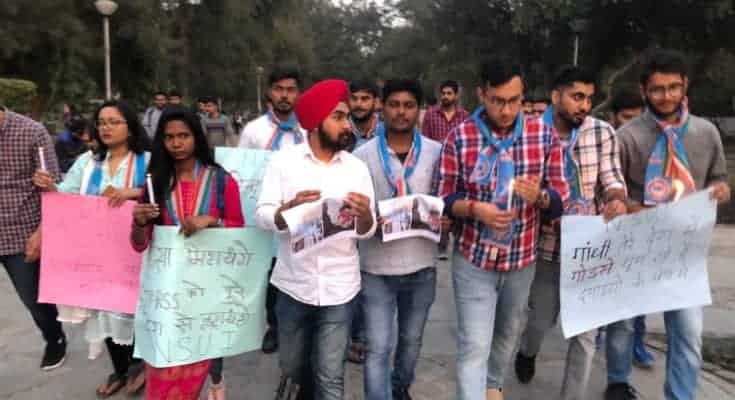
NSUI activists organised a peace march to protest against Delhi violence from Delhi University Student Union (DUSU) office at Faculty of Arts, North Campus. Delhi University students joined NSUI activists and participated in the peace march by holding the statue of Mahatma Gandhi in hand.

Ashish Lamba , Secretary of Delhi University Student Union (DUSU) from NSUI said, “The NSUI activists protested at Lieutenant Governor’s house in Civil Lines regarding the violence which took place in Delhi and the Lieutenant Governor still did not respond and kept himself as a mute spectator. We were detained at Civil Lines Police Station. In the evening NSUI led DUSU also took out a Shanti candle march from DUSU office to Arts Faculty in order to appeal for peace.”

NSUI members stated, “It is a pre-planned conspiracy by BJP leaders. This violence and atrocities against minorities and Dalits has been raised and now we can see the riots on minorities and Dalits. NSUI will keep its fight against such violence and will spread Mahatma Gandhi ‘s Ahimsa Marg among the people of India.” NSUI demanded Home Minister Amit Shah’s resignation and asked him to step down from the ministry.

Feature Image Credits: DU Beat

Paridhi Puri

pari22puri@gmail.com 


In a recent press release, National Students’ Union of India (NSUI) revealed that they have incorporated Akhil Bharatiya Vidyarthi Parishad’s (ABVP) entire North East Cell along with other students from the party’s Delhi Unit. Hoewever, ABVP has denied all these claims. 

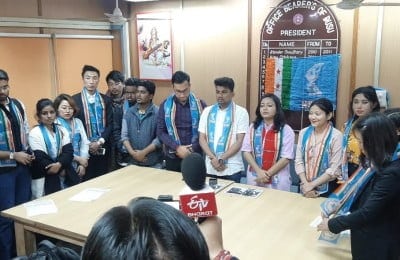
In a press release sent out on 13th February 2020, NSUI revealed that it has incorporated the ABVP’s entire North East Cell along with other students from ABVP’s Delhi Unit into their party. The students were incorporated via a formal incorporation event that took place at the Delhi University Students’ Union (DUSU) office on 13th February 2020 at 1 pm. The incorporated students had protested against the ABVP’s Pro-CAA stance which violated Constitutional underpinnings of India, and were severely affected by their former party’s role in campus violence across Delhi, and spread of communal hatred during recent elections and therefore, decided to join NSUI in a large number. “NSUI welcomes them equivocally into our fraternity and would enlist more students in upcoming days who are discontented with the divisive politics of right-wing groups,” NSUI stated. The students joined NSUI at the Delhi University Students’ Union (DUSU) Office premises in presence of NSUI National Secretary and Delhi State In-charge, Nikhil Kamble, NSUI National Co-ordinator, Manish Kumar, DUSU Secretary for 2019-20, Ashish Lamba, and others. The 15 students who were present today took the decision under the leadership of the Delhi University Northeast Cell In-charge (Secretary), Sheikh Raisa Tabasssum, ex-ABVP Northeast Cell Joint Secretary, Vishnu Parna Dutta, ex-ABVP Joint Secretary, Liza Gogoi, ex ABVP Cultural Secretary, Aditya Deka and others who joined the NSUI fraternity.

At the press conference, ex-ABVP members strongly and adamantly expressed their discontent at the divisive and communal agenda of ABVP, and insisted that they could no longer support their violence streaks along with attacks on female students.

“NSUI welcomes the students equivocally into our fraternity and would enlist more students in upcoming days who are discontented with the divisive politics of right and left-wing groups. Several students from Delhi University ABVP Unit have contacted NSUI and would like to switch their political affiliation after the indiscreet spread of hatred by Sangh Organisations in recent Delhi Elections. Students of Delhi have denounced their hatred and we welcome them all to join the largest secular, democratic and constitutional abiding student organisation of India,” Nikhil Kamble further stated.

Sidharth Yadav, State Secretary, ABVP-Delhi, said, “The Akhil Bharatiya Vidyarthi Parishad is the largest student organization in the country. Over time, it has emerged as the most sincere representative of students across the nation. By way of its inherently plural outlook and approach, specifically in Delhi University, ABVP has been working actively towards mainstreaming of students from the North-East. It is with this spirit of inclusivity that the organization continues to provide platforms to students from varied cultural backgrounds resulting in a diverse pool of activists in Delhi University and elsewhere.

While ABVP supports internal difference of opinions, it must be recapitulated that the decision pertinent to the Citizenship (Amendment) Act has received a unanimous welcome, including by our activists hailing from the North-Eastern states.

The news of resignation of some students from the North-East put up by a local digital portal is completely misleading. Out of the names mentioned therein, while only a handful were loosely associated with our organization, none of them were office-bearers. Our organizational structure is completely transparent and all declarations pertinent thereto are made during the annual state-specific conferences. All our activists and office-bearers from the North-East have declared their uniform support for the Citizenship (Amendment) Act. Therefore, the exaggerated claims of mass defection of disgruntled ‘ABVP’s North-East Cell’ members are completely baseless.

While ABVP is committed towards maintaining a vibrant and democratic atmosphere on campuses, the role of certain student-outfits, specifically NSUI, in attempting to vitiate the environment of peace and harmony on campuses must be foregrounded. Slanderous posts are being circulated online with the intention of dragging ABVP’s name through the mire. An outfit whose parent organization had mercilessly crushed student-dissent during the Emergency and continues to do the same till date has no right to call us communal. It would be instructive for NSUI activists and office-bearers to urge the higher-ups in their parent political outfit to mend their dictatorial mien and not suppress dissenting voices across campuses in Congress-ruled states.”

The ABVP has recently been under fire for their involvement in various violent acts across universities’ campuses which has been condemned by various student organisations, and have been open about their pro-CAA stance.


Feature Image Credits: NSUI


Shreya Juyal

shreyaj@dubeat.com


As many students finish their first semester in Delhi University (DU), the country is faced with a major political crisis which has divided India. At this time, should you join a student political party?

DU is an extremely political campus, with all colleges having some or the other form of student representation, with a wider Delhi University Students’ Union (DUSU) which represents students from most of the DU colleges. Some of the major student political parties present in DU are the Right wing, Akhil Bharatiya Vidyarthi Parishad (ABVP), which is affiliated to the Hindu nationalist Rashtriya Swayamsevak Sangh (RSS), National Students’ Union of India (NSUI), which is affiliated to Congress, All India Students Association (AISA) which is associated with Communist Party of India ( Marxist-Leninist) ( CPI-ML), and Students’ Federation of India which is associated with Communist Party of India (Marxist) ( CPI-M).

Many first years would have been told when they joined DU to stay away from politics by their parents, fearing the incidents of violence which come to play in DU politics. The political crisis in the country started by the passing of the Citizenship (Amendment) Act (CAA), which many opposed due to its openly islamophobic and communal nature and came out on the streets to protest against it. On the other side, groups have come out in support of this act.

Before joining a political party in a spur of the moment decision, one must try to consider what the party stands for. Joining a party just because you want to express dissent or because those around you are joining is not the right option, while these parties might give you the space to dissent and information about protests, it is important to know the ideologies that the party that you want to join, stands for. This can easily be done by reading the manifesto of the party.

Most parties can be easily joined by filling out a form on their website or by looking for their representatives on campus. If you do decide to join one, remember that you get to choose your level of participation. Being in parties will also open you up to learning more about the idealogies and the people behind them. Do not be discouraged by those telling you not to join, if you believe it is the the way to express yourself politically, then these organizations are the best way to go for it.

Feature Image credits: Noihirit Gogoi for DU Beat

Prabhanu Kumar Das

prabhanuk@dubeat.com

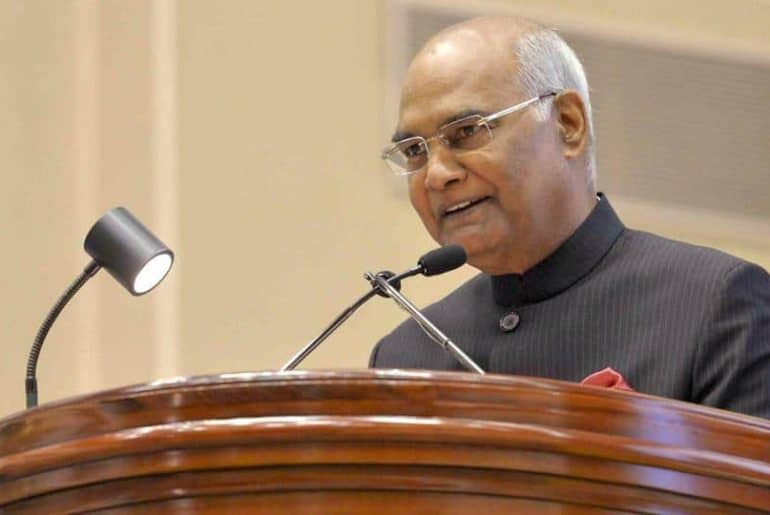
Owing to the aftermath of multiple incidents of violence against student fraternity, National Students’ Union of India (NSUI) is all set to deliver a peace petition campaign to Ram Nath Kovind, President of India.

On 25 January 2020, NSUI has initiated a ‘peace petition campaign’, requesting the honourable President of India Mr Ram Nath Kovind for his involvement, to aid mediation. This is done in the wake of the upsurge of violence and unjust brutality that is unleashed on University campuses like Jawaharlal Nehru University (JNU) ,Jamia Millia Islamia (JMI) ,etc to name a few.

The NSUI made an official statement and said it “condemns violence by individuals affiliated with a particular ideology and failures on the part of the state machinery.” This was reported by The Times of India. 

It has also hinted towards the 5th January violence that terrorized JNU where a bunch of masked miscreants entered the University campus with rods, bottled acid, etc to spread hooliganism and terror. The NSUI, while alluding to this attack stated the worry over escalating violence on students of universities pan India.

Saimon Farooqui, National Secretary, NSUI  told DU Beat, “because of the violence that has been caused by the right wing

political parties and their student wings, a feeling of terror has been instilled in the students of the campus.” He further added, “NSUI being a responsible Students’ Union, has followed the guidelines given by the Constitution of India.”

When asked upon as to what the primary objective boils down to, he said, “we want a discourse and a dialogue to take place within the campus unlike violence carried out by the Akhil Bharatiya Vidyarthi Parishad (ABVP),” he further added, “the reason why we are sending for the President is because he is the ‘visitor’ for central universities in India which makes him the visitor for Delhi University as well, and therefore such a matter is worthy of his attention.” 

Deepender Singh Hooda who’s the former Member of Parliament (MP) in the Lok Sabha from Rohtak, took the lead and signed the very first petition.

According to NSUI, the campaign will witness about one thousand written petitions for them to be sent to the President.

The use of petitions for social causes have been gaining quite a momentum these days. Quite popular ones for Climate Change and justice for rape victims made numerable rounds. Although there are some qualms about the success rates of petitions as a solution,since it doesn’t always end up in aiding to achieve the requisite demands and actions. However, there is no denying the fact that through petitions, students have found themselves to be empowered in recent times.


Featured Image Credits: Hindustan Times
Umaima Khanam 

umaimakhanam000@gmail.com


University of Delhi (DU) students organised a protest in the Arts Faculty of the university on 16th November, in solidarity with Jamia Milia Islamia University and Aligarh Muslim University.


The Political Science department of the Delhi University (DU) decided to boycott today’s exam. In the protest, the crowd could be heard chanting slogans like, “Amit Shah, Istifa Do” and “DU Prashasan Murdabad”. But, as the protest grew, the police were called in. The protest shifted from the Social Science building’s entrance to down the stairs where the police then began to manhandle students.

Although the police tried to snatch away the phones of the people recording, videos of the police manhandling the students chanting these slogans surfaced online. In one video, the policemen were dragging the All India Students’ Association (AISA) Presidential Candidate for Delhi University Students’ Union (DUSU) 2018, Abhigyan, while the student away while the crowd was chanting.

The police constables were allegedly heard saying “10 minutes mein sabka kaam khatam, ABVP bulaye hai abhi. (everything will end in 10 minutes for we have called ABVP)”

Soon after, other members of Akhil Bharatiya Vidyarthi Parishad (ABVP) also arrived along with Akshit Dahiya, DUSU President. “Kitne bacchon ka paper hai… Sir aap inhe bahar karo na (so many kids are giving their exams. Please take these people outside),” said Akshit, referring to the protesters.

However, after the arrival of ABVP, the protesters got chased and beaten up by the ABVP members and the police. On multiple videos, the police could be seen manhandling and detaining the students. Bharat Sharma, State Executive Committee member of ABVP, and Sonal Sharma, Ankita Biswas, and Inderjeet Dagar, members of ABVP were caught on tape verbally and physically assaulting the student protestors.

“Akshit Dahiya arrived and ABVP goons started pouring in. Soon, it became complete chaos. Police and ABVP hitting the protestors. Those with the ‘dandas‘ are ABVP goons. Police lent them the batons. Many protestors were detained,” said Noihrit Gogoi, a student who got beaten up at the protest.

Another student present at the protest added, “I got hit on my face. Ten ABVP boys circled me and called me a terrorist and snatched my phone as I was making a video. Akshit Dahiya gave them orders to snatch my phone in front of me. Police were just watching and did nothing.”

Messages of students warning each other to stay away from the Arts Faculty were also circulated on Whatsapp. Meanwhile, the students of the University started sharing messages asking people to message Akshit Dahiya regarding his statement supporting the Citizenship Amendment Act (CAA). “Spread the word, guys. He has to take this statement down. And that can only happen when students across DU unite. Please text him and let him know that DU does not stand with CAA,” read one message.

“The Delhi University Students’ Union condemns the attack of the academic process of the university by student groups in a move of forcefully preventing students from appearing in examinations… When the affected students called the DUSU President for help, the DUSU President immediately reached the spot and asked the protesters to continue the protest but not force any student to either join or boycott the examination. This led to a clash which sustained injuries on DUSU office bearers and members,” said the DUSU, in its press release.

Akshit Dahiya added, “It is my duty to go out to help the students who are appearing for the exams if they are stopped from doing so. The students called me for help and when I went, I was attacked by them. They raised anti-national slogans in front of me. We can never let such things happen in DU. We reject any lockdown call for DU. We condemn the act of such violent perpetrators and such environment building cannot be tolerated.”

Saimon Farooqi, National Secretary, National Students’ Union of India (NSUI) said, “We conducted a very peaceful protest inside the university campus itself. The police mistreated us. Rocky Tuseed who was the DUSU President in 2017 was also manhandled… we were just fighting for our rights and exercising our rights. If these ABVP members are against our protest, it reflects their ideologies. And because they follow the footprints of Rashtriya Swayamsevak Sangh (RSS) and Bharatiya Janata Party (BJP), it reflects in those parties also.”

The police then took the protesters at the Arts Faculty to Jantar Mantar in their police bus for them to continue the protest at Jantar Mantar as the situation became too violent on the campus.


Featured Image Credits: Arsh Mehdi

Satviki Sanjay

satvikis@dubeat.com

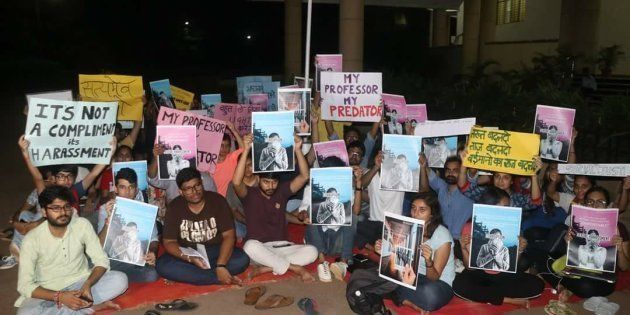
TW: Sexual Harassment

As the sexual harassment case filed against the head of the Chemistry Department (HoD) moves to a third panel, despite the Internal Complaint Committee (ICC) finding the perpetrator guilty 19 months ago, it is time to acknowledge that the harassment culture in DU is more predatory than it seems.

A safety audit carried out by the National Students’ Union of India (NSUI) across colleges affiliated to the Delhi University (DU) stated that one in every four women studying in the University has faced sexual harassment. One in five cases of harassment were of touching or groping. Lewd gestures, staring and vulgar comments make up for the most rampant kind of harassment.

A total of 188 cases were recorded by the survey. The survey also highlighted cyber harassment. Carried across 24 colleges with 736 female respondents, it stated that one in five cases of harassment concerned trolling on social media or harassment through calls, text or WhatsApp messages. The report also stated that not even half of the respondents were aware of the Internal Complaints Committee (ICC) in their institutions.

Last year, when the #MeToo movement was a billowing surge, DU’s debating and MUN circuit ignited their own version of it, with female debaters coming up to narrate incidents of sexual assault or harassment. It was a shocking revelation to be made, the debating circuit has long been a platform with liberal ideas as its mainstay, and constant debates on feminism and equality. With allegations being made on a Facebook Group that served as an announcement board for tournaments called, ‘Debate Lokpal’, they called out senior members of DU’s debating circuit.

In April 2019, Moksh Nair, a third-year student from Shaheed Sukhdev College of Business Studies (SSCBS), was accused of harassing seven third-year girls at a farewell party, and the girls ended up dropping any legal charges against him.

A Political Science professor, from Delhi University’s Daulat Ram College, was arrested by the Maurice Nagar police on Monday, 5th February for allegedly sexually harassing a 17-year-old student. The student alleged that Professor, Abhay Kumar, had often tried to touch her inappropriately whenever he found her alone. The girl reportedly informed the police that he would follow her and ask her to meet him. He would even, allegedly, threaten to fail her in internal exams if she rejected his advances.

Principal Savita Roy had allegedly been informed about the Professor’s misdemeanour beforehand but had refused to take action. In fact, in the six days it took between the complaint being filed (31st January) and Kumar’s arrest (5th February), students point out that the Professor was not only allowed to enter the college premises but also allowed to take classes until he finally submitted his resignation.

In 2015, a St. Stephen’s Ph.D. student has accused a professor- Satish Kumar- of the college of sexual harassment. The victim in her complaint has alleged that the Professor harassed her while she was working with him in college. She also said that the college Principal, Valson Thampu, tried to stop her from going to the police and instead forced her to end the matter in the college. The reasoning behind this was stated as not causing any delay or problems in the completion of her Ph.D.

In 2013, The principal of Bhim Rao Ambedkar College was booked by Delhi Police for abetting the suicide of Pavitra Bhardwaj, a former employee who had accused him of sexual harassment. Instead of hearing her out, the college had sacked her two years prior. Bhardwaj, who succumbed to injuries on 7th October, alleged sexual and mental harassment by Arora and another staff member.

These cases are a few of the many that go unreported, unnoticed or are hushed down. It becomes essential to acknowledge the fact that there remain to be a few isolated cases, wherein the accuser fabricates the case in an attempt to shame the accused.

Yet, it becomes important to also acknowledge the fact that most of these cases are factual and are hushed down by authorities in an attempt to not tarnish the reputation of an institution, or even a community. With the Bharati College case reaching its 19th month and the perpetrator having been found guilty with no actions taken, it becomes vital to try and understand why it is that an institution that prides itself for being a safe, largely-liberal and accepting space, does so much to silence its survivors and protect its perpetrators.

Feature Image Credits: HuffPost India

Shreya Juyal

shreya.juyal72002@gmail.com

The campaigning for Delhi University Students’ Union (DUSU) runs throughout August and September every year. However, these campaigns are not eco-friendly in the least, let us see how.


The student politics at the University of Delhi (DU) is a microcosm of our country’s political scenario. With examples like Arun Jaitley, former Union Finance Minister who was the DUSU President in 1973, student politicians at DU believe that they can be the ‘leaders of tomorrow’. Unfortunately, these ‘leaders of tomorrow’ are unaware of the amount of waste produced by them during political campaigning.
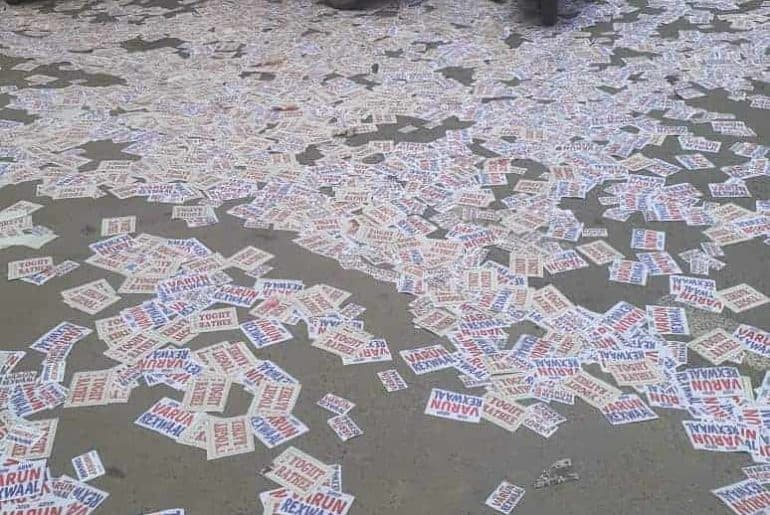
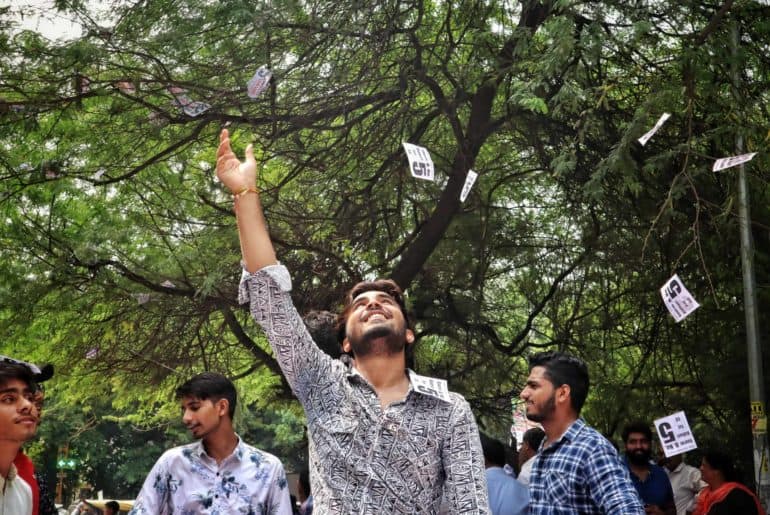
While walking through the streets of North Campus during campaigning months, one will come face-to-face with pamphlets, flyers, posters, brochures, and press invites littered on the roads. Students with political affiliations throw these posters out of their cars to ‘promote’ their leaders. Colleges like College of Vocational Studies, Shaheed Bhagat Singh College, and Sri Venkateswara College in the South Campus, which are affiliated to the DUSU, also bear the brunt of such hooliganism.

During the 2015 DUSU elections, as reported by The Hindu, the National Green Tribunal (NGT) issued a notice to the Centre, the Ministry of Environment and Forests, and the University Grants Commission (UGC) on the huge amount of paper being wasted in campaigning. Similarly in 2017, as reported by Firstpost, in an article titled “In North Campus, Student Bodies kick Swachh Bharat Abhiyan out of the Window”, Delhi High Court and the NGT expressed their shock over the massive misuse of pamphlets, flyers, and posters during the DUSU elections.
Since then, certain walls in the Campus were designated as the ‘Walls of Democracy’ where one was allowed to paste as many election-related posters as they wanted. But, even the 2018 elections saw the brunt of major exploitation of paper to an extent that the then sitting President, Rocky Tuseed, carried out a cleaning drive and removed the posters from near the Vishwavidyalaya metro station.

Despite being condemned over the years for their excessive use of paper in printing pamphlets, brochures, cards, and invites, the DUSU elections continue to be a hub of ecological hazard, producing extensive amounts of paper waste and littering the whole of North Campus by sticking posters on walls and littering flyers on the roads. Chhatra Marg still remains the most affected where a week before elections, we can see posters and pamphlets in every corner and niche.

As decoded by ScoopWhoop Unscripted in their video titled “How to Win a DUSU Election”, “the posters are simple and cheap; you can see it stuck on walls all over Delhi, that’s when you know that the Delhi University Elections are here.” One would believe that posters become a cheap method of promoting a campaign, inviting the masses to events organised by a particular party, and facilitate mobilisation. But, the aforementioned video revealed that INR five to six lakhs are spent in the printing process.
On the other hand, the Lyngdoh Committee, set up in 2006, only allows a small budget of INR 5,000 for campaigning and election-related activities. It also states that only handmade posters are to be used for canvassing and campaigning.

Hence, the huge waste of paper in DUSU elections is not only ethically and morally wrong, but it is also illegal.
Jaishree, a third-year student from Ramjas College pursuing B.A. (Honours) History, stated, “Nothing has changed here in the last three years, the walls are still decorated with multiple posters of the same candidate, underneath it lie decaying posters of yesteryear candidates. The heaps of garbage that the karamchaaris are made to clean every day is alarming. With climate change upon us, you’d really think that candidates would give a damn about the environment, but no.”

Feature Image Credits: Prabhanu Kumar Das

Sakshi Arora

sakshia@dubeat.com 

This year’s voter turnout for the Delhi University Students’ Union (DUSU) polls saw a considerable dip. The voting process in a few centres and colleges saw hiccups pertaining to a clash between the students and the Electric Voting Machines (EVMs).

The past month in the University of Delhi (DU) campuses and colleges saw a flurry of activities characterised by loud sloganeering, flashy SUVs and a lot of campaigning for the recently concluded DUSU polls.

The voting percentage in this year’s polls saw a considerable dip of four percentage points, this year. The overall voter turnout was recorded at 39.9%. The 43 morning colleges and departments which had conducted polling for independent posts as well, registered a voting percentage just below 40%, at 39.89%, which is over three percentage points less than last year’s 43.8%.

This year’s percentage turnout dipped below 2012’s 42.5% and came close to 2016’s lowest percentage of 36.9%.

Polling at nine centres, where voting went on till 7:30 p.m., as well as in the 43 colleges where voting concluded at 1:00 p.m., saw a footfall of close to 52,000 voters in all. Over 1.3 lakh students were eligible to vote in this year’s polls. This excludes the number of eligible voters in colleges of the varsity that are not associated with the DUSU such as Lady Shri Ram College, St. Stephen’s College, Daulat Ram College, etc.

Colleges also voted for their particular college union posts and even as the counting was underway, the Akhil Bharatiya Vidyarthi Parishad (ABVP) stated that it had won at least one post out of all, in each of the 35 colleges. “We have swept the entire panel in Bhaskaracharya College, Ramanujan College, Rajdhani College, and Shri Ram College of Commerce. We are finding out the numbers by and by,” claimed the ABVP’s media in-charge Ashutosh Singh, in conversation with the Indian Express. Meanwhile, the National Students’ Union of India (NSUI) claimed that it was leading the Union and was in the majority in 22 colleges. The ABVP has emerged victorious in the polls this year, yet again, with three of the main panel posts (those of President, Vice-President, and Joint Secretary) being bagged by them. Only one seat of the panel, that of the Secretary has gone to the candidate from the NSUI.

The day’s voting also saw a couple of hiccups along the way. The NSUI complained about police presence after their Joint Secretary candidate Abhishek Chaprana was detained by police from Dyal Singh College. He was later released after being questioned briefly, The NSUI also complained about EVM malfunctioning at Aryabhatta College. “…in Aryabhatta College, the EVM is malfunctioning against NSUI. When the ballot is pressed for NSUI candidate, the EVM does not light up to indicate the registration of vote… We say no to elections being hijacked by thugs and frauds,” said NSUI’s national in-charge Ruchi Gupta.

The University’s election office denied it to be a case of EVM malfunction, but replaced the machine nonetheless.

Feature Image Credits: Namrata Randhawa for DU Beat

Bhavya Pandey

bhavyapandey08@gmail.com


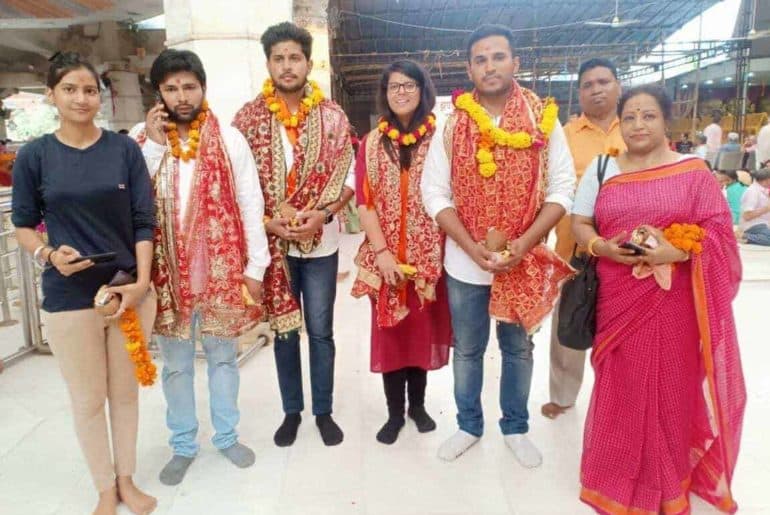
National Students Union of India (NSUI) issued an official complaint against the candidates of Akhil Bharatiya Vidyarthi Parishad (ABVP) for visiting the Jhandewalan Mandir on Sunday, 8th September 2019 and posting about the same on social media.

The National Students Union of India (NSUI) recently condemned its opponent, Akhil Bharatiya Vidyarthi Parishad (ABVP) for adopting the practice of religion and religious symbols for the purpose of political campaigning which stands in direct violation of the Lyngdoh guidelines which all students contesting the Delhi University Students’ Union (DUSU) elections are supposed to abide by, in order to not encounter direct disqualification.

In 2005, the Supreme Court decided to set up a committee to ensure measures that would hamper disruption caused by college elections. Following the order of the Supreme Court, a panel was set up by the ministry of Human Resource Development headed by the then Chief Election Commissioner, J.N Lyngdoh for the same, limiting the democratic functioning of the Student Unions and was called The Lyngdoh Committee.

The Lyngdoh guidelines clearly state that:

“No candidate shall indulge in, nor shall abet, any activity, which may aggravate existing differences or create mutual hatred or cause tension between different castes and communities, religious or linguistic, or between any group(s) of students.”

According to the allegations made by NSUI, the following four candidates of Akhil Bhartiya Vidya Parishad (ABVP), Akshit Dahiya (President nominee), Pradeep Tanwar (Vice President nominee), Yogit Rathee (Secretary Nominee) and Shivangi Kharwal (Joint Secretary Nominee) along with Professor Manu Kataria of Bhaskaracharya College of Applied Science (State President of ABVP Delhi) were sighted using religious symbols for their campaigning. Later, a Facebook post was uploaded by the Presidential candidate Akshit Dahiya in which they visited a famous temple in Delhi wearing religious garments while making an appeal to vote for them, which disregards the Lyngdoh guidelines for social media campaigning as well.

Apart from this, under the Delhi University Act, any Professor under the paid role of Central Government is not allowed to display their political affiliation in public but sources have also proclaimed that Mr. Manu Kataria endorsed candidates for the DUSU election, hence violating the Delhi University Service Rules.

As per sources, NSUI has registered a formal complaint on the issue and made a request to the Election Officer to constitute a Grievance Redressal Hearing against the violators under the Lyngdoh guidelines and withdraw their nomination at the earliest as it is against the norms of free and fair elections.

Shri Akshay Lakhra, NSUI Delhi State President stated, “NSUI will ensure no polarisation of University takes place. ABVP already used cheap rhetoric this election by illegally putting up the statue of a highly controversial figure Damodardas Savarkar. When the move failed, they retorted to further downgrade cheap theatrics of using religion as a tool to safeguard their defeated campaign. Delhi University students are not going to be fooled by such rhetoric of ABVP again after the fake degree issue, and would give a sounding reply to them in upcoming student union elections.”

Following this news, the students of University of Delhi didn’t take it as a surprise that candidates do not follow the guidelines established for running a campaign, they believe that the Lyngdoh Committee is not a solution to strengthen or improve the prevailing conditions of student politics and DU stands as a classic example of its failure in limiting money and muscle power politics.

Feature Image Credit: ABVP Media

Avni Dhawan

avnidhawan09@gmail.com