Tag

North Campus

Browsing

The following piece seeks to understand the superimposition of dominant ideological narratives on cultural events. It does not, in any way attempt to disrespect the cultural/religious beliefs of individuals.  

Delhi University has often been described as an educational space for multiculturalism and diversity, where students from all over India intermingle and share their cultures with one another. Very often, students bring to the university campus, festivals and celebrations from different corners of the country which helps them create a sense of community far from home. It is an act of claiming a space, far from one’s homeland that initiates intercultural interaction and contributes to the richness of the campus spaces.

However, is the culturally diverse space that many of us would like the university to be, a utopian imagination? Cultural expression is often monopolised by dominant majoritarian communities that can afford to be more visible and vocal. How do we distinguish free cultural expression from ideological imposition? Furthermore, what happens when politically motivated ideologies are superimposed on cultural festivals?

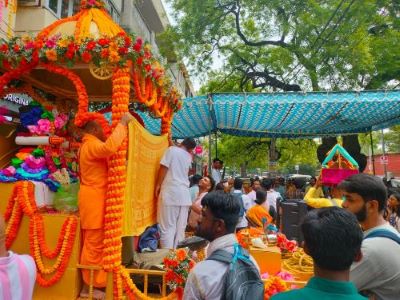
On 22nd June, the Delhi Odia Students’ Association (DOSA) in collaboration with the Iskcon Student Centre organised the Jagannath Rath Yatra in the North Campus of Delhi University. It goes without saying that the Rath Yatra is a festival that is extremely close to the hearts of the devotees of Lord Jagannath. People from different socio-economic backgrounds come to join the procession, hoping to get a glimpse of the deity. People are often seen crying, overwhelmed to see the lord.

But can an event that is often hailed for its inclusive quality, retain its cultural ideals and innocence when it becomes so visibly saffronised? It is true that perhaps every cultural or religious festival is influenced by certain belief systems, but when the belief system is aligned with an ideology which translates into an aggressively asserted political agenda, it becomes potentially dangerous.

The political alignment of the procession organised in the campus was not simply reflected in symbols, but was also verbalised on certain occasions. The event began with an open and unapologetic assertion- ‘Bharat ka dharam, Sanatan dharam’, (The religion of India is Hinduism) and ended with Jai Shree Ram chants. The procession, adorned by huge saffron flags, traced the campus with hundreds of people joining in. The devotees danced and sang along; the sentimental and cultural essence of the procession could be felt. At the same time, the markers of it being a politically aligned procession were hard to ignore.

One could obviously argue that Jai Shri Ram chants in a Jagannath yatra is not arbitrary because Ram and Jagannath are essentially different avatars of Lord Vishnu. In today’s India however, Jai Shri Ram is an immensely politicized slogan – one that is rooted in majoritarian beliefs of Hindutva. To say that it is an innocent appeal to lord Ram is to disregard the persecution faced by thousands of people from minority communities, against whom the slogan has been weaponised.

Before the commencement of the yatra, an elaborate speech was given which emphasised upon values of devotion, servitude and gratitude. The cultural belief system of a Brahmanical conception of Hinduism was presented as the moral standards of India. While science, modernism and ‘western’ values received censure, the ‘Indian’ way of life was pedestalised. It must be noted that the Jagannath Rath Yatra at Puri has no custom of preaching. Everybody joins the event as a devotee and no authority figure is given the centre stage. Representatives from the Akhil Bhartiya Vidyarthi Parishad (ABVP) – a right wing student organisation affiliated with the Hindu nationalist RSS – were formally present in the event.

The Rath Yatra was provided immense police protection. It is entirely valid to ensure police deployment in cultural festivals to ensure orderly execution of the same. However, the sincerity with which police protection is provided to events that exude right wing sentiments is entirely absent when students get attacked by mobs on campus. When a mob of men, gate-crashed the college fest at Indraprastha College for Women, raised misogynistic slogans and Jai Shri Ram chants and harassed women, the police did little to ensure their safety. The police has acted either as passive observers or violent upholders of law in situations like these.

When a religious event is distorted and appropriated to further a political ideology, the cultural and emotional essence of the festival is hurt and disrespected. Although the devotees attending the rath yatra did not express concern regarding the nature of the yatra, the ideological undertones were felt without doubt.

The Jagannath Yatra is very close to our hearts. Devotees wish to remain connected with the lord Jagannath and seek his blessings. It is an expression of unadulterated and innocent devotion. It is not supposed to be used to further any ideological agenda” – Aditi Routray, a student at LSR


Featured image credits – Tulip for DU Beat

Read also – https://dubeat.com/2023/04/04/the-invasion-of-ipcw-a-students-account/

Tulip Banerjee

[email protected]

The Akhil Bhartiya Vidyarthi Parishad organised a protest at the Aryabhatta College on 21st June, in order to express concerns regarding student safety and student welfare in the campus. The college administration received condemnation from the protestors for apathy and indifference towards student issues.

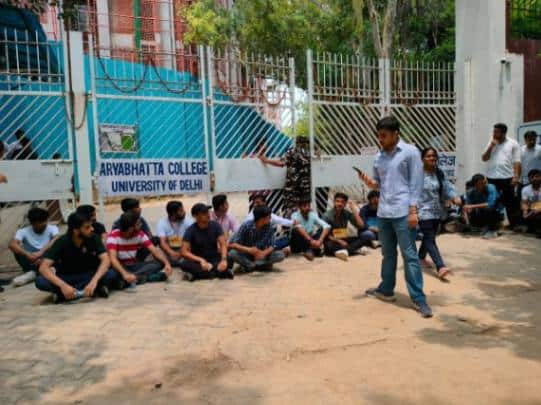
On the 21st of June, the Akhil Bhartiya Vidyarthi Parishad (ABVP) organised a protest at Aryabhatta College in the South Campus of the University of Delhi. The protest was reportedly organised in order to condemn the inability of the college administration to ensure student safety in and around the college campus. On 18th June, a 19-year-old student named Nikhil Chauhan was allegedly stabbed to death outside the Aryabhatta College. The protestors blamed administrative negligence and poor security conditions around the college campus for the murder.

The protest, which was scheduled at 10:30, finally began at 11:30 and lasted for about 2 hours. The protestors reportedly bolted the college gates, not allowing students and faculty members to enter the campus. The protestors raised ‘vande mataram’ slogans and ‘bharat mata ki jai’ chants while asserting their demands.

The members of the ABVP made a list of demands that included – recruiting more female security guards, ensuring the availability of sanitary pad vending machines, renovating washrooms across the college campus etc. While some of the demands were specific and aimed at student welfare, other demands such as – “proper and strict action should be taken against incapable and abusive admin staff” were vague and incomprehensible. The protestors were mostly men and very few women were present at the site.

A student getting murdered right outside our college is a big deal. This could have been prevented. No action was taken by the admin staff even though they were aware of the fight between the victim and the accused that happened a week before the murder. The administration has been apathetic to student concerns. Students have to struggle for days even to solve minor issues. Our sports ground has been out of use for the past four months. We have made a list of demands addressing these concerns that we intend to place before the principal.” – Tarun Yadav, ABVP President for Aryabhatta College

The students, after staging the protest outside the college, marched inside the campus, raising slogans and vocalising their demands. The members of the ABVP expressed that they intend to place their demands in a meeting with the principal. There was tussle between the members of the admin and the protestors that resulted in chaos. Four representatives of the ABVP finally met with the principal and a meeting was held in order to discuss the concerns raised by the protestors. After the meeting, the members informed the protestors that almost all their demands had been readily accepted by the principal.

There was considerable police presence at the protest site. On being asked about how they feel about the deployment of police forces at the college, an ABVP representative stated that the police was present to help them carry out the protest without interference.

The police forces are not here to suppress our protest. They are here to ensure our security and to prevent any unwanted interference from other parties.” – Tarun Yadav, ABVP President for Aryabhatta College

Read also – https://dubeat.com/2023/06/20/a-delhi-university-student-stabbed-to-death-outside-of-aryabhatta-college/

Featured Image Credits – Pratik for DuBeat

Tulip Banerjee

[email protected]

After issuing suspension notices and imposing fines on students for protesting, Hindu College is reconsidering its move. The students have submitted written apologies to the administration, and the principal is reportedly willing to let students explain themselves and address their concerns.

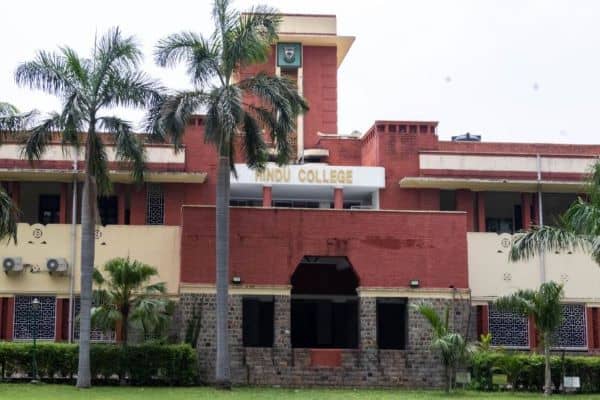
The Hindu College administration had issued notices suspending around 40 students and demanding a fine of Rs. 10,000, citing “gross misconduct” by students protesting against the administrative decision to reduce Mecca to a one-day event. The notice firmly stated that the students would not be allowed to take their semester exams if they failed to pay the fine. It further stated that they would not be allowed to hold any post of responsibility in the future and that “any repetition of such or other misconduct in the future will be treated with the utmost strictness, to the extent of rustication”. Additionally, 15 students have received a notice for financial fraud and cheating. The notice also alleged that the protesters caused damage to college property and behaved disrespectfully towards the principal, blocking her way and not letting her attend an official meeting.

However, after some deliberation and discussions, the principal, Ms. Anju Srivastava, is reconsidering the suspension. On the evening of May 9, a day after the suspension was issued, the principal reportedly held a meeting with the students. The students put forward their demands and concerns regarding the notice and requested that it be withdrawn.

They (the students) have given us verbal apologies and written apologies. We will give students another chance to put forward their sides. We are open to discussion with them. I have asked the disciplinary committee to look into each application separately on an urgent basis. The work has started. We will soon inform the students.

– Ms. Anju Srivastava, Principal of Hindu College, in conversation with PTI

The principal stated that the students will be given a chance to explain themselves and that their apologies will be accepted. It has been stressed that every student’s application will be reanalyzed in depth. The suspension notices drew widespread criticism from students involved in the protests. The students initially stated that they would resort to protesting against the suspension and the imposition of fines if they were not withdrawn.

The RSS-affiliated student body, Akhil Bharatiya Vidyarthi Parishad (ABVP), came out in support of the students and requested the administration withdraw the notice at the earliest. Despite all efforts to encourage dialogue between both sides, whether every student will be spared suspension is uncertain.

Read also: Hindu College Suspends and Issues Fines for Protesting Students

Featured Image Credits: Keshavi for DU Beat

Tulip Banerjee 
[email protected] 

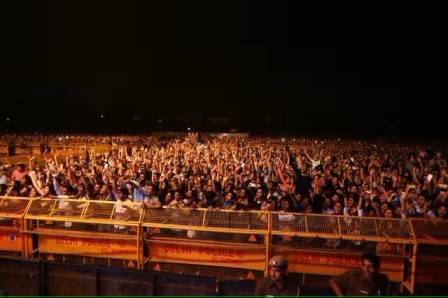
The annual festival of Hindu College, ‘Mecca’, has allegedly been put in jeopardy by an administration order to reduce the 3-day, star-studded event to just 1. Students of the college have reportedly gathered outside the college gates to stage a protest against the same.

An important cultural event in the college calendar, this year’s ‘Mecca’ was scheduled to be held on the 26th, 27th, and 28th of April, culminating in a megastar evening on the final day with Sunidhi Chauhan. Agreements had been made, and Coke Studio had signed up for sponsorship of about Rs. 34 lakhs. However, with the event just a week away, on April 20, the organising committee was informed by the college principal that the event should be wrapped up in a single day, i.e., April 28.

This order by the administration was reportedly in part due to the recent advisory issued by the University for  college fests requiring NOC from the police or being limited to the students of the college. Students who have been working hard for months for this event have come out to protest against this arbitrary decision. The organising committee has also opposed this decision, saying that MOUs have been signed and all the arrangements have been made. The college administration has also allegedly made the distasteful demand that Sunidhi Chauhan be dressed in a saree; otherwise, she won’t be allowed to perform on stage, as a gimmick to stop the event from taking place.

“The admin has shown a similar attitude towards every event. We had a North-East Fest in our college which had an open entry, but the principal denied that just one day before the event. They’ve always opposed Mecca from the first day, but if they’re letting it happen, why cancel at the last moment? Coke Studio can easily file a case against the OC head of Mecca for breaking the MOUs.” – Devesh Arya, a third-year student at Hindu College

According to sources, various protesters allegedly came to the college on the night of the 20th, breaking the locks of the gates and protesting for Mecca to be held according to the original itinerary of 3 days. The next morning, they reportedly didn’t let the professors into the college as a sign of protest. Later in the day, they shifted their protest to the principal’s office. While some students alleged that protesting students were detained by the police and lathi charged, others have claimed otherwise. On the same day, i.e., the 21st of April, the principal issued a notice stating that they “were anguished to the state that they were left with no choice but to seek police assistance”.

“Students have crowded outside the auditorium since last night; they’ve spread the mattresses and are continuously protesting. Since then, the principal has also made many attempts to leave the premises, but every time was stopped by protesting students.” – An eyewitness from Hindu College

Many people in the organizing committee claimed having their own money pitched in, but now that there are limitations on the people allowed to attend the event, the students fear that the sponsors will back out and also tarnish the name of the college.

“We don’t have any additional demand; we just want to continue with the same old format that Mecca used to happen. This is all our demand, and as long as it’s not fulfilled, we will continue to protest. A meeting with the principal happened, but no response was received.” – Prabal Mishra, a student of Hindu College and Junior Executive Head in PR

Read also: ‘No event without Police NOC’: DU Releases New Guidelines for College Fests

Featured Image Credits: Devesh Arya for DU Beat

Samra Iqbal
[email protected]


The Maulana Azad National Fellowship Scheme provided 5 years of financial support to minority scholars.

On 12th January 2022, members of the SFI (Students’ Federation of India) demonstrated against the government’s discontinuation of the Maulana Azad National Fellowship Scheme in front of the Ministry of Education, as well as at the University of Delhi and Jawaharlal Nehru University. Also part of the protest were members of the All India Students’ Association (AISA), Maulana Azad National Urdu University, Students’ Union (MSU), Krantikari Yuva Sangathan (KYS) and JNU Students’ Union, as well as students from institutions across the capital. The Maulana Azad National Fellowship was launched in 2009 and provided financial support for five years to students from six notified minority communities: Buddhists, Christians, Jains, Muslims, Parsis and Sikhs who were pursuing MPhils or PhDs.

While the government has claimed the decision to roll it back was taken because it overlapped with other schemes, opponents have argued that this justification is invalid, as students cannot benefit from more than one educational scheme in any case. They have also pointed out the discontinuation of other government aid such as the pre-matric scholarship for SC, ST, OBC and Minority students. They see this decision as part of a larger attack on minority scholars.

Shakir, a PhD student from DU, and a recipient of the MANF, told edexlive.com that following the decision he will essentially have to stop my research, or rush through it to submit it soon.” 

My academic journey will stop here. There are costs associated with being a research scholar that I cannot bear without this scholarship.” – Shakir, in conversation with edexlive.com

The protestors have alleged that they were manhandled by the police, being dragged across the road and shoved into buses despite demonstrating peacefully. Several students sustained injuries, and over 100 were detained at the Mandir Marg Police Station.

As far as I saw, all of the policemen at the protest were men and they seemed hostile right from the beginning. They soon began to push and shove us around, including the female protestors, and even those who were not seriously injured came out of the experience battered, both physically and otherwise.” – an MA student at the demonstration.


The student is not a member of any student political organisation, but attended the protest as she fears that the discontinuation of the MANF and other schemes like it will prove disastrous for her career as a scholar.

Feature Image credits: DU Beat

Shriya Ganguly

[email protected]

With the rosy season of auditions going on, this is an introduction for freshers to the dark side of DU Societies.  

As the audition season approaches, one could have seen the college areas buzzing with auditions. On the online campus, it’s a bit different; the society’s social media pages, which have been abandoned for long, now become the main agenda of society meetings. All of a sudden, reels are being posted, and you see clips of happy members of societies playing along, some on screens while some on the ground, and a Ritviz song playing in the background. The usual words that will be used in these videos are “family”, “creative community” and every adjective you can imagine for a bunch of happy undergrads. But are societies really this happy, or is it just the poster happiness to lure in freshers?

(Obviously, not all societies fall into this category, the main aim is to introduce freshers to the toxic side of DU societies.) A lot of societies are run by seniors who exercise control over all the functioning. At some colleges, administration or the teacher or convenor intervene, but at some, they don’t pay any heed. Some societies have also faced such extreme obstruction of administration that even their performances have been canceled, whereas the bullying by many societies goes unchecked due to no surveillance. (Societies should ideally lie between this tussle of control, where admin maintains minimum control but a required check, but hey, we are in DU!)

A hierarchy is maintained among all the members to maintain ‘discipline’. But this setup often leads to toxicity as seniors in positions of responsibility take undue advantage of their power. The societies that should act as communities housing creative talent become a powerhouse of trashy politics and toxicity, where bullying and ragging houses.

Recently, such a situation came to light during the auditions of Finance Investment Cell of Hansraj College, about which a first-year student said,

During our Finance Investment Cell interviews, the core team members made us dance against our will, I felt uncomfortable but since I wanted to get into the soc, I had to go with the flow. Later on, they were boasting about the fact that they made us do squats, dance, and sing in the interviews during our induction meeting.” 

First Years who are already ridden with anxiety get pushed underneath the wish of being in the cool circles of college and fail to report such behaviors, and the cycle of toxicity continues. Another student from a dance society shared their experience in a conversation with DU Beat.

This certain level of hierarchy restricts our freedom as an artist and as a person. The role of unions should be to represent the members of the society and to guide us, but it feels like someone has given them authority and they just want to show it off.”

Even in the online mode, several students have suffered terrible things at the hands of societies. With the second batch moving into the online campus, we need to configure our thinking accordingly. If the cultural front of the university keeps on reeking privilege and toxicity, the development of the individual would be a far-gone concept here. It’s high time proper redressal forums (talking about Cultural Secretaries) work in every college to respond to all grievances and dismantle these toxic hierarchies.

[email protected]

Kashish Shivani

Following the recent events, we tried to locate what language our nation speaks—of hate or of Mir?

“I knew that language is the most private and yet most public things.” – Arundhati Roy, In What Language Does Rain Fall Over Tormented Cities?

What language do we speak altogether, collectively as a nation? 780, or the ones actually recognised? Of love or of hate? Do we even speak together, ever?

I learned in my history class about imagined communities. Are we just one true imagination that exists with all its hypocrisies with just one name that binds us together? The peculiar curiosity about your identity starts somewhere around our age only, I think India never got out of that phase, she is still trudging the path of curiosity to know all about it.

Being trilingual, I get how difficult it can be to brainstorm with three words meaning something somewhat similar but never the exact same. How does India manage with so many? We read about diversity since first grade. In the language, I read it, “Anekta mei ekta.” At times, I think her diversity could never get out of this essay. It tried and tried, but it was such a high pedestal that returning was never an option, but we found out her invisibility on the streets at times, for we all read or maybe heard it – India: A Land of Diversities.

But whose language does India actually speak? Of Ghalib or of those who went rallying against Fab India when it named its Diwali Collection Jashn-e-Riwaaz, which loosely translates into a celebration of tradition.

The social media went mad with hails of ‘NO Abrahaminsation of Hindu Festivals’. And amidst this, a Markazi Khayal came to me that what word could we substitute for Khyal in Kabhi Kabhi mere dil mei Khayal aata hai? Or maybe what would we substitute when the people actually discover that the words Hindi, Hindu and Hindostan are from Persian Arabic? Did I miss a class of Language partition when the words of Urdu casually entered the conversations and even a bit of Shudh Hindi found its place with slang from the local dialect?

The Partition happened when, during the British era, the Hindustani language broke up into Hindi and Urdu, and since then, the graph has been up and down with the ‘language’ that we decide to speak publicly, sometimes of hate and sometimes of mir.

According to a research paper about the decline of Urdu sounds,

First, the decline of Urdu sounds began in the 1990s, which marks the rise of the Hindutva politics and the beginning of the mushrooming of cable television networks.”

So, this is the language I have been referring to the language that the current hegemony chooses to speak.

A good thing about Grammarly is that you can set the tone of language that you want to deliver your content in, and it rectifies the words accordingly. What would the tone be when people don’t let Munawwar Faruqui perform in Goa for 500 people would set themselves on fire. The organisers received threats from several Hindutva groups, and shows in Raipur, Surat, Ahmedabad, Vadodara and Mumbai had to be cancelled. Munawwar was also arrested for a joke he did not tell, and the apex court that granted him release said the tone of the FIR was vague and no apparent reason for his arrest.

Clearly, the cancel culture in our country goes a different way, where the dominant group shuns the language that it does not want to hear, be it just the name of the collection, an advertisement that talks of love bonds, or anything that might prick the forces of Hindutva. Who will be the next Kaifi saheb, perhaps Ghalib or the true sense of diversity that we talked about on pages?

Although Hindi’s victory has been a resounding one, it does not seem to have entirely allayed its keepers’ anxieties. Perhaps that’s because their enemies are dead poets who have a habit of refusing to really die.” – Arundhati Roy, In What Language Does Rain Fall Over Tormented Cities? 

There is a linguistic relativity hypothesis that says our language shapes our thought, and Arundhati writes in her essay that a country’s public language is its own public imagination. So, the next time you say ‘ye Ishq nahīñ āsāñ itnā hī samajh liije ik aag kā dariyā hai aur Duub ke jaanā hai’ know that in the current context it literally applies to the word Ishq for someday people might take offence for its existence because of its source.

All this is to say that we in India live and work (and write) in a complicated land, in which nothing is or ever will be settled. Especially not the question of language. Languages.” – Arundhati Roy, In What Language Does Rain Fall Over Tormented Cities? 

Kashish Shivani

[email protected] 

Fresh out of school, I was eager to join North Campus. I’ll put it simply. As cliché as it might sound and as annoying it might seem to my South Campus peers, North Campus is a world of its own. A world of the students, for the students, but not by the students.

A World where e-rickshaw drivers surround you like paparazzi, where Swiggy and Zomato give conveniently priced deliveries for the students, and where some lose their virginity. A world where some change their mentality (for good or bad reasons), some smoke their first cigarette or eat their first ‘malnourished’ momo in Kalyan Vihar, Vijay Nagar, or Kamla Nagar or non-Delhiites get to face some classic racist hate (again in Kalyan Vihar, Vijaynagar, or Kamla Nagar).

Where students, and even teachers come down to protest at the Arts Faculty when an obstacle arises, and great fests happen with mainstream musicians; and all the funds get drained with it. A world where all social classes have their own peer groups but unite under a common umbrella called the ‘College Canteen’. A world where attendance matters but doesn’t really matter.

A world where some sheltered kids get reality checks and try to change society in their little ways, and others become pseudo-intellectuals with their double-faced hypocrisy. A world where few become the future leaders by dominating student wings in the Students’ Union, like a gang of goons rather than a parliament of politicians, yet, there are more kids who tend to escape from the harsh realities and put their entire focus on studies. And then there are those who don’t exist in the real world; and only exist by the virtue of their involvement in the cultural societies of their college.

My point is that even though I have been living in this world for three years and I am to be a veteran soon as my course is about to end, I still can’t give you a guide to this world. That’s simply because it’s just so diverse as I have mentioned above. You are bound to be changed in various ways depending upon what path you take in North Campus. But that’s the thing about North Campus, most of us hardly chose paths consciously and some just choose us.

Okay, now, that just sounded ridiculously pretentious and poetically unrealistic. But what I mean to say is, if you are still going to be a student in North Campus (or even South Campus), try exploring the world which I tried describing in the aforementioned 400 words. This world might seem to get more Orwellian day-by-day, and soon after graduation we might become slaves to a larger system (I will have to see what happens when I reach that stage), so it’s better to make the best of our time in this Campus as much as we can.

I’m not saying burn your books, roll their pages into joints, smoke them up, and explore the city every day. Study, Wander, Write, Play, do whatever you want as long as you’re not harming anyone (so please don’t touch people at a college fest non-consensually, drive your car like you’re the DUSU president at a speed so high that a dog gets injured, or indulge in other miscreant behaviour of that sorts). If you hate the world of North Campus, then judge the living hell out of it and its people, and have a good laugh. Meet people, eat street food, throw around opinions, discern them, debate them, discuss them, sit idle in the college field. Study, surely study, but at the same don’t forget exploring this world you’re in. Because that world will give you knowledge that’s not in any sample paper or online module.

What knowledge awaits for you to be learned by in this Campus? That’s for you to find out.

So long,

Shaurya Singh Thapa,

Soon-to-be Ex-Web Editor, DU Beat.

Image Credits: Akarsh Mathur for DU Beat

Shaurya Singh Thapa

[email protected]

Among the most premier institutions in the country, the University Of Delhi has thousands of outstation students on its rolls, both at the undergraduate and at the postgraduate levels. Thus it was deemed necessary for the university to construct hostels to house these students.

From Assam to Afghanistan, Nagaland to Nepal, the University Of Delhi receives a significant number of outstation students every year. To accommodate this huge influx, the university has built numerous hostels in both the campuses. Besides that, many colleges have their own hostels for undergraduate students – St. Stephens’s College, Sri Venkateswara College, Hansraj College to name a few. Most of these hostels charge nominal fees, and since many students have financial constraints, the demand for rooms here is extremely high and allocation is usually merit – based. Students also prefer hostels due to the proximity to their place of study as well as for security reasons. We take a look at a few notable ones – 

Mansarovar Hostel 

MansarovarHostel_HostelsOfNorthCampusAndSouthCampus
Image Credits : Mansarovar Hostel

Situated in North Campus opposite Khalsa College, the Mansarovar Hostel was constructed in 1993. It has 167 seats and houses male post graduate and research students of the university. Amenities include a dining hall, gymnasium, air-conditioned reading room and a computer room. Located in a slightly secluded spot, the hostel provides a respite to its residents from the hustle and bustle of the campus. Though during DUSU elections, the hostel is usually considered a hotbed of political activity. “I have made countless memories while staying at Mansarovar, and the constant interaction with people from diverse backgrounds has helped me grow immensely as a person”, said Meraj Alam, a Ph.D researcher and resident.

Aravali Hostel

AravaliHostel_HostelsOfNorthCampusAndSouthCampus
Image Credits : Aravali Hostel

Established in 2005, the Aravali Hostel, located on Benito Juarez Marg, provides accommodation to male post graduate and research scholars studying in South Campus, with a total of 76 seats.  The hostel has facilities for table tennis and badminton, a dining hall and a recreation centre. 

Geetanjali Hostel

GeetanjaliHostel_HostelsOfNorthCampusAndSouthCampus
Image Credits : Geetanjali Hostel

One of the newer additions to the list of university accommodations, the girls-only Geetanjali Hostel is located in South Campus and takes in post graduate and research scholars, with a total of 102 seats. The hostel has a computer centre, library, gym and sports facilities. The boarders also host an annual function “Mridang”.

Gwyer Hall

GwyerHall_HostelsOfNorthCampusAndSouthCampus
Image Credits : Just Dial

With its sprawling lawns, rows of palm trees, huge arches and symmetrical corridors, one might mistake the Gwyer Hall for a colonial era monument at first glance. Among the most iconic and also the oldest hostel in the university, the Gwyer Hall has been a site of numerous historic events and produced a long list of illustrious alumni since its inception in 1938. Named after Sir Maurice Gwyer, a former Vice Chancellor of the university and the founder of Miranda House, the Hall is situated in North Campus, opposite the University Stadium and accommodates 158 post graduate and research students. “The years I spent at Gwyer Hall are the ones I cherish and remember the most. I often pay a visit once in a while to eat the canteen’s much loved meetha samosa”, quipped Pradeep Jain, a Delhi University professor and a former resident of the Hall. Indeed, the Gwyer Hall canteen, run by Pandit Ji, is famous for the unorthodox menu it has on offer – butterscotch lassi, butter masala Maggi and the flagship sweet samosa amongst others.

Meghdoot Hostel

MeghdootHostel_HostelsOFNorthCampusAndSouthCampus
Image Credits : DU Beat Archives

Located opposite the School Of Open Learning in North Campus and secluded from the main road by a canopy of trees, the girls-only Meghdoot Hostel was inaugurated in 1992. It houses full time post graduate and research students, with a capacity of 100 seats. The hostel is equipped with a computer lab, common room, dining hall, medical centre and sports facilities. Meghdoot is known for its strict administration and tight security– a curfew was imposed on the day of Holi in 2017, sparking controversy.

International Students House

InternationalStudentsHouse_HostelsOfNorthCampusAndSouthCampus
Image Credits : DU Beat Archives

Located beside Mansarovar Hostel and probably the first building which a person driving towards North Campus sees, the men-only International Students House was set up in 1964 with the efforts of the Indian Council For Cultural Relations to provide accommodation mainly to foreign students studying in the university. ISH has 98 seats in total, with 68 reserved for foreign students and the rest for Indian students. Currently students of more than 35 countries reside here, both undergraduates and postgraduates. The International Students House For Women is situated a few kilometres away in Mukherjee Nagar. ISH has been devoid of any notable controversy since its inception, a testament to the unity and harmony enjoyed by students from across the world living together.

Other notable hostels include – Jubilee Hall which was founded to commemorate the university’s silver jubilee in 1947, VKRV Rao Hostel which was founded in 1999 and houses research scholars from FMS and Delhi School Of Economics, Rajiv Gandhi Hostel For Girls which houses a large number of students from Northeast India, DS Kothari Hostel and the Ambedkar-Ganguly Students House.

The government should allocate funds to the University Of Delhi for construction of new hostels for both men and women keeping in mind the rising hostel: student ratio.

Image Credits – International Students House

Araba Kongbam

[email protected]


Trigger Warning: Sexual Assault

A woman, who has asked not to be named in the report, recently posted several stories on Instagram, alleging that Vaibhav, a student from Delhi University sexually assaulted and forced himself on her.

One of the stories posted by her describes the incident. It states that she met Vaibhav on 13th march, with whom she had connected with on Instagram. After meeting him, she had to go to a party to which she invited him, the party ended at 2 A.M. At that point, Vaibhav had suggested that he would book an Oyo but out of courtesy and considering safety, she invited him to spend the night at her flat.

The story goes on to say “at around 3 A.M, Vaibhav started touching me a bit sexually and I pulled away to make it clear that I am not interested. Guess he could not take a no and started forcing himself on me, I pulled away, said no a billion times, asked him to stop, begged, told him that he was making me uncomfortable and that I was scared while he pinned my hands against the bed and kept assaulting my body. When I kept saying please stop, he replied with “HOW? HOW DOES ONE EVEN STOP?” While I kept shivering under him and telling him that I am scared, he replied with ” WHAT ARE YOU SCARED OF? BACCHI THODI HAI? HAVE NOT YOU HAD A BOYFRIEND?” my body felt numb and weak and I was constantly shaking.” She also posted screenshots of the conversations with Vaibhav after the incident, both of which have been attached below.

image 2 image 1

On reaching out to Vaibhav, he completely denied the allegations stating that while they had gotten “intimate” at the flat when she had stated that she was uncomfortable, he “stopped getting physical with her and promised we won’t be.” He further goes on to point out how he had tried several times to leave at the party from her friend’s place and had even booked a cab to go back home and later an Oyo, both times he says that she had asked him to stay and told him there was no problem with staying. He repeatedly points to him being uncomfortable and how he tried several times to leave as a sign of his innocence. He also alleges that there were four other people in the flat and she was under the influence of alcohol. He states that he has been fired from his job on the 15th after the allegations reached his employers and how he has been bombarded with messages targeting him, his friends, and his family.

When we reached out to the victim, she stated that she tried to file an FIR yesterday but didn’t do so as she didn’t want the news to reach her family. When asked about how Vaibhav had said that he had tried to leave, she told us that even though he had booked an ola, he had no intentions of leaving because even before they had met, he had informed her that he won’t be going back home because he had fought with his parents and would book an Oyo room. She says that this was preplanned as she had said that she wanted to just find a place to sleep at her friend’s party around 2 A.M but Vaibhav had said that he was “uncomfortable using someone else’s bathroom.” She points out that out of common courtesy, she had told him not to book an Oyo room and spend the night at her flat since it was already 2:30 A.M. She also alleges that when they woke up, and she had to leave around 8 A.M, Vaibhav tried to force himself on her again but she managed to call a friend and pretend that they were talking about packing and leaving.
Prabhanu Kumar Das

[email protected]

Feature Image Credits: SafeCity