Tag

JNUSU

Browsing

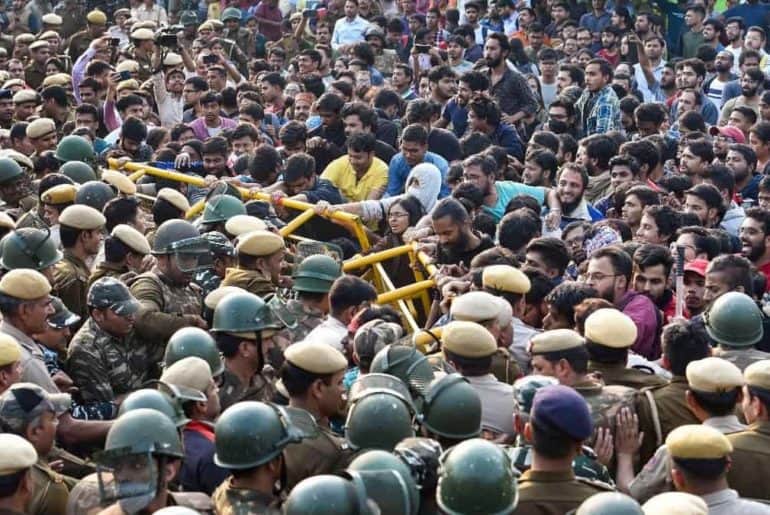
The Jawaharlal Nehru University (JNU) Fee Hike protest took a dramatic turn yesterday when Jawaharlal Nehru University Students’ Union (JNUSU) with thousands of students tried to march from the JNU Campus to the Parliament. As a result a heavy police deployment was put in place and around 100 students were detained, along with JNUSU President Aishe Ghosh.

JNUSU in its statement said that the march was a “way to appeal to lawmakers to fight on our behalf inside the floor of the house”. The Delhi Police along with CRPF had put in around 1,200 troops around the JNU Campus and in Central Delhi. Jawaharlal Nehru University Teachers’ Association (JNUTA) in its statement said, “barricading the campus to stop the students from taking out their planned march will thwart the students from exercising their constitutionally guaranteed democratic rights”. Before the protestors could reach the parliament, Delhi Police had enforced Section 144 in areas surrounding the JNU Campus and the Parliament. The march was first halted at Ber Sarai road wherein most of the detainments took place. From here the students initially started moving back, but after three hours by 3 p.m. they gathered around Safdarjung Tomb area, and  stated that they would not disperse until all of the detained students were released. Apart from this Delhi Metro Rail Corporation, as advised by Delhi Police, had to close Udyog Bhawan, Patel Chowk, Lok Kalyan Marg, and Central Secretariat metro stations on the Yellow Line. Along the way the protestors and the forces were locked in a constant struggle. The march saw use of violence by both sides like the breaking of barricades by the students, and baton charges by the forces. All the students detained were released by 9:30 p.m. which marked the end of the march. The effects of the protest could clearly be seen in the Parliament as questions were raised on the Bharatiya Janata Party Government during Zero Hour by Bahujan Samaj Party’s MP, Danish Ali.

The extensive protests have been organised since 1st November against the newly enforced Draft Hostel Manual by the IHF (Intel Hall Administration) which is the regulating body of JNU Hostels. According to the manual a host of new charges, from mess bills to water bills, were to be added while some charges were to be increased in the student fees which would increase the annual fee of a resident student in JNU from Rs. 8,000 to around Rs. 50,000. This extreme hike had caused a uproar by the not only JNUSU but also political groups like All India Students’ Association (AISA), Akhil Bharatiya Vidyarthi Parishad (ABVP), etc. Though students earlier claimed that the manual also mentioned rules relating to curfew timings and dress code but the JNU Administration via a notice on 1st November clarified that the manual housed no such rules. The Students’ Union also alleged that neither the Vice Chancellor nor anyone else from the Administration is ready for a dialogue with the students. Even though the protest has mostly been peaceful, but two events specifically have tainted the nature of the protest. Firstly, the vandalizing of Swami Vivekanand’s statue and writing of slogans such as,“Bhagwa Jalega” and “Long Live Fascism”. Secondly, confinement of the Associate Dean of Students, Prof. Vandana Mishra, by the Students for around 24 hours.

Seeing a such a massive opposition the Education Secretary via his Twitter handle tweeted that the fees has now been halved, and special provisions have been made for Below Poverty Line students. Still, JNUSU termed the step a gimmick and demanded a full roll back of the manual. Till now the JNUSU delegation after yesterday’s march has submitted their demands to the Ministry of Human Resource Develipmemt (HRD) after a meeting with GC Hosur, Joint Secretary of the HRD Ministry.

Image Caption: Image Credits:
Image Caption: The new proposed fee structure with BPL provisions. Image credits: Ritika Singh

Speaking to DU Beat, Surajit Mazumdar, Secretary, JNUTA, said, “The calling of the JNUSU delegation and the constitution of the 3 member committee itself shows us that the government acknowledges the failure of the JNU Administration. Secondly, the JNU Administration till now hasn’t even recognized the JNUSU, so even when the education minister wanted to meet the union the administration refused. JNUTA also hopes the committee will provides a fruitful solution. We have also put forward our demand that the VC should step down as he has time and again proved to be incapable of the post”. Ashutosh Singh, ABVP State Media In charge adds, “ABVP from the starting has been against the fee hike and we even put aside our ideological differences to protest with JNUSU and since they did not have roadmap for further actions we had to part ways after the first 13 days of the protest. We even have protested outside the UGC on 13th November which resulted in a very positive dialogue between us and UGC. ABVP also condemns the vandalizing of Swami Vivekanand’s statue as he is one of India’s greatest figures and disrespecting him is wrong. We have demanded strict action against those who did it”. The JNU Administration and JNUSU could not be contacted for a statement on the same.

Feature Image Credits: NDTV India

Aniket Singh Chauhan
[email protected]


A massive protest broke out in the Jawaharlal Nehru University (JNU) on Monday over fees hike during the Varsity’s convocation ceremony, leading to clashes with the police.

On 11th November 2019, thousands of students from JNU clashed with the Delhi police after the protests over drastic fee hike escalated. The students were demanding the withdrawal of the draft hostel manual, which they claimed has provisions for fee hike, dress code, and curfew timings. They were planning to protest outside the All India Council of Technical Education (AICTE) premises where the varsity’s third convocation that was being addressed by Vice President M. Venkaiah Naidu was held. While Naidu left the venue after attending the convocation, the Minister of Human Resource Development (HRD), Ramesh Pokhriyal ‘Nishank’ was stuck due to the protest for over six hours.

The students were demanding the withdrawal of the draft hostel manual, in which service charges of INR 1,700 were introduced and the one-time mess security fee, which is refundable, has been hiked from INR 5,500 to INR 12,000. The rent for a single-seater room has been increased from INR 20 per month to 600 per month, while rent for a double-seater room has been increased to INR 300 per month from INR 1,000 per month. The draft hostel manual also has provisions for dress code and curfew timings, the Students’ Union alleged, even as the administration denied these two claims.

Over 600 police personnel were deployed to handle the protest organised by the Jawaharlal Nehru University Students’ Union (JNUSU). Several blockades put up by the police were also broken by the protesting students, who started their march towards the AICTE around 11.30 a.m. Barricades were placed around the JNU Campus, as well as on the route between the AICTE auditorium and the University at Baba Balaknath Marg and nearby areas. As the protest escalated, students clashed with the Delhi police, leading to skirmishes. Water cannons were used to disperse the protestors and police claimed that students were detained. This intensified the protest, with the students shouting against the Delhi Police, as well as the Vice-Chancellor (VC).

As reported by the Times of India, the JNUSU office-bearers later met the HRD Minister who assured them that their demands would be looked into. But the VC still hasn’t met with the union. “The VC is destroying the varsity. We have made several attempts to meet him on campus, but there has been no fruitful result,” Aishe Ghosh, president of JNUSU.

The students claim that the decision to hike fees by 300 percent is exclusive of students from marginalised communities. The protest is also against other actions of the varsity, like restrictions by the administration on entry to the Parthasarathy Rocks – a hillock inside the campus, or attempts to lock Students’ Union office.

DU Beat spoke with a foreign student from JNU agitated against the administration who threw light on the condition of foreign students. The student revealed that the Science students of the Foreign Nationality category pay up to 1500$ which counts nearly INR 1 lakh per semester. The Arts students of the Foreign Nationality pay up to 1200$ per semester, which equates around INR 87,000. “Just because we are “foreign” category doesn’t mean everyone comes from well to-do families. Around 40 Tibetan students’ who passed the entrance exam, could not afford the fees. They couldn’t join. JNU has a good population of SAARC country students. The fee is particularly neck breaking for South Asian students who come from third world countries,” they said.

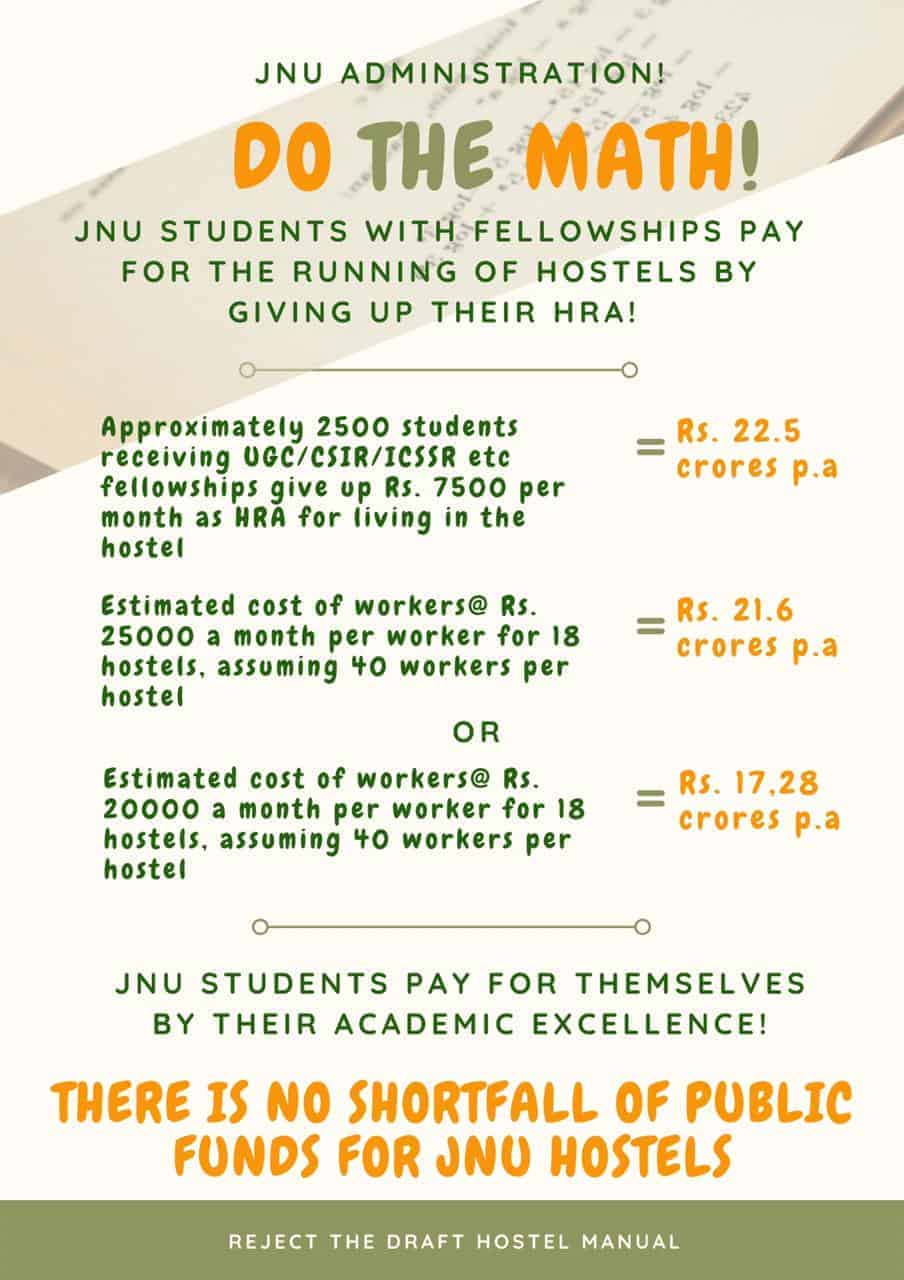
Image Caption: Posters elaborating on the fee hike crises were circulated among students' via whatsapp and social media. Image Credits: Unknown
Image Caption: Posters elaborating on the fee hike crises were circulated among students’ via whatsapp and social media.
Image Credits: Unknown
Image Caption: Posters elaborating on the fee hike crises were circulated among students' via whatsapp and social media. Image Credits: Unknown
Image Caption: Posters elaborating on the fee hike crises were circulated among students’ via whatsapp and social media.
Image Credits: Unknown

In these circumstance students’ raise pertinent questions like-“How is this affordable? And how does this hold to any foundational values of JNU?” while the responses remain bleak.

Around 15 to 20 students who were graduating were sitting inside the auditorium main gate in solidarity with the protestors. The JNUSU has said the strike would not end until the hostel manual is withdrawn.

Feature Image Credits: India Today

Shreya Juyal

[email protected]

The Delhi High Court on Thursday set aside the punishment against 15 students, including ex-Jawaharlal Nehru University Students’ Union President Kanhaiya Kumar, awarded by a committee constituted by the Jawaharlal Nehru University (JNU).

Ex-JNUSU President Kanhaiya Kumar, along with 14 other students, had the disciplinary actions taken against them set aside by the Delhi High Court on Thursday. The students had been involved in organising an event commemorating the hanging of Kashmiri separatist Afzal Guru in February 2016, which allegedly saw separatist slogans being raised.

After the uproar over the sloganeering, a five-member committee was constituted by JNU to investigate the matter. Punishments in the form of expulsion from the hostel (Kanhaiya Kumar), rustication (Umar Khalid), and barring entry in the University for five years (Anirban) were awarded to some students. However, the High Court in its judgement that replied to the petition filed by the students against the committee’s orders said, “The writ petition is allowed to the extent that the Appellate Order dated August 22, 2016, is set aside and the matter is remanded back to the Appellate Authority with a direction to grant an opportunity of inspection to the petitioner”. A period of six weeks has been granted for the students to get a chance to present their side regarding the issue and get a view of the official records and basis of the committee’s judgement. After this the committee must declare another judgement, having heard the side of the students.

Although the students had condemned the slogans, sedition cases were filed against some. The Delhi Police is yet to file a charge sheet regarding the February 2016 incident.


Feature Image Credits: Zee News

Rishika Singh
[email protected]