Tag

JNUSU

Browsing

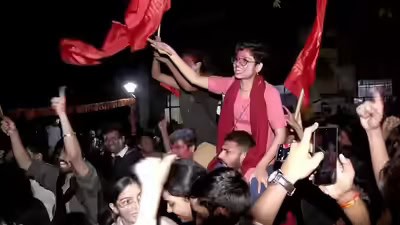
On the night of November 6th, election results were released, cementing Left’s dominance in JNU student politics as the alliance Left Unity swept the central panel. Unlike last time, AVBP was unable to get a hold of a seat in the central panel and especially in the councillor seat of School of International Studies (SIS) or School of Social Sciences (SSS) which it has previously won. 

On November 4th, elections for the new Jawaharlal Nehru University’s student union (JNUSU) was held. Many student unions formed panels to fight in the elections, namely the RSS backed Akhil Bharatiya Vidyarthi Parishad (AVBP), Indian National Congress Student Wing National Students’ Union of India (NSUI) and an alliance of All India Students’ Association (AISA), Students Federation of India (SFI) and the Democratic Students Federation (DSF) named Left Unity. Many smaller organisations and independent candidates also stood in the elections.

The counting began on the night of the 4th November and finished on 6th November night. A total of 5,802 votes were casted of the 9,043, 64% voter turnout. The alliance Left Unity swept all the central posts. For the president position, Aditi Mishra got 1,977 votes, around 33% of the votes, beating the AVBP backed candidate, Vikas Patel by 449 votes. The vice president Kizhakoot Gopika Babu won a staggering 3,101 votes, more than half of the total votes. For the general secretary Sunil Yadav secured 2,005 votes and Danish Ali secured 2,083 votes for the joint-general secretary. 

AVBP which had won seats in the last election, was unable to make a comeback in the central panel neither in many of the councillor seats especially SIS or SSS which they had previously won. Asking a JNU student as to why this was the case, they opined that it was due to an increase of violence. They recalled that the SSS general body meeting (GBM) had turned ugly when people started fighting, using abusive and casteist slurs against each other. It turned violent when elected councillor candidates and the JNUSU President were attacked. Another factor that they said was when a FIR was lodged against the students who went to report the above mentioned incident. Due to these incidents the alliance Left Unity was able to consolidate its hold.

The votes being divided in the last election due to two different left alliances was, for many, a major reason as to why ABVP was able to consolidate a seat in the central panel. This time however left organisations were able to come together and form a single alliance. Critics have, however, pointed out that the alliance has sidelined many smaller organisations and accused them for slacking on student issues. 

The results have cemented the Left Unity’s dominance in the university’s student politics and has marked a change in its strategy to organise, marking a significant shift from the previous election.


Read More: DU Cancels a Seminar from DSE’s Longest-Running Colloquiums, Convenor Resigns

Image Credits: Times of India

Reva Rawat
[email protected]

JNU has grabbed headlines again, and this time for its food policing agenda. The Maha-Mandvi Hostel of JNU is witnessing a cultural crisis of food-divisive policy.  

The Maha-Mandvi hostel of JNU witnessed a recent clash on the food-policing agenda of ABVP.  The hostel has introduced a new segregation arrangement for people with non-vegetarian and vegetarian needs. Students refer to this move as “divisive” and “disturbing” to the academic space of JNU. When asked about this incident, a student of JNU, on the account of anonymity, said,

JNU has a tradition of hosting special dinners on occasion. This is not the first time this has happened; in the past, there was a very violent altercation over the same issue at the Kaveri Hostel. As the Saawan month is going on, ABVP uses religious festivals as an excuse to indulge in politically motivated tactics.”

Saawan is a sacred month for Hindus to abstain from any indulgence in alcohol and non-vegetarian food. However, since there was no deliberate pressure to adhere to these standards, this is regarded as a harmless move; those who wished to do so could do so without any consequences. “JNUSU protested vehemently against this initiative but later quietly withdrew from it when they were reprimanded by the administration,” said an eyewitness.

Following the disturbing incident of food-based segregation at Mahi-Mandavi Hostel, JNUSU immediately intervened and raised the matter with the concerned authorities,” the union said in another statement.  JNUSU said that they had progressed the matter to the point where the administration will now initiate an inquiry against the perpetrators. This comes as a surprise in a space that is known for its academic integrity and cultural discourse. However, the union pledged to continue defending constitutional values and to oppose all forms of communal or discriminatory practices on campus. This is still a developing story. 

Image Credits – X account of JNU

Kinjal Sharma

[email protected]

Also read: https://dubeat.com/2025/02/27/communal-flashpoint-at-sau-abvp-members-allegedly-assault-students-over-non-veg-food/

On Friday, February 9, 2024, ABVP members and left-wing student groups, including AISA, SFI, and DSF, got into a clash during the University General Body Meeting (UGBM). Videos of the clashes show both groups engaging in sloganeering and clashing at night. Both sides have claimed that their students have been injured and targeted by the other party. Videos of the incident show ABVP members obstructing the meeting by encroaching upon the dias and getting into a confrontation with the council members. The SFI has alleged that JNUSU President Aishe Ghosh has been attacked by ABVP members with water thrown at her. ABVP JNU has also alleged that Vikas Patel, the ABVP-JNU secretary, disabled student Divyaprakash, and other supporters of ABVP have been targeted by the United Left groups.

The JNUSU stated that they had earlier on the day established the necessary quorum, but the ABVP argues that the rule for quorum of one-tenth of the university strength was defied. ABVP alleged in a comment,

Disparaging casteist slurs were made against a worker handling a mic and speaker. We had agreed to initiate the UGBM even without the mic, but it wasn’t agreeable to the communists who silence others with loud noises of dafli.

They further claimed that:

The dafli, made from hard steel, was used by the anti-Democratic left to batter JNU students in order to stop UGBM.

The incident lies ahead of the JNUSU elections, which will take place after four years in the month of March. Currently, the office-bearers elected in 2019 are holding the office as agreed upon in an earlier UGBM held in September 2023. Anagha Pradeep, a JNU Councillor, has called out the administration and ABVP for together supporting the agenda that the JNUSU is illegal since, according to them, it is not a recognised body. The JNU administration had halted the elections in lieu of the pandemic and stated that they would follow the Lyngdoh Committee recommendations and must wait for PhD admissions to be completed. Representatives of all fronts had staged protests demanding a free and fair election for the Student Union at the earliest. The students had pointed out that if elections in other universities like DU have been running in parallel, then perhaps the administration is purposely dodging the election question. The JNUSU and the administration have been at loggerheads with each other since last year. Aishe Ghosh commented,

Recently, in interviews given to several media outlets, the JNU vice chancellor claimed that JNUSU elections cannot be held until the entire admission process, including that of Ph.D. admissions, has not been completed. These are patent lies and tactics at dilly-dallying, as the same vice chancellor and administration refused to hold elections in April 2023 even after the completion of the entire admission process.

She also added,

It is a deliberate strategy of the JNU Administration to curb the growth of the students’ social and political consciousness, which leads to the growth of the students as critical citizens capable of asking tough questions to those in power. The RSS-controlled administration, hell-bent on turning the campus into the breeding ground of the saffronization of education, is perennially afraid of students who are aware of and capable of seeing through their agenda.

On Febrary 10th, the ABVP staged a march owing to the incident and demanded “free and fair elections.” In response, the Left Front has also formed a human chain “of solidarity and resilience against the ABVP.” Aishe Ghosh has also raised the slogan, “Reject hooliganism!”

Read Also: “Allowed At Designated Places”- JNU Bans Protests Within 100m Of Any Academic Building; Violators May Face Rs. 20k Fine Or Expulsion

Featured Image Source: Shiksha

Sarah Nautiyal
[email protected]

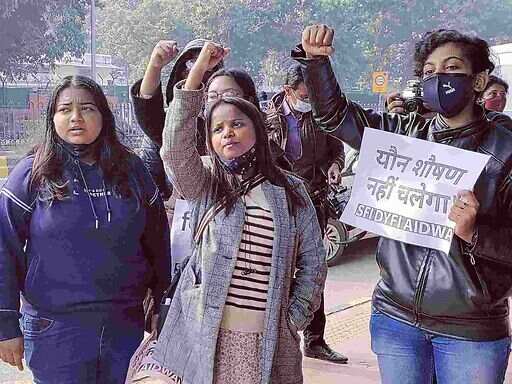
JNU’s Students along with SFI-AIDWA-DYFI staged a protest against the police inaction and demanded swift action for identifying and arresting the suspect who sexually harassed a student on campus on Monday night.


On 21 January 2022, the Students’ Federation of India (SFI) along with other student unions and associations, including All India Democratic Women’s Association (AIDWA) and Democratic Youth Federation of India (DYFI,) protested in front of Delhi Police Headquarters against the police inaction in regards to an attempt to rape at Jawaharlal Nehru University (JNU).  On Monday night, 17 January 2022, an attempt to rape was made on a JNU’s student. The student was taking an evening stroll near the VC house when a motorcyclist tried to drag the student into the forest and attempted to rape her. SFI condemns the casual approach of the police in this incident. They strongly feel that this incident is a shameful reflection of patriarchy that persists in society. Such incidents have been on the rise during the lockdown when vigilance has lowered. They find it disgraceful that students who identify with minority genders have to go through such traumas in University space. Asha Sharma, State Secretary of AIDWA, also condemns Delhi police for their lack of accountability towards the victim and towards the due process of law.

AIDWA Delhi was shocked by this unfortunate incident as it is a residential space where students return from libraries late at night. Moreover, since it has been considered a safer space for women, the female students often come out to walk even later than the time at which this incident has occurred. Satarupa Chakraborty from AIDWA points out that it is very irresponsible of the Internal Complaints Committee (ICC) who did nothing upon hearing about the incident. It is quite shameful that a young woman had to undergo such a heinous crime within the premises of a prestigious university.  She further adds the importance of escalating the efforts that are being made in bringing back the Gender Sensitization Committee Against Sexual Harassment (GSCASH) in JNU. In conversation with DU Beat, Twinkle Siwach, former GSCASH student representative, directed attention towards the ICC. According to her, ever since the ICC, the puppet body of the JNU administration (as opposed to the idea of GSCASH which was constituted with elected members from different constituencies) has been installed, they have witnessed that cases of harassment, stalking in particular, have significantly increased in number. She stated that woman students do not feel confident in approaching ICC, particularly because, in some cases, complaints have been leaked, or the blame has been put on the complainants. In the absence of GSCASH, students still find it a safer option to seek help from the former GSCASH student representatives instead of approaching any member from ICC. She points out that in some of the extreme cases; students prefer to contact the police directly.

This incident has once again highlighted the lackadaisical attitude of the JNU administration and ICC, which continues to control the freedom of women students inside the campus and does not outreach or come out in the support of the complainants or women students in general.

-Twinkle Siwach, former Gender Sensitization Committee Against Sexual Harassment (GSCASH) student representative

Elora Chakraborty, an EC member of the SFI JNU unit, in conversation with DU Beat strongly believes that the JNU administration should immediately pressurize the Delhi Police to carry out the investigation and arrest the culprit. The administration should leave no stone unturned to help the Police with all necessary information and data. Alongside the Administration, including the JNU VC, must immediately take not only cognizance of the crime but also apologize to the student community in general for the inability to provide security. Further, she stated that the scandalous appointment of Cyclops Security and Allied Services Pvt. Ltd. must be undone at the earliest. She marked out that ever since the security agency has been brought to campus, the campus is seeing more and more instances of security lapses in recent times like in this case of an attempt to rape a fellow female student along with the regular cases of sexual harassment in the campus space or on 5 January 2020, when the Jawaharlal Nehru University Students’ Union (JNUSU) President Aishe Ghosh was attacked by right-wing goons in a premeditated manner and also of harassment of students by the security agency. When the security agency is ill-equipped to provide the campus with the security they must immediately be replaced.

It is needless to say the JNUSU demands resignation of the JNU VC Mamidala Jagdish Kumar for degrading the institution and if the question is about what JNU students are doing, they already are protesting for justice to the survivor and for the revival of GSCASH in the campus alongside the JNUSU.

-Elora Chakraborty, former JNUSU councilor for School of Social Sciences, EC member, SFI JNU

Concluding her statement, Elora asserted that the student community in JNU will not rest until justice is provided to the survivor and the culprit is arrested. The voice for the reinstatement of GSCASH is getting stronger day by day and students are coming out on the streets of JNU and Delhi to demand justice for the survivor. On 20 January 2022, the student community walked alongside the JNUSU reclaiming the night with the campus in a March from Sabarmati hostel to the VC house. On 21 January 2022 the JNU student community and the JNUSU marched to the Vasant Kunj Police Station demanding speedy justice to the bone-chilling crime on the campus.  AIDWA-SFI-DYFI had a common call of protest at the Delhi Police headquarter to make campus spaces safer. The protest will go on in the demand for justice for the survivor and reinstatement for GSCASH.

Read Also: Multiple Accusations of Sexual Misconduct Against A Doctoral Student from JNU

Featured Image Credits: Chirag Jha for DU Beat

Ankita Baidya

[email protected]

Delhi High Court places an interim order against the new JNU Hostel manual and asks JNU administration to keep registration fees, reservations, and priorities according to the old manual.

On 28thOctober 2019, The Jawaharlal Nehru University (JNU) Administration unveiled a new hostel manual with extremely steep hostel fee hikes. The rationale given by the JNU administration was that the hostel fees had not been revised for 19 years. However, these overall fee hikes would have led to JNU becoming one of the most expensive central universities in the country. The Jawaharlal Nehru University Students’ Union (JNUSU) held massive and continuous protests against the decision by the administration, stating that according to the University’s own annual reports, 40% of the students who come from lower income backgrounds would not be able to afford the revised fees and would have to pursue education elsewhere, if at all.


Earlier this week, the Delhi High Court has granted a major relief to the students of JNU upon hearing a petition filed by AIshe Ghosh, JNUSU President and other office bearers against the new hostel Manual. According to a legal update dated 24th January, 2020, from JNUSU. The High Court has directed the JNU Administration to:

Firstly, allow for registration at old rates, as per the previous hostel manual; for students yet to register. Secondly, extend the last date of registration for a week without late fine. Thirdly, apply reservations and priorities/benefits according to the old hostel manual. And lastly, to hold dialogue with the students in order to resolve the issue.

Justice Rajiv Shakdher, who was hearing the case, points out that “Government can’t get out of education. Government has to fund public education. The burden of paying the salaries of contractual workers is not on the students. Someone has to find the funds.”

The next hearing of the case will be held on 28thFebruary , 2020.


Feature Image Credits: The Print


Prabhanu Kumar Das

[email protected]


Time and again, the Jawaharlal Nehru University (JNU) has come under the scrutiny of the masses. Right from media trials of the issues happening at the campus to the raising concerns about events taking place in the country, here is an extensive and expansive, multi-dimensional lens from a student studying at the University about the latest protests regarding the proposed fee-hike, taking place at JNU.

I am a student of the Jawaharlal Nehru University, New Delhi.
Throughout the University’s turbulent history with opinions and ideas concentrated in political sphere with controversies emerging out of them, one fact remains constant.

Consistently ranked among the top universities in India and world, JNU has claimed its much deserved place in the academic arena. Rather than acknowledging my university as one of the best in the world, it is more often than not seen as a political ground; dominated by the left ideology. So for obvious reasons, any issue that originates here is put under the veil of political spirit.

On the 28th of November, the Inter Hall Administration called a meeting in which the Jawaharlal Nehru University Students’ Union (JNUSU) was informed 15 minutes prior to it, via e-mail. Till the time the JNUSU and other students could make it, the hostel manual was passed.

Fast forward today, it’s almost been a month with students here, protesting against the draconian fee structure. I lay out some vital points for your better understanding of the ongoing strike and the triggering force behind it:

  • More than 40% of the students of JNU comprise of the students coming from humble backgrounds where their family income does not exceed more than INR 12000 a month. If the fee hike is to happen for real, they (40%) would be immediately wiped off the face of JNU.
  • JNU, by its very nature, has been known to out loud criticise the government and point out the fallacies that exist in the system. A hub for left wing ideas, as it is seen, it sure is to develop resistance from the right wing and its supporters. Hence, a political inclination is assigned here to a non-political protest.
  • The mainstream media, which is followed by the majority of the general public, has grown to become unreliable and is known to shift its ground; driven by politics, has been manipulating facts and showing them in a different and distorted light. However, there are a few media houses who put out straight facts before the public and show the actual situation of what’s happening in here. Many students who take admission here were of the same opinion before living in the campus and knowing the nature of the university. It’s simple: people will believe what is fed to them.
  • In JNU, the population of female students is greater than the male students. This promotes girl education and female literacy in a country like India, where patriarchy is still prevalent and people here come from the remotest of areas, breaking the shackles. This shows how the university attracts students from all over India, not from a particular section.
  • From the child of a tailor to the child of an IPS to even entrepreneurs, there is diversity in its true sense in our campus. We all sit down together as a community where it doesn’t matter what backgrounds we come from. Here, we are all equal.
  • Take the very basic example of our campus not having popular eateries like CCD, Subway, much like other colleges. This is because it creates a divide. People who can afford will visit these eateries, while people who can’t, simply won’t. To avoid any kind of divide where people lose their sense of equality is the primary reason our campus does not have fancy eateries. Everything on here is planned. This shows how the university has maintained its idea for years and how the new fee structure will shake the very basis of it.
  • Student activists and speakers here question the monetary privilege those in power get to ‘enjoy’. The construction of two hostels was underway which now is unheard of. It all boils down to one question: Where did the money go? The VC, this shows, is incompetent and JNU refuses to accept his idiosyncratic behaviour and asks for his immediate resignation. All the questioning that happens around here is the evident of how JNU is the center of all the intellectually stimulating debates and ideas that refuse to remain latent. How students here are to stay, exercise their rights, hold on to each other, collecting their existence into a string of unbreakable unity that fears no higher force.
  • The new Hostel Manual, that talked about curfew timings and Dress Code agitated the students all over the University. As people here come from all over India, coming from places we haven’t heard of, they’ve grown up in quite conservative environments with them not being allowed to step out of their houses at night and being expected to maintain a ‘decent’ dress code, JNU must have felt a better form of liberation. Here, we can roam around our massive campus at any given time safely, to any nook and corner. Students here wear whatever they want to because there are no confinements. One of the very few universities that allows girls to enter in the boys’ hostel. The new set of rules indeed contributed to the patriarchal culture. Though these set of regulations have been scraped, students demand a complete rollback on the fee hike, to this date.
  • The biggest myth about the ongoing protest is that the fee hike is from ?10 to ?300. Sorry to burst your bubble, but we already pay around INR 3000 a month as our mess bills. That will shoot up to around INR 7000 a month. It will include service charges, electricity and water bill, increment in admission fees, utility charges. JNU, after the fee hike, would be the most expensive central university in India. Affordable education? What’s that, again?
  • A partial rollback had happened a few days ago, which the students had out-rightly rejected, terming it a ‘lie’. A complete rollback is what the student community is fighting for, and will continue to do so.
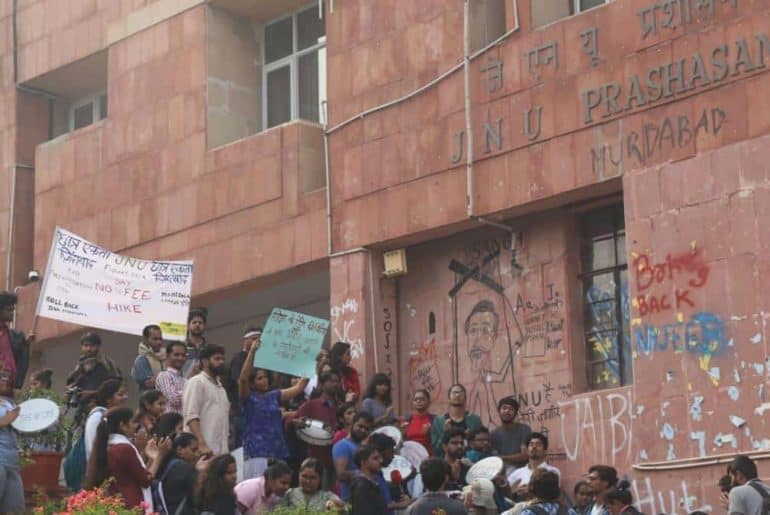
  • JNU, known for its poster making culture, has always been very open to the idea of expressing agitation, emotions and opinions by penning them down on paper, colouring their views across the walls and exhibiting them for the world to see. The Freedom Square, which is the main administrative building, was taken by the students on one of the protesting days, which they painted the whole building in, making sure that their voices be heard, loud and clear.
  • The protests, as the general public knows, is not always about the ‘shows’ that attract news channels and media houses, with JNU again being the headline of the national mainstream media. No media house would show how peaceful our protests are, with students singing songs of revolution over a cup of chai and debates. Almost every alternate day, different centres of JNU organise this programme, that goes by the name ‘Guerrilla Dhaba’. Besides, every hostel organises their own cultural programme that includes students performing and discussing the implications and consequences of the new fee structure, and how it would affect their lives.
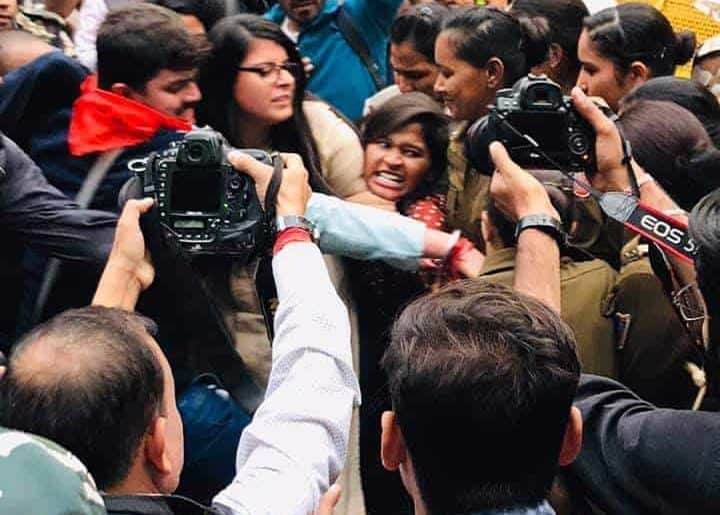
  • On the 17th of November 2019, students in huge numbers took to the streets of Delhi to march to the Parliament for their voices to be heard. A proper guideline was published a day before which clearly mentioned how to go about the march without disturbing and blocking the roads causing inconvenience to the public. The Police Forces, appointed in huge numbers, did not spare the peacefully protesting students and detained them in hundreds, laathi charging students so as to disperse them and break their unity. They even shut the three nearest metro stations so that they don’t escape, and no form of help is provided to them. In the process, many students got hurt who were not allowed medical help, too. Students who were detained mentioned how the police officers were treating them and particularly the female students. One word for this incident: shameful.
  • Seeing the critical conditions in the campus with academic activities being heavily hampered, the Ministry of Human Resource Development (MHRD) forms a committee to listen to the concerns of the students. The meeting happens, we are promised a positive outcome soon. Fast forward a few days, nothing fruitful is gained out of the meeting. Administration, on the other hand, releases notices every other day appealing students to get back to classes and resume their academic work, retaining the normalcy of the campus. Students are in no mood to withdraw till they achieve what they are protesting for, day in and day out.
  • On the 25th of November, another notice is released that talks about slashing the fees (utility and service charges) for APL by 50% and BPL by 75% on the strong recommendation of the High Level Committee (HLC) set up by the administration. JNU Students’ Union and the others on University observing strike from Day 1, reject this revised fee structure wholly and completely. Not an inch back, as they say, students are hell bent on wanting their demands to be listened to. This move by administration is a ‘lollipop’ and a form of ‘bargain’, as students claim, and rightly so.
  • The inside story that majority of the people who comment on the JNU protests don’t know anything about: The meeting in which the new fee structure was passed, clearly cut the JNU Students’ Union out and failed to recognise the presence of the student body. Therefore, by this very nature, the meeting stands null and void.
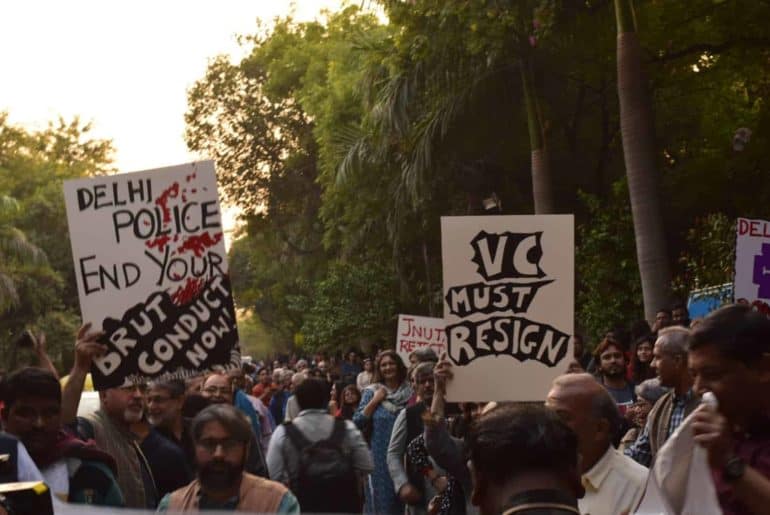
  • JNU VC, has all the time in the world to spew venom against his own students on Twitter and news channels, but we haven’t heard from him now in a month. A VC who does not prefer dialogue with his own students is of no good. Hence, we are demanding his immediate stepping down from the post because he’s proven incompetent to run a university like JNU.
  • A fee hike has been observed in many colleges around the country, why only JNU is protesting, you ask? Think of the better question: Why is Education being sold as a commodity? Isn’t free education a right for all? Why are the students around the country okay with their fees being this high? Why are the students quiet, why are you quiet?


I’ve friends here who were laathi charged, and chased by the Delhi police in kilometres, on the day they were marching to the Parliament. They haven’t succumbed to the higher authoritarian wrath and still go out, participating passionately in all the protests. The enthusiasm to save their University from the evils of privatisation of education hasn’t been knocked down by ‘efforts’ of the Delhi Police and their cruel and disgusting tactics.

As JNU students say, you can lock them up and shut them down. But you can never shut out their ideas. The emotions of anger, agitation and pain that JNUites share with each other, I say no force is strong enough to bog them down.

I request you all to stop being so unfair to us and see beyond what is shown. Hear our story out. Save JNU, before it gets destroyed at the hands of the higher authoritarian body. I pity people who can’t see what gem of a university JNU truly is, where our ideas echoes out loud and that is what sets JNU apart from other universities.

Stand with JNU, because once it starts getting tarnished and eventually, destroyed, the nation will weep the death of an incredible university and it will be too late.

The author is a student, currently studying at the Jawaharlal Nehru University. A close observer of what is happening in, around and about the University, and the intense student politics at the Varsity, through this piece the authors tries to present various facts and issues of importance concern which need their due place in the public space. 

Feature Image Credits: Priyanshu Sinha for DU Beat

Students from different universities came together in support of Jawaharlal Nehru University (JNU) to protest against the fee hike. Read on to find out more.

On Thursday, 21st November 2019 students from Delhi University (DU), JNU, and Jamia Milia Islamia (JMI) participated in a protest led by Akhil Bhartiya Vidyarthi Parishad (ABVP) and Delhi University Students’ Union (DUSU) against the hostel fee hike in JNU.

The protest consisted of a march commencing from Mandi House which continued till the Ministry of Human Resource Development (MHRD). The demands of the protestors included a complete rollback of the increased hostel fee hike amount, resumption of classes. Apart from this, they also demanded an end to the prevaricating attitude of MHRD with powerful slogans.

Sidharth Yadav, Secretary, ABVP Delhi, said, “We demand a complete rollback of the hiked hostel fee. Today’s protest has only served to fortify our fight for reversion to the earlier fee-structure. In principle, ABVP is against the ongoing series of fee hikes across several educational institutions and would request their respective administrations to refrain from such inexcusable conduct. We chose to organise a separate protest vis-a-vis JNU Students’ Union because of the latter’s unseemly actions wherein they desecrated the University space and damaged public property, in addition to undercutting the momentum and sullying the spirit of the ongoing movement. While they employ profitable victimhood to further their self-serving ends, we choose the openhanded and inclusive approach in our fight for justice.”

According to sources, around 160 people were arrested during the protest taking place at the Parliament street which included 3 handicapped student protestors. Students came in support of JNU in a huge number and didn’t care about the consequences. The protestors chanted slogans like “HRD Minister istifa do (HRD Minister, resign), Fee hike nahi sahenge” (we won’t tolerate fee hike) against the JNU administration and HRD ministry, who according to students is responsible behind this fee hike.

Durgesh Kumar, President, ABVP, JNU, said, “Left-oriented organisations, in an infelicitous act of misrepresentation, misappropriation and crass political expediency, have blunderingly acquiesced to the intervention of HRD Ministry’s High Powered Committee into the ongoing issue. We reject such interposition and push for the uncritical acceptance of all our demands.”

Apart from students, members of Rashtriya Swayamsevak Sangh (RSS) and ABVP were also detained after a quarrel between the protestors and the security personnel. The area had protection through triple layers of barricades and Delhi Police was on high alert. Students still managed to climb through the barricades out of rage and ignite a conflict with the security personnel which also involved Central Reserve Police Force (CRPF) personnel.

Manish Jangid, Secretary, ABVP, JNU, said, “While JNUSU has thrown in the towel, we continue to hold out. The manner in which the police authorities stymied our protest was undemocratic. We call for the HRD Minister to either unconditionally comply with our demands or resign forthwith.”

Akshit Dahiya, President, DUSU, said, “DUSU stands in opposition to this undue increase in JNU hostel fee. We stand in unison with all sincere protestors and request the government to put in place a discrete regulatory body to independently judge the necessity as well as delineate the quantum of any fee hikes in future. Our successes against similar fee-hikes in Delhi University is a testament to our commitment and our capability to take this fight to its logical end.”


Feature Image Credits: Ashutosh Singh for ABVP

Avni Dhawan

[email protected]

Jawaharlal Nehru University (JNU) has moved the Delhi High Court (HC) against the protesting students for “gross violation” of the court’s previous order of August 2017 banning protests within 100 metres of the administrative block. 

The contempt plea has been filed by JNU Registrar Pramod Kumar, along with the University’s standing counsel Monika Arora against the protesting students for violation of the Court’s order of 2017 banning protests within 100 metres of the administrative block. As reported by news agency Indo-Asian News Service, the plea is filed against the Delhi Police, JNU Students’ Union (JNUSU) President Aishe Ghose, General Secretary Satish Chandra Yadav, Vice President Saket Moon and former JNU student leaders N. Sai Balaji, Geeta Kumari, Sarika Choudhary, Apeksha Priyadarshani, Krishna Rao, among others.

The plea read, “The instant petition is being preferred by the university against the contemnors for gross and continuing violation of the order dated 09.08.2017…by protesting within 100 meters of the administrative block and the day-to-day administration of the petitioner University due to which the working of the university has come to a standstill.”

Two FIR’s have been registered against JNU students on Tuesday who clashed with the Delhi Police. The FIR’s have been registered at two different police stations against unidentified individuals. Over the past few weeks, severe protests have led to clashes with the police after they were barred from marching towards the Parliament as it reconvened for the winter session. Delhi Police set up barricades and closed down four metro stations around the Parliament. Students were allegedly lathi-charged which led to severe injuries to both police personnel and the students.

JNUSU on Tuesday said they are ready to undertake a march to the Parliament 10 times if their demands are not met. The resignation of JNU Vice-Chancellor Mamidala Jagadesh Kumar has also been demanded. JNUSU President Aishe Ghosh quoted to The Hindustan Times, “Police had detained at least a hundred students including me, and Satish (General Secretary of JNUSU), just to make sure the high powered meeting with the secretary (MHRD) does not take place.” Followed by a press conference in the JNU Administrative block, she addressed, “We have made it clear in the meeting, that the agitation will stop only after all our demands are accepted, and if the VC has a problem with that then we demand his resignation…”


Students at JNU have been protesting against the fee hike and have conveyed their demands to the Ministry of Human Resource Development. One of which stated, the protesting students should not face any enquiry.


Feature Image Credits: DU Beat Archives

Anandi Sen
[email protected]


Following a press briefing by JNUSU (Jawaharlal Nehru University Student’s Union), teachers of the varsity marched around the campus to bestow solidarity with students who faced the wrath of police forces on Monday in light of their protest against the arbitrary fee hike.

 A day after several  Jawaharlal Nehru University (JNU) students were thrashed, manhandled and jailed for protesting against the fee hike, the varsity’s teachers association marched past the campus in solidarity with the students. The protest on Monday was marred with intense scuffle between protesters and police forces. Around 100 students who were detained yesterday have been released. Several students suffered injuries after government deployed 2000 Central Reserve Police Force (CRPF) to contain the protest.

As the march began at campus’s main gate, teachers of the varsity started raising slogans such as “Fee hike waapis lo” (Revoke the Fee Hike), “JNU VC Ko Jaana Hoga” (The Vice Chancellor must go), demanding for the Vice Chancellor’s resignation.

“We are standing with students from the very beginning. Fee hike should not take place otherwise underprivileged students will lose the opportunity to study. If public education system collapses than people like us talking here won’t be in a situation to raise voices”, said Professor D.K. Lobiyal who teaches in the School of Computer and System Sciences.

On the question of the Ministry of Human Resource Development (MHRD) forming a three member committee to look after the fee hike issue he said,  “The committee is saying that (Vice Chancellor) VC should talk to the students. So, MHRD had to formulate a committee for getting the Vice Chancellor in touch with students? Why is the Vice Chancellor there for?” Demonstrating his displeasure he went on to to bring into light that if it requires MHRD to instigate a conversation with students then what’s the need of Vice Chancellor in a University. He added “MHRD has legitimised our claim that this VC is incapable of running JNU.”

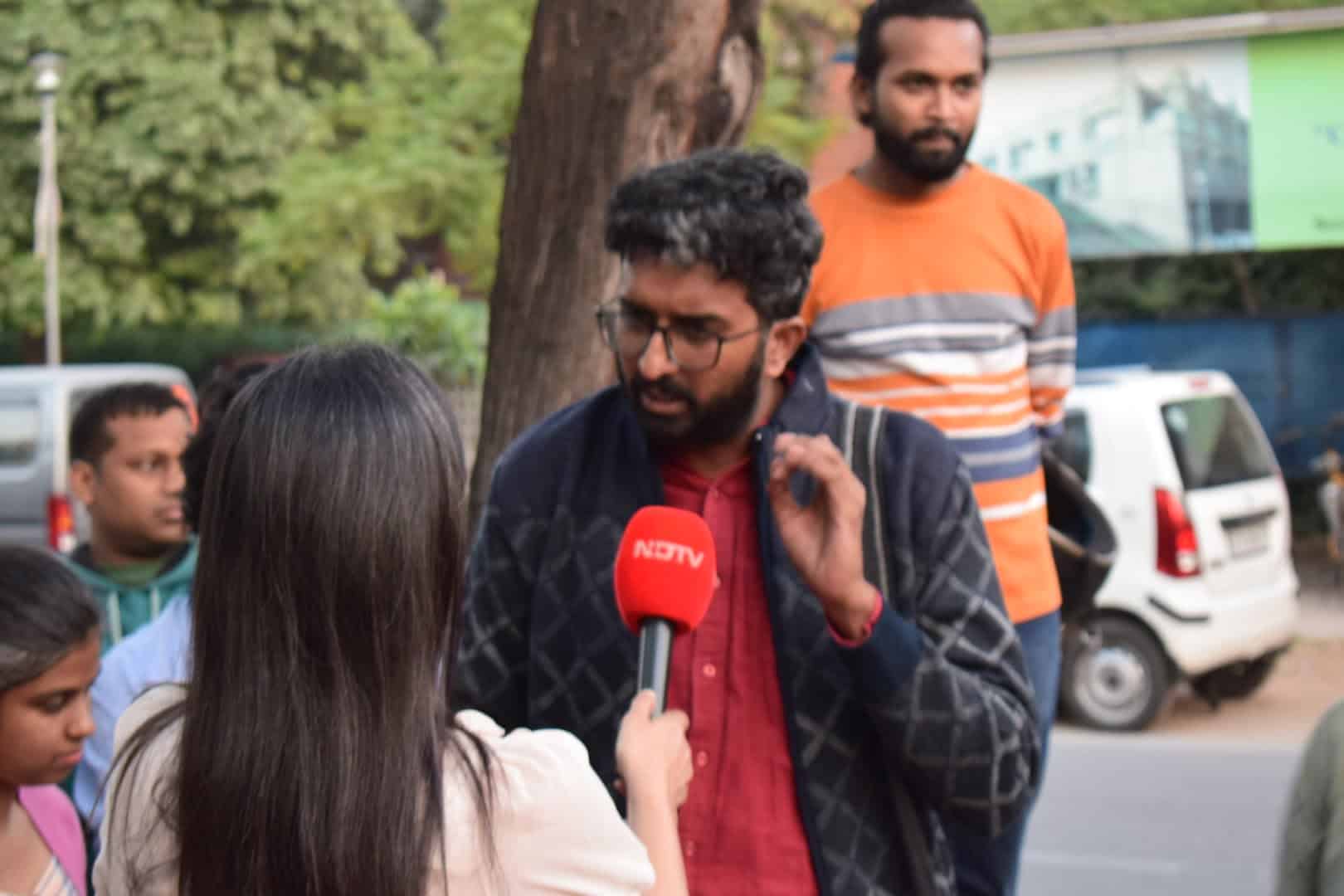
NDTV Balaji

Media flocked in the campus to cover the protest. In picture: N. Sai Balaji (ex-JNUSU president) talking about the issue with NDTV. Image credits: Priyanshu Sinha for DU Beat

Various media organisations had flocked in to cover the event which was preceded by a press conference by the JNUSU. Reconciling his chilling encounter with police yesterday, Shashi Bhushan Pandey, a student union councillor said, “I told them (Police) that I am visually impaired, so that they would spare beating me. But No! One of them hit me from the front and when I tried to flee, I was beaten on my leg. The boy who helped me and took me to the hospital was also attacked by the Delhi Police.”

The brutality on Pandey, a visually challenged student got the University’s Visually Challenged Students Forum to issue a notice condemning Delhi Police’s action towards students taking part in peaceful march demanding accessible and affordable education for all.

JNUTA PROTEST

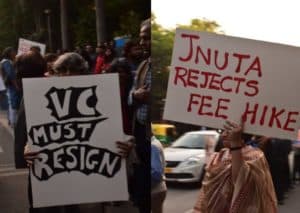
Teachers assembled near the main gate with placards in hand. Image credits: Priyanshu Sinha for DU Beat

Later on Tuesday, the JNU outfit of Akhil Bharatiya Vidyarthi Parishad (ABVP) issued a statement  that condemned the JNUSU and alleged that the left led student union of making the issue their agenda leaving behind rest of JNUites who oppose their ideology. The statement said that as the hike affects every JNU students, their should be a joint struggle committee consisting students from all ideological background. ABVP, who holds no political representation in University’s Student Union rejected the high power committee set up by MHRD and demanded JNU administration to reclaim the 6.7 Crore Rupees that University Grants Commission (UGC) had promised to waive off as additional fee charges.

The protest against exorbitant fee hike entered its 21st day on Tuesday. The exponential hike increased room rent from INR 10-20  to 300-600 per month. An additional service charge of INR 1700 will surge the fee to INR 2,000-2,300 per month. This hike would make Jawaharlal Nehru University the most expensive Central University in India, surpassing even Delhi University whose average annual fees is Rs 40,000-55,000 . After dissatisfaction on a partial rollback by University’s executive council, the Student Union went on with their protest which has already witnessed the participation of huge number of students, many even from outside the campus flocking everyday to stand with the students.


Priyanshu Sinha 

[email protected]


Feature Image Credits : Priyanshu Sinha for DU Beat

The Jawaharlal Nehru University (JNU) Fee Hike protest took a dramatic turn yesterday when Jawaharlal Nehru University Students’ Union (JNUSU) with thousands of students tried to march from the JNU Campus to the Parliament. As a result a heavy police deployment was put in place and around 100 students were detained, along with JNUSU President Aishe Ghosh.

JNUSU in its statement said that the march was a “way to appeal to lawmakers to fight on our behalf inside the floor of the house”. The Delhi Police along with CRPF had put in around 1,200 troops around the JNU Campus and in Central Delhi. Jawaharlal Nehru University Teachers’ Association (JNUTA) in its statement said, “barricading the campus to stop the students from taking out their planned march will thwart the students from exercising their constitutionally guaranteed democratic rights”. Before the protestors could reach the parliament, Delhi Police had enforced Section 144 in areas surrounding the JNU Campus and the Parliament. The march was first halted at Ber Sarai road wherein most of the detainments took place. From here the students initially started moving back, but after three hours by 3 p.m. they gathered around Safdarjung Tomb area, and  stated that they would not disperse until all of the detained students were released. Apart from this Delhi Metro Rail Corporation, as advised by Delhi Police, had to close Udyog Bhawan, Patel Chowk, Lok Kalyan Marg, and Central Secretariat metro stations on the Yellow Line. Along the way the protestors and the forces were locked in a constant struggle. The march saw use of violence by both sides like the breaking of barricades by the students, and baton charges by the forces. All the students detained were released by 9:30 p.m. which marked the end of the march. The effects of the protest could clearly be seen in the Parliament as questions were raised on the Bharatiya Janata Party Government during Zero Hour by Bahujan Samaj Party’s MP, Danish Ali.

The extensive protests have been organised since 1st November against the newly enforced Draft Hostel Manual by the IHF (Intel Hall Administration) which is the regulating body of JNU Hostels. According to the manual a host of new charges, from mess bills to water bills, were to be added while some charges were to be increased in the student fees which would increase the annual fee of a resident student in JNU from Rs. 8,000 to around Rs. 50,000. This extreme hike had caused a uproar by the not only JNUSU but also political groups like All India Students’ Association (AISA), Akhil Bharatiya Vidyarthi Parishad (ABVP), etc. Though students earlier claimed that the manual also mentioned rules relating to curfew timings and dress code but the JNU Administration via a notice on 1st November clarified that the manual housed no such rules. The Students’ Union also alleged that neither the Vice Chancellor nor anyone else from the Administration is ready for a dialogue with the students. Even though the protest has mostly been peaceful, but two events specifically have tainted the nature of the protest. Firstly, the vandalizing of Swami Vivekanand’s statue and writing of slogans such as,“Bhagwa Jalega” and “Long Live Fascism”. Secondly, confinement of the Associate Dean of Students, Prof. Vandana Mishra, by the Students for around 24 hours.

Seeing a such a massive opposition the Education Secretary via his Twitter handle tweeted that the fees has now been halved, and special provisions have been made for Below Poverty Line students. Still, JNUSU termed the step a gimmick and demanded a full roll back of the manual. Till now the JNUSU delegation after yesterday’s march has submitted their demands to the Ministry of Human Resource Develipmemt (HRD) after a meeting with GC Hosur, Joint Secretary of the HRD Ministry.

Image Caption: Image Credits:
Image Caption: The new proposed fee structure with BPL provisions. Image credits: Ritika Singh

Speaking to DU Beat, Surajit Mazumdar, Secretary, JNUTA, said, “The calling of the JNUSU delegation and the constitution of the 3 member committee itself shows us that the government acknowledges the failure of the JNU Administration. Secondly, the JNU Administration till now hasn’t even recognized the JNUSU, so even when the education minister wanted to meet the union the administration refused. JNUTA also hopes the committee will provides a fruitful solution. We have also put forward our demand that the VC should step down as he has time and again proved to be incapable of the post”. Ashutosh Singh, ABVP State Media In charge adds, “ABVP from the starting has been against the fee hike and we even put aside our ideological differences to protest with JNUSU and since they did not have roadmap for further actions we had to part ways after the first 13 days of the protest. We even have protested outside the UGC on 13th November which resulted in a very positive dialogue between us and UGC. ABVP also condemns the vandalizing of Swami Vivekanand’s statue as he is one of India’s greatest figures and disrespecting him is wrong. We have demanded strict action against those who did it”. The JNU Administration and JNUSU could not be contacted for a statement on the same.

Feature Image Credits: NDTV India

Aniket Singh Chauhan

[email protected]