Tag

DUSU elections

Browsing

As the country’s capital, Delhi has witnessed student movements and politics with the greatest trajectories. Other universities in India do not observe the same scenario. What makes politics and DUSU elections at DU different? Read on to find out.

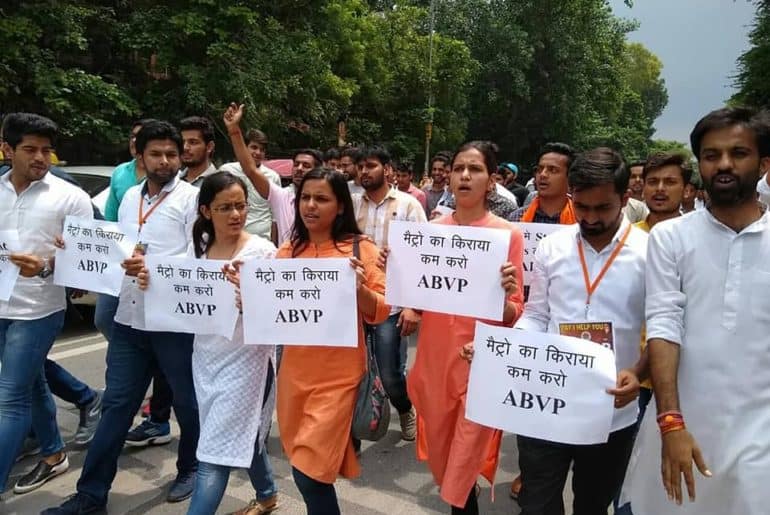
The University of Delhi (DU) has never faltered to be on the forefront of political upheaval in the nation. From Gurmehar Kaur’s anti-war stances and resistance in the face of dogmatic backlash to her opinions, to Umar Khalid being shot two days before Independence Day, the students in Delhi have been vocal and active in their dissent and their vision to make a difference. During the election season in DU, the collaborative accounts of students reveal a picture of the campus filled with pamphlets, party supporters driving around in expensive vehicles, rallies, gatherings, and heated quarrels between the student leaders.

The candidates use techniques of mass polarisation by making promises of substance and raising appeal by distributing numerous popular items among students. There is an essence of participatory politics where students sit and discuss the candidates, party agendas, motivations, and political ideologies concerning the students. In a stark contrast to the situation in the capital, the atmosphere in the University of Mumbai is laid back. Students in Mumbai seldom voice their disapproval in the form of long-lasting loud protests. One of the deliberated reasons for this is the fact that colleges in Mumbai have an autonomous culture with rare unity as a single University, unlike DU. There are no common elections for the University of Mumbai, and the election day in colleges involves 20 to 25 people sitting in a room, discussing agendas, and finally voting for various posts.
At the Indian Institute of Technologies (IITs), there is a state of polarisation for freshers and some rallying, but the intensity of DU still supersedes. Shivam Rohilla, a third-year student at IIT Kharagpur, states, “Publicity levels are extremely high during elections, especially targeting the fresher population of over 1,400. But the passion of politics of DU is much higher.” Students at the Banaras Hindu University gripped this country’s attention in 2017 with their protests against the gender discriminatory practices of the university. The #Hokkolorob (make some noise) Movement in Jadavpur University of Kolkata against the molestation of female students resulted in the resignation of Abhijit Chakraborty, the Vice Chancellor.

Many such incidents have occurred across the country, but they do not receive the same traction as political movements in DU often do. Vishal Ranka, the current Sports Secretary at Usha Pravin Gandhi College in Mumbai, shared his experience of studying a semester in DU, and said, “People here at Mumbai University are more confined to their colleges and react to the issues with peace, which is irritating some times, but in DU, the scene has a way stronger vocalisation of its issues.” He believes that the influence of the national political parties on the student politics in Delhi, like Akhil Bharatiya Vidyarthi Parishad and the National Students’ Union of India has a great impact on the political scene at DU.


Feature Image Credits: DU Beat.

Anushree Joshi

[email protected]

 AISA will nominate candidates for the positions of President and Vice-President while CYSS will contest for the posts of Secretary and Joint Secretary.

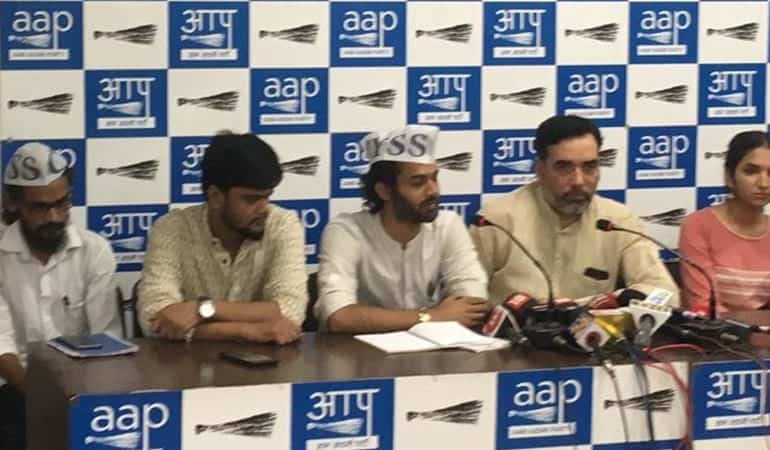
In a joint press conference, Aam Aadmi Party’s (AAP) Delhi convenor Gopal Rai today announced the alignment of the party’s student wing Chhatra Yuva Sangharsh Samiti (CYSS) and Communist Party of India’s (CPI-ML) youth wing All India Students Association (AISA) to tackle the NSUI-ABVP hegemony in the University political sphere. Also attending the press conference were Kawalpreet Kaur, President of Delhi wing of AISA and CYSS student leader Sumit Yadav.

The alliance would be key to the resurgence of CYSS as the party returns after a hiatus of two years and would be heavily banking on the experiences of AISA in the DU elections and its recent successes in pitching student relating issues.

Gopal Rai alluded to the degrading quality of campus politicians and the money-muscle dominance as the chief motivation behind the joint contention. “This coming together is for the students who want a clean politics in the campus, a politics of total participation, and a politics of a change in the educational climate in the campus.”

However, AISA president Kawalpreet Kaur indicated that rather than considering this an ideological merger, this move should rather be seen as a necessary political move to tackle campus anarchy.
In a conversation with our correspondent, she maintained, “It is in no way a compromise on the ideology rather as Marxists we have responded to the immediate vaccum in this country as this is the last DUSU election before 2019 Lok Sabha polls. We wanted to provide a platform which rejects goondaism. As all of us were hoping that NSUI has defeated ABVP last year and will be an alternative but it has so far proven that both of them are similar as NSUI stood silent on all anti-student policies of the government and the ABVP-NSUI nexus gave each other support. This is a historic time where our campus can send a big message, establish an alternative model and set tone for 2019”.

Feature Image Credits – Navodaya Times

Nikhil Kumar
[email protected]

Another edition of Delhi University Students’ Union(DUSU) elections gone by, another year’s campaigning done and dusted. What lies ahead is the vast aftermath of elections and the countless reforms the process is yet to witness.

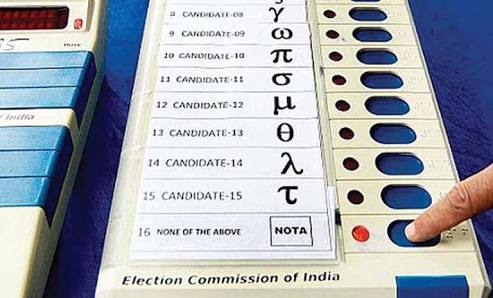
DUSU elections are continuously undergoing some change. From the implementation of EVMs(Electronic Voter Machines) that replaced ballot boxes to the NOTA(None of The Above) option that was introduced last year, many issues have been rectified by the responsible authorities.

However, a slight cause of worry is the fact that out of the total votes for all four posts, NOTA votes increased by a staggering 60%, from 17,722 last year to 29,770 this year. The use of this option should be lauded, but to prevent NOTA votes from increasing next year too, we can improve and learn from foreign universities’ student body elections and draw parallels that stand relevant in the Indian scenario.

  1. Referendums can be held to solidify the constitution that governs DUSU elections.This procedure, complicated to understand but easier in practice, requires contesting suits to get signatures to put forward a question for a referendum on the ballot. If a threshold of signatories is reached, the referendum is conducted to make elections more student inclusive. If the question gets the support of 2/3rd of the voters with at least 10% voting in favour, the proposed amendment is passed and cannot be repealed by any authority. This gives voters the significant power to exercise their rights and influence legislation governing them. This model is actively followed at Harvard University.
  2. Unlike the case in India, in most University Government Bodies(UGB) in the U.S, candidates are not affiliated with any political party, either the Democrats or Republicans. There are, however, separate clubs and organisations that harbour their ideologies, regardless of which they still have no direct link with the parties. It is unlikely that the same model will ever be followed in the Indian scenario, but it provides an insightful snippet of thought for future elections.
  3. University officials are striving to make elections relevant to the digital age but still follow outdated mediums to do the same. Since Delhi University is an open university with colleges spread far and wide, for a candidate to reach out to the maximum number of students in limited time is an impossibility. Conducting university-wide debates in henceforth not possible, and not every college has the required infrastructure to accommodate all the students of its institution for the same. Candidates in foreign universities come up with websites meant specifically for their election campaigns. Following a similar digital route, candidates for DUSU elections can conduct live sessions, use chat boxes for live question-answer rounds and spread manifesto circulars on open social media platforms.

As much as political parties are despised during the time leading up to elections, many have pitched in reforms that could potentially bring revolutionary changes. The number of EVMs can be increased and mock runs of EVMs can be conducted, as the controversy of tampering always arises after elections are through. Audits could be conducted of the DUSU expenditure and the same published on a public portal to help interested students review the functioning of the outgoing DUSU panel. (Credits: NSUI and ABVP)

A plethora of similar suggestions have been pitched already, but very few implemented to keep up with the time. Most of the time there are administrative delays and faults that hinder path-breaking changes in the student electoral process. A certain degree of autonomy and accountability could go hand-in-hand to help voters and candidates exercise this opportunity and uphold the spirit of democracy.

Image Credits: My Republica


Vijeata Balani

[email protected]


Now that the Delhi University Students’ Union (DUSU) elections are finally over and you’ve voted to elect your leaders who claimed to transform your college into one that resembled an institution of the west, it’s time to rest. The ‘rest’ doesn’t refer to you relaxing, but rather to the Union.

Every year, the same sequence of events plays out. It has been running for so long that this silence which suddenly appears everywhere after this hullabullah of elections seems normal. The storyline is obvious; the passion and vigour of the student leaders to work for the welfare of the students is so short-lived that even the graffiti which carries their names and is used to deface the city during the elections lasts longer.

How does so much energy suddenly fade into oblivion at the end of the day?

“The leaders are, after all, students and are lazy just like you and me.” Even if one decides to buy this logic, the argument that follows fails to be convincing on any level. There is no reason for any sort of leader to ignore his or her responsibilities one he or she has come to power on the back of people’s votes. Accountability is key. Another reason might be that this vigour doesn’t actually belong to the students of the University but is, in fact, artificially created by the outsiders who are mostly the caste-based supporters brought into the varsity by these candidates. Hence, this ‘outsourced’ vigour doesn’t survive even a day after it has served its purpose. Out of both of these reasons, the latter portrays the reality.

If one digs deeper in search of the reason behind this inactivity, the story becomes clear. A simple look into the manifestoes floated by parties before the election uncovers the entire picture. This year, the Akhil Bharatiya Vidyarthi Parishad (ABVP) promised to start U-special buses and increase the number of hostels for students of the varsity. This is an unreasonable promise as out of these, one comes under the onus of the Delhi Transport Corporation (DTC) which is a body of the Delhi government, while the latter entirely rests upon the university administration and governing bodies of the colleges. In both cases, the Union has no real power to do anything except for protesting and writing letters. Similar pictures emerge with the National Students’ Union of India (NSUI) and other parties. These tall promises by candidates and parties are akin to showing students the dream of reaching the moon when in reality, they don’t even have the technology of building a rocket. This is precisely why the same issues are raised every year, with absolutely no success.

In the condition of having promised the moon, and with no promises of the things that they can actually do within their power, these leaders embark upon the slippery slope of being absent for major parts of the year. They only make their presence known until something controversial pops up, such as the Ramjas College issue which can offer them another chance of greater media visibility.

In a scenario where our leaders are absent for the majority of the year, it’s we, the students, who suffer the most. It’s high time these elections stop referring to things that the Union cannot do, and instead start becoming a fight about what the Union can, and should, do.


Srivedant Kar

[email protected]

Delhi University Students Union (DUSU) polls have been done with and now the winning party has announced of competitions that can present you with a trip to abroad.

In the unending list of promises made by the students’ wings of major political parties, the latest addition is the announcement of a lucky draw competition to be held for students of Delhi University. The venue has been tentatively disclosed as the Vice-Chancellors’ lawns in the North Campus, while the dates shall  be announced soon. The leaders have wide agendas from covering placements to trips, and now they have added to their list the dreams of a few who want to travel abroad.  Among the thousands of applications, ideate yourself as the five lucky winners who get a chance to fly overseas!

The procedure is simple and interesting:

Apply as soon as the dates are released; through the given link, a ticket will be generated that you have to show on the day of the competition. The ticket shall have your university enrollment number, college name and residential  address. On the day of the competition, the participants will be required to bring their tickets to begin the game.

As per the released data, only students with passports older than three months shall be allowed to participate. To this, added are the details of the places that they have finalised. The winners get to choose among six different places: The most attractive being Rio-de-Janeiro, the beautiful city in Brazil. Gorgeous mountains, pristine beaches, and a surplus of rainforests near a deep blue sea – Rio is one of the most gorgeous cities in the world. Dublin, the capital of Ireland is the place you have been dreaming since ever. Next is Kuala Lumpur, Malaysia, a city that houses monkeys and a myriad of cultures you’d love to explore. Then comes the Fiji Islands where travellers of all kinds flock to for its remarkable beaches and welcoming demeanour. Fifth is Chiang Mai, nestled grandly on Northern Thailand’s foothills with picturesque mountains. The last option is Thimphu, Bhutan with the Himalayan sceneries. Excited much? And now, here’s to drop the cherry topping: insiders have informed us of the probable complementary ticket for any one family member.

Of the historical extravagant DUSU polls, with food and movie ticket distribution, this year will mark the beginning of a new era of inordinate competition by the winning posse. So, gear up boys and girls because this tenure of the leaders is going to be proven the best with this dream-come-true competition. Indeed, elections are at times a big boon for the lucky few.

**Disclaimer: Bazinga is our weekly column of almost believable fake news. It is a humorous, light hearted column that should only be appreciated and not accepted.


Feature Image Credits: Trip Advisor

Radhika Boruah

[email protected] 

The Ministry of Human Resource Development had recently issued a direction to nearly 40,000 higher education institutions to tune into Prime Minister Narendra Modi’s speech, to be delivered on 11 September, in commemoration of the 125th anniversary of Swami Vivekananda’s famous address at the World Parliament of Religions in Chicago.

The National Students’ Union of India (NSUI), which is the student wing of the Indian National Congress, has specifically condemned these actions taken by the University Grants Commission (UGC) to promote and telecast the speech in every Delhi University college just a day before the DUSU elections are scheduled.

In a press release today, the NSUI Media In-Charge, Neeraj Mishra, said, “Forcing this in Delhi University will be a flagrant violation of the moral code on conduct since the elections for the DUSU are scheduled on September 12, day after PM’s address. ABVP, one of the organisations contesting the DUSU elections is closely linked to the ruling party, the BJP.” (sic). Midrash Mathew, Media Department, NSUI, said, “It is well known that the UGC and the government are linked since the UGC works under the government directives. By telecasting the speech of our Prime Minister in all colleges of DU, it will only help further ABVP’s agenda since the speech is on Swami Vivekananda and it will actively reflect and propagate the ideologies followed by ABVP. This will be a clear violation of the moral code of conduct set by the Lyngdoh Committee, and ABVP will greatly benefit from it. Hence, the speech should not be streamed in Delhi University as it is unfair.”

NSUI issued another press release today in which they requested the Chief Election Officer (CEO) of DUSU to extend the campaigning time and election day by four days, while restricting other candidates to campaign during this time. The presidential candidate of NSUI, Rocky Tuseed, received his ballot number yesterday evening after the High Court directed the CEO. The Officer had prohibited Tuseed from campaigning for two days while the other candidates were actively campaigning. Neeraj Mishra pointed out that since the University is closed over the weekend, and the campaigning officially has to stop at 8:30 a.m. on Monday morning, Tuseed will get no time to campaign.

The CEO rejected the request put forth by the NSUI by stating that the office was constrained by the Lyngdoh Committee guidelines which directed the University to conduct the elections within 56 days. On this matter, Midrash Mathew said, “A bigger mandate of the Lyngdoh Committee is to conduct free and fair elections. If the elections are not postponed, our presidential candidate will get no time to go to students and make them aware about his views and campaign. Because of the accusations put on us, we were left in the dark when the ballot number was taken away. However, the High Court’s decision came in our favour. Hence the CEO should take our request into account.”

the-hindu-rocky-tuseed
Rocky Tuseed after being cleared to contest for DUSU elections. Image Credits: The Hindu


DU Beat reached out to multiple official representatives of the Akhil Bharatiya Vidyarthi Parishad (ABVP), but none were available for comment.


Feature Image Credits: The Indian Express

Bhavya Banerjee
[email protected]

With the country’s top-notch universities going to polls, JNUSU on 8th September and DUSU on 12th September, we celebrate the International Day for Democracy on 15th September amidst intolerance for dissent and curbed free spaces in universities.

Lord Acton said, “Power tends to corrupt and absolute power corrupts absolutely.” Since centuries, the disciplines of politics, philosophy, law, sociology etc. have revolved around the notions of power and rights – be it of the state or of the people. Questions of sovereignty, national interest, natural rights, freedom, legitimacy, coercion, rule of law etc. have been raised to, for, and against state power.  Many theorists and intellectuals of the liberal tradition  maintain that where the roots of democracy are not ingrained deeply and people’s civil liberties face threats constantly, societies soon fall into the trap of authoritarianism. They are then susceptible to radical change through social movements and rebellion. This happened once in India during the late 60s and early 70s, when people faced a serious crisis of inflation and drought in 1966-67, already draining resources, and a fragile economy due to the three wars fought in 1962, 1965 and 1971. With a corrupt government ready to stifle dissent and reward the supporters  of despotism, we saw the ascent of the Naxalbari Movement in Bengal and the JP movement in Gujarat. The government’s immediate response to such uprisings was the brutal suppression of the dissenters, finally giving way to the imposition of an internal Emergency in 1975, which is still commemorated as the darkest phase for democracy in India. Maybe, as the liberals put it, ‘our democracy had still not matured and we fell into trap of absolutism’, and thus Lord Acton’s remark for Indira’s India proved right.

In 2014, we saw the rise of another  party which won with a sweeping majority with the help of a charismatic demagogue. Issues of tolerance, or rather intolerance, jobless growth, majoritarianism, what to eat, or better, what not to eat, censorship of artistic freedom or the of teaching Indian values (#SANSKAAR), moral policing in the form Anti-Romeo squads etc. have resurfaced in the political scene. Cows are safer in this country than women.  Draconian, archaic sedition laws which were a part of British Raj are being used to infiltrate university spaces, army tanks are placed to instil nationalism when there  are already problems regarding hostels, a journalist who spoke her mind has been killed and a girl who raises her opinion is bombarded with rape threats. In this atmosphere, the Jawaharlal Nehru University Students’ Union (JNUSU) and Delhi University Students’ Union (DUSU) polls will happen. Whereas in one, debate and ideology play a crucial role for the winning party, in the other, caste and muscle-money power rule the results. Even after 70 years, we believe that holding an election is the crux of any democracy, both in the national scenario as well as at the university level. Though we may not be facing the dark times of Emergency again, with the judiciary being our knight-in-shining-armour (as the Triple Talaq case, right to privacy and other cases demonstrate), Modi’s “New India” is still treading upon the same path as Indira’s India. On this International Day for Democracy, let’s question whether our civil-political liberties and economic, social, and cultural rights are intact or not – whether our 70 year old democracy has matured or not.


Feature Image Credits: The Hindu

Oorja Tapan
[email protected]

The Delhi State Committee of Students’ Federation of India (SFI) has decided to join hands with All India Democratic Students’ Organisation (AIDSO), with an aim to fight against Akhil Bharatiya Vidyarthi Parishad (ABVP), the student wing of the Bharatiya Janata Party for this year’s DUSU election.
In a press release, AIDSO said, “We believe in forging a broader unity of the left and democratic forces.” The radical transformation of university space in DU cannot be accomplished without building the broadest possible unity of all the progressive forces in the campus based on students’ rights, which are being attacked by the ruling ABVP led DUSU in collaboration with the Central government”.
Furthermore, their statement also stated, “SFI believes Left politics wholly depends on mobilising the masses, and this can happen only by forging broad alliances of progressive political forces in the University. In pursuance of the need for a greater unity, SFI-AIDSO has come together in Delhi University Students’ Union Elections to forge an alliance of struggles.”
The student panel standing for the election from this alliance is as follows:
1. Rafat Alam: DUSU President (SFI), M.A, from Department of Social Work
2. Jitendra Kumar: DUSU Vice-President (SFI), LLB from Campus Law Centre
3. Kolisetty Lakshmi: DUSU Secretary (SFI), from Shri Ram College of Commerce
4. Roshan: DUSU joint Secretary (AIDSO), from Satyawati College.
All India Students’ Association (AISA) is the only other Left aligned party contesting the election. Earlier this week, ABVP, NSUI and AISA also released their student panels for this year’polls.

Image credits: Asian Age

Joyee Bhattacharya
[email protected]

The student wing of the Communist Party of India (Marxist-Leninist) Liberation, a prominent leftist party on the campus of Delhi University and a staunch opponent of the party politics of DUSU’s ruling party’s muscle-power and money, All India Students’ Association (AISA) recently released a press release prior to upcoming DUSU elections.
The press release acts as an announcement by its candidates their unambiguous stand on ABVP’s alleged violence during the Ramjas College protests earlier this year in the month of February. 

The Ramjas College protests transpired on a fateful Wednesday afternoon when ABVP members arrived within the college premises to disrupt a literary event which invited speakers like Umar Khaled and Shehla Rashid.
Parties like AISA and SFI (The Students’ Federation of India) were in the forefront protesting against ABVP’s alleged hooliganism-turned-violent activities.

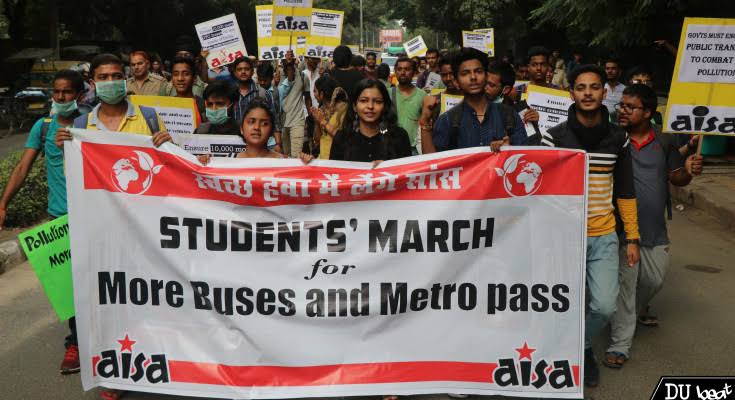
Since then, AISA has been campaigning for a freer and safer, non-violent campus which provides a space for uninterrupted discourse of ideas, however controversial it be.

The party claims, if in power it will address issues of
-Affordable accommodation
-Affordable transportation
-Violence free campus

Parul Chauhan, a third year student from Satyawati College (Evening) contesting for the post of president said that “This DUSU election is being fought in the backdrop of Ramjas Incident in which the goons of ABVP assaulted both students and teachers. Instead of working for the benefit of students the ABVP has only perpetuated violence in the campus. They have repeatedly failed in their promises of building hostel and in fact have ended up promoting PG’s.

If AISA is elected to union, we will ensure that the DUSU election post 2017 will be free from all malpractices and even common students like me will have a fair chance of contesting DUSU elections against the money muscle power of ABVP”.

Akash Gupta a student of Law Faculty and former student of Deshbandhu College contesting for the post of Joint Secretary said that “the biggest issue Delhi University is facing right now is that of campus violence which is single handedly perpetuated by ABVP across Delhi University. He recounted how ABVP tried to disrupt seminar on Ambedkar in Deshbandhu college, beat up activists in Shaheed Bhagat Singh and PGDAV college. He also said that the incidences of Violence by ABVP is not only limited to North Campus, but also in almost all colleges of Delhi University, because of which common students live in perpetual terror of ABVP goons.  

“We have seen how for the last 40 years the DUSU has been made a launch pad for the ABVP/NSUI goons who invest huge sum of money just to win DUSU elections and launch their political career. Our objective is to reclaim the DUSU from the hands of castiest, feudal, communalist ABVP and give it back to the common students. We aim to make DUSU a platform of struggle instead of a platform for enjoyment where last DUSU office bearers ate tea and snacks of 21 lakhs ” said Kawalpreet Kaur President of DU AISA.

Ankita Dhar Karmakar

[email protected]

Following a historical decision, you can now expect student political parties to hand out pens and notebooks for your vote.


In a latest press conference, the University of Delhi’s Vice Chancellor has sent out an order to political parties which states that they can distribute freebies legally, however, only one day preceding the Delhi University Students’ Union (DUSU) elections. This decision comes right before the polls that are set to be conducted on 12th September this year. When the VC, Satish Saraf, was approached to reason this historical decision, he said, “The DUSU elections happen in an arbitrary manner as no political party follows the Lyngdoh Committee’s guidelines anyway. Through this reform, we plan to introduce transparency in the system.” This report, however, is incomplete without the numerous terms and conditions it clearly states; which need to be followed as protocol to distribute freebies legally. A few of these conditions are:


  1. Political parties can only distribute freebies on only one day, that day being at least one week prior to elections.
  2. Political parties can distribute only education related freebies like pens, registers, books and other similar items that add to the welfare of students.
  3. If the political party is found  distributing alcohol or weed, its candidate would be prosecuted and disqualified to contest the elections with immediate effect.
  4. No printed posters can be put up. This is in accordance with orders given by the National Green Tribunal(NGT) to encourage a poster-less and digital campaign.
  5. A maximum cap of 5000 INR would be set so that parties with lesser funds have no complaints.
  6. To help students make an informed decision, all those parties that partake inthe distribution of freebies are expected to arrange for seminars and workshops, wherein they explain in detail the functioning of DUSU and delineate the actions they will take to achieve all points in their manifestos.


Two schools of thoughts have emerged from this landmark decision- one which strongly opposes this decision, and one which stands in staunch support for it.

A second year student of Shaheed Bhagat Singh College under condition of anonymity, said, “I think the DU VC has gone berserk. His decision places small, genuine parties to a major disadvantage and ensures that parties with large funding get abundant visibility.”

However, not everybody harbours the same viewpoint. Avni Bansal, President of Sangharsh Yuva Parishad is of the view that this decision will transform elections for the better. In conversation with DU Beat, she said,  “Everybody knows that use of muscle power cannot be removed from elections. But, this can definitely be put to good use for the welfare of students. Students belonging to lower economic backgrounds can benefit immensely from this opportunity”


While we already have protests from opposition parties against this decision, the executive council has been tabled to discuss reforms in DUSU budget as well. Whether the decision will face a roll back or actual implementation, only time will tell.

Feature Image Credits: Cloudapp

Disclaimer: Bazinga is our weekly column of almost believable fake news. It is a humorous, light hearted column that should only be appreciated and not accepted.

Vijeata Balani

[email protected]